NEUROLOGY AND BEHAVIOR
 Stimulus – a change in the external or internal
 environment that is detected by a receptor and
 brings about a response.

 Response – change in an organism due to a
 stimulus.

 Reflex – a rapid and “unconscious” response
      Require a precise pathway – at least 3 synapses
      Include 6 parts: >>>>>>>>>>>>>>>>>>>

   REFLEXES and REFLEX ARCS
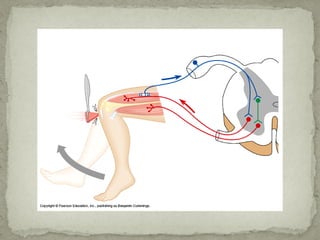
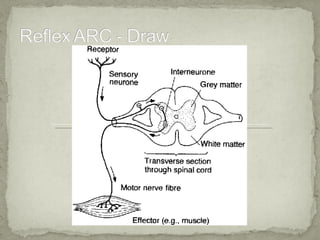
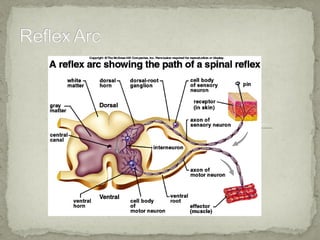
 Receptor – detects stimulus, transforms into an impulse


 Sensory Neurons –
    part of the PNS
   connects receptor to CNS thru dorsal nerve root
   Impulse travels freely along the axon


 Relay Neuron –
   receives messages from sensory neurons across
    synapses - passes them to motor neurons
   Within gray matter of spinal cord
 Motor Neurons –
   Part of the PNS
   Carries impulse from CNS (relay neuron) to
     effector (muscle)
    Leaves thru ventral root of SC
    Cell body is in gray matter SC
 Gray Matter – region of synaptic connection in
  the SC
 Effector – carries out response
 The mechanism of evolution- requires:
   Variations in phenotypes
   Genetic basis for variation
   Change in the environment
 Examples: 2 related to global warming:
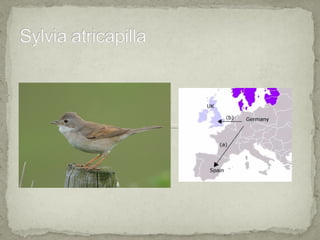
   Sylvia atricapilla – Black Cap - migration
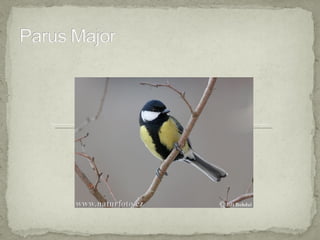
   Parus major – Great tit - breeding
 MIGRATION PATTERNS
   Normal breeding – early summer across central and
    northern Europe.
   Then migrates to warmer areas before winter.
      Patterns show normal migratory pattern – Germany to Spain
      Recent studies – 10% migrating to the UK
 Experiments show that direction of migration is
 genetically inherited.
 Breed in spring/early summer through Europe.
   Timing of egg laying is genetically programmed
      Day length determines time of year.
   Recent studies have shown that egg laying time is
    becoming earlier.
      Have greater reproductive success
      due to earlier opening of leaves on trees & biomass that feeds
       on the leaves –
      Biomass – food for the great tit!
Types of Receptors

Mechanoreceptor – pressure, texture, vibrations (ear)

Chemoreceptors – chemical solutes and vapors

Photoreceptors – react to light

Thermoreceptors – change in temperature
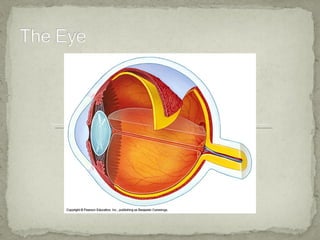
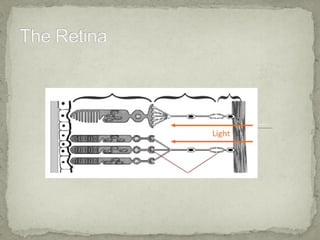
 Choroid – light absorbing pigment; stray light
 Retina – receptors for vision; rod cells
 Fovea – densely packed cone cells; acute vision
 Optic nerve – carries nerve impulses to brain
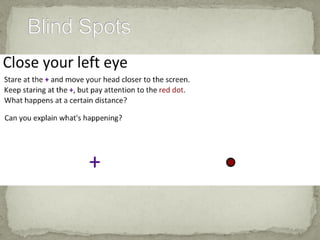
 Optic disk – blind spot
 Vitreous humor – supports eye; transparent
 Lens – focuses light
 Aqueous humor - supports eye; transparent
 Pupil – light enters here
 Iris – regulate size of pupil
 Cornea – outer layer; fixed focusing
 Sclera and conjunctiva – white; protects and supports
 Rod cells – black and white sensors; dark light
 Cone – color sensors; bright light
The Perception of Light
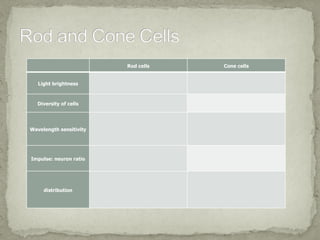
              Rod cells   Cone cells


   Light brightness


   Diversity of cells


Wavelength sensitivity


Impulse: neuron ratio


     distribution
Edge Enhancement – pre
central nervous system;
carried out on the retina
itself.
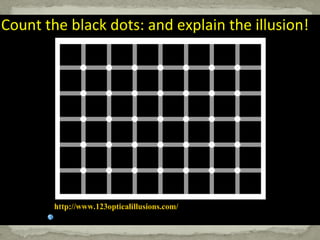
 Gray areas – peripheral vision; fewer light sensitive
 cells


 Focused attention on any gray area – use center of
 the retina.
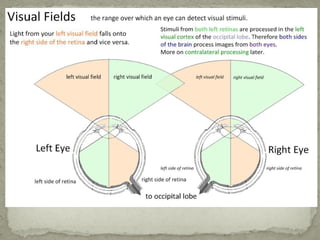
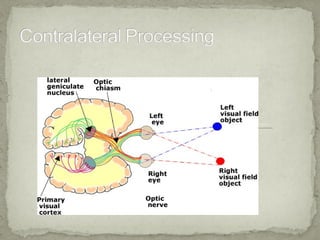
Contralateral Processing – is
 the way the brain collects and
 integrates information to
 create the perception of
 seeing.
Both eyes send information and sends to both sides
    of the brain.
n   Optic chiasm – where information crosses to the
    other side of the brain
e   Both eyes are responsible for processing information
    from both eyes.
 HOW DOES VISION WORK


 BLIND SPOTS


 OPTICAL ILLUSIONS
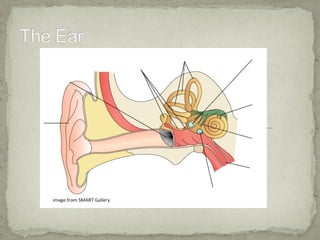
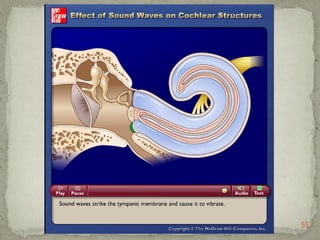
1.   Eardrum – pressure waves causes the eardrum to vibrate
2.   Hammer, Anvil, Stirrup – eardrum pushes on bones of the
     middle ear; magnifies 20x.
3.   Oval Window – middle ear bones push on membrane ; causes
     cochlea to move
4.   Cochlea – pressure wave travels through fluid
     r   Sensory cilia in cochlea move
         Causes the release of neurotransmitters between receptor and auditory
         nerve.
s  Auditory nerve – generates an impulse.
   Impulse is carried to the brain for translation
________________________________________________
  Semicircular canals – responsible for balance
  Eustachian Tube – functions to equalize air pressure and drains
   mucus

     Hearing Test
Learned Behavior             Innate Behavior
 Experience                 Instinctive
 Modified by trial and      Genetically based
  error                      Not modified
 Variation within           Uniform throughout
  population                  population
 Affected by environment    Unaffected by
 Capacity to learn may       environment
  product of natural         Beneficial behaviors
  selection rather than       product of natural
  specific behaviors          selection
  Learned or Innate??
INNATE                    LEARNED
 Sucking instinct
 Emotional expressions
                           Training animals
 Birds hatching
                           Walking
 Migratory patterns
                           Learning to drive
 Hunting instinct
                           Tying shoes
 Not breathing
  underwater
 Courtship and sexual
  behavior in species
 Reflexes – all
 Instincts
 A directional response to a stimulus:
 Positive or Negative

     Chemotaxis – response to chemicals
     Phototaxis – response to light
     Gravitaxis – response to gravity
     Rheotaxis – response to water current
     Thigmotaxis – response to touch

  Paramecium
 Response to a non directional stimulus:
 Humidity – a non directional stimulus


   Orthokinesis – speed of movement altered
   Klinokinesis – rate of turning
Allows an organism to
change or adapt in
response to the
environment which gives
an increased chance of
survival
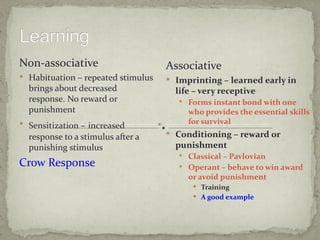
Non-associative                     Associative
 Habituation – repeated stimulus    Imprinting – learned early in
  brings about decreased              life – very receptive
  response. No reward or                Forms instant bond with one
  punishment                             who provides the essential skills
 Sensitization – increased              for survival
  response to a stimulus after a     Conditioning – reward or
  punishing stimulus                  punishment
                                        Classical – Pavlovian
Crow Response                           Operant – behave to win award
                                         or avoid punishment
                                           Training
                                           A good example
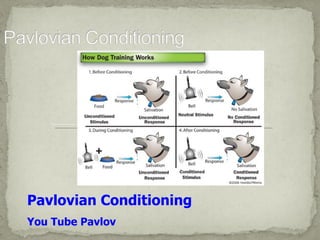
Pavlovian Conditioning 
You Tube Pavlov
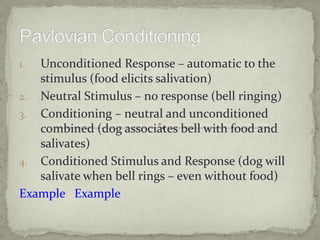
1. Unconditioned Response – automatic to the
   stimulus (food elicits salivation)
2. Neutral Stimulus – no response (bell ringing)
3. Conditioning – neutral and unconditioned
   combined (dog associates bell with food and
   salivates)
4. Conditioned Stimulus and Response (dog will
   salivate when bell rings – even without food)
Example Example
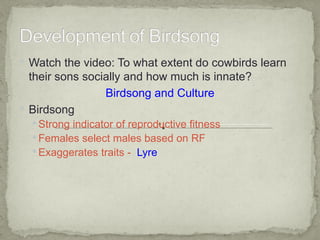
 Watch the video: To what extent do cowbirds learn
  their sons socially and how much is innate?
                 Birdsong and Culture
 Birdsong
   Strong indicator of reproductive fitness
   Females select males based on RF
   Exaggerates traits - Lyre
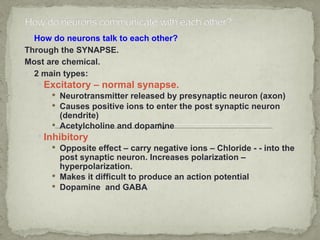
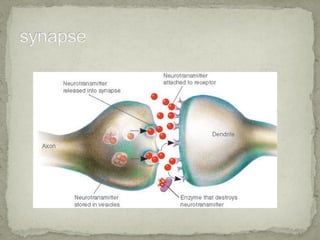
 How do neurons talk to each other?
Through the SYNAPSE.
Most are chemical.
 2 main types:
    Excitatory – normal synapse.
        Neurotransmitter released by presynaptic neuron (axon)
        Causes positive ions to enter the post synaptic neuron
         (dendrite)
        Acetylcholine and dopamine
    Inhibitory
        Opposite effect – carry negative ions – Chloride - - into the
         post synaptic neuron. Increases polarization –
         hyperpolarization.
        Makes it difficult to produce an action potential
        Dopamine and GABA
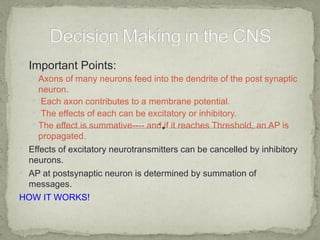
 Important Points:
    Axons of many neurons feed into the dendrite of the post synaptic
     neuron.
    Each axon contributes to a membrane potential.
    The effects of each can be excitatory or inhibitory.
    The effect is summative---- and if it reaches Threshold, an AP is
     propagated.
 Effects of excitatory neurotransmitters can be cancelled by inhibitory
  neurons.
 AP at postsynaptic neuron is determined by summation of
  messages.
HOW IT WORKS!
Psychoactive Drugs
Affect the brain and
 personality by either
 increasing or decreasing
 post-synaptic transmission.
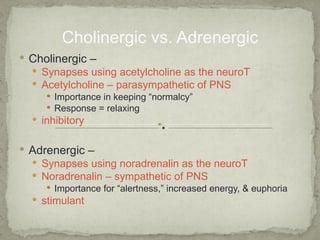
Cholinergic vs. Adrenergic
 Cholinergic –
   Synapses using acetylcholine as the neuroT
   Acetylcholine – parasympathetic of PNS
      Importance in keeping “normalcy”
      Response = relaxing
   inhibitory


 Adrenergic –
   Synapses using noradrenalin as the neuroT
   Noradrenalin – sympathetic of PNS
      Importance for “alertness,” increased energy, & euphoria
   stimulant
Excitatory Drugs
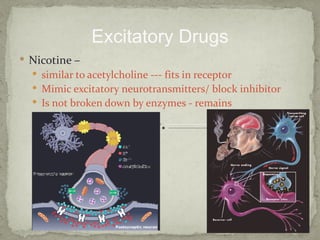
 Nicotine –
   similar to acetylcholine --- fits in receptor
   Mimic excitatory neurotransmitters/ block inhibitor
   Is not broken down by enzymes - remains
Excitatory Drugs
Amphetamines –

  stimulate release of noradrenalin and
   dopamine
  Moves directly into pre-synaptic neuron
   vesicle.
  Results increased awareness and energy
Excitatory Drugs
COCAINE –
Normal
   Dopamine and adrenaline act as excitatory neurotransmitters
   Both usually taken back up at the pre synaptic axon or enzyme.

With Cocaine
   Blocks receptors on the re-uptake pump
   NT/hormone remains and more is released
   Increases post-synaptic transmission
 Changes –
   Dopamine is a pleasure NT
      Euphoria, increased energy, alertness
      Highly addictive – body produces less natural dopamine
Inhibitory Drugs
 BENZODIAZAPINES
 (gamma-Aminobutyric acid) main
 inhibitory NT

  Enhance the effect of GABA (main
   inhibitory NT)
  Combines with and slows down GABA
   receptors on post-synaptic neurons
  Slows down brain activity.
Inhibitory Drugs
Alcohol

  Initially acts as a stimulant
    Release of dopamine
  As level of BAC raises – has a
  sedative effect
    Increases binding of GABA
  Acts as an anesthetic
Inhibitory Drugs
Tetrahydrocannabinol
    Cannabis –
Normal
 Dopamine and GABA proceed when needed


With THC
 THC inhibits GABA release
 GABA cannot inhibit dopamine


 Mood and Behavior
   Increased feelings of pleasure
   Intoxicated, hunger, memory loss,
   Used to treat nausea in cancer patients.
ADDICTION (Mouse Party)
 A chronic neurological disorder
 with:
 Genetic characteristics
 Psychosocial characteristics
 Environmental characteristics
 Changes in the brain result in
  compulsive desire to use a drug
General Causes of Addiction
 Genetic – not fully understood
   Different allele for a receptor?
   Carry modified versions of genes linked to drug
    metabolism
   Susceptibility does not mean inevitability.
 Psychosocial/ Environmental
   Peer pressure
   Timing
   Availability
   Legality/Religion
   Community
   Family
   Mental health
END
55

Option e

  • 1.
  • 2.
     Stimulus –a change in the external or internal environment that is detected by a receptor and brings about a response.  Response – change in an organism due to a stimulus.  Reflex – a rapid and “unconscious” response  Require a precise pathway – at least 3 synapses  Include 6 parts: >>>>>>>>>>>>>>>>>>> REFLEXES and REFLEX ARCS
  • 3.
     Receptor –detects stimulus, transforms into an impulse  Sensory Neurons –  part of the PNS  connects receptor to CNS thru dorsal nerve root  Impulse travels freely along the axon  Relay Neuron –  receives messages from sensory neurons across synapses - passes them to motor neurons  Within gray matter of spinal cord
  • 4.
     Motor Neurons–  Part of the PNS  Carries impulse from CNS (relay neuron) to effector (muscle)  Leaves thru ventral root of SC  Cell body is in gray matter SC  Gray Matter – region of synaptic connection in the SC  Effector – carries out response
  • 8.
     The mechanismof evolution- requires:  Variations in phenotypes  Genetic basis for variation  Change in the environment  Examples: 2 related to global warming:  Sylvia atricapilla – Black Cap - migration  Parus major – Great tit - breeding
  • 10.
     MIGRATION PATTERNS  Normal breeding – early summer across central and northern Europe.  Then migrates to warmer areas before winter.  Patterns show normal migratory pattern – Germany to Spain  Recent studies – 10% migrating to the UK  Experiments show that direction of migration is genetically inherited.
  • 12.
     Breed inspring/early summer through Europe.  Timing of egg laying is genetically programmed  Day length determines time of year.  Recent studies have shown that egg laying time is becoming earlier.  Have greater reproductive success  due to earlier opening of leaves on trees & biomass that feeds on the leaves –  Biomass – food for the great tit!
  • 13.
    Types of Receptors Mechanoreceptor– pressure, texture, vibrations (ear) Chemoreceptors – chemical solutes and vapors Photoreceptors – react to light Thermoreceptors – change in temperature
  • 15.
     Choroid –light absorbing pigment; stray light  Retina – receptors for vision; rod cells  Fovea – densely packed cone cells; acute vision  Optic nerve – carries nerve impulses to brain  Optic disk – blind spot  Vitreous humor – supports eye; transparent  Lens – focuses light  Aqueous humor - supports eye; transparent  Pupil – light enters here  Iris – regulate size of pupil  Cornea – outer layer; fixed focusing  Sclera and conjunctiva – white; protects and supports  Rod cells – black and white sensors; dark light  Cone – color sensors; bright light
  • 16.
  • 18.
      Rod cells Cone cells Light brightness Diversity of cells Wavelength sensitivity Impulse: neuron ratio distribution
  • 21.
    Edge Enhancement –pre central nervous system; carried out on the retina itself.
  • 23.
     Gray areas– peripheral vision; fewer light sensitive cells  Focused attention on any gray area – use center of the retina.
  • 25.
    Contralateral Processing –is the way the brain collects and integrates information to create the perception of seeing.
  • 27.
    Both eyes sendinformation and sends to both sides of the brain. n Optic chiasm – where information crosses to the other side of the brain e Both eyes are responsible for processing information from both eyes.
  • 28.
     HOW DOESVISION WORK  BLIND SPOTS  OPTICAL ILLUSIONS
  • 30.
    1. Eardrum – pressure waves causes the eardrum to vibrate 2. Hammer, Anvil, Stirrup – eardrum pushes on bones of the middle ear; magnifies 20x. 3. Oval Window – middle ear bones push on membrane ; causes cochlea to move 4. Cochlea – pressure wave travels through fluid r Sensory cilia in cochlea move Causes the release of neurotransmitters between receptor and auditory nerve. s Auditory nerve – generates an impulse. Impulse is carried to the brain for translation ________________________________________________  Semicircular canals – responsible for balance  Eustachian Tube – functions to equalize air pressure and drains mucus Hearing Test
  • 31.
    Learned Behavior Innate Behavior  Experience  Instinctive  Modified by trial and  Genetically based error  Not modified  Variation within  Uniform throughout population population  Affected by environment  Unaffected by  Capacity to learn may environment product of natural  Beneficial behaviors selection rather than product of natural specific behaviors selection Learned or Innate??
  • 32.
    INNATE LEARNED  Sucking instinct  Emotional expressions  Training animals  Birds hatching  Walking  Migratory patterns  Learning to drive  Hunting instinct  Tying shoes  Not breathing underwater  Courtship and sexual behavior in species  Reflexes – all  Instincts
  • 33.
     A directionalresponse to a stimulus:  Positive or Negative  Chemotaxis – response to chemicals  Phototaxis – response to light  Gravitaxis – response to gravity  Rheotaxis – response to water current  Thigmotaxis – response to touch Paramecium
  • 34.
     Response toa non directional stimulus:  Humidity – a non directional stimulus  Orthokinesis – speed of movement altered  Klinokinesis – rate of turning
  • 35.
    Allows an organismto change or adapt in response to the environment which gives an increased chance of survival
  • 36.
    Non-associative Associative  Habituation – repeated stimulus  Imprinting – learned early in brings about decreased life – very receptive response. No reward or  Forms instant bond with one punishment who provides the essential skills  Sensitization – increased for survival response to a stimulus after a  Conditioning – reward or punishing stimulus punishment  Classical – Pavlovian Crow Response  Operant – behave to win award or avoid punishment  Training  A good example
  • 37.
  • 38.
    1. Unconditioned Response– automatic to the stimulus (food elicits salivation) 2. Neutral Stimulus – no response (bell ringing) 3. Conditioning – neutral and unconditioned combined (dog associates bell with food and salivates) 4. Conditioned Stimulus and Response (dog will salivate when bell rings – even without food) Example Example
  • 39.
     Watch thevideo: To what extent do cowbirds learn their sons socially and how much is innate? Birdsong and Culture  Birdsong  Strong indicator of reproductive fitness  Females select males based on RF  Exaggerates traits - Lyre
  • 41.
     How doneurons talk to each other? Through the SYNAPSE. Most are chemical.  2 main types:  Excitatory – normal synapse.  Neurotransmitter released by presynaptic neuron (axon)  Causes positive ions to enter the post synaptic neuron (dendrite)  Acetylcholine and dopamine  Inhibitory  Opposite effect – carry negative ions – Chloride - - into the post synaptic neuron. Increases polarization – hyperpolarization.  Makes it difficult to produce an action potential  Dopamine and GABA
  • 43.
     Important Points:  Axons of many neurons feed into the dendrite of the post synaptic neuron.  Each axon contributes to a membrane potential.  The effects of each can be excitatory or inhibitory.  The effect is summative---- and if it reaches Threshold, an AP is propagated.  Effects of excitatory neurotransmitters can be cancelled by inhibitory neurons.  AP at postsynaptic neuron is determined by summation of messages. HOW IT WORKS!
  • 44.
    Psychoactive Drugs Affect thebrain and personality by either increasing or decreasing post-synaptic transmission.
  • 45.
    Cholinergic vs. Adrenergic Cholinergic –  Synapses using acetylcholine as the neuroT  Acetylcholine – parasympathetic of PNS  Importance in keeping “normalcy”  Response = relaxing  inhibitory  Adrenergic –  Synapses using noradrenalin as the neuroT  Noradrenalin – sympathetic of PNS  Importance for “alertness,” increased energy, & euphoria  stimulant
  • 46.
    Excitatory Drugs  Nicotine–  similar to acetylcholine --- fits in receptor  Mimic excitatory neurotransmitters/ block inhibitor  Is not broken down by enzymes - remains
  • 47.
    Excitatory Drugs Amphetamines –  stimulate release of noradrenalin and dopamine  Moves directly into pre-synaptic neuron vesicle.  Results increased awareness and energy
  • 48.
    Excitatory Drugs COCAINE – Normal  Dopamine and adrenaline act as excitatory neurotransmitters  Both usually taken back up at the pre synaptic axon or enzyme. With Cocaine  Blocks receptors on the re-uptake pump  NT/hormone remains and more is released  Increases post-synaptic transmission  Changes –  Dopamine is a pleasure NT  Euphoria, increased energy, alertness  Highly addictive – body produces less natural dopamine
  • 49.
    Inhibitory Drugs  BENZODIAZAPINES (gamma-Aminobutyric acid) main inhibitory NT  Enhance the effect of GABA (main inhibitory NT)  Combines with and slows down GABA receptors on post-synaptic neurons  Slows down brain activity.
  • 50.
    Inhibitory Drugs Alcohol Initially acts as a stimulant  Release of dopamine  As level of BAC raises – has a sedative effect  Increases binding of GABA  Acts as an anesthetic
  • 51.
    Inhibitory Drugs Tetrahydrocannabinol  Cannabis – Normal  Dopamine and GABA proceed when needed With THC  THC inhibits GABA release  GABA cannot inhibit dopamine  Mood and Behavior  Increased feelings of pleasure  Intoxicated, hunger, memory loss,  Used to treat nausea in cancer patients.
  • 52.
    ADDICTION (Mouse Party) A chronic neurological disorder with: Genetic characteristics Psychosocial characteristics Environmental characteristics Changes in the brain result in compulsive desire to use a drug
  • 53.
    General Causes ofAddiction  Genetic – not fully understood  Different allele for a receptor?  Carry modified versions of genes linked to drug metabolism  Susceptibility does not mean inevitability.  Psychosocial/ Environmental  Peer pressure  Timing  Availability  Legality/Religion  Community  Family  Mental health
  • 54.
  • 55.

Editor's Notes