The Advanced Distribution
Management System (ADMS)
Managing the distribution network in the Smart Grid era


March 2012 / White Paper


by Telvent utilities group


Make the most of your energy          SM
Summary

Executive Summary . ................................................................................... p	 1

Introduction ................................................................................................. p 	2

The ADMS . ................................................................................................. p 	4

The foundation of the ADMS . ...................................................................... p 	5

Visualization of ADMS results . ..................................................................... p 	6

State estimation — ensuring the accuracy of ADMS results ......................... p 	7

Operations planning and analysis ................................................................ p 	8

Convergence of Technologies . .................................................................... p 	9

Demand Management ................................................................................. p 10

Distributed energy ....................................................................................... p 11

Dispatcher training simulator ........................................................................ p 12

Conclusion................................................................................................... p 13
The Advanced Distribution Management System


Executive summary

The Advanced Distribution Management System – ADMS – brings together
distribution management system (DMS), supervisory control and data acquisition
(SCADA) and outage management system (OMS) technologies , along with control
room applications, on one, secure platform with a single user interface. With this
comprehensive mission critical solution, the electric utility can monitor, analyze and
control the distribution network to improve the level and quality of service.


At its core is the network model representing the as-operated state and based
on the as-built state defined by the geographic information system (GIS). A load
flow algorithm responds quickly to data sourced from throughout the network
to analyze the balanced, unbalanced and dynamically changing network in
real time. Users across the network – operators, dispatchers, management,
planning engineers and others – have consistent visualization of model results in
geographic, schematic and single-line diagram views. State estimation validates
viewed data and estimates non-telemetered points to achieve a complete network
representation.


With this accurate network model and a portfolio of robust functionalities, the utility
is empowered with continuous, real-time analysis of the operational state of the
network that enables self-healing capabilities. Demand can be managed through
reduction of technical losses; by forecasting near-term load and applying volt/VAR
control for peak shaving; and by securely integrating and managing distributed
energy resources, including energy storage, to flatten the daily load curve. These
and other options enabled by ADMS are key to managing demand in the face
of increasing energy usage, surging energy costs and network infrastructure
instability due to aging.


The ADMS represents the evolution of control room technology that will help
utilities mobilize to meet increasing consumer demand and environmental
obligations and reap many of the benefits all stakeholders expect from their smart
grid investments.


                                                                                                                     White paper | 01
The Advanced Distribution Management System


Introduction

Electric utilities are preparing for the multitude of challenges facing the industry
— limited generation to supply increasing energy demand, growing regulatory
and customer pressure for increased reliability and reduced carbon emissions,
adoption of distributed renewable generation and energy storage, and the
inevitability of both an aging workforce and aging infrastructure.


In a rather short period of time, these challenges have converged, and in doing so,
have exposed the need for a comprehensive mission critical solution to monitor,
analyze, and control the distribution network.


This paper will provide an overview of the Advanced Distribution Management
System (ADMS), including its diverse portfolio of functionality and a host of
benefits for the distribution network owner and the energy consumer.


                                                                                                                  White paper | 02
The Advanced Distribution
Management System
The Advanced Distribution Management System


The ADMS

For more than 40 years, utilities have used the           The ADMS is the tool that enables the power system
strength and speed of computers to model electricity      engineer and dispatcher to effectively and efficiently
networks. For the most part, that focus has been on       plan, operate, and facilitate work on the distribution
transmission networks, and there are many mature          network. It analyzes balanced and unbalanced and
software products on the market that provide strong       dynamically changing distribution networks in real-
functionality for bulk power transmission networks.       time, while providing study mode capability for both
                                                          backward and forward review to identify options to
Modeling distribution networks is a different, and in     improve network reliability while lowering electricity
many ways, more complex problem.                          costs.

Instead of the need to model static, meshed, and          The ADMS is the critical tool for management of the
balanced transmission networks, today’s ADMS              distribution network, and enables the acquisition of
technology must model meshed and radial,                  many of the benefits utilities and consumers expect
balanced and unbalanced distribution networks with        from their Smart Grid investments.
rapidly-changing topologies and demand profiles.
Instead of consistent and frequent telemetry from
the transmission network, ADMS technology must
be able to coordinate unsynchronized data for
management of these network models. ADMS must
also help prepare utilities for “islanding” portions of
the distribution network — creating the potential for          What makes a DMS advanced?
management of multiple and independent distribution
networks.
                                                               When a DMS has advanced functionality
                                                               — such as Volt/VAR Optimization (VVO),
The ADMS must also deal with the evolving use of               Fault management (FLISR), Near-term
electricity, supporting variable, localized demand             load forecasting, and Distributed energy
profiles created by changing consumption habits, and           support — and includes complete SCADA
by new electricity-powered devices such as battery-            and OMS technology on the same platform
powered vehicles and high-tech equipment. Further,             with the same user interface, then it is
                                                               an Advanced Distribution Management
the ADMS must deal with shifting consumption
                                                               System (ADMS).
patterns and customer demand for higher levels of
service for their devices. Not only must service levels
improve, but also the service must be of high quality,
including voltage levels that operate within regulatory
norms.


                                                                                                                                  White paper | 04
The Advanced Distribution Management System


The foundation of the ADMS

At the core of the ADMS is the ability to precisely
define the network model, and to process an
unbalanced load flow algorithm based on that model
with telemetered data taken from the network.


•  he network model
  T
 The ADMS must be able to represent all aspects
 of the distribution network, including a variety of
 conductor types, transformers, switches (both
 manual and motorized), fuses, and other permanent
 and temporary devices used in distribution system
 operations. The model represents the
 as-operated state of the network typically based on
 the as-built state as maintained by a Geographic
 Information System (GIS).


•  he dynamic data
  T
 To enable accuracy of the ADMS load flow
 algorithm, it requires data telemetered from the
 distribution network. That data is generally made
 available through supervisory control and data
 acquisition (SCADA) systems, telemetry, where
 available, through AMI, and via OMS.


 The amount of data to be telemetered and stored
 is significant and changes frequently, suggesting
 that high performance data management is critical
 for quick and efficient analysis by the ADMS. This
 data provides a variety of information (e.g. voltage,
 current) and device status (e.g. open/closed) to
 enable the load flow algorithm to provide more
 reliable results.


• The unbalanced load flow algorithm
  
  The ADMS must have a very fast load flow
  algorithm that can solve unbalanced distribution
  networks based on ever-changing data
  telemetered from the field including single phase
  operations such as on laterals, fuses, and
  underground network sections.


                                                                                    White paper | 05
The Advanced Distribution Management System


Visualization of ADMS results

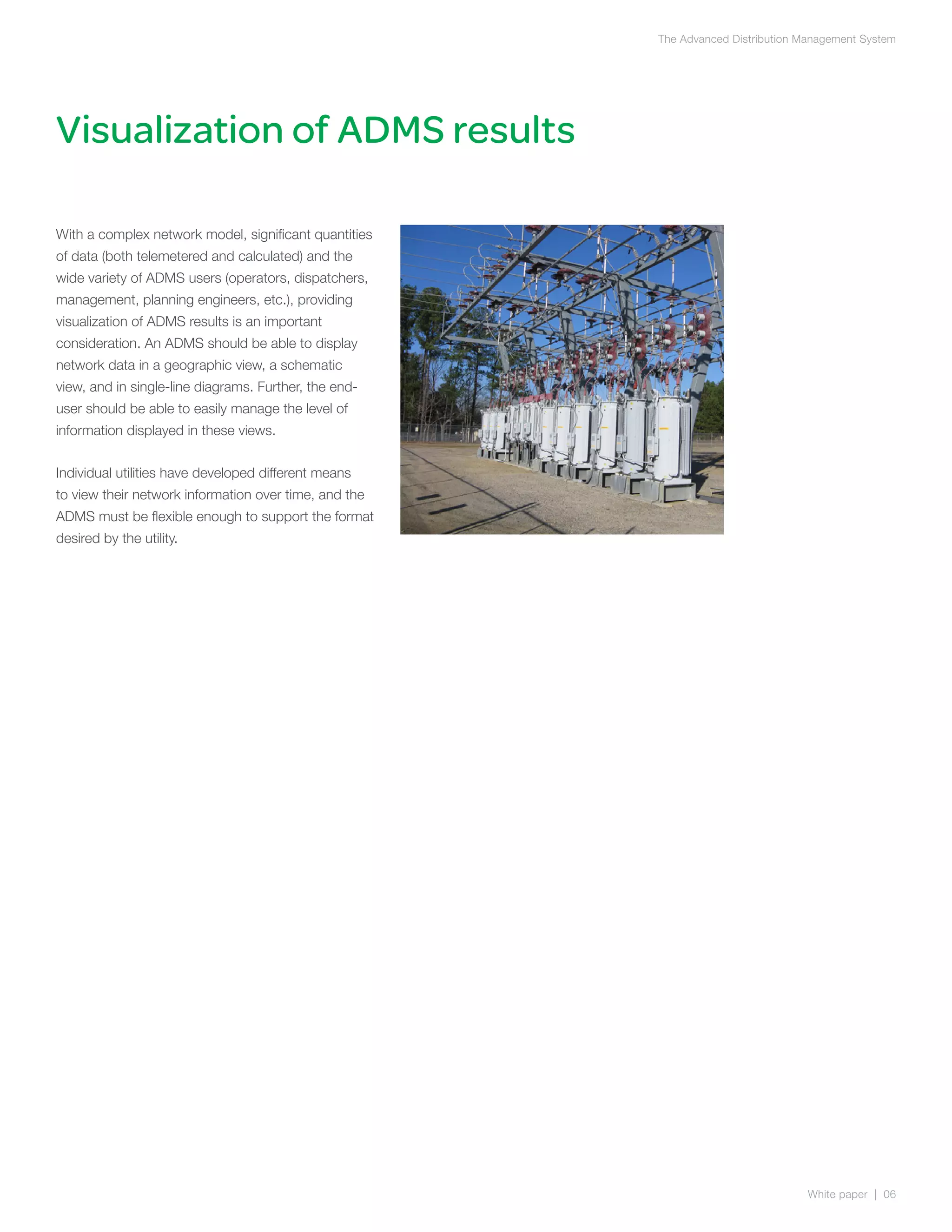
With a complex network model, significant quantities
of data (both telemetered and calculated) and the
wide variety of ADMS users (operators, dispatchers,
management, planning engineers, etc.), providing
visualization of ADMS results is an important
consideration. An ADMS should be able to display
network data in a geographic view, a schematic
view, and in single-line diagrams. Further, the end-
user should be able to easily manage the level of
information displayed in these views.


Individual utilities have developed different means
to view their network information over time, and the
ADMS must be flexible enough to support the format
desired by the utility.


                                                                                  White paper | 06
The Advanced Distribution Management System


State estimation — ensuring the
accuracy of ADMS results
Generically, state estimate can be defined as “a
branch of probability and statistics concerned with
deriving information about properties of random
variables, stochastic processes, and systems based
on observed samples.” In power networks, state
estimation validates observable data and estimates all
non-telemetered points in order to derive a compete
network representation.


The quality of data collected from various points
on the distribution network is typically imperfect.
Problems in devices or in the telecommunications
networks associated with those devices suggest that
prior to conducting an advanced analysis, the data
must be pre-processed to eliminate bad data points,
estimate non-telemetered points, and resolve any
issues with “time skew” for unsynchronized telemetry
systems.


Distribution State Estimation is much more than
simple Load Calibration. It is important to calculate
the network state with the highest possible precision
as it is the basis for all advanced functions and
the benefits that can be derived from network
optimization.


                                                                                    White paper | 07
The Advanced Distribution Management System


Operations planning and analysis

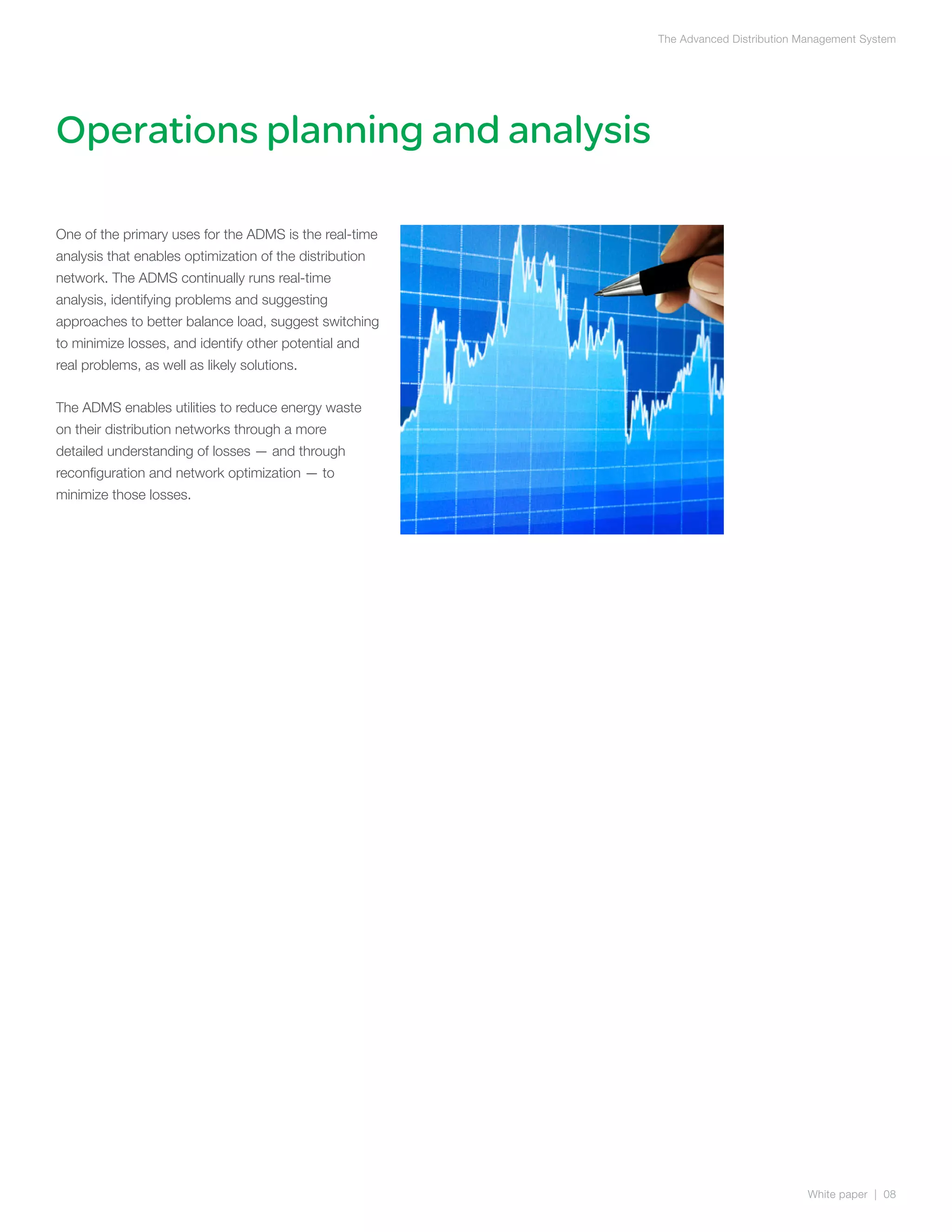
One of the primary uses for the ADMS is the real-time
analysis that enables optimization of the distribution
network. The ADMS continually runs real-time
analysis, identifying problems and suggesting
approaches to better balance load, suggest switching
to minimize losses, and identify other potential and
real problems, as well as likely solutions.


The ADMS enables utilities to reduce energy waste
on their distribution networks through a more
detailed understanding of losses — and through
reconfiguration and network optimization — to
minimize those losses.


                                                                                    White paper | 08
The Advanced Distribution Management System


Convergence of Technologies

Distribution SCADA
The ADMS combines feature-rich distribution                now have the luxury of deploying ADMS to integrate
management technology with the optional benefits           with their existing SCADA systems or replace them,
of an incorporated, field-proven distribution SCADA        now or in the future, with the latest and greatest in
system. The Smart Grid era is ushering in a dramatic       distribution SCADA technology. Nothing beats the
increase in deployment of intelligent field devices, yet   flexibility and strategic approach to bringing control
legacy SCADA systems were not designed to scale            room applications together into one secure, single
to a high number of connected points. But utilities        user interface solution.


Outage Management (OMS)
The ADMS provides analytical support to ensure             The ADMS facilitates and automates the creation of
that outage causes are identified and resolved more        switching orders, for planned and unplanned work
quickly. With the functionality of a traditional OMS       that dispatchers or field operators can execute
(such as call and event management, prediction             according to traditional procedures, or which can be
analysis, incident and crew management), it provides       executed automatically. This can all be accomplished
a “next generation” level of functionality to improve      while managing tagging functionality as needed,
network reliability.                                       and ensuring that the state of the network is well
                                                           represented at all times — including the incorporation
The ADMS has a strong level of functionality around        of temporary elements that may be used to support
fault location, isolation, and service restoration         outage restoration.
(FLISR). The FLISR functionality already present at
most utilities is enhanced with the ADMS’s ability to
locate faults (based on telemetry and analysis) and to
provide ranked switching options to a dispatcher (e.g.
prioritization based on connected load, connected
customers, etc.) based on the dynamic state of the
network. The ADMS can go beyond the capability
of traditional distribution automation by allowing it to
operate on the as-switched network model in any
arbitrary configuration.


                                                                                                                                   White paper | 09
The Advanced Distribution Management System


Demand Management

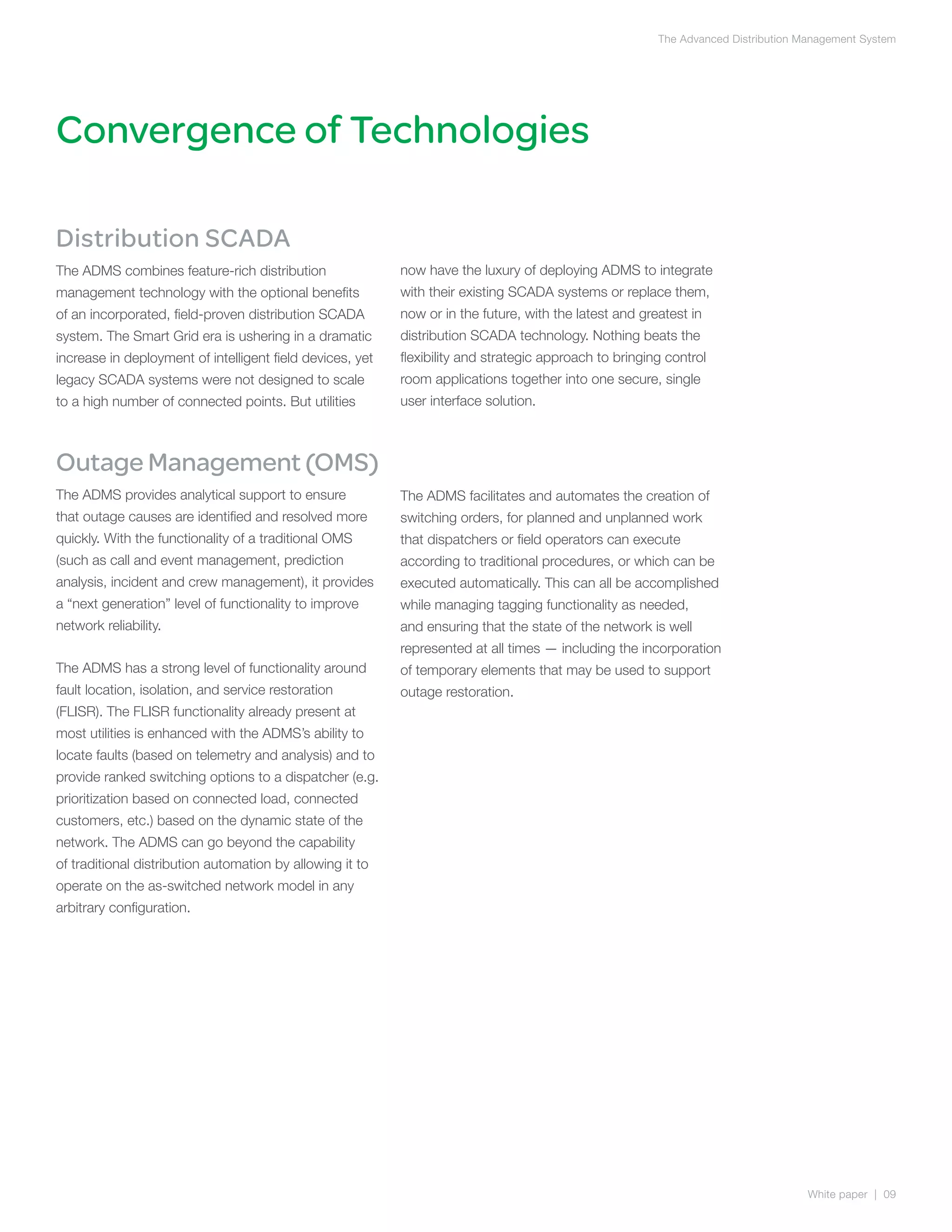
Demand management is a key capability that
drives utilities to Smart Grid programs and to the
implementation of ADMS software. Many options
can be exercised to manage demand in the face
of increasing energy usage, surging energy costs,
and network instability. The ADMS understands that
there are multiple approaches to demand response,
and the software can direct the implementation of
demand response options that are created by Smart
Grid programs.


Examples of these options include:


1.  etwork Optimization
   N
  In order to reduce technical losses on the network,
  an accurate and efficient analysis of the location
  of higher concentration of losses is required. Loss       3. Energy Storage
                                                               
  optimization functionality can identify these areas         An ADMS can be implemented to model
  and recommend (or automatically control) network            distributed energy resources including energy
  devices and switches accordingly. Reduction of              storage. Whether energy storage is owned by the
  losses provides not only direct power and cost              utility or by the customer, monitoring, analysis, and
  reduction, but implicitly means better voltage              ultimately control of energy storage can serve as
  profile, balancing of loads, and better network             an ideal approach to flattening the daily load curve.
  utilization.                                                Utilities can operate distributed energy resources
                                                              for both reliability and economic reasons to the
2.  eak Shaving
   P                                                          benefit of all interested parties.
  Near-term load forecasting is a great tool to
  identify the potential for a peak load event during
  the course of the day. Combining this forecast
  capability with Volt/VAR Optimization is a great
  way to continue to manage demand on the
  network without affecting any customers. Load tap
  changers, voltage regulators, and capacitors can
  be automatically or manually controlled to maintain
  voltage profiles, within regulatory limits, in order to
  manage demand. This can be done only during
  peak events or as a normal mode of operation as
  desired.


                                                                                                                                   White paper | 10
The Advanced Distribution Management System


Distributed energy

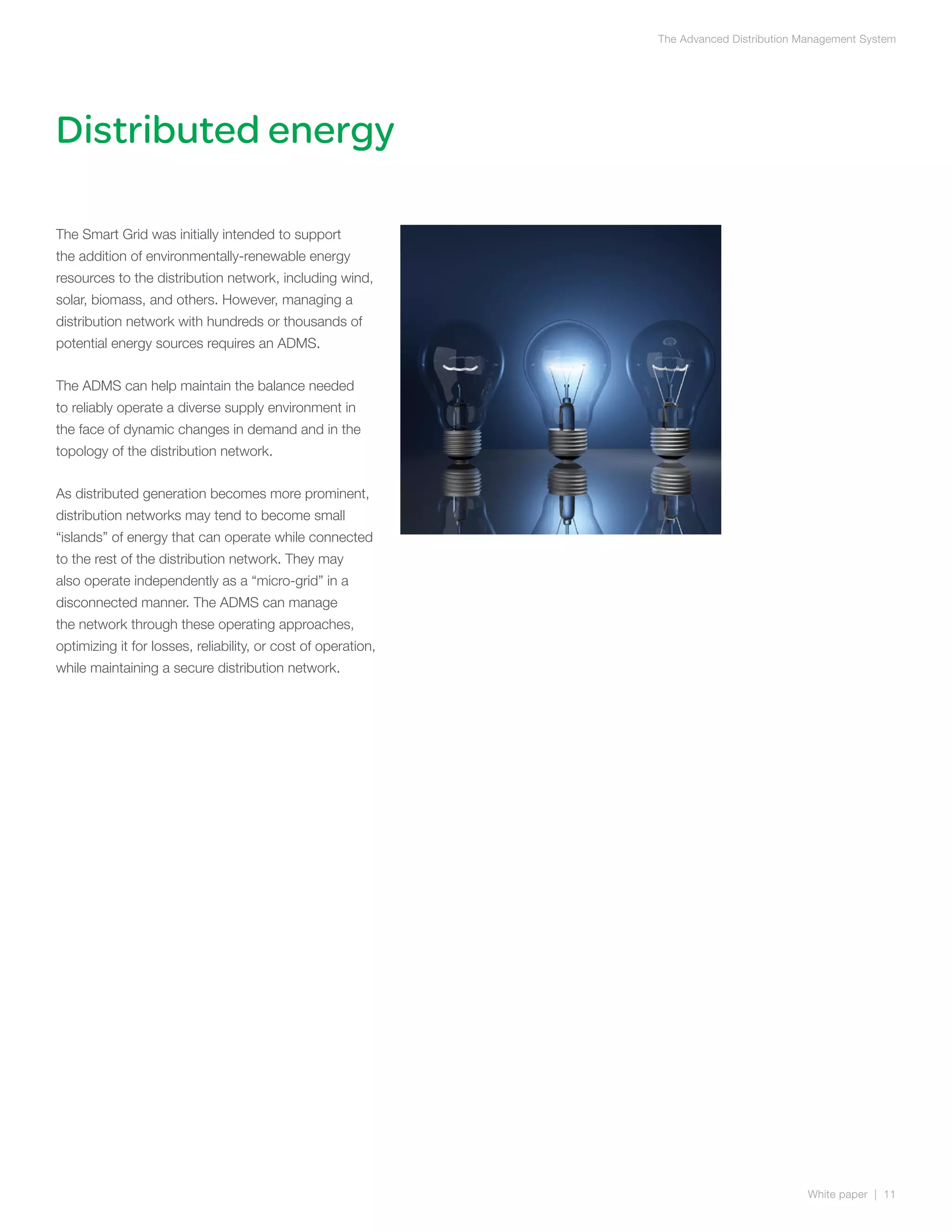
The Smart Grid was initially intended to support
the addition of environmentally-renewable energy
resources to the distribution network, including wind,
solar, biomass, and others. However, managing a
distribution network with hundreds or thousands of
potential energy sources requires an ADMS.


The ADMS can help maintain the balance needed
to reliably operate a diverse supply environment in
the face of dynamic changes in demand and in the
topology of the distribution network.


As distributed generation becomes more prominent,
distribution networks may tend to become small
“islands” of energy that can operate while connected
to the rest of the distribution network. They may
also operate independently as a “micro-grid” in a
disconnected manner. The ADMS can manage
the network through these operating approaches,
optimizing it for losses, reliability, or cost of operation,
while maintaining a secure distribution network.


                                                                                          White paper | 11
The Advanced Distribution Management System


Dispatcher training simulator

In addition to the diverse real-time and off-line
analytical functionality contained in the ADMS, it is
also possible to replay a history of events against the
network model. This can be used to train distribution     The concept of the distribution
system operators, validate system configuration, and      power plant
plan for future activity. The ADMS can also support
the storage of past forecasted models.
                                                          Distribution power plants come from a
                                                          utility’s ability to dispatch power that exists
To be effective, the dispatcher training simulator must   in the form of distributed generation and
also have the ability to move through time (typical       demand management, instead of as a
demand and supply changes), with events that can          physical power plant.
be programmed in advance. In this manner, the
                                                          Using a variety of demand management
simulator enables training cases based on experience
                                                          approaches and dispatching distributed
or in advance of anticipated events.
                                                          energy resources (e.g. energy storage,
                                                          renewable generation, etc.), a utility can
                                                          create a profile of a distribution power
                                                          plant, and start using it in its energy
                                                          dispatch algorithms when balancing
                                                          demand and supply.

                                                          This requires critical analytics and controls,
                                                          such as those provided by the ADMS to
                                                          create an environment where a utility can
                                                          leverage the distribution network as a
                                                          dispatchable resource.


                                                                                                                              White paper | 12
The Advanced Distribution Management System


Conclusion

The ADMS is an indispensable tool of the Smart Grid era. Starting with the
foundation of a fast, unbalanced load flow engine and the ability to validate data
via state estimation, the ADMS provides complete functionality to help utilities
optimize their distribution networks. The software also provides dispatchers,
engineers, and others who operate and manage the network with easy network
visualization.


The ADMS includes significant functionality to manage outages and perform
FLISR operations. It also has the tools to support Volt/VAR Optimization, which
enables Distribution System Demand Management (DSDM): a form of demand
response that operates utility controlled devices with no impact to customers.
The technology supports distributed energy, enabling the utility to grow and
accommodate the renewable generation expected of the Smart Grid era, while
optimizing the network for reliable service.


Lastly, the ADMS represents the evolution of control room technology by
merging DMS, OMS, and SCADA technologies into one comprehensive network
management solution. As part of a Smart Grid strategy, it can help utilities
transition into next-generation energy providers.


                                                                                                                White paper | 13
©2012 Schneider Electric. All rights reserved.


Schneider Electric USA, Inc.
   4701 Royal Vista Circle
   Fort Collins, CO 80528
   Phone:  -866-537-1091
           1
   	      + (34) 9-17-14-70-02
   Fax: 1-970-223-5577
   www.schneider-electric.com/us
                                   June 2012

The Advanced Distribution Management System (ADMS)

  • 1.
    The Advanced Distribution ManagementSystem (ADMS) Managing the distribution network in the Smart Grid era March 2012 / White Paper by Telvent utilities group Make the most of your energy SM
  • 2.
    Summary Executive Summary .................................................................................... p 1 Introduction ................................................................................................. p 2 The ADMS . ................................................................................................. p 4 The foundation of the ADMS . ...................................................................... p 5 Visualization of ADMS results . ..................................................................... p 6 State estimation — ensuring the accuracy of ADMS results ......................... p 7 Operations planning and analysis ................................................................ p 8 Convergence of Technologies . .................................................................... p 9 Demand Management ................................................................................. p 10 Distributed energy ....................................................................................... p 11 Dispatcher training simulator ........................................................................ p 12 Conclusion................................................................................................... p 13
  • 3.
    The Advanced DistributionManagement System Executive summary The Advanced Distribution Management System – ADMS – brings together distribution management system (DMS), supervisory control and data acquisition (SCADA) and outage management system (OMS) technologies , along with control room applications, on one, secure platform with a single user interface. With this comprehensive mission critical solution, the electric utility can monitor, analyze and control the distribution network to improve the level and quality of service. At its core is the network model representing the as-operated state and based on the as-built state defined by the geographic information system (GIS). A load flow algorithm responds quickly to data sourced from throughout the network to analyze the balanced, unbalanced and dynamically changing network in real time. Users across the network – operators, dispatchers, management, planning engineers and others – have consistent visualization of model results in geographic, schematic and single-line diagram views. State estimation validates viewed data and estimates non-telemetered points to achieve a complete network representation. With this accurate network model and a portfolio of robust functionalities, the utility is empowered with continuous, real-time analysis of the operational state of the network that enables self-healing capabilities. Demand can be managed through reduction of technical losses; by forecasting near-term load and applying volt/VAR control for peak shaving; and by securely integrating and managing distributed energy resources, including energy storage, to flatten the daily load curve. These and other options enabled by ADMS are key to managing demand in the face of increasing energy usage, surging energy costs and network infrastructure instability due to aging. The ADMS represents the evolution of control room technology that will help utilities mobilize to meet increasing consumer demand and environmental obligations and reap many of the benefits all stakeholders expect from their smart grid investments. White paper | 01
  • 4.
    The Advanced DistributionManagement System Introduction Electric utilities are preparing for the multitude of challenges facing the industry — limited generation to supply increasing energy demand, growing regulatory and customer pressure for increased reliability and reduced carbon emissions, adoption of distributed renewable generation and energy storage, and the inevitability of both an aging workforce and aging infrastructure. In a rather short period of time, these challenges have converged, and in doing so, have exposed the need for a comprehensive mission critical solution to monitor, analyze, and control the distribution network. This paper will provide an overview of the Advanced Distribution Management System (ADMS), including its diverse portfolio of functionality and a host of benefits for the distribution network owner and the energy consumer. White paper | 02
  • 5.
  • 6.
    The Advanced DistributionManagement System The ADMS For more than 40 years, utilities have used the The ADMS is the tool that enables the power system strength and speed of computers to model electricity engineer and dispatcher to effectively and efficiently networks. For the most part, that focus has been on plan, operate, and facilitate work on the distribution transmission networks, and there are many mature network. It analyzes balanced and unbalanced and software products on the market that provide strong dynamically changing distribution networks in real- functionality for bulk power transmission networks. time, while providing study mode capability for both backward and forward review to identify options to Modeling distribution networks is a different, and in improve network reliability while lowering electricity many ways, more complex problem. costs. Instead of the need to model static, meshed, and The ADMS is the critical tool for management of the balanced transmission networks, today’s ADMS distribution network, and enables the acquisition of technology must model meshed and radial, many of the benefits utilities and consumers expect balanced and unbalanced distribution networks with from their Smart Grid investments. rapidly-changing topologies and demand profiles. Instead of consistent and frequent telemetry from the transmission network, ADMS technology must be able to coordinate unsynchronized data for management of these network models. ADMS must also help prepare utilities for “islanding” portions of the distribution network — creating the potential for What makes a DMS advanced? management of multiple and independent distribution networks. When a DMS has advanced functionality — such as Volt/VAR Optimization (VVO), The ADMS must also deal with the evolving use of Fault management (FLISR), Near-term electricity, supporting variable, localized demand load forecasting, and Distributed energy profiles created by changing consumption habits, and support — and includes complete SCADA by new electricity-powered devices such as battery- and OMS technology on the same platform powered vehicles and high-tech equipment. Further, with the same user interface, then it is an Advanced Distribution Management the ADMS must deal with shifting consumption System (ADMS). patterns and customer demand for higher levels of service for their devices. Not only must service levels improve, but also the service must be of high quality, including voltage levels that operate within regulatory norms. White paper | 04
  • 7.
    The Advanced DistributionManagement System The foundation of the ADMS At the core of the ADMS is the ability to precisely define the network model, and to process an unbalanced load flow algorithm based on that model with telemetered data taken from the network. • he network model T The ADMS must be able to represent all aspects of the distribution network, including a variety of conductor types, transformers, switches (both manual and motorized), fuses, and other permanent and temporary devices used in distribution system operations. The model represents the as-operated state of the network typically based on the as-built state as maintained by a Geographic Information System (GIS). • he dynamic data T To enable accuracy of the ADMS load flow algorithm, it requires data telemetered from the distribution network. That data is generally made available through supervisory control and data acquisition (SCADA) systems, telemetry, where available, through AMI, and via OMS. The amount of data to be telemetered and stored is significant and changes frequently, suggesting that high performance data management is critical for quick and efficient analysis by the ADMS. This data provides a variety of information (e.g. voltage, current) and device status (e.g. open/closed) to enable the load flow algorithm to provide more reliable results. • The unbalanced load flow algorithm The ADMS must have a very fast load flow algorithm that can solve unbalanced distribution networks based on ever-changing data telemetered from the field including single phase operations such as on laterals, fuses, and underground network sections. White paper | 05
  • 8.
    The Advanced DistributionManagement System Visualization of ADMS results With a complex network model, significant quantities of data (both telemetered and calculated) and the wide variety of ADMS users (operators, dispatchers, management, planning engineers, etc.), providing visualization of ADMS results is an important consideration. An ADMS should be able to display network data in a geographic view, a schematic view, and in single-line diagrams. Further, the end- user should be able to easily manage the level of information displayed in these views. Individual utilities have developed different means to view their network information over time, and the ADMS must be flexible enough to support the format desired by the utility. White paper | 06
  • 9.
    The Advanced DistributionManagement System State estimation — ensuring the accuracy of ADMS results Generically, state estimate can be defined as “a branch of probability and statistics concerned with deriving information about properties of random variables, stochastic processes, and systems based on observed samples.” In power networks, state estimation validates observable data and estimates all non-telemetered points in order to derive a compete network representation. The quality of data collected from various points on the distribution network is typically imperfect. Problems in devices or in the telecommunications networks associated with those devices suggest that prior to conducting an advanced analysis, the data must be pre-processed to eliminate bad data points, estimate non-telemetered points, and resolve any issues with “time skew” for unsynchronized telemetry systems. Distribution State Estimation is much more than simple Load Calibration. It is important to calculate the network state with the highest possible precision as it is the basis for all advanced functions and the benefits that can be derived from network optimization. White paper | 07
  • 10.
    The Advanced DistributionManagement System Operations planning and analysis One of the primary uses for the ADMS is the real-time analysis that enables optimization of the distribution network. The ADMS continually runs real-time analysis, identifying problems and suggesting approaches to better balance load, suggest switching to minimize losses, and identify other potential and real problems, as well as likely solutions. The ADMS enables utilities to reduce energy waste on their distribution networks through a more detailed understanding of losses — and through reconfiguration and network optimization — to minimize those losses. White paper | 08
  • 11.
    The Advanced DistributionManagement System Convergence of Technologies Distribution SCADA The ADMS combines feature-rich distribution now have the luxury of deploying ADMS to integrate management technology with the optional benefits with their existing SCADA systems or replace them, of an incorporated, field-proven distribution SCADA now or in the future, with the latest and greatest in system. The Smart Grid era is ushering in a dramatic distribution SCADA technology. Nothing beats the increase in deployment of intelligent field devices, yet flexibility and strategic approach to bringing control legacy SCADA systems were not designed to scale room applications together into one secure, single to a high number of connected points. But utilities user interface solution. Outage Management (OMS) The ADMS provides analytical support to ensure The ADMS facilitates and automates the creation of that outage causes are identified and resolved more switching orders, for planned and unplanned work quickly. With the functionality of a traditional OMS that dispatchers or field operators can execute (such as call and event management, prediction according to traditional procedures, or which can be analysis, incident and crew management), it provides executed automatically. This can all be accomplished a “next generation” level of functionality to improve while managing tagging functionality as needed, network reliability. and ensuring that the state of the network is well represented at all times — including the incorporation The ADMS has a strong level of functionality around of temporary elements that may be used to support fault location, isolation, and service restoration outage restoration. (FLISR). The FLISR functionality already present at most utilities is enhanced with the ADMS’s ability to locate faults (based on telemetry and analysis) and to provide ranked switching options to a dispatcher (e.g. prioritization based on connected load, connected customers, etc.) based on the dynamic state of the network. The ADMS can go beyond the capability of traditional distribution automation by allowing it to operate on the as-switched network model in any arbitrary configuration. White paper | 09
  • 12.
    The Advanced DistributionManagement System Demand Management Demand management is a key capability that drives utilities to Smart Grid programs and to the implementation of ADMS software. Many options can be exercised to manage demand in the face of increasing energy usage, surging energy costs, and network instability. The ADMS understands that there are multiple approaches to demand response, and the software can direct the implementation of demand response options that are created by Smart Grid programs. Examples of these options include: 1. etwork Optimization N In order to reduce technical losses on the network, an accurate and efficient analysis of the location of higher concentration of losses is required. Loss 3. Energy Storage optimization functionality can identify these areas An ADMS can be implemented to model and recommend (or automatically control) network distributed energy resources including energy devices and switches accordingly. Reduction of storage. Whether energy storage is owned by the losses provides not only direct power and cost utility or by the customer, monitoring, analysis, and reduction, but implicitly means better voltage ultimately control of energy storage can serve as profile, balancing of loads, and better network an ideal approach to flattening the daily load curve. utilization. Utilities can operate distributed energy resources for both reliability and economic reasons to the 2. eak Shaving P benefit of all interested parties. Near-term load forecasting is a great tool to identify the potential for a peak load event during the course of the day. Combining this forecast capability with Volt/VAR Optimization is a great way to continue to manage demand on the network without affecting any customers. Load tap changers, voltage regulators, and capacitors can be automatically or manually controlled to maintain voltage profiles, within regulatory limits, in order to manage demand. This can be done only during peak events or as a normal mode of operation as desired. White paper | 10
  • 13.
    The Advanced DistributionManagement System Distributed energy The Smart Grid was initially intended to support the addition of environmentally-renewable energy resources to the distribution network, including wind, solar, biomass, and others. However, managing a distribution network with hundreds or thousands of potential energy sources requires an ADMS. The ADMS can help maintain the balance needed to reliably operate a diverse supply environment in the face of dynamic changes in demand and in the topology of the distribution network. As distributed generation becomes more prominent, distribution networks may tend to become small “islands” of energy that can operate while connected to the rest of the distribution network. They may also operate independently as a “micro-grid” in a disconnected manner. The ADMS can manage the network through these operating approaches, optimizing it for losses, reliability, or cost of operation, while maintaining a secure distribution network. White paper | 11
  • 14.
    The Advanced DistributionManagement System Dispatcher training simulator In addition to the diverse real-time and off-line analytical functionality contained in the ADMS, it is also possible to replay a history of events against the network model. This can be used to train distribution The concept of the distribution system operators, validate system configuration, and power plant plan for future activity. The ADMS can also support the storage of past forecasted models. Distribution power plants come from a utility’s ability to dispatch power that exists To be effective, the dispatcher training simulator must in the form of distributed generation and also have the ability to move through time (typical demand management, instead of as a demand and supply changes), with events that can physical power plant. be programmed in advance. In this manner, the Using a variety of demand management simulator enables training cases based on experience approaches and dispatching distributed or in advance of anticipated events. energy resources (e.g. energy storage, renewable generation, etc.), a utility can create a profile of a distribution power plant, and start using it in its energy dispatch algorithms when balancing demand and supply. This requires critical analytics and controls, such as those provided by the ADMS to create an environment where a utility can leverage the distribution network as a dispatchable resource. White paper | 12
  • 15.
    The Advanced DistributionManagement System Conclusion The ADMS is an indispensable tool of the Smart Grid era. Starting with the foundation of a fast, unbalanced load flow engine and the ability to validate data via state estimation, the ADMS provides complete functionality to help utilities optimize their distribution networks. The software also provides dispatchers, engineers, and others who operate and manage the network with easy network visualization. The ADMS includes significant functionality to manage outages and perform FLISR operations. It also has the tools to support Volt/VAR Optimization, which enables Distribution System Demand Management (DSDM): a form of demand response that operates utility controlled devices with no impact to customers. The technology supports distributed energy, enabling the utility to grow and accommodate the renewable generation expected of the Smart Grid era, while optimizing the network for reliable service. Lastly, the ADMS represents the evolution of control room technology by merging DMS, OMS, and SCADA technologies into one comprehensive network management solution. As part of a Smart Grid strategy, it can help utilities transition into next-generation energy providers. White paper | 13
  • 16.
    ©2012 Schneider Electric.All rights reserved. Schneider Electric USA, Inc. 4701 Royal Vista Circle Fort Collins, CO 80528 Phone: -866-537-1091 1 + (34) 9-17-14-70-02 Fax: 1-970-223-5577 www.schneider-electric.com/us June 2012