
Enabling Sustainability through
Demand Side Management
Ajay Raj
EESL
 EESL Company profile
 Energy Solution Portfolio
 Supply Side Versus Demand Side Management
 DSM Essentials
 EESL DSM portfolio
AGENDA
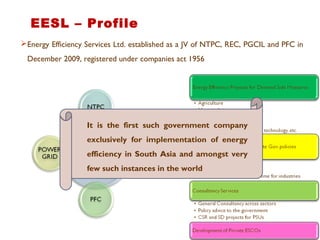
Energy Efficiency Services Ltd. established as a JV of NTPC, REC, PGCIL and PFC in
December 2009, registered under companies act 1956
EESL – Profile
It is the first such government company
exclusively for implementation of energy
efficiency in South Asia and amongst very
few such instances in the world
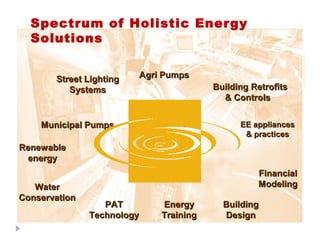
Agri PumpsAgri Pumps
Building RetrofitsBuilding Retrofits
& Controls& Controls
FinancialFinancial
ModelingModeling
BuildingBuilding
DesignDesign
PATPAT
TechnologyTechnology
WaterWater
ConservationConservation
Municipal PumpsMunicipal Pumps
Street LightingStreet Lighting
SystemsSystems
EnergyEnergy
TrainingTraining
RenewableRenewable
energyenergy
EE appliancesEE appliances
& practices& practices
Spectrum of Holistic Energy
Solutions
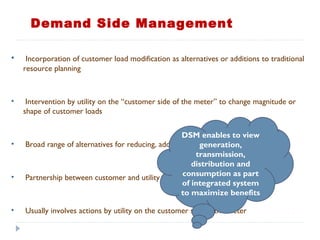
• Incorporation of customer load modification as alternatives or additions to traditional
resource planning
• Intervention by utility on the “customer side of the meter” to change magnitude or
shape of customer loads
• Broad range of alternatives for reducing, adding or changing load
• Partnership between customer and utility with benefits to both
• Usually involves actions by utility on the customer side of the meter
DSM enables to view
generation,
transmission,
distribution and
consumption as part
of integrated system
to maximize benefits
Demand Side Management
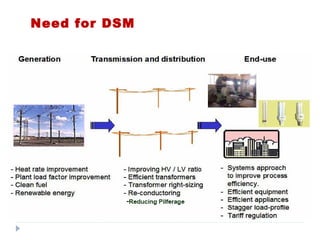
Generation Transmission Distribution Consumption
Rs. 35,000 Crores is
estimated to be lost
via T&D losses
30% T&D Loss
Reduction
20% Efficiency
Improvement
Financing Instruments need to be designed appropriately
for Each DSM endeavor
Need for DSM
Source: US DOE
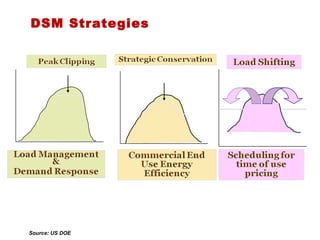
DSM Strategies
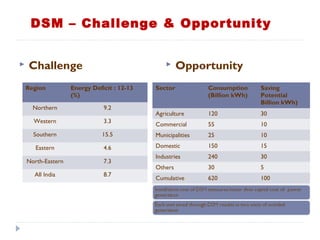
DSM – Challenge & Opportunity
 Challenge  Opportunity
Region Energy Deficit : 12-13
(%)
Northern 9.2
Western 3.3
Southern 15.5
Eastern 4.6
North-Eastern 7.3
All India 8.7
Sector Consumption
(Billion kWh)
Saving
Potential
Billion kWh)
Agriculture 120 30
Commercial 55 10
Municipalities 25 10
Domestic 150 15
Industries 240 30
Others 30 5
Cumulative 620 100
% Saving Potential 15 %
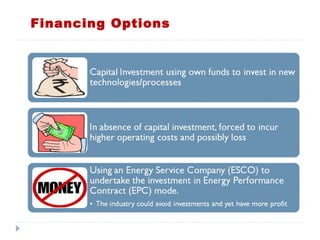
Financing Options
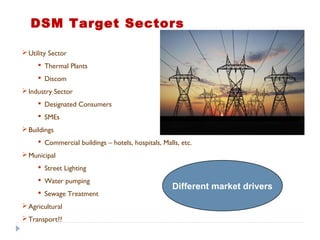
Utility Sector
 Thermal Plants
 Discom
Industry Sector
 Designated Consumers
 SMEs
Buildings
 Commercial buildings – hotels, hospitals, Malls, etc.
Municipal
 Street Lighting
 Water pumping
 Sewage Treatment
Agricultural
Transport??
Different market drivers
DSM Target Sectors
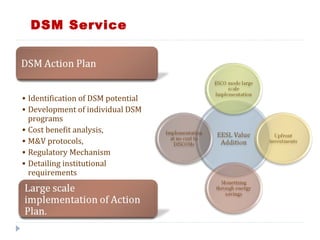
• Identification of DSM potential
• Development of individual DSM
programs
• Cost benefit analysis,
• M&V protocols,
• Regulatory Mechanism
• Detailing institutional
requirements
DSM Service
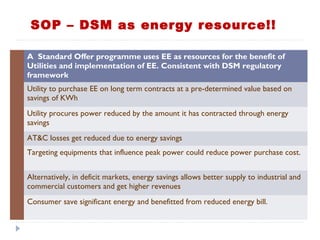
SOP – DSM as energy resource!!
A Standard Offer programme uses EE as resources for the benefit of
Utilities and implementation of EE. Consistent with DSM regulatory
framework
Utility to purchase EE on long term contracts at a pre-determined value based on
savings of KWh
Utility procures power reduced by the amount it has contracted through energy
savings
AT&C losses get reduced due to energy savings
Targeting equipments that influence peak power could reduce power purchase cost.
Alternatively, in deficit markets, energy savings allows better supply to industrial and
commercial customers and get higher revenues
Consumer save significant energy and benefitted from reduced energy bill.
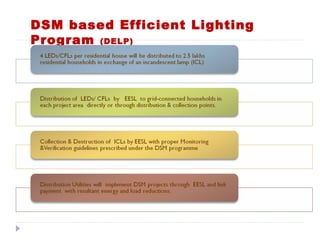
DSM based Efficient Lighting
Program (DELP)
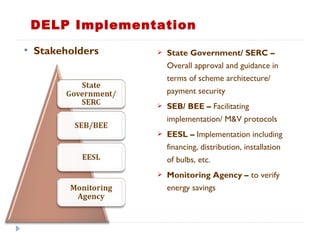
 Stakeholders  State Government/ SERC –
Overall approval and guidance in
terms of scheme architecture/
payment security
 SEB/ BEE – Facilitating
implementation/ M&V protocols
 EESL – Implementation including
financing, distribution, installation
of bulbs, etc.
 Monitoring Agency – to verify
energy savings
DELP Implementation
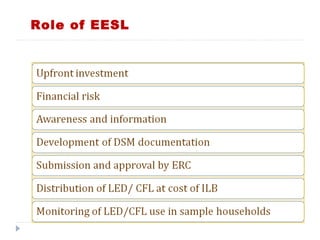
Role of EESL
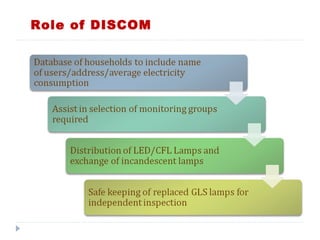
Role of DISCOM
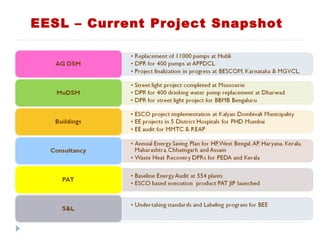
EESL – Current Project Snapshot
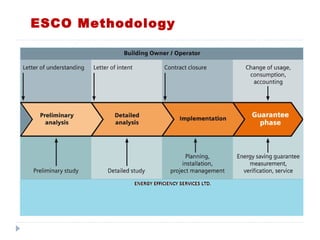
ESCO Methodology
Let us paint...Let us paint...
make India Greenmake India Green

Day-3, Mr. Ajay raj

  • 1.
    Enabling Sustainability through DemandSide Management Ajay Raj EESL
  • 2.
     EESL Companyprofile  Energy Solution Portfolio  Supply Side Versus Demand Side Management  DSM Essentials  EESL DSM portfolio AGENDA
  • 3.
    Energy Efficiency ServicesLtd. established as a JV of NTPC, REC, PGCIL and PFC in December 2009, registered under companies act 1956 EESL – Profile It is the first such government company exclusively for implementation of energy efficiency in South Asia and amongst very few such instances in the world
  • 4.
    Agri PumpsAgri Pumps BuildingRetrofitsBuilding Retrofits & Controls& Controls FinancialFinancial ModelingModeling BuildingBuilding DesignDesign PATPAT TechnologyTechnology WaterWater ConservationConservation Municipal PumpsMunicipal Pumps Street LightingStreet Lighting SystemsSystems EnergyEnergy TrainingTraining RenewableRenewable energyenergy EE appliancesEE appliances & practices& practices Spectrum of Holistic Energy Solutions
  • 5.
    • Incorporation ofcustomer load modification as alternatives or additions to traditional resource planning • Intervention by utility on the “customer side of the meter” to change magnitude or shape of customer loads • Broad range of alternatives for reducing, adding or changing load • Partnership between customer and utility with benefits to both • Usually involves actions by utility on the customer side of the meter DSM enables to view generation, transmission, distribution and consumption as part of integrated system to maximize benefits Demand Side Management
  • 6.
    Generation Transmission DistributionConsumption Rs. 35,000 Crores is estimated to be lost via T&D losses 30% T&D Loss Reduction 20% Efficiency Improvement Financing Instruments need to be designed appropriately for Each DSM endeavor Need for DSM
  • 7.
  • 8.
    DSM – Challenge& Opportunity  Challenge  Opportunity Region Energy Deficit : 12-13 (%) Northern 9.2 Western 3.3 Southern 15.5 Eastern 4.6 North-Eastern 7.3 All India 8.7 Sector Consumption (Billion kWh) Saving Potential Billion kWh) Agriculture 120 30 Commercial 55 10 Municipalities 25 10 Domestic 150 15 Industries 240 30 Others 30 5 Cumulative 620 100 % Saving Potential 15 %
  • 9.
  • 10.
    Utility Sector  ThermalPlants  Discom Industry Sector  Designated Consumers  SMEs Buildings  Commercial buildings – hotels, hospitals, Malls, etc. Municipal  Street Lighting  Water pumping  Sewage Treatment Agricultural Transport?? Different market drivers DSM Target Sectors
  • 11.
    • Identification ofDSM potential • Development of individual DSM programs • Cost benefit analysis, • M&V protocols, • Regulatory Mechanism • Detailing institutional requirements DSM Service
  • 12.
    SOP – DSMas energy resource!! A Standard Offer programme uses EE as resources for the benefit of Utilities and implementation of EE. Consistent with DSM regulatory framework Utility to purchase EE on long term contracts at a pre-determined value based on savings of KWh Utility procures power reduced by the amount it has contracted through energy savings AT&C losses get reduced due to energy savings Targeting equipments that influence peak power could reduce power purchase cost. Alternatively, in deficit markets, energy savings allows better supply to industrial and commercial customers and get higher revenues Consumer save significant energy and benefitted from reduced energy bill.
  • 13.
    DSM based EfficientLighting Program (DELP)
  • 14.
     Stakeholders State Government/ SERC – Overall approval and guidance in terms of scheme architecture/ payment security  SEB/ BEE – Facilitating implementation/ M&V protocols  EESL – Implementation including financing, distribution, installation of bulbs, etc.  Monitoring Agency – to verify energy savings DELP Implementation
  • 15.
  • 16.
  • 17.
    EESL – CurrentProject Snapshot
  • 18.
  • 19.
    Let us paint...Letus paint... make India Greenmake India Green

Editor's Notes

  • #7 Impact Statement Transition Statement: Points to Make: NOTE: This is NOT “our” process. This is the customer’s buying process. CONCEPTUAL PHASE... Education and planning with key decision makers... PROJECT DEVELOPMENT PHASE... Uniting as a team to evaluate the situation… Delivering a “Report Card” to the executive body seeking endorsement to proceed into the buying process... PROCUREMENT PHASE... Acting according to established state legislation in procurement... We operate from a three step process… We seek to first understand conceptually, then practically or functionally. Then act appropriately to state legislation... When do you think the best time for an installation is? Let’s look at it on a timeline...
  • #11 Impact Statement Transition Statement: Points to Make: NOTE: This is NOT “our” process. This is the customer’s buying process. CONCEPTUAL PHASE... Education and planning with key decision makers... PROJECT DEVELOPMENT PHASE... Uniting as a team to evaluate the situation… Delivering a “Report Card” to the executive body seeking endorsement to proceed into the buying process... PROCUREMENT PHASE... Acting according to established state legislation in procurement... We operate from a three step process… We seek to first understand conceptually, then practically or functionally. Then act appropriately to state legislation... When do you think the best time for an installation is? Let’s look at it on a timeline...