Semiconductor Optical Amplifiers 1st Edition Michael J. Connelly
Semiconductor Optical Amplifiers 1st Edition Michael J. Connelly
Semiconductor Optical Amplifiers 1st Edition Michael J. Connelly
Semiconductor Optical Amplifiers 1st Edition Michael J. Connelly
Semiconductor Optical Amplifiers 1st Edition Michael J. Connelly
1.
Visit https://ebookultra.com todownload the full version and
explore more ebooks
Semiconductor Optical Amplifiers 1st Edition
Michael J. Connelly
_____ Click the link below to download _____
https://ebookultra.com/download/semiconductor-optical-
amplifiers-1st-edition-michael-j-connelly/
Explore and download more ebooks at ebookultra.com
2.
Here are somesuggested products you might be interested in.
Click the link to download
Semiconductor Industry Wafer Fab Exhaust Management 1st
Edition J. Michael Sherer
https://ebookultra.com/download/semiconductor-industry-wafer-fab-
exhaust-management-1st-edition-j-michael-sherer/
Echo Park Harry Bosch 12 Harry Bosch Universe 17 First
Edition Michael Connelly
https://ebookultra.com/download/echo-park-harry-bosch-12-harry-bosch-
universe-17-first-edition-michael-connelly/
Design of CMOS Operational Amplifiers Dehghani
https://ebookultra.com/download/design-of-cmos-operational-amplifiers-
dehghani/
Operational amplifiers 2nd edition Edition Barna A.
https://ebookultra.com/download/operational-amplifiers-2nd-edition-
edition-barna-a/
3.
The Book ofRevelation for Blockheads Douglas Connelly
https://ebookultra.com/download/the-book-of-revelation-for-blockheads-
douglas-connelly/
Semiconductor Transport 1st Edition Ferry
https://ebookultra.com/download/semiconductor-transport-1st-edition-
ferry/
Semiconductor Electrochemistry 1st Edition Rudiger Memming
https://ebookultra.com/download/semiconductor-electrochemistry-1st-
edition-rudiger-memming/
Quantum Theory of Optical Coherence Selected Papers and
Lectures 1st Edition Roy J. Glauber
https://ebookultra.com/download/quantum-theory-of-optical-coherence-
selected-papers-and-lectures-1st-edition-roy-j-glauber/
Fundamentals of RF and Microwave Transistor Amplifiers 1st
Edition Inder Bahl
https://ebookultra.com/download/fundamentals-of-rf-and-microwave-
transistor-amplifiers-1st-edition-inder-bahl/
5.
Semiconductor Optical Amplifiers1st Edition Michael J.
Connelly Digital Instant Download
Author(s): Michael J. Connelly
ISBN(s): 9780792376576, 0792376579
Edition: 1st
File Details: PDF, 8.76 MB
Year: 2002
Language: english
Contents
Preface ix
INTRODUCTION 1
BASICPRINCIPLES 7
STRUCTURES 21
MATERIALS 43
MODELLING 69
BASIC NETWORK APPLICATIONS 97
FUNCTIONAL APPLICATIONS 127
Index 167
vii
12.
Preface
Communications can bebroadly defined as the transfer of information from
one point to another. In optical fibre communications, this transfer is
achieved by using light as the information carrier. There has been an
exponential growth in the deployment and capacity of optical fibre
communication technologies and networks over the past twenty-five years.
This growth has been made possible by the development of new
optoelectronic technologies that can be utilised to exploit the enormous
potential bandwidth of optical fibre. Today, systems are operational which
operate at aggregate bit rates in excess of 100 Gb/s. Such high capacity
systems exploit the optical fibre bandwidth by employing wavelength
division multiplexing.
Optical technology is the dominant carrier of global information. It is also
central to the realisation of future networks that will have the capabilities
demanded by society. These capabilities include virtually unlimited
bandwidth to carry communication services of almost any kind, and full
transparency that allows terminal upgrades in capacity and flexible routing
of channels. Many of the advances in optical networks have been made
possible by the advent of the optical amplifier.
In general, optical amplifiers can be divided into two classes: optical fibre
amplifiers and semiconductor amplifiers. The former has tended to dominate
conventional system applications such as in-line amplification used to
compensate for fibre losses. However, due to advances in optical
semiconductor fabrication techniques and device design, especially over the
last five years, the semiconductor optical amplifier (SOA) is showing great
promise for use in evolving optical communication networks. It can be
utilised as a general gain unit but also has many functional applications
including an optical switch, modulator and wavelength converter. These
ix
13.
x Introduction
functions, wherethere is no conversion of optical signals into the electrical
domain, are required in transparent optical networks.
It is the intention of this book to provide the reader with a comprehensive
introduction to the design and applications of SOAs, particularly with regard
to their use in optical communication systems. It is hoped that the book has
achieved this aim.
14.
1.3
Chapter 1
INTRODUCTION
In thischapter we begin with the reasons why optical amplification is
required in optical communication networks. This is followed by a brief
history of semiconductor optical amplifiers (SOAs), a summary of the
applications of SOAs and a comparison between SOAs and optical fibre
amplifiers (OFAs).
1.1 THE NEED FOR OPTICAL AMPLIFICATION
Optical fibre suffers from two principal limiting factors: Attenuation and
dispersion. Attenuation leads to signal power loss, which limits transmission
distance. Dispersion causes optical pulse broadening and hence intersymbol
interference leading to an increase in the system bit error rate (BER).
Dispersion essentially limits the fibre bandwidth. The attenuation spectrum
of conventional single-mode silica fibre, shown in Fig. 1.1, has a minimum
in the 1.55 wavelength region. The attenuation is somewhat higher in the
region.
The dispersion spectrum of conventional single-mode silica fibre, shown
in Fig. 1.2, has a minimum in the 1.3 region. Because the attenuation and
material dispersion minima are located in the 1.55 and 1.3
‘windows’, these are the main wavelength regions used in commercial
optical fibre communication systems. Systems operating in the 830 nm
region are also utilised, mainly for short-haul links at moderate bit rates
which do not usually require optical amplification.
Because signal attenuation and dispersion increases as the fibre length
increases, at some point in an optical fibre communication link the optical
signal will need to be regenerated. 3R (reshaping-retiming-retransmission)
1
15.
2 Semiconductor OpticalAmplifiers
regeneration involves detection (photon-electron conversion), electrical
amplification, retiming, pulse shaping and retransmission (electron-photon
conversion).
This method has a number of disadvantages. Firstly, it involves breaking
the optical link and so is not optically transparent. Secondly, the regeneration
process is dependent on the signal modulation format and bit rate and so is
not electrically transparent. This in turn creates difficulties if the link needs
to be upgraded. Ideally link upgrades should only involve changes in or
replacement of terminal equipment (transmitter or receiver). Thirdly, as
regenerators are complex systems and often situated in remote or difficult to
access location, as is the case in undersea transmission links, network
16.
3
Introduction
reliability is impaired.In systems where fibre loss is the limiting factor, an
in-line optical amplifier can be used instead of a regenerator. As the in-line
amplifier has only to carry out one function (amplification of the input
signal) compared to full regeneration, it is intrinsically a more reliable and
less expensive device.
Ideally an in-line optical amplifier should be compatible with single-mode
fibre, impart large gain and be optically transparent (i.e. independent of the
input optical signal properties).
In addition optical amplifiers can also be useful as power boosters, for
example to compensate for splitting losses in optical distribution networks,
and as optical preamplifiers to improve receiver sensitivity. Besides these
basic system applications optical amplifiers are also useful as generic optical
gain blocks for use in larger optical systems. The improvements in optical
communication networks realised through the use of optical amplifiers
provides new opportunities to exploit the fibre bandwidth.
There are two types of optical amplifier: The SOA and the OFA [1-6]. In
recent times the latter has dominated; however SOAs have attracted renewed
interest for use as basic amplifiers and also as functional elements in optical
communication networks and optical signal processing devices.
1.2 BRIEF HISTORY OF SEMICONDUCTOR OPTICAL
AMPLIFIERS
The first studies on SOAs were carried out around the time of the invention
of the semiconductor laser in the 1960’s. These early devices were based on
GaAs homojunctions operating at low temperatures. The arrival of double
heterostructure devices spurred further investigation into the use of SOAs in
optical communication systems. In the 1970’s Zeidler and Personick carried
out early work on SOAs [7-8]. In the 1980’s there were further important
advances on SOA device design and modelling. Early studies concentrated
on AlGaAs SOAs operating in the 830 nm range [9-10]. In the late 1980’s
studies on InP/InGaAsP SOAs designed to operate in the 1.3 and 1.55
regions began to appear [11].
Developments in anti-reflection coating technology enabled the
fabrication of true travelling-wave SOAs [12]. Prior to 1989, SOA structures
were based on anti-reflection coated semiconductor laser diodes. These
devices had an asymmetrical waveguide structure leading to strongly
polarisation sensitive gain.
In 1989 SOAs began to be designed as devices in their own right, with the
use of more symmetrical waveguide structures giving much reduced
polarisation sensitivities [13]. Since then SOA design and development has
17.
4 Semiconductor OpticalAmplifiers
progressed in tandem with advances in semiconductor materials, device
fabrication, antireflection coating technology, packaging and photonic
integrated circuits, to the point where reliable cost competitive devices are
now available for use in commercial optical communication systems.
Developments in SOA technology are ongoing with particular interest in
functional applications such as photonic switching and wavelength
conversion. The use of SOAs in photonic integrated circuits (PICs) is also
attracting much research interest.
1.3 SEMICONDUCTOR AND OPTICAL FIBRE
AMPLIFIERS: COMPLEMENTARY
TECHNOLOGIES
The Erbium Doped Fibre Amplifier (EDFA) was invented in 1985. The
EDFA led to a revolution in optical communications as it made possible the
replacement of 3R regenerators in links limited by fibre attenuation, leading
to the possibility of optically transparent networks and thereby overcoming
the ‘electronic bottleneck’. The EDFA has become the optical amplifier of
choice in long haul, multichannel digital and analog applications at 1.55
Neodymium Doped Fibre Amplifiers are also available for use in the 1.3
region. Fibre amplifiers are especially attractive, as they possess high gain,
low insertion loss, low noise figure and negligible nonlinearities, but require
an external pump laser.
SOAs have poorer gain and noise and nonlinearities can be severe.
However SOA technology is advancing rapidly. SOAs are compatible with
monolithic integration (hence low cost potential) and offer a wide range of
applications, including optical signal processing that cannot be performed by
fibre amplifiers. It is expected that deployment of SOAs in evolving optical
communication networks will increase. A comparison between the main
features ofOFAs and SOAs is given in Table 1.1. Fig. 1.2 illustrates some of
diverse range of applications possible with SOAs.
18.
5
Introduction
It is forecastthat the consumption of SOAs will expand rapidly from $48
million in 2000 to $903 million in 2010 [14]. The main near-term use of
SOAs will be as basic amplifiers in wavelength division multiplexed
(WDM) and other digital optical communication links, and as switching
elements in all-optical switches and optical crossconnects. As the above
figures show, the future for SOAs is bright, and even more applications of
the device will arise as the technology matures and manufacturing costs
decrease.
REFERENCES
1. S. Shimada and H. Ishio, Eds., Optical Amplifiers and their Applications, John Wiley
(1992).
2. H. Ghafouri-Shiraz, Fundamentals of Laser Diode Amplifiers, John Wiley (1995).
3. Y. Yamamoto, Ed., Coherence, Amplification and Quantum Effects in Semiconductor
Lasers, John Wiley (1991).
4. E. Desurvire, Erbium-Doped Fibre Amplifiers: Principles and Applications, John Wiley,
New York (1994).
5. M. J. O’Mahony, Semiconductor optical amplifiers for use in future fibre systems,
IEEE/OSA J. Lightwave Technol., 6, 531-544 (1988).
6. N. A. Olsson, Semiconductor optical amplifiers, IEEE Proc., 80, 375-382 (1992).
7. G. Zeidler and D. Schicetanz, Use of laser amplifiers in glass fibre communication systems,
Siemens Forch. u. Entwickl. Ber., 2, 227-234 (1973).
8. S. D. Personick, Applications for quantum amplifiers in simple digital optical
communication systems, Bell Syst. Tech. J., 52, 117-133 (1973).
9. Y. Yamamoto, Characteristics of AlGaAs Fabry-Perot cavity type laser amplifiers, IEEE J.
Quantum Electron., 16, 1047-1052 (1980).
19.
6 Semiconductor OpticalAmplifiers
10. T. Mukai, Y. Yamamoto and T. Kimura, S/N and error rate performance in AlGaAs
semiconductor laser preamplifier and linear repeater systems, IEEE Trans. Microwave
Theory And Tech., 30, 1548-1556 (1982).
11. J. C. Simon, GaInAsP semiconductor laser amplifiers for single-mode fibre
communications, IEEE/OSA J. Lightwave Technol., 5, 1286-1295, 1987.
12. C. E. Zah, C. Caneau, F. K. Shokoohi, S. G. Menocal, F. Favire, L. A. Reith and T. P.
Lee, 1.3 GaInAsP near-travelling-wave laser amplifiers made by combination of
angled facets and antireflection coatings, Electron. Lett., 24, 1275-1276 (1988).
13. N. A. Olsson, R. F. Kazarinov, W. A. Nordland, C. H. Henry, M. G. Oberg, H. G. White,
P. A. Garbinski and A. Savage, Polarisation-independent optical amplifier with buried
facets, Electron. Lett., 25, 1048-1049 (1989).
14. J.D. Montgomery, S. Montgomery and S. Hailu, Semiconductor optical amplifiers expand
commercial opportunities, WDM Solutions, Supplement to Laser Focus World, 27-30
August 2001.
20.
Chapter 2
BASIC PRINCIPLES
Inthis chapter the basic principles of SOAs are explained. The processes of
optical gain and additive noise are discussed along with fundamental device
parameters including gain ripple, polarisation sensitivity, saturation output
power and noise figure.
2.1 SOA - BASIC DESCRIPTION
An SOA is an optoelectronic device that under suitable operating conditions
can amplify an input light signal. A schematic diagram of a basic SOA is
shown in Fig. 2.1. The active region in the device imparts gain to an input
signal. An external electric current provides the energy source that enables
gain to take place. An embedded waveguide is used to confine the
propagating signal wave to the active region. However, the optical
confinement is weak so some of the signal will leak into the surrounding
lossy cladding regions. The output signal is accompanied by noise. This
additive noise is produced by the amplification process itself and so cannot
be entirely avoided. The amplifier facets are reflective causing ripples in the
gain spectrum.
SOAs can be classified into two main types shown in Fig. 2.2: The Fabry-
Perot SOA (FP-SOA) where reflections from the end facets are significant
(i.e. the signal undergoes many passes through the amplifier) and the
travelling-wave SOA (TW-SOA) where reflections are negligible (i.e. the
signal undergoes a single-pass of the amplifier). Anti-reflection coatings can
be used to create SOAs with facet reflectivities The TW-SOA is not
as sensitive as the FP-SOA to fluctuations in bias current, temperature and
signal polarisation.
7
21.
8 Semiconductor OpticalAmplifiers
2.2 PRINCIPLES OF OPTICAL AMPLIFICATION
In an SOA electrons (more commonly referred to as carriers) are injected
from an external current source into the active region. These energised
22.
9
Basic Principles
carriers occupyenergy states in the conduction band (CB) of the active
region material, leaving holes in the valence band (VB). Three radiative
mechanisms are possible in the semiconductor. These are shown in Fig 2.3
for a material with an energy band structure consisting of two discrete
energy levels.
In stimulated absorption an incident light photon of sufficient energy can
stimulate a carrier from the VB to the CB. This is a loss process as the
incident photon is extinguished.
If a photon of light of suitable energy is incident on the semiconductor, it
can cause stimulated recombination of a CB carrier with a VB hole. The
recombining carrier loses its energy in the form of a photon of light. This
new stimulated photon will be identical in all respects to the inducing photon
(identical phase, frequency and direction, i.e. a coherent interaction). Both
the original photon and stimulated photon can give rise to more stimulated
transitions. If the injected current is sufficiently high then a population
inversion is created when the carrier population in the CB exceeds that in the
VB. In this case the likelihood of stimulated emission is greater than
stimulated absorption and so semiconductor will exhibit optical gain.
In the spontaneous emission process, there is a non-zero probability per
unit time that a CB carrier will spontaneously recombine with a VB hole and
thereby emit a photon with random phase and direction. Spontaneously
emitted photons have a wide range of frequencies. Spontaneously emitted
photons are essentially noise and also take part in reducing the carrier
population available for optical gain. Spontaneous emission is a direct
23.
10 Semiconductor OpticalAmplifiers
consequence of the amplification process and cannot be avoided; hence a
noiseless SOA cannot be created. Stimulated processes are proportional to
the intensity of the inducing radiation whereas the spontaneous emission
process is independent of it.
2.2.1 Spontaneous and induced transitions
The gain properties of optical semiconductors are directly related to the
processes of spontaneous and stimulated emission. To quantify this
relationship we consider a system of energy levels associated with a
particular physical system. Let and
per unit volume of the system characterised
be the average number of atoms
by energies and
respectively, with If a particular atom has energy then there is a
finite probability per unit time that it will undergo a transition from to
and in the process emit a photon. The spontaneous carrier transition rate per
unit time from level 2 to level 1 is given by
where is the spontaneous emission parameter of the level 2 to level 1
transition. Along with spontaneous emission it is also possible to have
induced transitions. The induced carrier transition rate from level 2 to level 1
(stimulated emission) is given by
where is the stimulated emission parameter of the level 2 to level 1
transition and the incident radiation energy density at frequency The
induced photons have energy The induced transition rate from
level 1 to level 2 (stimulated absorption) is given by
where is the stimulated emission parameter of the level 2 to level 1
transition. It can be proved, from quantum-mechanical considerations [1,2],
that
24.
11
Basic Principles
where isthe material refractive index and the speed of light in a vacuum.
Inserting (2.5) into (2.2) gives
In the case where the inducing radiation is monochromatic at frequency
then the induced transition rate from level 2 to level 1 is
where is the energy density of the electromagnetic field inducing
the transition and is the transition lineshape function, normalised such
that
is the probability that a particular spontaneous emission event from
is
level 2 to level 1 will result in a photon with a frequency between and
The inducing field intensity
So (2.7) becomes
25.
12 Semiconductor OpticalAmplifiers
2.2.2 Absorption and amplification
By using the expression for the stimulated transition rates developed in
Section 2.2.1, it is now possible to derive an equation for the optical gain
coefficient for a two level system. We consider the case of a monochromatic
plane wave propagating in the through a gain medium with cross-
section area A and elemental length The net power generated by a
volume of the material is simply the difference in the induced transition
rates between the levels multiplied by the transition energy and the
elemental volume i.e.
This radiation is added coherently to the propagating wave. This process of
amplification can then be described by the differential equation
is the material gain coefficient given by
(2.13) implies that to achieve positive gain a population inversion
must exist between level 2 and level 1. It also shows, by the presence of
that the process of optical gain is always accompanied by spontaneous
emission, i.e. noise. A more detailed description of optical gain in
semiconductors is given in Chapter 4.
2.2.3 Spontaneous emission noise
As shown above, spontaneous emission is a direct consequence of the
amplification process. In this section an expression is derived for the noise
power generated by an optical amplifier. We consider the arrangement of
Fig. 2.4 [3], which shows an input monochromatic signal of frequency
travelling through a gain medium having the energy level structure of Fig
2.3. A polariser and optical filter of bandwidth centred about are placed
26.
13
Basic Principles
before thedetector. The input beam is focussed such that its waist occupies
the gain medium. If the beam is assumed to have a circular cross-section
with waist diameter D then the beam divergence angle is
where is the free space wavelength. The net change in the signal power
due to coherent amplification by an elemental length of the gain medium
is
A volume element, with cross-section area A and length at position
of the gain medium spontaneously emits a noise power
This noise is emitted isotropically over a solid angle. Each spontaneously
emitted photon can exist with equal probability in one of two mutually
orthogonal polarisation states. The polariser passes the signal, while
reducing the noise by half. Hence the total noise power emitted by the
volume element into a solid angle and bandwidth is
27.
14 Semiconductor OpticalAmplifiers
The smallest solid angle that can be used without losing signal power [4] is
This solid angle can be obtained by the use of a suitably narrow output
aperture. In this case (2.17) can be rewritten as
The total beam power P (signal and noise) can then be described by
where the spontaneous emission factor is given by
z
The solution of (2.20), assuming that is independent of , is
where is the input signal power. If the amplifying medium has length L
then the total output power is
where is the single-pass signal gain. The amplifier additive noise
power is
28.
15
Basic Principles
(2.24) showsthat increasing the level of population inversion can reduce
SOA noise. The noise can also be reduced by the use of a narrowband
optical filter.
2.3 FUNDAMENTAL DEVICE CHARACTERISTICS
The most common application of SOAs is as a basic optical gain block. For
such an application, a list ofthe desired properties is given in Table 2.1. The
goal of most SOA research and development is to realise these properties in
practical devices.
2.3.1 Small-signal gain and gain bandwidth
In general there are two basic gain definitions for SOAs. The first is the
intrinsic gain G of the SOA, which is simply the ratio of the input signal
power at the input facet to the signal power at the output facet. The second
definition is the fibre-to-fibre gain, which includes the input and output
coupling losses. These gains are usually expressed in dB. The gain spectrum
of a particular SOA depends on its structure, materials and operational
parameters. For most applications high gain and wide gain bandwidth are
desired. The small-signal (small here meaning that the signal has negligible
influence on the SOA gain coefficient) internal gain ofa Fabry-Perot SOA at
optical frequency is given by [5],
29.
16 Semiconductor OpticalAmplifiers
where and are the input and output facet reflectivities and is the
cavity longitudinal mode spacing given by
. Cavity resonance frequencies occur at
integermultiples of
is the closest cavity resonance to
The factor in (2.25) is equal to zero at resonance
frequencies and equal to unity at the anti-resonance frequencies (located
midway between successive resonance frequencies). The effective SOA gain
coefficient is
where is the optical mode confinement factor (the fraction of the
propagating signal field mode confined to the active region) and the
absorption coefficient. is the single-pass amplifier gain.
An uncoated SOA has facet reflectivities approximately equal to 0.32.
The amplifier gain ripple is defined as the ratio between the resonant and
non-resonant gains. From (2.25) we get
From (2.28) the relationship between the geometric mean facet reflectivity
and is
Curves of versus are shown in Fig. 2.5 with as parameter. For
example, to obtain a gain ripple less than 1 dB at an amplifier single-pass
gain of 25 dB requires that Facet reflectivities of this order
can be achieved by the application of anti-reflection (AR) coatings to the
amplifier facets. The effective facet reflectivities can be reduced further by
the use of specialised SOA structures. These techniques are discussed in
Chapter 3.
30.
17
Basic Principles
A typicalTW-SOA small-signal gain spectrum is shown in Fig. 2.2. The
gain bandwidth of the amplifier is defined as the wavelength range over
which the signal gain is not less than half its peak value. Wide gain
bandwidth SOAs are especially useful in systems where multichannel
amplification is required such as in WDM networks. A wide gain bandwidth
can be achieved in an SOA with an active region fabricated from quantum-
well or multiple quantum-well (MQW) material as discussed in Chapter 4.
Typical maximum internal gains achievable in practical devices are in the
range of 30 to 35 dB. Typical small-signal gain bandwidths are in the range
of 30 to 60 nm.
2.3.2 Polarisation sensitivity
In general the gain of an SOA depends on the polarisation state of the input
signal. This dependency is due to a number of factors including the
waveguide structure, the polarisation dependent nature of anti-reflection
coatings and the gain material. Cascaded SOAs accentuate this polarisation
dependence. The amplifier waveguide is characterised by two mutually
orthogonal polarisation modes termed the Transverse Electric (TE) and
Transverse Magnetic (TM) modes. The input signal polarisation state usually
lies somewhere between these two extremes. The polarisation sensitivity of
an SOA is defined as the magnitude of the difference between the TE mode
gain and TM mode gain i.e.
31.
18 Semiconductor OpticalAmplifiers
Techniques for realising SOAs with low polarisation sensitivity (< 1 dB) are
discussed in Chapter 3.
2.3.3 Signal gain saturation
The gain of an SOA is influenced both by the input signal power and internal
noise generated by the amplification process. As the signal power increases
the carriers in the active region become depleted leading to a decrease in the
amplifier gain. This gain saturation can cause significant signal distortion. It
can also limit the gain achievable when SOAs are used as multichannel
amplifiers. A typical SOA gain versus output signal power characteristic is
saturation output power
shown in Fig. 2.6. A useful parameter for quantifying gain saturation is the
which is defined as the amplifier output signal
power at which the amplifier gain is half the small-signal gain. Techniques
for realising SOAs with high are discussed in Chapter 3. Values in the
range of 5 to 20 dBm for are typical of practical devices.
2.3.4 Noise figure
A useful parameter for quantifying optical amplifier noise is the noise figure.
F, defined as the ratio of the input and output signal to noise ratios, i.e.
32.
19
Basic Principles
The signalto noise ratios in (2.31) are those obtained when the input and
output powers of the amplifier are detected by an ideal photodetector. Full
expressions for the photocurrent signal to noise ratio in optically amplified
systems are derived in Chapter 6.
In the limiting case where the amplifier gain is much larger than unity and
the amplifier output is passed through a narrowband optical filter, the noise
figure is given by
The lowest value possible for is unity, which occurs when there is
complete inversion of the atomic medium, i.e. giving F = 2 (i.e. 3
dB). Typical intrinsic (i.e. not including coupling losses) noise figures of
practical SOAs are in the range of 7 to 12 dB. The noise figure is degraded
by the amplifier input coupling loss. Coupling losses are usually ofthe order
of 3 dB, so the noise figure of typical packaged SOAs is between 10 and 15
dB.
2.3.5 Dynamic effects
SOAs are normally used to amplify modulated light signals. If the signal
power is high then gain saturation will occur. This would not be a serious
problem if the amplifier gain dynamics were a slow process. However in
SOAs the gain dynamics are determined by the carrier recombination
lifetime (average time for a carrier to recombine with a hole in the valence
band). This lifetime is typically of a few hundred picoseconds. This means
that the amplifier gain will react relatively quickly to changes in the input
signal power. This dynamic gain can cause signal distortion, which becomes
more severe as the modulated signal bandwidth increases. These effects are
further exacerbated in multichannel systems where the dynamic gain leads to
interchannel crosstalk. This is in contrast to doped fibre amplifiers, which
have recombination lifetimes of the order of milliseconds leading to
negligible signal distortion. Dynamic effects are explored further in Chapter
5.
2.3.6 Nonlinearities
SOAs also exhibit nonlinear behaviour. In general these nonlinearities can
cause problems such as frequency chirping and generation of second or third
order intermodulation products. However, nonlinearities can also be of use
33.
20 Semiconductor OpticalAmplifiers
in using SOAs as functional devices such as wavelength converters. SOA
nonlinearities are discussed in more detail in Chapter 7.
REFERENCES
1. Y. Suematsu and A.R. Adams, Handbook of Semiconductor lasers and Photonic Integrated
Circuits, London, Chapman and Hall (1994).
2. A. Yariv, Quantum Electronics, New York, Wiley (1989).
3. A. Yariv, Optical Electronics, New York, HWR International (1985).
4. F.L. Pedrotti and L.S. Pedrotti, Introduction to Optics, Prentice-Hall (1993).
5. Y. Yamamoto, Characteristics of AlGaAs Fabry-Perot cavity type laser amplifiers, IEEE J.
Quantum Electron., 16, 1047-1052 (1980).
34.
Chapter 3
STRUCTURES
The structuraldesign of an SOA has a large bearing on its performance.
SOA structures are chosen so a given device approaches the ideal
characteristics listed in Table 2.1 or to accentuate a particular characteristic
desirable for a given application (e.g. high saturation output power for
booster applications). In this chapter the principles underlying SOA design
are reviewed.
3.1 SOA BASIC STRUCTURE
In the early days of SOA research, their structures were based on anti
reflection coated double-heterostructure (DH) semiconductor laser diodes as
shown in Fig. 3.1. In this type of structure the active region (usually intrinsic
i.e. undoped) is sandwiched between n-type and p-type cladding regions.
The interfaces between the active region and cladding regions are
heterojunctions, as shown in Fig. 3.2. A heterojunction is an interface
between two semiconductor materials having different bandgap energies.
The cladding regions have higher bandgap energies and lower refractive
indices compared to the active region.
Carriers are injected into the device active region from the applied bias
current. The injected carriers have to make their way through surrounding
layers of semiconductor before they reach the active region. If there were no
carrier confinement, the carriers would diffuse throughout the device. As the
active region is relatively small, this means that a only a small percentage of
the injected carriers would eventually provide gain to a propagating light
signal. This leads to inefficient device operation. To overcome this effect,
confinement of carriers to the active region is necessary. In the DH structure
21
35.
22 Semiconductor OpticalAmplifiers
this is achieved by the bandgap difference between the active region and the
cladding regions. This confines carriers to the region between the barriers.
However, it is only in the central intrinsic region that the carrier density is
high enough to impart gain to a propagating light wave. Carrier confinement
has the additional benefit in that the device can be operated at a lower bias
36.
23
Structures
current thereby reducingresistive power losses and placing fewer demands
on temperature control.
The efficiency of an SOA is improved if the light signal is confined to the
active region. In the DH structure the active region has a slightly higher
refractive index than the cladding regions and so behaves as a dielectric
waveguide with a rectangular cross-section. This helps to confine light
travelling through the device to the active region. The amount of
waveguiding is quantified by the optical confinement factor defined as the
fraction of the energy of a particular waveguide mode confined to the active
region. Waveguide modes are solutions to Maxwell’s equations for the
electric and magnetic fields in the waveguide obeying the waveguide
boundary conditions. The calculation of dielectric waveguide modes and
their associated confinement factors is not a trivial problem; more details can
be found in [1-4].
If the waveguide is sufficiently narrow, it will only support a single
transverse mode with two possible polarisations, the transverse electric (TE)
mode where the electric field is polarised along the heterojunction plane
(along the x-axis in Fig. 3.1) and the transverse magnetic (TM) mode where
the magnetic field is polarised along the x-axis. The mode is transverse
because the associated electric and magnetic fields are both normal to the
direction of propagation.
Single transverse mode operation helps to reduce modal gain dependency
as the optical confinement factor is mode dependent and also improves the
coupling efficiency from the device to optical fibre. The design of an SOA
active waveguide to support a single transverse mode is identical to that for
laser design. This topic is outside the scope of this book, but is covered in
detail in [1-4].
In the above DH SOA there is a well-defined refractive index step in the
y-direction between the intrinsic and cladding regions. However, in the x-
direction there is no such step. Wave guiding in x-direction is achieved by
the injected carriers, which change the refractive index of the intrinsic
region. This process is referred to as gain guiding. This refractive index
change is less than that in the y-direction. This implies that is polarisation
dependent, increases as the active region thickness is increased. However
if the active region is too wide single transverse mode operation will cease.
A typical profile of the light field intensity across the device cross-section is
shown in Fig. 3.2.
The polarisation dependent optical confinement factors are usually
referred to as the TE and TM optical confinement factors, i.e. and
Methods for reducing polarisation sensitivity include the use ofsquare cross-
section active waveguides and strained superlattices (Section 3.3).
37.
24 Semiconductor OpticalAmplifiers
3.2 SUPPRESSION OF CAVITY RESONANCE
We have seen in Chapter 2 that suppression of SOA facet reflectivities is
necessary to achieve travelling-wave operation in an OA. There are a
number of methods to reduce the effective facet reflectivities.
3.2.1 Antireflection coatings
The power reflectivity for normal incidence at the interface between two
dielectrics is given by
where and are the dielectric refractive indices. Semiconductor materials
have a high refractive index (typically between 3 and 4). Typical cleaved
semiconductor-air interface reflectivities are of the order of 32%. While a
reflectivity of this magnitude is suitable to achieve laser oscillation in a DH
device, it is excessively large for a TW-SOA. The effective facet
reflectivities can be greatly reduced by the application of antireflection (AR)
coatings. If a plane wave of free-space wavelength is normally incident on
a material of refractive index placed in air (refractive index = 1), then the
optimal (i.e. for lowest reflectivity) fabrication conditions for an AR coating
formed by a single dielectric layer are [5],
where and are the refractive index and thickness of the AR coating.
(3.2) only applies to a particular wavelength so a single AR coating is not
suitable for SOA operation over a wide bandwidth.
To achieve wideband low facet reflectivities requires the use of multilayer
dielectric coatings. The analysis of such coatings is complex and even more
difficult when applied to SOAs. This is because the SOA waveguide mode is
distributed in the active and cladding regions, which have different refractive
indices.
In the following analysis we follow the technique of [6]. If it is assumed
that the field distribution is uniform along the direction parallel to the
38.
25
Structures
junction between thefacet and AR coatings, the waveguide can be analysed
using the symmetric two-dimensional model shown in Fig. 3.3.
In the analysis only TE polarised waves are considered. The active layer
has refractive index and thickness d. The surrounding cladding regions
have refractive index and are assumed to extend to infinity.
The incident field distribution at the boundary between the
active region and the AR coating, is
where
which satisfy
39.
26 Semiconductor OpticalAmplifiers
where the subscripts a and c denote the active and cladding regions
respectively, is the propagation constant, and
are wavenumbers and A is an arbitrary constant. The plane wave angular
spectrum of the incident field is given by the Fourier transform of
(3.3) which gives
where is the angle of incidence and and are the
components of in the active and cladding layers respectively. The
Fresnel reflection coefficient of the multilayer AR coating is
where l is the number of AR coating layers,
and
are the elements of the 2 x
2 transfer matrix
i-th layer
the refractive index of the i-th layer. is the refractive index of the
active region or cladding layer.
The elements of the transfer matrix of the
are
with
40.
Structures 27
where andis the thickness of the i-th layer. The reflected-field
angular spectrum is
where and are the reflection coefficients for the field components
in the active and cladding regions respectively. The reflected field at z
= 0 is equal to the inverse Fourier transform of The reflectivity R for
the coated facet is given by the square of the coupling coefficient between
and , i.e.
This equation can be solved numerically. A similar technique can be applied
to obtain the reflectivity of the TM mode. An example of the use of (3.11)
for a single layer AR coating is shown in Fig 3.4. With an appropriate
an effective facet reflectivity
combination of film refractive index and thickness, it is possible to achieve
using a single layer AR coating.
The AR coating conditions for TE and TM polarisations are not equal.
However, the use of multilayer coatings can reduce polarisation dependency
and also broaden the low-reflectivity wavelength range [7]. Many dielectric
materials such as SiN, and can be used as AR
coatings. They are applied to an SOA by evaporation or sputtering. The
refractive index of the AR coating layer can be controlled by the evaporation
or sputtering conditions. Techniques are also available for measuring AR
coating reflectivity [8,9].
To achieve low facet reflectivities using AR coatings requires careful
control of the refractive index and thickness of the dielectric layers. Altering
the SOA structure can reduce the tight tolerances required. Two techniques
are commonly used: Angled facets and the window structure, which in
conjunction with AR coatings can deliver low reflectivities over a wide
bandwidth with minimal polarisation sensitivity.
41.
28 Semiconductor OpticalAmplifiers
3.2.2 Angled facet structure
In an angled facet SOA, shown in Fig. 3.5, the active region is slanted away
from the facet cleavage plane, thereby reducing the effective facet
reflectivity. The V-number of the waveguide is
where is the waveguide width and and are the effective refractive
indices of the active and cladding regions respectively. The TE mode full
power width is given by the approximation [10]
42.
29
Structures
If the TEmode is assumed to have a Gaussian distribution, the effective
reflectivity of an angled facet is given approximately by
where is the angle between the beam propagation direction and the normal
to the end facet. The Fresnel reflectivity of a TE plane wave, confined to
the waveguide, at the angled facet-air interface is given by
The effective reflectivity of the TM mode is almost identical to that of the
TE mode. The effective reflectivity is shown in Fig 3.6 as a function of the
facet angle and active region width. The relative reflectivity decreases as the
facet angle increases. However the coupling efficiency between an SOA and
optical fibre degrades at large facet angles due to the far-field asymmetry.
AR coatings also become more polarisation sensitive as the facet angle
increases. The relative reflectivity also decreases as the waveguide width
increases. However, if the waveguide is too wide higher order transverse
modes can appear. This problem can be overcome by broadening the
waveguide near the end facets as shown in Fig. 3.7. This also preserves the
single transverse mode condition [11]. Optimal facet angles lie in the range
to . More analyses of angled facets can be found in [12-13].
43.
30 Semiconductor OpticalAmplifiers
3.2.3 Window facet structure
As noted above facet reflectivities and optimum AR coating conditions are
polarisation dependent. The effective facet reflectivity can be further
reduced and made less sensitive to polarisation by the use of window (or
buried) facets as shown in Fig 3.8 [14-15]. This structure is simply
composed of a transparent region between the active region and end facets.
This transparent region has an energy bandgap greater than the signal photon
44.
31
Structures
energy. This meansthat stimulated absorption is not possible although some
intrinsic material absorption will be present. The guided field
from the waveguide propagates in the window region at some angle due to
diffraction and is partially reflected at the end facet. The reflected field
continues to broaden in space so only a small fraction is coupled back into
the active region. The effective reflectivity decreases with increase in the
length of the window region. However, the coupling efficiency from the
SOA to an optical fibre is degraded for long Effective facet reflectivities,
junction
with single-layer AR coatings, facetreflectivities
of the order of 5% are possible with window facets. Used in con
are possible.
3.3 POLARISATION INSENSITIVE STRUCTURES
Polarisation insensitive SOAs are desirable because the polarisation state of
the input signal can vary slowly with time. The main cause of polarisation
sensitivity is the difference between and Polarisation insensitive
SOA structural designs aim to reduce or compensate for this difference. In
the early stages of SOA development hybrid designs utilising two or more
SOA were used to reduce polarisation sensitivity. Those techniques have
now been superseded by single chip solutions that mainly focus on
improvements in active region design. Three common techniques used are:
Square cross-section waveguide, ridge waveguide and strained-layer
superlattice material.
3.3.1 SOAs with square cross-section active waveguide
Equalisation of and can be achieved through the use of a waveguide
with square cross-section [16-19] as shown in the buried ridge strip device of
45.
32 Semiconductor OpticalAmplifiers
Fig 3.9. In this device the potential barrier of the n-type/p-type InP
homojunction is greater than that of the InGaAsP active region/n-type InP
heterojunction. This means that there is very little carrier leakage from the
active region. This carrier confinement is further improved by the use of
highly resistive proton implanted InP regions.
However, such structures exhibit large far-field divergence, which leads
to poor coupling efficiency from the SOA to optical fibre. Tapering the
active waveguide near the amplifier facets as shown in Fig. 3.9 can reduce
the far field divergence. [16,18-19]. The guided mode is strongly confined in
the central square-cross section waveguide, but experiences less confinement
in the tapered sections and so expands. This increases the output mode size
and reduces the far-field divergence, thereby increasing the coupling
efficiency. The device also includes window regions to reduce the effective
facet reflectivity. With this type of device a polarisation sensitivity less than
1 dB was achieved over a wide range of bias currents as shown in Fig. 3.10
[18].
3.3.2 Ridge waveguide SOA
The buried ridge waveguide SOA, as shown in Fig. 3.11, has a relatively
large active region with a geometry that can be varied to equalise and
[20]. The relatively large bulk active region and ridge-waveguide
structure allow very low modal reflectivities both for AR coated and tilted
facets without the requirement for window regions.
46.
Structures 33
3.3.3 Structuresbased on strained-layer superlattices
If bulk material is used in the active region of an SOA, the only parameter
that can be changed to achieve polarisation insensitive operation is the
optical confinement factor by using either a square cross-section active
waveguide or a ridge-waveguide structure.
Another solution is to keep the usual waveguide geometry (i.e. rectangular
cross-section) and to use strained materials in the active region to increase
47.
34 Semiconductor OpticalAmplifiers
the TM mode gain coefficient relative to the TE mode gain coefficient and
thereby compensate for the fact that Reductions in polarisation
sensitivity have been reported from device structures with strained tensile
barriers [21], tensile strained quantum-wells [22], alternating tensile and
compressive strained quantum-wells [23] and strain-balanced superlattices
[24]. The particular advantage of the latter structure is that it allows
simultaneous control of the polarisation sensitivity and peak gain of the
device without limitations placed on the active region thickness. The
properties of quantum-wells are covered in more detail in Chapter 4. Using
the above techniques low polarisation sensitivity can be achieved over wide
bias current and wavelength ranges with the additional advantage of high
output saturation power.
3.4 HIGH SATURATION OUTPUT POWER
STRUCTURES
High saturation output power is a desirable SOA characteristic, particularly
for power booster and multichannel applications.
3.4.1 Basic model for prediction of amplifier saturation characteristics
To determine the factors that influence SOA gain at high input powers, a
simple rate equation model can be used. The amplifier is assumed to have
zero facet reflectivities. The material gain coefficient at the signal
wavelength is assumed to be a linear function of carrier density
where is the differential of with respect to n and is assumed here to be
a constant. is the transparency carrier density. The carrier density obeys
the rate equation
The propagation of the signal intensity through the SOA is described by
the travelling-wave equation
48.
Structures 35
In (3.17)and (3.18), t is time, z is the propagation direction (along the
amplifier axis), J is the active region current density, e the electronic charge,
d the active region thickness, the spontaneous carrier lifetime, h the Planck
constant, the signal optical frequency and the waveguide loss coefficient.
Under steady state conditions the differential in (3.17) is zero. Solving (3.17)
in this case gives
The saturation intensity and saturation power are given by
where A is the active region cross-section area. is the amplifier mode
cross-section area. Inserting (3.19) into (3.18) gives
where the unsaturated material gain coefficient is given by
If for simplicity we assume that , then (3.21) has the solution
49.
36 Semiconductor OpticalAmplifiers
where and are the input and output signal intensities respectively.
The amplifier gain G is the ratio of the output and input signal intensities.
From (3.23) we get
where
and
is the unsaturated gain. The amplifier gain, obtained
from the numerical solution of (3.24), is shown in Fig. 3.12 as a function of
the ratio of for unsaturated gains of 10, 20 and 30 dB.
From (3.24) the saturation output intensity (at which the
amplifier gain is halfthe unsaturated gain), is given by
The saturation output power of the amplifier is given by
50.
Structures 37
3.4.2 Improvingsaturation output power
(3.26) shows that the saturation output power of an SOA can be improved by
increasing Inspection of (3.20) shows that this can be achieved by
reducing and . In practice is inversely proportional to carrier density, so
operating at high bias currents leads to an increase in . However, as the
carrier density increases the amplifier gain will also increase making
by reducing
resonance effects more significant. The single-pass gain can be maintained
or the amplifier length.. This may not always be necessary as
the peak material gain coefficient shifts to shorter wavelengths as the carrier
density increases.
The choice of gain material can also influence the saturation behaviour of
the amplifier via . In bulk materials is relatively sensitive to changes in
carrier density. In quantum-well material, conditions can exist where the
gain is relatively insensitive to changes in carrier density. This leads to a
high [25].
It is also possible to increase by increasing An approach based
on this concept, shown in Fig. 3.13, is to unfold the amplifier waveguide
width towards the output facet [26-28]. This increases the mode field area at
the amplifier output.
This ebook isfor the use of anyone anywhere in the United States
and most other parts of the world at no cost and with almost no
restrictions whatsoever. You may copy it, give it away or re-use it
under the terms of the Project Gutenberg License included with this
ebook or online at www.gutenberg.org. If you are not located in the
United States, you will have to check the laws of the country where
you are located before using this eBook.
Title: The Mutable Many: A Novel
Author: Robert Barr
Release date: August 10, 2017 [eBook #55326]
Most recently updated: October 23, 2024
Language: English
Credits: Produced by David Widger from page images generously
provided by the Internet Archive
*** START OF THE PROJECT GUTENBERG EBOOK THE MUTABLE
MANY: A NOVEL ***
By Robert Barr
SecondEdition
“For the imitable, rank-scented many, let
them
Regard me as I do not flatter, and
Therein behold themselves?
CORIOLANUS.
London: Frederick A. Stokes Company
1896
60.
He that trustsyou,
Where he should find you lions, finds you hares;
Where foxes, geese. You are no surer, no,
Than is the coal of fire upon the ice,
Or hailstone in the sun. Your virtue is,
To make him worthy, whose offence subdues him
And curse that justice did it.
61.
Who deserves greatness,
Deservesyour hate: and your affections are
A sick man’s appetite, who desires most that
Which would increase his evil. He that depends
Upon your favours, swims with fins of lead,
And hews down oaks with rushes.. Hang ye!
Trust ye?
With every minute you do change a mind;
And call him noble that was now your hate,
Him vile, that was now your garland.”
Coriolanus.
CONTENTS
THE MUTABLE MANY
CHAPTER I.
CHAPTER II.
CHAPTER III.
CHAPTER IV.
CHAPTER V.
62.
CHAPTER VI.
CHAPTER VII.
CHAPTERVIII.
CHAPTER IX.
CHAPTER X.
CHAPTER XI.
CHAPTER XII.
CHAPTER XIII.
CHAPTER XIV.
CHAPTER XV.
CHAPTER XVI.
CHAPTER XVII.
CHAPTER XVIII.
CHAPTER XIX.
CHAPTER XX.
CHAPTER XXI.
CHAPTER XXII.
CHAPTER XXIII.
CHAPTER XXIV.
CHAPTER XXV.
CHAPTER XXVI.
CHAPTER XXVII.
T
CHAPTER I.
he officeof Monkton & Hope’s great factory hung between
heaven and earth, and, at the particular moment John
Sartwell, manager, stood looking out of the window towards
the gates, heaven consisted of a brooding London fog suspended a
hundred feet above the town, hesitating to fall, while earth was
represented by a sticky black-cindered factory-yard bearing the
imprint of many a hundred boots. The office was built between the
two huge buildings known as the “Works.” The situation of the office
had evidently been an after-thought—it was of wood, while the two
great buildings which it joined together as if they were Siamese
twins of industry, were of brick. Although no architect had ever
foreseen the erection of such a structure between the two buildings,
yet necessity, the mother of invention, had given birth to what
Sartwell always claimed was the most conveniently situated office in
London. More and more room had been acquired in the big buildings
as business increased, and the office—the soul of the whole thing—
had, as it were, to take up a position outside its body.
The addition, then, hung over the roadway that passed between
the two buildings; it commanded a view of both front and back
yards, and had, therefore, more light and air than the office Sartwell
had formerly occupied in the left-hand building. The unique situation
caused it to be free from the vibration of the machinery to a large
extent, and as a door led into each building, the office had easy
access to both. Sartwell was very proud of these rooms and their
position, for he had planned them, and had thus given the firm
much additional space, with no more ground occupied than had
been occupied before—a most desirable feat to perform in a
crowded city like London.
66.
Two rooms atthe back were set apart for the two members of the
firm, while Sartwell’s office in the front was three times the size of
either of these rooms and extended across the whole space between
the two buildings. This was as it should be; for Sartwell did three
times the amount; of work the owners of the business accomplished
and, if it came to that, had three times the brain power of the two
members of the firm combined, who were there simply because they
were the sons of their fathers. The founders of the firm had with
hard work and shrewd management established the large
manufactory whose present prosperity was due to Sartwell and not
to the two men whose names were known to the public as the
heads of the business.
Monkton and Hope were timid, cautious, somewhat irresolute
men, as capitalists should be all the world over. They had
unbounded confidence in their manager, and generally shifted any
grave responsibility or unpleasant decision to his shoulders, which
bore the burdens placed upon them with equanimity. Sartwell was
an iron man, with firm resolute lips, and steely blue eyes that were
most disconcerting to any one who had something not quite straight
to propose. Even the two partners quailed under these eyes and
gave way before them if it came to a conflict of opinion. Sartwell’s
rather curt “It won’t do, you know” always settled things.
Sartwell knew infinitely more about the works than they did; for
while they had been at college the future manager was working his
way up into the confidence of their fathers, and every step he took
advanced his position in the factory. The three men were as nearly
as possible of the same age, and the hair of each was tinged with
grey; Sartwell’s perhaps more than the others.
It was difficult to think of love in connection with the two partners,
yet it is pleasing to know that when love did come to them at the
proper time of life, it had come with gold in one hand and a rigid
non-conformist conscience in the other. The two had thus added
wealth to wealth by marrying, and, as their wives were much taken
up with deeds of goodness, done only after strict and conscientious
67.
investigation, so thatthe unworthy might not benefit, and as both
Monkton and Hope were somewhat timorous men who were bound
to be ruled by the women they married some of their wealth found
its way into the coffers of struggling societies and organizations for
the relieving of distress.
Thus there came to impregnate the name of Monk-ton & Hope
(Limited) a certain odour of sanctity which is most unusual in
business circles in London. The firm, when once got at, could be
counted on for a subscription almost with certainty, but alas! it was
not easy to get at the firm. The applicant had to come under the
scrutiny of those searching eyes of Sartwell’s, which had a
perturbing habit of getting right at the heart of a matter with
astonishing quickness; and when once he said “It won’t do, you
know,” there was no going behind the verdict.
A private stairway led from the yard below to the hall in the
suspended building which divided the large office of the manager
from the two smaller private rooms of the firm. This stairway was
used only by the three men. The clerks and the public came in by
the main entrance, where a watchful man sat behind a little arched
open window over which was painted the word “Enquiries.”
Outside in the gloom the two great lamps over the gateposts
flared yellow light down on the cindery roadway and the narrow
street beyond. Through the wide open gateway into the narrow
stone-paved street poured hundreds of workingmen. There was no
jostling and they went out silently, which was unusual. It seemed as
if something hovered over them even more depressing than the
great fog cloud just above their heads. Sartwell, alone in his office,
stood somewhat back from the window, unseen, and watched their
exit grimly, sternly. The lines about his firm mouth tightened his lips
into more than their customary rigidity. He noticed that now and
then a workman cast a glance at his windows, and he knew they
cursed him in their hearts as standing between them and their
demands, for they were well aware that the firm would succumb did
Sartwell but give the word. The manager knew that at their
68.
meetings their leaderhad said none was so hard on workingmen as
a workman who had risen from the ranks. Sartwell’s name had been
hissed while the name of the firm had been cheered; but the
manager was not to be deterred by unpopularity, although the
strained relations between the men and himself gave him good
cause for anxiety.
As he thought over the situation and searched his mind to find
whether he himself were to blame in any way, there was a rap at his
door. He turned quickly away from the window, stood by his desk,
and said sharply, “Come in.”
There entered a young man in workman’s dress with his cap in his
hand. His face was frank, clear-cut, and intelligent, and he had
washed it when his work was done, which was a weakness not
indulged in by the majority of his companions.
“Ah, Marsten,” said the manager, his brow clearing when he saw
who it was. “Did you get that job done in time?”
“It was off before half-past five, sir.”
“Right. Were there any obstacles thrown in your way?”
“None that could not be surmounted, sir.”
“Right again. That’s the way I like to have things done. The young
man who can accomplish impossibilities is the man for me, and the
man who gets along in this world.”
The young fellow turned his cap over and over in his hands, and,
although he was evidently pleased with the commendation of the
manager, he seemed embarrassed. At last he said, hesitatingly:
“I am very anxious to get on in the world, sir.”
“Well, you may have an opportunity shortly,” replied the manager.
Then he suddenly shot the question:
69.
“Are you peoplegoing to strike?”
“I’m afraid so, sir.”
“Why do you say ‘afraid’? Are you going out with the others, or do
you call your soul your own?”
“A man cannot fight the Union single-handed.”
“You are talking to a man who is going to.”
The young man looked up at his master.
“With you it is different,” he said. “You are backed by a wealthy
company. Whether you win or lose, your situation is secure. If I
failed the Union in a crisis, I could never get another situation.”
Sartwell smiled grimly when the young man mentioned the firm.
He knew that there lay his weakness rather than his strength, for
although the firm had said he was to have a free hand, yet he was
certain the moment the contest became bitter the firm would be
panic-stricken. Then, if the women took a hand in, the jig was up. If
the strikers had known on which side their bread was buttered they
would have sent a delegation of their wives to Mrs. Monkton and
Mrs. Hope. But they did not know this, and Sartwell was not the
man to show the weakness of his hand.
“Yes,” said the manager, “I have the entire confidence of Mr.
Monkton and Mr. Hope. I wonder if the men appreciate that fact.”
“Oh yes, sir; they know that.”
“Now, Marsten, have you any influence with the men?”
“Very little, I’m afraid, sir.”
“If you have any, now is the time to exert it; for their sakes, you
know, not for mine. The strike is bound to fail. Nevertheless I don’t
forget a man who stands by me.”
70.
The young manshook his head.
“If my comrades go, I’ll go with them. I am not so sure that a
strike is bound to fail, although I am against it. The Union is very
strong, Mr. Sartwell. Perhaps you do not know that it is the strongest
Union in London.”
The manager allowed his hand to hover for a moment over a nest
of pigeon-holes, then he drew out a paper and handed it to Marsten.
“There is the strength of the Union,” he said, “down to the
seventeen pounds eight shillings and twopence they put in the bank
yesterday afternoon. If you want any information about your Union,
Marsten, I shall be happy to oblige you with it.”
The young man opened his eyes as he looked at the figures.
“It is a very large sum,” he said.
“A respectable fighting fund,” remarked Sartwell, impartially. “But
how many Saturdays do you think it would stand the drain of the
pay-roll of this establishment?”
“Not very many perhaps.”
“It would surprise you to know how few. The men look at one side
of this question only, while I am compelled to look at two sides. If
any Saturday their pay was not forthcoming, they would not be
pleased, would they? Now I have to scheme and plan so that the
money is there every Saturday, and besides there must be enough
more to pay the firm for its investment and its risk. These little
details may not seem important to a demagogue who knows nothing
of business, but who can harangue a body of men and make them
dissatisfied. I should be very pleased to give him my place here for a
month or two while I took a rest, and then we would see whether he
thought there was anything in my point of view.”
“Mr. Sartwell,” said Marsten, looking suddenly at the manager,
“some of the more moderate men asked me to-night a similar
71.
question to oneof yours.”
“What question was that?”
“They asked if I had any influence with you.”
“Yes? And you told them——?”
“That I didn’t know.”
“Well, you will never know until you test the point. Have you
anything to suggest?”
“Many are against a strike, but even the more moderate think you
are wrong in refusing to see the delegation. They think the refusal
seems high-handed, and that if you were compelled to reject any
requests made, you ought not to let things come to a crisis without
at least allowing the delegation to present the men’s case.”
“And do you think I am wrong in this?”
“I do.”
“Very well. I’ll settle that in a moment. You get some of the more
moderate together—head the delegation yourself. I will make an
appointment with you, and we will talk the matter over.”
The young man did not appear so satisfied with this prompt
concession as might have been expected. He did not reply for some
moments, while the elder man looked at him critically, with his back
against the tall desk.
At last Marsten spoke:
“I could not lead the delegation, being one of the youngest in the
employ of the firm. The secretary of the Union is the leader the men
have chosen.”
“Ah! The secretary of the Union. That is quite a different matter.
He is not in my employ. I cannot allow outsiders to interfere in any
72.
business with whichI am connected. I am always willing to receive
my own men, either singly or in deputation, and that is no small
matter where so many men are at work; but if I am to open my
office doors to the outside world—well, life is too short. For instance,
I discuss these things with you, but I should decline to discuss them
with any man who dropped in out of the street.”
“Yes, I see the difficulty, but don’t you think you might make a
concession in this instance, to avoid trouble?”
“It wouldn’t be avoiding trouble, it would merely be postponing it.
It would form a precedent, and I would have this man or that
interfering time and again. I would have to make a stand some time,
perhaps when I was not so well prepared. If there is to be a fight, I
want it now. We need some new machinery in, and we could do with
a week’s shut-down.”
Marsten shook his head.
“The shut-down would be for longer than a week,” he said.
“I know that. The strike will last exactly three weeks. At the end of
that time there will be no Union.”
“Perhaps there will also be no factory.”
“You mean there will be violence? Very well. In that case the strike
will last but a fortnight. You see, my boy, we are in London, and
there are not only the police within a moment’s call, but, back of
them, the soldiers, and back of them again the whole British Empire.
Oh no, Marsten, it won’t do, you know, it won’t do.
“The men are very determined, Mr. Sartwell.”
“All the better. I like a determined antagonist. Then you get things
settled once for all. I don’t object to a square stand-up fight, but
eternal haggling and higgling and seeing deputations and
arbitrations, and all that sort of thing, I cannot endure. Let us know
where we are, and then get on with our work.”
73.
“Then you havenothing to propose, Mr. Sartwell? Nothing
conciliatory, I mean.”
“Certainly I have. Let the men request that blatant ass Gibbons to
attend to his secretarial duties and then let a deputation from our
own workshops come up and see me. We’ll talk the matter over, and
if they have any just grievance I will remedy it for them. What can
be fairer than that?”
“It’s got to be a matter of principle with the men now—that is, the
inclusion of Gibbons has. It means recognizing of the Union.”
“Oh, I’ll recognize the Union and take off my hat to it; that is, so
far as my own employees are concerned. But I will not have an
outsider, who knows nothing of this business, come up here and
spout his nonsense. It’s a matter of principle with me as well as with
the men.”
Marsten sighed.
“I’m afraid there is nothing for it then but a fight,” he said.
“Perhaps not. One fool makes many. Think well, Marsten, which
side you are going to be with in this fight. I left a Union, and
although I was older than you are at the time, I never repented it. It
kept me out of employment, but not for long, and they kept me out
of it in the very business of which I am now manager. The Union is
founded on principles that won’t do, you know. Any scheme that
tends to give a poor workman the same wages as a good workman
is all wrong.”
“I don’t agree with you, Mr. Sartwell. The only hope for the
workingman is in combination. Of course we make mistakes and are
led away by demagogues, but some day there will be a strike led by
an individual Napoleon, and then we will settle things once for all, as
you said a while ago.”
Sartwell laughed, and held out his hand.
74.
“Oh, that’s yourambition is it? Well, good luck attend you, my
young Napoleon. I should have chosen Wellington, if I had been
you. Good-night. I am waiting for my daughter, to whom I foolishly
gave permission to call for me here in a cab.”
Marsten held the hand extended to him so long that the manager
looked at him in astonishment. The colour had mounted from the
young man’s cheeks to his brow and his eyes were on the floor.
“Mr. Sartwell,” he said, with an effort, “I came tonight to speak
with you about your daughter and not about the strike.”
The manager dropped his hand as if it had been red-hot, and
stepped back two paces.
“About my daughter?” he cried, sternly. “What do you mean?”
Marsten had to moisten his lips once or twice before he could
reply. His released hand opened and shut nervously.
“I mean,” he said, “that I am in love with her.”
The manager sat down in the office chair beside his table. All the
former friendliness had left his face, and his dark brows lowered
over his keen eyes, into which their usual cold glitter had returned.
“What folly is this?” he cried, with rising anger. “You are a boy,
and from the gutter at that, for all I know. My daughter is but a child
yet; she is only——” He paused. He had been about to say
seventeen when it occurred to him that he had married her mother
when she was but a year older.
Marsten’s colour became a deeper red when the manager spoke
so contemptuously of the gutter. He said slowly, and with a certain
doggedness in his tone:
“It is no reproach to come from the gutter—the reproach is in
staying there. I have left it, and I don’t intend to return.”
75.
“Oh, ‘intend’!” criedthe manager, impatiently. “We all know what
is paved with intentions. Why; you have never even spoken to the
girl!”
“No, but I mean to.”
“Do you? Well, I shall take very good care that you do not.”
“What have you against me, Mr. Sartwell?”
“What is there for you? Perhaps you will kindly specify your
recommendations.”
“You are very hard on me, Mr. Sartwell. You know that if I came
from the gutter, what education I have, I gave to myself. I have
studied hard, and worked hard. Does that count for nothing? I have
a good character, and I have a good situation——”
“You have not. I discharge you. You will call at the office to-
morrow, get your week’s money, and go.”
“Oh!”
“Yes, ‘oh!’ You did not think that of me, did you?”
“I did not.”
“Well, for once you are right. I merely wish to show you how your
good situation depends on the caprice of one man. I have no
intention of discharging you. I am not so much afraid of you as that.
I’ll look after my daughter.”
Marsten said bitterly:
“Gibbons, ass as he is, is right when he says that no one is so
hard on a workman as one who has risen from the ranks. You were
no better off than I am, when you were my age.”
Sartwell sprang to his feet, his eyes ablaze with anger.
76.
“Pay attention, youngman,” he cried. “All the things you have
done, I have done. All the things you intend to do, I have already
done. I have, in a measure, educated myself, and I have worked
hard night and day. I have attained a certain position, a certain
responsibility, and a certain amount of money. I have had little
pleasure and much toil in my life, and I am now growing old. Yet as
I look back I see that there was as much luck as merit in what
success I have had. I was ready when the chance came, that was
all; if the chance hadn’t come, all my readiness would have done me
little good. For one man who succeeds, a dozen, equally deserving,
fail.
“Now, why have I gone through all this? Why? For myself? Not
likely. I have done it so that she may not have to be that tired
drudge—a workman’s wife—so that she may begin where I leave off.
That’s why. For myself, I would as soon wear a workman’s jacket as
a manager’s coat. And now, having gone through all this for her sake
—you talk of love! What is your love for her compared to mine?
When I have done all this that she might never know what it means,
shall I be fool enough, knave enough, idiot enough, to thrust her
back where I began, at the beck of the first mouthing ranter who
has the impudence to ask for her? No, by God, no! Now you have
had your answer, get out, and don’t dare to set foot in this office
until you are sent for.”
Sartwell in his excitement smote the desk with his clenched fist to
emphasize his sentences. Marsten shrank before his vehemence,
realizing that no workman had ever seen the manager angry before,
and he dreaded the resentment that would rise in Sartwell’s heart
when the coldness returned. He felt that he would have been more
diplomatic to have left sooner. Nevertheless, seeing that things could
be no worse, he stood his ground.
“I thought,” he said, “that it would be honourable in me to let you
know——”
“Don’t talk to me of honour. Get out.”
77.
At that momentthe door from the private stairway opened and a
young girl came in. Her father had completely forgotten his
appointment with her, and both men were taken aback by her
entrance.
“I knocked, father,” she said, “but you did not hear me.”
“In a moment, Edna. Just step into the hall for a moment,” said
her father, hurriedly.
“I beg of you not to leave, Miss Sartwell,” said Marsten, going to
the other door and opening it. “Good-night, Mr. Sartwell.”
“Good-night,” said the manager, shortly.
“Good-night, Miss Sartwell.”
“Good-night,” said the girl sweetly, with the suggestion of a bow.
The eyes of the two men met for a moment, the obstinacy of the
race in each; but the eyes of the younger man said defiantly:
“I have spoken to her, you see.”
78.
W
CHAPTER II.
e speakof our individuality as if such a thing really existed
—as if we were actually ourselves, forgetting that we are
but the sum of various qualities belonging to ancestors,
most of whom are dead and gone and forgotten. The shrewd
business-man in the City imagines that his keen instincts are all his
own; he does not recognize the fact that those admirable attributes
which enable him to form a joint-stock company helped an ancestor
in the Middle Ages to loot a town, or a highwayman of a later day to
relieve a fellow-subject of a full purse on an empty heath.
Edna Sartwell possessed one visible, undeniable, easily recognized
token of heredity: she had her father’s eyes, but softened and
luminous and disturbingly beautiful—eyes to haunt a man’s dreams.
They had none of the searching rapier-like incisiveness that made
her father’s eyes weapons of offence and defence; but they were
his, nevertheless, with a kindly womanly difference, and in that
difference lived again the dead mother.
“Edna,” said her father, when they were alone, “you must not
come to this office again.”
There was more sharpness in his tone than he was accustomed to
use toward his daughter, and she looked up at him quickly.
“Have I interrupted an important conference?” she asked. “What
did the young man want, father?”
“He wanted something I was unable to grant.”
“Oh, I am so sorry! He did appear disappointed. Was it a
situation?”
“Something of the sort.”
79.
“And why couldn’tyou give it to him? Wasn’t he worthy?”
“No, no. No, no!”
“He seemed to me to have such a good face—honest and
straightforward.”
“Good gracious! child, what do you know about faces? Do not
interfere in business matters; you don’t understand them. Don’t
chatter, chatter, chatter. One woman who does that is enough in a
family—all a man can stand.”
The daughter became silent; the father pigeonholed some papers,
took them out again, rearranged them, and placed them back. He
was regaining control over himself. He glanced at his daughter, and
saw tears in her eyes.
“There, there, Edna,” he said. “It is all right. I’m a little worried to-
night, that’s all. I’m afraid there’s going to be trouble with the men.
It is a difficult situation, and I have to deal with it alone. A strike
seems inevitable, and one never can tell where it will end.”
“And is he one of the strikers? It seems impossible.”
A look of annoyance swept over her father’s face.
“He? Why the——Edna, you return to a subject with all the
persistency of a woman. Yes. He will doubtless go on strike to-
morrow with all the rest of the fools. He is a workman, if you want
to know; and furthermore, he is going on strike when he doesn’t
believe in it—going merely because the others go. He admitted it to
me shortly before you came in. So you see how much you are able
to read in a man’s face.”
“I shouldn’t have thought it,” said the girl, with a sigh. “Perhaps if
you had given him what he wanted he would not go on strike.”
“Oh, now you are making him out worse than even I think him. I
don’t imagine he is bribable, you know.”
80.
“Would that bebribery?”
“Suspiciously like it; but he can strike or not as he wishes—one
more or less doesn’t matter to me. I hope, if they go, they will go in
a body; a few remaining would only complicate things. Now that you
understand all about the situation, are you satisfied? It isn’t every
woman I would discuss it with, you know, so you ought to be
flattered.”
Sartwell was his own man once more, and he was mentally
resolving not to be thrown off the centre again.
“Yes, father, and thank you,” said the girl. “The cab is waiting,” she
added, more to let him know that so far as she was concerned the
discussion was ended, than to impart the information conveyed in
her words.
“Let it wait. That’s what cabs are for. The cabby usually likes it
better than hurrying. Sit down a moment, Edna; I’ll be ready
presently.”
The girl sat down beside her father’s table. Usually Mr. Sartwell
preferred his desk to his table, for the desk was tall where a man
stands when he writes. This desk had three compartments, with a lid
to each. These were always locked, and Sartwell’s clerks had keys to
two of them. The third was supposed to contain the manager’s most
private papers, as no one but himself ever saw the inside of it. The
lid locked automatically when it was shut, and the small key that
opened it dangled at Sartwell’s watch-chain.
Edna watched her father as he unlocked one after another of the
compartments and apparently rearranged his papers. There was
always about his actions a certain well-defined purpose, but the girl
could not help noticing that now he appeared irresolute and
wavering. He seemed to be marking time rather than making
progress with any definite work. She wondered if the coming strike
was worrying him more than he had been willing to admit. She
wished to help, but knew that nothing would be more acceptable to
81.
him than simplyleaving him alone. She also knew that when her
father said he would be ready to go home with her at a certain hour
he usually was ready when that hour came. Why, then, did he delay
his departure?
At last Sartwell closed down the lid of one desk and locked it as if
he were shutting in his wavering purpose, then he placed the key
from his watch-guard in the third lock and threw back the cover. An
electric light dangling by a cord from the ceiling, threw down into
the desk rays reflected by a circular opal shade that covered the
lamp. The manager gazed for a few moments into the desk, then
turning to his daughter, said:
“Edna, you startled me when you came in tonight.”
“I am very sorry, father. Didn’t you expect me?”
“Yes, but not at that moment, as it happened. You are growing
very like your mother, my girl.”
There was a pause, Edna not knowing what to say. Her father
seldom spoke of his dead wife, and Edna could not remember her
mother.
“Somehow I did not realize until to-night—that you were growing
up. You have always been my baby to me. Then—suddenly—you
came in. Edna, she was only four years older than you when she
died. You see, my dear, although I grow older, she always remains
young—but I sometimes think that the young man who was her
husband is dead too, for there is not much likeness to him in me.”
Sartwell had been drumming lightly with his fingers on the desk
top as he spoke; now he reached up and turned off the electric light
as if its brilliancy troubled him. The lamp in the centre of the room
was sufficient, and it left him in the shadow.
“I suppose there comes a time in the life of every father, when he
learns, with something of a shock, that the little girl who has been
playing about his knee is a young woman. It is like when a man
82.
hears himself alludedto as old for the first time. I well remember
how it made me catch my breath when I first heard myself spoken
of as an old man.”
“But you are not old,” cried the girl, with a little indignant half sob
in her voice. She wished to go to her father and put her arms
around his neck, but she felt intuitively that he desired her to stay
where she was until he finished what he had to say.
“I am getting on in that direction. None of us grows younger, but
the dead. I suppose a daughter is as blind to her father’s growing
old, as he to her advancing womanhood. But we won’t talk of my
age. We are welcoming the coming, rather than speeding the going,
to-night. You and I, Edna, must realize that we, in a measure, begin
life on a new line with each other. We are both grown-up people.
When your mother was a little older than you are, I had her portrait
painted. She laughed at me and called me extravagant. You see, we
were really very poor, and she thought, poor girl, that a portrait of
herself was not exactly a necessity. I have thought since that it was
the one necessary thing I ever bought. I had it copied, when I got
richer, by a noted painter, who did it more as a favour to me than for
the money, for painters do not care to copy other men’s work.
Curiously enough he made a more striking likeness of her than the
original was. Come here, my girl.”
Edna sprang to her father’s side and rested her hand lightly on his
shoulder. Sartwell turned on the electric light. At the bottom of the
desk lay a large portrait of a most beautiful woman. The light shone
down on the face, and the fine eyes looked smilingly up at them.
“That was your mother, Edna,” said the father, almost in a whisper,
speaking with difficulty.
The girl was crying softly, trying not to let her father know it. Her
hand stole from the shoulder next her to the other, his hand
caressed her fair hair.
“Poor father!” she said, trying to speak bravely.
83.
“How lonely youmust have been. I seem to—to understand things
—that I didn’t before—as if I had suddenly grown old.”
They looked at the picture for some time together in silence, then
she said:
“Why did you never show me the portrait before?”
“Well, my dear, it was here and not at the house, and when you
were a small girl, you did not come to the office, you know. Then,
you see, your stepmother had the responsibility of bringing you up—
and—and—somehow I thought it wouldn’t be giving her a fair
chance. The world is rather hard on stepmothers.” He hurriedly
closed the desk. “Come, come,” he cried, brusquely, “this won’t do,
you know, Edna. But this is what I want to say. I want you to
remember—to understand rather—that you and I are, as it were,
alone in the world; there is a bond between us in that, as well as in
the fact that we are father and daughter. I want you always to feel
that I am your best friend, and there must never come any
misunderstanding between us.”
“There never could, father,” said the girl, solemnly.
“That’s right, that’s right. Now if anything should happen to
trouble you, I want you to come to me and tell me all about it. I
wish there to be complete confidence between us. If anything
perplexes you, tell me; if it is trivial I want to know, and if it is
serious I want to know. Sometimes an apparently trivial problem is
really a serious one, and vice-versa; and remember, it is almost as
important to classify your problem as to solve it. That’s where I can
help you; for even if I could not disentangle the skein, I could
perhaps show you that it was not worth unravelling.”
The girl regarded her father earnestly while he spoke, and then,
as if to show that woman’s intuition will touch the spot around which
a man’s reason is elaborately circling, she startled him by saying:
84.
“Father, something hashappened concerning me, that has made
you anxious on my account. What is it? I think I should know. Has
my step-mother been saying——”
“No no, my child, your step-mother has been saying nothing about
you. And if she had I would not—that is, I would have given it my
best attention, and would have no hesitation in letting you know
what it was. You mustn’t jump at conclusions; perhaps I am talking
with unnecessary seriousness; all I wish to impress upon you is that
although I am seemingly absorbed in business, you are much more
important to me than anything else—that, in fact, since your mother
died, you are the only person who has been of real importance to
me, and so if you want anything, let me know—a new frock, for
instance, of exceptional expensiveness. I think you will find that
where your happiness is concerned, I shall not allow any prejudices
of mine to stand in the way.”
The girl looked up at her father with a smile.
“I don’t think my happiness will be endangered for lack of a new
gown,” she said.
“Well, dress is very important, Edna, we mustn’t forget that;
though I merely instanced dress for fear you would take me too
seriously. And now, my girl, let us get home. This is our last
conference in this office, you know, and there has somehow entered
into it the solemnity that pertains to all things done for the last time.
Now if you are ready, I am.”
“Not quite, father. You see, I like this office—I always did,—and
now—after to-night—it will always seem sacred to me. All this talk
has been about an insignificant person and her clothes—but what
impresses me, father, is how much alone you have been nearly all
your life. I never realized that before. Now after this you must talk
over your business with me; I may not be able to help, at first, but
later on, who can tell? Then it will flatter me by making me think our
compact is not one-sided. Is it a bargain, father?”
85.
Welcome to ourwebsite – the ideal destination for book lovers and
knowledge seekers. With a mission to inspire endlessly, we offer a
vast collection of books, ranging from classic literary works to
specialized publications, self-development books, and children's
literature. Each book is a new journey of discovery, expanding
knowledge and enriching the soul of the reade
Our website is not just a platform for buying books, but a bridge
connecting readers to the timeless values of culture and wisdom. With
an elegant, user-friendly interface and an intelligent search system,
we are committed to providing a quick and convenient shopping
experience. Additionally, our special promotions and home delivery
services ensure that you save time and fully enjoy the joy of reading.
Let us accompany you on the journey of exploring knowledge and
personal growth!
ebookultra.com




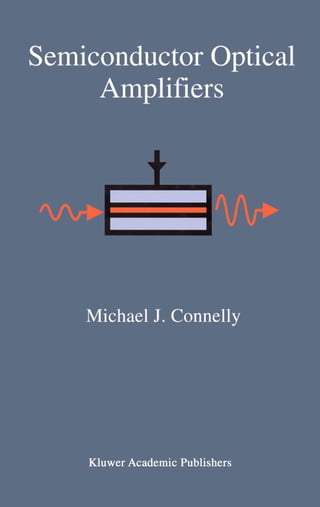


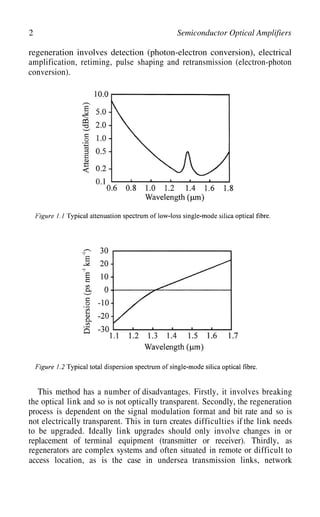
![3
Introduction
reliability is impaired. In systems where fibre loss is the limiting factor, an
in-line optical amplifier can be used instead of a regenerator. As the in-line
amplifier has only to carry out one function (amplification of the input
signal) compared to full regeneration, it is intrinsically a more reliable and
less expensive device.
Ideally an in-line optical amplifier should be compatible with single-mode
fibre, impart large gain and be optically transparent (i.e. independent of the
input optical signal properties).
In addition optical amplifiers can also be useful as power boosters, for
example to compensate for splitting losses in optical distribution networks,
and as optical preamplifiers to improve receiver sensitivity. Besides these
basic system applications optical amplifiers are also useful as generic optical
gain blocks for use in larger optical systems. The improvements in optical
communication networks realised through the use of optical amplifiers
provides new opportunities to exploit the fibre bandwidth.
There are two types of optical amplifier: The SOA and the OFA [1-6]. In
recent times the latter has dominated; however SOAs have attracted renewed
interest for use as basic amplifiers and also as functional elements in optical
communication networks and optical signal processing devices.
1.2 BRIEF HISTORY OF SEMICONDUCTOR OPTICAL
AMPLIFIERS
The first studies on SOAs were carried out around the time of the invention
of the semiconductor laser in the 1960’s. These early devices were based on
GaAs homojunctions operating at low temperatures. The arrival of double
heterostructure devices spurred further investigation into the use of SOAs in
optical communication systems. In the 1970’s Zeidler and Personick carried
out early work on SOAs [7-8]. In the 1980’s there were further important
advances on SOA device design and modelling. Early studies concentrated
on AlGaAs SOAs operating in the 830 nm range [9-10]. In the late 1980’s
studies on InP/InGaAsP SOAs designed to operate in the 1.3 and 1.55
regions began to appear [11].
Developments in anti-reflection coating technology enabled the
fabrication of true travelling-wave SOAs [12]. Prior to 1989, SOA structures
were based on anti-reflection coated semiconductor laser diodes. These
devices had an asymmetrical waveguide structure leading to strongly
polarisation sensitive gain.
In 1989 SOAs began to be designed as devices in their own right, with the
use of more symmetrical waveguide structures giving much reduced
polarisation sensitivities [13]. Since then SOA design and development has](https://image.slidesharecdn.com/87866-250225213249-f35702e2/85/Semiconductor-Optical-Amplifiers-1st-Edition-Michael-J-Connelly-16-320.jpg)
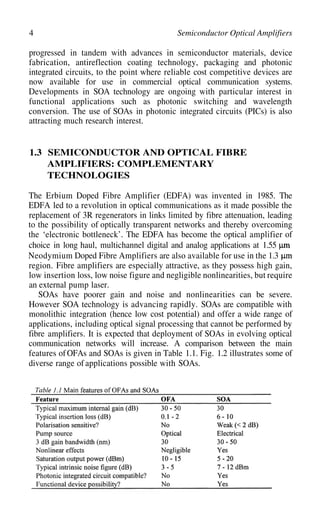
![5
Introduction
It is forecast that the consumption of SOAs will expand rapidly from $48
million in 2000 to $903 million in 2010 [14]. The main near-term use of
SOAs will be as basic amplifiers in wavelength division multiplexed
(WDM) and other digital optical communication links, and as switching
elements in all-optical switches and optical crossconnects. As the above
figures show, the future for SOAs is bright, and even more applications of
the device will arise as the technology matures and manufacturing costs
decrease.
REFERENCES
1. S. Shimada and H. Ishio, Eds., Optical Amplifiers and their Applications, John Wiley
(1992).
2. H. Ghafouri-Shiraz, Fundamentals of Laser Diode Amplifiers, John Wiley (1995).
3. Y. Yamamoto, Ed., Coherence, Amplification and Quantum Effects in Semiconductor
Lasers, John Wiley (1991).
4. E. Desurvire, Erbium-Doped Fibre Amplifiers: Principles and Applications, John Wiley,
New York (1994).
5. M. J. O’Mahony, Semiconductor optical amplifiers for use in future fibre systems,
IEEE/OSA J. Lightwave Technol., 6, 531-544 (1988).
6. N. A. Olsson, Semiconductor optical amplifiers, IEEE Proc., 80, 375-382 (1992).
7. G. Zeidler and D. Schicetanz, Use of laser amplifiers in glass fibre communication systems,
Siemens Forch. u. Entwickl. Ber., 2, 227-234 (1973).
8. S. D. Personick, Applications for quantum amplifiers in simple digital optical
communication systems, Bell Syst. Tech. J., 52, 117-133 (1973).
9. Y. Yamamoto, Characteristics of AlGaAs Fabry-Perot cavity type laser amplifiers, IEEE J.
Quantum Electron., 16, 1047-1052 (1980).](https://image.slidesharecdn.com/87866-250225213249-f35702e2/85/Semiconductor-Optical-Amplifiers-1st-Edition-Michael-J-Connelly-18-320.jpg)
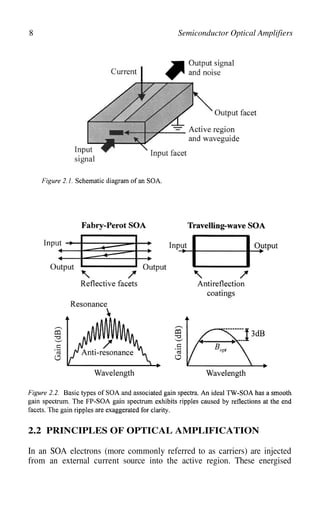
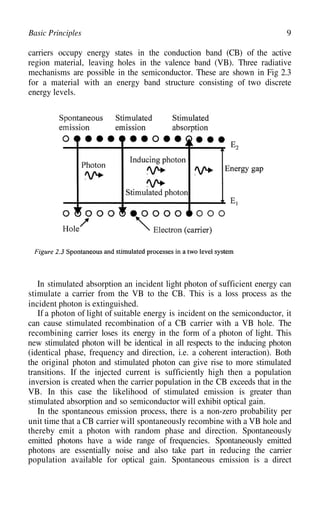
![10 Semiconductor Optical Amplifiers
consequence of the amplification process and cannot be avoided; hence a
noiseless SOA cannot be created. Stimulated processes are proportional to
the intensity of the inducing radiation whereas the spontaneous emission
process is independent of it.
2.2.1 Spontaneous and induced transitions
The gain properties of optical semiconductors are directly related to the
processes of spontaneous and stimulated emission. To quantify this
relationship we consider a system of energy levels associated with a
particular physical system. Let and
per unit volume of the system characterised
be the average number of atoms
by energies and
respectively, with If a particular atom has energy then there is a
finite probability per unit time that it will undergo a transition from to
and in the process emit a photon. The spontaneous carrier transition rate per
unit time from level 2 to level 1 is given by
where is the spontaneous emission parameter of the level 2 to level 1
transition. Along with spontaneous emission it is also possible to have
induced transitions. The induced carrier transition rate from level 2 to level 1
(stimulated emission) is given by
where is the stimulated emission parameter of the level 2 to level 1
transition and the incident radiation energy density at frequency The
induced photons have energy The induced transition rate from
level 1 to level 2 (stimulated absorption) is given by
where is the stimulated emission parameter of the level 2 to level 1
transition. It can be proved, from quantum-mechanical considerations [1,2],
that](https://image.slidesharecdn.com/87866-250225213249-f35702e2/85/Semiconductor-Optical-Amplifiers-1st-Edition-Michael-J-Connelly-23-320.jpg)
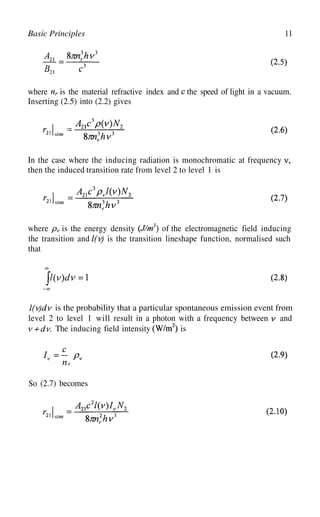
![12 Semiconductor Optical Amplifiers
2.2.2 Absorption and amplification
By using the expression for the stimulated transition rates developed in
Section 2.2.1, it is now possible to derive an equation for the optical gain
coefficient for a two level system. We consider the case of a monochromatic
plane wave propagating in the through a gain medium with cross-
section area A and elemental length The net power generated by a
volume of the material is simply the difference in the induced transition
rates between the levels multiplied by the transition energy and the
elemental volume i.e.
This radiation is added coherently to the propagating wave. This process of
amplification can then be described by the differential equation
is the material gain coefficient given by
(2.13) implies that to achieve positive gain a population inversion
must exist between level 2 and level 1. It also shows, by the presence of
that the process of optical gain is always accompanied by spontaneous
emission, i.e. noise. A more detailed description of optical gain in
semiconductors is given in Chapter 4.
2.2.3 Spontaneous emission noise
As shown above, spontaneous emission is a direct consequence of the
amplification process. In this section an expression is derived for the noise
power generated by an optical amplifier. We consider the arrangement of
Fig. 2.4 [3], which shows an input monochromatic signal of frequency
travelling through a gain medium having the energy level structure of Fig
2.3. A polariser and optical filter of bandwidth centred about are placed](https://image.slidesharecdn.com/87866-250225213249-f35702e2/85/Semiconductor-Optical-Amplifiers-1st-Edition-Michael-J-Connelly-25-320.jpg)
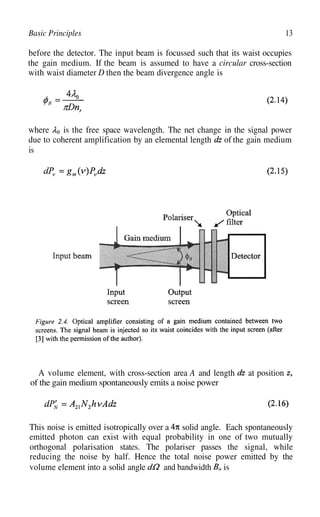
![14 Semiconductor Optical Amplifiers
The smallest solid angle that can be used without losing signal power [4] is
This solid angle can be obtained by the use of a suitably narrow output
aperture. In this case (2.17) can be rewritten as
The total beam power P (signal and noise) can then be described by
where the spontaneous emission factor is given by
z
The solution of (2.20), assuming that is independent of , is
where is the input signal power. If the amplifying medium has length L
then the total output power is
where is the single-pass signal gain. The amplifier additive noise
power is](https://image.slidesharecdn.com/87866-250225213249-f35702e2/85/Semiconductor-Optical-Amplifiers-1st-Edition-Michael-J-Connelly-27-320.jpg)
![15
Basic Principles
(2.24) shows that increasing the level of population inversion can reduce
SOA noise. The noise can also be reduced by the use of a narrowband
optical filter.
2.3 FUNDAMENTAL DEVICE CHARACTERISTICS
The most common application of SOAs is as a basic optical gain block. For
such an application, a list ofthe desired properties is given in Table 2.1. The
goal of most SOA research and development is to realise these properties in
practical devices.
2.3.1 Small-signal gain and gain bandwidth
In general there are two basic gain definitions for SOAs. The first is the
intrinsic gain G of the SOA, which is simply the ratio of the input signal
power at the input facet to the signal power at the output facet. The second
definition is the fibre-to-fibre gain, which includes the input and output
coupling losses. These gains are usually expressed in dB. The gain spectrum
of a particular SOA depends on its structure, materials and operational
parameters. For most applications high gain and wide gain bandwidth are
desired. The small-signal (small here meaning that the signal has negligible
influence on the SOA gain coefficient) internal gain ofa Fabry-Perot SOA at
optical frequency is given by [5],](https://image.slidesharecdn.com/87866-250225213249-f35702e2/85/Semiconductor-Optical-Amplifiers-1st-Edition-Michael-J-Connelly-28-320.jpg)
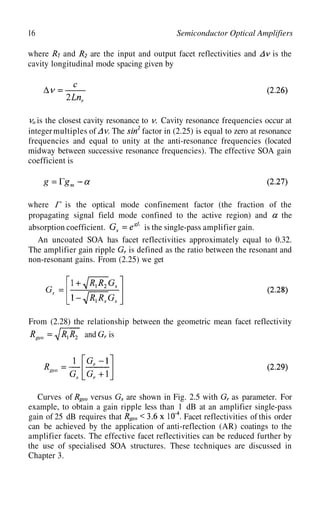
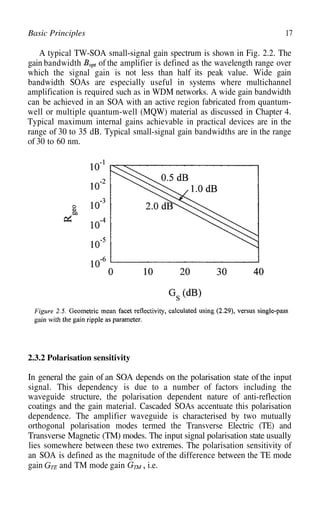
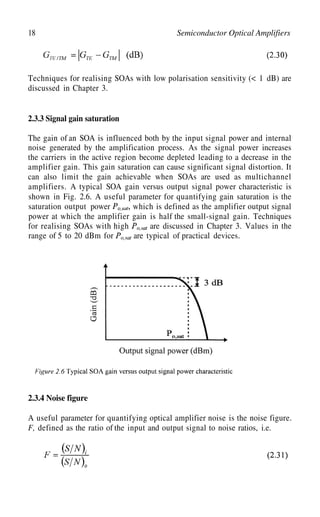

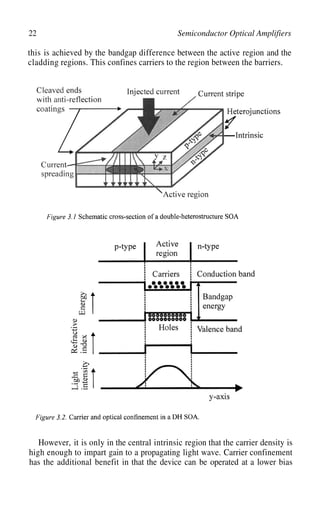
![23
Structures
current thereby reducing resistive power losses and placing fewer demands
on temperature control.
The efficiency of an SOA is improved if the light signal is confined to the
active region. In the DH structure the active region has a slightly higher
refractive index than the cladding regions and so behaves as a dielectric
waveguide with a rectangular cross-section. This helps to confine light
travelling through the device to the active region. The amount of
waveguiding is quantified by the optical confinement factor defined as the
fraction of the energy of a particular waveguide mode confined to the active
region. Waveguide modes are solutions to Maxwell’s equations for the
electric and magnetic fields in the waveguide obeying the waveguide
boundary conditions. The calculation of dielectric waveguide modes and
their associated confinement factors is not a trivial problem; more details can
be found in [1-4].
If the waveguide is sufficiently narrow, it will only support a single
transverse mode with two possible polarisations, the transverse electric (TE)
mode where the electric field is polarised along the heterojunction plane
(along the x-axis in Fig. 3.1) and the transverse magnetic (TM) mode where
the magnetic field is polarised along the x-axis. The mode is transverse
because the associated electric and magnetic fields are both normal to the
direction of propagation.
Single transverse mode operation helps to reduce modal gain dependency
as the optical confinement factor is mode dependent and also improves the
coupling efficiency from the device to optical fibre. The design of an SOA
active waveguide to support a single transverse mode is identical to that for
laser design. This topic is outside the scope of this book, but is covered in
detail in [1-4].
In the above DH SOA there is a well-defined refractive index step in the
y-direction between the intrinsic and cladding regions. However, in the x-
direction there is no such step. Wave guiding in x-direction is achieved by
the injected carriers, which change the refractive index of the intrinsic
region. This process is referred to as gain guiding. This refractive index
change is less than that in the y-direction. This implies that is polarisation
dependent, increases as the active region thickness is increased. However
if the active region is too wide single transverse mode operation will cease.
A typical profile of the light field intensity across the device cross-section is
shown in Fig. 3.2.
The polarisation dependent optical confinement factors are usually
referred to as the TE and TM optical confinement factors, i.e. and
Methods for reducing polarisation sensitivity include the use ofsquare cross-
section active waveguides and strained superlattices (Section 3.3).](https://image.slidesharecdn.com/87866-250225213249-f35702e2/85/Semiconductor-Optical-Amplifiers-1st-Edition-Michael-J-Connelly-36-320.jpg)
![24 Semiconductor Optical Amplifiers
3.2 SUPPRESSION OF CAVITY RESONANCE
We have seen in Chapter 2 that suppression of SOA facet reflectivities is
necessary to achieve travelling-wave operation in an OA. There are a
number of methods to reduce the effective facet reflectivities.
3.2.1 Antireflection coatings
The power reflectivity for normal incidence at the interface between two
dielectrics is given by
where and are the dielectric refractive indices. Semiconductor materials
have a high refractive index (typically between 3 and 4). Typical cleaved
semiconductor-air interface reflectivities are of the order of 32%. While a
reflectivity of this magnitude is suitable to achieve laser oscillation in a DH
device, it is excessively large for a TW-SOA. The effective facet
reflectivities can be greatly reduced by the application of antireflection (AR)
coatings. If a plane wave of free-space wavelength is normally incident on
a material of refractive index placed in air (refractive index = 1), then the
optimal (i.e. for lowest reflectivity) fabrication conditions for an AR coating
formed by a single dielectric layer are [5],
where and are the refractive index and thickness of the AR coating.
(3.2) only applies to a particular wavelength so a single AR coating is not
suitable for SOA operation over a wide bandwidth.
To achieve wideband low facet reflectivities requires the use of multilayer
dielectric coatings. The analysis of such coatings is complex and even more
difficult when applied to SOAs. This is because the SOA waveguide mode is
distributed in the active and cladding regions, which have different refractive
indices.
In the following analysis we follow the technique of [6]. If it is assumed
that the field distribution is uniform along the direction parallel to the](https://image.slidesharecdn.com/87866-250225213249-f35702e2/85/Semiconductor-Optical-Amplifiers-1st-Edition-Michael-J-Connelly-37-320.jpg)
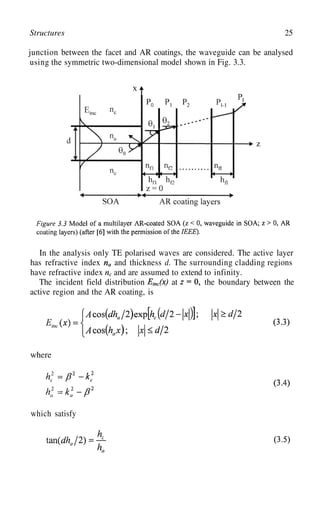
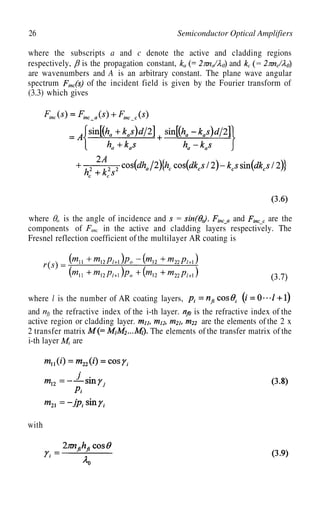
![Structures 27
where and is the thickness of the i-th layer. The reflected-field
angular spectrum is
where and are the reflection coefficients for the field components
in the active and cladding regions respectively. The reflected field at z
= 0 is equal to the inverse Fourier transform of The reflectivity R for
the coated facet is given by the square of the coupling coefficient between
and , i.e.
This equation can be solved numerically. A similar technique can be applied
to obtain the reflectivity of the TM mode. An example of the use of (3.11)
for a single layer AR coating is shown in Fig 3.4. With an appropriate
an effective facet reflectivity
combination of film refractive index and thickness, it is possible to achieve
using a single layer AR coating.
The AR coating conditions for TE and TM polarisations are not equal.
However, the use of multilayer coatings can reduce polarisation dependency
and also broaden the low-reflectivity wavelength range [7]. Many dielectric
materials such as SiN, and can be used as AR
coatings. They are applied to an SOA by evaporation or sputtering. The
refractive index of the AR coating layer can be controlled by the evaporation
or sputtering conditions. Techniques are also available for measuring AR
coating reflectivity [8,9].
To achieve low facet reflectivities using AR coatings requires careful
control of the refractive index and thickness of the dielectric layers. Altering
the SOA structure can reduce the tight tolerances required. Two techniques
are commonly used: Angled facets and the window structure, which in
conjunction with AR coatings can deliver low reflectivities over a wide
bandwidth with minimal polarisation sensitivity.](https://image.slidesharecdn.com/87866-250225213249-f35702e2/85/Semiconductor-Optical-Amplifiers-1st-Edition-Michael-J-Connelly-40-320.jpg)
![28 Semiconductor Optical Amplifiers
3.2.2 Angled facet structure
In an angled facet SOA, shown in Fig. 3.5, the active region is slanted away
from the facet cleavage plane, thereby reducing the effective facet
reflectivity. The V-number of the waveguide is
where is the waveguide width and and are the effective refractive
indices of the active and cladding regions respectively. The TE mode full
power width is given by the approximation [10]](https://image.slidesharecdn.com/87866-250225213249-f35702e2/85/Semiconductor-Optical-Amplifiers-1st-Edition-Michael-J-Connelly-41-320.jpg)
![29
Structures
If the TE mode is assumed to have a Gaussian distribution, the effective
reflectivity of an angled facet is given approximately by
where is the angle between the beam propagation direction and the normal
to the end facet. The Fresnel reflectivity of a TE plane wave, confined to
the waveguide, at the angled facet-air interface is given by
The effective reflectivity of the TM mode is almost identical to that of the
TE mode. The effective reflectivity is shown in Fig 3.6 as a function of the
facet angle and active region width. The relative reflectivity decreases as the
facet angle increases. However the coupling efficiency between an SOA and
optical fibre degrades at large facet angles due to the far-field asymmetry.
AR coatings also become more polarisation sensitive as the facet angle
increases. The relative reflectivity also decreases as the waveguide width
increases. However, if the waveguide is too wide higher order transverse
modes can appear. This problem can be overcome by broadening the
waveguide near the end facets as shown in Fig. 3.7. This also preserves the
single transverse mode condition [11]. Optimal facet angles lie in the range
to . More analyses of angled facets can be found in [12-13].](https://image.slidesharecdn.com/87866-250225213249-f35702e2/85/Semiconductor-Optical-Amplifiers-1st-Edition-Michael-J-Connelly-42-320.jpg)
![30 Semiconductor Optical Amplifiers
3.2.3 Window facet structure
As noted above facet reflectivities and optimum AR coating conditions are
polarisation dependent. The effective facet reflectivity can be further
reduced and made less sensitive to polarisation by the use of window (or
buried) facets as shown in Fig 3.8 [14-15]. This structure is simply
composed of a transparent region between the active region and end facets.
This transparent region has an energy bandgap greater than the signal photon](https://image.slidesharecdn.com/87866-250225213249-f35702e2/85/Semiconductor-Optical-Amplifiers-1st-Edition-Michael-J-Connelly-43-320.jpg)
![31
Structures
energy. This means that stimulated absorption is not possible although some
intrinsic material absorption will be present. The guided field
from the waveguide propagates in the window region at some angle due to
diffraction and is partially reflected at the end facet. The reflected field
continues to broaden in space so only a small fraction is coupled back into
the active region. The effective reflectivity decreases with increase in the
length of the window region. However, the coupling efficiency from the
SOA to an optical fibre is degraded for long Effective facet reflectivities,
junction
with single-layer AR coatings, facetreflectivities
of the order of 5% are possible with window facets. Used in con
are possible.
3.3 POLARISATION INSENSITIVE STRUCTURES
Polarisation insensitive SOAs are desirable because the polarisation state of
the input signal can vary slowly with time. The main cause of polarisation
sensitivity is the difference between and Polarisation insensitive
SOA structural designs aim to reduce or compensate for this difference. In
the early stages of SOA development hybrid designs utilising two or more
SOA were used to reduce polarisation sensitivity. Those techniques have
now been superseded by single chip solutions that mainly focus on
improvements in active region design. Three common techniques used are:
Square cross-section waveguide, ridge waveguide and strained-layer
superlattice material.
3.3.1 SOAs with square cross-section active waveguide
Equalisation of and can be achieved through the use of a waveguide
with square cross-section [16-19] as shown in the buried ridge strip device of](https://image.slidesharecdn.com/87866-250225213249-f35702e2/85/Semiconductor-Optical-Amplifiers-1st-Edition-Michael-J-Connelly-44-320.jpg)
![32 Semiconductor Optical Amplifiers
Fig 3.9. In this device the potential barrier of the n-type/p-type InP
homojunction is greater than that of the InGaAsP active region/n-type InP
heterojunction. This means that there is very little carrier leakage from the
active region. This carrier confinement is further improved by the use of
highly resistive proton implanted InP regions.
However, such structures exhibit large far-field divergence, which leads
to poor coupling efficiency from the SOA to optical fibre. Tapering the
active waveguide near the amplifier facets as shown in Fig. 3.9 can reduce
the far field divergence. [16,18-19]. The guided mode is strongly confined in
the central square-cross section waveguide, but experiences less confinement
in the tapered sections and so expands. This increases the output mode size
and reduces the far-field divergence, thereby increasing the coupling
efficiency. The device also includes window regions to reduce the effective
facet reflectivity. With this type of device a polarisation sensitivity less than
1 dB was achieved over a wide range of bias currents as shown in Fig. 3.10
[18].
3.3.2 Ridge waveguide SOA
The buried ridge waveguide SOA, as shown in Fig. 3.11, has a relatively
large active region with a geometry that can be varied to equalise and
[20]. The relatively large bulk active region and ridge-waveguide
structure allow very low modal reflectivities both for AR coated and tilted
facets without the requirement for window regions.](https://image.slidesharecdn.com/87866-250225213249-f35702e2/85/Semiconductor-Optical-Amplifiers-1st-Edition-Michael-J-Connelly-45-320.jpg)
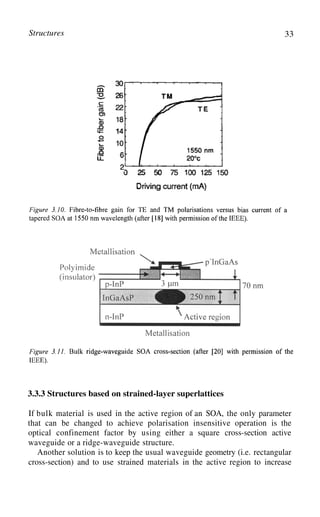
![34 Semiconductor Optical Amplifiers
the TM mode gain coefficient relative to the TE mode gain coefficient and
thereby compensate for the fact that Reductions in polarisation
sensitivity have been reported from device structures with strained tensile
barriers [21], tensile strained quantum-wells [22], alternating tensile and
compressive strained quantum-wells [23] and strain-balanced superlattices
[24]. The particular advantage of the latter structure is that it allows
simultaneous control of the polarisation sensitivity and peak gain of the
device without limitations placed on the active region thickness. The
properties of quantum-wells are covered in more detail in Chapter 4. Using
the above techniques low polarisation sensitivity can be achieved over wide
bias current and wavelength ranges with the additional advantage of high
output saturation power.
3.4 HIGH SATURATION OUTPUT POWER
STRUCTURES
High saturation output power is a desirable SOA characteristic, particularly
for power booster and multichannel applications.
3.4.1 Basic model for prediction of amplifier saturation characteristics
To determine the factors that influence SOA gain at high input powers, a
simple rate equation model can be used. The amplifier is assumed to have
zero facet reflectivities. The material gain coefficient at the signal
wavelength is assumed to be a linear function of carrier density
where is the differential of with respect to n and is assumed here to be
a constant. is the transparency carrier density. The carrier density obeys
the rate equation
The propagation of the signal intensity through the SOA is described by
the travelling-wave equation](https://image.slidesharecdn.com/87866-250225213249-f35702e2/85/Semiconductor-Optical-Amplifiers-1st-Edition-Michael-J-Connelly-47-320.jpg)
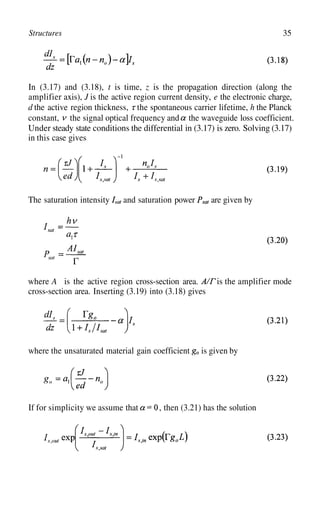
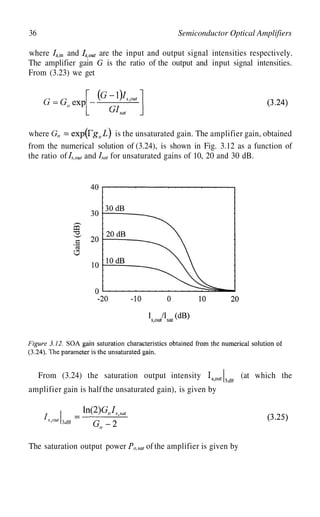
![Structures 37
3.4.2 Improving saturation output power
(3.26) shows that the saturation output power of an SOA can be improved by
increasing Inspection of (3.20) shows that this can be achieved by
reducing and . In practice is inversely proportional to carrier density, so
operating at high bias currents leads to an increase in . However, as the
carrier density increases the amplifier gain will also increase making
by reducing
resonance effects more significant. The single-pass gain can be maintained
or the amplifier length.. This may not always be necessary as
the peak material gain coefficient shifts to shorter wavelengths as the carrier
density increases.
The choice of gain material can also influence the saturation behaviour of
the amplifier via . In bulk materials is relatively sensitive to changes in
carrier density. In quantum-well material, conditions can exist where the
gain is relatively insensitive to changes in carrier density. This leads to a
high [25].
It is also possible to increase by increasing An approach based
on this concept, shown in Fig. 3.13, is to unfold the amplifier waveguide
width towards the output facet [26-28]. This increases the mode field area at
the amplifier output.](https://image.slidesharecdn.com/87866-250225213249-f35702e2/85/Semiconductor-Optical-Amplifiers-1st-Edition-Michael-J-Connelly-50-320.jpg)





![This ebook is for the use of anyone anywhere in the United States
and most other parts of the world at no cost and with almost no
restrictions whatsoever. You may copy it, give it away or re-use it
under the terms of the Project Gutenberg License included with this
ebook or online at www.gutenberg.org. If you are not located in the
United States, you will have to check the laws of the country where
you are located before using this eBook.
Title: The Mutable Many: A Novel
Author: Robert Barr
Release date: August 10, 2017 [eBook #55326]
Most recently updated: October 23, 2024
Language: English
Credits: Produced by David Widger from page images generously
provided by the Internet Archive
*** START OF THE PROJECT GUTENBERG EBOOK THE MUTABLE
MANY: A NOVEL ***](https://image.slidesharecdn.com/87866-250225213249-f35702e2/85/Semiconductor-Optical-Amplifiers-1st-Edition-Michael-J-Connelly-56-320.jpg)