
FACULTY OF SCIENCE 
Opportunities for improving 
phosphorus-use efficiency in crop plants 
Erik Veneklaas 
School of Plant Biology - UWA
Perth
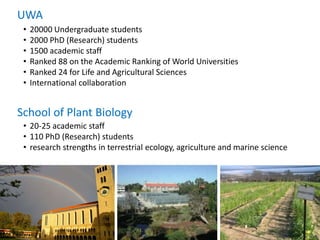
UWA 
• 20000 Undergraduate students 
• 2000 PhD (Research) students 
• 1500 academic staff 
• Ranked 88 on the Academic Ranking of World Universities 
• Ranked 24 for Life and Agricultural Sciences 
• International collaboration 
School of Plant Biology 
• 20-25 academic staff 
• 110 PhD (Research) students 
• research strengths in terrestrial ecology, agriculture and marine science
New Phytologist 195:306-320
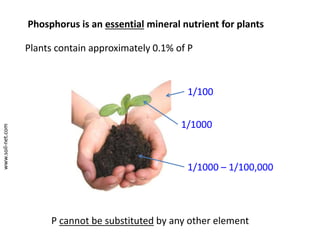
Phosphorus is an essential mineral nutrient for plants 
Plants contain approximately 0.1% of P 
1/100 
1/1000 
1/1000 – 1/100,000 
P cannot be substituted by any other element 
www.soil-net.com
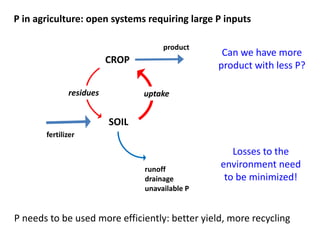
P in agriculture: open systems requiring large P inputs 
CROP 
residues uptake 
SOIL 
fertilizer 
product 
runoff 
drainage 
unavailable P 
Can we have more 
product with less P? 
Losses to the 
environment need 
to be minimized! 
P needs to be used more efficiently: better yield, more recycling
Mohr & Evans (2013) http://www.philica.com 
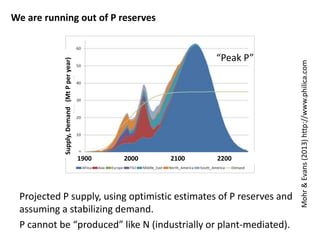
We are running out of P reserves 
“Peak P” 
1900 2000 2100 2200 
Supply, Demand (Mt P per year) 
Projected P supply, using optimistic estimates of P reserves and 
assuming a stabilizing demand. 
P cannot be “produced” like N (industrially or plant-mediated).
Fertilizer phosphorus will become scarce and expensive 
Environmental impact of P is undesirable 
Aim: produce more food with less P 
= increase P use efficiency 
Most food contains more P than we need. 
• Most P in cereal and legume grains is phytate. 
• Phytate cannot be used by humans and most animals, and 
restricts the bioavailability of Fe and Zn.
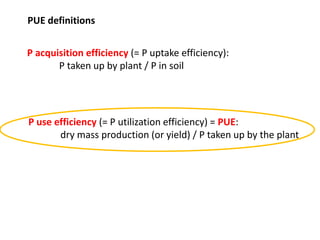
PUE definitions 
P acquisition efficiency (= P uptake efficiency): 
P taken up by plant / P in soil 
P use efficiency (= P utilization efficiency) = PUE: 
dry mass production (or yield) / P taken up by the plant
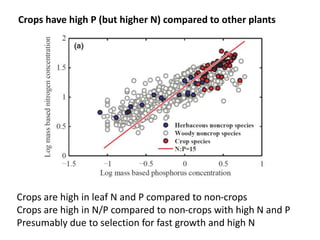
Crops have high P (but higher N) compared to other plants 
Crops are high in leaf N and P compared to non-crops 
Crops are high in N/P compared to non-crops with high N and P 
Presumably due to selection for fast growth and high N
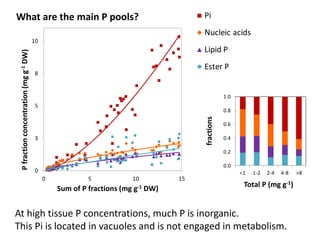
What are the main P pools? 
10 
8 
5 
3 
0 
0 5 10 15 
P fractions concentrations (mg g-1 DW) 
Sum of P fractions (mg g-1 DW) 
Pi 
Nucleic acids 
Lipid P 
Ester P 
1.0 
0.8 
0.6 
0.4 
0.2 
0.0 
<1 1-2 2-4 4-8 >8 
Total P (mg g-1) 
fractions 
At high tissue P concentrations, much P is inorganic. 
This 5 Pi is located in 10 vacuoles and is 15 
not engaged in metabolism. 
Sum of P fractions (mg g-1 DW) 
Pi 
Nucleic acids 
Lipid P 
Ester P 
Sum of P fractions (mg g-1 DW) 
P fraction concentration (mg g-1 DW)
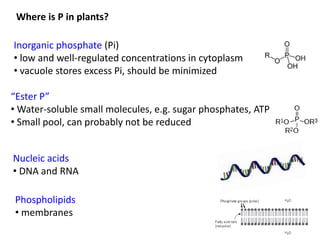
Where is P in plants? 
Inorganic phosphate (Pi) 
• low and well-regulated concentrations in cytoplasm 
• vacuole stores excess Pi, should be minimized 
“Ester P” 
•Water-soluble small molecules, e.g. sugar phosphates, ATP 
• Small pool, can probably not be reduced 
Nucleic acids 
• DNA and RNA 
Phospholipids 
• membranes
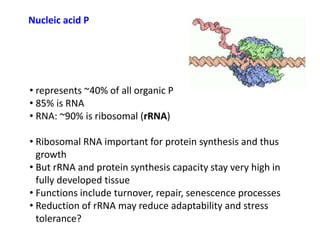
Nucleic acid P 
• represents ~40% of all organic P 
• 85% is RNA 
• RNA: ~90% is ribosomal (rRNA) 
• Ribosomal RNA important for protein synthesis and thus 
growth 
• But rRNA and protein synthesis capacity stay very high in 
fully developed tissue 
• Functions include turnover, repair, senescence processes 
• Reduction of rRNA may reduce adaptability and stress 
tolerance?
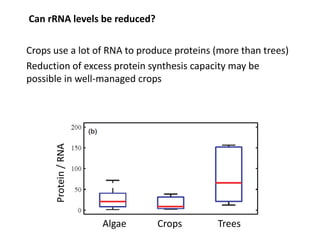
Can rRNA levels be reduced? 
Crops use a lot of RNA to produce proteins (more than trees) 
Reduction of excess protein synthesis capacity may be 
possible in well-managed crops 
Protein / RNA 
Algae Crops Trees
Lambers et al. (2012) 
New Phytologist 196:1098-1108 
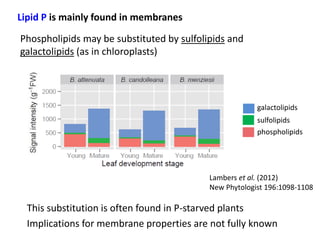
Lipid P is mainly found in membranes 
Phospholipids may be substituted by sulfolipids and 
galactolipids (as in chloroplasts) 
galactolipids 
sulfolipids 
phospholipids 
This substitution is often found in P-starved plants 
Implications for membrane properties are not fully known
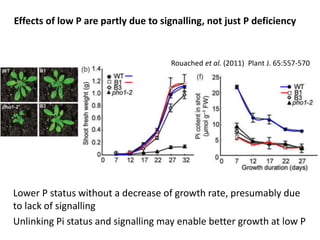
Effects of low P are partly due to signalling, not just P deficiency 
Rouached et al. (2011) Plant J. 65:557-570 
Lower P status without a decrease of growth rate, presumably due 
to lack of signalling 
Unlinking Pi status and signalling may enable better growth at low P
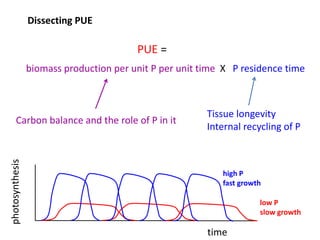
Dissecting PUE 
PUE = 
biomass production per unit P per unit time X P residence time 
Carbon balance and the role of P in it 
Tissue longevity 
Internal recycling of P 
photosynthesis 
high P 
fast growth 
time 
low P 
slow growth
Photosynthetic P-use efficiency = net photosynthesis per P present 
Global patterns using the “leaf economics spectrum” dataset 
(Wright et al. (2004) Nature 428:821-827) 
1.0 
0.5 
0.0 
-0.5 
-1.0 
-1.5 
1.0 1.5 2.0 2.5 3.0 3.5 
log [P] (mg g-1) 
log LMA (g m-2) 
3.0 
2.5 
2.0 
1.5 
1.0 
0.5 
0.0 
1.0 1.5 2.0 2.5 3.0 
log Amass (nmol g-1 s-1) 
Higher Leaf Dry Mass per Area (LMA): thicker, denser leaves 
Longer leaf lifespan 
log LMA (g m-2) 
P concentration Photosynthesis
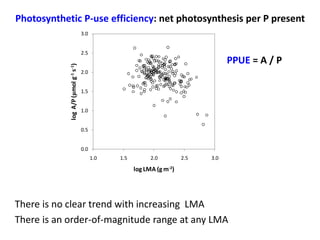
Photosynthetic P-use efficiency: net photosynthesis per P present 
3.0 
2.5 
2.0 
1.5 
1.0 
0.5 
0.0 
1.0 1.5 2.0 2.5 3.0 
log A/P (μmol g-1 s-1) 
log LMA (g m-2) 
PPUE = A / P 
There is no clear trend with increasing LMA 
There is an order-of-magnitude range at any LMA
Some of the variation in A/P at a given LMA is related with [N] 
A/P (μmol g-1 s-1) 
Leaf N/P > 15 
“P-limited” 
129.4 
Leaf N/P < 15 
“N-limited” 
59.3 
3.0 
2.5 
2.0 
1.5 
1.0 
0.5 
0.0 
N/P < 15 
N/P > 15 
1.0 1.5 2.0 2.5 3.0 
log A/P (μmol g-1 s-1) 
log LMA (g m-2) 
Much higher Photosynthetic P-use Efficiency in “P-limited” than “N-limited” 
plants 
Implication for agronomy: plant production is most efficient when all 
resources are used optimally at all times
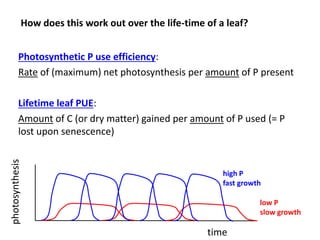
How does this work out over the life-time of a leaf? 
Photosynthetic P use efficiency: 
Rate of (maximum) net photosynthesis per amount of P present 
Lifetime leaf PUE: 
Amount of C (or dry matter) gained per amount of P used (= P 
lost upon senescence) 
photosynthesis 
high P 
fast growth 
time 
low P 
slow growth
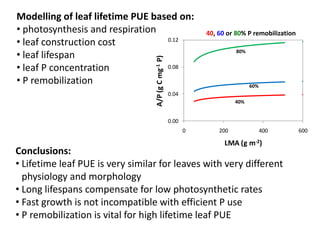
Modelling of leaf lifetime PUE based on: 
• photosynthesis and respiration 
• leaf construction cost 
0.12 
• leaf lifespan 
• leaf P concentration 
0.08 
• P remobilization 
0.04 
0.00 
40, 60 or 80% P remobilization 
80% 
40% 
60% 
0 200 400 600 
A/P (g C mg-1 P) 
LMA (g m-2) 
Conclusions: 
• Lifetime leaf PUE is very similar for leaves with very different 
physiology and morphology 
• Long lifespans compensate for low photosynthetic rates 
• Fast growth is not incompatible with efficient P use 
• P remobilization is vital for high lifetime leaf PUE
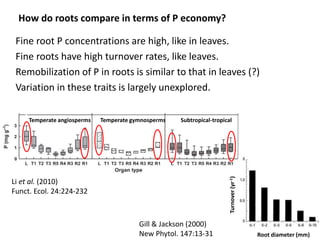
How do roots compare in terms of P economy? 
Fine root P concentrations are high, like in leaves. 
Fine roots have high turnover rates, like leaves. 
Remobilization of P in roots is similar to that in leaves (?) 
Variation in these traits is largely unexplored. 
Temperate angiosperms Temperate gymnosperms Subtropical-tropical 
Li et al. (2010) 
Funct. Ecol. 24:224-232 
Gill & Jackson (2000) 
New Phytol. 147:13-31 
Turnover (yr-1) 
Root diameter (mm)
An extreme leaf-root contrast in PUE in a low-P environment 
Trait Banksia leaf Banksia cluster root 
[P], mg g-1 0.2 1 
Life span, yr 3 0.1 
P remobilisation, % 80 90 
P cost, mg g-1 yr-1 0.01 1.0 
P cost per unit standing crop per year may be 100X more for cluster roots than leaves
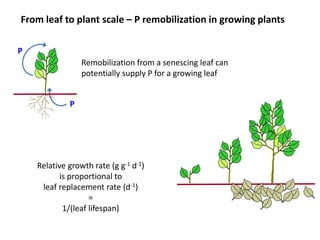
From leaf to plant scale – P remobilization in growing plants 
Remobilization from a senescing leaf can 
potentially supply P for a growing leaf 
Relative growth rate (g g-1 d-1) 
is proportional to 
leaf replacement rate (d-1) 
= 
1/(leaf lifespan) 
P 
P
P recycling in the vegetative plant 
60 
50 
40 
30 
20 
10 
0 
remobilisation = 80% 
0 10 20 30 
% P from remobilisation 
time 
current 
cumulative 
Remobilization only starts 
contributing to P economy 
when there is senescing 
tissue 
Even with constant growth rate, senescence, [P] and remobilization: 
• % P derived from remobilization increases only slowly over time 
• total % P derived from remobilization for vegetative growth is 
considerably less than the % P remobilized from senescing biomass
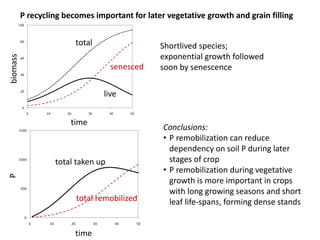
P recycling becomes important for later vegetative growth and grain filling 
Shortlived species; 
exponential growth followed 
soon by senescence 
Conclusions: 
• P remobilization can reduce 
dependency on soil P during later 
stages of crop 
• P remobilization during vegetative 
growth is more important in crops 
with long growing seasons and short 
leaf life-spans, forming dense stands 
100 
80 
60 
40 
20 
0 
biomass produced 
biomass shed 
live biomass 
senesced 
0 10 20 30 40 50 
biomass 
time 
live 
total 
biomass 
time 
1500 
1000 
500 
0 
P taken up 
P remobilised 
total taken up 
total remobilized 
0 10 20 30 40 50 
P 
time 
P 
time
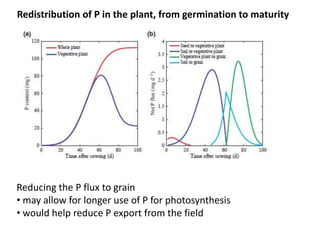
Transition to reproductive growth 
In this period 30-90% of 
plant P is remobilized 
100 
50 
0 
into the grain 
whole 
plant 
vegetative 
plant 
0 20 40 60 80 100 
P content (mg) 
Time after sowing (d) 
Plant P content (mg) 
Time after sowing (d) 
rice 
wheat 
lupin 
canola 
sunflower
Redistribution of P in the plant, from germination to maturity 
Reducing the P flux to grain 
• may allow for longer use of P for photosynthesis 
• would help reduce P export from the field
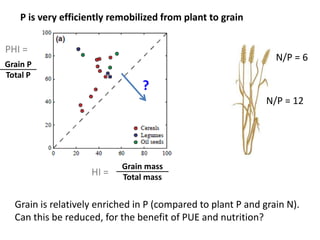
P is very efficiently remobilized from plant to grain 
PHI = 
Grain P 
Total P 
? 
Grain mass 
Total mass 
N/P = 6 
N/P = 12 
HI = 
Grain is relatively enriched in P (compared to plant P and grain N). 
Can this be reduced, for the benefit of PUE and nutrition?
[P] in grain has already been reduced through selection 
0.6 
0.4 
0.2 
0 
Domestication of wheat Historic wheat cultivars 
diploid tetraploid hexaploid 
P concentration in grain (%) 
high P 
low P 
Calderini et al. (1995) Ann. Bot. 76:315-322 
Batten et al. (1986) Ann. Bot. 58:49-59 
Mainly due to ‘dilution’ (more starch). 
Further progress may be possible; physiological limits are unknown 
but links with N and C are likely.
“Ideotype” for efficient use of P 
Fast and early P uptake and efficient internal recycling of P 
• P will be in plant for a longer time to be used 
productively 
High photosynthesis at low P 
• No excess P in tissues (including roots and stems) 
• More productive use of P 
Low grain P • More P returns to the soil 
• Less P is lost to the environment 
• Improved nutritional value 
[Need to watch possible early vigour penalty]
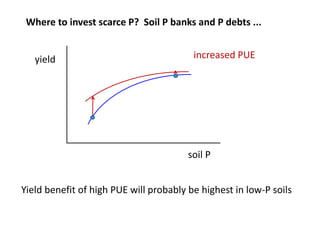
Where to invest scarce P? Soil P banks and P debts ... 
yield 
increased PUE 
soil P 
Yield benefit of high PUE will probably be highest in low-P soils
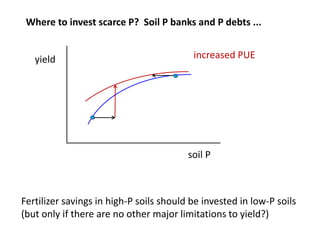
Where to invest scarce P? Soil P banks and P debts ... 
yield 
increased PUE 
soil P 
Fertilizer savings in high-P soils should be invested in low-P soils 
(but only if there are no other major limitations to yield?)
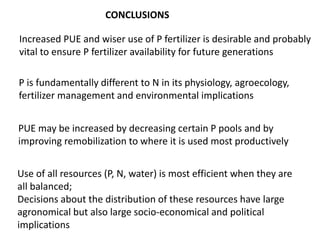
CONCLUSIONS 
Increased PUE and wiser use of P fertilizer is desirable and probably 
vital to ensure P fertilizer availability for future generations 
P is fundamentally different to N in its physiology, agroecology, 
fertilizer management and environmental implications 
PUE may be increased by decreasing certain P pools and by 
improving remobilization to where it is used most productively 
Use of all resources (P, N, water) is most efficient when they are 
all balanced; 
Decisions about the distribution of these resources have large 
agronomical but also large socio-economical and political 
implications
Acknowledgements 
Hans Lambers, John Raven and 
other co-authors of the review 
Ian Wright/Peter Reich/Glopnet 
and many others … 
The University of Western Australia 
Contact: 
Erik.Veneklaas@uwa.edu.au
The University of Western Australia 
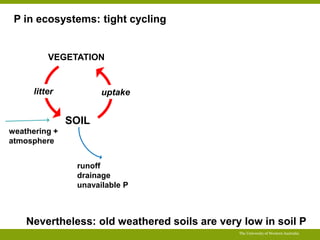
P in ecosystems: tight cycling 
VEGETATION 
litter uptake 
SOIL 
weathering + 
atmosphere 
runoff 
drainage 
unavailable P 
Nevertheless: old weathered soils are very low in soil P
The University of Western Australia 
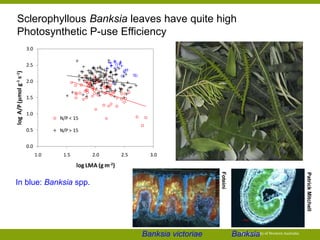
Sclerophyllous Banksia leaves have quite high 
Photosynthetic P-use Efficiency 
3.0 
2.5 
2.0 
1.5 
1.0 
0.5 
0.0 
N/P < 15 
N/P > 15 
1.0 1.5 2.0 2.5 3.0 
log A/P (μmol g-1 s-1) 
log LMA (g m-2) 
In blue: Banksia spp. 
Foteini 
Hassiotou 
Banksia victoriae Banksia 
Patrick Mitchell
PUE over the life-time of a leaf (in the context of 
the Leaf Economic Spectrum) 
C balance: High-LMA leaves live longer but have lower 
rates of photosynthesis … 
P balance: High-LMA leaves have lower [P] and may 
have higher remobilisation … 
The University of Western Australia 
150 
100 
50 
0 
0 100 200 300 400 
LL (mo) 
LMA (g m-2) 
500 
400 
300 
200 
100 
0 
0 100 200 300 400 
Amass (nmol g-1 s-1) 
LMA (g m-2) 
5 
4 
3 
2 
1 
0 
0 100 200 300 400 
[P] (mg g-1) 
LMA (g m-2) 
Data: glopnet database – Wright et al. (2004) Nature 
428:821-827
The University of Western Australia 
Assumptions for life-time C and P balance: 
C balance = (mean daily net photosynthesis – respiration) X lifespan – 
leaf C cost 
Photosynthetic capacity (Amass) scales with mean net photosynthesis (daily 
basis): 
• Daily C balance accounts for suboptimal light conditions, respiration. 
• Amass declines over lifetime of leaf. 
Reich et al. (2009) New Phytol. 183:153–166 
P balance = (1-remobilised fraction) X leaf P content 
Remobilisation is typically 40 to 80%, not strongly correlated with LMA
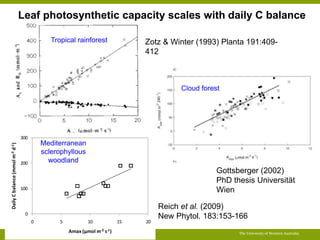
Leaf photosynthetic capacity scales with daily C balance 
Zotz & Winter (1993) Planta 191:409- 
412 
Gottsberger (2002) 
PhD thesis Universität 
Wien 
The University of Western Australia 
Reich et al. (2009) 
300 
200 
100 
Tropical rainforest 
Mediterranean 
sclerophyllous 
woodland 
0 New Phytol. 183:153-166 
0 5 10 15 20 
Daily C balance (mmol m-2 d-1) 
Amax (μmol m-2 s-1) 
Cloud forest
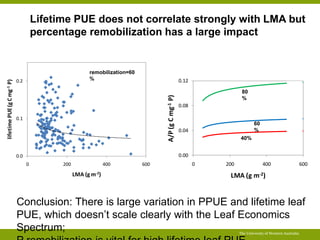
Lifetime PUE does not correlate strongly with LMA but 
percentage remobilization has a large impact 
80 
% 
40% 
60 
% 
The University of Western Australia 
0.2 
0.1 
0.0 
remobilization=60 
% 
0 200 400 600 
lifetime PUE (g C mg-1 P) 
LMA (g m-2) 
0.12 
0.08 
0.04 
0.00 
0 200 400 600 
A/P (g C mg-1 P) 
LMA (g m-2) 
Conclusion: There is large variation in PPUE and lifetime leaf 
PUE, which doesn’t scale clearly with the Leaf Economics 
Spectrum; 
P remobilization is vital for high lifetime leaf PUE.
Summary lifetime leaf PUE: comparing leaves with LMA 100 and 200 g 
m-2 
(P remobilisation 60%) 
[P] X 0.57 
lifetime P balance X 1.85 
LMA 100 LMA 200 
The University of Western Australia 
30 
20 
10 
0 
LL X 3.3 
LMA 100 LMA 200 
100 
50 
0 
Amax X 0.59 
LMA 100 LMA 200 
15 
10 
5 
0 
lifetime C balance X 2.01 
LMA 100 LMA 200 
1.5 
1.0 
0.5 
0.0 
LMA 100 LMA 200 
200 
150 
100 
50 
0 
0.06 
0.04 
0.02 
0.00 
lifetime PUE X 1.09 
LMA 100 LMA 200 
Despite large differences in morphology and physiology, PUE differs by 
less than 10%
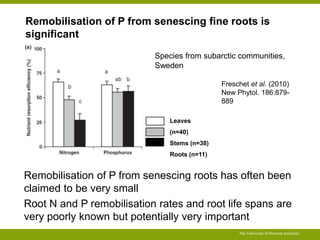
Remobilisation of P from senescing fine roots is 
significant 
Species from subarctic communities, 
Sweden 
Freschet et al. (2010) 
New Phytol. 186:879- 
889 
Remobilisation of P from senescing roots has often been 
claimed to be very small 
Root N and P remobilisation rates and root life spans are 
very poorly known but potentially very important 
The University of Western Australia 
Leaves 
(n=40) 
Stems (n=38) 
Roots (n=11)
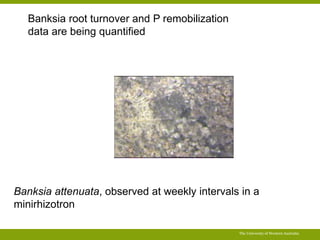
Banksia attenuata, observed at weekly intervals in a 
minirhizotron 
The University of Western Australia 
Banksia root turnover and P remobilization 
data are being quantified
P required to maintain biomass (e.g. mature perennial plants) 
The University of Western Australia 
1000 
800 
600 
400 
200 
0 
P 
remobilisation 
20% 
40% 
60% 
80% 
0 10 20 30 
Annual P cost (% of P content) 
Tissue lifespan (months) 
No net growth – maintenance 
only; 
P uptake required to maintain 
same amount of tissue with same 
[P]
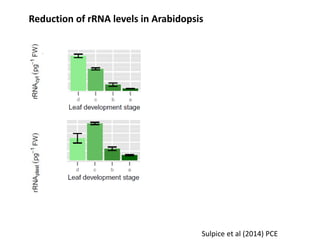
Reduction of rRNA levels in Arabidopsis 
Sulpice et al (2014) PCE
Lessons from Nature? 
Many of the traits identified are present in undomesticated plants 
Plants on low-P soils have: 
-Low tissue P concentrations 
-Replace phospholipids by sulfo- and galactolipids 
-Low levels of RNA 
-Efficient internal P recycling 
-Long tissue lifespans (often perennial plants)

Opportunities for improving phosphorus-use efficiency in crop plants

  • 1.
    FACULTY OF SCIENCE Opportunities for improving phosphorus-use efficiency in crop plants Erik Veneklaas School of Plant Biology - UWA
  • 2.
  • 3.
    UWA • 20000Undergraduate students • 2000 PhD (Research) students • 1500 academic staff • Ranked 88 on the Academic Ranking of World Universities • Ranked 24 for Life and Agricultural Sciences • International collaboration School of Plant Biology • 20-25 academic staff • 110 PhD (Research) students • research strengths in terrestrial ecology, agriculture and marine science
  • 4.
  • 5.
    Phosphorus is anessential mineral nutrient for plants Plants contain approximately 0.1% of P 1/100 1/1000 1/1000 – 1/100,000 P cannot be substituted by any other element www.soil-net.com
  • 6.
    P in agriculture:open systems requiring large P inputs CROP residues uptake SOIL fertilizer product runoff drainage unavailable P Can we have more product with less P? Losses to the environment need to be minimized! P needs to be used more efficiently: better yield, more recycling
  • 7.
    Mohr & Evans(2013) http://www.philica.com We are running out of P reserves “Peak P” 1900 2000 2100 2200 Supply, Demand (Mt P per year) Projected P supply, using optimistic estimates of P reserves and assuming a stabilizing demand. P cannot be “produced” like N (industrially or plant-mediated).
  • 8.
    Fertilizer phosphorus willbecome scarce and expensive Environmental impact of P is undesirable Aim: produce more food with less P = increase P use efficiency Most food contains more P than we need. • Most P in cereal and legume grains is phytate. • Phytate cannot be used by humans and most animals, and restricts the bioavailability of Fe and Zn.
  • 9.
    PUE definitions Pacquisition efficiency (= P uptake efficiency): P taken up by plant / P in soil P use efficiency (= P utilization efficiency) = PUE: dry mass production (or yield) / P taken up by the plant
  • 10.
    Crops have highP (but higher N) compared to other plants Crops are high in leaf N and P compared to non-crops Crops are high in N/P compared to non-crops with high N and P Presumably due to selection for fast growth and high N
  • 11.
    What are themain P pools? 10 8 5 3 0 0 5 10 15 P fractions concentrations (mg g-1 DW) Sum of P fractions (mg g-1 DW) Pi Nucleic acids Lipid P Ester P 1.0 0.8 0.6 0.4 0.2 0.0 <1 1-2 2-4 4-8 >8 Total P (mg g-1) fractions At high tissue P concentrations, much P is inorganic. This 5 Pi is located in 10 vacuoles and is 15 not engaged in metabolism. Sum of P fractions (mg g-1 DW) Pi Nucleic acids Lipid P Ester P Sum of P fractions (mg g-1 DW) P fraction concentration (mg g-1 DW)
  • 12.
    Where is Pin plants? Inorganic phosphate (Pi) • low and well-regulated concentrations in cytoplasm • vacuole stores excess Pi, should be minimized “Ester P” •Water-soluble small molecules, e.g. sugar phosphates, ATP • Small pool, can probably not be reduced Nucleic acids • DNA and RNA Phospholipids • membranes
  • 13.
    Nucleic acid P • represents ~40% of all organic P • 85% is RNA • RNA: ~90% is ribosomal (rRNA) • Ribosomal RNA important for protein synthesis and thus growth • But rRNA and protein synthesis capacity stay very high in fully developed tissue • Functions include turnover, repair, senescence processes • Reduction of rRNA may reduce adaptability and stress tolerance?
  • 14.
    Can rRNA levelsbe reduced? Crops use a lot of RNA to produce proteins (more than trees) Reduction of excess protein synthesis capacity may be possible in well-managed crops Protein / RNA Algae Crops Trees
  • 15.
    Lambers et al.(2012) New Phytologist 196:1098-1108 Lipid P is mainly found in membranes Phospholipids may be substituted by sulfolipids and galactolipids (as in chloroplasts) galactolipids sulfolipids phospholipids This substitution is often found in P-starved plants Implications for membrane properties are not fully known
  • 16.
    Effects of lowP are partly due to signalling, not just P deficiency Rouached et al. (2011) Plant J. 65:557-570 Lower P status without a decrease of growth rate, presumably due to lack of signalling Unlinking Pi status and signalling may enable better growth at low P
  • 17.
    Dissecting PUE PUE= biomass production per unit P per unit time X P residence time Carbon balance and the role of P in it Tissue longevity Internal recycling of P photosynthesis high P fast growth time low P slow growth
  • 18.
    Photosynthetic P-use efficiency= net photosynthesis per P present Global patterns using the “leaf economics spectrum” dataset (Wright et al. (2004) Nature 428:821-827) 1.0 0.5 0.0 -0.5 -1.0 -1.5 1.0 1.5 2.0 2.5 3.0 3.5 log [P] (mg g-1) log LMA (g m-2) 3.0 2.5 2.0 1.5 1.0 0.5 0.0 1.0 1.5 2.0 2.5 3.0 log Amass (nmol g-1 s-1) Higher Leaf Dry Mass per Area (LMA): thicker, denser leaves Longer leaf lifespan log LMA (g m-2) P concentration Photosynthesis
  • 19.
    Photosynthetic P-use efficiency:net photosynthesis per P present 3.0 2.5 2.0 1.5 1.0 0.5 0.0 1.0 1.5 2.0 2.5 3.0 log A/P (μmol g-1 s-1) log LMA (g m-2) PPUE = A / P There is no clear trend with increasing LMA There is an order-of-magnitude range at any LMA
  • 20.
    Some of thevariation in A/P at a given LMA is related with [N] A/P (μmol g-1 s-1) Leaf N/P > 15 “P-limited” 129.4 Leaf N/P < 15 “N-limited” 59.3 3.0 2.5 2.0 1.5 1.0 0.5 0.0 N/P < 15 N/P > 15 1.0 1.5 2.0 2.5 3.0 log A/P (μmol g-1 s-1) log LMA (g m-2) Much higher Photosynthetic P-use Efficiency in “P-limited” than “N-limited” plants Implication for agronomy: plant production is most efficient when all resources are used optimally at all times
  • 21.
    How does thiswork out over the life-time of a leaf? Photosynthetic P use efficiency: Rate of (maximum) net photosynthesis per amount of P present Lifetime leaf PUE: Amount of C (or dry matter) gained per amount of P used (= P lost upon senescence) photosynthesis high P fast growth time low P slow growth
  • 22.
    Modelling of leaflifetime PUE based on: • photosynthesis and respiration • leaf construction cost 0.12 • leaf lifespan • leaf P concentration 0.08 • P remobilization 0.04 0.00 40, 60 or 80% P remobilization 80% 40% 60% 0 200 400 600 A/P (g C mg-1 P) LMA (g m-2) Conclusions: • Lifetime leaf PUE is very similar for leaves with very different physiology and morphology • Long lifespans compensate for low photosynthetic rates • Fast growth is not incompatible with efficient P use • P remobilization is vital for high lifetime leaf PUE
  • 23.
    How do rootscompare in terms of P economy? Fine root P concentrations are high, like in leaves. Fine roots have high turnover rates, like leaves. Remobilization of P in roots is similar to that in leaves (?) Variation in these traits is largely unexplored. Temperate angiosperms Temperate gymnosperms Subtropical-tropical Li et al. (2010) Funct. Ecol. 24:224-232 Gill & Jackson (2000) New Phytol. 147:13-31 Turnover (yr-1) Root diameter (mm)
  • 24.
    An extreme leaf-rootcontrast in PUE in a low-P environment Trait Banksia leaf Banksia cluster root [P], mg g-1 0.2 1 Life span, yr 3 0.1 P remobilisation, % 80 90 P cost, mg g-1 yr-1 0.01 1.0 P cost per unit standing crop per year may be 100X more for cluster roots than leaves
  • 25.
    From leaf toplant scale – P remobilization in growing plants Remobilization from a senescing leaf can potentially supply P for a growing leaf Relative growth rate (g g-1 d-1) is proportional to leaf replacement rate (d-1) = 1/(leaf lifespan) P P
  • 26.
    P recycling inthe vegetative plant 60 50 40 30 20 10 0 remobilisation = 80% 0 10 20 30 % P from remobilisation time current cumulative Remobilization only starts contributing to P economy when there is senescing tissue Even with constant growth rate, senescence, [P] and remobilization: • % P derived from remobilization increases only slowly over time • total % P derived from remobilization for vegetative growth is considerably less than the % P remobilized from senescing biomass
  • 27.
    P recycling becomesimportant for later vegetative growth and grain filling Shortlived species; exponential growth followed soon by senescence Conclusions: • P remobilization can reduce dependency on soil P during later stages of crop • P remobilization during vegetative growth is more important in crops with long growing seasons and short leaf life-spans, forming dense stands 100 80 60 40 20 0 biomass produced biomass shed live biomass senesced 0 10 20 30 40 50 biomass time live total biomass time 1500 1000 500 0 P taken up P remobilised total taken up total remobilized 0 10 20 30 40 50 P time P time
  • 28.
    Transition to reproductivegrowth In this period 30-90% of plant P is remobilized 100 50 0 into the grain whole plant vegetative plant 0 20 40 60 80 100 P content (mg) Time after sowing (d) Plant P content (mg) Time after sowing (d) rice wheat lupin canola sunflower
  • 29.
    Redistribution of Pin the plant, from germination to maturity Reducing the P flux to grain • may allow for longer use of P for photosynthesis • would help reduce P export from the field
  • 30.
    P is veryefficiently remobilized from plant to grain PHI = Grain P Total P ? Grain mass Total mass N/P = 6 N/P = 12 HI = Grain is relatively enriched in P (compared to plant P and grain N). Can this be reduced, for the benefit of PUE and nutrition?
  • 31.
    [P] in grainhas already been reduced through selection 0.6 0.4 0.2 0 Domestication of wheat Historic wheat cultivars diploid tetraploid hexaploid P concentration in grain (%) high P low P Calderini et al. (1995) Ann. Bot. 76:315-322 Batten et al. (1986) Ann. Bot. 58:49-59 Mainly due to ‘dilution’ (more starch). Further progress may be possible; physiological limits are unknown but links with N and C are likely.
  • 32.
    “Ideotype” for efficientuse of P Fast and early P uptake and efficient internal recycling of P • P will be in plant for a longer time to be used productively High photosynthesis at low P • No excess P in tissues (including roots and stems) • More productive use of P Low grain P • More P returns to the soil • Less P is lost to the environment • Improved nutritional value [Need to watch possible early vigour penalty]
  • 33.
    Where to investscarce P? Soil P banks and P debts ... yield increased PUE soil P Yield benefit of high PUE will probably be highest in low-P soils
  • 34.
    Where to investscarce P? Soil P banks and P debts ... yield increased PUE soil P Fertilizer savings in high-P soils should be invested in low-P soils (but only if there are no other major limitations to yield?)
  • 35.
    CONCLUSIONS Increased PUEand wiser use of P fertilizer is desirable and probably vital to ensure P fertilizer availability for future generations P is fundamentally different to N in its physiology, agroecology, fertilizer management and environmental implications PUE may be increased by decreasing certain P pools and by improving remobilization to where it is used most productively Use of all resources (P, N, water) is most efficient when they are all balanced; Decisions about the distribution of these resources have large agronomical but also large socio-economical and political implications
  • 36.
    Acknowledgements Hans Lambers,John Raven and other co-authors of the review Ian Wright/Peter Reich/Glopnet and many others … The University of Western Australia Contact: Erik.Veneklaas@uwa.edu.au
  • 38.
    The University ofWestern Australia P in ecosystems: tight cycling VEGETATION litter uptake SOIL weathering + atmosphere runoff drainage unavailable P Nevertheless: old weathered soils are very low in soil P
  • 39.
    The University ofWestern Australia Sclerophyllous Banksia leaves have quite high Photosynthetic P-use Efficiency 3.0 2.5 2.0 1.5 1.0 0.5 0.0 N/P < 15 N/P > 15 1.0 1.5 2.0 2.5 3.0 log A/P (μmol g-1 s-1) log LMA (g m-2) In blue: Banksia spp. Foteini Hassiotou Banksia victoriae Banksia Patrick Mitchell
  • 40.
    PUE over thelife-time of a leaf (in the context of the Leaf Economic Spectrum) C balance: High-LMA leaves live longer but have lower rates of photosynthesis … P balance: High-LMA leaves have lower [P] and may have higher remobilisation … The University of Western Australia 150 100 50 0 0 100 200 300 400 LL (mo) LMA (g m-2) 500 400 300 200 100 0 0 100 200 300 400 Amass (nmol g-1 s-1) LMA (g m-2) 5 4 3 2 1 0 0 100 200 300 400 [P] (mg g-1) LMA (g m-2) Data: glopnet database – Wright et al. (2004) Nature 428:821-827
  • 41.
    The University ofWestern Australia Assumptions for life-time C and P balance: C balance = (mean daily net photosynthesis – respiration) X lifespan – leaf C cost Photosynthetic capacity (Amass) scales with mean net photosynthesis (daily basis): • Daily C balance accounts for suboptimal light conditions, respiration. • Amass declines over lifetime of leaf. Reich et al. (2009) New Phytol. 183:153–166 P balance = (1-remobilised fraction) X leaf P content Remobilisation is typically 40 to 80%, not strongly correlated with LMA
  • 42.
    Leaf photosynthetic capacityscales with daily C balance Zotz & Winter (1993) Planta 191:409- 412 Gottsberger (2002) PhD thesis Universität Wien The University of Western Australia Reich et al. (2009) 300 200 100 Tropical rainforest Mediterranean sclerophyllous woodland 0 New Phytol. 183:153-166 0 5 10 15 20 Daily C balance (mmol m-2 d-1) Amax (μmol m-2 s-1) Cloud forest
  • 43.
    Lifetime PUE doesnot correlate strongly with LMA but percentage remobilization has a large impact 80 % 40% 60 % The University of Western Australia 0.2 0.1 0.0 remobilization=60 % 0 200 400 600 lifetime PUE (g C mg-1 P) LMA (g m-2) 0.12 0.08 0.04 0.00 0 200 400 600 A/P (g C mg-1 P) LMA (g m-2) Conclusion: There is large variation in PPUE and lifetime leaf PUE, which doesn’t scale clearly with the Leaf Economics Spectrum; P remobilization is vital for high lifetime leaf PUE.
  • 44.
    Summary lifetime leafPUE: comparing leaves with LMA 100 and 200 g m-2 (P remobilisation 60%) [P] X 0.57 lifetime P balance X 1.85 LMA 100 LMA 200 The University of Western Australia 30 20 10 0 LL X 3.3 LMA 100 LMA 200 100 50 0 Amax X 0.59 LMA 100 LMA 200 15 10 5 0 lifetime C balance X 2.01 LMA 100 LMA 200 1.5 1.0 0.5 0.0 LMA 100 LMA 200 200 150 100 50 0 0.06 0.04 0.02 0.00 lifetime PUE X 1.09 LMA 100 LMA 200 Despite large differences in morphology and physiology, PUE differs by less than 10%
  • 45.
    Remobilisation of Pfrom senescing fine roots is significant Species from subarctic communities, Sweden Freschet et al. (2010) New Phytol. 186:879- 889 Remobilisation of P from senescing roots has often been claimed to be very small Root N and P remobilisation rates and root life spans are very poorly known but potentially very important The University of Western Australia Leaves (n=40) Stems (n=38) Roots (n=11)
  • 46.
    Banksia attenuata, observedat weekly intervals in a minirhizotron The University of Western Australia Banksia root turnover and P remobilization data are being quantified
  • 47.
    P required tomaintain biomass (e.g. mature perennial plants) The University of Western Australia 1000 800 600 400 200 0 P remobilisation 20% 40% 60% 80% 0 10 20 30 Annual P cost (% of P content) Tissue lifespan (months) No net growth – maintenance only; P uptake required to maintain same amount of tissue with same [P]
  • 48.
    Reduction of rRNAlevels in Arabidopsis Sulpice et al (2014) PCE
  • 49.
    Lessons from Nature? Many of the traits identified are present in undomesticated plants Plants on low-P soils have: -Low tissue P concentrations -Replace phospholipids by sulfo- and galactolipids -Low levels of RNA -Efficient internal P recycling -Long tissue lifespans (often perennial plants)