Vegetable Production Technologies
and Organic Production
Prakash S Naik
Indian Institute of Vegetable Research
Varanasi
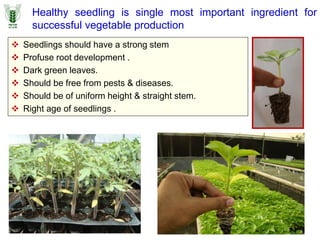
Healthy seedling is single most important ingredient for
successful vegetable production
 Seedlings should have a strong stem
 Profuse root development .
 Dark green leaves.
 Should be free from pests & diseases.
 Should be of uniform height & straight stem.
 Right age of seedlings .
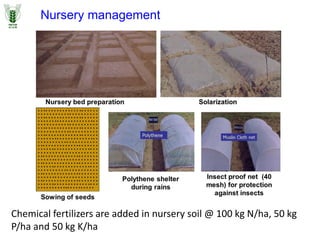
Nursery management
Chemical fertilizers are added in nursery soil @ 100 kg N/ha, 50 kg
P/ha and 50 kg K/ha
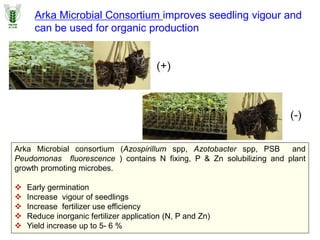
Arka Microbial Consortium improves seedling vigour and
can be used for organic production
Arka Microbial consortium (Azospirillum spp, Azotobacter spp, PSB and
Peudomonas fluorescence ) contains N fixing, P & Zn solubilizing and plant
growth promoting microbes.
 Early germination
 Increase vigour of seedlings
 Increase fertilizer use efficiency
 Reduce inorganic fertilizer application (N, P and Zn)
 Yield increase up to 5- 6 %
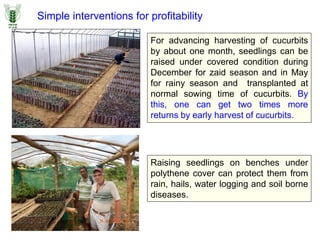
Simple interventions for profitability
For advancing harvesting of cucurbits
by about one month, seedlings can be
raised under covered condition during
December for zaid season and in May
for rainy season and transplanted at
normal sowing time of cucurbits. By
this, one can get two times more
returns by early harvest of cucurbits.
Raising seedlings on benches under
polythene cover can protect them from
rain, hails, water logging and soil borne
diseases.
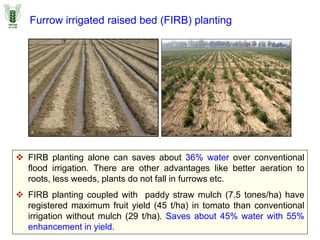
Furrow irrigated raised bed (FIRB) planting
 FIRB planting alone can saves about 36% water over conventional
flood irrigation. There are other advantages like better aeration to
roots, less weeds, plants do not fall in furrows etc.
 FIRB planting coupled with paddy straw mulch (7.5 tones/ha) have
registered maximum fruit yield (45 t/ha) in tomato than conventional
irrigation without mulch (29 t/ha). Saves about 45% water with 55%
enhancement in yield.
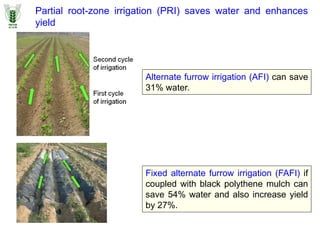
Partial root-zone irrigation (PRI) saves water and enhances
yield
Alternate furrow irrigation (AFI) can save
31% water.
Fixed alternate furrow irrigation (FAFI) if
coupled with black polythene mulch can
save 54% water and also increase yield
by 27%.
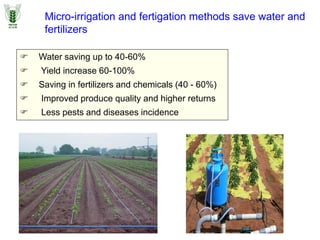
Micro-irrigation and fertigation methods save water and
fertilizers
 Water saving up to 40-60%
 Yield increase 60-100%
 Saving in fertilizers and chemicals (40 - 60%)
 Improved produce quality and higher returns
 Less pests and diseases incidence
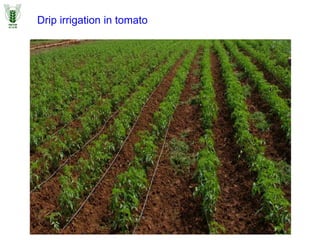
Drip irrigation in tomato
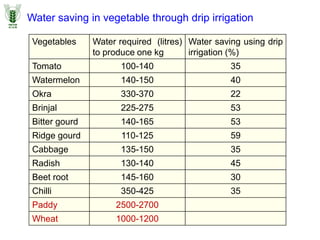
Water saving in vegetable through drip irrigation
Vegetables Water required (litres)
to produce one kg
Water saving using drip
irrigation (%)
Tomato 100-140 35
Watermelon 140-150 40
Okra 330-370 22
Brinjal 225-275 53
Bitter gourd 140-165 53
Ridge gourd 110-125 59
Cabbage 135-150 35
Radish 130-140 45
Beet root 145-160 30
Chilli 350-425 35
Paddy 2500-2700
Wheat 1000-1200
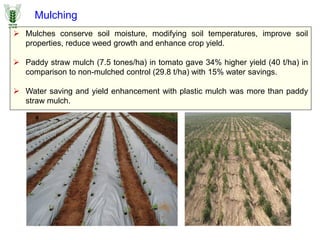
Mulching
 Mulches conserve soil moisture, modifying soil temperatures, improve soil
properties, reduce weed growth and enhance crop yield.
 Paddy straw mulch (7.5 tones/ha) in tomato gave 34% higher yield (40 t/ha) in
comparison to non-mulched control (29.8 t/ha) with 15% water savings.
 Water saving and yield enhancement with plastic mulch was more than paddy
straw mulch.
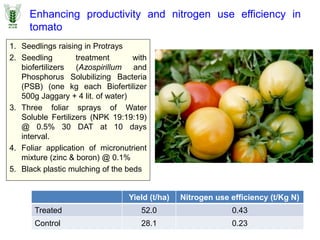
Enhancing productivity and nitrogen use efficiency in
tomato
1. Seedlings raising in Protrays
2. Seedling treatment with
biofertilizers (Azospirillum and
Phosphorus Solubilizing Bacteria
(PSB) (one kg each Biofertilizer
500g Jaggary + 4 lit. of water)
3. Three foliar sprays of Water
Soluble Fertilizers (NPK 19:19:19)
@ 0.5% 30 DAT at 10 days
interval.
4. Foliar application of micronutrient
mixture (zinc & boron) @ 0.1%
5. Black plastic mulching of the beds
Yield (t/ha) Nitrogen use efficiency (t/Kg N)
Treated 52.0 0.43
Control 28.1 0.23
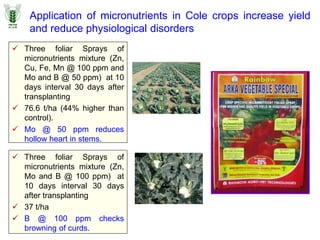
Application of micronutrients in Cole crops increase yield
and reduce physiological disorders
 Three foliar Sprays of
micronutrients mixture (Zn,
Cu, Fe, Mn @ 100 ppm and
Mo and B @ 50 ppm) at 10
days interval 30 days after
transplanting
 76.6 t/ha (44% higher than
control).
 Mo @ 50 ppm reduces
hollow heart in stems.
 Three foliar Sprays of
micronutrients mixture (Zn,
Mo and B @ 100 ppm) at
10 days interval 30 days
after transplanting
 37 t/ha
 B @ 100 ppm checks
browning of curds.
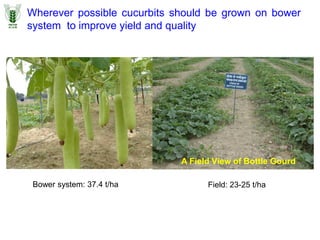
Wherever possible cucurbits should be grown on bower
system to improve yield and quality
A Field View of Bottle Gourd
Bower system: 37.4 t/ha Field: 23-25 t/ha
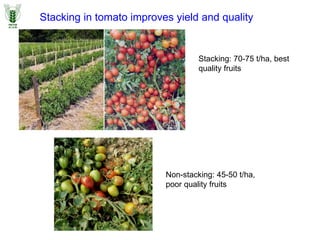
Stacking in tomato improves yield and quality
Stacking: 70-75 t/ha, best
quality fruits
Non-stacking: 45-50 t/ha,
poor quality fruits
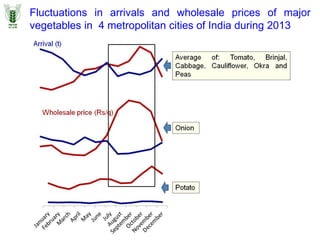
Fluctuations in arrivals and wholesale prices of major
vegetables in 4 metropolitan cities of India during 2013
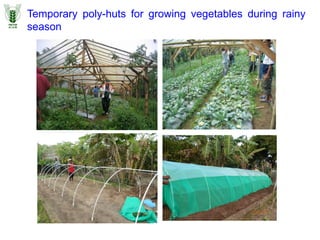
Temporary poly-huts for growing vegetables during rainy
season
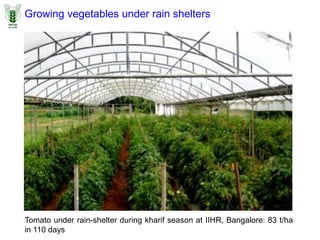
Tomato under rain-shelter during kharif season at IIHR, Bangalore: 83 t/ha
in 110 days
Growing vegetables under rain shelters
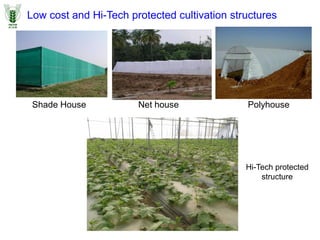
Shade House Net house
Low cost and Hi-Tech protected cultivation structures
Polyhouse
Hi-Tech protected
structure
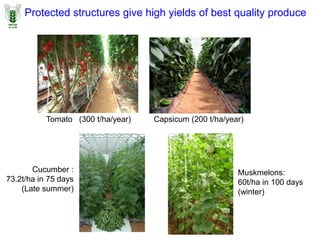
Tomato (300 t/ha/year) Capsicum (200 t/ha/year)
Muskmelons:
60t/ha in 100 days
(winter)
Cucumber :
73.2t/ha in 75 days
(Late summer)
Protected structures give high yields of best quality produce
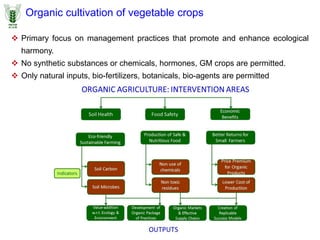
 Primary focus on management practices that promote and enhance ecological
harmony.
 No synthetic substances or chemicals, hormones, GM crops are permitted.
 Only natural inputs, bio-fertilizers, botanicals, bio-agents are permitted
Organic cultivation of vegetable crops
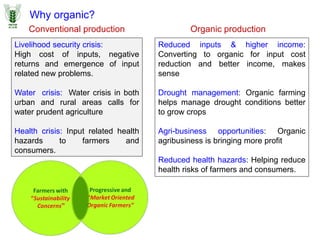
Livelihood security crisis:
High cost of inputs, negative
returns and emergence of input
related new problems.
Water crisis: Water crisis in both
urban and rural areas calls for
water prudent agriculture
Health crisis: Input related health
hazards to farmers and
consumers.
Reduced inputs & higher income:
Converting to organic for input cost
reduction and better income, makes
sense
Drought management: Organic farming
helps manage drought conditions better
to grow crops
Agri-business opportunities: Organic
agribusiness is bringing more profit
Reduced health hazards: Helping reduce
health risks of farmers and consumers.
Conventional production Organic production
Why organic?
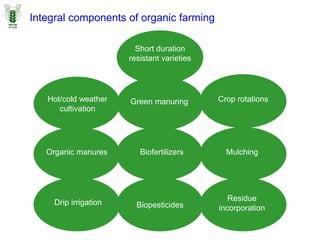
Integral components of organic farming
Crop rotation
Hot/cold weather
cultivation
Residue
incorporation
Biopesticides
Organic manures
Drip irrigation
Mulching
Biofertilizers
Green manuring Crop rotations
Short duration
resistant varieties
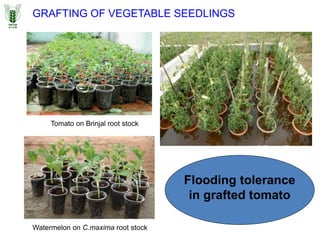
Flooding tolerance
in grafted tomato
6 Days Flooding
GRAFTING OF VEGETABLE SEEDLINGS
Watermelon on C.maxima root stock
Tomato on Brinjal root stock
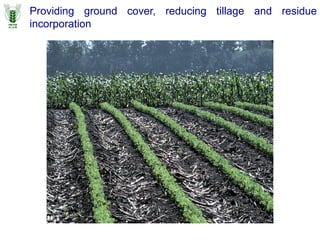
Providing ground cover, reducing tillage and residue
incorporation
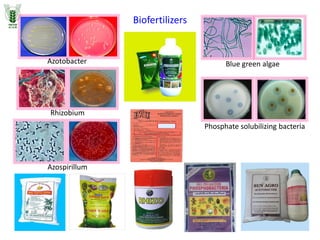
Rhizobium
Azotobacter
Phosphate solubilizing bacteria
Blue green algae
Azospirillum
Biofertilizers
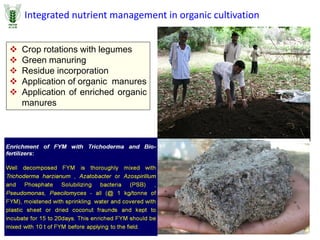
Integrated nutrient management in organic cultivation
 Crop rotations with legumes
 Green manuring
 Residue incorporation
 Application of organic manures
 Application of enriched organic
manures
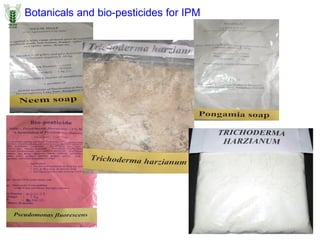
Botanicals and bio-pesticides for IPM
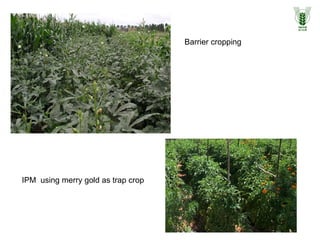
Barrier cropping
IPM using merry gold as trap crop
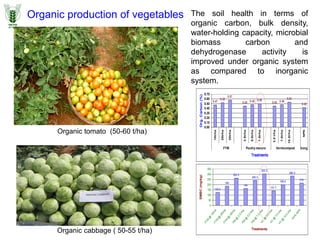
Organic production of vegetables
0.47
0.52
0.57
0.45 0.48 0.50
0.45 0.48
0.53
0.42
0.00
0.10
0.20
0.30
0.40
0.50
0.60
0.70
10t/ha
20t/ha
30t/ha
2.5t/ha
5.0t/ha
7.5t/ha
3.5
t/ha
7.0t/ha
10.5t/ha
NPK
FYM Poultry manure Vermicompost Inorg.
Treatments
Org.
Carbon
(%)
125.5
185
263.3
164
240.3
303.3
141.7
199.5
282.3
215
0
50
100
150
200
250
300
350
F
Y
M
@
1
0
t
/
h
a
F
Y
M
@
2
0
t
/
h
a
F
Y
M
@
3
0
t
/
h
a
P
M
@
2
.
5
t
/
h
a
P
M
@
5
.
0
t
/
h
a
P
M
@
7
.
5
t
/
h
a
V
C
@
3
.
5
t
/
h
a
V
C
@
7
.
0
t
/
h
a
V
C
@
1
0
.
5
t
/
h
a
1
0
0
%
N
P
K
Treatments
SMBC
(mg/kg)
Organic cabbage ( 50-55 t/ha)
Organic tomato (50-60 t/ha)
The soil health in terms of
organic carbon, bulk density,
water-holding capacity, microbial
biomass carbon and
dehydrogenase activity is
improved under organic system
as compared to inorganic
system.
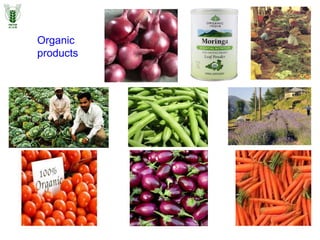
Organic
products
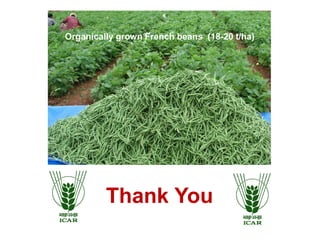
Organically grown French beans (18-20 t/ha)
Thank You

ICAR_2.pdf

  • 1.
    Vegetable Production Technologies andOrganic Production Prakash S Naik Indian Institute of Vegetable Research Varanasi
  • 2.
    Healthy seedling issingle most important ingredient for successful vegetable production  Seedlings should have a strong stem  Profuse root development .  Dark green leaves.  Should be free from pests & diseases.  Should be of uniform height & straight stem.  Right age of seedlings .
  • 3.
    Nursery management Chemical fertilizersare added in nursery soil @ 100 kg N/ha, 50 kg P/ha and 50 kg K/ha
  • 4.
    Arka Microbial Consortiumimproves seedling vigour and can be used for organic production Arka Microbial consortium (Azospirillum spp, Azotobacter spp, PSB and Peudomonas fluorescence ) contains N fixing, P & Zn solubilizing and plant growth promoting microbes.  Early germination  Increase vigour of seedlings  Increase fertilizer use efficiency  Reduce inorganic fertilizer application (N, P and Zn)  Yield increase up to 5- 6 %
  • 5.
    Simple interventions forprofitability For advancing harvesting of cucurbits by about one month, seedlings can be raised under covered condition during December for zaid season and in May for rainy season and transplanted at normal sowing time of cucurbits. By this, one can get two times more returns by early harvest of cucurbits. Raising seedlings on benches under polythene cover can protect them from rain, hails, water logging and soil borne diseases.
  • 6.
    Furrow irrigated raisedbed (FIRB) planting  FIRB planting alone can saves about 36% water over conventional flood irrigation. There are other advantages like better aeration to roots, less weeds, plants do not fall in furrows etc.  FIRB planting coupled with paddy straw mulch (7.5 tones/ha) have registered maximum fruit yield (45 t/ha) in tomato than conventional irrigation without mulch (29 t/ha). Saves about 45% water with 55% enhancement in yield.
  • 7.
    Partial root-zone irrigation(PRI) saves water and enhances yield Alternate furrow irrigation (AFI) can save 31% water. Fixed alternate furrow irrigation (FAFI) if coupled with black polythene mulch can save 54% water and also increase yield by 27%.
  • 8.
    Micro-irrigation and fertigationmethods save water and fertilizers  Water saving up to 40-60%  Yield increase 60-100%  Saving in fertilizers and chemicals (40 - 60%)  Improved produce quality and higher returns  Less pests and diseases incidence
  • 9.
  • 10.
    Water saving invegetable through drip irrigation Vegetables Water required (litres) to produce one kg Water saving using drip irrigation (%) Tomato 100-140 35 Watermelon 140-150 40 Okra 330-370 22 Brinjal 225-275 53 Bitter gourd 140-165 53 Ridge gourd 110-125 59 Cabbage 135-150 35 Radish 130-140 45 Beet root 145-160 30 Chilli 350-425 35 Paddy 2500-2700 Wheat 1000-1200
  • 11.
    Mulching  Mulches conservesoil moisture, modifying soil temperatures, improve soil properties, reduce weed growth and enhance crop yield.  Paddy straw mulch (7.5 tones/ha) in tomato gave 34% higher yield (40 t/ha) in comparison to non-mulched control (29.8 t/ha) with 15% water savings.  Water saving and yield enhancement with plastic mulch was more than paddy straw mulch.
  • 12.
    Enhancing productivity andnitrogen use efficiency in tomato 1. Seedlings raising in Protrays 2. Seedling treatment with biofertilizers (Azospirillum and Phosphorus Solubilizing Bacteria (PSB) (one kg each Biofertilizer 500g Jaggary + 4 lit. of water) 3. Three foliar sprays of Water Soluble Fertilizers (NPK 19:19:19) @ 0.5% 30 DAT at 10 days interval. 4. Foliar application of micronutrient mixture (zinc & boron) @ 0.1% 5. Black plastic mulching of the beds Yield (t/ha) Nitrogen use efficiency (t/Kg N) Treated 52.0 0.43 Control 28.1 0.23
  • 13.
    Application of micronutrientsin Cole crops increase yield and reduce physiological disorders  Three foliar Sprays of micronutrients mixture (Zn, Cu, Fe, Mn @ 100 ppm and Mo and B @ 50 ppm) at 10 days interval 30 days after transplanting  76.6 t/ha (44% higher than control).  Mo @ 50 ppm reduces hollow heart in stems.  Three foliar Sprays of micronutrients mixture (Zn, Mo and B @ 100 ppm) at 10 days interval 30 days after transplanting  37 t/ha  B @ 100 ppm checks browning of curds.
  • 14.
    Wherever possible cucurbitsshould be grown on bower system to improve yield and quality A Field View of Bottle Gourd Bower system: 37.4 t/ha Field: 23-25 t/ha
  • 15.
    Stacking in tomatoimproves yield and quality Stacking: 70-75 t/ha, best quality fruits Non-stacking: 45-50 t/ha, poor quality fruits
  • 16.
    Fluctuations in arrivalsand wholesale prices of major vegetables in 4 metropolitan cities of India during 2013
  • 17.
    Temporary poly-huts forgrowing vegetables during rainy season
  • 18.
    Tomato under rain-shelterduring kharif season at IIHR, Bangalore: 83 t/ha in 110 days Growing vegetables under rain shelters
  • 19.
    Shade House Nethouse Low cost and Hi-Tech protected cultivation structures Polyhouse Hi-Tech protected structure
  • 20.
    Tomato (300 t/ha/year)Capsicum (200 t/ha/year) Muskmelons: 60t/ha in 100 days (winter) Cucumber : 73.2t/ha in 75 days (Late summer) Protected structures give high yields of best quality produce
  • 21.
     Primary focuson management practices that promote and enhance ecological harmony.  No synthetic substances or chemicals, hormones, GM crops are permitted.  Only natural inputs, bio-fertilizers, botanicals, bio-agents are permitted Organic cultivation of vegetable crops
  • 22.
    Livelihood security crisis: Highcost of inputs, negative returns and emergence of input related new problems. Water crisis: Water crisis in both urban and rural areas calls for water prudent agriculture Health crisis: Input related health hazards to farmers and consumers. Reduced inputs & higher income: Converting to organic for input cost reduction and better income, makes sense Drought management: Organic farming helps manage drought conditions better to grow crops Agri-business opportunities: Organic agribusiness is bringing more profit Reduced health hazards: Helping reduce health risks of farmers and consumers. Conventional production Organic production Why organic?
  • 23.
    Integral components oforganic farming Crop rotation Hot/cold weather cultivation Residue incorporation Biopesticides Organic manures Drip irrigation Mulching Biofertilizers Green manuring Crop rotations Short duration resistant varieties
  • 24.
    Flooding tolerance in graftedtomato 6 Days Flooding GRAFTING OF VEGETABLE SEEDLINGS Watermelon on C.maxima root stock Tomato on Brinjal root stock
  • 25.
    Providing ground cover,reducing tillage and residue incorporation
  • 26.
    Rhizobium Azotobacter Phosphate solubilizing bacteria Bluegreen algae Azospirillum Biofertilizers
  • 27.
    Integrated nutrient managementin organic cultivation  Crop rotations with legumes  Green manuring  Residue incorporation  Application of organic manures  Application of enriched organic manures
  • 28.
  • 29.
    Barrier cropping IPM usingmerry gold as trap crop
  • 30.
    Organic production ofvegetables 0.47 0.52 0.57 0.45 0.48 0.50 0.45 0.48 0.53 0.42 0.00 0.10 0.20 0.30 0.40 0.50 0.60 0.70 10t/ha 20t/ha 30t/ha 2.5t/ha 5.0t/ha 7.5t/ha 3.5 t/ha 7.0t/ha 10.5t/ha NPK FYM Poultry manure Vermicompost Inorg. Treatments Org. Carbon (%) 125.5 185 263.3 164 240.3 303.3 141.7 199.5 282.3 215 0 50 100 150 200 250 300 350 F Y M @ 1 0 t / h a F Y M @ 2 0 t / h a F Y M @ 3 0 t / h a P M @ 2 . 5 t / h a P M @ 5 . 0 t / h a P M @ 7 . 5 t / h a V C @ 3 . 5 t / h a V C @ 7 . 0 t / h a V C @ 1 0 . 5 t / h a 1 0 0 % N P K Treatments SMBC (mg/kg) Organic cabbage ( 50-55 t/ha) Organic tomato (50-60 t/ha) The soil health in terms of organic carbon, bulk density, water-holding capacity, microbial biomass carbon and dehydrogenase activity is improved under organic system as compared to inorganic system.
  • 31.
  • 32.
    Organically grown Frenchbeans (18-20 t/ha) Thank You