OPHTHALMIC DIAGNOSTIC
MEDICATIONS
WHICH CLASSES OF DRUGS?
Cycloplegics
Mydriatics
Anesthetics
WHY USE DIAGNOSTICS?
Ocular media and fundus examination
Enhancing retinal photography; optical coherence
tomography
Refraction through cataracts when pupils are small
Cycloplegic refraction
Techniques where anesthesia is required
CYCLOPLEGIA
It is the paralysis of the ciliary
muscle of the eye, resulting in loss
of accommodation.
CYCLOPLEGICS
Cycloplegics work by binding to effector sites in the
ciliary muscle thereby blocking action of acetylcholine.
Pupillary dilation is an (unwanted) side effect and its
onset precedes cycloplegia.
The optometrist should ensure there are no angle
anomalies before instillation of cycloplegic drop.
CYCLOPLEGICS
Cycloplegics are most often used in
children in the presence of esotropia or
esophoria or when latent hypermetropia is
suspected.
Another use is to impose penalization of a
dominant eye in amblyopia.
COMMON CYCLOPLEGIC
DRUGS
Atropine
Cyclopentolate
Tropicamide
ATROPINE
Atropine is a strong cycloplegic agent.
Atropine Sulphate is used 0.5% and 1% as eye
drops; and 1% eye ointment.
Muscarinic antagonist.
Peak effect of the drug is in 2-3 days.
Duration is 7-10 days.
TROPICAMIDE
Tropicamide (Midriacyl) is also a short-duration
cycloplegic available in 0.5% and 1% solutions.
For young adults 3 to 4 drops of the 1% solution,
separated by a few minutes, will bring about full
cycloplegia in about 30 minutes.
Recovery occurs within 6-8 hours.
CYCLOPENTOLATE
Short duration cycloplegic agent available in
0.5% and 1% solutions.
Cycloplegia occurs within 30 to 45 minutes and
persists for as long as 24 hours.
For children aged 6 to 16, one drop of 1%
solution
For adults one drop of 0.5% solution.
SIDE EFFECTS
Blurring of vision
Patient cannot read
Photophobia
Dry mouth
Flushing of the face
Fever
CONTRAINDICATIONS
 abnormally shallow anterior chamber
dislocation or subluxation of the
crystalline lens.
MYDRIATICS
Mydriatics dilate the pupil to facilitate a more
thorough examination of the fundus, lens
periphery and vitreous. They are mostly used on
elderly patients, as older pupils are usually smaller
and lens opacities and abnormal retinal
conditions are not uncommon.
MODE OF ACTION
 The pupil dilator muscle is innervated by
the sympathetic nervous system and
sympathomimetic drugs will cause a
contraction of the dilator muscle causing
mydriasis. Sympathomimetic drugs also
have little effect on accommodation.
MYDRIATICS USES
Mydriatics are used to examine properly the ocular
media and ocular fundi
Retinoscopy through small pupil and cataract
Recent onset of floating vitreous opacities, especially if
accompanied by the symptoms of flashing light.
Fundus photography.
ANTIMUSCARIANIC MYDRIATICS
TROPICAMIDE
1. Tropicamide is the antimuscarinic mydriatic of choice today.
2. Normally available in 0.5% and 1.0% strengths, the weaker
solution is used most often for mydriasis; the 1% strength is used
for cycloplegia.
3. Tropicamide is quick in onset and short in duration (Onset in 20-
30 minutes and duration of cycloplegic effect is 6-8 hours)
All cycloplegics can be used as mydriatics but
the effect is usually too long lasting. The
following have been used in the past:
CYCLOPENTOLATE
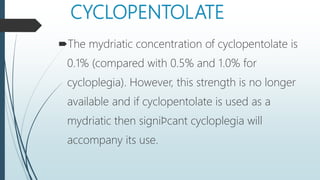
The mydriatic concentration of cyclopentolate is
0.1% (compared with 0.5% and 1.0% for
cycloplegia). However, this strength is no longer
available and if cyclopentolate is used as a
mydriatic then significant cycloplegia will
accompany its use.
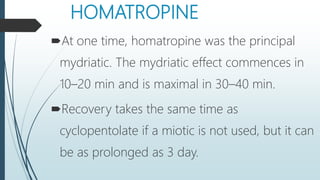
HOMATROPINE
At one time, homatropine was the principal
mydriatic. The mydriatic effect commences in
10–20 min and is maximal in 30–40 min.
Recovery takes the same time as
cyclopentolate if a miotic is not used, but it can
be as prolonged as 3 day.
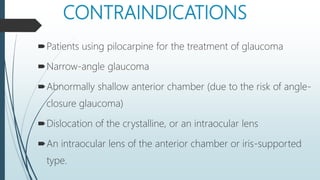
CONTRAINDICATIONS
Patients using pilocarpine for the treatment of glaucoma
Narrow-angle glaucoma
Abnormally shallow anterior chamber (due to the risk of angle-
closure glaucoma)
Dislocation of the crystalline, or an intraocular lens
An intraocular lens of the anterior chamber or iris-supported
type.
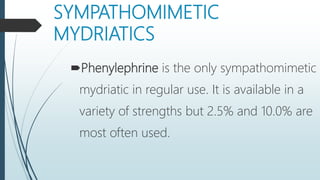
SYMPATHOMIMETIC
MYDRIATICS
Phenylephrine is the only sympathomimetic
mydriatic in regular use. It is available in a
variety of strengths but 2.5% and 10.0% are
most often used.
PHENYLEPHRINE
Mydriasis commences in about 10 min and is maximal in
30 min; the mydriasis lasts for several hours.
There is little doubt that sympathomimetics produce less
effect on accommodation than antimuscarinics, and some
authors (Kanski 1969) suggest that phenylephrine
produces mydriasis without any cycloplegic effect at all.
ANESTHETICS
Local anaesthetics are chemical agents
that reversibly block the transmission of
nerve impulses along sensory fibres.
MODE OF ACTION
Sensory information passes along nerve fibres via electrical
impulses, or action potentials. When the nerve is at rest, the
interior has a negative charge. An action potential is generated
by the influx of sodium ions into the interior of the nerve, giving
it a positive charge (depolarization). The nerve fibre is returned
to its resting potential (negative state) by the efflux of potassium
ions (repolarization). The action potential is then generated
along the axon by successive depolarization and repolarization
of adjacent regions.
INDICATIONS FOR USE
Foreign body removal
Tonometry
Contact lens fitting
Gonioscopy
Certain diagnostic procedures like
Schirmer’s test.
ANESTHETICS
Among the topical anaesthetics, the most widely used
agents are proparacaine hydrochloride 0.5% (Alcaine),
benoxinate 0.5% and tetracaine 0.5%.
 The instillation of 1 drop of these compounds renders
the corneal epithelium insensate within 15 seconds.
Reapplication will enhance the anaesthetic effect

Ophthalmic diagnostic medications

  • 1.
  • 2.
    WHICH CLASSES OFDRUGS? Cycloplegics Mydriatics Anesthetics
  • 3.
    WHY USE DIAGNOSTICS? Ocularmedia and fundus examination Enhancing retinal photography; optical coherence tomography Refraction through cataracts when pupils are small Cycloplegic refraction Techniques where anesthesia is required
  • 4.
    CYCLOPLEGIA It is theparalysis of the ciliary muscle of the eye, resulting in loss of accommodation.
  • 5.
    CYCLOPLEGICS Cycloplegics work bybinding to effector sites in the ciliary muscle thereby blocking action of acetylcholine. Pupillary dilation is an (unwanted) side effect and its onset precedes cycloplegia. The optometrist should ensure there are no angle anomalies before instillation of cycloplegic drop.
  • 6.
    CYCLOPLEGICS Cycloplegics are mostoften used in children in the presence of esotropia or esophoria or when latent hypermetropia is suspected. Another use is to impose penalization of a dominant eye in amblyopia.
  • 7.
  • 8.
    ATROPINE Atropine is astrong cycloplegic agent. Atropine Sulphate is used 0.5% and 1% as eye drops; and 1% eye ointment. Muscarinic antagonist. Peak effect of the drug is in 2-3 days. Duration is 7-10 days.
  • 9.
    TROPICAMIDE Tropicamide (Midriacyl) isalso a short-duration cycloplegic available in 0.5% and 1% solutions. For young adults 3 to 4 drops of the 1% solution, separated by a few minutes, will bring about full cycloplegia in about 30 minutes. Recovery occurs within 6-8 hours.
  • 10.
    CYCLOPENTOLATE Short duration cycloplegicagent available in 0.5% and 1% solutions. Cycloplegia occurs within 30 to 45 minutes and persists for as long as 24 hours. For children aged 6 to 16, one drop of 1% solution For adults one drop of 0.5% solution.
  • 11.
    SIDE EFFECTS Blurring ofvision Patient cannot read Photophobia Dry mouth Flushing of the face Fever
  • 12.
    CONTRAINDICATIONS  abnormally shallowanterior chamber dislocation or subluxation of the crystalline lens.
  • 13.
    MYDRIATICS Mydriatics dilate thepupil to facilitate a more thorough examination of the fundus, lens periphery and vitreous. They are mostly used on elderly patients, as older pupils are usually smaller and lens opacities and abnormal retinal conditions are not uncommon.
  • 14.
    MODE OF ACTION The pupil dilator muscle is innervated by the sympathetic nervous system and sympathomimetic drugs will cause a contraction of the dilator muscle causing mydriasis. Sympathomimetic drugs also have little effect on accommodation.
  • 15.
    MYDRIATICS USES Mydriatics areused to examine properly the ocular media and ocular fundi Retinoscopy through small pupil and cataract Recent onset of floating vitreous opacities, especially if accompanied by the symptoms of flashing light. Fundus photography.
  • 16.
    ANTIMUSCARIANIC MYDRIATICS TROPICAMIDE 1. Tropicamideis the antimuscarinic mydriatic of choice today. 2. Normally available in 0.5% and 1.0% strengths, the weaker solution is used most often for mydriasis; the 1% strength is used for cycloplegia. 3. Tropicamide is quick in onset and short in duration (Onset in 20- 30 minutes and duration of cycloplegic effect is 6-8 hours)
  • 17.
    All cycloplegics canbe used as mydriatics but the effect is usually too long lasting. The following have been used in the past:
  • 18.
    CYCLOPENTOLATE The mydriatic concentrationof cyclopentolate is 0.1% (compared with 0.5% and 1.0% for cycloplegia). However, this strength is no longer available and if cyclopentolate is used as a mydriatic then significant cycloplegia will accompany its use.
  • 19.
    HOMATROPINE At one time,homatropine was the principal mydriatic. The mydriatic effect commences in 10–20 min and is maximal in 30–40 min. Recovery takes the same time as cyclopentolate if a miotic is not used, but it can be as prolonged as 3 day.
  • 20.
    CONTRAINDICATIONS Patients using pilocarpinefor the treatment of glaucoma Narrow-angle glaucoma Abnormally shallow anterior chamber (due to the risk of angle- closure glaucoma) Dislocation of the crystalline, or an intraocular lens An intraocular lens of the anterior chamber or iris-supported type.
  • 21.
    SYMPATHOMIMETIC MYDRIATICS Phenylephrine is theonly sympathomimetic mydriatic in regular use. It is available in a variety of strengths but 2.5% and 10.0% are most often used.
  • 22.
    PHENYLEPHRINE Mydriasis commences inabout 10 min and is maximal in 30 min; the mydriasis lasts for several hours. There is little doubt that sympathomimetics produce less effect on accommodation than antimuscarinics, and some authors (Kanski 1969) suggest that phenylephrine produces mydriasis without any cycloplegic effect at all.
  • 23.
    ANESTHETICS Local anaesthetics arechemical agents that reversibly block the transmission of nerve impulses along sensory fibres.
  • 24.
    MODE OF ACTION Sensoryinformation passes along nerve fibres via electrical impulses, or action potentials. When the nerve is at rest, the interior has a negative charge. An action potential is generated by the influx of sodium ions into the interior of the nerve, giving it a positive charge (depolarization). The nerve fibre is returned to its resting potential (negative state) by the efflux of potassium ions (repolarization). The action potential is then generated along the axon by successive depolarization and repolarization of adjacent regions.
  • 25.
    INDICATIONS FOR USE Foreignbody removal Tonometry Contact lens fitting Gonioscopy Certain diagnostic procedures like Schirmer’s test.
  • 26.
    ANESTHETICS Among the topicalanaesthetics, the most widely used agents are proparacaine hydrochloride 0.5% (Alcaine), benoxinate 0.5% and tetracaine 0.5%.  The instillation of 1 drop of these compounds renders the corneal epithelium insensate within 15 seconds. Reapplication will enhance the anaesthetic effect