OPERATIVE
GYNAECOLOGY
NUR IZZATUL NAJWA (036)
LEARNING OBJECTIVES
ALL ARE ABLE TO UNDERSTAND :
• HYSTERECTOMY
•MYOMECTOMY
•DILATATION AND CURRETAGE
•OVARIAN CYSTECTOMY
•OOPHORECTOMY
•DILATATION AND INSUFFLATION
•CERVICAL BIOPSY
•THERMAL CAUTERIZATION
•CRYOSURGERY
•AMPUTATION OF CERVIX
•SALPHINGECTOMY
•HYSTEROSALPHINGOGRAPHY
•LAPAROSCOPY
•HYSTEROSCOPY
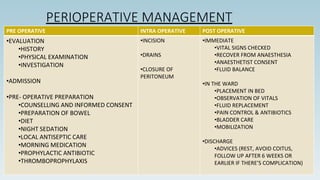
PERIOPERATIVE MANAGEMENT
PRE OPERATIVE INTRA OPERATIVE POST OPERATIVE
•EVALUATION
•HISTORY
•PHYSICAL EXAMINATION
•INVESTIGATION
•ADMISSION
•PRE- OPERATIVE PREPARATION
•COUNSELLING AND INFORMED CONSENT
•PREPARATION OF BOWEL
•DIET
•NIGHT SEDATION
•LOCAL ANTISEPTIC CARE
•MORNING MEDICATION
•PROPHYLACTIC ANTIBIOTIC
•THROMBOPROPHYLAXIS
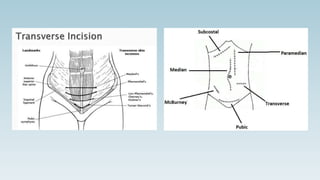
•INCISION
•DRAINS
•CLOSURE OF
PERITONEUM
•IMMEDIATE
•VITAL SIGNS CHECKED
•RECOVER FROM ANAESTHESIA
•ANAESTHETIST CONSENT
•FLUID BALANCE
•IN THE WARD
•PLACEMENT IN BED
•OBSERVATION OF VITALS
•FLUID REPLACEMENT
•PAIN CONTROL & ANTIBIOTICS
•BLADDER CARE
•MOBILIZATION
•DISCHARGE
•ADVICES (REST, AVOID COITUS,
FOLLOW UP AFTER 6 WEEKS OR
EARLIER IF THERE’S COMPLICATION)
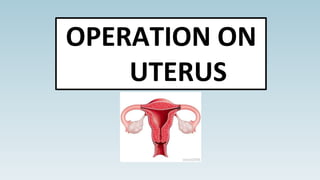
OPERATION ON
UTERUS
HYSTERECTOMY
ABDOMINAL
HYSTERECTOMY
VAGINAL HYSTERECTOMY
LAPAROSCOPIC ASSISTED
VAGINAL HYSTERECTOMY
ABDOMIN
AL
HYSTERECT
OMY
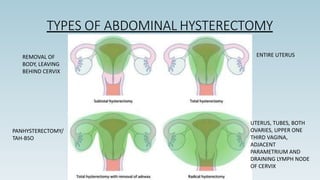
TYPES OF ABDOMINAL HYSTERECTOMY
ENTIRE UTERUSREMOVAL OF
BODY, LEAVING
BEHIND CERVIX
UTERUS, TUBES, BOTH
OVARIES, UPPER ONE
THIRD VAGINA,
ADJACENT
PARAMETRIUM AND
DRAINING LYMPH NODE
OF CERVIX
PANHYSTERECTOMY/
TAH-BSO
INDICATION OF HYSTERECTOMY
BENIGN LESIONS MALIGNANCY TRAUMATIC OBSTETRICAL
DUB Ca Cervix Uterine
perforation
Atonic PPH
Fibroid uterus Ca Ovary Cervical tear Morbid adherent
placenta
Tuboovarian mass Ca endometrium Rupture uterus Hydatidiform mole
(>35 y/o
Endometriosis,
Adenomyosis
Uterine sarcoma Septic abortion
CIN Choriocarcinoma
Endometrial hyperplasia
Benign ovarian tumour
PRE OPERATIVEPROCEDURE
1. Blood testing , review her medical records, confirm the diagnosis.
2. Take patient’s consent, explain risk and procedures
3. Place IV line and prophylactic antibiotics
4. Catheterization
5. Call for anaesthetist, prepare for operating room and prepare
blood products.
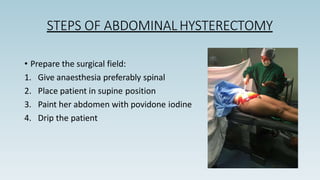
STEPS OF ABDOMINAL HYSTERECTOMY
• Prepare the surgical field:
1. Give anaesthesia preferably spinal
2. Place patient in supine position
3. Paint her abdomen with povidone iodine
4. Drip the patient
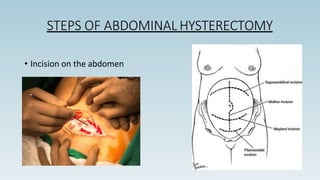
STEPS OF ABDOMINAL HYSTERECTOMY
• Incision on the abdomen
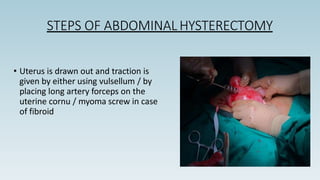
• Uterus is drawn out and traction is
given by either using vulsellum / by
placing long artery forceps on the
uterine cornu / myoma screw in case
of fibroid
STEPS OF ABDOMINAL HYSTERECTOMY
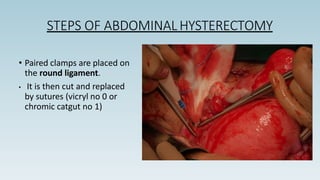
• Paired clamps are placed on
the round ligament.
• It is then cut and replaced
by sutures (vicryl no 0 or
chromic catgut no 1)
STEPS OF ABDOMINAL HYSTERECTOMY
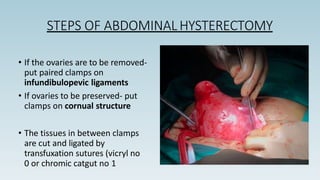
• If the ovaries are to be removed-
put paired clamps on
infundibulopevic ligaments
• If ovaries to be preserved- put
clamps on cornual structure
• The tissues in between clamps
are cut and ligated by
transfuxation sutures (vicryl no
0 or chromic catgut no 1
STEPS OF ABDOMINAL HYSTERECTOMY
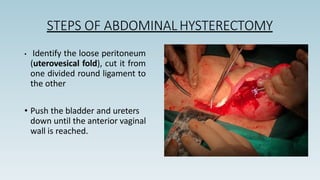
• Identify the loose peritoneum
(uterovesical fold), cut it from
one divided round ligament to
the other
• Push the bladder and ureters
down until the anterior vaginal
wall is reached.
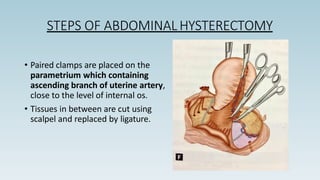
• Paired clamps are placed on the
parametrium which containing
ascending branch of uterine artery,
close to the level of internal os.
• Tissues in between are cut using
scalpel and replaced by ligature.
STEPS OF ABDOMINAL HYSTERECTOMY
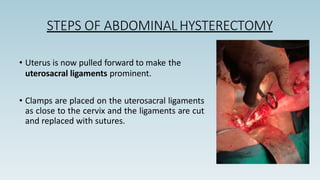
• Uterus is now pulled forward to make the
uterosacral ligaments prominent.
• Clamps are placed on the uterosacral ligaments
as close to the cervix and the ligaments are cut
and replaced with sutures.
STEPS OF ABDOMINAL HYSTERECTOMY
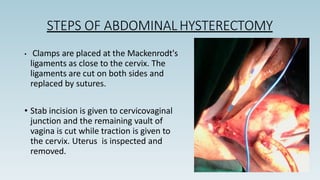
• Clamps are placed at the Mackenrodt's
ligaments as close to the cervix. The
ligaments are cut on both sides and
replaced by sutures.
• Stab incision is given to cervicovaginal
junction and the remaining vault of
vagina is cut while traction is given to
the cervix. Uterus is inspected and
removed.
STEPS OF ABDOMINAL HYSTERECTOMY
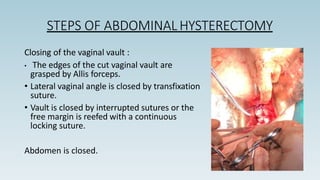
Closing of the vaginal vault :
• The edges of the cut vaginal vault are
grasped by Allis forceps.
• Lateral vaginal angle is closed by transfixation
suture.
• Vault is closed by interrupted sutures or the
free margin is reefed with a continuous
locking suture.
Abdomen is closed.
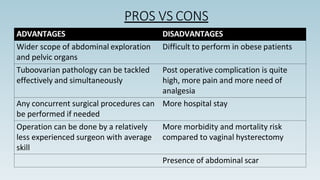
PROS VS CONS
ADVANTAGES DISADVANTAGES
Wider scope of abdominal exploration
and pelvic organs
Difficult to perform in obese patients
Tuboovarian pathology can be tackled
effectively and simultaneously
Post operative complication is quite
high, more pain and more need of
analgesia
Any concurrent surgical procedures can
be performed if needed
More hospital stay
Operation can be done by a relatively
less experienced surgeon with average
skill
More morbidity and mortality risk
compared to vaginal hysterectomy
Presence of abdominal scar
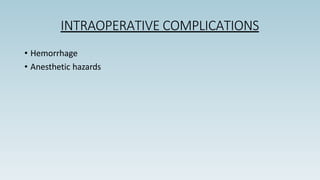
INTRAOPERATIVE COMPLICATIONS
• Hemorrhage
• Anesthetic hazards
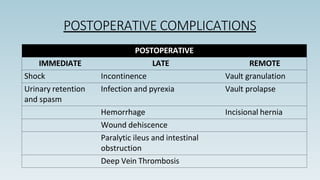
POSTOPERATIVE COMPLICATIONS
POSTOPERATIVE
IMMEDIATE LATE REMOTE
Shock Incontinence Vault granulation
Urinary retention
and spasm
Infection and pyrexia Vault prolapse
Hemorrhage Incisional hernia
Wound dehiscence
Paralytic ileus and intestinal
obstruction
Deep Vein Thrombosis
VAGINAL HYSTERECTOMY
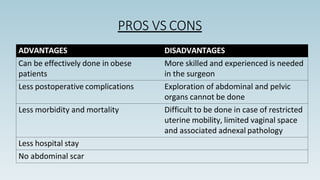
PROS VS CONS
ADVANTAGES DISADVANTAGES
Can be effectively done in obese
patients
More skilled and experienced is needed
in the surgeon
Less postoperative complications Exploration of abdominal and pelvic
organs cannot be done
Less morbidity and mortality Difficult to be done in case of restricted
uterine mobility, limited vaginal space
and associated adnexal pathology
Less hospital stay
No abdominal scar
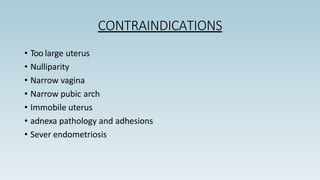
CONTRAINDICATIONS
• Too large uterus
• Nulliparity
• Narrow vagina
• Narrow pubic arch
• Immobile uterus
• adnexa pathology and adhesions
• Sever endometriosis
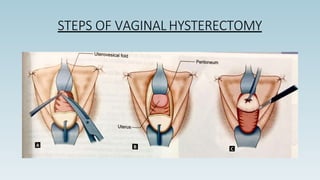
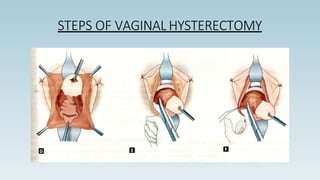
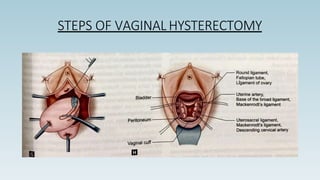
STEPS OF VAGINAL HYSTERECTOMY
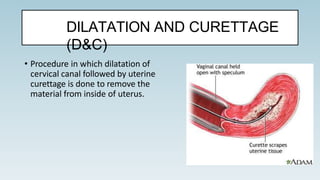
DILATATION AND CURETTAGE
(D&C)
• Procedure in which dilatation of
cervical canal followed by uterine
curettage is done to remove the
material from inside of uterus.
INDICATIONS OF D&C
DIAGNOSTIC INDICATIONS :
1. DUB
2. Infertility
3. Pathologic amenorrhoea
4. Postmenopausal bleeding
5. Endometrial pathology
THERAPEUTIC INDICATIONS :
1. DUB
2. Endometrial polyp
3. Removal of IUD
4. Incomplete abortion
5. Molar pregnancies
PREPARING FOR D&C
1. Blood testing , review her medical records
2. Take patient’s consent, explain risk and procedures
3. Patients should not drink or eat prior to the procedure
4. Ensure that somebody is accompanying the patient for a safe drive
back home
5. Keep the patient’s at ease and ask patient to empty her bladder
6. Place IV line and prophylactic antibiotics
7. Call for anaesthetist, prepare for operating room and prepare
blood products.
PROCEDURE OF D&C
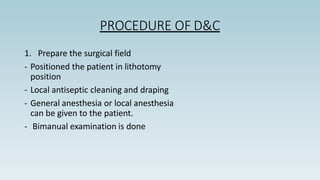
1. Prepare the surgical field
- Positioned the patient in lithotomy
position
- Local antiseptic cleaning and draping
- General anesthesia or local anesthesia
can be given to the patient.
- Bimanual examination is done
PROCEDURE OF D&C
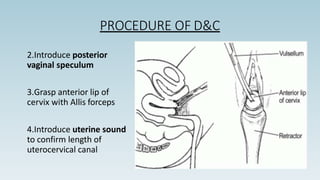
2.Introduce posterior
vaginal speculum
3.Grasp anterior lip of
cervix with Allis forceps
4.Introduce uterine sound
to confirm length of
uterocervical canal
PROCEDURE OF D&C
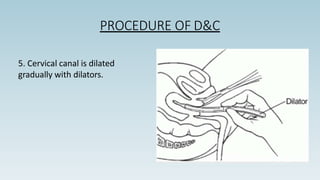
5. Cervical canal is dilated
gradually with dilators.
PROCEDURE OF D&C
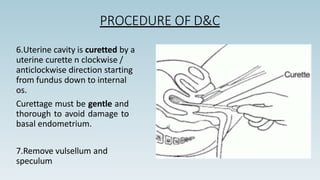
6.Uterine cavity is curetted by a
uterine curette n clockwise /
anticlockwise direction starting
from fundus down to internal
os.
Curettage must be gentle and
thorough to avoid damage to
basal endometrium.
7.Remove vulsellum and
speculum
POST PROCEDURE CARE
Monitor patient in recovering room for a few hours.
-Any excessive vaginal bleeding
-Vital signs
-Treat any anaesthetic side effects if needed
Advice patient about:
-mild cramping and spotting which may occur for a few hours or days:
can be treated by NSAIDs
-Avoidance in putting anything into the vagina
-Avoid any sexual intercourse
-Next menstrual period should occurs within 4-6 weeks of the
procedure
COMPLICATIONS
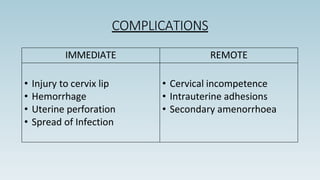
IMMEDIATE REMOTE
• Injury to cervix lip
• Hemorrhage
• Uterine perforation
• Spread of Infection
• Cervical incompetence
• Intrauterine adhesions
• Secondary amenorrhoea
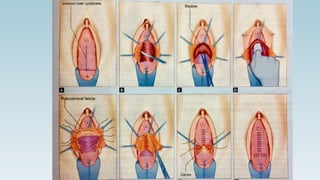
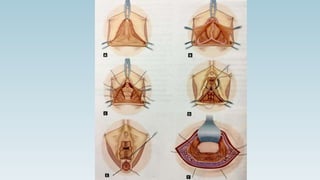
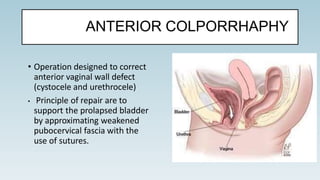
• Operation designed to correct
anterior vaginal wall defect
(cystocele and urethrocele)
• Principle of repair are to
support the prolapsed bladder
by approximating weakened
pubocervical fascia with the
use of sutures.
ANTERIOR COLPORRHAPHY
PROCEDURE
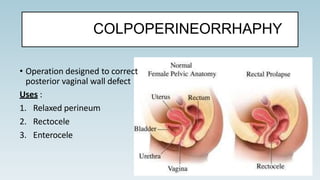
COLPOPERINEORRHAPHY
• Operation designed to correct
posterior vaginal wall defect
Uses :
1. Relaxed perineum
2. Rectocele
3. Enterocele
• Vaginal route operation designed to correct uterine prolapse
associated with cystocele and rectocele where the preservation of
the uterus is possible.
• This is done when the symptoms are due to vaginal prolapse
associated with elongation of supravaginal cervix
FOTHERGILL’S / MANCHESTER
OPERATION
PRINCIPAL STEPS IN FOTHERGILL’SOPERATION
Preliminary D&C
Amputation of Cervix
Plication of Mackenrodt’s ligaments
Anterior colporrhaphy
Colpoperineorrhaphy
MYOMECTOMY
• Enucleation of myomata from the uterus, leaving behind a potentially
functioning organ capable of future reproduction.
• Important consideration prior to myomectomy are :
1. Size and numbers of fibroids
2. Should be done mainly to preserve reproductive function,
pregnancy rate (40-60%)
3. Risk of recurrence / persistence (30-50%)
4. Risk of persistence menorrhagia (1-5%)
INDICATIONS FOR MYOMECTOMY
• Persistent uterine bleeding despite medical therapy with excessive
pain and pressure symptoms
• Size >12 weeks, in woman desirous to have a baby
• Distortion of uterine cavity without any other cause
• Recurrent pregnancy loss due to uterine fibroid
• Rapidly growing myoma
• Subserous pedunculated fibroid
CONTRAINDICATIONS OF MYOMECTOMY
• Infected fibroid
• Parous woman, no longer desire fertility where hysterectomy is safer
• Suspected malignant change
• Fibroid located in the region of uterine vessels or broad ligament
• Pelvic or endometrial tuberculosis
• During pregnancy or cesarean section
PREOPERATIVE PROCEDURE
1. Confirm the diagnosis (USG, MRI,HSG, endometrial biopsy,
examination of the husband in case of infertility)
2. Take consent, explain risk and procedures
3. Blood investigations
4. Preoperative treatment with Gnrh analogue – to reduce vascularity
of the tumour
5. Place IV line and antibiotic prophylaxis
6. Call for anaesthetist, prepare operating room and keep blood
products ready
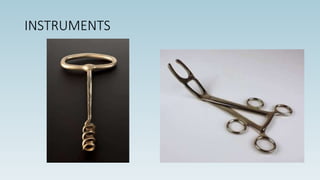
INSTRUMENTS
BASIC STEPS
1.Incision on uterus
- Single vertical incision is the midline on the anterior wall of the uterus
- Incision is deepened through the myometrium and the capsule until
myoma is reached
2. Removal of myoma
- Grasp fibroid with single toothed vulsellum or myoma screw.
- Traction is given between myometrium and fibroid
- Dissection is done by sharp (scissors) and blunt method (finger, knife
handle)
3. Closure of deep space
- Myoma bed is obliterated by
interrupted mattress or figure of
eight sutures.
- Sometimes tire stitch may be
required to approximate the
myometrium
BASIC STEPS
MEASURES TO CONTROL BLOOD LOSS
DURING MYOMECTOMY
1. Preoperative treatment with GnRH analogue
2. Use of vasocontrictive agents (20 U of vasopressin is diluted in 20
ml normal saline and injected to myometrium overlying the
myoma)
3. Use of Victor Bonney's specially designed clamp to reduce uterine
artery blood flow – place the clamp around uterine vessels and
round ligaments
4. Use of tourniquets – to occlude vessels at infundibulopelvic
ligaments
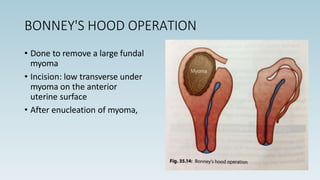
BONNEY'S HOOD OPERATION
• Done to remove a large fundal
myoma
• Incision: low transverse under
myoma on the anterior
uterine surface
• After enucleation of myoma,
COMPLICATIONS
INTRAOPERATIVE
1. Hemorrhage
2. Injury to bladder, rectum
3. Conversion to hysterectomy
POSTOPERATIVE
1. Myoma fever
2. Reactionary and secondary hemorrhage
3. Adhesions
4. Recurrence of fibroid
OPERATIONS ON
OVARY
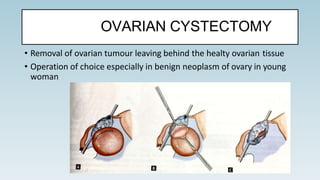
OVARIAN CYSTECTOMY
• Removal of ovarian tumour leaving behind the healty ovarian tissue
• Operation of choice especially in benign neoplasm of ovary in young
woman
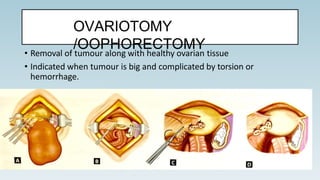
OVARIOTOMY
/OOPHORECTOMY• Removal of tumour along with healthy ovarian tissue
• Indicated when tumour is big and complicated by torsion or
hemorrhage.
OPERATIONS
ON FALLOPIAN
TUBES
DILATATION AND INSUFFLATION
(D&I)• Dilatation of cervix followed by introduction of air or carbon dioxide
into the uterine cavity to check for tubal patency.
• Indications are for infertility investigation and following tuboplasty.
• Contraindicated in case of pelvic infection
• Complications include all the risk from dilatation process and the
following:
- Air embolism
- Rupture of the tube
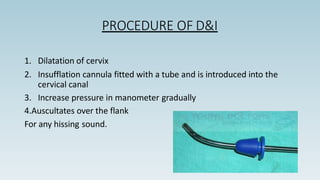
PROCEDURE OF D&I
1. Dilatation of cervix
2. Insufflation cannula fitted with a tube and is introduced into the
cervical canal
3. Increase pressure in manometer gradually
4.Auscultates over the flank
For any hissing sound.
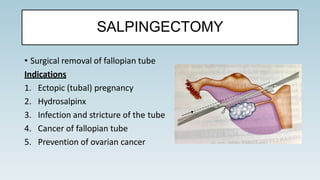
SALPINGECTOMY
• Surgical removal of fallopian tube
Indications
1. Ectopic (tubal) pregnancy
2. Hydrosalpinx
3. Infection and stricture of the tube
4. Cancer of fallopian tube
5. Prevention of ovarian cancer
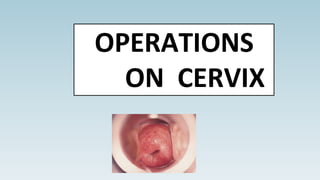
OPERATIONS
ON CERVIX
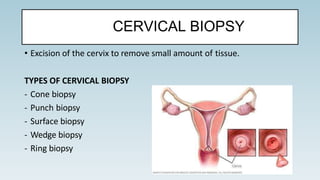
CERVICAL BIOPSY
• Excision of the cervix to remove small amount of tissue.
TYPES OF CERVICAL BIOPSY
- Cone biopsy
- Punch biopsy
- Surface biopsy
- Wedge biopsy
- Ring biopsy
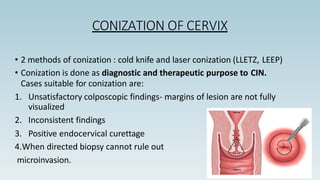
CONIZATION OF CERVIX
• 2 methods of conization : cold knife and laser conization (LLETZ, LEEP)
• Conization is done as diagnostic and therapeutic purpose to CIN.
Cases suitable for conization are:
1. Unsatisfactory colposcopic findings- margins of lesion are not fully
visualized
2. Inconsistent findings
3. Positive endocervical curettage
4.When directed biopsy cannot rule out
microinvasion.
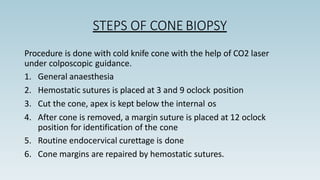
STEPS OF CONE BIOPSY
Procedure is done with cold knife cone with the help of CO2 laser
under colposcopic guidance.
1. General anaesthesia
2. Hemostatic sutures is placed at 3 and 9 oclock position
3. Cut the cone, apex is kept below the internal os
4. After cone is removed, a margin suture is placed at 12 oclock
position for identification of the cone
5. Routine endocervical curettage is done
6. Cone margins are repaired by hemostatic sutures.
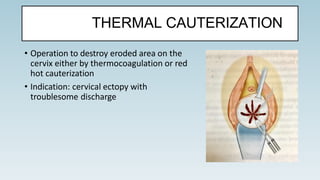
• Operation to destroy eroded area on the
cervix either by thermocoagulation or red
hot cauterization
• Indication: cervical ectopy with
troublesome discharge
THERMAL CAUTERIZATION
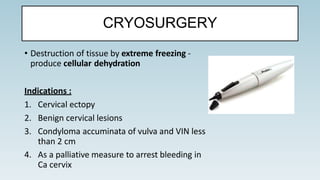
• Destruction of tissue by extreme freezing -
produce cellular dehydration
Indications :
1. Cervical ectopy
2. Benign cervical lesions
3. Condyloma accuminata of vulva and VIN less
than 2 cm
4. As a palliative measure to arrest bleeding in
Ca cervix
CRYOSURGERY
• Operative procedure whereby a part of lower cervix is excised.
Indications
1. Congenital elongation
2. Chronic cervicitis with hypertrophied cervix (not relived by
conventional therapy)
3. As a component part of Fothergill’s to rectify the supravaginal
elongation.
AMPUTATION OF CERVIX
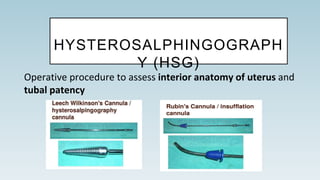
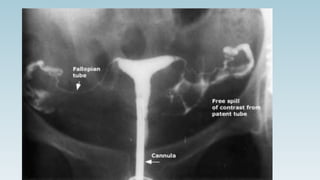
HYSTEROSALPHINGOGRAPH
Y (HSG)
Operative procedure to assess interior anatomy of uterus and
tubal patency
INDICATIONS
1. ASSESS INTERIOR ANATOMY OF UTERINE
-Detection of Uterine malformations
-Diagnosis of cervical in competence
-Detection of translocated IUD
-Diagnosis of uterine synechiae
-Confirm diagnosis of secondary abdominal pregnancy
2. TO ASSESS TUBAL PATENCY
-Following tuboplasty
-Infertility investigations
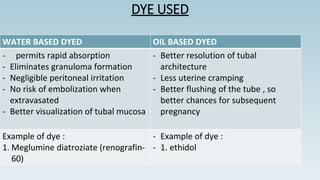
DYE USED
WATER BASED DYED OIL BASED DYED
- permits rapid absorption
- Eliminates granuloma formation
- Negligible peritoneal irritation
- No risk of embolization when
extravasated
- Better visualization of tubal mucosa
- Better resolution of tubal
architecture
- Less uterine cramping
- Better flushing of the tube , so
better chances for subsequent
pregnancy
Example of dye :
1. Meglumine diatroziate (renografin-
60)
- Example of dye :
- 1. ethidol
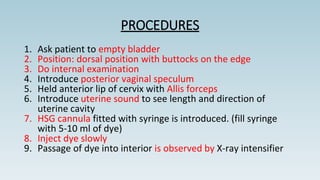
PROCEDURES
1. Ask patient to empty bladder
2. Position: dorsal position with buttocks on the edge
3. Do internal examination
4. Introduce posterior vaginal speculum
5. Held anterior lip of cervix with Allis forceps
6. Introduce uterine sound to see length and direction of
uterine cavity
7. HSG cannula fitted with syringe is introduced. (fill syringe
with 5-10 ml of dye)
8. Inject dye slowly
9. Passage of dye into interior is observed by X-ray intensifier
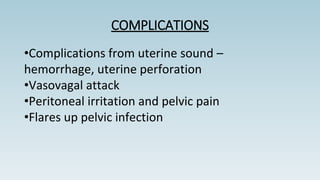
COMPLICATIONS
•Complications from uterine sound –
hemorrhage, uterine perforation
•Vasovagal attack
•Peritoneal irritation and pelvic pain
•Flares up pelvic infection
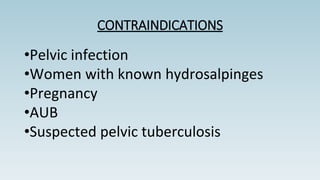
CONTRAINDICATIONS
•Pelvic infection
•Women with known hydrosalpinges
•Pregnancy
•AUB
•Suspected pelvic tuberculosis
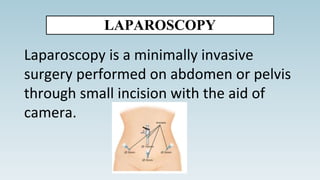
LAPAROSCOPY
Laparoscopy is a minimally invasive
surgery performed on abdomen or pelvis
through small incision with the aid of
camera.
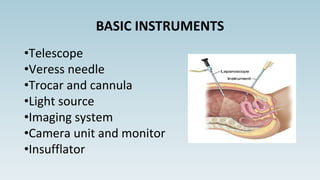
•Telescope
•Veress needle
•Trocar and cannula
•Light source
•Imaging system
•Camera unit and monitor
•Insufflator
BASIC INSTRUMENTS
INDICATIONS
1. Uterus
-myomectomy
-Laparoscopic assisted vaginal hysterectomy
-Adhesiolysis
-Sacrocolpoplexy
2. Ovary
-Drainage of endometriomas
-Ovarian cystectomy
-Salpingo-ovariolysis
-Ovarian biopsy
INDICATIONS
3. FALLOPIAN TUBES
-Tubal sterilization
-Tubal ectopic pregnancy treatment
(salpingectomy, salpingostomy, salpingo-
oophorectomy)
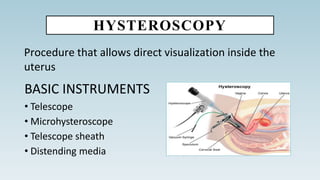
HYSTEROSCOPY
Procedure that allows direct visualization inside the
uterus
BASIC INSTRUMENTS
• Telescope
• Microhysteroscope
• Telescope sheath
• Distending media
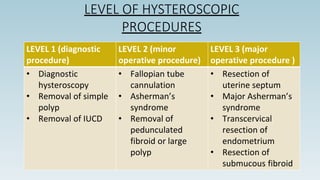
LEVEL OF HYSTEROSCOPIC
PROCEDURES
LEVEL 1 (diagnostic
procedure)
LEVEL 2 (minor
operative procedure)
LEVEL 3 (major
operative procedure )
• Diagnostic
hysteroscopy
• Removal of simple
polyp
• Removal of IUCD
• Fallopian tube
cannulation
• Asherman’s
syndrome
• Removal of
pedunculated
fibroid or large
polyp
• Resection of
uterine septum
• Major Asherman’s
syndrome
• Transcervical
resection of
endometrium
• Resection of
submucous fibroid
Operative gynaecology

Operative gynaecology

  • 1.
  • 2.
    LEARNING OBJECTIVES ALL AREABLE TO UNDERSTAND : • HYSTERECTOMY •MYOMECTOMY •DILATATION AND CURRETAGE •OVARIAN CYSTECTOMY •OOPHORECTOMY •DILATATION AND INSUFFLATION •CERVICAL BIOPSY •THERMAL CAUTERIZATION •CRYOSURGERY •AMPUTATION OF CERVIX •SALPHINGECTOMY •HYSTEROSALPHINGOGRAPHY •LAPAROSCOPY •HYSTEROSCOPY
  • 3.
    PERIOPERATIVE MANAGEMENT PRE OPERATIVEINTRA OPERATIVE POST OPERATIVE •EVALUATION •HISTORY •PHYSICAL EXAMINATION •INVESTIGATION •ADMISSION •PRE- OPERATIVE PREPARATION •COUNSELLING AND INFORMED CONSENT •PREPARATION OF BOWEL •DIET •NIGHT SEDATION •LOCAL ANTISEPTIC CARE •MORNING MEDICATION •PROPHYLACTIC ANTIBIOTIC •THROMBOPROPHYLAXIS •INCISION •DRAINS •CLOSURE OF PERITONEUM •IMMEDIATE •VITAL SIGNS CHECKED •RECOVER FROM ANAESTHESIA •ANAESTHETIST CONSENT •FLUID BALANCE •IN THE WARD •PLACEMENT IN BED •OBSERVATION OF VITALS •FLUID REPLACEMENT •PAIN CONTROL & ANTIBIOTICS •BLADDER CARE •MOBILIZATION •DISCHARGE •ADVICES (REST, AVOID COITUS, FOLLOW UP AFTER 6 WEEKS OR EARLIER IF THERE’S COMPLICATION)
  • 5.
  • 6.
  • 7.
  • 8.
    TYPES OF ABDOMINALHYSTERECTOMY ENTIRE UTERUSREMOVAL OF BODY, LEAVING BEHIND CERVIX UTERUS, TUBES, BOTH OVARIES, UPPER ONE THIRD VAGINA, ADJACENT PARAMETRIUM AND DRAINING LYMPH NODE OF CERVIX PANHYSTERECTOMY/ TAH-BSO
  • 9.
    INDICATION OF HYSTERECTOMY BENIGNLESIONS MALIGNANCY TRAUMATIC OBSTETRICAL DUB Ca Cervix Uterine perforation Atonic PPH Fibroid uterus Ca Ovary Cervical tear Morbid adherent placenta Tuboovarian mass Ca endometrium Rupture uterus Hydatidiform mole (>35 y/o Endometriosis, Adenomyosis Uterine sarcoma Septic abortion CIN Choriocarcinoma Endometrial hyperplasia Benign ovarian tumour
  • 10.
    PRE OPERATIVEPROCEDURE 1. Bloodtesting , review her medical records, confirm the diagnosis. 2. Take patient’s consent, explain risk and procedures 3. Place IV line and prophylactic antibiotics 4. Catheterization 5. Call for anaesthetist, prepare for operating room and prepare blood products.
  • 11.
    STEPS OF ABDOMINALHYSTERECTOMY • Prepare the surgical field: 1. Give anaesthesia preferably spinal 2. Place patient in supine position 3. Paint her abdomen with povidone iodine 4. Drip the patient
  • 12.
    STEPS OF ABDOMINALHYSTERECTOMY • Incision on the abdomen
  • 13.
    • Uterus isdrawn out and traction is given by either using vulsellum / by placing long artery forceps on the uterine cornu / myoma screw in case of fibroid STEPS OF ABDOMINAL HYSTERECTOMY
  • 14.
    • Paired clampsare placed on the round ligament. • It is then cut and replaced by sutures (vicryl no 0 or chromic catgut no 1) STEPS OF ABDOMINAL HYSTERECTOMY
  • 15.
    STEPS OF ABDOMINALHYSTERECTOMY • If the ovaries are to be removed- put paired clamps on infundibulopevic ligaments • If ovaries to be preserved- put clamps on cornual structure • The tissues in between clamps are cut and ligated by transfuxation sutures (vicryl no 0 or chromic catgut no 1
  • 16.
    STEPS OF ABDOMINALHYSTERECTOMY • Identify the loose peritoneum (uterovesical fold), cut it from one divided round ligament to the other • Push the bladder and ureters down until the anterior vaginal wall is reached.
  • 17.
    • Paired clampsare placed on the parametrium which containing ascending branch of uterine artery, close to the level of internal os. • Tissues in between are cut using scalpel and replaced by ligature. STEPS OF ABDOMINAL HYSTERECTOMY
  • 18.
    • Uterus isnow pulled forward to make the uterosacral ligaments prominent. • Clamps are placed on the uterosacral ligaments as close to the cervix and the ligaments are cut and replaced with sutures. STEPS OF ABDOMINAL HYSTERECTOMY
  • 19.
    STEPS OF ABDOMINALHYSTERECTOMY • Clamps are placed at the Mackenrodt's ligaments as close to the cervix. The ligaments are cut on both sides and replaced by sutures. • Stab incision is given to cervicovaginal junction and the remaining vault of vagina is cut while traction is given to the cervix. Uterus is inspected and removed.
  • 20.
    STEPS OF ABDOMINALHYSTERECTOMY Closing of the vaginal vault : • The edges of the cut vaginal vault are grasped by Allis forceps. • Lateral vaginal angle is closed by transfixation suture. • Vault is closed by interrupted sutures or the free margin is reefed with a continuous locking suture. Abdomen is closed.
  • 21.
    PROS VS CONS ADVANTAGESDISADVANTAGES Wider scope of abdominal exploration and pelvic organs Difficult to perform in obese patients Tuboovarian pathology can be tackled effectively and simultaneously Post operative complication is quite high, more pain and more need of analgesia Any concurrent surgical procedures can be performed if needed More hospital stay Operation can be done by a relatively less experienced surgeon with average skill More morbidity and mortality risk compared to vaginal hysterectomy Presence of abdominal scar
  • 22.
  • 23.
    POSTOPERATIVE COMPLICATIONS POSTOPERATIVE IMMEDIATE LATEREMOTE Shock Incontinence Vault granulation Urinary retention and spasm Infection and pyrexia Vault prolapse Hemorrhage Incisional hernia Wound dehiscence Paralytic ileus and intestinal obstruction Deep Vein Thrombosis
  • 24.
  • 25.
    PROS VS CONS ADVANTAGESDISADVANTAGES Can be effectively done in obese patients More skilled and experienced is needed in the surgeon Less postoperative complications Exploration of abdominal and pelvic organs cannot be done Less morbidity and mortality Difficult to be done in case of restricted uterine mobility, limited vaginal space and associated adnexal pathology Less hospital stay No abdominal scar
  • 26.
    CONTRAINDICATIONS • Too largeuterus • Nulliparity • Narrow vagina • Narrow pubic arch • Immobile uterus • adnexa pathology and adhesions • Sever endometriosis
  • 27.
    STEPS OF VAGINALHYSTERECTOMY
  • 28.
    STEPS OF VAGINALHYSTERECTOMY
  • 29.
    STEPS OF VAGINALHYSTERECTOMY
  • 30.
    DILATATION AND CURETTAGE (D&C) •Procedure in which dilatation of cervical canal followed by uterine curettage is done to remove the material from inside of uterus.
  • 31.
    INDICATIONS OF D&C DIAGNOSTICINDICATIONS : 1. DUB 2. Infertility 3. Pathologic amenorrhoea 4. Postmenopausal bleeding 5. Endometrial pathology THERAPEUTIC INDICATIONS : 1. DUB 2. Endometrial polyp 3. Removal of IUD 4. Incomplete abortion 5. Molar pregnancies
  • 32.
    PREPARING FOR D&C 1.Blood testing , review her medical records 2. Take patient’s consent, explain risk and procedures 3. Patients should not drink or eat prior to the procedure 4. Ensure that somebody is accompanying the patient for a safe drive back home 5. Keep the patient’s at ease and ask patient to empty her bladder 6. Place IV line and prophylactic antibiotics 7. Call for anaesthetist, prepare for operating room and prepare blood products.
  • 33.
    PROCEDURE OF D&C 1.Prepare the surgical field - Positioned the patient in lithotomy position - Local antiseptic cleaning and draping - General anesthesia or local anesthesia can be given to the patient. - Bimanual examination is done
  • 34.
    PROCEDURE OF D&C 2.Introduceposterior vaginal speculum 3.Grasp anterior lip of cervix with Allis forceps 4.Introduce uterine sound to confirm length of uterocervical canal
  • 35.
    PROCEDURE OF D&C 5.Cervical canal is dilated gradually with dilators.
  • 36.
    PROCEDURE OF D&C 6.Uterinecavity is curetted by a uterine curette n clockwise / anticlockwise direction starting from fundus down to internal os. Curettage must be gentle and thorough to avoid damage to basal endometrium. 7.Remove vulsellum and speculum
  • 37.
    POST PROCEDURE CARE Monitorpatient in recovering room for a few hours. -Any excessive vaginal bleeding -Vital signs -Treat any anaesthetic side effects if needed Advice patient about: -mild cramping and spotting which may occur for a few hours or days: can be treated by NSAIDs -Avoidance in putting anything into the vagina -Avoid any sexual intercourse -Next menstrual period should occurs within 4-6 weeks of the procedure
  • 38.
    COMPLICATIONS IMMEDIATE REMOTE • Injuryto cervix lip • Hemorrhage • Uterine perforation • Spread of Infection • Cervical incompetence • Intrauterine adhesions • Secondary amenorrhoea
  • 39.
    • Operation designedto correct anterior vaginal wall defect (cystocele and urethrocele) • Principle of repair are to support the prolapsed bladder by approximating weakened pubocervical fascia with the use of sutures. ANTERIOR COLPORRHAPHY
  • 40.
  • 41.
    COLPOPERINEORRHAPHY • Operation designedto correct posterior vaginal wall defect Uses : 1. Relaxed perineum 2. Rectocele 3. Enterocele
  • 43.
    • Vaginal routeoperation designed to correct uterine prolapse associated with cystocele and rectocele where the preservation of the uterus is possible. • This is done when the symptoms are due to vaginal prolapse associated with elongation of supravaginal cervix FOTHERGILL’S / MANCHESTER OPERATION
  • 44.
    PRINCIPAL STEPS INFOTHERGILL’SOPERATION Preliminary D&C Amputation of Cervix Plication of Mackenrodt’s ligaments Anterior colporrhaphy Colpoperineorrhaphy
  • 45.
    MYOMECTOMY • Enucleation ofmyomata from the uterus, leaving behind a potentially functioning organ capable of future reproduction. • Important consideration prior to myomectomy are : 1. Size and numbers of fibroids 2. Should be done mainly to preserve reproductive function, pregnancy rate (40-60%) 3. Risk of recurrence / persistence (30-50%) 4. Risk of persistence menorrhagia (1-5%)
  • 46.
    INDICATIONS FOR MYOMECTOMY •Persistent uterine bleeding despite medical therapy with excessive pain and pressure symptoms • Size >12 weeks, in woman desirous to have a baby • Distortion of uterine cavity without any other cause • Recurrent pregnancy loss due to uterine fibroid • Rapidly growing myoma • Subserous pedunculated fibroid
  • 47.
    CONTRAINDICATIONS OF MYOMECTOMY •Infected fibroid • Parous woman, no longer desire fertility where hysterectomy is safer • Suspected malignant change • Fibroid located in the region of uterine vessels or broad ligament • Pelvic or endometrial tuberculosis • During pregnancy or cesarean section
  • 48.
    PREOPERATIVE PROCEDURE 1. Confirmthe diagnosis (USG, MRI,HSG, endometrial biopsy, examination of the husband in case of infertility) 2. Take consent, explain risk and procedures 3. Blood investigations 4. Preoperative treatment with Gnrh analogue – to reduce vascularity of the tumour 5. Place IV line and antibiotic prophylaxis 6. Call for anaesthetist, prepare operating room and keep blood products ready
  • 49.
  • 50.
    BASIC STEPS 1.Incision onuterus - Single vertical incision is the midline on the anterior wall of the uterus - Incision is deepened through the myometrium and the capsule until myoma is reached 2. Removal of myoma - Grasp fibroid with single toothed vulsellum or myoma screw. - Traction is given between myometrium and fibroid - Dissection is done by sharp (scissors) and blunt method (finger, knife handle)
  • 51.
    3. Closure ofdeep space - Myoma bed is obliterated by interrupted mattress or figure of eight sutures. - Sometimes tire stitch may be required to approximate the myometrium BASIC STEPS
  • 52.
    MEASURES TO CONTROLBLOOD LOSS DURING MYOMECTOMY 1. Preoperative treatment with GnRH analogue 2. Use of vasocontrictive agents (20 U of vasopressin is diluted in 20 ml normal saline and injected to myometrium overlying the myoma) 3. Use of Victor Bonney's specially designed clamp to reduce uterine artery blood flow – place the clamp around uterine vessels and round ligaments 4. Use of tourniquets – to occlude vessels at infundibulopelvic ligaments
  • 53.
    BONNEY'S HOOD OPERATION •Done to remove a large fundal myoma • Incision: low transverse under myoma on the anterior uterine surface • After enucleation of myoma,
  • 54.
    COMPLICATIONS INTRAOPERATIVE 1. Hemorrhage 2. Injuryto bladder, rectum 3. Conversion to hysterectomy POSTOPERATIVE 1. Myoma fever 2. Reactionary and secondary hemorrhage 3. Adhesions 4. Recurrence of fibroid
  • 55.
  • 56.
    OVARIAN CYSTECTOMY • Removalof ovarian tumour leaving behind the healty ovarian tissue • Operation of choice especially in benign neoplasm of ovary in young woman
  • 57.
    OVARIOTOMY /OOPHORECTOMY• Removal oftumour along with healthy ovarian tissue • Indicated when tumour is big and complicated by torsion or hemorrhage.
  • 58.
  • 59.
    DILATATION AND INSUFFLATION (D&I)•Dilatation of cervix followed by introduction of air or carbon dioxide into the uterine cavity to check for tubal patency. • Indications are for infertility investigation and following tuboplasty. • Contraindicated in case of pelvic infection • Complications include all the risk from dilatation process and the following: - Air embolism - Rupture of the tube
  • 60.
    PROCEDURE OF D&I 1.Dilatation of cervix 2. Insufflation cannula fitted with a tube and is introduced into the cervical canal 3. Increase pressure in manometer gradually 4.Auscultates over the flank For any hissing sound.
  • 61.
    SALPINGECTOMY • Surgical removalof fallopian tube Indications 1. Ectopic (tubal) pregnancy 2. Hydrosalpinx 3. Infection and stricture of the tube 4. Cancer of fallopian tube 5. Prevention of ovarian cancer
  • 62.
  • 63.
    CERVICAL BIOPSY • Excisionof the cervix to remove small amount of tissue. TYPES OF CERVICAL BIOPSY - Cone biopsy - Punch biopsy - Surface biopsy - Wedge biopsy - Ring biopsy
  • 64.
    CONIZATION OF CERVIX •2 methods of conization : cold knife and laser conization (LLETZ, LEEP) • Conization is done as diagnostic and therapeutic purpose to CIN. Cases suitable for conization are: 1. Unsatisfactory colposcopic findings- margins of lesion are not fully visualized 2. Inconsistent findings 3. Positive endocervical curettage 4.When directed biopsy cannot rule out microinvasion.
  • 65.
    STEPS OF CONEBIOPSY Procedure is done with cold knife cone with the help of CO2 laser under colposcopic guidance. 1. General anaesthesia 2. Hemostatic sutures is placed at 3 and 9 oclock position 3. Cut the cone, apex is kept below the internal os 4. After cone is removed, a margin suture is placed at 12 oclock position for identification of the cone 5. Routine endocervical curettage is done 6. Cone margins are repaired by hemostatic sutures.
  • 66.
    • Operation todestroy eroded area on the cervix either by thermocoagulation or red hot cauterization • Indication: cervical ectopy with troublesome discharge THERMAL CAUTERIZATION
  • 67.
    • Destruction oftissue by extreme freezing - produce cellular dehydration Indications : 1. Cervical ectopy 2. Benign cervical lesions 3. Condyloma accuminata of vulva and VIN less than 2 cm 4. As a palliative measure to arrest bleeding in Ca cervix CRYOSURGERY
  • 68.
    • Operative procedurewhereby a part of lower cervix is excised. Indications 1. Congenital elongation 2. Chronic cervicitis with hypertrophied cervix (not relived by conventional therapy) 3. As a component part of Fothergill’s to rectify the supravaginal elongation. AMPUTATION OF CERVIX
  • 69.
    HYSTEROSALPHINGOGRAPH Y (HSG) Operative procedureto assess interior anatomy of uterus and tubal patency
  • 70.
    INDICATIONS 1. ASSESS INTERIORANATOMY OF UTERINE -Detection of Uterine malformations -Diagnosis of cervical in competence -Detection of translocated IUD -Diagnosis of uterine synechiae -Confirm diagnosis of secondary abdominal pregnancy 2. TO ASSESS TUBAL PATENCY -Following tuboplasty -Infertility investigations
  • 71.
    DYE USED WATER BASEDDYED OIL BASED DYED - permits rapid absorption - Eliminates granuloma formation - Negligible peritoneal irritation - No risk of embolization when extravasated - Better visualization of tubal mucosa - Better resolution of tubal architecture - Less uterine cramping - Better flushing of the tube , so better chances for subsequent pregnancy Example of dye : 1. Meglumine diatroziate (renografin- 60) - Example of dye : - 1. ethidol
  • 72.
    PROCEDURES 1. Ask patientto empty bladder 2. Position: dorsal position with buttocks on the edge 3. Do internal examination 4. Introduce posterior vaginal speculum 5. Held anterior lip of cervix with Allis forceps 6. Introduce uterine sound to see length and direction of uterine cavity 7. HSG cannula fitted with syringe is introduced. (fill syringe with 5-10 ml of dye) 8. Inject dye slowly 9. Passage of dye into interior is observed by X-ray intensifier
  • 73.
    COMPLICATIONS •Complications from uterinesound – hemorrhage, uterine perforation •Vasovagal attack •Peritoneal irritation and pelvic pain •Flares up pelvic infection
  • 74.
    CONTRAINDICATIONS •Pelvic infection •Women withknown hydrosalpinges •Pregnancy •AUB •Suspected pelvic tuberculosis
  • 76.
    LAPAROSCOPY Laparoscopy is aminimally invasive surgery performed on abdomen or pelvis through small incision with the aid of camera.
  • 77.
    •Telescope •Veress needle •Trocar andcannula •Light source •Imaging system •Camera unit and monitor •Insufflator BASIC INSTRUMENTS
  • 78.
    INDICATIONS 1. Uterus -myomectomy -Laparoscopic assistedvaginal hysterectomy -Adhesiolysis -Sacrocolpoplexy 2. Ovary -Drainage of endometriomas -Ovarian cystectomy -Salpingo-ovariolysis -Ovarian biopsy
  • 79.
    INDICATIONS 3. FALLOPIAN TUBES -Tubalsterilization -Tubal ectopic pregnancy treatment (salpingectomy, salpingostomy, salpingo- oophorectomy)
  • 80.
    HYSTEROSCOPY Procedure that allowsdirect visualization inside the uterus BASIC INSTRUMENTS • Telescope • Microhysteroscope • Telescope sheath • Distending media
  • 81.
    LEVEL OF HYSTEROSCOPIC PROCEDURES LEVEL1 (diagnostic procedure) LEVEL 2 (minor operative procedure) LEVEL 3 (major operative procedure ) • Diagnostic hysteroscopy • Removal of simple polyp • Removal of IUCD • Fallopian tube cannulation • Asherman’s syndrome • Removal of pedunculated fibroid or large polyp • Resection of uterine septum • Major Asherman’s syndrome • Transcervical resection of endometrium • Resection of submucous fibroid