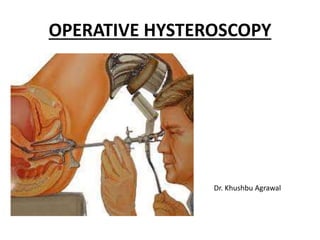
OPERATIVE HYSTEROSCOPY
Dr. Khushbu Agrawal
THERAPEUTIC INDICATIONS
• Resection of uterine septum
• Uterine synechiae
• Cannulation of fallopian tubes
• Uterine polyps
• Submucous myomas
• Endometrial ablation
• Sterilization - ESSURE
• IUD removal
• Biopsy of intrauterine lesions
• Hemangioma and A-V malformations
• Foreign body removal
INSTRUMENTS
• OPERATING SHEATH
The sheath outer diameter ranging between 7 – 10 mm
•to permit the passage of surgical instruments and
•to provide adequate uterine distention using liquid media.
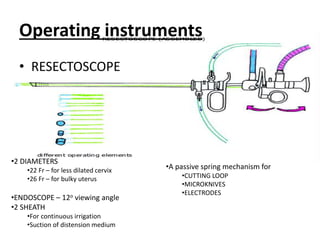
Operating instruments
• RESECTOSCOPE
•2 DIAMETERS
•22 Fr – for less dilated cervix
•26 Fr – for bulky uterus
•ENDOSCOPE – 12o viewing angle
•2 SHEATH
•For continuous irrigation
•Suction of distension medium
•A passive spring mechanism for
•CUTTING LOOP
•MICROKNIVES
•ELECTRODES
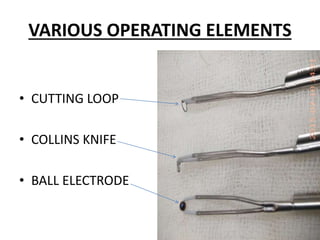
VARIOUS OPERATING ELEMENTS
• CUTTING LOOP
• COLLINS KNIFE
• BALL ELECTRODE
Accessory instruments
BIOPSY AND GRASPING FORCEPS
SCISSORS
PUNCH
BIOPSY SPOON FORCEPS
SCISSORS
TENACULUM GRASPING FORCEPS
COMPLETE SET FOR OPERATIVE
RESECTOSCOPY
• A RESECTOSCOPE
• THE VIDEO-CAMERA SYSTEM
• THE COLD LIGHT SOURCE
• THE ELECTROSURGICAL UNIT
WITH AUTOMATIC POWER
SUPPLY CONTROL AND
ALARM FUNCTION
SPECIFIC PROCEDURES IN
HYSTEROSCOPIC SURGERIES
Septate Uterus
• Problem –
– 1st & 2nd trimester losses
– Premature labour
– Primary Infertility
• Concurrent hysteroscopy and laparoscopy:
gold standard for diagnosis
• Laparoscopy needed to r/o bicornuate uterus
Pregnancy wastage
Hysteroscopic Meteroplasty
• Anesthesia- GA/SA
• Method
– Microscissors
– Nd-YAG Laser
– Electrosurgery
• Guidance Under
– Laparoscopy
– Ultrasonography
Technique
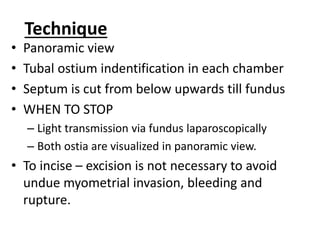
• Panoramic view
• Tubal ostium indentification in each chamber
• Septum is cut from below upwards till fundus
• WHEN TO STOP
– Light transmission via fundus laparoscopically
– Both ostia are visualized in panoramic view.
• To incise – excision is not necessary to avoid
undue myometrial invasion, bleeding and
rupture.
• Resect at midpoint
• Avoid to drift posteriorly to prevent bleeding
• Clip the septum squarely in the middle
• At thicker septa – cut from periphery inward
to center.
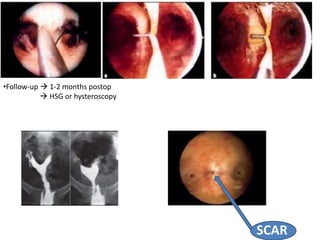
•Follow-up  1-2 months postop
 HSG or hysteroscopy
SCAR
Uterine Synechiae
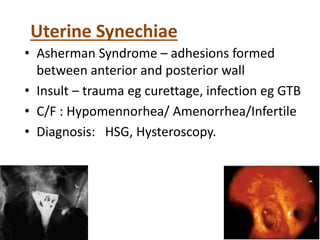
• Asherman Syndrome – adhesions formed
between anterior and posterior wall
• Insult – trauma eg curettage, infection eg GTB
• C/F : Hypomennorhea/ Amenorrhea/Infertile
• Diagnosis: HSG, Hysteroscopy.
ADHESIOLYSIS
• Most difficult of all hysteroscopic surgeries
• Methods:-
– Scissors
– Resectoscope
– Nd-YAG laser
• Lysis opens many vascular channels
– high risk of Intravascular Absorption Syndrome.
Technique
• Thorough cavity assessment for degree of
adhesions.
• Filmy and central adhesions
– Cut first
– Use Microscissors
• Marginal and dense adhesions
– Cut last
– Use Bipolar electrode
• Post op – use of IUDs prevents readhesions
Catheterization of Fallopian Tubes
• Indications
– Unblocking of the ostium and proximal tract
– Application of intratubal contraception devices
• ESSURE
• ADIANA
Cannulation in Tubal obstruction
• Proximal tube – 10- 20% cases
• PID
• ENDOMETRIOSIS
Diagnosis – HSG, Chromopertubation.
• Tubal plugs – non anatomical blockage:
resolve after diagnostic procedures
• True anatomical occlusion – 50%
Technique –
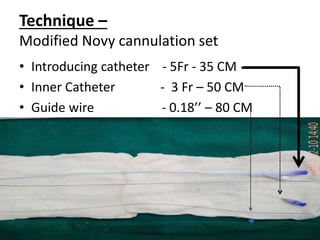
Modified Novy cannulation set
• Introducing catheter - 5Fr - 35 CM
• Inner Catheter - 3 Fr – 50 CM
• Guide wire - 0.18’’ – 80 CM
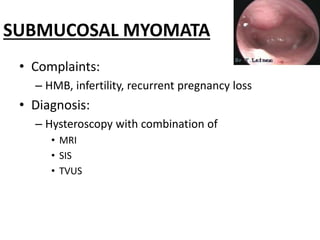
SUBMUCOSAL MYOMATA
• Complaints:
– HMB, infertility, recurrent pregnancy loss
• Diagnosis:
– Hysteroscopy with combination of
• MRI
• SIS
• TVUS
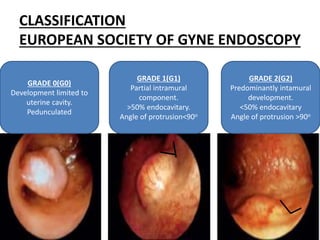
CLASSIFICATION
EUROPEAN SOCIETY OF GYNE ENDOSCOPY
GRADE 0(G0)
Development limited to
uterine cavity.
Pedunculated
GRADE 1(G1)
Partial intramural
component.
>50% endocavitary.
Angle of protrusion<90o
GRADE 2(G2)
Predominantly intamural
development.
<50% endocavitary
Angle of protrusion >90o
MYOMECTOMY
• ROUTE OF MYOMECTOMY
– Desire for future fertility
– Size of myoma
– Number of myoma
– Locations of myoma
– Type 2 lesions – relationship with uterine serosa
– Presence of other coexisting pelvic disease
– Availability of appropriate equipment
Transcervical Myomectomy
• Preferred due to
– Higher efficacy
– Reduction in surgical morbidity
– Absence of abdominal scar
• Methods of hysteroscopic myomectomy
– Cutting using electrosurgical loop
– Vaporization
– Morcellation – Mechanical (FDA Approved)
Preprocedural Preparation
• Use of suppressive medical therapy
– Reduction of volume
– Amenorrhea to built up hemoglobin and iron store
– Facilitation of procedure including improved
visualization
– Reduced systemic absorption of the distending
media
– Complete resection of large myomas in one
setting
GnRH administration 2 months before TCRM resulted in 35% reduction of size.
Cervical preparation
• Misoprostol – PGE1 analogue
– 200-400 mcg PO/PV, 12-24 hrs before surgery
• Intracervical vasopressin
– 4 U in 80ml : use 10 ml to inject at 4:00, 8:00 of
the cervix at the time of hysteroscopy.
– Significant reduction in force for dilation of cervix
– Decrease risk for absorption syndrome, bleeding.
Technique
• LOOP ELECTROSURGICAL RESECTION
– Activation of electrode with low voltage(cutting)
current  strips of myoma created  removal of
the fragmented tissue
• BULK ELECTROSURGICAL VAPORIZATION
– Activated large surface area electrode with low
voltage applied over large volumes of tissue 
volume reduction of tumor  removal of residual
tissue with grasping forceps
• Results in AUB treatment
– EA + TCRM : In women who do not desire fertility,
it improves the success rate to decrease HMB.
TCRM TCRM + EA EA
Completely resected
myomas
84.4% 96.7%
Incompletely resected
myomas
70.4% 92.3%
REPEAT SURGERY RATE 34.6% 39.6%
Loffer FD. Improving results of hysteroscopic submucosal
mymoectomy. J Minimum Invasive Gynecol. 2005;12:254-260(II-3).
SUCCESS RATE
PROCEDURE
• Results in INFERTILITY treatment
STUDY- 108 TYPE 0 TYPE 1 TYPE 2
FERTILITY
RATE
49% 36% 33%
STUDY - 215 TCRE DHL & BIOPSY
FERTILITY RATE 63% 28%
RCT – FertilSteril. 2010;94:724-729(I)
Italian study- ObstetGynecol.1999;94:341-347(II-2)
• Results in RECURRENT PREG LOSSES
•Less evidence to support the benefit.
•Mostly 1st trimester losses due to natural risk
DHL: DIAGNOSTIC
HYSTEROLAPAROSCOPY
ENDOMETRIAL POLYP
• Hyperplasia: single/multiple; sessile/
pedunculated
• Causes:- AUB/ Infertility/ Endometritis
• DIAGNOSIS: USG/SIS/Hysteroscopy
• Treatment:
– Operative hysteroscope with scissors
• Extraction using grasper or endobasket or simple
curettage.
– Resectoscope electric snare loop – for larger polyp
in piecemeal
ENDOMETRIAL ABLATION in AUB
• Described first in 1981.
• Decreased cost , morbidity
• Adequate preoperative counseling
– Hypomenorrhea.
– Rare need for hysterectomy
– Not a method of contraception
– No protection - endometrial Ca.
Preoperative preparation
• EB – R/O endometrial Ca and hyperplasia
• Pretreatment :6 wks with GnRH
• Haemogram, Coagulogram.
• Consent
• 1.5% Glycine: distention media.
• No need of simultaneous laparoscopy
AIM & ACTION OF ABLATION
• AIM – To destroy the visible endometrium
including the cornual endometrium
• Depth – 1-2 mm.
• ACTION – Heat penetrates 3-5 mm deeper, burns
the superficial myometrium and coagulates the
radial branches of the cavity.
• No regeneration due to loss of basal and spiral
arterioles.
• 6-8 weeks later the uterine walls scar and shrinks
Technique
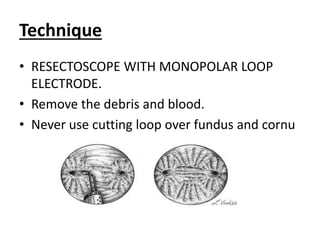
• RESECTOSCOPE WITH MONOPOLAR LOOP
ELECTRODE.
• Remove the debris and blood.
• Never use cutting loop over fundus and cornu
Technique contd.
• Next – anterior and lateral walls
• Last – posterior wall
• Never- below the internal os into cervix
• AVOID –
– Prolong contact time to reduce risk of deeper
injuries and perforation.
Views during Ablation
Failure of endometrial ablation
• Adenomyosis
• Bulky uterus
• Curettage immediately prior to the procedure
• No premedication with GnRH analogues
MISCELLANEOUS PROCEDURES
• MISSING IUD REMOVAL
– String grasped with – Alligator-jaw forceps
– Embedded IUDs – Rigid grasping forceps used
COMPLICATIONS OF
HYSTEROSCOPY
• INCIDENCE : 0.2%
• 10% with major operative surgeries
• SPECTRUM
– Perioperative complications
– Postoperative complications
Perioperative
• Patient positioning
• Anesthesia
• Access to the endometrial cavity
– Cervical trauma
– Uterine perforation.
• Gas emboli
• Intraoperative bleed
• Absorption of distention media syndrome.
• Lower genital tract injuries, burns.
Post operative
• EARLY
– Infection
– Postop bleeding
• LATE – sequelea
– Intrauterine adhesions
– Uterine rupture during pregnancy
PATIENT POSITIONING
• Nerve trauma
• Direct trauma
• Compartment syndrome
• VARIOUS POSITIONS
– Lithotomy position
– Modified lithotomy position – Ideal position
IN ALL PATIENTS WITH
GENERAL ANESTHESIA – AS
THEY CANT REPORT OF
THEIR DISCOMFORT.
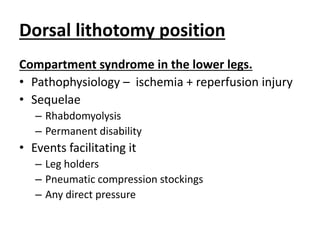
Dorsal lithotomy position
Compartment syndrome in the lower legs.
• Pathophysiology – ischemia + reperfusion injury
• Sequelae
– Rhabdomyolysis
– Permanent disability
• Events facilitating it
– Leg holders
– Pneumatic compression stockings
– Any direct pressure
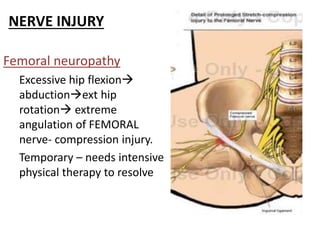
NERVE INJURY
Femoral neuropathy
Excessive hip flexion
abductionext hip
rotation extreme
angulation of FEMORAL
nerve- compression injury.
Temporary – needs intensive
physical therapy to resolve
• Sciatic nerve injury-
– At sciatic notch
• Common peroneal injury
– At neck of fibula – FOOT DROP/ LOWER LATERAL
PARAESTHESIA
RISK REDUCTION & MANAGEMENT
• Ideal lithotomy position- moderate flexion
with limited abduction and ext rotation
• Avoid pressure on injury prone areas
• Avoid leaning on the thigh of the patient.
• Early identification and t/t of complication
Compartment syn & Neuropathy
ANESTHESIA RELATED
• Local anesthesia related
– Allergic reactions
– Cardiovascular complications
• Awareness and avoiding
– Fluid overload
– Electrolyte disturbance
– Signs of gas embolization
INTRAOP/POSTOP BLEEDING
• Most common complication.
• Mostly in myoma resection.
• Immediate :aspirate the blood and increase the
pressure of distention media above the mean
arterial pressure.
• Coagulate with 3mm ball electrode.
• Foleys balloon compression with 3-5ml saline –
kept for 6-12 hrs.
• Rare – UAE/ Hysterectomy
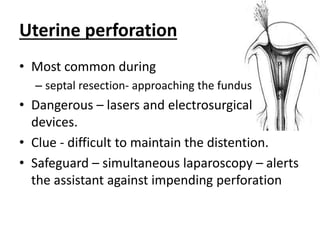
Uterine perforation
• Most common during
– septal resection- approaching the fundus
• Dangerous – lasers and electrosurgical
devices.
• Clue - difficult to maintain the distention.
• Safeguard – simultaneous laparoscopy – alerts
the assistant against impending perforation
Management
• Non-energy instrument
– Strict observation in postop period
– Any hemodynamic deterioration – immediate
laparotomy.
• Energy instrument
– Laparotomy to ensue adjacent organs injury
• High risk for uterine rupture during future
pregnancy
Prevention
• Activate the foot pedal only during the return
phase of electrode towards the sheath.
• Never activate the device during a forward
movement.
• Use roller-ball based
device at the cornu.
INTRAVASCULAR ABSORPTION SYNDROME
(OHIA)
• Low viscosity Liquid distention media
• Incidence < 1%.
• More in premenopausal women
– Female sex steriods – inhibits Na-K+/ATPase pump
thus water and sodium not thrown out of cells.
– GnRH agonists inhibits such hormones action –
may prevent this complication to occur.
1.5% Glycine
Low Viscosity Fluid
Hypoosmolar in nature – when delivered by high
pressure infusion pump – excess vascular absorption
 sudden onset Acute Hyponatremia, hypo-osmolar
state IN BLOOD
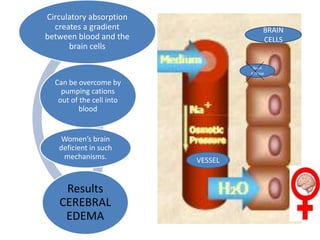
Women’s brain
deficient in such
mechanisms.
Circulatory absorption
creates a gradient
between blood and the
brain cells
Can be overcome by
pumping cations
out of the cell into
blood
Results
CEREBRAL
EDEMA
BRAIN
CELLS
VESSEL
Na/K
ATPase
• NORMAL SALINE
– SAFEST
– EXCESSIVE VASCULAR ABSORPTION  FLUID
OVERLOAD  PULMONARY EDEMA.
– NOT SUITABLE FOR MONOPOLAR SYSTEM : good
conductor of electrons.
Media Delivery & Management
• Delivery system
– Simple gravity – 10mm tubing – 70-100 mmHg –
height 1-1.5 m above uterus.
– Automated pumps
– Insufflators – for CO2 gaseous media
• Volume estimation
– Vol infused– Vol coming out = Vol absorbed
– Measured manually by capturing & measuring.
DEVICES
PREVENTION & TREATMENT
• Preprocedure
– Use of GnRH analogs
– Use of Vasopressin
• Intraop
– Work at lowest effective pressure(50-80mmHg)
– Complete as quickly as possible
– Baseline electrolyte
– Cautious in cardiopulmonary disease
PREVENTION & TREATMENT
• Deficit – 750ml  check electrolytes & give
Inj Lasix 10-40mg
• Deficit > 1500 ml  stop the procedure
• If Na <125mEq/L  terminate the procedure.
• Post op care of such cases in HDU.
• Look for CEREBRAL OR PUL EDEMA, RHF, need
for VENTILATOR support, use of diuretics.
• May require use of hypertonic solutions.
Gas Embolus
• Faulty methods
– Use of laparoscopic insufflator to infuse CO2 in
uterus.
• Diagnosis:
– Tachycardia , desaturation & Hypotension
– Cog-wheel murmur (10% cases) – disappearance
once the hysteroscopy stops
– Rapid fall in expired CO2.
Precautions to prevent embolism
• Avoid Trendelenburg positioning
• Remove last dilator just before inserting the
resectoscope
• Limit repeated removal-reinsertion of the
resectoscope
• Vaporizing myomas eliminates the need to
remove fibroid chips
• Intracervical injection of vasopressin may
block gas from entering circulation
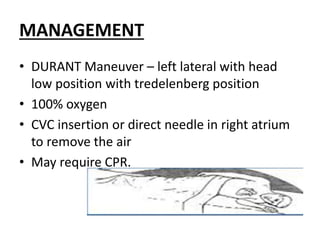
MANAGEMENT
• DURANT Maneuver – left lateral with head
low position with tredelenberg position
• 100% oxygen
• CVC insertion or direct needle in right atrium
to remove the air
• May require CPR.
INFECTION
• Avoid hysteroscopy in gross cervical infection,
uterine infection & salpingitis.
• Role of antibiotics controversial
– Supportive studies in cases with RHD, CHD, MVP.
– Suspected chronic endometritis
– Submucous myomas procedure
– Imbedded IUDs.
ACOG guidelines do not recommend routine prophylactic
antibiotics for hysteroscopy.
CONTRAINDICATIONS of
Operative Hysteroscopy
• Acute pelvic inflammatory disease
• Pregnancy
• Genital tract malignancies
• Inability to dilate the cervix
• Inability to distend the uterus to obtain visualization
• Renal disease – fluid overload risk
• Patient with pacemaker – avoid radiofrequency current
• The patient desires and expects complete amenorrhea
HYSTEROSCOPY

HYSTEROSCOPY

  • 1.
  • 2.
    THERAPEUTIC INDICATIONS • Resectionof uterine septum • Uterine synechiae • Cannulation of fallopian tubes • Uterine polyps • Submucous myomas • Endometrial ablation • Sterilization - ESSURE • IUD removal • Biopsy of intrauterine lesions • Hemangioma and A-V malformations • Foreign body removal
  • 3.
    INSTRUMENTS • OPERATING SHEATH Thesheath outer diameter ranging between 7 – 10 mm •to permit the passage of surgical instruments and •to provide adequate uterine distention using liquid media.
  • 4.
    Operating instruments • RESECTOSCOPE •2DIAMETERS •22 Fr – for less dilated cervix •26 Fr – for bulky uterus •ENDOSCOPE – 12o viewing angle •2 SHEATH •For continuous irrigation •Suction of distension medium •A passive spring mechanism for •CUTTING LOOP •MICROKNIVES •ELECTRODES
  • 5.
    VARIOUS OPERATING ELEMENTS •CUTTING LOOP • COLLINS KNIFE • BALL ELECTRODE
  • 6.
    Accessory instruments BIOPSY ANDGRASPING FORCEPS SCISSORS PUNCH BIOPSY SPOON FORCEPS SCISSORS TENACULUM GRASPING FORCEPS
  • 7.
    COMPLETE SET FOROPERATIVE RESECTOSCOPY • A RESECTOSCOPE • THE VIDEO-CAMERA SYSTEM • THE COLD LIGHT SOURCE • THE ELECTROSURGICAL UNIT WITH AUTOMATIC POWER SUPPLY CONTROL AND ALARM FUNCTION
  • 9.
  • 10.
    Septate Uterus • Problem– – 1st & 2nd trimester losses – Premature labour – Primary Infertility • Concurrent hysteroscopy and laparoscopy: gold standard for diagnosis • Laparoscopy needed to r/o bicornuate uterus Pregnancy wastage
  • 11.
    Hysteroscopic Meteroplasty • Anesthesia-GA/SA • Method – Microscissors – Nd-YAG Laser – Electrosurgery • Guidance Under – Laparoscopy – Ultrasonography
  • 12.
    Technique • Panoramic view •Tubal ostium indentification in each chamber • Septum is cut from below upwards till fundus • WHEN TO STOP – Light transmission via fundus laparoscopically – Both ostia are visualized in panoramic view. • To incise – excision is not necessary to avoid undue myometrial invasion, bleeding and rupture.
  • 13.
    • Resect atmidpoint • Avoid to drift posteriorly to prevent bleeding • Clip the septum squarely in the middle • At thicker septa – cut from periphery inward to center.
  • 14.
    •Follow-up  1-2months postop  HSG or hysteroscopy SCAR
  • 15.
    Uterine Synechiae • AshermanSyndrome – adhesions formed between anterior and posterior wall • Insult – trauma eg curettage, infection eg GTB • C/F : Hypomennorhea/ Amenorrhea/Infertile • Diagnosis: HSG, Hysteroscopy.
  • 16.
    ADHESIOLYSIS • Most difficultof all hysteroscopic surgeries • Methods:- – Scissors – Resectoscope – Nd-YAG laser • Lysis opens many vascular channels – high risk of Intravascular Absorption Syndrome.
  • 17.
    Technique • Thorough cavityassessment for degree of adhesions. • Filmy and central adhesions – Cut first – Use Microscissors • Marginal and dense adhesions – Cut last – Use Bipolar electrode • Post op – use of IUDs prevents readhesions
  • 18.
    Catheterization of FallopianTubes • Indications – Unblocking of the ostium and proximal tract – Application of intratubal contraception devices • ESSURE • ADIANA
  • 19.
    Cannulation in Tubalobstruction • Proximal tube – 10- 20% cases • PID • ENDOMETRIOSIS Diagnosis – HSG, Chromopertubation. • Tubal plugs – non anatomical blockage: resolve after diagnostic procedures • True anatomical occlusion – 50%
  • 20.
    Technique – Modified Novycannulation set • Introducing catheter - 5Fr - 35 CM • Inner Catheter - 3 Fr – 50 CM • Guide wire - 0.18’’ – 80 CM
  • 22.
    SUBMUCOSAL MYOMATA • Complaints: –HMB, infertility, recurrent pregnancy loss • Diagnosis: – Hysteroscopy with combination of • MRI • SIS • TVUS
  • 23.
    CLASSIFICATION EUROPEAN SOCIETY OFGYNE ENDOSCOPY GRADE 0(G0) Development limited to uterine cavity. Pedunculated GRADE 1(G1) Partial intramural component. >50% endocavitary. Angle of protrusion<90o GRADE 2(G2) Predominantly intamural development. <50% endocavitary Angle of protrusion >90o
  • 24.
    MYOMECTOMY • ROUTE OFMYOMECTOMY – Desire for future fertility – Size of myoma – Number of myoma – Locations of myoma – Type 2 lesions – relationship with uterine serosa – Presence of other coexisting pelvic disease – Availability of appropriate equipment
  • 25.
    Transcervical Myomectomy • Preferreddue to – Higher efficacy – Reduction in surgical morbidity – Absence of abdominal scar • Methods of hysteroscopic myomectomy – Cutting using electrosurgical loop – Vaporization – Morcellation – Mechanical (FDA Approved)
  • 26.
    Preprocedural Preparation • Useof suppressive medical therapy – Reduction of volume – Amenorrhea to built up hemoglobin and iron store – Facilitation of procedure including improved visualization – Reduced systemic absorption of the distending media – Complete resection of large myomas in one setting GnRH administration 2 months before TCRM resulted in 35% reduction of size.
  • 27.
    Cervical preparation • Misoprostol– PGE1 analogue – 200-400 mcg PO/PV, 12-24 hrs before surgery • Intracervical vasopressin – 4 U in 80ml : use 10 ml to inject at 4:00, 8:00 of the cervix at the time of hysteroscopy. – Significant reduction in force for dilation of cervix – Decrease risk for absorption syndrome, bleeding.
  • 28.
    Technique • LOOP ELECTROSURGICALRESECTION – Activation of electrode with low voltage(cutting) current  strips of myoma created  removal of the fragmented tissue • BULK ELECTROSURGICAL VAPORIZATION – Activated large surface area electrode with low voltage applied over large volumes of tissue  volume reduction of tumor  removal of residual tissue with grasping forceps
  • 29.
    • Results inAUB treatment – EA + TCRM : In women who do not desire fertility, it improves the success rate to decrease HMB. TCRM TCRM + EA EA Completely resected myomas 84.4% 96.7% Incompletely resected myomas 70.4% 92.3% REPEAT SURGERY RATE 34.6% 39.6% Loffer FD. Improving results of hysteroscopic submucosal mymoectomy. J Minimum Invasive Gynecol. 2005;12:254-260(II-3). SUCCESS RATE PROCEDURE
  • 30.
    • Results inINFERTILITY treatment STUDY- 108 TYPE 0 TYPE 1 TYPE 2 FERTILITY RATE 49% 36% 33% STUDY - 215 TCRE DHL & BIOPSY FERTILITY RATE 63% 28% RCT – FertilSteril. 2010;94:724-729(I) Italian study- ObstetGynecol.1999;94:341-347(II-2) • Results in RECURRENT PREG LOSSES •Less evidence to support the benefit. •Mostly 1st trimester losses due to natural risk DHL: DIAGNOSTIC HYSTEROLAPAROSCOPY
  • 31.
    ENDOMETRIAL POLYP • Hyperplasia:single/multiple; sessile/ pedunculated • Causes:- AUB/ Infertility/ Endometritis • DIAGNOSIS: USG/SIS/Hysteroscopy • Treatment: – Operative hysteroscope with scissors • Extraction using grasper or endobasket or simple curettage. – Resectoscope electric snare loop – for larger polyp in piecemeal
  • 32.
    ENDOMETRIAL ABLATION inAUB • Described first in 1981. • Decreased cost , morbidity • Adequate preoperative counseling – Hypomenorrhea. – Rare need for hysterectomy – Not a method of contraception – No protection - endometrial Ca.
  • 33.
    Preoperative preparation • EB– R/O endometrial Ca and hyperplasia • Pretreatment :6 wks with GnRH • Haemogram, Coagulogram. • Consent • 1.5% Glycine: distention media. • No need of simultaneous laparoscopy
  • 34.
    AIM & ACTIONOF ABLATION • AIM – To destroy the visible endometrium including the cornual endometrium • Depth – 1-2 mm. • ACTION – Heat penetrates 3-5 mm deeper, burns the superficial myometrium and coagulates the radial branches of the cavity. • No regeneration due to loss of basal and spiral arterioles. • 6-8 weeks later the uterine walls scar and shrinks
  • 35.
    Technique • RESECTOSCOPE WITHMONOPOLAR LOOP ELECTRODE. • Remove the debris and blood. • Never use cutting loop over fundus and cornu
  • 36.
    Technique contd. • Next– anterior and lateral walls • Last – posterior wall • Never- below the internal os into cervix • AVOID – – Prolong contact time to reduce risk of deeper injuries and perforation.
  • 37.
  • 38.
    Failure of endometrialablation • Adenomyosis • Bulky uterus • Curettage immediately prior to the procedure • No premedication with GnRH analogues
  • 39.
    MISCELLANEOUS PROCEDURES • MISSINGIUD REMOVAL – String grasped with – Alligator-jaw forceps – Embedded IUDs – Rigid grasping forceps used
  • 40.
  • 41.
    • INCIDENCE :0.2% • 10% with major operative surgeries • SPECTRUM – Perioperative complications – Postoperative complications
  • 42.
    Perioperative • Patient positioning •Anesthesia • Access to the endometrial cavity – Cervical trauma – Uterine perforation. • Gas emboli • Intraoperative bleed • Absorption of distention media syndrome. • Lower genital tract injuries, burns.
  • 43.
    Post operative • EARLY –Infection – Postop bleeding • LATE – sequelea – Intrauterine adhesions – Uterine rupture during pregnancy
  • 44.
    PATIENT POSITIONING • Nervetrauma • Direct trauma • Compartment syndrome • VARIOUS POSITIONS – Lithotomy position – Modified lithotomy position – Ideal position IN ALL PATIENTS WITH GENERAL ANESTHESIA – AS THEY CANT REPORT OF THEIR DISCOMFORT.
  • 45.
    Dorsal lithotomy position Compartmentsyndrome in the lower legs. • Pathophysiology – ischemia + reperfusion injury • Sequelae – Rhabdomyolysis – Permanent disability • Events facilitating it – Leg holders – Pneumatic compression stockings – Any direct pressure
  • 46.
    NERVE INJURY Femoral neuropathy Excessivehip flexion abductionext hip rotation extreme angulation of FEMORAL nerve- compression injury. Temporary – needs intensive physical therapy to resolve
  • 47.
    • Sciatic nerveinjury- – At sciatic notch • Common peroneal injury – At neck of fibula – FOOT DROP/ LOWER LATERAL PARAESTHESIA
  • 48.
    RISK REDUCTION &MANAGEMENT • Ideal lithotomy position- moderate flexion with limited abduction and ext rotation • Avoid pressure on injury prone areas • Avoid leaning on the thigh of the patient. • Early identification and t/t of complication Compartment syn & Neuropathy
  • 49.
    ANESTHESIA RELATED • Localanesthesia related – Allergic reactions – Cardiovascular complications • Awareness and avoiding – Fluid overload – Electrolyte disturbance – Signs of gas embolization
  • 50.
    INTRAOP/POSTOP BLEEDING • Mostcommon complication. • Mostly in myoma resection. • Immediate :aspirate the blood and increase the pressure of distention media above the mean arterial pressure. • Coagulate with 3mm ball electrode. • Foleys balloon compression with 3-5ml saline – kept for 6-12 hrs. • Rare – UAE/ Hysterectomy
  • 51.
    Uterine perforation • Mostcommon during – septal resection- approaching the fundus • Dangerous – lasers and electrosurgical devices. • Clue - difficult to maintain the distention. • Safeguard – simultaneous laparoscopy – alerts the assistant against impending perforation
  • 52.
    Management • Non-energy instrument –Strict observation in postop period – Any hemodynamic deterioration – immediate laparotomy. • Energy instrument – Laparotomy to ensue adjacent organs injury • High risk for uterine rupture during future pregnancy
  • 53.
    Prevention • Activate thefoot pedal only during the return phase of electrode towards the sheath. • Never activate the device during a forward movement. • Use roller-ball based device at the cornu.
  • 54.
    INTRAVASCULAR ABSORPTION SYNDROME (OHIA) •Low viscosity Liquid distention media • Incidence < 1%. • More in premenopausal women – Female sex steriods – inhibits Na-K+/ATPase pump thus water and sodium not thrown out of cells. – GnRH agonists inhibits such hormones action – may prevent this complication to occur.
  • 55.
    1.5% Glycine Low ViscosityFluid Hypoosmolar in nature – when delivered by high pressure infusion pump – excess vascular absorption  sudden onset Acute Hyponatremia, hypo-osmolar state IN BLOOD
  • 56.
    Women’s brain deficient insuch mechanisms. Circulatory absorption creates a gradient between blood and the brain cells Can be overcome by pumping cations out of the cell into blood Results CEREBRAL EDEMA BRAIN CELLS VESSEL Na/K ATPase
  • 57.
    • NORMAL SALINE –SAFEST – EXCESSIVE VASCULAR ABSORPTION  FLUID OVERLOAD  PULMONARY EDEMA. – NOT SUITABLE FOR MONOPOLAR SYSTEM : good conductor of electrons.
  • 58.
    Media Delivery &Management • Delivery system – Simple gravity – 10mm tubing – 70-100 mmHg – height 1-1.5 m above uterus. – Automated pumps – Insufflators – for CO2 gaseous media • Volume estimation – Vol infused– Vol coming out = Vol absorbed – Measured manually by capturing & measuring.
  • 59.
  • 60.
    PREVENTION & TREATMENT •Preprocedure – Use of GnRH analogs – Use of Vasopressin • Intraop – Work at lowest effective pressure(50-80mmHg) – Complete as quickly as possible – Baseline electrolyte – Cautious in cardiopulmonary disease
  • 61.
    PREVENTION & TREATMENT •Deficit – 750ml  check electrolytes & give Inj Lasix 10-40mg • Deficit > 1500 ml  stop the procedure • If Na <125mEq/L  terminate the procedure. • Post op care of such cases in HDU. • Look for CEREBRAL OR PUL EDEMA, RHF, need for VENTILATOR support, use of diuretics. • May require use of hypertonic solutions.
  • 62.
    Gas Embolus • Faultymethods – Use of laparoscopic insufflator to infuse CO2 in uterus. • Diagnosis: – Tachycardia , desaturation & Hypotension – Cog-wheel murmur (10% cases) – disappearance once the hysteroscopy stops – Rapid fall in expired CO2.
  • 63.
    Precautions to preventembolism • Avoid Trendelenburg positioning • Remove last dilator just before inserting the resectoscope • Limit repeated removal-reinsertion of the resectoscope • Vaporizing myomas eliminates the need to remove fibroid chips • Intracervical injection of vasopressin may block gas from entering circulation
  • 64.
    MANAGEMENT • DURANT Maneuver– left lateral with head low position with tredelenberg position • 100% oxygen • CVC insertion or direct needle in right atrium to remove the air • May require CPR.
  • 65.
    INFECTION • Avoid hysteroscopyin gross cervical infection, uterine infection & salpingitis. • Role of antibiotics controversial – Supportive studies in cases with RHD, CHD, MVP. – Suspected chronic endometritis – Submucous myomas procedure – Imbedded IUDs. ACOG guidelines do not recommend routine prophylactic antibiotics for hysteroscopy.
  • 66.
    CONTRAINDICATIONS of Operative Hysteroscopy •Acute pelvic inflammatory disease • Pregnancy • Genital tract malignancies • Inability to dilate the cervix • Inability to distend the uterus to obtain visualization • Renal disease – fluid overload risk • Patient with pacemaker – avoid radiofrequency current • The patient desires and expects complete amenorrhea