
Dr. Rafi Rozan
Obstetrician & Gynecologist
Specialist in Comprehensive Family Medicine
Mastology, Cosmetic & Laparoscopic Gyn.
Medical Technologist
Vaginal Hysterectomy
Soranus of Rome (Reign of the Emperor Hadrian)
Berengarius of Balogna (1507)
Grafenberg (1617)
Laumonier (1792)
Baudelocque (Supurative Peritonitis)
Beyerle (asserted that the Uterus was removed)
Bardol, Marc Antonie, Petit de lyon, Widmann, Ramsbotham,
Figuet, Blasius
Midwives (1646 -1824
Johnson, Baxter, Faivre, Zwinger, Winsor, Weber
Paletta (1812 Malignant uterus)
Operative techniques
Radical Shauta operation
Shushart incision
Vaginal hysterectomy Prolapsed Hayney (2)
Te Linde Matingly (6)
Mayo (4)
Kapson
Cambel
Tchernstuk Cornil
Doderlein – Kronig
Without prolapse Dick Eclins
Introduction
• The technique of operating through the vagina is a prerogative of the
gynecologic surgeon.
• Vaginal surgery is an essential pre requisite in the cultural and surgical
training of a qualified gynecologist.
• Vaginal hysterectomy is a signature operation of the gynecologic
profession, it is the gold standard and the hallmark of surgical
extirpative hysterectomy surgery.
• At minimum a gynecologist should preform at least 25% of
hysterectomies by the vaginal route.
Advantages of the vaginal route
• Lower morbidity
• Less pain
• More rapid recovery
• Rapid return to normal activities
• Less consumption of health care dollars
• Less use of resources
• Less hemorrhage
• Shorter hospital stay
• No scars, better cosmetic finish
• Safer
Indications
• The same as all other routes
Contraindications
• Absolute : There is no absolute contraindication
• Relative : Malignancy
Extremely enlarged uterus
Dense pelvic adhesions
Characteristics that can make the
vaginal approach challenging
• Nulliparity
• Increased BMI
• History of pelvic radiation
• Lack of uterine descent
Surgical & Preoperative Planning
• Informed consent
• Surgical counselling
• Medical optimization
• Adhesions
• Mass (leiomyomata)
• Enlarged uterine size
• Adnexa - Fallopian tubes
- Ovaries
• Prophylactic cuff suspension
• Cystourethroscopy
• Thromboprophylaxis
• Antibiotics
• Vaginal infection
• Pelvic organ prolapse (UI)
• Bowel preparation
• Choice of anesthetic
• Instrument selection
• Patient positioning
• Bladder catheter insertion
• Vaginal preparation
- 4% chlorohexidine + 4%
isopropyl alcohol concentration
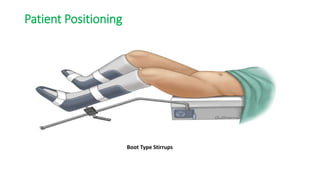
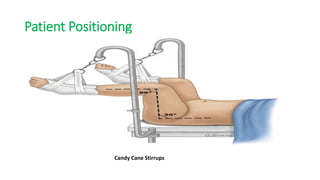
Patient Positioning
*Dorsal Lithotomy Position
*Pelvic Tilt
*Arms tucked to the Side
Patient Positioning
Boot Type Stirrups
Patient Positioning
Candy Cane Stirrups
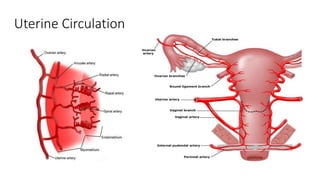
Uterine Circulation
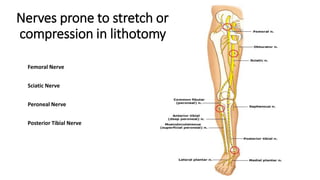
Nerves prone to stretch or
compression in lithotomy
Femoral Nerve
Sciatic Nerve
Peroneal Nerve
Posterior Tibial Nerve
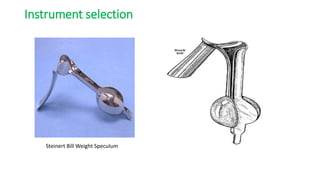
Instrument selection
Steinert Bill Weight Speculum
Instrument selection
SIMS Double end Retractor SIMS Single end Retractor
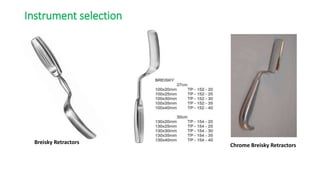
Instrument selection
Breisky Retractors
Chrome Breisky Retractors
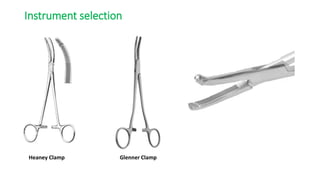
Instrument selection
Heaney Clamp Glenner Clamp
Instrument selection
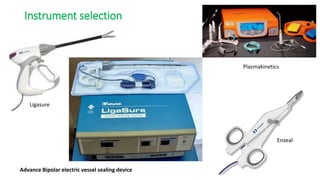
Advance Bipolar electric vessel sealing device
Ligasure
Plasmakinetics
Enseal
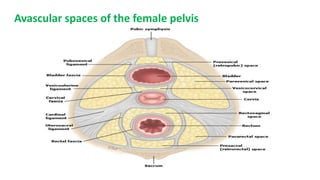
Avascular spaces of the female pelvis
Procedure
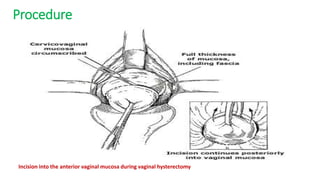
Incision into the anterior vaginal mucosa during vaginal hysterectomy
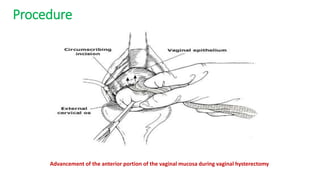
Advancement of the anterior portion of the vaginal mucosa during vaginal hysterectomy
Procedure
Procedure
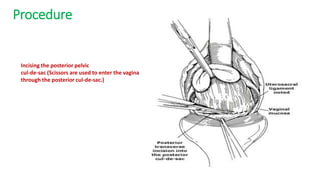
Incising the posterior pelvic
cul-de-sac (Scissors are used to enter the vagina
through the posterior cul-de-sac.)
Procedure
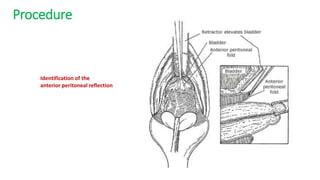
Identification of the
anterior peritoneal reflection
Procedure
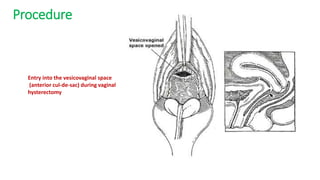
Entry into the vesicovaginal space
(anterior cul-de-sac) during vaginal
hysterectomy
Procedure
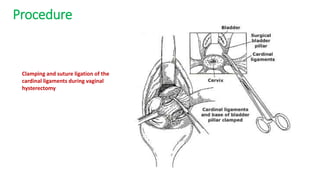
Clamping and suture ligation of the
cardinal ligaments during vaginal
hysterectomy
Procedure
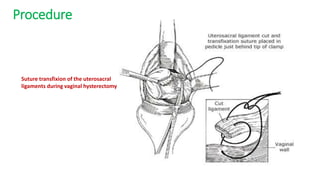
Suture transfixion of the uterosacral
ligaments during vaginal hysterectomy
Procedure
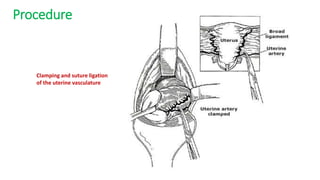
Clamping and suture ligation
of the uterine vasculature
Procedure
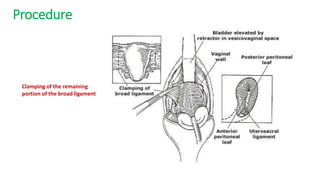
Clamping of the remaining
portion of the broad ligament
Procedure
Clamping of the utero-ovarian ligament
Procedure
Delivery of the uterine fundus posteriorly
Procedure
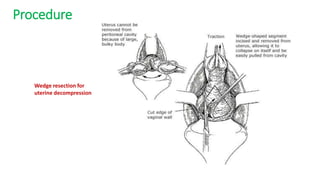
Wedge resection for
uterine decompression
Procedure
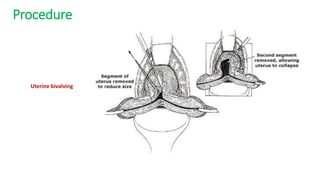
Uterine bivalving
Procedure
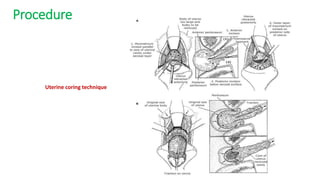
Uterine coring technique
Procedure
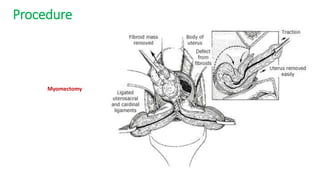
Myomectomy
Morcelation
Procedure
Procedure
Closure of the vaginal mucosa.
Culdoplasty: Halban
Moschowitz
Mc Call
Common post operative complications
• Urinary retention
• Urinary incontinence
• Cuff Abscess
• Cuff dehiscence
• Bleeding
• Fallopian tube prolapse
• Fever
• Fistula
• Ileus and bowel obstruction
• Venous thromboembolism
REFERENCES
• Aarts JW, Nieboer TE, Johnson N, et al. Surgical approach to hysterectomy for benign gynaecological disease. Cochrane
Database Syst Rev 2015; :CD003677.
• Committee on Gynecologic Practice. Committee Opinion No 701: Choosing the Route of Hysterectomy for Benign
Disease. Obstet Gynecol 2017; 129:e155.
• Zimmerman CW. Vaginal hysterectomy. In: TeLinde's Operative Gynecology, 11, Howard W. Jones III, John A. Rock (Eds),
Wolters Kluwer, Philadephia 2015. p.715.
• Doucette RC, Sharp HT, Alder SC. Challenging generally accepted contraindications to vaginal hysterectomy. Am J
Obstet Gynecol 2001; 184:1386.
• Friedman AJ, Barbieri RL, Doubilet PM, et al. A randomized, double-blind trial of a gonadotropin releasing-hormone
agonist (leuprolide) with or without medroxyprogesterone acetate in the treatment of leiomyomata uteri. Fertil Steril
1988; 49:404.
• Carr BR, Marshburn PB, Weatherall PT, et al. An evaluation of the effect of gonadotropin-releasing hormone analogs
and medroxyprogesterone acetate on uterine leiomyomata volume by magnetic resonance imaging: a prospective,
randomized, double blind, placebo-controlled, crossover trial. J Clin Endocrinol Metab 1993; 76:1217.
• Minaguchi H, Wong JM, Snabes MC. Clinical use of nafarelin in the treatment of leiomyomas. A review of the
literature. J Reprod Med 2000; 45:481.
• Favero G, Miglino G, Köhler C, et al. Vaginal Morcellation Inside Protective Pouch: A Safe Strategy for Uterine Extration
in Cases of Bulky Endometrial Cancers: Operative and Oncological Safety of the Method. J Minim Invasive Gynecol
2015; 22:938.
• Shiota M, Kotani Y, Umemoto M, et al. Indication for laparoscopically assisted vaginal hysterectomy. JSLS 2011; 15:343.
• Lash AF. A method for reducing the size of the uterus in vaginal hysterectomy. Am J Obstet Gynecol 1941; 42:452.
Dr. Rafi Rozan
Obstetrician & Gynecologist
Specialist in Comprehensive Family Medicine
Mastology, Cosmetic & Laparoscopic Gyn.
Medical Technologist

Vaginal Hysterectomy

  • 1.
    Dr. Rafi Rozan Obstetrician& Gynecologist Specialist in Comprehensive Family Medicine Mastology, Cosmetic & Laparoscopic Gyn. Medical Technologist Vaginal Hysterectomy
  • 2.
    Soranus of Rome(Reign of the Emperor Hadrian) Berengarius of Balogna (1507) Grafenberg (1617) Laumonier (1792) Baudelocque (Supurative Peritonitis) Beyerle (asserted that the Uterus was removed) Bardol, Marc Antonie, Petit de lyon, Widmann, Ramsbotham, Figuet, Blasius Midwives (1646 -1824 Johnson, Baxter, Faivre, Zwinger, Winsor, Weber Paletta (1812 Malignant uterus)
  • 3.
    Operative techniques Radical Shautaoperation Shushart incision Vaginal hysterectomy Prolapsed Hayney (2) Te Linde Matingly (6) Mayo (4) Kapson Cambel Tchernstuk Cornil Doderlein – Kronig Without prolapse Dick Eclins
  • 4.
    Introduction • The techniqueof operating through the vagina is a prerogative of the gynecologic surgeon. • Vaginal surgery is an essential pre requisite in the cultural and surgical training of a qualified gynecologist. • Vaginal hysterectomy is a signature operation of the gynecologic profession, it is the gold standard and the hallmark of surgical extirpative hysterectomy surgery. • At minimum a gynecologist should preform at least 25% of hysterectomies by the vaginal route.
  • 5.
    Advantages of thevaginal route • Lower morbidity • Less pain • More rapid recovery • Rapid return to normal activities • Less consumption of health care dollars • Less use of resources • Less hemorrhage • Shorter hospital stay • No scars, better cosmetic finish • Safer
  • 6.
    Indications • The sameas all other routes
  • 7.
    Contraindications • Absolute :There is no absolute contraindication • Relative : Malignancy Extremely enlarged uterus Dense pelvic adhesions
  • 8.
    Characteristics that canmake the vaginal approach challenging • Nulliparity • Increased BMI • History of pelvic radiation • Lack of uterine descent
  • 9.
    Surgical & PreoperativePlanning • Informed consent • Surgical counselling • Medical optimization • Adhesions • Mass (leiomyomata) • Enlarged uterine size • Adnexa - Fallopian tubes - Ovaries • Prophylactic cuff suspension • Cystourethroscopy • Thromboprophylaxis • Antibiotics • Vaginal infection • Pelvic organ prolapse (UI) • Bowel preparation • Choice of anesthetic • Instrument selection • Patient positioning • Bladder catheter insertion • Vaginal preparation - 4% chlorohexidine + 4% isopropyl alcohol concentration
  • 10.
    Patient Positioning *Dorsal LithotomyPosition *Pelvic Tilt *Arms tucked to the Side
  • 11.
  • 12.
  • 13.
  • 14.
    Nerves prone tostretch or compression in lithotomy Femoral Nerve Sciatic Nerve Peroneal Nerve Posterior Tibial Nerve
  • 15.
  • 16.
    Instrument selection SIMS Doubleend Retractor SIMS Single end Retractor
  • 17.
  • 18.
  • 19.
    Instrument selection Advance Bipolarelectric vessel sealing device Ligasure Plasmakinetics Enseal
  • 20.
    Avascular spaces ofthe female pelvis
  • 21.
    Procedure Incision into theanterior vaginal mucosa during vaginal hysterectomy
  • 22.
    Advancement of theanterior portion of the vaginal mucosa during vaginal hysterectomy Procedure
  • 23.
    Procedure Incising the posteriorpelvic cul-de-sac (Scissors are used to enter the vagina through the posterior cul-de-sac.)
  • 24.
  • 25.
    Procedure Entry into thevesicovaginal space (anterior cul-de-sac) during vaginal hysterectomy
  • 26.
    Procedure Clamping and sutureligation of the cardinal ligaments during vaginal hysterectomy
  • 27.
    Procedure Suture transfixion ofthe uterosacral ligaments during vaginal hysterectomy
  • 28.
    Procedure Clamping and sutureligation of the uterine vasculature
  • 29.
    Procedure Clamping of theremaining portion of the broad ligament
  • 30.
    Procedure Clamping of theutero-ovarian ligament
  • 31.
    Procedure Delivery of theuterine fundus posteriorly
  • 32.
  • 33.
  • 34.
  • 35.
  • 36.
  • 37.
    Procedure Closure of thevaginal mucosa. Culdoplasty: Halban Moschowitz Mc Call
  • 38.
    Common post operativecomplications • Urinary retention • Urinary incontinence • Cuff Abscess • Cuff dehiscence • Bleeding • Fallopian tube prolapse • Fever • Fistula • Ileus and bowel obstruction • Venous thromboembolism
  • 39.
    REFERENCES • Aarts JW,Nieboer TE, Johnson N, et al. Surgical approach to hysterectomy for benign gynaecological disease. Cochrane Database Syst Rev 2015; :CD003677. • Committee on Gynecologic Practice. Committee Opinion No 701: Choosing the Route of Hysterectomy for Benign Disease. Obstet Gynecol 2017; 129:e155. • Zimmerman CW. Vaginal hysterectomy. In: TeLinde's Operative Gynecology, 11, Howard W. Jones III, John A. Rock (Eds), Wolters Kluwer, Philadephia 2015. p.715. • Doucette RC, Sharp HT, Alder SC. Challenging generally accepted contraindications to vaginal hysterectomy. Am J Obstet Gynecol 2001; 184:1386. • Friedman AJ, Barbieri RL, Doubilet PM, et al. A randomized, double-blind trial of a gonadotropin releasing-hormone agonist (leuprolide) with or without medroxyprogesterone acetate in the treatment of leiomyomata uteri. Fertil Steril 1988; 49:404. • Carr BR, Marshburn PB, Weatherall PT, et al. An evaluation of the effect of gonadotropin-releasing hormone analogs and medroxyprogesterone acetate on uterine leiomyomata volume by magnetic resonance imaging: a prospective, randomized, double blind, placebo-controlled, crossover trial. J Clin Endocrinol Metab 1993; 76:1217. • Minaguchi H, Wong JM, Snabes MC. Clinical use of nafarelin in the treatment of leiomyomas. A review of the literature. J Reprod Med 2000; 45:481. • Favero G, Miglino G, Köhler C, et al. Vaginal Morcellation Inside Protective Pouch: A Safe Strategy for Uterine Extration in Cases of Bulky Endometrial Cancers: Operative and Oncological Safety of the Method. J Minim Invasive Gynecol 2015; 22:938. • Shiota M, Kotani Y, Umemoto M, et al. Indication for laparoscopically assisted vaginal hysterectomy. JSLS 2011; 15:343. • Lash AF. A method for reducing the size of the uterus in vaginal hysterectomy. Am J Obstet Gynecol 1941; 42:452.
  • 40.
    Dr. Rafi Rozan Obstetrician& Gynecologist Specialist in Comprehensive Family Medicine Mastology, Cosmetic & Laparoscopic Gyn. Medical Technologist

Editor's Notes

  • #7 VH is the preferred route. Surgeons preference for other routes is no longer considered appropriate to avoid vaginal approach.
  • #12 Allows to change the patient position intraoperatively. Decrease exposure because of large size
  • #13 Provides most access and exposure for vaginal delivery because they are least bulky. Does not allow for change in position intraoperatively.
  • #16 Steinert retracts the posterior vaginal and peritoneal surface one the posterior peritoneum has been entered
  • #17 Sims retractor are used with short weight speculum to visualize the cervix
  • #18 Breisky Retractors are used to back the vaginal side walls
  • #19 Use to clamp vascular pedicles
  • #21 Avascular spaces of the female pelvis (Schematic sectional drawing of the pelvis shows the firm connective tissue covering. The bladder, cervix, and rectum are surrounded by a connective tissue.