Operational Planning: The Key to
     Building a Culture of Implementation
                  and Focus

                Anthony Reese

                February 13, 2013


A Service
   Of:                      Sponsored by:
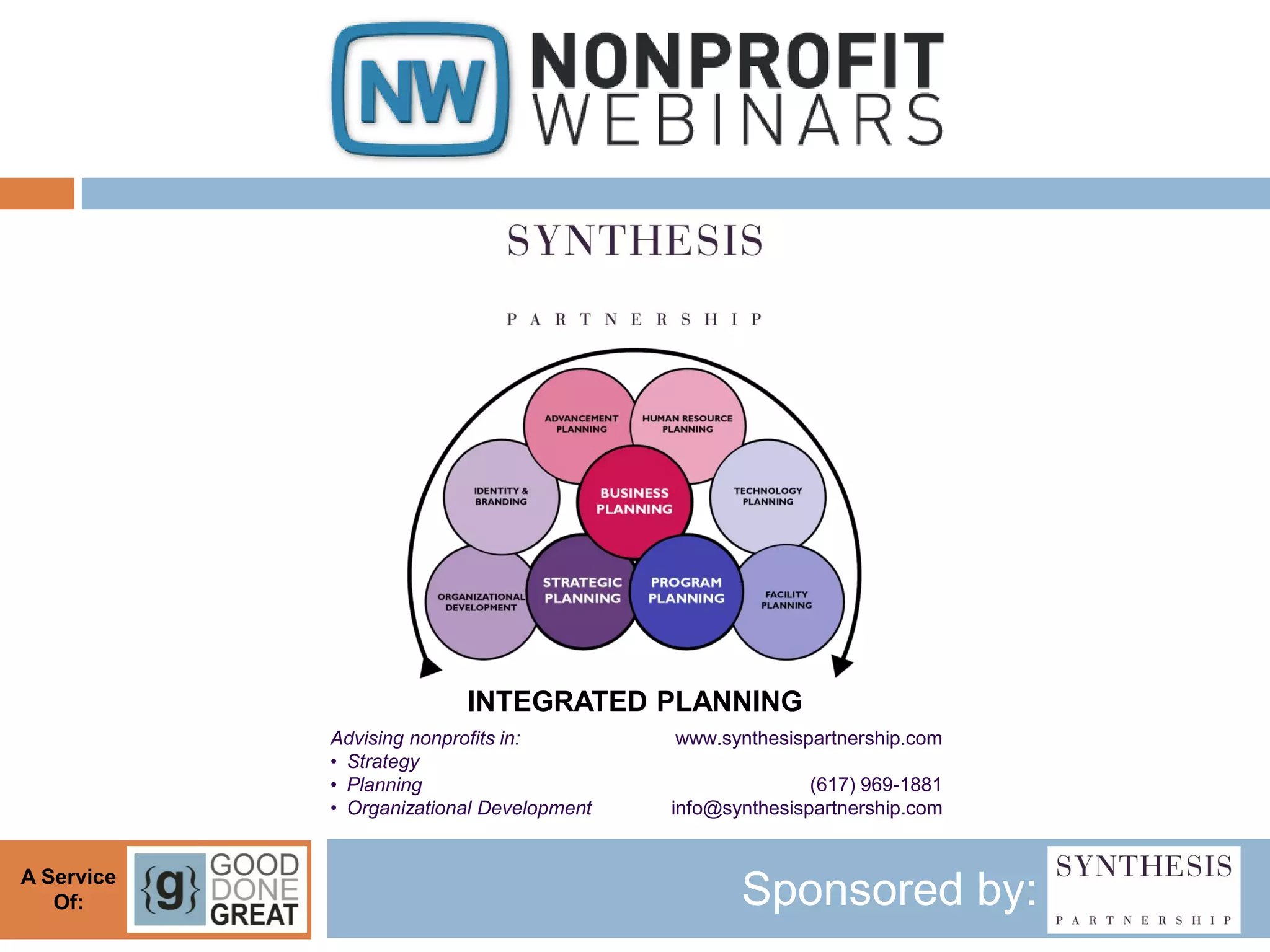
INTEGRATED PLANNING
            Advising nonprofits in:        www.synthesispartnership.com
            • Strategy
            • Planning                                    (617) 969-1881
            • Organizational Development   info@synthesispartnership.com


A Service
   Of:                                            Sponsored by:
Affordable collaborative data
             management in the cloud.

A Service
   Of:                        Sponsored by:
Today’s Speaker


                                     Anthony Reese
                                     CFO and Vice President
                               of Financial Management Practice
Assisting with chat questions:        Olive Grove Consulting                              Hosting:
Jamie Maloney, Nonprofit Webinars                                 Sam Frank, Synthesis Partnership

A Service
   Of:                                                 Sponsored by:
ACHIEVING ORGANIZATIONAL
         FOCUS
Between the Idea
 And the Reality

Between the Motion
   And the Act

 Falls the Shadow

   --T.S.Eliot
The questions seem eternal:

“Why do so many organizations suffer from internal
     instability and a lack of focus on program
                     outcomes?”

   “What investment can you make to generate
    organizational focus, stability, and efficacy?”
ACHIEVING ORGANIZATIONAL FOCUS

           Organizational Life Cycle


  Entrepreneurial
  Institutionalizing
  Mature
  Reorganizing
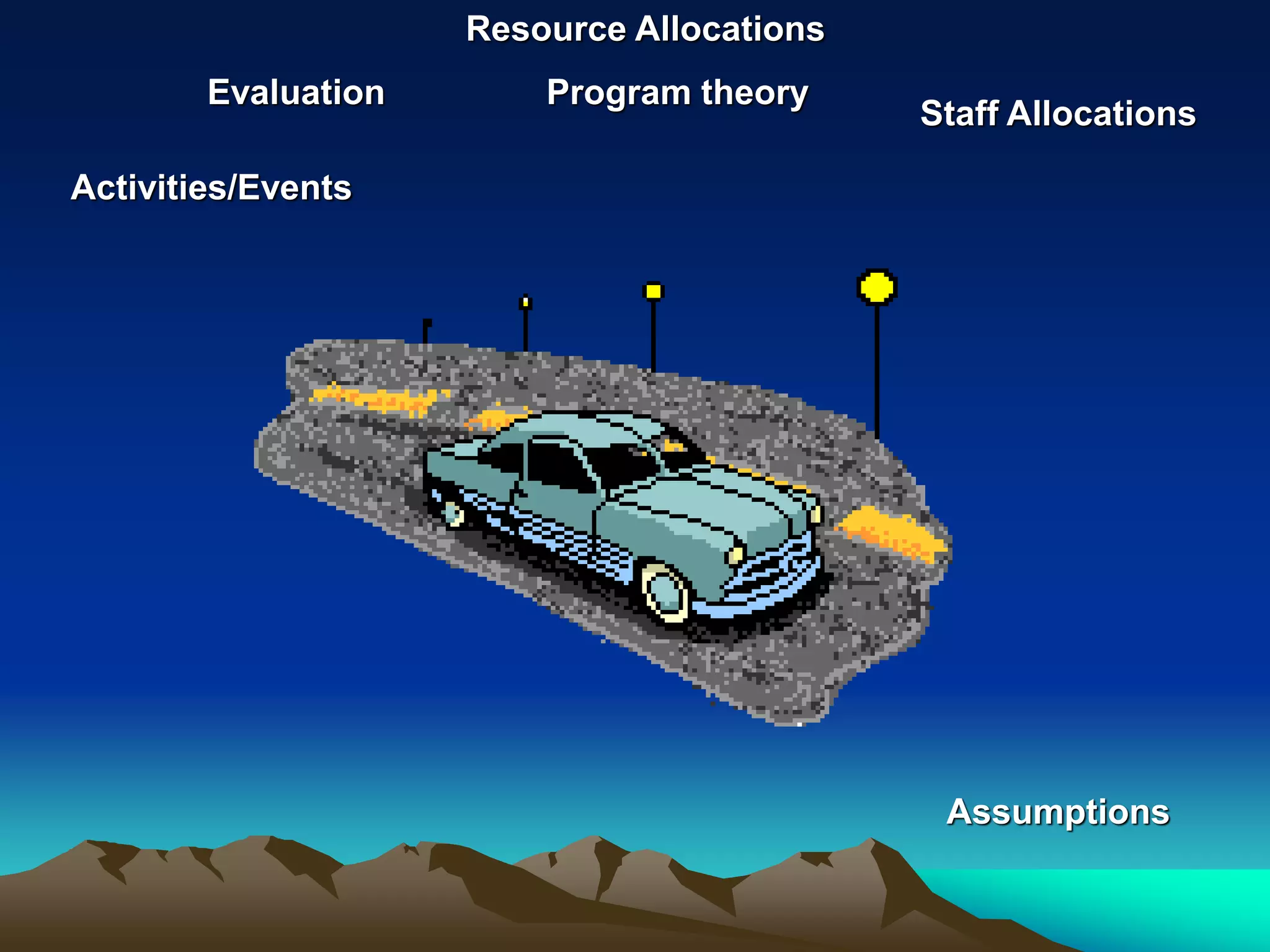
Resource Allocations
        Evaluation       Program theory
                                            Staff Allocations

Activities/Events


                                             Assumptions
How Do We Achieve Focus and Coordinated Action?
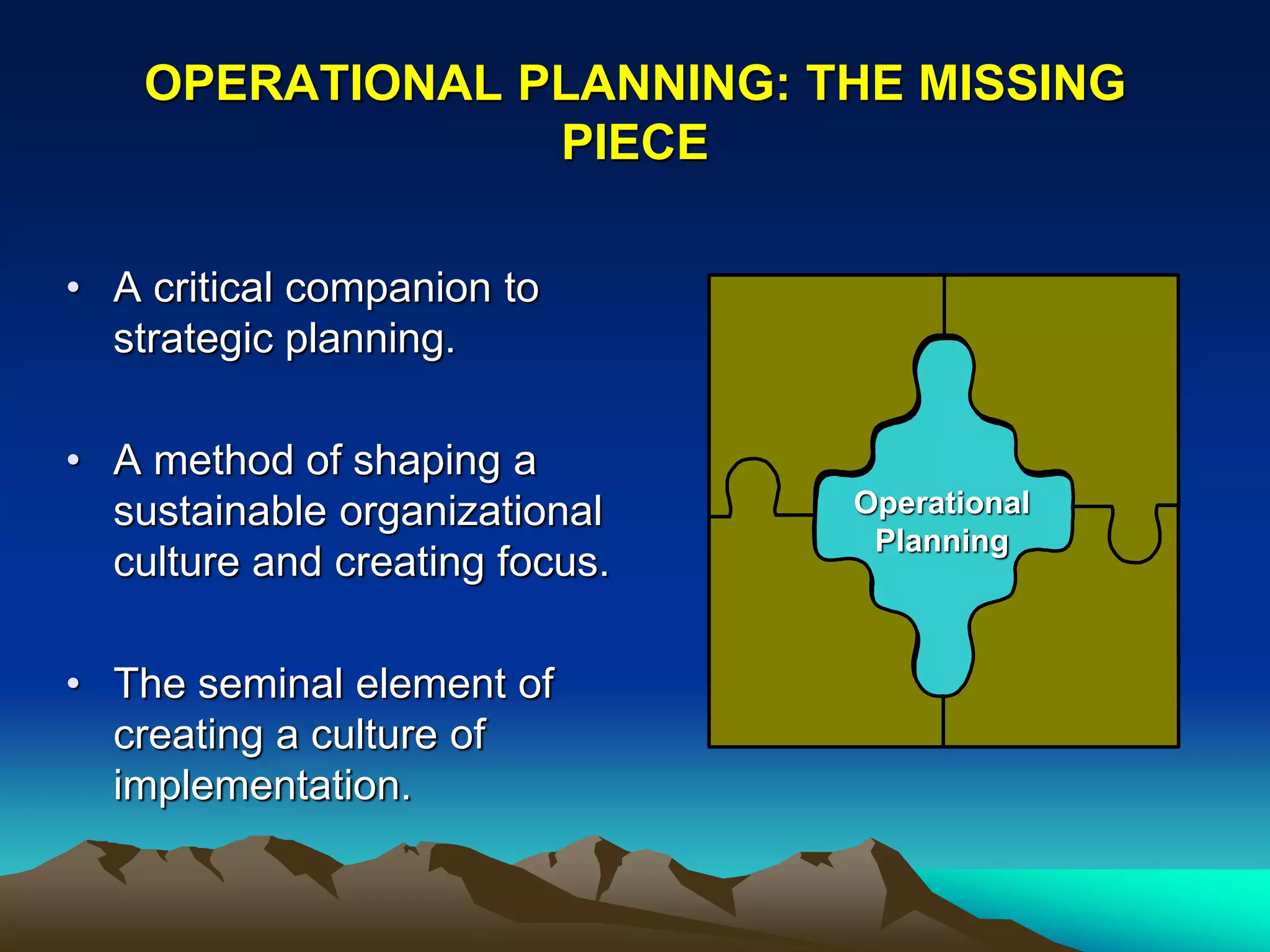
OPERATIONAL PLANNING: THE MISSING
                 PIECE

• A critical companion to
  strategic planning.

• A method of shaping a
  sustainable organizational    Operational
                                 Planning
  culture and creating focus.

• The seminal element of
  creating a culture of
  implementation.
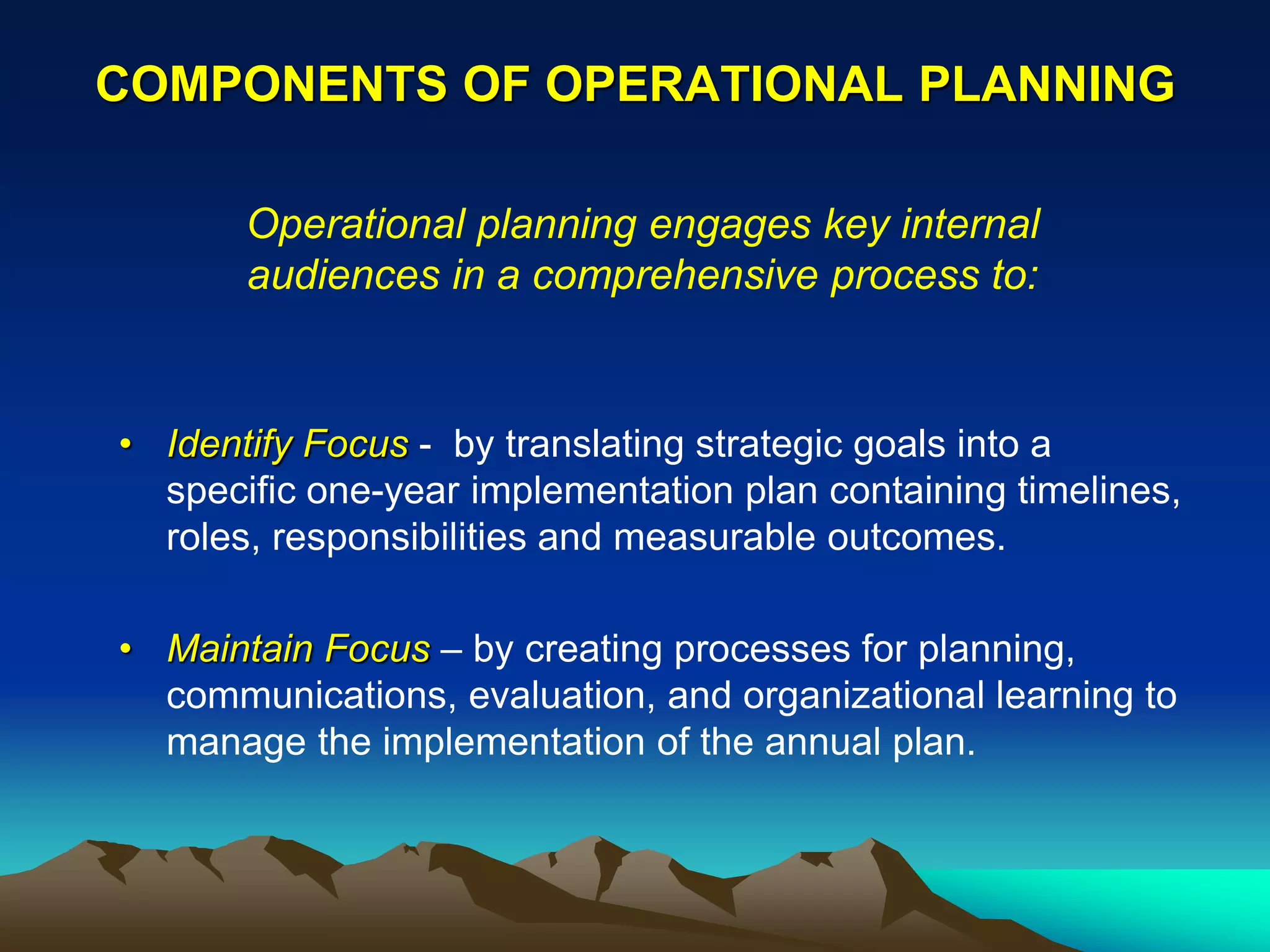
COMPONENTS OF OPERATIONAL PLANNING

       Operational planning engages key internal
       audiences in a comprehensive process to:


• Identify Focus - by translating strategic goals into a
  specific one-year implementation plan containing timelines,
  roles, responsibilities and measurable outcomes.

• Maintain Focus – by creating processes for planning,
  communications, evaluation, and organizational learning to
  manage the implementation of the annual plan.
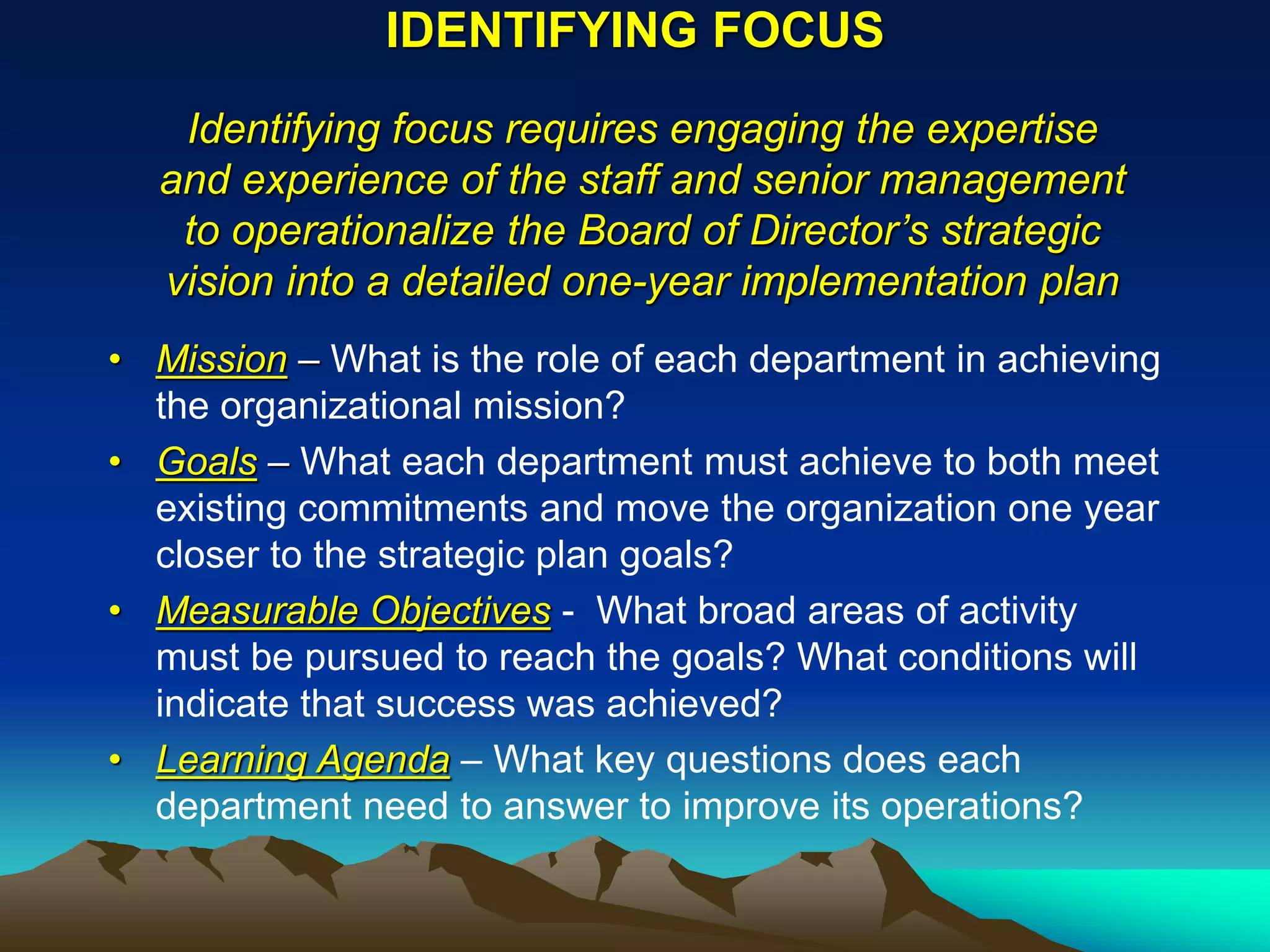
IDENTIFYING FOCUS
   Identifying focus requires engaging the expertise
  and experience of the staff and senior management
   to operationalize the Board of Director’s strategic
  vision into a detailed one-year implementation plan
• Mission – What is the role of each department in achieving
  the organizational mission?
• Goals – What each department must achieve to both meet
  existing commitments and move the organization one year
  closer to the strategic plan goals?
• Measurable Objectives - What broad areas of activity
  must be pursued to reach the goals? What conditions will
  indicate that success was achieved?
• Learning Agenda – What key questions does each
  department need to answer to improve its operations?
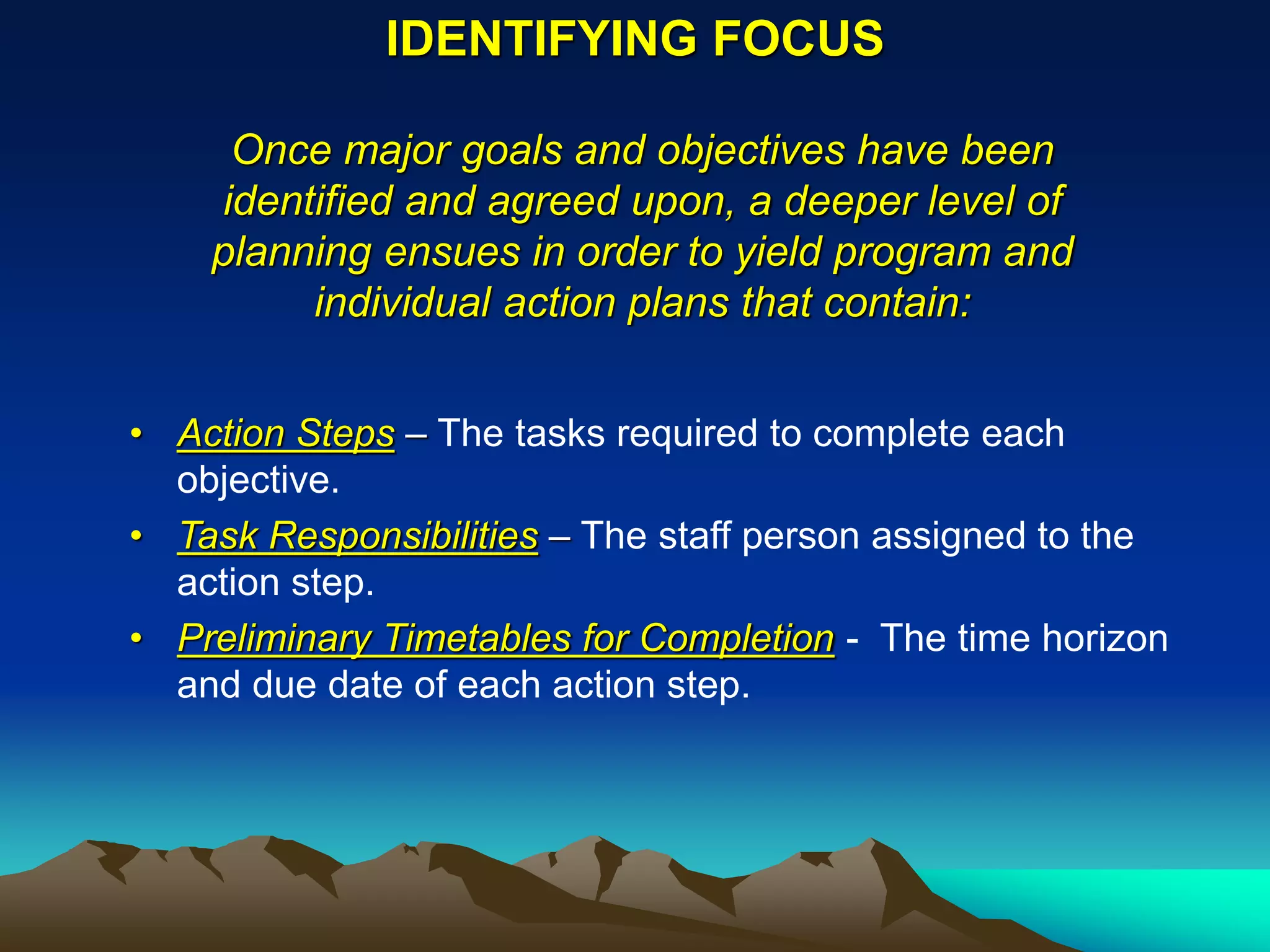
IDENTIFYING FOCUS

     Once major goals and objectives have been
    identified and agreed upon, a deeper level of
    planning ensues in order to yield program and
         individual action plans that contain:


• Action Steps – The tasks required to complete each
  objective.
• Task Responsibilities – The staff person assigned to the
  action step.
• Preliminary Timetables for Completion - The time horizon
  and due date of each action step.
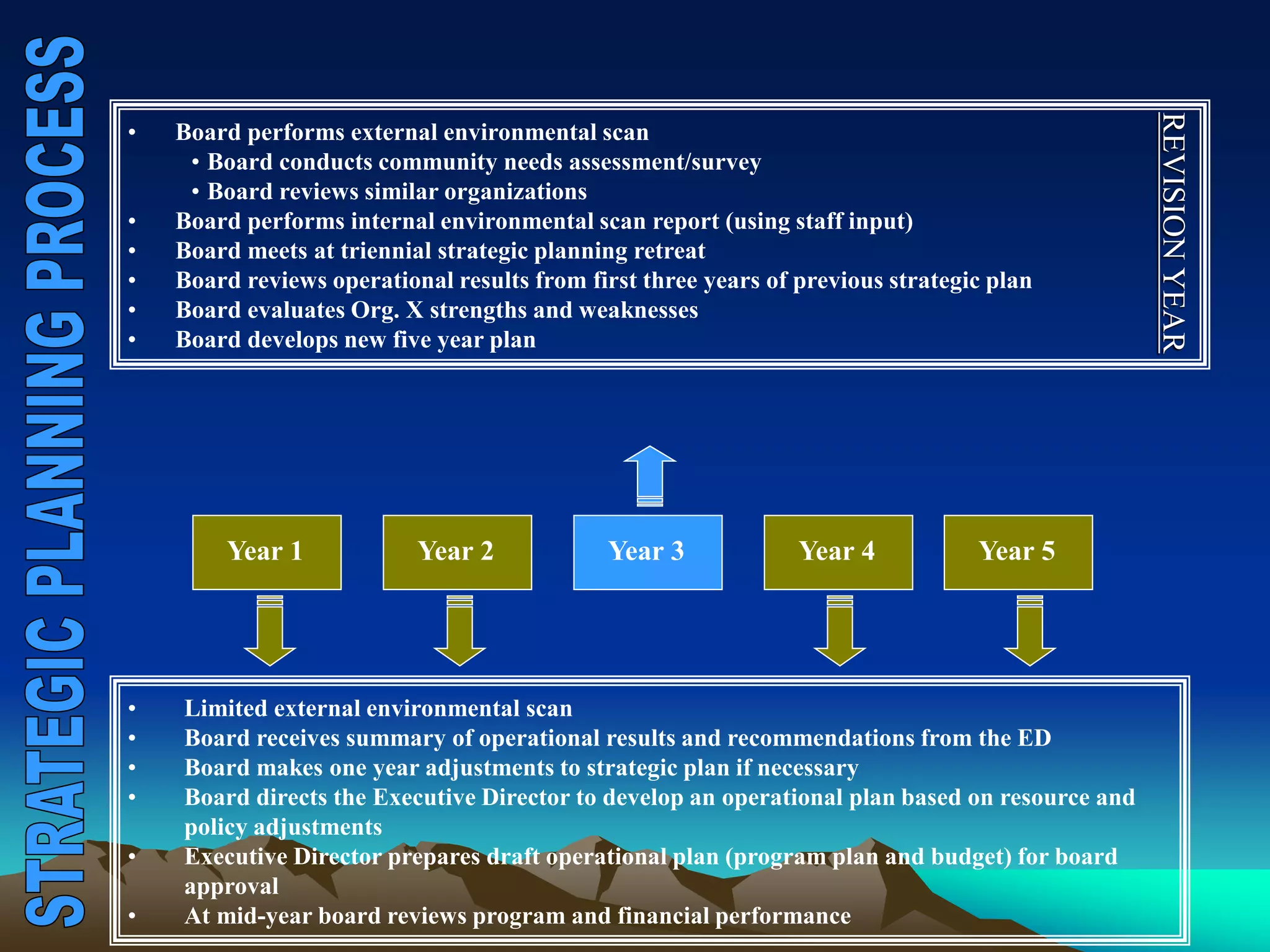
REVISION YEAR
•   Board performs external environmental scan
     • Board conducts community needs assessment/survey
     • Board reviews similar organizations
•   Board performs internal environmental scan report (using staff input)
•   Board meets at triennial strategic planning retreat
•   Board reviews operational results from first three years of previous strategic plan
•   Board evaluates Org. X strengths and weaknesses
•   Board develops new five year plan


        Year 1             Year 2            Year 3             Year 4           Year 5


•   Limited external environmental scan
•   Board receives summary of operational results and recommendations from the ED
•   Board makes one year adjustments to strategic plan if necessary
•   Board directs the Executive Director to develop an operational plan based on resource and
    policy adjustments
•   Executive Director prepares draft operational plan (program plan and budget) for board
    approval
•   At mid-year board reviews program and financial performance
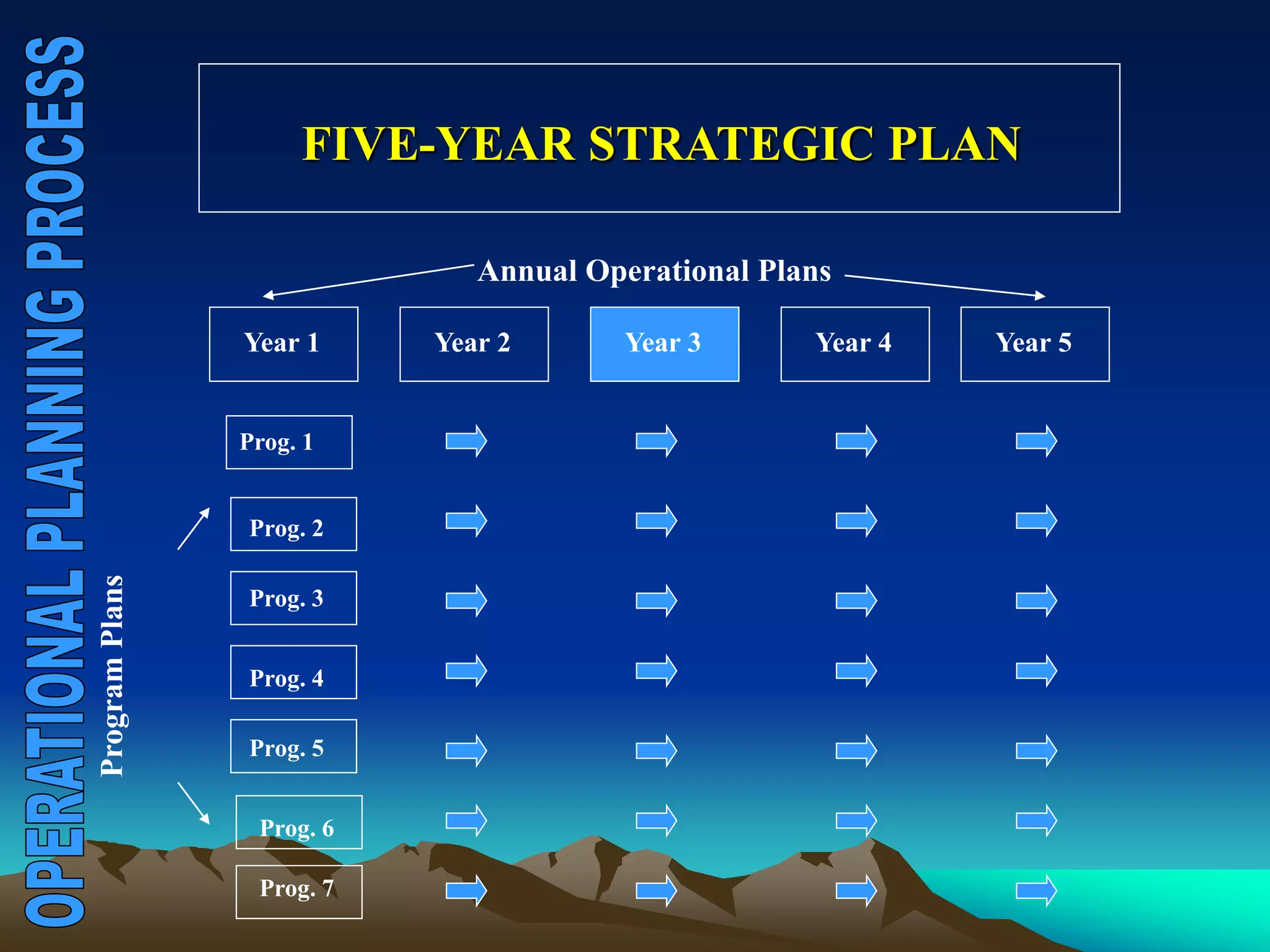
FIVE-YEAR STRATEGIC PLAN

                              Annual Operational Plans

                Year 1     Year 2      Year 3       Year 4   Year 5


                Prog. 1


                Prog. 2
Program Plans


                Prog. 3


                Prog. 4

                Prog. 5


                 Prog. 6

                 Prog. 7
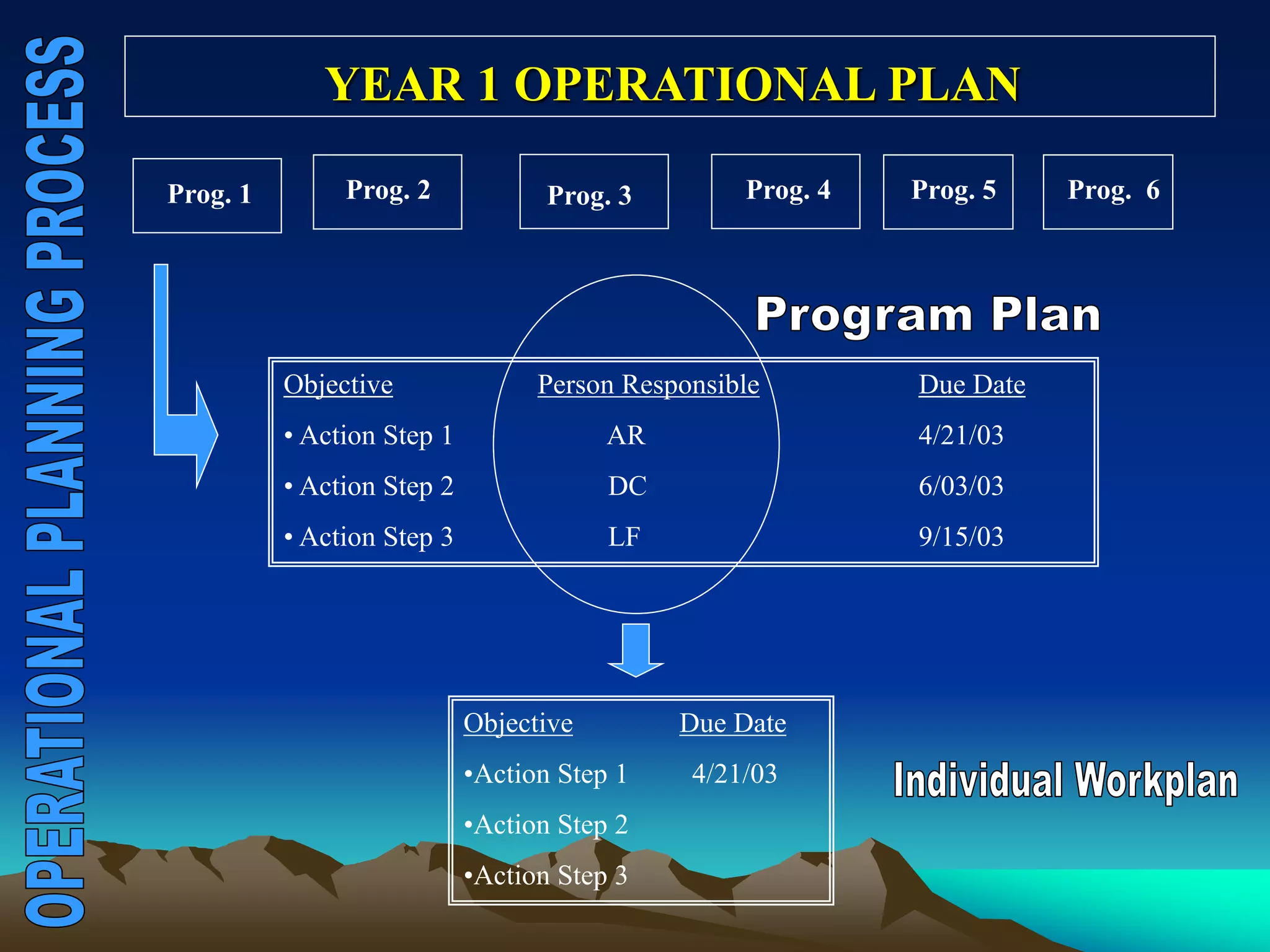
YEAR 1 OPERATIONAL PLAN

Prog. 1        Prog. 2             Prog. 3        Prog. 4   Prog. 5    Prog. 6


          Objective               Person Responsible        Due Date
          • Action Step 1               AR                  4/21/03
          • Action Step 2               DC                  6/03/03
          • Action Step 3               LF                  9/15/03


                            Objective        Due Date
                            •Action Step 1    4/21/03
                            •Action Step 2
                            •Action Step 3
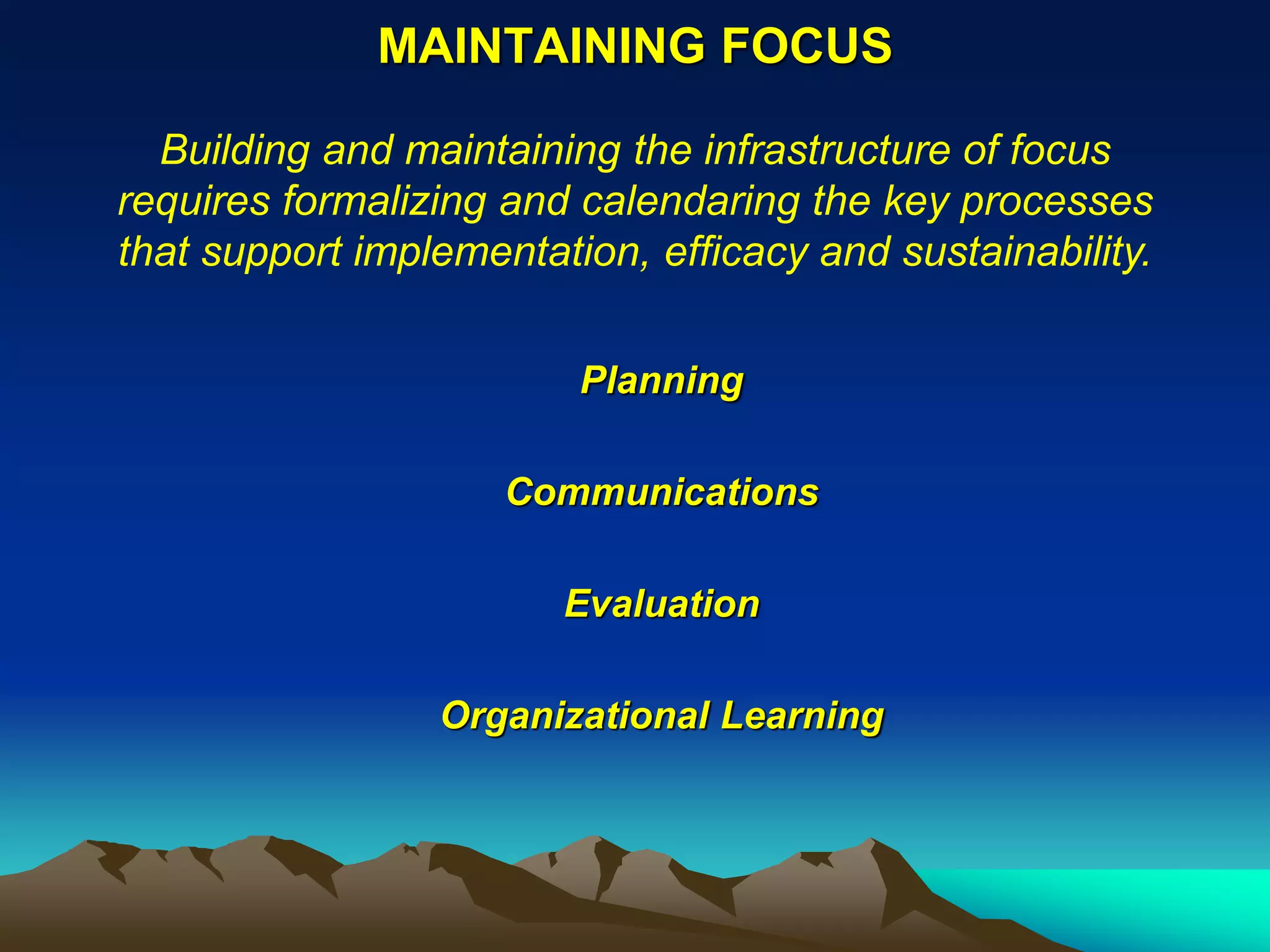
MAINTAINING FOCUS

  Building and maintaining the infrastructure of focus
requires formalizing and calendaring the key processes
that support implementation, efficacy and sustainability.


                         Planning

                     Communications

                        Evaluation

                 Organizational Learning
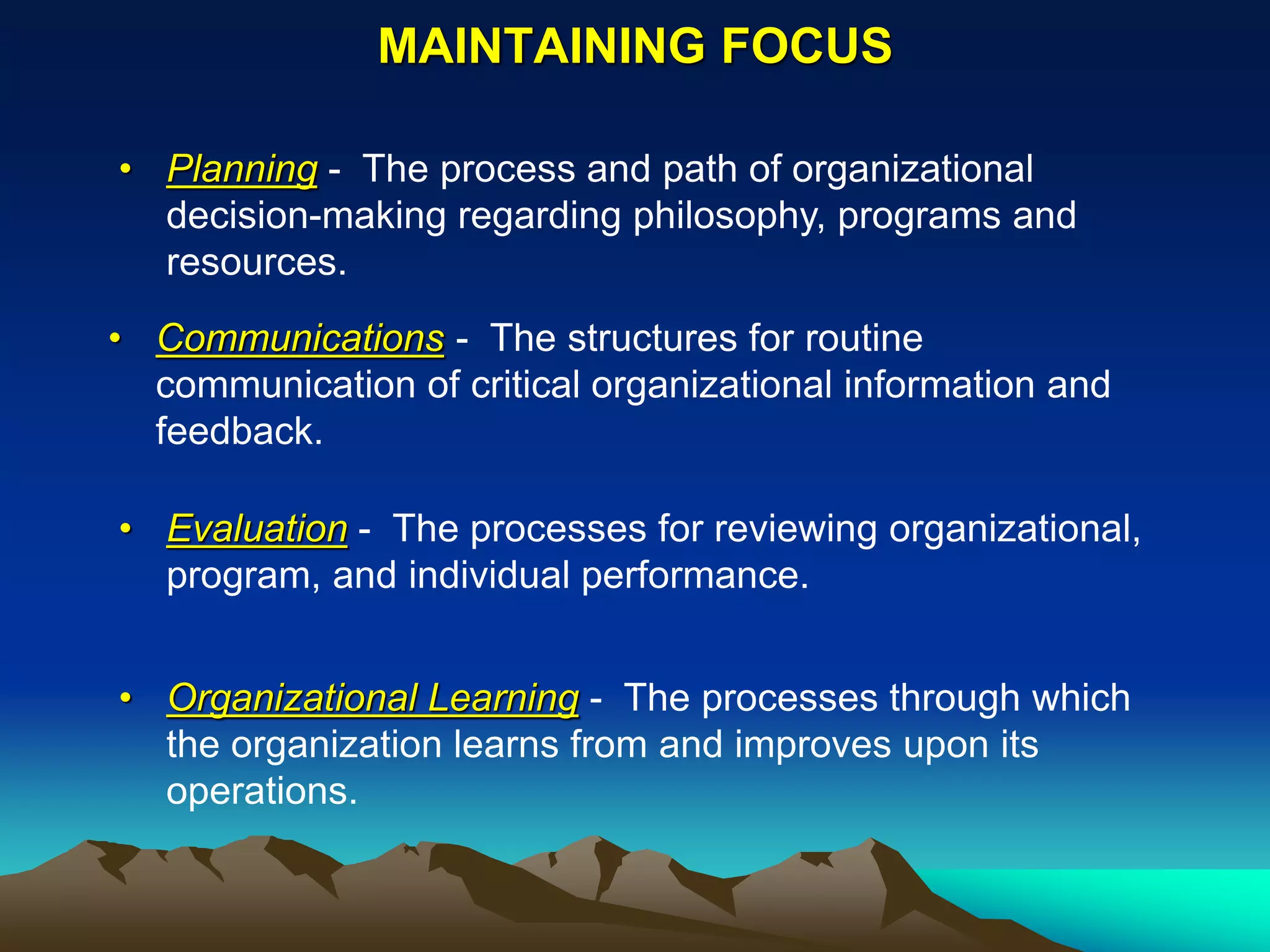
MAINTAINING FOCUS

• Planning - The process and path of organizational
  decision-making regarding philosophy, programs and
  resources.
• Communications - The structures for routine
  communication of critical organizational information and
  feedback.

• Evaluation - The processes for reviewing organizational,
  program, and individual performance.


• Organizational Learning - The processes through which
  the organization learns from and improves upon its
  operations.
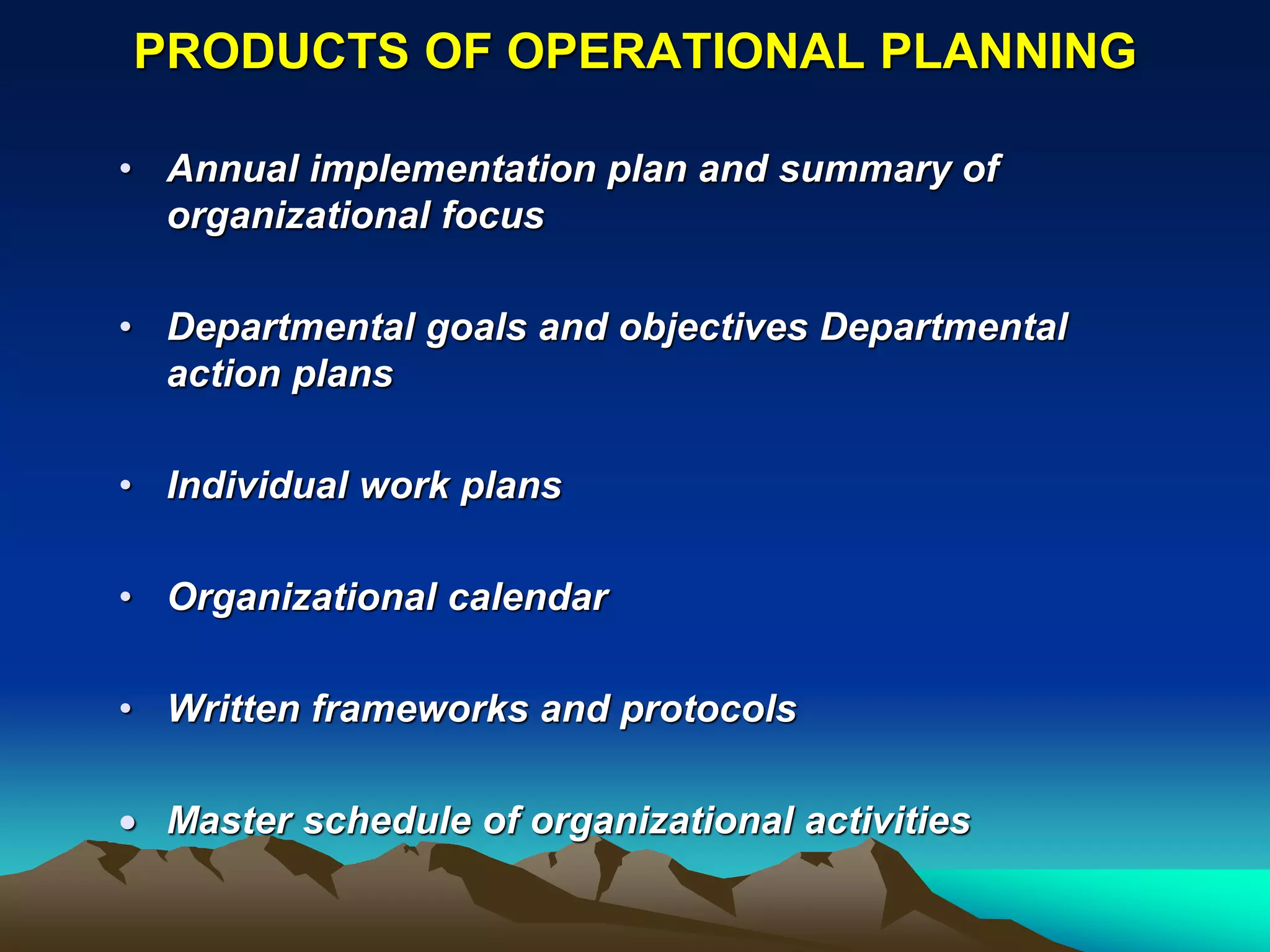
PRODUCTS OF OPERATIONAL PLANNING

• Annual implementation plan and summary of
  organizational focus

• Departmental goals and objectives Departmental
  action plans

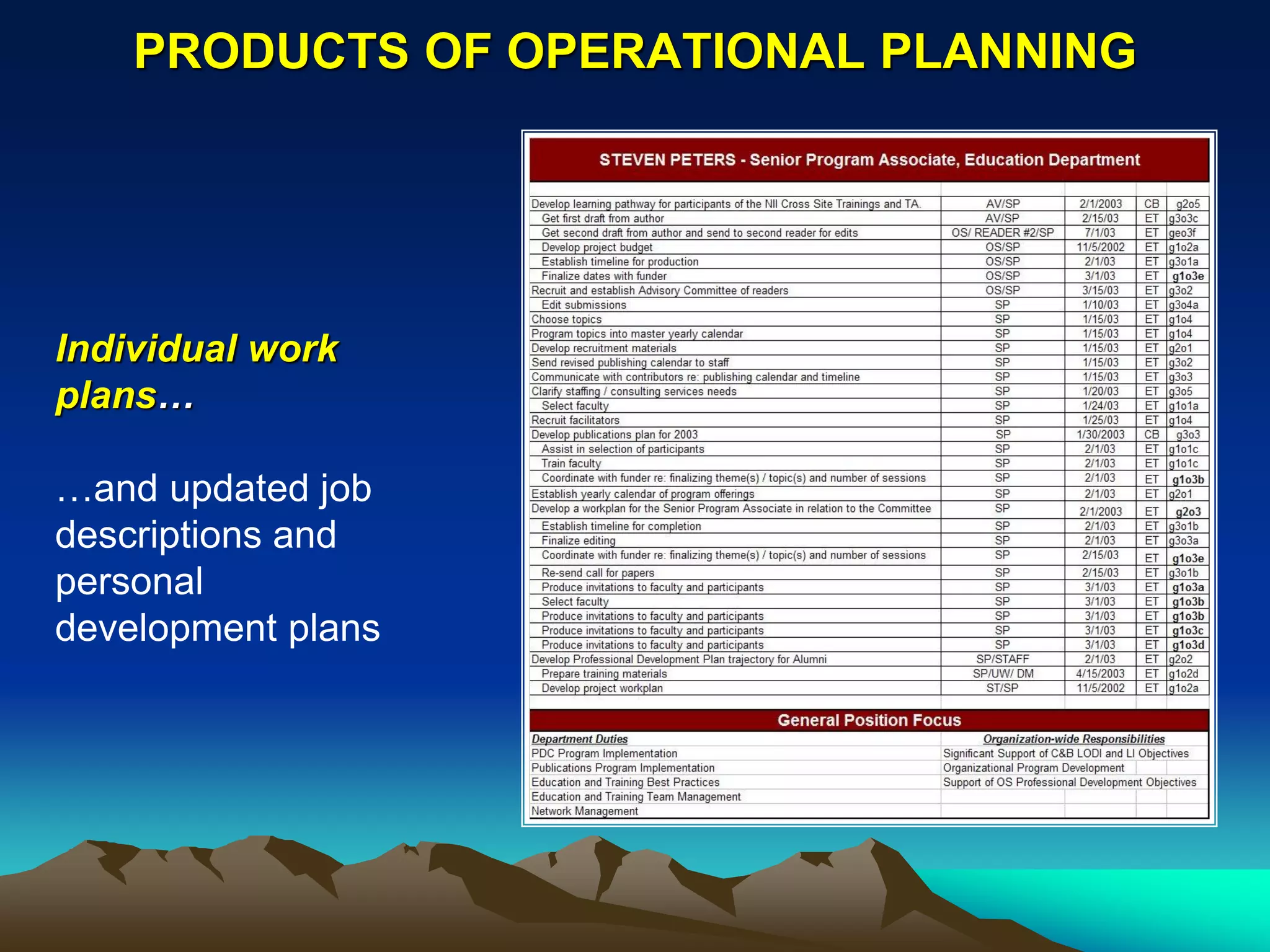
• Individual work plans

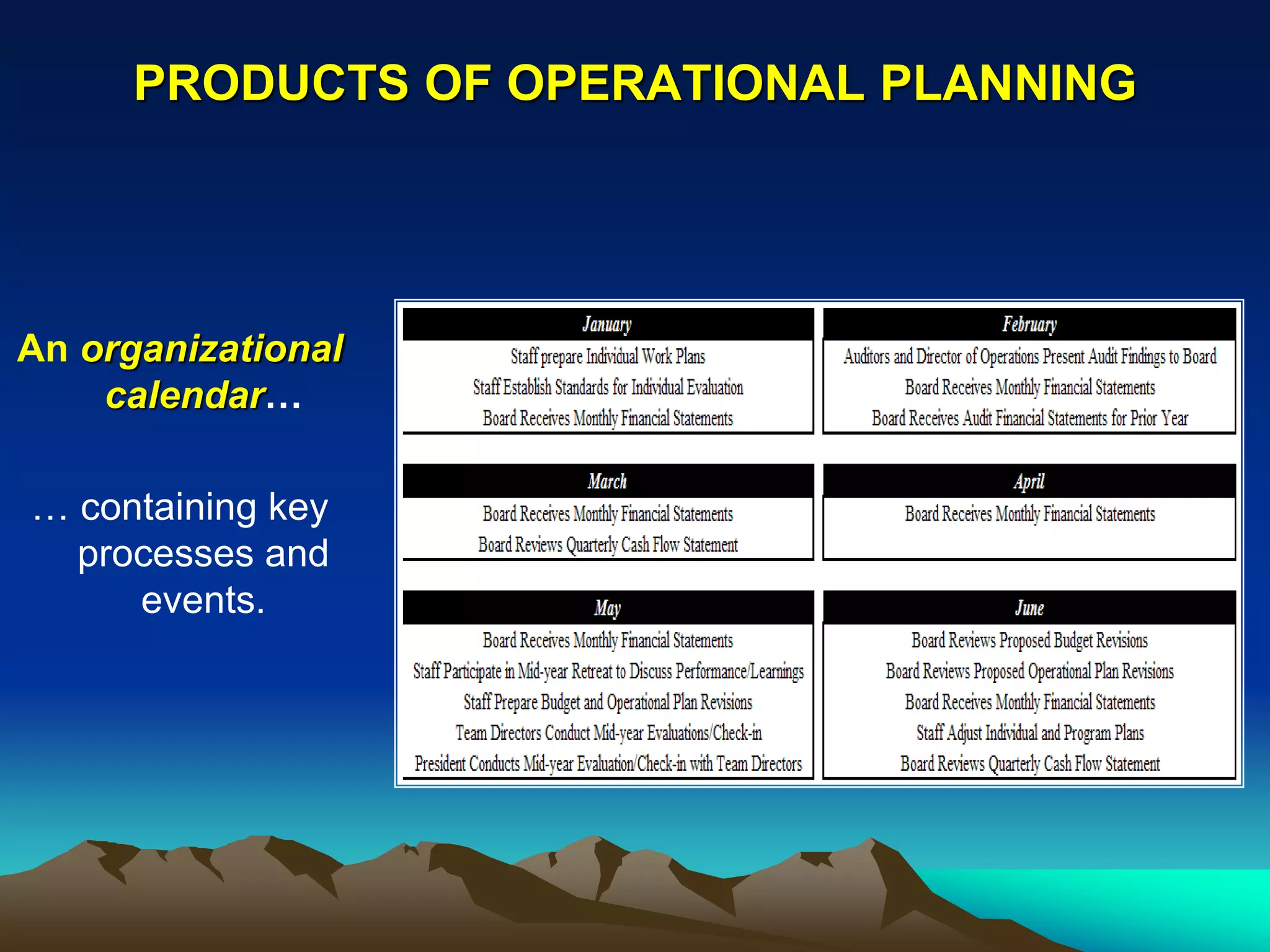
• Organizational calendar

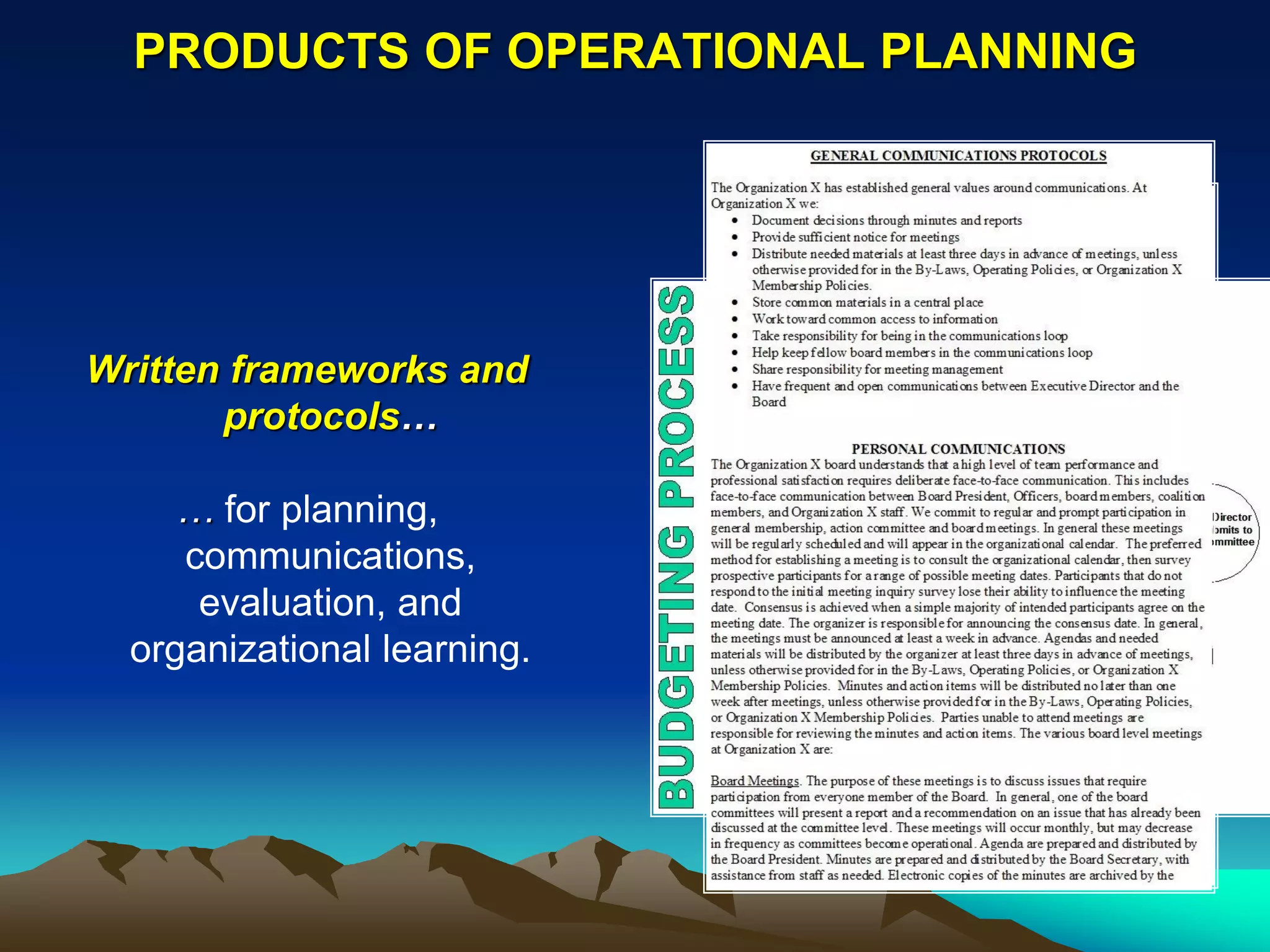
• Written frameworks and protocols

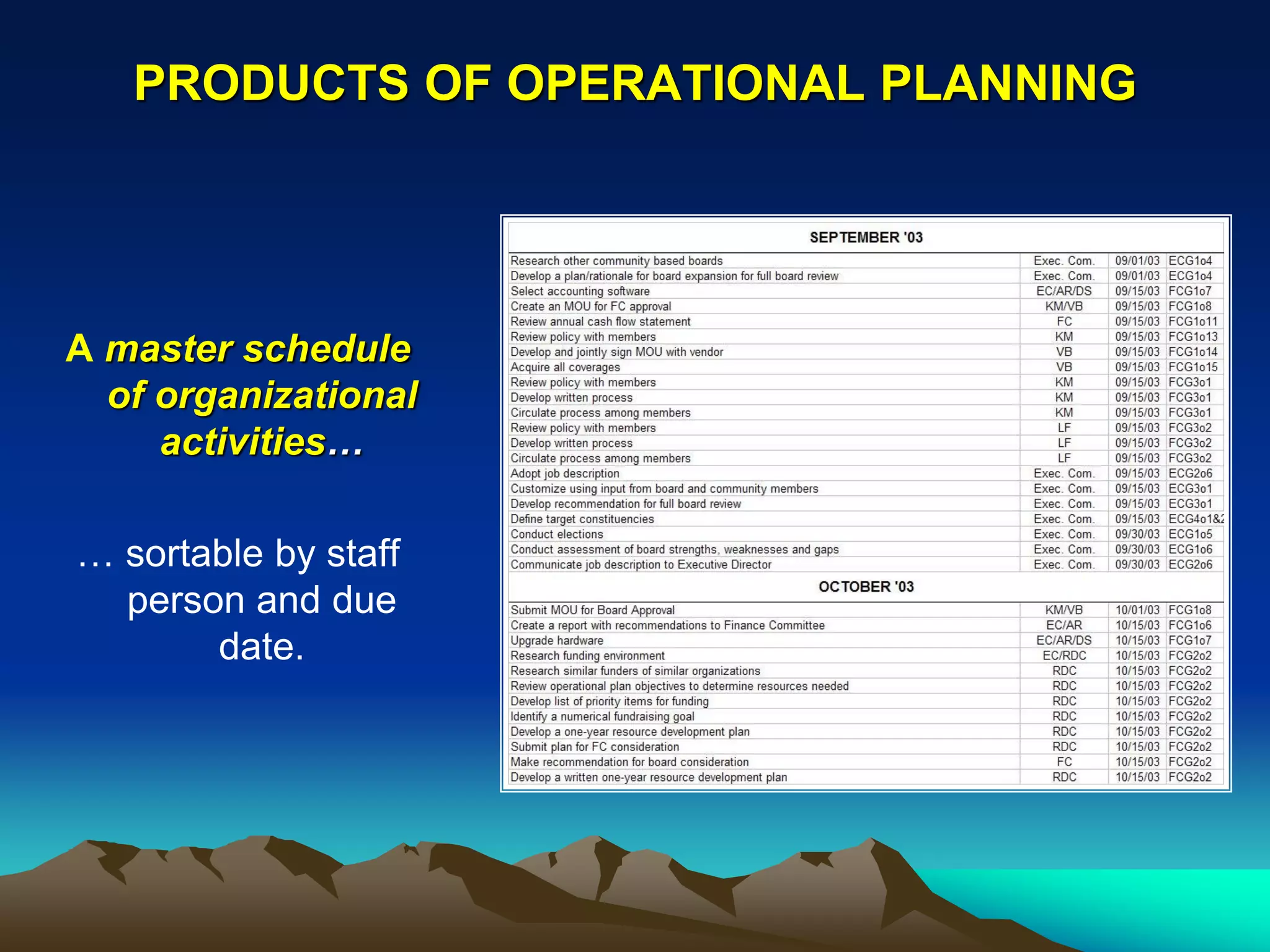
 Master schedule of organizational activities
PRODUCTS OF OPERATIONAL PLANNING


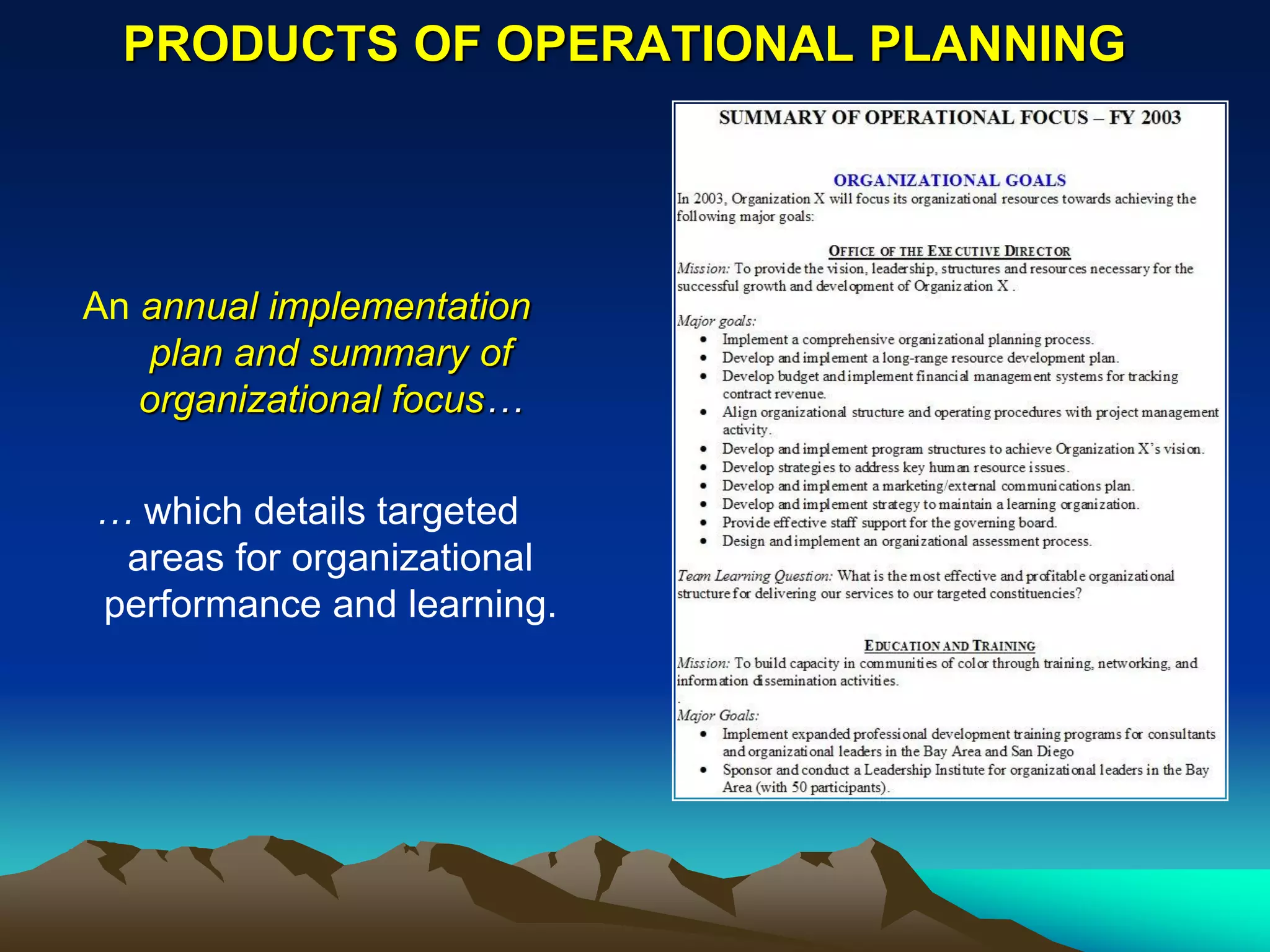
An annual implementation
    plan and summary of
   organizational focus…

… which details targeted
 areas for organizational
performance and learning.
PRODUCTS OF OPERATIONAL PLANNING


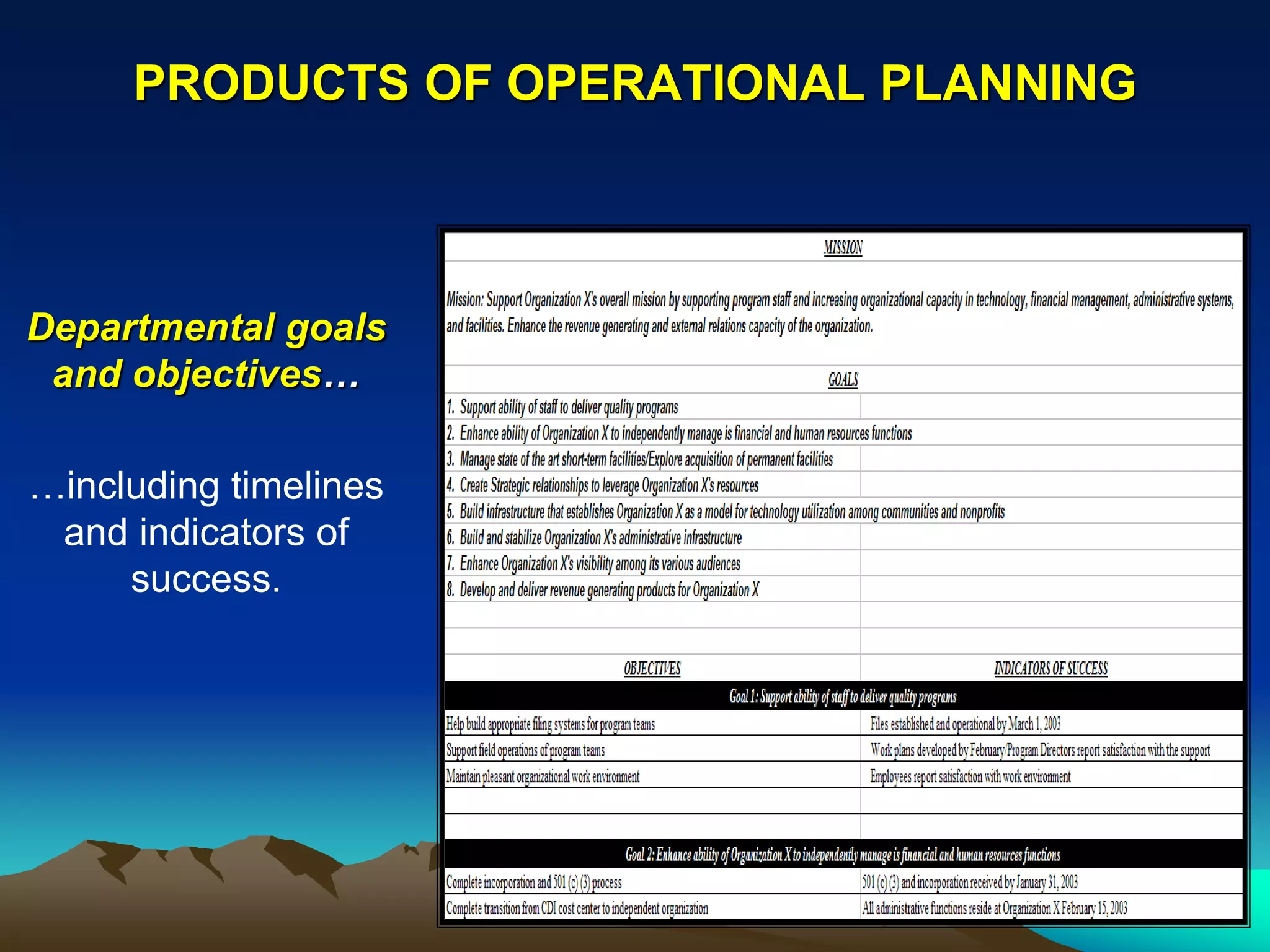
Departmental goals
 and objectives…

…including timelines
 and indicators of
     success.
PRODUCTS OF OPERATIONAL PLANNING


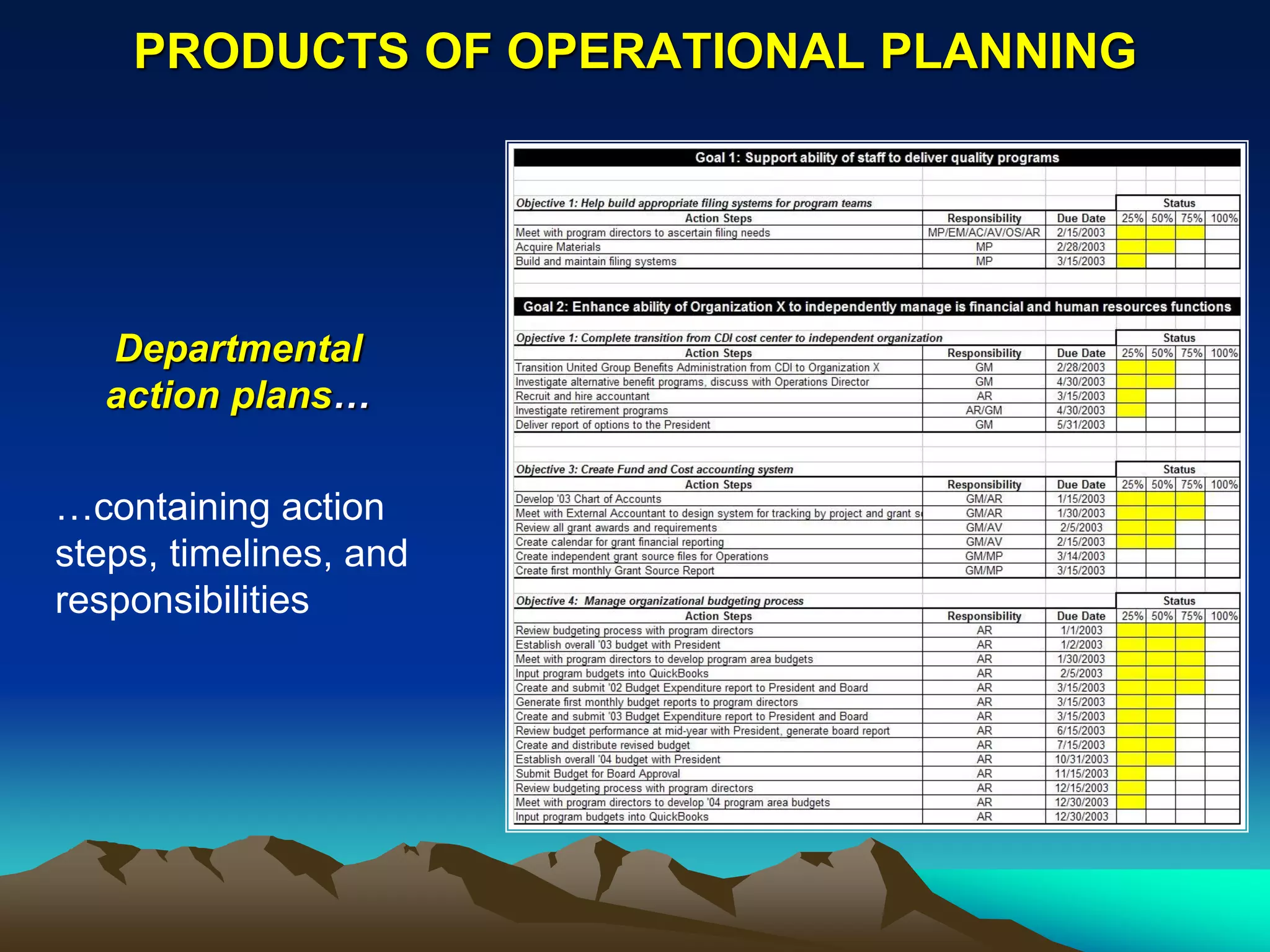
  Departmental
  action plans…

…containing action
steps, timelines, and
responsibilities
PRODUCTS OF OPERATIONAL PLANNING


Individual work
plans…

…and updated job
descriptions and
personal
development plans
PRODUCTS OF OPERATIONAL PLANNING


An organizational
    calendar…

… containing key
  processes and
     events.
PRODUCTS OF OPERATIONAL PLANNING


Written frameworks and
       protocols…

     … for planning,
     communications,
      evaluation, and
  organizational learning.
PRODUCTS OF OPERATIONAL PLANNING


A master schedule
  of organizational
     activities…

… sortable by staff
  person and due
       date.
OUTCOMES OF OPERATIONAL PLANNING
       Organizations that have undergone Operational
         Planning have enhanced their capacity to:

• Communicate organizational priorities and achievements to
  funders and external audiences

• Increase programmatic coordination

• Anticipate peak periods in organizational workload

• Manage external demands for programmatic expansion

• Properly align resources with program objectives
OUTCOMES OF OPERATIONAL PLANNING
       Organizations that have undergone Operational
         planning have increased their capacity to:

• Maintain staff and board focus on organizational objectives

• Develop organization-wide standards/expectations
  regarding performance and success

• Respond to emerging opportunities in their communities

• Increase programmatic quality through capturing lessons
  learned and innovation

• Retain staff and avoid Executive Director burnout
OPERATIONAL PLANNING SCOPE OF WORK
           Major engagement activities include:
•   Reviewing existing organizational culture, processes and
    materials

•   Facilitating group and individual meetings with staff to
    establish annual goals and organizational processes,

•   Constructing and analyzing process and planning
    documents

•   Assisting the development of an organizational budget

•   Coaching and skills transference to key staff

•   Providing follow-up monitoring and technical assistance.
Find listings for our current season
          of webinars and register at:

            NonprofitWebinars.com


A Service
   Of:                     Sponsored by:

Operational Planning: The Key to Building a Culture of Implementation and Focus

  • 1.
    Operational Planning: TheKey to Building a Culture of Implementation and Focus Anthony Reese February 13, 2013 A Service Of: Sponsored by:
  • 2.
    INTEGRATED PLANNING Advising nonprofits in: www.synthesispartnership.com • Strategy • Planning (617) 969-1881 • Organizational Development info@synthesispartnership.com A Service Of: Sponsored by:
  • 3.
    Affordable collaborative data management in the cloud. A Service Of: Sponsored by:
  • 4.
    Today’s Speaker Anthony Reese CFO and Vice President of Financial Management Practice Assisting with chat questions: Olive Grove Consulting Hosting: Jamie Maloney, Nonprofit Webinars Sam Frank, Synthesis Partnership A Service Of: Sponsored by:
  • 5.
  • 6.
    Between the Idea And the Reality Between the Motion And the Act Falls the Shadow --T.S.Eliot
  • 7.
    The questions seemeternal: “Why do so many organizations suffer from internal instability and a lack of focus on program outcomes?” “What investment can you make to generate organizational focus, stability, and efficacy?”
  • 8.
    ACHIEVING ORGANIZATIONAL FOCUS Organizational Life Cycle Entrepreneurial Institutionalizing Mature Reorganizing
  • 10.
    Resource Allocations Evaluation Program theory Staff Allocations Activities/Events Assumptions
  • 12.
    How Do WeAchieve Focus and Coordinated Action?
  • 13.
    OPERATIONAL PLANNING: THEMISSING PIECE • A critical companion to strategic planning. • A method of shaping a sustainable organizational Operational Planning culture and creating focus. • The seminal element of creating a culture of implementation.
  • 14.
    COMPONENTS OF OPERATIONALPLANNING Operational planning engages key internal audiences in a comprehensive process to: • Identify Focus - by translating strategic goals into a specific one-year implementation plan containing timelines, roles, responsibilities and measurable outcomes. • Maintain Focus – by creating processes for planning, communications, evaluation, and organizational learning to manage the implementation of the annual plan.
  • 15.
    IDENTIFYING FOCUS Identifying focus requires engaging the expertise and experience of the staff and senior management to operationalize the Board of Director’s strategic vision into a detailed one-year implementation plan • Mission – What is the role of each department in achieving the organizational mission? • Goals – What each department must achieve to both meet existing commitments and move the organization one year closer to the strategic plan goals? • Measurable Objectives - What broad areas of activity must be pursued to reach the goals? What conditions will indicate that success was achieved? • Learning Agenda – What key questions does each department need to answer to improve its operations?
  • 16.
    IDENTIFYING FOCUS Once major goals and objectives have been identified and agreed upon, a deeper level of planning ensues in order to yield program and individual action plans that contain: • Action Steps – The tasks required to complete each objective. • Task Responsibilities – The staff person assigned to the action step. • Preliminary Timetables for Completion - The time horizon and due date of each action step.
  • 17.
    REVISION YEAR • Board performs external environmental scan • Board conducts community needs assessment/survey • Board reviews similar organizations • Board performs internal environmental scan report (using staff input) • Board meets at triennial strategic planning retreat • Board reviews operational results from first three years of previous strategic plan • Board evaluates Org. X strengths and weaknesses • Board develops new five year plan Year 1 Year 2 Year 3 Year 4 Year 5 • Limited external environmental scan • Board receives summary of operational results and recommendations from the ED • Board makes one year adjustments to strategic plan if necessary • Board directs the Executive Director to develop an operational plan based on resource and policy adjustments • Executive Director prepares draft operational plan (program plan and budget) for board approval • At mid-year board reviews program and financial performance
  • 18.
    FIVE-YEAR STRATEGIC PLAN Annual Operational Plans Year 1 Year 2 Year 3 Year 4 Year 5 Prog. 1 Prog. 2 Program Plans Prog. 3 Prog. 4 Prog. 5 Prog. 6 Prog. 7
  • 19.
    YEAR 1 OPERATIONALPLAN Prog. 1 Prog. 2 Prog. 3 Prog. 4 Prog. 5 Prog. 6 Objective Person Responsible Due Date • Action Step 1 AR 4/21/03 • Action Step 2 DC 6/03/03 • Action Step 3 LF 9/15/03 Objective Due Date •Action Step 1 4/21/03 •Action Step 2 •Action Step 3
  • 20.
    MAINTAINING FOCUS Building and maintaining the infrastructure of focus requires formalizing and calendaring the key processes that support implementation, efficacy and sustainability. Planning Communications Evaluation Organizational Learning
  • 21.
    MAINTAINING FOCUS • Planning- The process and path of organizational decision-making regarding philosophy, programs and resources. • Communications - The structures for routine communication of critical organizational information and feedback. • Evaluation - The processes for reviewing organizational, program, and individual performance. • Organizational Learning - The processes through which the organization learns from and improves upon its operations.
  • 22.
    PRODUCTS OF OPERATIONALPLANNING • Annual implementation plan and summary of organizational focus • Departmental goals and objectives Departmental action plans • Individual work plans • Organizational calendar • Written frameworks and protocols  Master schedule of organizational activities
  • 23.
    PRODUCTS OF OPERATIONALPLANNING An annual implementation plan and summary of organizational focus… … which details targeted areas for organizational performance and learning.
  • 24.
    PRODUCTS OF OPERATIONALPLANNING Departmental goals and objectives… …including timelines and indicators of success.
  • 25.
    PRODUCTS OF OPERATIONALPLANNING Departmental action plans… …containing action steps, timelines, and responsibilities
  • 26.
    PRODUCTS OF OPERATIONALPLANNING Individual work plans… …and updated job descriptions and personal development plans
  • 27.
    PRODUCTS OF OPERATIONALPLANNING An organizational calendar… … containing key processes and events.
  • 28.
    PRODUCTS OF OPERATIONALPLANNING Written frameworks and protocols… … for planning, communications, evaluation, and organizational learning.
  • 29.
    PRODUCTS OF OPERATIONALPLANNING A master schedule of organizational activities… … sortable by staff person and due date.
  • 30.
    OUTCOMES OF OPERATIONALPLANNING Organizations that have undergone Operational Planning have enhanced their capacity to: • Communicate organizational priorities and achievements to funders and external audiences • Increase programmatic coordination • Anticipate peak periods in organizational workload • Manage external demands for programmatic expansion • Properly align resources with program objectives
  • 31.
    OUTCOMES OF OPERATIONALPLANNING Organizations that have undergone Operational planning have increased their capacity to: • Maintain staff and board focus on organizational objectives • Develop organization-wide standards/expectations regarding performance and success • Respond to emerging opportunities in their communities • Increase programmatic quality through capturing lessons learned and innovation • Retain staff and avoid Executive Director burnout
  • 32.
    OPERATIONAL PLANNING SCOPEOF WORK Major engagement activities include: • Reviewing existing organizational culture, processes and materials • Facilitating group and individual meetings with staff to establish annual goals and organizational processes, • Constructing and analyzing process and planning documents • Assisting the development of an organizational budget • Coaching and skills transference to key staff • Providing follow-up monitoring and technical assistance.
  • 33.
    Find listings forour current season of webinars and register at: NonprofitWebinars.com A Service Of: Sponsored by: