CHAPTER 7 Developing A Business Plan
WHAT BUSINESS PLANNING EXPLAINED? Planning is -What to do. -How to do it. -When to do it. -What to expect in the future. It involves the attainment of goals, and the way to accomplish  such goals.
PRINCIPLES OF PLANNING (General application  particularly for micro and small business) Planning must be realistic Planning must be based on felt needs Planning must be flexible Planning must start with simple projects
STAGES OF BUSINESS PLANNING ( Based on Phillip Kotler) Unplanned stage-  the owner- manger is busy looking for funds, customers. Materials and equipment. Budgeting- System stage-  the owner- manager realizes the need to develop budgeting system. Annual planning stage-  the owner drafts an annual plan. Strategic planning stages-  this is a 3 or 5 year planning.
CRITERIA OF EFFECTIVE PLANNING The plan should state clearly its objectives. The plan should provide measures for a satisfactory accomplishment of the objectives in terms of quantity, quality, time and cost. The plan should state the policies which should guide people in attaining the objectives. The plan should indicate what department or unit will be involved in accomplishing the objectives.
CONTINUATION- PRINCIPLE OF CRITERIA OF EFFECTIVE PLANNING 5.  The plan should indicate the time which should be allowed for each activity. 6.  The plan should specify the required resources and their corresponding costs. 7.  The plan should designate the officers who will be held accountable for the accomplishment of the objectives.
COMPONENTS OF BUSINESS PLANNING SWOT Objectives Strategies Time frame
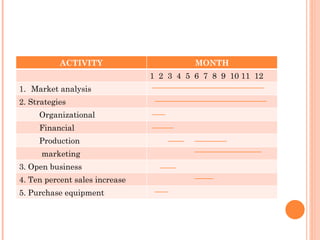
ACTIVITY MONTH 1  2  3  4  5  6  7  8  9  10 11  12 Market analysis 2. Strategies Organizational Financial Production marketing 3. Open business 4. Ten percent sales increase 5. Purchase equipment
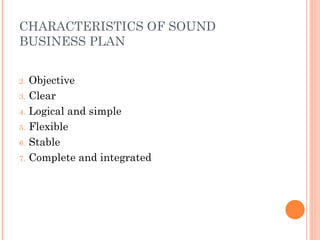
CHARACTERISTICS OF SOUND BUSINESS PLAN Objective Clear Logical and simple Flexible Stable Complete and integrated
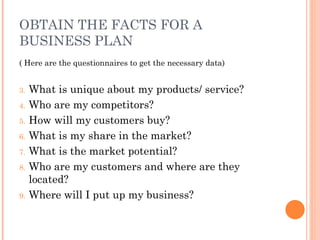
OBTAIN THE FACTS FOR A BUSINESS PLAN ( Here are the questionnaires to get the necessary data) What is unique about my products/ service? Who are my competitors? How will my customers buy? What is my share in the market? What is the market potential? Who are my customers and where are they located? Where will I put up my business?
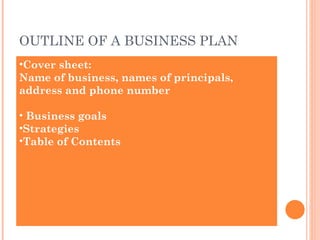
OUTLINE OF A BUSINESS PLAN Cover sheet:  Name of business, names of principals, address and phone number Business goals Strategies Table of Contents
SECTION ONE: The Business Description of Business Product/ Service Market Location of Business Competition Management Personnel Application and Expected effect of Loan ( if neede) Summary
SECTION TWO: Financial Data Sources and Application of Funding Capital Equipment List Balance Sheet Break- Even Analysis Income Projections ( Profit and Loss Statements) Five year summary Detail by month for first year Detail by quarter for second, third, fourth, and fifth year
F. Cash flow Projection Detail by month for first year Detail by quarter for second, third, fourth, and fifth years Notes of Explanation G. Deviation Analysis H. Historical Financial Reports for Existing Business Balance sheets for past five years Income statements for past five years Tax returns
SECTION THREE: Supporting Documents Personal resumes, personal balance sheets, cost of living budget, credit reports, letter of reference, job descriptions, letters of intent, copies of leases, contracts, legal documents, and anything else relevant to the plan.
STEPS IN BUSINESS PLANNING Evaluate your personal resources and interests, and the resources of the community. Analyze your market Choose a proper business location Prepare a financial  plan Prepare  a production plan Prepare an organizational plan Prepare a management plan
THE IMPORTANCE OF BUSINESS PLANNING Planning can eliminate business risks Planning can minimize costs of production Planning can detect the weaknesses of the business operations
THE END  SALAMAT SA LISTENING! GODBLESS!
CHAPTER 7 QUIZ
1.  STAGE OF BUSINESS PLAN THAT IN 3 OR 5 YEAR PLANNING.
2.  IT IS THE STAGE OF BUSINESS PLAN THAT THE OWNER DRAFTS AN ANNUAL PLAN.
3.  THE OWNER- MANAGER REALIZES THE NEED TO DEVELOP BUDGETING SYSTEM.
4.  THE OWNER- MANGER IS BUSY LOOKING FOR FUNDS, CUSTOMERS. MATERIALS AND EQUIPMENT.
5 . PART OF BUSINESS PLAN OUTLINE THAT TELLS THE NAME OF BUSINESS, NAMES OF PRINCIPALS, ADDRESS AND PHONE NUMBER
6 . SECTION OF FINANCIAL DATA THAT TELLS THE SOURCES AND APPLICATION OF FUNDING
7.  PART OF BUSINESS PLAN OUTLINE THAT TELLS THE NAME OF BUSINESS, NAMES OF PRINCIPALS, ADDRESS AND PHONE NUMBER
8 . SECTION OF BUSINESS PLAN THAT TELLS THE PERSONAL RESUMES, PERSONAL BALANCE SHEETS, COST OF LIVING BUDGET, CREDIT REPORTS, LETTER OF REFERENCE, JOB DESCRIPTIONS, LETTERS OF INTENT, COPIES OF LEASES, CONTRACTS, LEGAL DOCUMENTS, AND ANYTHING ELSE RELEVANT TO THE PLAN.
9 . IT INVOLVES THE ATTAINMENT OF GOALS, AND THE WAY TO ACCOMPLISH  SUCH GOALS.
10.  THE OWNER- MANGER IS BUSY LOOKING FOR FUNDS, CUSTOMERS. MATERIALS AND EQUIPMENT
11-13. COMPONENTS OF BUSINESS PLANNING
13- 18 CHARACTERISTICS OF SOUND BUSINESS PLAN
19-20  IMPORTANCE OF BUSINESS PLANNING

Chapter 7 entrep

  • 1.
    CHAPTER 7 DevelopingA Business Plan
  • 2.
    WHAT BUSINESS PLANNINGEXPLAINED? Planning is -What to do. -How to do it. -When to do it. -What to expect in the future. It involves the attainment of goals, and the way to accomplish such goals.
  • 3.
    PRINCIPLES OF PLANNING(General application particularly for micro and small business) Planning must be realistic Planning must be based on felt needs Planning must be flexible Planning must start with simple projects
  • 4.
    STAGES OF BUSINESSPLANNING ( Based on Phillip Kotler) Unplanned stage- the owner- manger is busy looking for funds, customers. Materials and equipment. Budgeting- System stage- the owner- manager realizes the need to develop budgeting system. Annual planning stage- the owner drafts an annual plan. Strategic planning stages- this is a 3 or 5 year planning.
  • 5.
    CRITERIA OF EFFECTIVEPLANNING The plan should state clearly its objectives. The plan should provide measures for a satisfactory accomplishment of the objectives in terms of quantity, quality, time and cost. The plan should state the policies which should guide people in attaining the objectives. The plan should indicate what department or unit will be involved in accomplishing the objectives.
  • 6.
    CONTINUATION- PRINCIPLE OFCRITERIA OF EFFECTIVE PLANNING 5. The plan should indicate the time which should be allowed for each activity. 6. The plan should specify the required resources and their corresponding costs. 7. The plan should designate the officers who will be held accountable for the accomplishment of the objectives.
  • 7.
    COMPONENTS OF BUSINESSPLANNING SWOT Objectives Strategies Time frame
  • 8.
    ACTIVITY MONTH 1 2 3 4 5 6 7 8 9 10 11 12 Market analysis 2. Strategies Organizational Financial Production marketing 3. Open business 4. Ten percent sales increase 5. Purchase equipment
  • 9.
    CHARACTERISTICS OF SOUNDBUSINESS PLAN Objective Clear Logical and simple Flexible Stable Complete and integrated
  • 10.
    OBTAIN THE FACTSFOR A BUSINESS PLAN ( Here are the questionnaires to get the necessary data) What is unique about my products/ service? Who are my competitors? How will my customers buy? What is my share in the market? What is the market potential? Who are my customers and where are they located? Where will I put up my business?
  • 11.
    OUTLINE OF ABUSINESS PLAN Cover sheet: Name of business, names of principals, address and phone number Business goals Strategies Table of Contents
  • 12.
    SECTION ONE: TheBusiness Description of Business Product/ Service Market Location of Business Competition Management Personnel Application and Expected effect of Loan ( if neede) Summary
  • 13.
    SECTION TWO: FinancialData Sources and Application of Funding Capital Equipment List Balance Sheet Break- Even Analysis Income Projections ( Profit and Loss Statements) Five year summary Detail by month for first year Detail by quarter for second, third, fourth, and fifth year
  • 14.
    F. Cash flowProjection Detail by month for first year Detail by quarter for second, third, fourth, and fifth years Notes of Explanation G. Deviation Analysis H. Historical Financial Reports for Existing Business Balance sheets for past five years Income statements for past five years Tax returns
  • 15.
    SECTION THREE: SupportingDocuments Personal resumes, personal balance sheets, cost of living budget, credit reports, letter of reference, job descriptions, letters of intent, copies of leases, contracts, legal documents, and anything else relevant to the plan.
  • 16.
    STEPS IN BUSINESSPLANNING Evaluate your personal resources and interests, and the resources of the community. Analyze your market Choose a proper business location Prepare a financial plan Prepare a production plan Prepare an organizational plan Prepare a management plan
  • 17.
    THE IMPORTANCE OFBUSINESS PLANNING Planning can eliminate business risks Planning can minimize costs of production Planning can detect the weaknesses of the business operations
  • 18.
    THE END SALAMAT SA LISTENING! GODBLESS!
  • 19.
  • 20.
    1. STAGEOF BUSINESS PLAN THAT IN 3 OR 5 YEAR PLANNING.
  • 21.
    2. ITIS THE STAGE OF BUSINESS PLAN THAT THE OWNER DRAFTS AN ANNUAL PLAN.
  • 22.
    3. THEOWNER- MANAGER REALIZES THE NEED TO DEVELOP BUDGETING SYSTEM.
  • 23.
    4. THEOWNER- MANGER IS BUSY LOOKING FOR FUNDS, CUSTOMERS. MATERIALS AND EQUIPMENT.
  • 24.
    5 . PARTOF BUSINESS PLAN OUTLINE THAT TELLS THE NAME OF BUSINESS, NAMES OF PRINCIPALS, ADDRESS AND PHONE NUMBER
  • 25.
    6 . SECTIONOF FINANCIAL DATA THAT TELLS THE SOURCES AND APPLICATION OF FUNDING
  • 26.
    7. PARTOF BUSINESS PLAN OUTLINE THAT TELLS THE NAME OF BUSINESS, NAMES OF PRINCIPALS, ADDRESS AND PHONE NUMBER
  • 27.
    8 . SECTIONOF BUSINESS PLAN THAT TELLS THE PERSONAL RESUMES, PERSONAL BALANCE SHEETS, COST OF LIVING BUDGET, CREDIT REPORTS, LETTER OF REFERENCE, JOB DESCRIPTIONS, LETTERS OF INTENT, COPIES OF LEASES, CONTRACTS, LEGAL DOCUMENTS, AND ANYTHING ELSE RELEVANT TO THE PLAN.
  • 28.
    9 . ITINVOLVES THE ATTAINMENT OF GOALS, AND THE WAY TO ACCOMPLISH SUCH GOALS.
  • 29.
    10. THEOWNER- MANGER IS BUSY LOOKING FOR FUNDS, CUSTOMERS. MATERIALS AND EQUIPMENT
  • 30.
    11-13. COMPONENTS OFBUSINESS PLANNING
  • 31.
    13- 18 CHARACTERISTICSOF SOUND BUSINESS PLAN
  • 32.
    19-20 IMPORTANCEOF BUSINESS PLANNING