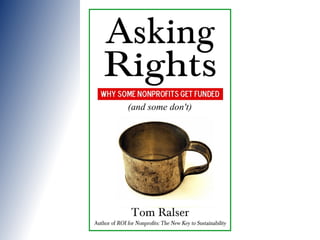
Asking Rights
Tom Ralser
October 30, 2013
Twitter Hashtag - #4Glearn
Part
Of:

Sponsored by:
INTEGRATED PLANNING
Advising nonprofits in:
• Strategy
• Planning
• Organizational Development

Part
Of:

www.synthesispartnership.com
(617) 969-1881
info@synthesispartnership.com

Sponsored by:
Coming Soon
Part
Of:

Sponsored by:
Today’s Speaker

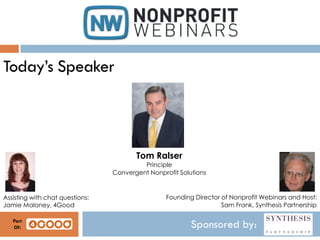
Tom Ralser
Principle
Convergent Nonprofit Solutions

Assisting with chat questions:
Jamie Maloney, 4Good
Part
Of:

Founding Director of Nonprofit Webinars and Host:
Sam Frank, Synthesis Partnership

Sponsored by:
Asking Rights

TM

Nonprofits have the legal right to

ask for money
Asking Rights

TM

Nonprofits have the obligation to

ask for money
Not all nonprofits have

Asking Rights
Many have not earned the right to
ask for money
“Son, what gives you the right
to ask me for money?”
The Genesis
Unique position to see macro trends
and common denominators
 Experience (500+ projects)

 National projects and local projects, nationally
 All types (arts & culture, human services,
economic development, education,
health, etc.)
Had to Ask . . .
Why do some projects
experience wild success,
while others struggle?
It Came Down to This:
Because they did not have

Asking Rights!
Asking Rights

TM

What are they?
Asking Rights

TM

The ability to deliver outcomes that

are valuable to investors
Asking Rights

TM

Actually deliver on promises,
not print glossy brochures that
repeat your mission

Ability to deliver outcomes that are

valuable to investors
Results in terms of impact on
customers’ lives, not just
measures of activity that tell
how the money was spent

Asking Rights

TM

Ability to deliver outcomes that are

valuable to investors
Asking Rights

TM

Ability to deliver outcomes that are

valuable to investors
Are they meaningful/
desired/coveted/longed for by
those whose investment made
them possible?
Asking Rights

TM

Ability to deliver outcomes that are

valuable to investors
Those who make the outcomes
possible. Carries the expectation
of performance.
Key Concepts
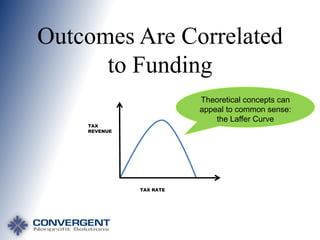
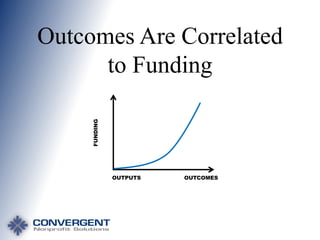
 Outcomes are correlated to funding
 Investors are different
 Emotional and Rational Camps
Outcomes Are Correlated
to Funding
Theoretical concepts can
appeal to common sense:
the Laffer Curve

TAX
REVENUE

TAX RATE
FUNDING

Outcomes Are Correlated
to Funding

OUTPUTS

OUTCOMES
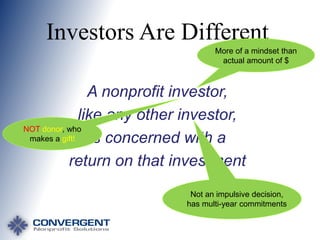
Investors Are Different
More of a mindset than
actual amount of $

A nonprofit investor,
like any other investor,
NOT donor, who
makes a gift!
is concerned with a
return on that investment
Not an impulsive decision,
has multi-year commitments
How investors think can be
summed up by the following:
If you can’t demonstrate results (outcomes),
then you do not have the right to
ask for money.
If you can’t make your outcomes meaningful
to me, then you do not have the right to
ask me for money.
Emotional and Rational
Camps
Motivations
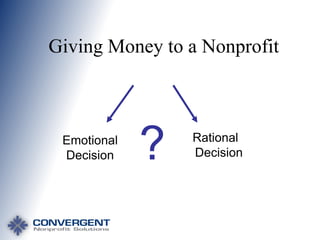
Giving Money to a Nonprofit

Emotional
Decision

?

Rational
Decision
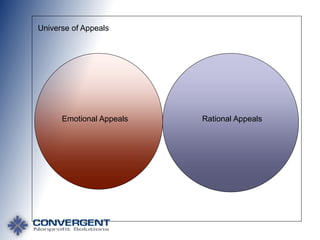
Universe of Appeals

Emotional Appeals

Rational Appeals
Emotional Camp
 No information is better than
good information

 Want the warm glow
 We want to be like Warren
Emotional Camp
 Sick beats healthy
 We want to be winners
 Blondes beat brunettes
Rational Camp
“The Rokia study points to a real danger in the
movement to encourage donors to give more
rationally. While most everyone would like to see
donors allocate their money based on a logical
understanding of the problems they hope their
gifts will solve, it turns out that encouraging
donors to act this way may thwart their natural
urge to give.”
Emotional "Proof"
 Participants were given 5 $1 bills
 Could give one to five dollars

 Four scenarios with Identifiable
victims and/or statistical victims
Conclusion
The more statistical information
people were given, the less
generous they became
The Rest of the Story
It's not that the studies are wrong,
it's that they are studies!
Refuting Rokia
 Small amounts of money
 Artificial circumstances
 Subjects not personally connected
to the cause
 Only deal with individuals, not
boards or families
Refuting Rokia
Somewhat risky to base your funding
strategy on privileged twentysomethings that made trivial decisions
about insignificant amounts of money
that was just given to them
Can't Make the Leap
 These exercises have little to do
with the outcomes delivered by
the organization
 The conclusion has become perverse
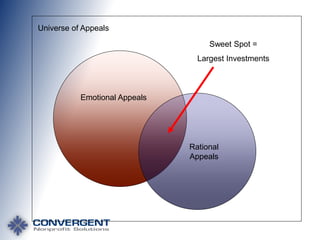
Universe of Appeals
Sweet Spot =
Largest Investments

Emotional Appeals

Rational
Appeals
Commonalities
 On an individual level, easy to spot

 Collectively, more difficult
Asking Rights
The Ingredients/Formula
1. Outcomes

2. Credibility
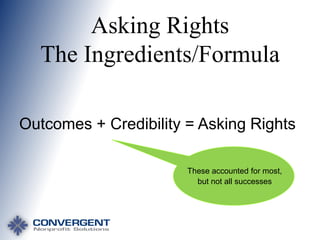
Asking Rights
The Ingredients/Formula
Outcomes + Credibility = Asking Rights
These accounted for most,
but not all successes
Asking Rights
The Ingredients/Formula
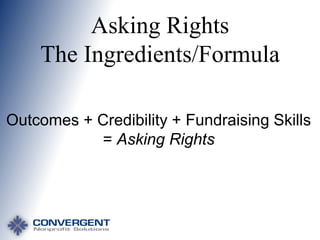
Outcomes + Credibility + Fundraising Skills
= Asking Rights
Asking Rights
The Ingredients/Formula
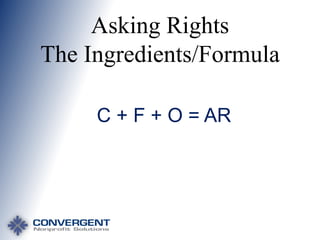
C + F + O = AR
Asking Rights
The Ingredients/Formula
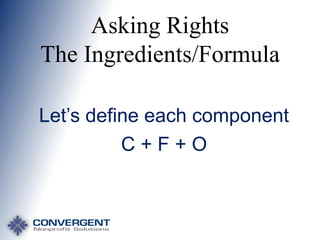
Let’s define each component
C+F+O
Asking Rights
Examples of Success
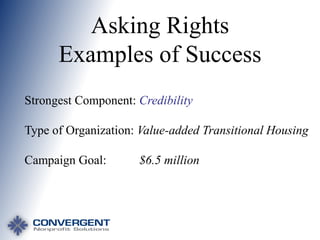
Strongest Component: Credibility

Type of Organization: Value-added Transitional Housing
Campaign Goal:

$6.5 million
Asking Rights
Examples of Success
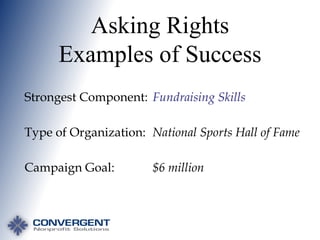
Strongest Component: Fundraising Skills

Type of Organization: National Sports Hall of Fame
Campaign Goal:

$6 million
Asking Rights
Examples of Success
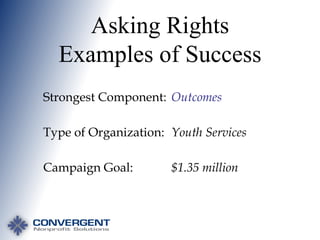
Strongest Component: Outcomes

Type of Organization: Youth Services
Campaign Goal:

$1.35 million
Asking Rights
Examples of Struggle
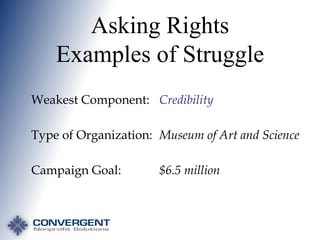
Weakest Component: Credibility

Type of Organization: Museum of Art and Science
Campaign Goal:

$6.5 million
Asking Rights
Examples of Struggle
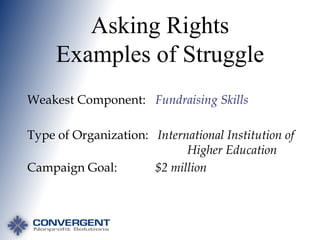
Weakest Component: Fundraising Skills

Type of Organization: International Institution of
Higher Education
Campaign Goal:
$2 million
Asking Rights
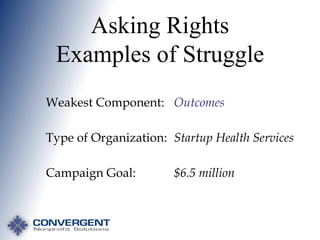
Examples of Struggle
Weakest Component: Outcomes
Type of Organization: Startup Health Services
Campaign Goal:

$6.5 million
Asking Rights
The Recipe
The Investment-Driven Model™
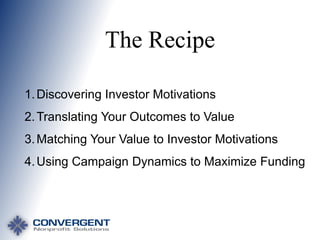
The Recipe
1. Discovering Investor Motivations
2. Translating Your Outcomes to Value
3. Matching Your Value to Investor Motivations
4. Using Campaign Dynamics to Maximize Funding
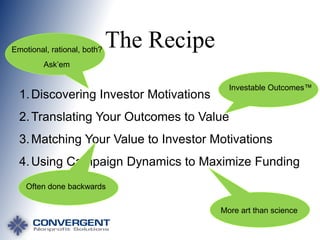
Emotional, rational, both?

The Recipe

Ask’em

1. Discovering Investor Motivations

Investable Outcomes™

2. Translating Your Outcomes to Value
3. Matching Your Value to Investor Motivations
4. Using Campaign Dynamics to Maximize Funding
Often done backwards
More art than science
Speaking of Motivations…
Why Do You Give?
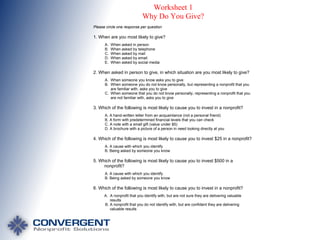
Worksheet 1
Why Do You Give?
Please circle one response per question

1. When are you most likely to give?
A.
B.
C.
D.
E.

When asked in person
When asked by telephone
When asked by mail
When asked by email
When asked by social media

2. When asked in person to give, in which situation are you most likely to give?
A. When someone you know asks you to give
B. When someone you do not know personally, but representing a nonprofit that you
are familiar with, asks you to give
C. When someone that you do not know personally, representing a nonprofit that you
are not familiar with, asks you to give

3. Which of the following is most likely to cause you to invest in a nonprofit?
A. A hand-written letter from an acquaintance (not a personal friend)
B. A form with predetermined financial levels that you can check
C. A note with a small gift (value under $5)
D. A brochure with a picture of a person in need looking directly at you

4. Which of the following is most likely to cause you to invest $25 in a nonprofit?
A. A cause with which you identify
B. Being asked by someone you know

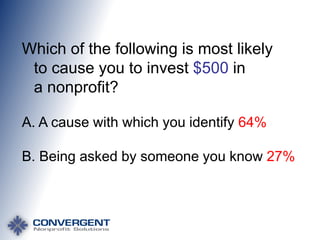
5. Which of the following is most likely to cause you to invest $500 in a
nonprofit?
A. A cause with which you identify
B. Being asked by someone you know

6. Which of the following is most likely to cause you to invest in a nonprofit?
A. A nonprofit that you identify with, but are not sure they are delivering valuable
results
B. A nonprofit that you do not identify with, but are confident they are delivering
valuable results
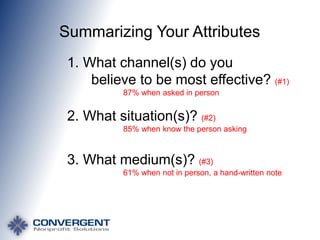
Summarizing Your Attributes
1. What channel(s) do you
believe to be most effective? (#1)
87% when asked in person

2. What situation(s)? (#2)
85% when know the person asking

3. What medium(s)? (#3)
61% when not in person, a hand-written note
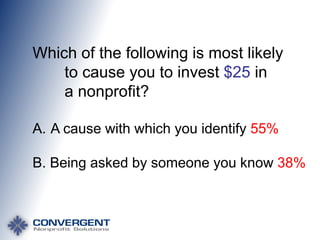
Which of the following is most likely
to cause you to invest $25 in
a nonprofit?
A. A cause with which you identify 55%
B. Being asked by someone you know 38%
Which of the following is most likely
to cause you to invest $500 in
a nonprofit?
A. A cause with which you identify 64%
B. Being asked by someone you know 27%
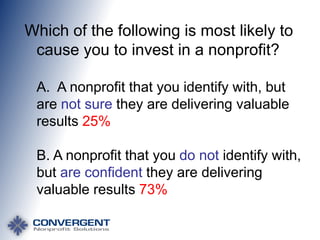
Which of the following is most likely to
cause you to invest in a nonprofit?
A. A nonprofit that you identify with, but
are not sure they are delivering valuable
results 25%

B. A nonprofit that you do not identify with,
but are confident they are delivering
valuable results 73%
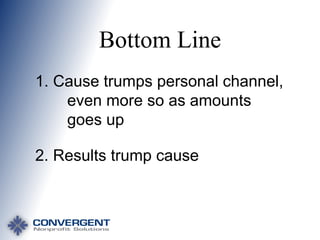
Bottom Line
1. Cause trumps personal channel,
even more so as amounts
goes up
2. Results trump cause
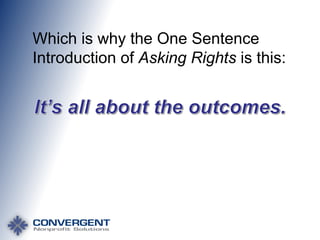
Which is why the One Sentence
Introduction of Asking Rights is this:
Takeaways
 Outcomes are correlated to funding
 There are alternatives to the old fallback
of emotional appeals and volunteer asks

 Don’t be afraid of rational motivations
 The right ingredients, combined into
the right recipe, make for a highly
sustainable organization
Things to Remember If
Nothing Else:
 Not everyone has Asking Rights.
They are earned, not given just because you are a nonprofit.

 Everyone is capable of developing Asking Rights.
It just takes effort and an organization-wide commitment.

 There is more to Asking Rights than just asking for money.
Even though the IRS says you can ask people for money, it does not
mean you will be successful at it.
Things to Remember If
Nothing Else:
 Those that have Asking Rights make their value obvious.
These organizations stand apart from the ones that don’t and will have a
smoother road to sustainable funding.

 It’s more about the right outcomes being valued than how the
value is determined.
It’s not how good your aim is, but whether you are aiming at the right
targets.

 An investor’s motivations are different than a donor’s.
Ignore this at your own peril.
Learn more about
Asking Rights
Follow us online for exclusive Asking Rights
excerpts, insights, and discussions, as well as
staying up to date on book release details, special
offers, and future speaking events.
@FundingResults

#AskingRights

Facebook.com/ConvergentNonprofitSolutions
Thank You!
www.ConvergentNonprofit.com
TRalser@ConvergentNonprofit.com

(800) 886-0280

Asking Rights

  • 1.
    Asking Rights Tom Ralser October30, 2013 Twitter Hashtag - #4Glearn Part Of: Sponsored by:
  • 2.
    INTEGRATED PLANNING Advising nonprofitsin: • Strategy • Planning • Organizational Development Part Of: www.synthesispartnership.com (617) 969-1881 info@synthesispartnership.com Sponsored by:
  • 3.
  • 4.
    Today’s Speaker Tom Ralser Principle ConvergentNonprofit Solutions Assisting with chat questions: Jamie Maloney, 4Good Part Of: Founding Director of Nonprofit Webinars and Host: Sam Frank, Synthesis Partnership Sponsored by:
  • 6.
    Asking Rights TM Nonprofits havethe legal right to ask for money
  • 7.
    Asking Rights TM Nonprofits havethe obligation to ask for money
  • 8.
    Not all nonprofitshave Asking Rights
  • 9.
    Many have notearned the right to ask for money
  • 10.
    “Son, what givesyou the right to ask me for money?”
  • 11.
    The Genesis Unique positionto see macro trends and common denominators  Experience (500+ projects)  National projects and local projects, nationally  All types (arts & culture, human services, economic development, education, health, etc.)
  • 12.
    Had to Ask. . . Why do some projects experience wild success, while others struggle?
  • 13.
    It Came Downto This: Because they did not have Asking Rights!
  • 14.
  • 15.
    Asking Rights TM The abilityto deliver outcomes that are valuable to investors
  • 16.
    Asking Rights TM Actually deliveron promises, not print glossy brochures that repeat your mission Ability to deliver outcomes that are valuable to investors
  • 17.
    Results in termsof impact on customers’ lives, not just measures of activity that tell how the money was spent Asking Rights TM Ability to deliver outcomes that are valuable to investors
  • 18.
    Asking Rights TM Ability todeliver outcomes that are valuable to investors Are they meaningful/ desired/coveted/longed for by those whose investment made them possible?
  • 19.
    Asking Rights TM Ability todeliver outcomes that are valuable to investors Those who make the outcomes possible. Carries the expectation of performance.
  • 20.
    Key Concepts  Outcomesare correlated to funding  Investors are different  Emotional and Rational Camps
  • 21.
    Outcomes Are Correlated toFunding Theoretical concepts can appeal to common sense: the Laffer Curve TAX REVENUE TAX RATE
  • 22.
    FUNDING Outcomes Are Correlated toFunding OUTPUTS OUTCOMES
  • 23.
    Investors Are Different Moreof a mindset than actual amount of $ A nonprofit investor, like any other investor, NOT donor, who makes a gift! is concerned with a return on that investment Not an impulsive decision, has multi-year commitments
  • 24.
    How investors thinkcan be summed up by the following: If you can’t demonstrate results (outcomes), then you do not have the right to ask for money. If you can’t make your outcomes meaningful to me, then you do not have the right to ask me for money.
  • 25.
  • 26.
  • 27.
    Giving Money toa Nonprofit Emotional Decision ? Rational Decision
  • 28.
    Universe of Appeals EmotionalAppeals Rational Appeals
  • 29.
    Emotional Camp  Noinformation is better than good information  Want the warm glow  We want to be like Warren
  • 30.
    Emotional Camp  Sickbeats healthy  We want to be winners  Blondes beat brunettes
  • 31.
    Rational Camp “The Rokiastudy points to a real danger in the movement to encourage donors to give more rationally. While most everyone would like to see donors allocate their money based on a logical understanding of the problems they hope their gifts will solve, it turns out that encouraging donors to act this way may thwart their natural urge to give.”
  • 32.
    Emotional "Proof"  Participantswere given 5 $1 bills  Could give one to five dollars  Four scenarios with Identifiable victims and/or statistical victims
  • 33.
    Conclusion The more statisticalinformation people were given, the less generous they became
  • 34.
    The Rest ofthe Story It's not that the studies are wrong, it's that they are studies!
  • 35.
    Refuting Rokia  Smallamounts of money  Artificial circumstances  Subjects not personally connected to the cause  Only deal with individuals, not boards or families
  • 36.
    Refuting Rokia Somewhat riskyto base your funding strategy on privileged twentysomethings that made trivial decisions about insignificant amounts of money that was just given to them
  • 37.
    Can't Make theLeap  These exercises have little to do with the outcomes delivered by the organization  The conclusion has become perverse
  • 38.
    Universe of Appeals SweetSpot = Largest Investments Emotional Appeals Rational Appeals
  • 39.
    Commonalities  On anindividual level, easy to spot  Collectively, more difficult
  • 40.
  • 41.
    Asking Rights The Ingredients/Formula Outcomes+ Credibility = Asking Rights These accounted for most, but not all successes
  • 42.
    Asking Rights The Ingredients/Formula Outcomes+ Credibility + Fundraising Skills = Asking Rights
  • 43.
  • 44.
  • 45.
    Asking Rights Examples ofSuccess Strongest Component: Credibility Type of Organization: Value-added Transitional Housing Campaign Goal: $6.5 million
  • 46.
    Asking Rights Examples ofSuccess Strongest Component: Fundraising Skills Type of Organization: National Sports Hall of Fame Campaign Goal: $6 million
  • 47.
    Asking Rights Examples ofSuccess Strongest Component: Outcomes Type of Organization: Youth Services Campaign Goal: $1.35 million
  • 48.
    Asking Rights Examples ofStruggle Weakest Component: Credibility Type of Organization: Museum of Art and Science Campaign Goal: $6.5 million
  • 49.
    Asking Rights Examples ofStruggle Weakest Component: Fundraising Skills Type of Organization: International Institution of Higher Education Campaign Goal: $2 million
  • 50.
    Asking Rights Examples ofStruggle Weakest Component: Outcomes Type of Organization: Startup Health Services Campaign Goal: $6.5 million
  • 51.
    Asking Rights The Recipe TheInvestment-Driven Model™
  • 52.
    The Recipe 1. DiscoveringInvestor Motivations 2. Translating Your Outcomes to Value 3. Matching Your Value to Investor Motivations 4. Using Campaign Dynamics to Maximize Funding
  • 53.
    Emotional, rational, both? TheRecipe Ask’em 1. Discovering Investor Motivations Investable Outcomes™ 2. Translating Your Outcomes to Value 3. Matching Your Value to Investor Motivations 4. Using Campaign Dynamics to Maximize Funding Often done backwards More art than science
  • 54.
  • 55.
    Worksheet 1 Why DoYou Give? Please circle one response per question 1. When are you most likely to give? A. B. C. D. E. When asked in person When asked by telephone When asked by mail When asked by email When asked by social media 2. When asked in person to give, in which situation are you most likely to give? A. When someone you know asks you to give B. When someone you do not know personally, but representing a nonprofit that you are familiar with, asks you to give C. When someone that you do not know personally, representing a nonprofit that you are not familiar with, asks you to give 3. Which of the following is most likely to cause you to invest in a nonprofit? A. A hand-written letter from an acquaintance (not a personal friend) B. A form with predetermined financial levels that you can check C. A note with a small gift (value under $5) D. A brochure with a picture of a person in need looking directly at you 4. Which of the following is most likely to cause you to invest $25 in a nonprofit? A. A cause with which you identify B. Being asked by someone you know 5. Which of the following is most likely to cause you to invest $500 in a nonprofit? A. A cause with which you identify B. Being asked by someone you know 6. Which of the following is most likely to cause you to invest in a nonprofit? A. A nonprofit that you identify with, but are not sure they are delivering valuable results B. A nonprofit that you do not identify with, but are confident they are delivering valuable results
  • 56.
    Summarizing Your Attributes 1.What channel(s) do you believe to be most effective? (#1) 87% when asked in person 2. What situation(s)? (#2) 85% when know the person asking 3. What medium(s)? (#3) 61% when not in person, a hand-written note
  • 57.
    Which of thefollowing is most likely to cause you to invest $25 in a nonprofit? A. A cause with which you identify 55% B. Being asked by someone you know 38%
  • 58.
    Which of thefollowing is most likely to cause you to invest $500 in a nonprofit? A. A cause with which you identify 64% B. Being asked by someone you know 27%
  • 59.
    Which of thefollowing is most likely to cause you to invest in a nonprofit? A. A nonprofit that you identify with, but are not sure they are delivering valuable results 25% B. A nonprofit that you do not identify with, but are confident they are delivering valuable results 73%
  • 60.
    Bottom Line 1. Causetrumps personal channel, even more so as amounts goes up 2. Results trump cause
  • 61.
    Which is whythe One Sentence Introduction of Asking Rights is this:
  • 62.
    Takeaways  Outcomes arecorrelated to funding  There are alternatives to the old fallback of emotional appeals and volunteer asks  Don’t be afraid of rational motivations  The right ingredients, combined into the right recipe, make for a highly sustainable organization
  • 63.
    Things to RememberIf Nothing Else:  Not everyone has Asking Rights. They are earned, not given just because you are a nonprofit.  Everyone is capable of developing Asking Rights. It just takes effort and an organization-wide commitment.  There is more to Asking Rights than just asking for money. Even though the IRS says you can ask people for money, it does not mean you will be successful at it.
  • 64.
    Things to RememberIf Nothing Else:  Those that have Asking Rights make their value obvious. These organizations stand apart from the ones that don’t and will have a smoother road to sustainable funding.  It’s more about the right outcomes being valued than how the value is determined. It’s not how good your aim is, but whether you are aiming at the right targets.  An investor’s motivations are different than a donor’s. Ignore this at your own peril.
  • 65.
    Learn more about AskingRights Follow us online for exclusive Asking Rights excerpts, insights, and discussions, as well as staying up to date on book release details, special offers, and future speaking events. @FundingResults #AskingRights Facebook.com/ConvergentNonprofitSolutions
  • 66.