Presented By:
                            Sardar Sikander
                            Tajamul Farooq
                            Saffi DAR
Chapter No.07
Decision Making and Planning process


    Contents:

   Decision Making and the Planning Process
   Organizational Goal
   Organizational Planning
   Tactical Planning
   Operational Planning
   Managing Goal-Setting and Planning Processes
Decision Making and Planning process


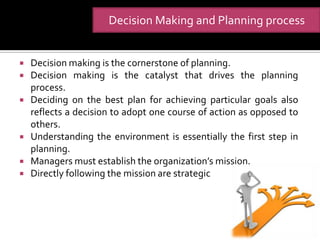
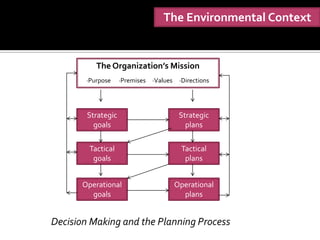
   Decision making is the cornerstone of planning.
   Decision making is the catalyst that drives the planning
    process.
   Deciding on the best plan for achieving particular goals also
    reflects a decision to adopt one course of action as opposed to
    others.
   Understanding the environment is essentially the first step in
    planning.
   Managers must establish the organization’s mission.
   Directly following the mission are strategic
The Environmental Context


          The Organization’s Mission
       ∙Purpose     ∙Premises   ∙Values    ∙Directions


        Strategic                          Strategic
          goals                              plans

        Tactical                            Tactical
         goals                               plans


      Operational                         Operational
        goals                               plans


Decision Making and the Planning Process
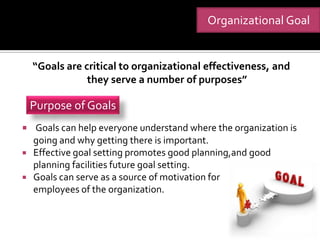
Organizational Goal


    “Goals are critical to organizational effectiveness, and
                they serve a number of purposes”

    Purpose of Goals
 Goals can help everyone understand where the organization is
    going and why getting there is important.
   Effective goal setting promotes good planning,and good
    planning facilities future goal setting.
   Goals can serve as a source of motivation for
    employees of the organization.
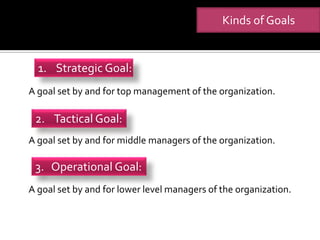
Kinds of Goals


  1. Strategic Goal:
A goal set by and for top management of the organization.

 2. Tactical Goal:
A goal set by and for middle managers of the organization.

 3. Operational Goal:
A goal set by and for lower level managers of the organization.
An organizational plan is basically a “to do” list for and
    organization. It lists out the plan of work, programs &
                              tasks.

   Each specific plan is designed for achieving each specific goal.
   Plans are also distributed according to the time frame in which
    they are implemented or act upon.
   Different plans are also prepared by management in order to
    tackle any unexpected event.
Kinds of Organizational Planning


 1. Strategic Plan:
A general plan outlining decisions of resource
allocation,priorities,and action steps necessary to reach
strategic goals.
 2. Tactical Plan:
A plan aimed at achieving tactical goals and developed to
implement parts of a strategic plan.
 3. Operational Plan:
Focuses on carring out tactical plans to achieve operational
goals.
Time Frames for Planning


 1. Long range plan:
A plan that covers many years even decades; common long range
   plans are for five years or more.

 2. Immediate plan:
A plan that generally covers from one to five years.
Time Frames for Planning (cont’d)


3. Short range plan:

A plan that generally covers a span of one year or less.

4. Action plan:
A plan used to operationalize any other kind of plan.

5. Reaction plan:
A plan developed to react to an unforeseen circumstances.
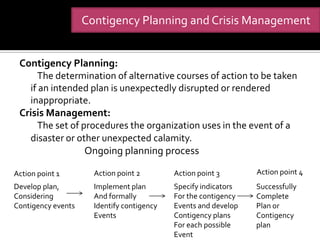
Contigency Planning and Crisis Management


 Contigency Planning:
     The determination of alternative courses of action to be taken
   if an intended plan is unexpectedly disrupted or rendered
   inappropriate.
 Crisis Management:
     The set of procedures the organization uses in the event of a
   disaster or other unexpected calamity.
                 Ongoing planning process

Action point 1        Action point 2        Action point 3       Action point 4
Develop plan,         Implement plan        Specify indicators   Successfully
Considering           And formally          For the contigency   Complete
Contigency events     Identify contigency   Events and develop   Plan or
                      Events                Contigency plans     Contigency
                                            For each possible    plan
                                            Event
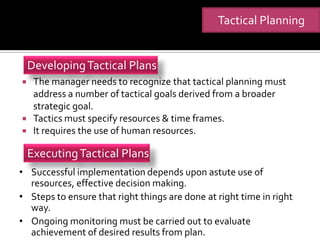
Tactical Planning


    Developing Tactical Plans
    The manager needs to recognize that tactical planning must
     address a number of tactical goals derived from a broader
     strategic goal.
    Tactics must specify resources & time frames.
    It requires the use of human resources.

    Executing Tactical Plans
• Successful implementation depends upon astute use of
  resources, effective decision making.
• Steps to ensure that right things are done at right time in right
  way.
• Ongoing monitoring must be carried out to evaluate
  achievement of desired results from plan.
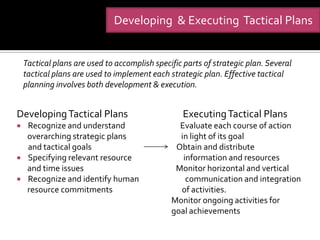
Developing & Executing Tactical Plans


    Tactical plans are used to accomplish specific parts of strategic plan. Several
    tactical plans are used to implement each strategic plan. Effective tactical
    planning involves both development & execution.


Developing Tactical Plans                          Executing Tactical Plans
    Recognize and understand                    Evaluate each course of action
     overarching strategic plans                 in light of its goal
     and tactical goals                         Obtain and distribute
    Specifying relevant resource                 information and resources
     and time issues                            Monitor horizontal and vertical
    Recognize and identify human                  communication and integration
     resource commitments                        of activities.
                                               Monitor ongoing activities for
                                               goal achievements
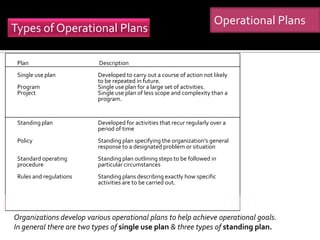
Operational Plans
Types of Operational Plans

 Plan                     Description
 Single use plan          Developed to carry out a course of action not likely
                          to be repeated in future.
 Program                  Single use plan for a large set of activities.
 Project                  Single use plan of less scope and complexity than a
                          program.


 Standing plan            Developed for activities that recur regularly over a
                          period of time
 Policy                   Standing plan specifying the organization’s general
                          response to a designated problem or situation
 Standard operating       Standing plan outlining steps to be followed in
 procedure                particular circumstances
 Rules and regulations    Standing plans describing exactly how specific
                          activities are to be carried out.


Organizations develop various operational plans to help achieve operational goals.
In general there are two types of single use plan & three types of standing plan.
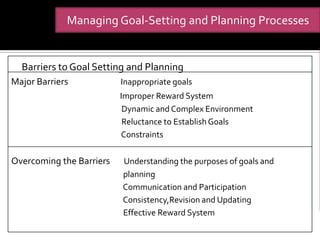
Managing Goal-Setting and Planning Processes


  Barriers to Goal Setting and Planning
Major Barriers            Inappropriate goals
                          Improper Reward System
                           Dynamic and Complex Environment
                           Reluctance to Establish Goals
                          Constraints

Overcoming the Barriers   Understanding the purposes of goals and
                          planning
                          Communication and Participation
                          Consistency,Revision and Updating
                          Effective Reward System
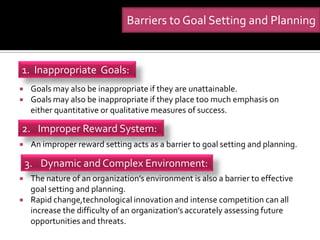
Barriers to Goal Setting and Planning


1. Inappropriate Goals:
    Goals may also be inappropriate if they are unattainable.
    Goals may also be inappropriate if they place too much emphasis on
     either quantitative or qualitative measures of success.

2. Improper Reward System:
    An improper reward setting acts as a barrier to goal setting and planning.

    3. Dynamic and Complex Environment:
    The nature of an organization’s environment is also a barrier to effective
     goal setting and planning.
    Rapid change,technological innovation and intense competition can all
     increase the difficulty of an organization’s accurately assessing future
     opportunities and threats.
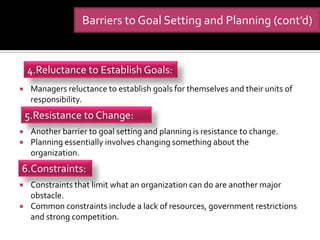
Barriers to Goal Setting and Planning (cont’d)


    4.Reluctance to Establish Goals:
    Managers reluctance to establish goals for themselves and their units of
     responsibility.
    5.Resistance to Change:
    Another barrier to goal setting and planning is resistance to change.
    Planning essentially involves changing something about the
     organization.
6.Constraints:
    Constraints that limit what an organization can do are another major
     obstacle.
    Common constraints include a lack of resources, government restrictions
     and strong competition.
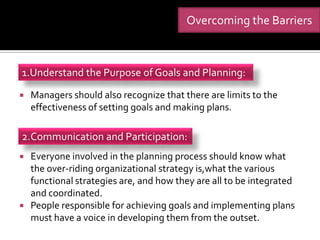
Overcoming the Barriers


1.Understand the Purpose of Goals and Planning:
   Managers should also recognize that there are limits to the
    effectiveness of setting goals and making plans.

2.Communication and Participation:
   Everyone involved in the planning process should know what
    the over-riding organizational strategy is,what the various
    functional strategies are, and how they are all to be integrated
    and coordinated.
   People responsible for achieving goals and implementing plans
    must have a voice in developing them from the outset.
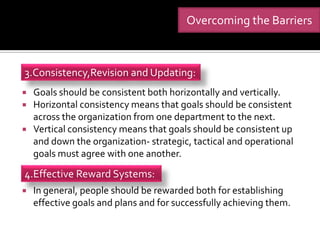
Overcoming the Barriers


3.Consistency,Revision and Updating:
   Goals should be consistent both horizontally and vertically.
   Horizontal consistency means that goals should be consistent
    across the organization from one department to the next.
   Vertical consistency means that goals should be consistent up
    and down the organization- strategic, tactical and operational
    goals must agree with one another.

4.Effective Reward Systems:
   In general, people should be rewarded both for establishing
    effective goals and plans and for successfully achieving them.
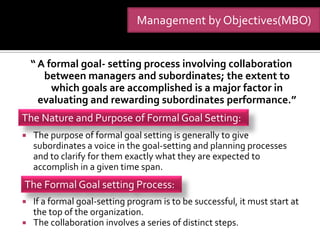
Management by Objectives(MBO)


    “ A formal goal- setting process involving collaboration
       between managers and subordinates; the extent to
         which goals are accomplished is a major factor in
      evaluating and rewarding subordinates performance.”
The Nature and Purpose of Formal Goal Setting:
   The purpose of formal goal setting is generally to give
    subordinates a voice in the goal-setting and planning processes
    and to clarify for them exactly what they are expected to
    accomplish in a given time span.
The Formal Goal setting Process:
 If a formal goal-setting program is to be successful, it must start at
  the top of the organization.
 The collaboration involves a series of distinct steps.
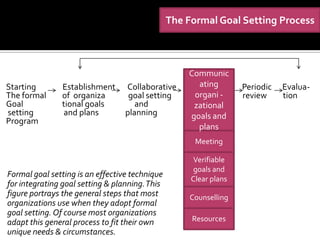
The Formal Goal Setting Process


                                                    Communic
Starting       Establishment      Collaborative       ating        Periodic   Evalua-
The formal     of organiza         goal setting      organi -      review     tion
Goal           tional goals          and             zational
setting        and plans          planning          goals and
Program
                                                      plans
                                                      Meeting

                                                     Verifiable
                                                      goals and
Formal goal setting is an effective technique
                                                     Clear plans
for integrating goal setting & planning. This
figure portrays the general steps that most          Counselling
organizations use when they adopt formal
goal setting. Of course most organizations
adapt this general process to fit their own          Resources
unique needs & circumstances.
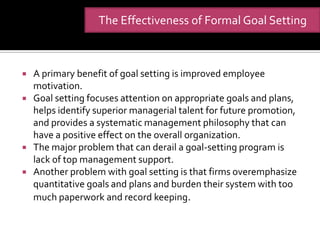
The Effectiveness of Formal Goal Setting


   A primary benefit of goal setting is improved employee
    motivation.
   Goal setting focuses attention on appropriate goals and plans,
    helps identify superior managerial talent for future promotion,
    and provides a systematic management philosophy that can
    have a positive effect on the overall organization.
   The major problem that can derail a goal-setting program is
    lack of top management support.
   Another problem with goal setting is that firms overemphasize
    quantitative goals and plans and burden their system with too
    much paperwork and record keeping.
Thank You

Chapter#7 planning & decision making process

  • 1.
    Presented By: Sardar Sikander Tajamul Farooq Saffi DAR Chapter No.07
  • 2.
    Decision Making andPlanning process Contents:  Decision Making and the Planning Process  Organizational Goal  Organizational Planning  Tactical Planning  Operational Planning  Managing Goal-Setting and Planning Processes
  • 3.
    Decision Making andPlanning process  Decision making is the cornerstone of planning.  Decision making is the catalyst that drives the planning process.  Deciding on the best plan for achieving particular goals also reflects a decision to adopt one course of action as opposed to others.  Understanding the environment is essentially the first step in planning.  Managers must establish the organization’s mission.  Directly following the mission are strategic
  • 4.
    The Environmental Context The Organization’s Mission ∙Purpose ∙Premises ∙Values ∙Directions Strategic Strategic goals plans Tactical Tactical goals plans Operational Operational goals plans Decision Making and the Planning Process
  • 5.
    Organizational Goal “Goals are critical to organizational effectiveness, and they serve a number of purposes” Purpose of Goals  Goals can help everyone understand where the organization is going and why getting there is important.  Effective goal setting promotes good planning,and good planning facilities future goal setting.  Goals can serve as a source of motivation for employees of the organization.
  • 6.
    Kinds of Goals 1. Strategic Goal: A goal set by and for top management of the organization. 2. Tactical Goal: A goal set by and for middle managers of the organization. 3. Operational Goal: A goal set by and for lower level managers of the organization.
  • 7.
    An organizational planis basically a “to do” list for and organization. It lists out the plan of work, programs & tasks.  Each specific plan is designed for achieving each specific goal.  Plans are also distributed according to the time frame in which they are implemented or act upon.  Different plans are also prepared by management in order to tackle any unexpected event.
  • 8.
    Kinds of OrganizationalPlanning 1. Strategic Plan: A general plan outlining decisions of resource allocation,priorities,and action steps necessary to reach strategic goals. 2. Tactical Plan: A plan aimed at achieving tactical goals and developed to implement parts of a strategic plan. 3. Operational Plan: Focuses on carring out tactical plans to achieve operational goals.
  • 9.
    Time Frames forPlanning 1. Long range plan: A plan that covers many years even decades; common long range plans are for five years or more. 2. Immediate plan: A plan that generally covers from one to five years.
  • 10.
    Time Frames forPlanning (cont’d) 3. Short range plan: A plan that generally covers a span of one year or less. 4. Action plan: A plan used to operationalize any other kind of plan. 5. Reaction plan: A plan developed to react to an unforeseen circumstances.
  • 11.
    Contigency Planning andCrisis Management Contigency Planning: The determination of alternative courses of action to be taken if an intended plan is unexpectedly disrupted or rendered inappropriate. Crisis Management: The set of procedures the organization uses in the event of a disaster or other unexpected calamity. Ongoing planning process Action point 1 Action point 2 Action point 3 Action point 4 Develop plan, Implement plan Specify indicators Successfully Considering And formally For the contigency Complete Contigency events Identify contigency Events and develop Plan or Events Contigency plans Contigency For each possible plan Event
  • 12.
    Tactical Planning Developing Tactical Plans  The manager needs to recognize that tactical planning must address a number of tactical goals derived from a broader strategic goal.  Tactics must specify resources & time frames.  It requires the use of human resources. Executing Tactical Plans • Successful implementation depends upon astute use of resources, effective decision making. • Steps to ensure that right things are done at right time in right way. • Ongoing monitoring must be carried out to evaluate achievement of desired results from plan.
  • 13.
    Developing & ExecutingTactical Plans Tactical plans are used to accomplish specific parts of strategic plan. Several tactical plans are used to implement each strategic plan. Effective tactical planning involves both development & execution. Developing Tactical Plans Executing Tactical Plans  Recognize and understand Evaluate each course of action overarching strategic plans in light of its goal and tactical goals Obtain and distribute  Specifying relevant resource information and resources and time issues Monitor horizontal and vertical  Recognize and identify human communication and integration resource commitments of activities. Monitor ongoing activities for goal achievements
  • 14.
    Operational Plans Types ofOperational Plans Plan Description Single use plan Developed to carry out a course of action not likely to be repeated in future. Program Single use plan for a large set of activities. Project Single use plan of less scope and complexity than a program. Standing plan Developed for activities that recur regularly over a period of time Policy Standing plan specifying the organization’s general response to a designated problem or situation Standard operating Standing plan outlining steps to be followed in procedure particular circumstances Rules and regulations Standing plans describing exactly how specific activities are to be carried out. Organizations develop various operational plans to help achieve operational goals. In general there are two types of single use plan & three types of standing plan.
  • 15.
    Managing Goal-Setting andPlanning Processes Barriers to Goal Setting and Planning Major Barriers Inappropriate goals Improper Reward System Dynamic and Complex Environment Reluctance to Establish Goals Constraints Overcoming the Barriers Understanding the purposes of goals and planning Communication and Participation Consistency,Revision and Updating Effective Reward System
  • 16.
    Barriers to GoalSetting and Planning 1. Inappropriate Goals:  Goals may also be inappropriate if they are unattainable.  Goals may also be inappropriate if they place too much emphasis on either quantitative or qualitative measures of success. 2. Improper Reward System:  An improper reward setting acts as a barrier to goal setting and planning. 3. Dynamic and Complex Environment:  The nature of an organization’s environment is also a barrier to effective goal setting and planning.  Rapid change,technological innovation and intense competition can all increase the difficulty of an organization’s accurately assessing future opportunities and threats.
  • 17.
    Barriers to GoalSetting and Planning (cont’d) 4.Reluctance to Establish Goals:  Managers reluctance to establish goals for themselves and their units of responsibility. 5.Resistance to Change:  Another barrier to goal setting and planning is resistance to change.  Planning essentially involves changing something about the organization. 6.Constraints:  Constraints that limit what an organization can do are another major obstacle.  Common constraints include a lack of resources, government restrictions and strong competition.
  • 18.
    Overcoming the Barriers 1.Understandthe Purpose of Goals and Planning:  Managers should also recognize that there are limits to the effectiveness of setting goals and making plans. 2.Communication and Participation:  Everyone involved in the planning process should know what the over-riding organizational strategy is,what the various functional strategies are, and how they are all to be integrated and coordinated.  People responsible for achieving goals and implementing plans must have a voice in developing them from the outset.
  • 19.
    Overcoming the Barriers 3.Consistency,Revisionand Updating:  Goals should be consistent both horizontally and vertically.  Horizontal consistency means that goals should be consistent across the organization from one department to the next.  Vertical consistency means that goals should be consistent up and down the organization- strategic, tactical and operational goals must agree with one another. 4.Effective Reward Systems:  In general, people should be rewarded both for establishing effective goals and plans and for successfully achieving them.
  • 20.
    Management by Objectives(MBO) “ A formal goal- setting process involving collaboration between managers and subordinates; the extent to which goals are accomplished is a major factor in evaluating and rewarding subordinates performance.” The Nature and Purpose of Formal Goal Setting:  The purpose of formal goal setting is generally to give subordinates a voice in the goal-setting and planning processes and to clarify for them exactly what they are expected to accomplish in a given time span. The Formal Goal setting Process:  If a formal goal-setting program is to be successful, it must start at the top of the organization.  The collaboration involves a series of distinct steps.
  • 21.
    The Formal GoalSetting Process Communic Starting Establishment Collaborative ating Periodic Evalua- The formal of organiza goal setting organi - review tion Goal tional goals and zational setting and plans planning goals and Program plans Meeting Verifiable goals and Formal goal setting is an effective technique Clear plans for integrating goal setting & planning. This figure portrays the general steps that most Counselling organizations use when they adopt formal goal setting. Of course most organizations adapt this general process to fit their own Resources unique needs & circumstances.
  • 22.
    The Effectiveness ofFormal Goal Setting  A primary benefit of goal setting is improved employee motivation.  Goal setting focuses attention on appropriate goals and plans, helps identify superior managerial talent for future promotion, and provides a systematic management philosophy that can have a positive effect on the overall organization.  The major problem that can derail a goal-setting program is lack of top management support.  Another problem with goal setting is that firms overemphasize quantitative goals and plans and burden their system with too much paperwork and record keeping.
  • 23.