
Organizing People To Get Stuff Done


                                      Presented to TAG W k h
                                      P       d        Workshop
                                                   April 29, 2003
I have made these presentations available in the hopes that the ideas will be
helpful to others. I only ask that you respect my work by providing
attribution as appropriate and not re posting the document.
                                     re-posting

Thank you and enjoy.
Bill Nussey

This presentation and others available at http://NusseyNotes.com and
http://www.slideshare.net/BillNussey1
Agenda

 Introduction

 The fundamentals of organizing companies

 An organizational model

 Putting organizational improvements in place

 Summary
 S
Flexibility Is The Core Advantage of Start Ups

  Fundamental differentiator of a start up: Flexibility

  Flexibility provides several advantages:
      Re-allocate resources relatively easily
      The downside impact of changing directions is small (often nothing
      more than egos)

  Flexibility does not mean:
      Lack of clarity or focus
      Lack of planning or measurement
      Lack of structure or organization

  Bottom line: Flexibility means start ups can turn on a dime
Is There a Perfect Organizational Structure?

  There is absolutely NOT a best organizational structure – it varies widely
  for each particular company

  Issues to consider when designing organizational structure

     Leadership Style & Corporate Culture

     Risk Profile of owners

     Product delivery requirements: Execution vs. Innovation

     Expected growth rate
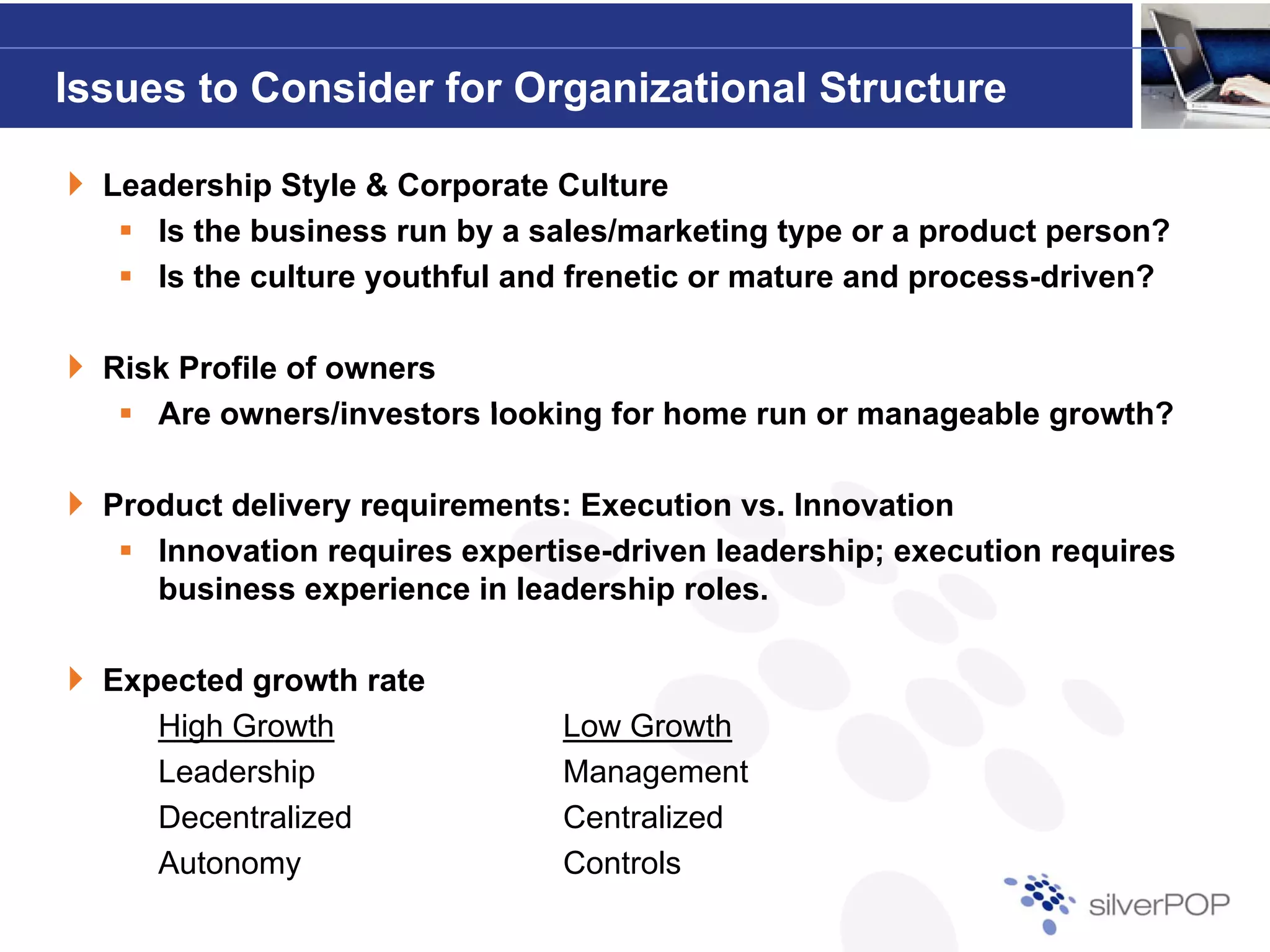
Issues to Consider for Organizational Structure

  Leadership Style & Corporate Culture
     Is the business run by a sales/marketing type or a product person?
     Is the culture youthful and frenetic or mature and process-driven?
                                                        process driven?

  Risk Profile of owners
     Are o ners/in estors looking for home r n or manageable gro th?
         owners/investors                  run               growth?

  Product delivery requirements: Execution vs. Innovation
     Innovation requires expertise-driven leadership; execution requires
     I      ti       i        ti d i      l d    hi        ti       i
     business experience in leadership roles.

  Expected growth rate
     High Growth                Low Growth
     Leadership                 Management
     Decentralized              Centralized
     Autonomy                   Controls
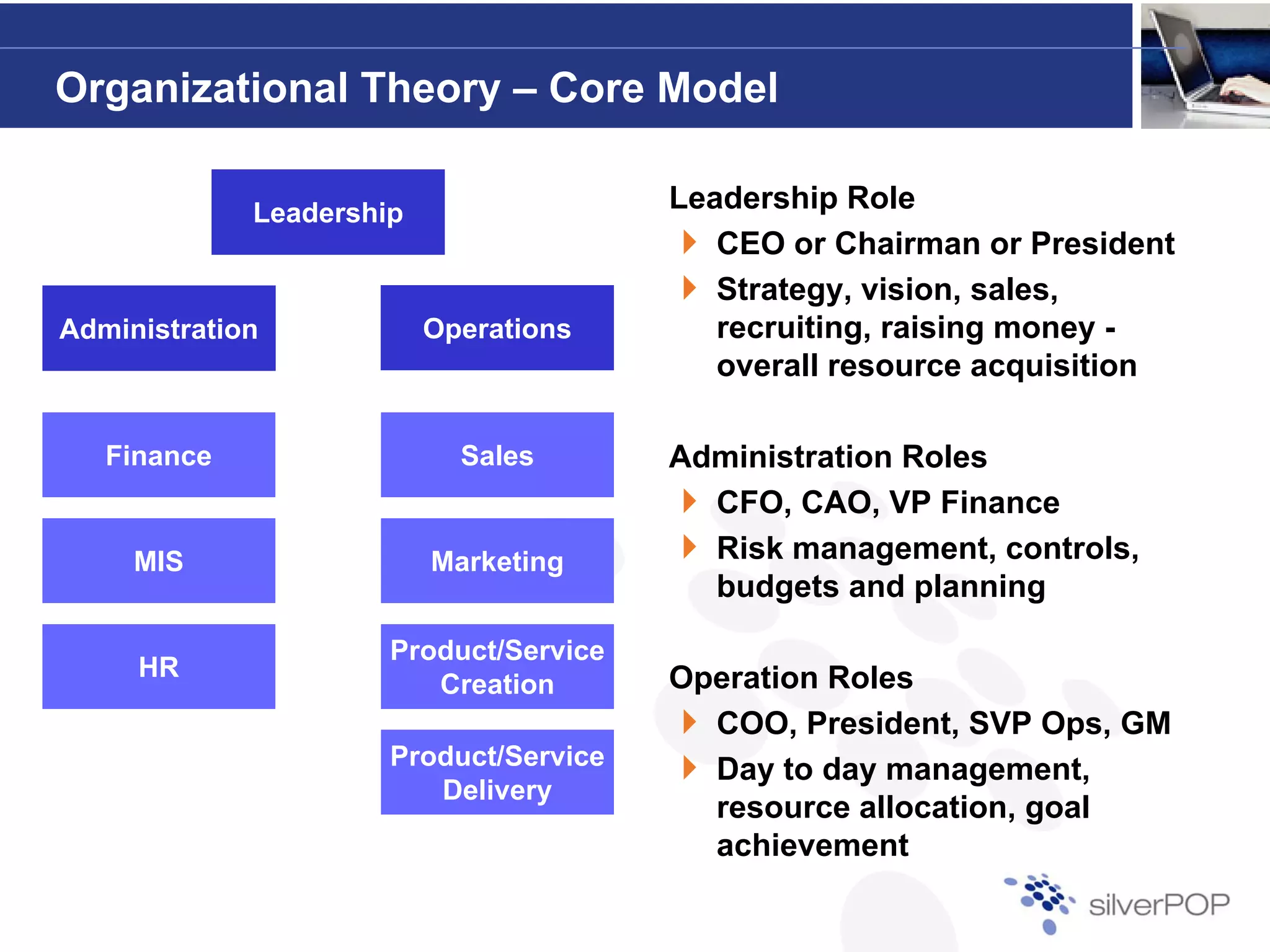
Organizational Theory – Core Model

             Leadership                 Leadership Role
                                           CEO or Chairman or President
                                           Strategy, vision, sales,
Administration            Operations       recruiting, raising money -
                                           overall resource acquisition

   Finance                  Sales       Administration Roles
                                          CFO, CAO, VP Finance
     MIS                  Marketing       Risk management controls
                                               management, controls,
                                          budgets and planning
                      Product/Service
     HR                                 Operation Roles
                         Creation
                                          COO, President, SVP Ops, GM
                      Product/Service     Day to day management,
                         Delivery
                                          resource allocation, goal
                                          achievement
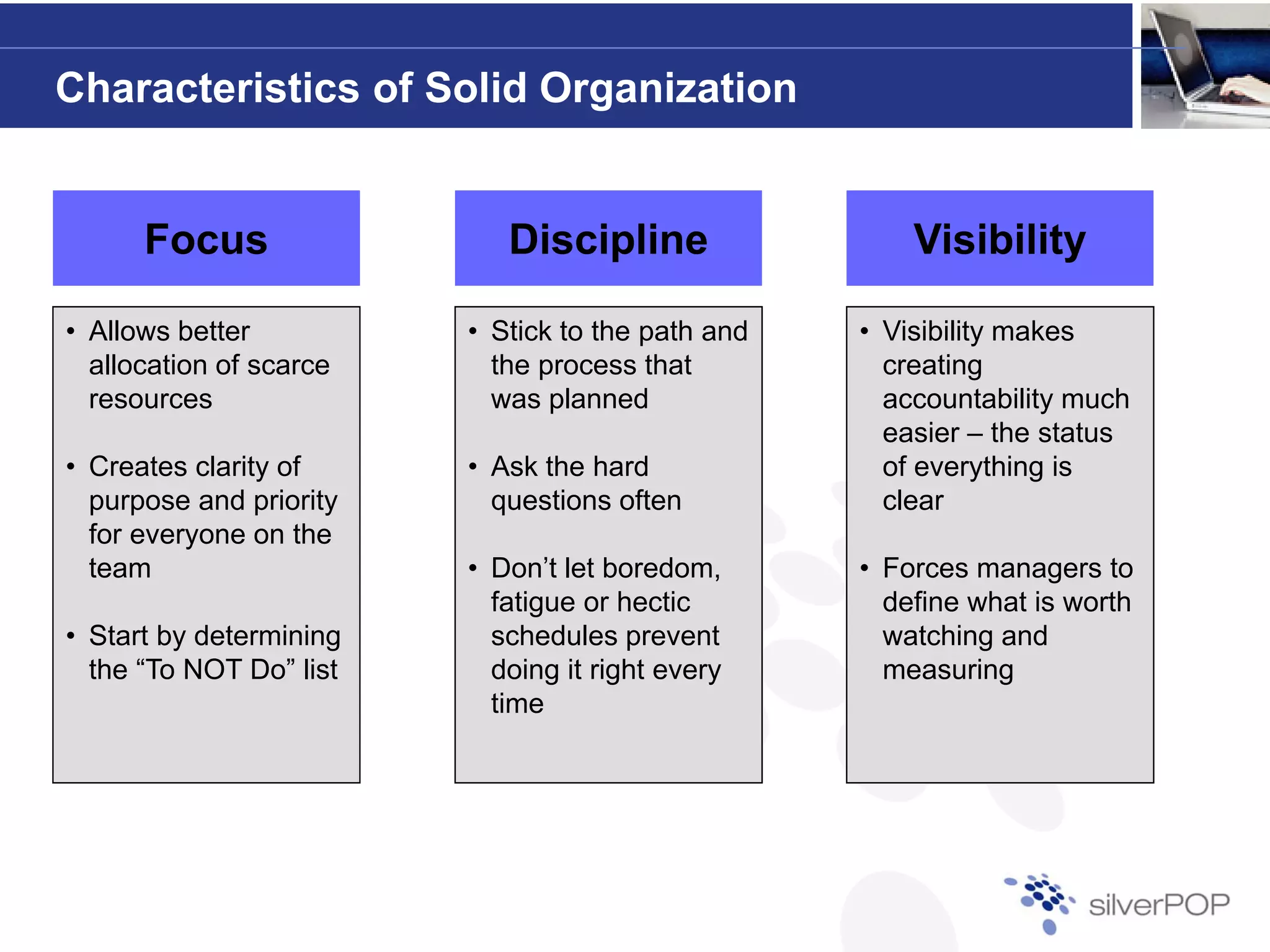
Characteristics of Solid Organization


      Focus                 Discipline                 Visibility

• Allows better          • Stick to the path and   • Visibility makes
  allocation of scarce     the process that          creating
  resources                was planned               accountability much
                                                     easier – the status
• Creates clarity of     • Ask the hard              of everything is
  purpose and priority     questions often           clear
  for e e yo e o t e
   o everyone on the
  team                   • Don’t let boredom,      • Forces managers to
                           fatigue or hectic         define what is worth
• Start by determining     schedules prevent         watching and
  the “To NOT Do” list     doing it right every
                                g     g       y      measuringg
                           time
Putting Organizational Improvements In Place…

There are several, related issues to consider…

   Planning

   People

   Processes and Systems

   Performance Management

   Reporting and Controls
Planning

  “In preparing for battle I have always found that plans are useless, but
  planning is indispensable.” - Dwight D. Eisenhower

  “Planning is an unnatural process; it is much more fun to do something. The
  nicest thing about not planning is that failure comes as a complete surprise,
  rather than being preceded b a period of worry and depression ”
                              by                 orr     depression.”
  - Sir John Harvey-Jones

  Planning is the foundation of a well organized company. Planning
  Pl   i i th f       d ti    f     ll      i d           Pl   i
  encompasses goal setting, budgeting, MBO’s and product timelines.
Planning

Tips

  Start with an annual plan and work it into monthly targets. Never recast
                                                     targets
  but instead differentiate between forecast and budget. The power of a
  budget/plan is that you have something to compare against when things
  g
  go off track, good or bad.
                g

  Remember, companies win 1 of 3 ways: low price, best service,
  innovative offering. Pick one and focus on it.
People

  “Organization doesn't really accomplish anything. Plans don't accomplish
  anything, either. Theories of management don't much matter. Endeavors
  succeed or fail because of the people involved. Only by attracting the best
  people will you accomplish great deeds. In a brain-based economy, your best
  assets are people.” - Collin Powell

  Organizing people requires having the right people, not just the right
  roles. One of the toughest business challenges is determining if a
  manager is failing because of the person or because of the role.
        g          g                p
People

Tips

  The best “Experts” generally make lousy managers Don’t assume your
                                          managers.
  best programmer or sales person should run the department.

  Build a model of the ideal organization and see where the current team
  members fit. You’ll learn a lot by analyzing the people left over.

  Start ups must strike a balance between the available people and the
  needed roles.
Processes and Systems


  “If you can't describe what you are doing as a p
      y                       y           g      process, y don't know what
                                                          you
  you're doing.” - W Edwards Deming

  Organization and processes are inseparable – they each support the
  other. Processes and systems are the framework that lets
  organizational structures deliver results.
Processes and Systems

Tips

  Don’t over design processes. In nearly every situation most of what
                    processes                    situation,
  actually gets done in a process is implicit and relies on trust and
  communication between participants.

  Computer systems are rarely the solution for managing processes. Start
  with Excel, paper forms or even 3x5 cards. Only after the process works
  should you consider locking it into an IT-run busines system.
Performance Management


 “People don’t do what you expect, they do what you inspect.” - Bob Hayes,
 Harvard Business School

 Organizing people, even the right people, is not enough. People need to
 be achieving their objectives and fulfilling their roles with the right
 deliverables and behavior.
Performance Management

Tips

  Avoid step-wise incentives, people will do the wrong things to hit their
        step wise incentives
  next plateau.

  Some companies look purely at measurable goals; some at purely
  subjective goals. The truth is that both are required.

  Be careful what you reward people for, they might just achieve it (to the
  exclusion of other important but implicit things).
Reporting and Controls


  “The best organizational control is not control of people, but control of events,
  outcomes and products ” - General Bill Creech author of “The Five Pillars of
                products.                                     The
  TQM”

  If the p a is t e roadmap, and processes and systems a e t e ca , t e
     t e plan s the oad ap, a d p ocesses a d syste s are the car, then
  reporting and controls are the compass, speedometer and gas gauge.
  The single best way to create an “accountable” organization is through
  openness and visibility – this way everyone becomes a manager.
Reporting and Controls

Tips

  Create a weekly or monthly operational flash report and share it with key
  managers. Assume the format will constantly change.

  Financial reports are always important; however, most start ups have
  other important metrics they need to focus on as well – sales pipeline,
  customer support count, product problems, etc.

  Micromanagement is often seen as tight control. Nothing could be
  further from the truth. Control is about outcomes, not tasks.
Summary

 Start ups are about flexibility

 There is no “best” organizational structure. Organization should reflect
 the company’s growth, size, culture and offerings.

 Structure is just a part. Planning, people, systems, etc, are inseparable
 from organization.

 Success is not about getting the organization right and stepping back. It
 is about dealing with an endless barrage of unexpected circumstances
 and surprises. The best organizations are designed to deal with this.
Thank You


                        Bill N
                             Nussey
            http:/NusseyNotes.com

Organizing People to Get Stuff Done

  • 1.
    Organizing People ToGet Stuff Done Presented to TAG W k h P d Workshop April 29, 2003
  • 2.
    I have madethese presentations available in the hopes that the ideas will be helpful to others. I only ask that you respect my work by providing attribution as appropriate and not re posting the document. re-posting Thank you and enjoy. Bill Nussey This presentation and others available at http://NusseyNotes.com and http://www.slideshare.net/BillNussey1
  • 3.
    Agenda Introduction Thefundamentals of organizing companies An organizational model Putting organizational improvements in place Summary S
  • 4.
    Flexibility Is TheCore Advantage of Start Ups Fundamental differentiator of a start up: Flexibility Flexibility provides several advantages: Re-allocate resources relatively easily The downside impact of changing directions is small (often nothing more than egos) Flexibility does not mean: Lack of clarity or focus Lack of planning or measurement Lack of structure or organization Bottom line: Flexibility means start ups can turn on a dime
  • 5.
    Is There aPerfect Organizational Structure? There is absolutely NOT a best organizational structure – it varies widely for each particular company Issues to consider when designing organizational structure Leadership Style & Corporate Culture Risk Profile of owners Product delivery requirements: Execution vs. Innovation Expected growth rate
  • 6.
    Issues to Considerfor Organizational Structure Leadership Style & Corporate Culture Is the business run by a sales/marketing type or a product person? Is the culture youthful and frenetic or mature and process-driven? process driven? Risk Profile of owners Are o ners/in estors looking for home r n or manageable gro th? owners/investors run growth? Product delivery requirements: Execution vs. Innovation Innovation requires expertise-driven leadership; execution requires I ti i ti d i l d hi ti i business experience in leadership roles. Expected growth rate High Growth Low Growth Leadership Management Decentralized Centralized Autonomy Controls
  • 7.
    Organizational Theory –Core Model Leadership Leadership Role CEO or Chairman or President Strategy, vision, sales, Administration Operations recruiting, raising money - overall resource acquisition Finance Sales Administration Roles CFO, CAO, VP Finance MIS Marketing Risk management controls management, controls, budgets and planning Product/Service HR Operation Roles Creation COO, President, SVP Ops, GM Product/Service Day to day management, Delivery resource allocation, goal achievement
  • 8.
    Characteristics of SolidOrganization Focus Discipline Visibility • Allows better • Stick to the path and • Visibility makes allocation of scarce the process that creating resources was planned accountability much easier – the status • Creates clarity of • Ask the hard of everything is purpose and priority questions often clear for e e yo e o t e o everyone on the team • Don’t let boredom, • Forces managers to fatigue or hectic define what is worth • Start by determining schedules prevent watching and the “To NOT Do” list doing it right every g g y measuringg time
  • 9.
    Putting Organizational ImprovementsIn Place… There are several, related issues to consider… Planning People Processes and Systems Performance Management Reporting and Controls
  • 10.
    Planning “Inpreparing for battle I have always found that plans are useless, but planning is indispensable.” - Dwight D. Eisenhower “Planning is an unnatural process; it is much more fun to do something. The nicest thing about not planning is that failure comes as a complete surprise, rather than being preceded b a period of worry and depression ” by orr depression.” - Sir John Harvey-Jones Planning is the foundation of a well organized company. Planning Pl i i th f d ti f ll i d Pl i encompasses goal setting, budgeting, MBO’s and product timelines.
  • 11.
    Planning Tips Startwith an annual plan and work it into monthly targets. Never recast targets but instead differentiate between forecast and budget. The power of a budget/plan is that you have something to compare against when things g go off track, good or bad. g Remember, companies win 1 of 3 ways: low price, best service, innovative offering. Pick one and focus on it.
  • 12.
    People “Organizationdoesn't really accomplish anything. Plans don't accomplish anything, either. Theories of management don't much matter. Endeavors succeed or fail because of the people involved. Only by attracting the best people will you accomplish great deeds. In a brain-based economy, your best assets are people.” - Collin Powell Organizing people requires having the right people, not just the right roles. One of the toughest business challenges is determining if a manager is failing because of the person or because of the role. g g p
  • 13.
    People Tips Thebest “Experts” generally make lousy managers Don’t assume your managers. best programmer or sales person should run the department. Build a model of the ideal organization and see where the current team members fit. You’ll learn a lot by analyzing the people left over. Start ups must strike a balance between the available people and the needed roles.
  • 14.
    Processes and Systems “If you can't describe what you are doing as a p y y g process, y don't know what you you're doing.” - W Edwards Deming Organization and processes are inseparable – they each support the other. Processes and systems are the framework that lets organizational structures deliver results.
  • 15.
    Processes and Systems Tips Don’t over design processes. In nearly every situation most of what processes situation, actually gets done in a process is implicit and relies on trust and communication between participants. Computer systems are rarely the solution for managing processes. Start with Excel, paper forms or even 3x5 cards. Only after the process works should you consider locking it into an IT-run busines system.
  • 16.
    Performance Management “Peopledon’t do what you expect, they do what you inspect.” - Bob Hayes, Harvard Business School Organizing people, even the right people, is not enough. People need to be achieving their objectives and fulfilling their roles with the right deliverables and behavior.
  • 17.
    Performance Management Tips Avoid step-wise incentives, people will do the wrong things to hit their step wise incentives next plateau. Some companies look purely at measurable goals; some at purely subjective goals. The truth is that both are required. Be careful what you reward people for, they might just achieve it (to the exclusion of other important but implicit things).
  • 18.
    Reporting and Controls “The best organizational control is not control of people, but control of events, outcomes and products ” - General Bill Creech author of “The Five Pillars of products. The TQM” If the p a is t e roadmap, and processes and systems a e t e ca , t e t e plan s the oad ap, a d p ocesses a d syste s are the car, then reporting and controls are the compass, speedometer and gas gauge. The single best way to create an “accountable” organization is through openness and visibility – this way everyone becomes a manager.
  • 19.
    Reporting and Controls Tips Create a weekly or monthly operational flash report and share it with key managers. Assume the format will constantly change. Financial reports are always important; however, most start ups have other important metrics they need to focus on as well – sales pipeline, customer support count, product problems, etc. Micromanagement is often seen as tight control. Nothing could be further from the truth. Control is about outcomes, not tasks.
  • 20.
    Summary Start upsare about flexibility There is no “best” organizational structure. Organization should reflect the company’s growth, size, culture and offerings. Structure is just a part. Planning, people, systems, etc, are inseparable from organization. Success is not about getting the organization right and stepping back. It is about dealing with an endless barrage of unexpected circumstances and surprises. The best organizations are designed to deal with this.
  • 21.
    Thank You Bill N Nussey http:/NusseyNotes.com