Other Versions of Linux
Damian Gordon
Slackware
• Slackware is oriented toward simplicity and
software purity
• Provides no graphical installation procedure
July
1993
Developed by:
Patrick Volkerding
Debian
• The Debian Project's policies focus on
collaborative software development and
testing processes
• New release every two years.
September
1993
Developed by:
Ian Murdock and the
Debian Project
SUSE
• "Software und System-Entwicklung", meaning
"Software and systems development".
• Often includes YaST setup and configuration
tool
1994
Developed by:
Roland Dyroff, Thomas
Fehr, Burchard Steinbild,
and Hubert Mantel
Red Hat
• In 2003 Red Hat Linux merged with the
community-based Fedora Project
• Introduced a graphical installer called
Anaconda and Lokkit for configuring the
firewall capabilities.
May
1995
Developed by:
Bob Young, Marc Ewing
and Red Hat Inc.
Knoppix
• Can be used to copy files easily from hard
drives with inaccessible operating systems.
• Designed to be booted straight from CD, DVD
or USB.
September
2000
Developed by:
Klaus Knopper
Gentoo
• Gentoo package management is designed to
be modular, portable, and easy to maintain.
• Not a binary software distribution, source
code is compiled locally and optimized for the
specific type of computer.
March
2002
Developed by:
Daniel Robbins and Gentoo
Foundation
Arch
• The development team focused on elegance,
code correctness, and minimalism.
• The user is expected to make significant effort
to understand the systems function.
March
2002
Developed by:
Judd Vinet, Aaron Griffin
and the Arch Linux team
Fedora
• Focuses on innovation, integrating new
technologies early on and working closely with
Linux communities.
• Linus Torvalds uses Fedora on all of his
computers.
November
2003
Developed by:
Fedora Project (owned by
Red Hat)
CentOS
• The project is affiliated with Red Hat but
aspires to be more public, open, and inclusive.
• Provides a free, enterprise-class, community-
supported computing platform.
2004
Developed by:
David Parsley, Lance Davis
and the CentOS Project
Ubuntu
• Committed to open source development;
encouraged to use free software, study how it
works, improve upon it, and distribute it.
• Named after the Southern African philosophy
of ubuntu (literally, "human-ness").
October
2004
Developed by:
Mark Shuttleworth and
Canonical Ltd.
Alpine
• Lightweight and secure by default while still
being useful for general-purpose tasks.
• Compiles all packages with stack-smashing
protection.
2006
Developed by:
Alpine Linux development
team
Oracle
• Based on Red Hat Enterprise
Linux (RHEL), repackaged and
freely distributed by Oracle.
• Oracle Linux supports KVM
and Xen.
October
2006
Developed by:
Oracle Corporation
Musix
• Collection of software for audio production,
graphic design, video editing and general
purpose applications.
• Documentation is in Spanish.
December
2006
Developed by:
Marcos Germán
Guglielmetti. And teams
from Argentina, Spain,
Mexico and Brazil.
Android
• Android is designed primarily for touchscreen
mobile devices such as smartphones and
tablet computers.
• The most widely used mobile OS.
September
2008
Developed by:
Google, and Open Handset
Alliance
Mageia
• A secure, and sustainable operating system,
designed to set up a stable and trustable
governance to direct collaborative projects.
• Uses all major desktop environments
June
2011
Developed by:
Former employees of
Mandriva
Some Linux Desktop
Environments
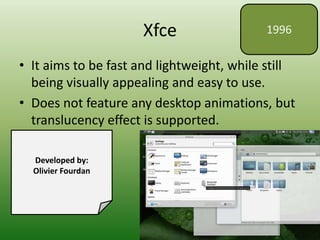
Xfce
• It aims to be fast and lightweight, while still
being visually appealing and easy to use.
• Does not feature any desktop animations, but
translucency effect is supported.
1996
Developed by:
Olivier Fourdan
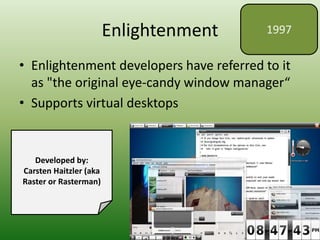
Enlightenment
• Enlightenment developers have referred to it
as "the original eye-candy window manager“
• Supports virtual desktops
1997
Developed by:
Carsten Haitzler (aka
Raster or Rasterman)
KDE
• Developed as an easy-to-use environment
• Works well with multimedia devices and
applications and mobile devices.
July
1998
Developed by:
Matthias Ettrich and KDE
GNOME
• Focuses on internationalization and localization and
accessibility of software.
• Incorporates freedesktop.org standards and
programs to better interoperate with other desktops.
March
1999
Developed by:
Miguel de Icaza, Federico
Mena, and the GNOME
project
LXDE
• Suitable for resource-constrained computers,
e.g., netbooks or System on a chip computers.
• A desktop environment that is fast and energy
efficient
2006
Developed by:
Hong Jen Yee ( aka PCMan)
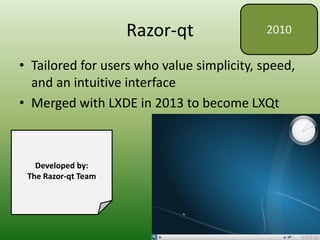
Razor-qt
• Tailored for users who value simplicity, speed,
and an intuitive interface
• Merged with LXDE in 2013 to become LXQt
2010
Developed by:
The Razor-qt Team
MATE
• Forked from GNOME 2, to maintain the simple
and clean interface that was controversially
removed in GNOME 3.
August
2011
Developed by:
Perberos and MATE
Developers
Cinnamon
• Another fork of GNOME 2, which provides a
range of user configurable interface
components.
• Better performance.
December
2011
Developed by:
Linux Mint development
team

Operating Systems: Versions of Linux

  • 1.
    Other Versions ofLinux Damian Gordon
  • 2.
    Slackware • Slackware isoriented toward simplicity and software purity • Provides no graphical installation procedure July 1993 Developed by: Patrick Volkerding
  • 3.
    Debian • The DebianProject's policies focus on collaborative software development and testing processes • New release every two years. September 1993 Developed by: Ian Murdock and the Debian Project
  • 4.
    SUSE • "Software undSystem-Entwicklung", meaning "Software and systems development". • Often includes YaST setup and configuration tool 1994 Developed by: Roland Dyroff, Thomas Fehr, Burchard Steinbild, and Hubert Mantel
  • 5.
    Red Hat • In2003 Red Hat Linux merged with the community-based Fedora Project • Introduced a graphical installer called Anaconda and Lokkit for configuring the firewall capabilities. May 1995 Developed by: Bob Young, Marc Ewing and Red Hat Inc.
  • 6.
    Knoppix • Can beused to copy files easily from hard drives with inaccessible operating systems. • Designed to be booted straight from CD, DVD or USB. September 2000 Developed by: Klaus Knopper
  • 7.
    Gentoo • Gentoo packagemanagement is designed to be modular, portable, and easy to maintain. • Not a binary software distribution, source code is compiled locally and optimized for the specific type of computer. March 2002 Developed by: Daniel Robbins and Gentoo Foundation
  • 8.
    Arch • The developmentteam focused on elegance, code correctness, and minimalism. • The user is expected to make significant effort to understand the systems function. March 2002 Developed by: Judd Vinet, Aaron Griffin and the Arch Linux team
  • 9.
    Fedora • Focuses oninnovation, integrating new technologies early on and working closely with Linux communities. • Linus Torvalds uses Fedora on all of his computers. November 2003 Developed by: Fedora Project (owned by Red Hat)
  • 10.
    CentOS • The projectis affiliated with Red Hat but aspires to be more public, open, and inclusive. • Provides a free, enterprise-class, community- supported computing platform. 2004 Developed by: David Parsley, Lance Davis and the CentOS Project
  • 11.
    Ubuntu • Committed toopen source development; encouraged to use free software, study how it works, improve upon it, and distribute it. • Named after the Southern African philosophy of ubuntu (literally, "human-ness"). October 2004 Developed by: Mark Shuttleworth and Canonical Ltd.
  • 12.
    Alpine • Lightweight andsecure by default while still being useful for general-purpose tasks. • Compiles all packages with stack-smashing protection. 2006 Developed by: Alpine Linux development team
  • 13.
    Oracle • Based onRed Hat Enterprise Linux (RHEL), repackaged and freely distributed by Oracle. • Oracle Linux supports KVM and Xen. October 2006 Developed by: Oracle Corporation
  • 14.
    Musix • Collection ofsoftware for audio production, graphic design, video editing and general purpose applications. • Documentation is in Spanish. December 2006 Developed by: Marcos Germán Guglielmetti. And teams from Argentina, Spain, Mexico and Brazil.
  • 15.
    Android • Android isdesigned primarily for touchscreen mobile devices such as smartphones and tablet computers. • The most widely used mobile OS. September 2008 Developed by: Google, and Open Handset Alliance
  • 16.
    Mageia • A secure,and sustainable operating system, designed to set up a stable and trustable governance to direct collaborative projects. • Uses all major desktop environments June 2011 Developed by: Former employees of Mandriva
  • 17.
  • 18.
    Xfce • It aimsto be fast and lightweight, while still being visually appealing and easy to use. • Does not feature any desktop animations, but translucency effect is supported. 1996 Developed by: Olivier Fourdan
  • 19.
    Enlightenment • Enlightenment developershave referred to it as "the original eye-candy window manager“ • Supports virtual desktops 1997 Developed by: Carsten Haitzler (aka Raster or Rasterman)
  • 20.
    KDE • Developed asan easy-to-use environment • Works well with multimedia devices and applications and mobile devices. July 1998 Developed by: Matthias Ettrich and KDE
  • 21.
    GNOME • Focuses oninternationalization and localization and accessibility of software. • Incorporates freedesktop.org standards and programs to better interoperate with other desktops. March 1999 Developed by: Miguel de Icaza, Federico Mena, and the GNOME project
  • 22.
    LXDE • Suitable forresource-constrained computers, e.g., netbooks or System on a chip computers. • A desktop environment that is fast and energy efficient 2006 Developed by: Hong Jen Yee ( aka PCMan)
  • 23.
    Razor-qt • Tailored forusers who value simplicity, speed, and an intuitive interface • Merged with LXDE in 2013 to become LXQt 2010 Developed by: The Razor-qt Team
  • 24.
    MATE • Forked fromGNOME 2, to maintain the simple and clean interface that was controversially removed in GNOME 3. August 2011 Developed by: Perberos and MATE Developers
  • 25.
    Cinnamon • Another forkof GNOME 2, which provides a range of user configurable interface components. • Better performance. December 2011 Developed by: Linux Mint development team