Contents
• What isGenerative AI?
• Text Generation
• Image, Video and Audio Generation
• AI Business Models and Strategy
• Governance, Policy, and Compliance
What is
Generati
ve AI?
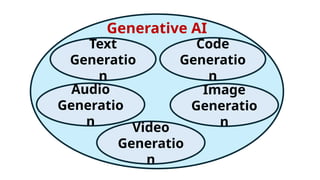
•GenerativeAI are AI systems that
can generate content, such as text,
images, audio, video and code.
•It includes models that produce
new content based on patterns
learned from training data.
• Examples include image
generators like DALL·E, music
generators, and AI tools that
generate 3D models.
What
are
LLMs?
•Large Language Models(LLMs) are a
subset of generative AI specifically
designed to generate and understand
human-like text.
•They are trained on vast amounts of
text data and can perform tasks like
text completion, translation,
summarization, and dialogue
generation.
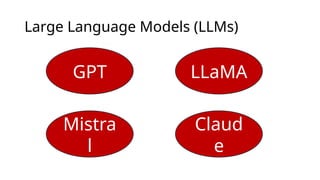
•Examples include GPT-4, Claude, and
LLaMA.
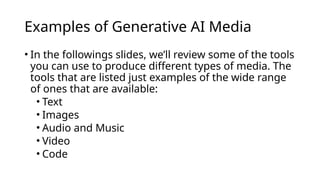
Examples of GenerativeAI Media
• In the followings slides, we’ll review some of the tools
you can use to produce different types of media. The
tools that are listed just examples of the wide range
of ones that are available:
• Text
• Images
• Audio and Music
• Video
• Code
9.
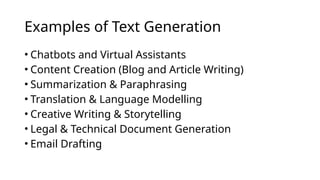
Examples of TextGeneration
• Chatbots and Virtual Assistants
• Content Creation (Blog and Article Writing)
• Summarization & Paraphrasing
• Translation & Language Modelling
• Creative Writing & Storytelling
• Legal & Technical Document Generation
• Email Drafting
10.
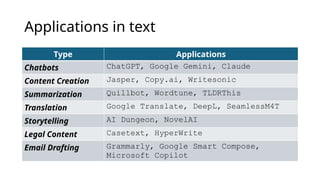
Applications in text
TypeApplications
Chatbots ChatGPT, Google Gemini, Claude
Content Creation Jasper, Copy.ai, Writesonic
Summarization Quillbot, Wordtune, TLDRThis
Translation Google Translate, DeepL, SeamlessM4T
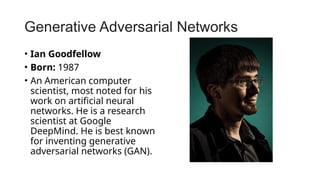
Storytelling AI Dungeon, NovelAI
Legal Content Casetext, HyperWrite
Email Drafting Grammarly, Google Smart Compose,
Microsoft Copilot
11.
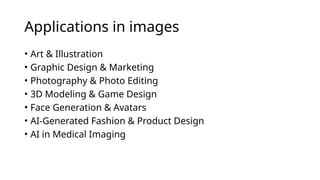
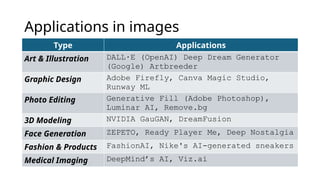
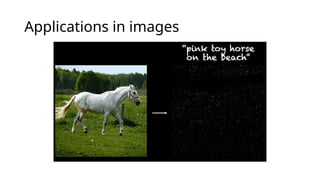
Applications in images
•Art & Illustration
• Graphic Design & Marketing
• Photography & Photo Editing
• 3D Modeling & Game Design
• Face Generation & Avatars
• AI-Generated Fashion & Product Design
• AI in Medical Imaging
12.
Applications in images
TypeApplications
Art & Illustration DALL·E (OpenAI) Deep Dream Generator
(Google) Artbreeder
Graphic Design Adobe Firefly, Canva Magic Studio,
Runway ML
Photo Editing Generative Fill (Adobe Photoshop),
Luminar AI, Remove.bg
3D Modeling NVIDIA GauGAN, DreamFusion
Face Generation ZEPETO, Ready Player Me, Deep Nostalgia
Fashion & Products FashionAI, Nike's AI-generated sneakers
Medical Imaging DeepMind’s AI, Viz.ai
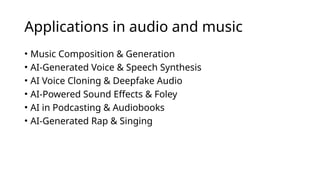
Applications in audioand music
• Music Composition & Generation
• AI-Generated Voice & Speech Synthesis
• AI Voice Cloning & Deepfake Audio
• AI-Powered Sound Effects & Foley
• AI in Podcasting & Audiobooks
• AI-Generated Rap & Singing
15.
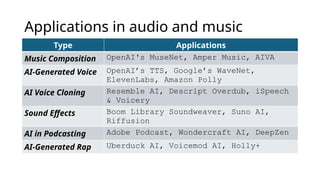
Applications in audioand music
Type Applications
Music Composition OpenAI's MuseNet, Amper Music, AIVA
AI-Generated Voice OpenAI’s TTS, Google’s WaveNet,
ElevenLabs, Amazon Polly
AI Voice Cloning Resemble AI, Descript Overdub, iSpeech
& Voicery
Sound Effects Boom Library Soundweaver, Suno AI,
Riffusion
AI in Podcasting Adobe Podcast, Wondercraft AI, DeepZen
AI-Generated Rap Uberduck AI, Voicemod AI, Holly+
16.
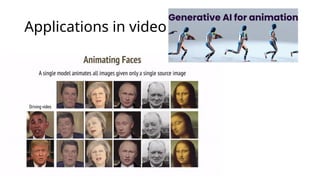
Applications in video
•AI-Powered Text-to-Video Generation
• AI-Generated Animation & CGI
• AI for Video Editing & Enhancement
• AI for Deepfake & Face Swapping
• AI-Generated Virtual Avatars & Digital Humans
• AI-Driven Motion Capture & Video-to-Animation
• AI for Film, TV & Gaming
17.
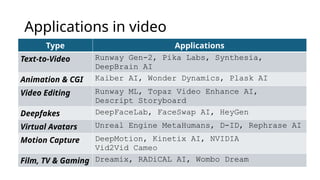
Applications in video
TypeApplications
Text-to-Video Runway Gen-2, Pika Labs, Synthesia,
DeepBrain AI
Animation & CGI Kaiber AI, Wonder Dynamics, Plask AI
Video Editing Runway ML, Topaz Video Enhance AI,
Descript Storyboard
Deepfakes DeepFaceLab, FaceSwap AI, HeyGen
Virtual Avatars Unreal Engine MetaHumans, D-ID, Rephrase AI
Motion Capture DeepMotion, Kinetix AI, NVIDIA
Vid2Vid Cameo
Film, TV & Gaming Dreamix, RADiCAL AI, Wombo Dream
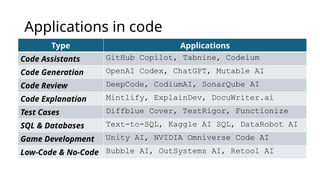
Applications in code
•AI Code Assistants & Autocompletion
• AI for Code Generation & Automation
• AI-Powered Debugging & Code Review
• AI for Documentation & Code Explanation
• AI-Generated Test Cases & Automation
• AI for SQL & Database Queries
• AI for Game Development & 3D Coding
• AI for Low-Code & No-Code Development
20.
Applications in code
TypeApplications
Code Assistants GitHub Copilot, Tabnine, Codeium
Code Generation OpenAI Codex, ChatGPT, Mutable AI
Code Review DeepCode, CodiumAI, SonarQube AI
Code Explanation Mintlify, ExplainDev, DocuWriter.ai
Test Cases Diffblue Cover, TestRigor, Functionize
SQL & Databases Text-to-SQL, Kaggle AI SQL, DataRobot AI
Game Development Unity AI, NVIDIA Omniverse Code AI
Low-Code & No-Code Bubble AI, OutSystems AI, Retool AI
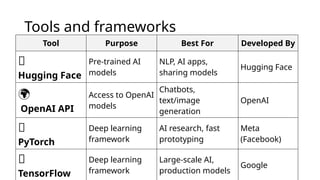
Tools and frameworks
ToolPurpose Best For Developed By
🤗
Hugging Face
Pre-trained AI
models
NLP, AI apps,
sharing models
Hugging Face
🌍
OpenAI API
Access to OpenAI
models
Chatbots,
text/image
generation
OpenAI
🔥
PyTorch
Deep learning
framework
AI research, fast
prototyping
Meta
(Facebook)
🔷
TensorFlow
Deep learning
framework
Large-scale AI,
production models
Google
NLP Fundamentals
•NLP ishow computers understand and work with
human language. Imagine talking to Siri, Alexa, or
ChatGPT—they understand your words, answer
questions, and even hold conversations. NLP helps
machines read, understand, and generate text, just
like humans do.
•It combines linguistics (how language works) and
machine learning (training computers to recognize
patterns in data). NLP tasks include:
25.
NLP Fundamentals
•Tokenization:
•This isthe first step, it involves breaking a
sentence into individual words or parts so a
computer can understand them better.
•For example:
•Sentence: “I love NLP!”
•Tokens: ["I", "love", "NLP", "!"]
26.
NLP Fundamentals
•Stemming:
•This involveschopping off word endings to get
the root form of a word.
•For example:
•“Running” → “Run”
•“Walks” → “Walk”
•“Studies” → “Studi”
27.
NLP Fundamentals
•Lemmatization:
•This involvesimproving the outcomes of
Stemming by finding the dictionary form of a
word instead of just chopping off endings.
•For example:
•Stemming : “Caring” → “Car”
•Lemmatization: “Caring” → “Care”
28.
NLP Fundamentals
•Embeddings:
• Thisis like turning words into numbers so computers
can understand them. Since computers don’t
understand words, we convert words into
mathematical representations (vectors). These vectors
capture the meaning and relationships between words.
•For example:
• King – Man + Woman ≈ Queen
• Paris – France + Italy ≈ Rome
29.
NLP Fundamentals
•Transformers:
• ATransformer is an AI model that understands and
generates human language. It does the following:
• Reads an entire sentence all at once instead of one word
at a time.
• Finds relationships between words, even if they are far
apart.
• Understands context better using "self-attention“, where
all words in the sentence are compared to all other
words.
Continued
30.
NLP Fundamentals
•Transformers:
• Forexample:
• "The cat chased the mouse because it was
hungry."
• Without self-attention, an AI might think "it" refers to
"mouse", but self-attention helps it correctly connect "it" to
"cat."
Large Language Models(LLMs)
•GPT is a type of AI that can understand and
generate human-like text. It works in three
main steps:
1. Pre-training ("Learning from the
Internet")
2. Fine-tuning ("Becoming Smarter")
3. Text Generation ("Answering &
Writing")
GP
T
33.
Large Language Models(LLMs)
1. Pre-training ("Learning from the Internet"): GPT is
trained on a massive amount of text data (books,
articles, websites). It learns how words, sentences, and
ideas are connected.
2. Fine-tuning ("Becoming Smarter"): After pre-training,
it's fine-tuned to improve accuracy and avoid harmful
responses. Human feedback is used to make sure it gives
useful and safe answers.
3. Text Generation ("Answering & Writing"): When you
ask GPT something, it predicts the next word based on
patterns it learned. It keeps doing this quickly to form
coherent sentences and paragraphs.
GP
T
34.
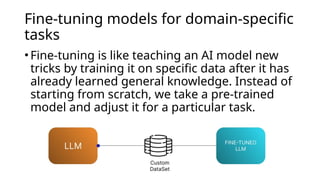
Fine-tuning models fordomain-specific
tasks
•Fine-tuning is like teaching an AI model new
tricks by training it on specific data after it has
already learned general knowledge. Instead of
starting from scratch, we take a pre-trained
model and adjust it for a particular task.
35.
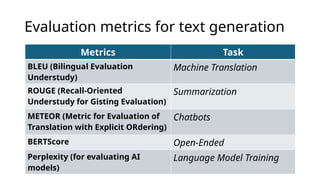
Evaluation metrics fortext generation
Metrics Task
BLEU (Bilingual Evaluation
Understudy)
Machine Translation
ROUGE (Recall-Oriented
Understudy for Gisting Evaluation)
Summarization
METEOR (Metric for Evaluation of
Translation with Explicit ORdering)
Chatbots
BERTScore Open-Ended
Perplexity (for evaluating AI
models)
Language Model Training
Image, Video andAudio Generation
•AI-powered generative models are
revolutionizing media production, allowing
users to create realistic images, videos, and
audio from simple text prompts or existing
content. These technologies are transforming
entertainment, marketing, gaming, education,
and content creation.
Overview of keyGenAI models
• Stable Diffusion is an AI model that can generate images
from text. Think of it as an AI-powered artist that paints
whatever you describe, using the following 4 steps:
1. Understanding Your Text ("What do you want to
see?")
2. Starting with Noise ("A Messy Canvas")
3. Gradual Refinement ("Bringing the Picture to Life")
4. Final Output ("Your AI-Generated Artwork!")
Stable
Diffusio
n
40.
Overview of keyGenAI models
1. Understanding Your Text ("What do you want to see?") You
type a description, like "a futuristic city at sunset." The AI reads
and understands your words.
2. Starting with Noise ("A Messy Canvas") Instead of drawing
from scratch, the AI starts with a random noisy image (like TV
static).
3. Gradual Refinement ("Bringing the Picture to Life") The AI
removes noise step by step, shaping the image based on your
text. It uses a process called diffusion, like sculpting a blurry
image into something clear.
4. Final Output ("Your AI-Generated Artwork!") After many
steps, the AI generates a detailed, high-quality image that
matches your description.
Stable
Diffusio
n
Overview of keyGenAI models
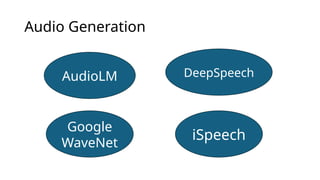
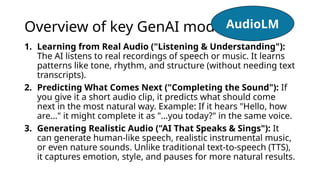
• AudioLM is an AI model that can generate realistic
audio, like speech, music, and sound effects, without
needing transcripts., using the following 3 steps:
1. Learning from Real Audio ("Listening &
Understanding")
2. Predicting What Comes Next ("Completing the Sound")
3. Generating Realistic Audio ("AI That Speaks & Sings")
AudioLM
43.
Overview of keyGenAI models
1. Learning from Real Audio ("Listening & Understanding"):
The AI listens to real recordings of speech or music. It learns
patterns like tone, rhythm, and structure (without needing text
transcripts).
2. Predicting What Comes Next ("Completing the Sound"): If
you give it a short audio clip, it predicts what should come
next in the most natural way. Example: If it hears "Hello, how
are…" it might complete it as "…you today?" in the same voice.
3. Generating Realistic Audio ("AI That Speaks & Sings"): It
can generate human-like speech, realistic instrumental music,
or even nature sounds. Unlike traditional text-to-speech (TTS),
it captures emotion, style, and pauses for more natural results.
AudioLM
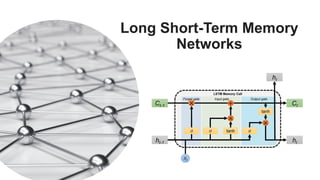
Long Short-Term MemoryNetworks
•Long short-term memory (LSTM) is a specific
type of recurrent neural network (RNN) aimed
at mitigating the issue when a neural network
forgets things from earlier steps because the
learning signals become too weak.
47.
Long Short-Term MemoryNetworks
• Think of it like passing a
message through a long line of
people. If each person whispers
too softly, by the time the
message reaches the last
person, it’s almost gone or
completely lost. In a neural
network, this means the early
layers stop learning because
they don’t get enough updates.
48.
Long Short-Term MemoryNetworks
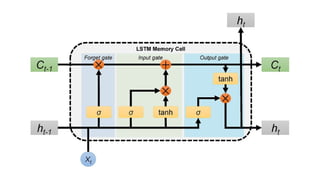
• Think of LSTM like a notepad:
• It erases old notes that are no longer needed.
• It adds new important notes when necessary.
• It remembers useful notes from earlier.
• LSTMs do this using three gates:
• Forget Gate – Decides what information to erase.
• Input Gate – Decides what new information to store.
• Output Gate – Decides what part of the stored
information to use for the output.
49.
Long Short-Term MemoryNetworks
•Candidate
• The candidate is the potential new information
that could be added to the memory (cell state). It
is generated based on the current input and
previous hidden state using a tanh activation.
50.
Long Short-Term MemoryNetworks
•New Cell State
• The new cell state is the actual updated memory
of the LSTM. It is formed by combining:
• The old cell state (some parts are kept or forgotten via
the forget gate).
• The candidate (some parts are added via the input
gate).
52.
Long Short-Term MemoryNetworks
•Example Use Cases
• Predicting text (like autocomplete on your
phone)
• Speech recognition (turning speech into text)
• Time-series forecasting (stock prices, weather
predictions)
53.
Long Short-Term MemoryNetworks
• in 1997, Sepp Hochreiter
and Jürgen Schmidhuber
developed the Long Short-
Term Memory (LSTM)
network, which addressed
the vanishing gradient
problem in standard RNNs,
making them more effective
for long-sequence learning.
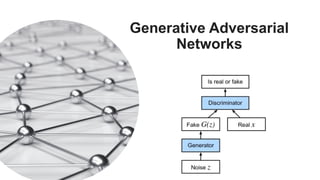
Generative Adversarial Networks
•GenerativeAdversarial Networks (GANs) are a
type of artificial intelligence model used to
create new data that looks similar to real data.
•They are widely used in image generation,
deepfake creation, art generation, and data
augmentation.
56.
Generative Adversarial Networks
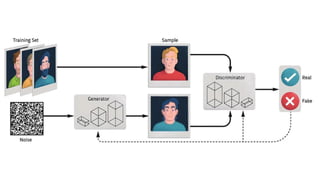
•GANs have two parts that compete with each other:
• Generator: Tries to create fake data (e.g., images
that look like real photos). It learns to generate
data that resembles real-world examples.
• Discriminator: Tries to detect fake data and
distinguish it from real data. This helps the
generator improve by providing feedback.
58.
Generative Adversarial Networks
•GANs have been used for transfer learning to
enforce the alignment of the latent feature space,
such as in deep reinforcement learning.
• This works by feeding the embeddings of the source
and target task to the discriminator which tries to
guess the context.
• The resulting loss is then (inversely) backpropagated
through the encoder.
59.
Generative Adversarial Networks
•Ian Goodfellow
• Born: 1987
• An American computer
scientist, most noted for his
work on artificial neural
networks. He is a research
scientist at Google
DeepMind. He is best known
for inventing generative
adversarial networks (GAN).
AI Business Modelsand Strategy
•What is Business Process Re-engineering?
•How Businesses leverage GenAI?
•AI-driven Product Development
•Case studies from startups and big tech
•Cybersecurity risks in AI systems
62.
What is BusinessProcess Re-engineering?
•Business Process Reengineering (BPR) is a
strategic approach to improving business
efficiency by redesigning workflows,
optimizing processes, and leveraging
technology. The goal is to achieve dramatic
improvements in cost, quality, speed, and
customer satisfaction.
63.
What is BusinessProcess Re-engineering?
•BPR focuses on rethinking and radically
redesigning core business processes to
improve performance, efficiency, and
competitiveness. Unlike incremental
improvements, BPR involves fundamental
changes to how a business operates.
64.
What is BusinessProcess Re-engineering?
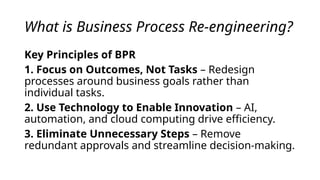
Key Principles of BPR
1. Focus on Outcomes, Not Tasks – Redesign
processes around business goals rather than
individual tasks.
2. Use Technology to Enable Innovation – AI,
automation, and cloud computing drive efficiency.
3. Eliminate Unnecessary Steps – Remove
redundant approvals and streamline decision-making.
65.
What is BusinessProcess Re-engineering?
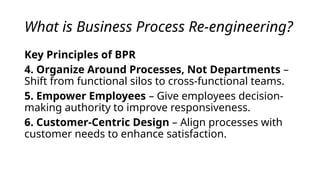
Key Principles of BPR
4. Organize Around Processes, Not Departments –
Shift from functional silos to cross-functional teams.
5. Empower Employees – Give employees decision-
making authority to improve responsiveness.
6. Customer-Centric Design – Align processes with
customer needs to enhance satisfaction.
66.
How Businesses leverageGenAI?
•Businesses leverage Generative AI (GenAI) in
multiple ways across cost reduction,
innovation, and automation. Here’s a few
example:
67.
How Businesses leverageGenAI?
1. Cost Reduction
• Operational Efficiency: Automates repetitive tasks (e.g., customer
support, data entry), reducing labor costs.
• Cloud-Based AI Models: Many businesses use pay-as-you-go AI services,
cutting infrastructure and R&D expenses.
• Marketing & Content Creation: AI-generated content (blogs, ads, product
descriptions) reduces costs related to hiring copywriters and designers.
• Predictive Maintenance: AI helps optimize supply chain management
and reduce equipment downtime.
• Fraud Detection & Risk Management: AI models identify fraudulent
transactions, reducing financial losses.
68.
How Businesses leverageGenAI?
2. Innovation
• Product Design & Prototyping: AI assists in designing new products
using generative models (e.g., AI-powered CAD tools).
• AI-Generated Code: Developers use AI-assisted coding tools (e.g.,
GitHub Copilot, ChatGPT) to accelerate software development.
• Drug Discovery & Healthcare: GenAI helps in designing new drugs,
analyzing medical images, and personalizing treatment plans.
• Creative Industries: AI-generated art, music, and video enhance
creative workflows (e.g., deepfake technology, AI-powered movie scripts).
• New Business Models: Companies explore AI-driven personalization
(e.g., AI-powered recommendation systems in e-commerce).
69.
How Businesses leverageGenAI?
3. Automation
• Customer Support & Chatbots: AI-driven virtual assistants handle
customer queries, reducing the need for human support staff.
• AI-Powered Decision Making: Businesses automate decision-making in
finance, HR, and operations using AI analytics.
• Manufacturing & Robotics: AI optimizes production lines, improves
quality control, and enables autonomous robotic systems.
• Legal & Compliance Automation: AI reviews contracts, ensures
regulatory compliance, and minimizes legal risks.
• Personalization & Targeted Advertising: AI customizes user experiences
on e-commerce platforms, streaming services, and social media.
70.
AI-driven Product Development
•AI-driven product development is transforming
industries by accelerating innovation, reducing
costs, and enhancing customer-centric solutions.
Companies leverage AI to ideate, prototype, and
optimize products efficiently. Here’s how businesses
integrate AI in product development:
71.
AI-driven Product Development
1.AI in Ideation & Market Research
Before designing a product, companies use AI to analyze market trends,
customer feedback, and competitor strategies.
• Sentiment Analysis: AI tools like Brandwatch and MonkeyLearn
analyze customer reviews and social media to identify gaps in the market.
• AI-Generated Concepts: GPT-4, Midjourney, and DALL·E help generate
new product ideas and designs based on consumer needs.
• Predictive Analytics: AI-driven data modeling forecasts demand, guiding
product decisions.
• 📌 Case Study: Nike uses AI-powered analytics to identify emerging fashion
trends and personalize shoe designs.
72.
AI-driven Product Development
2.AI-Enhanced Prototyping & Design
AI accelerates the design and prototyping phase by automating tasks
that traditionally required human effort.
• Generative Design: AI-driven tools like Autodesk Fusion 360, NVIDIA
Omniverse, and Runway generate optimized product designs.
• Digital Twins: Virtual models simulate how a product will perform in
real-world conditions before physical production.
• 3D AI Modelling: AI-based CAD tools refine product models for faster
iteration.
• 📌 Case Study: Airbus employs AI-powered generative design to create
lighter aircraft components, improving fuel efficiency.
73.
AI-driven Product Development
3.AI in Product Testing & Quality Control
AI enhances testing by automating defect detection and simulating
real-world scenarios.
• Computer Vision: AI-powered cameras identify defects in
manufacturing, reducing quality control errors.
• AI Simulation: Companies use digital twins and reinforcement
learning to test product durability and efficiency.
• Automated Bug Testing: AI tools like Testim and Applitools
automate software testing, reducing development cycles.
• 📌 Case Study: Tesla uses AI-driven quality control to detect defects in
car manufacturing, reducing recalls.
74.
AI-driven Product Development
4.AI in Manufacturing & Production
AI optimizes manufacturing efficiency, minimizes waste, and
automates assembly.
• Predictive Maintenance: AI predicts equipment failures, reducing
downtime and costs.
• Supply Chain Optimization: AI analyzes demand patterns and
logistics for efficient production.
• Robotic Process Automation (RPA): AI-driven robots automate
repetitive tasks, improving precision.
• 📌 Case Study: Siemens integrates AI in smart factories, using digital
twins to optimize machine performance.
75.
AI-driven Product Development
5.AI-Powered Product Personalization
AI enables businesses to create personalized products and
experiences.
• Custom AI Models: AI tailors recommendations and product
configurations based on user data.
• Dynamic Pricing: AI-driven pricing strategies adjust prices based on
demand and competition.
• Chatbots & Virtual Assistants: AI-powered assistants guide
customers through product selection.
• 📌 Case Study: Spotify uses AI-driven algorithms to personalize
playlists and music recommendations.
76.
AI-driven Product Development
6.AI in Post-Launch Monitoring & Innovation
AI continuously refines products after launch through data-driven
insights.
• User Behaviour Analysis: AI monitors how customers interact with
products and suggests improvements.
• Automated Updates: AI updates software dynamically, fixing bugs
and enhancing user experience.
• Customer Feedback Analysis: AI extracts insights from reviews and
support tickets.
• 📌 Case Study: Apple integrates AI-driven performance monitoring in
iOS updates to enhance user experience.
77.
Case studies fromstartups and big
tech
•Businesses, both startups and established tech
giants, are increasingly integrating Generative
AI (GenAI) to enhance operations, drive
innovation, and automate processes. Here are
some notable case studies:
78.
Case studies fromstartups and big
tech
Startups Leveraging GenAI
• 1. OpusClip OpusClip, a Generative AI video editing
startup, has developed a multimodal AI tool that
enables users to create short social media videos from
text prompts. The AI analyzes the input to select
compelling clips, simplifying the video editing process
to meet the growing demand for social media content.
As of March 2025, OpusClip has over 10 million users
and notable clients, including Univision, Billboard, and
LinkedIn.
79.
Case studies fromstartups and big
tech
Startups Leveraging GenAI
• 2. Colossyan Colossyan offers an AI video platform
that allows companies to create training videos
without traditional filming equipment. Utilizing text-to-
speech technology, the platform generates human-like
AI avatars delivering content with realistic lip-syncing.
Supporting over 70 languages, Colossyan's platform is
used by major corporations such as Hewlett Packard,
BASF, BMW, Novartis, Porsche, and Vodafone.
80.
Case studies fromstartups and big
tech
Startups Leveraging GenAI
• 3. Runway Runway specializes in Generative AI for
video, media, and art. Notably, the company co-
released Stable Diffusion, an open-source text-to-
image model, and developed Gen-1 and Gen-2, models
capable of video-to-video and text-to-video generation,
respectively. Runway's tools have been utilized in films
like "Everything Everywhere All At Once" and in music
videos for artists such as A$AP Rocky and Kanye West.
81.
Case studies fromstartups and big
tech
Startups Leveraging GenAI
• 4. Headway Headway, a Ukrainian edtech startup,
has significantly improved its advertising
performance by leveraging AI tools like Midjourney
and HeyGen. The integration of these tools led to a
40% increase in return on investment for video ads,
achieving 3.3 billion impressions in the first half of
2024. AI has also helped reduce production costs
and freed resources for more innovative tasks.
82.
Case studies fromstartups and big
tech
Big Tech Companies Implementing GenAI
• 1. Visa Visa has launched an innovative scam detection
initiative that incorporates Generative AI and
automation to protect customers and dismantle online
scam networks. The initiative includes a dedicated
intelligence team studying the dark web and social
media to uncover scam activities, and a disruption team
working with law enforcement to dismantle scam
networks. In the previous year, Visa's efforts prevented
over $350 million in fraud.
83.
Case studies fromstartups and big
tech
Big Tech Companies Implementing GenAI
• 2. Microsoft Microsoft has introduced an AI tool called
Muse, aimed at revolutionizing the game development
process. Muse creates AI-generated gameplay videos to
help designers experiment efficiently, producing mock
gameplay clips that can be tweaked with prompts.
While Muse currently cannot create entirely new games
or playable simulations, it represents a significant
technical achievement in AI-assisted game design.
84.
Case studies fromstartups and big
tech
Big Tech Companies Implementing GenAI
• 3. Pegasystems Pegasystems has integrated Generative
AI across its Pega Infinity portfolio, enhancing AI, low-
code, and automation capabilities. This integration
includes Pega GenAI, a set of 20 Generative AI boosters
compatible with AWS and Google Cloud's large language
models. These tools assist in optimizing application
workflow designs, finding answers to user questions
using enterprise knowledge bases, and teaching users
how to use Pega software.
85.
Case studies fromstartups and big
tech
Big Tech Companies Implementing GenAI
• 4. Google Google is incorporating Generative AI to
enhance user experiences, particularly in Google
Search with AI Overviews. The company emphasizes
responsible integration to avoid misinformation and
is investing in AI to benefit users broadly, despite
concerns about profitability and the economic
impact on traditional content industries.
86.
Cybersecurity risks inAI systems
• AI systems introduce new cybersecurity challenges,
including vulnerabilities to attacks, data privacy
issues, and ethical concerns. Below are key
cybersecurity risks in AI and how businesses can
mitigate them.
87.
Cybersecurity risks inAI systems
1. Adversarial Attacks
Attackers manipulate AI models by introducing carefully
crafted data to mislead them.
• Evasion Attacks: Slight modifications to input data (e.g.,
changing a few pixels in an image) can fool AI models into
misclassifying objects.
• Poisoning Attacks: Injecting malicious data into training
datasets to alter model behavior.
• Model Extraction: Attackers reverse-engineer AI models to
steal intellectual property or find vulnerabilities.
88.
Cybersecurity risks inAI systems
1. Adversarial Attacks
Example: In 2017, researchers tricked Google’s image
recognition AI into misidentifying a panda as a gibbon by
altering just a few pixels.
Mitigation Strategies:
• Use adversarial training to harden AI models against attacks.
• Regularly update and monitor AI models for anomalies.
• Implement input validation techniques to detect suspicious
inputs.
89.
Cybersecurity risks inAI systems
2. Data Privacy & Model Inference Risks
AI models often process vast amounts of sensitive data, raising
privacy concerns.
• Membership Inference Attacks: Attackers determine
whether a specific individual’s data was used to train an AI
model.
• Data Leakage: AI models may inadvertently reveal private
training data through responses.
• Unauthorized Access: AI-driven automation can expose
confidential data if access controls are weak.
90.
Cybersecurity risks inAI systems
2. Data Privacy & Model Inference Risks
Example: OpenAI’s GPT models have faced concerns about
inadvertently memorizing and leaking user-provided data.
Mitigation Strategies:
• Apply differential privacy techniques to limit data
exposure.
• Restrict access to AI training data and implement zero-trust
security policies.
• Regularly audit AI models for unintended data leakage.
91.
Cybersecurity risks inAI systems
3. Bias & Ethical Risks
AI systems can inherit biases from training data, leading to
unfair or discriminatory outcomes.
• Algorithmic Bias: AI models may favor certain groups over
others, leading to biased hiring, loan approvals, or policing.
• Deepfake & Misinformation: AI-generated fake content
(text, video, and audio) can be used maliciously.
• Ethical AI Decision-Making: AI-driven decisions in
healthcare, finance, and security may have life-altering
consequences.
92.
Cybersecurity risks inAI systems
3. Bias & Ethical Risks
Example: Amazon’s AI hiring tool was found to discriminate
against female candidates because it was trained on past
hiring data that favored male applicants.
Mitigation Strategies:
• Use bias detection tools to audit AI decisions.
• Implement diverse and representative training datasets.
• Establish AI ethics policies and compliance frameworks.
93.
Cybersecurity risks inAI systems
4. AI Supply Chain Attacks
AI models rely on third-party datasets, open-source software,
and cloud environments, creating security risks.
• Compromised AI Libraries: Attackers inject malicious code
into widely used AI frameworks like TensorFlow or PyTorch.
• Cloud AI Vulnerabilities: AI models hosted on cloud
platforms can be targeted through API vulnerabilities.
• Data Manipulation in Training: Attackers tamper with
datasets sourced from external providers.
94.
Cybersecurity risks inAI systems
4. AI Supply Chain Attacks
Example: Researchers demonstrated how poisoning open-
source AI datasets could corrupt AI systems used by major
companies.
Mitigation Strategies:
• Vet and verify third-party AI tools before integration.
• Use secure federated learning to train AI models without
exposing raw data.
• Monitor supply chain dependencies for vulnerabilities.
95.
Cybersecurity risks inAI systems
5. Automated Malware & AI-Powered Cyber Threats
Cybercriminals are using AI to automate attacks and generate
new forms of malware.
• AI-Generated Phishing: AI can create highly convincing
phishing emails and deepfake videos to manipulate users.
• Malware Automation: AI-powered malware can adapt and
evade traditional detection systems.
• Autonomous Hacking: AI-driven bots can exploit system
vulnerabilities without human intervention.
96.
Cybersecurity risks inAI systems
5. Automated Malware & AI-Powered Cyber Threats
Example: In 2023, AI-generated deepfake scams resulted in millions
in financial fraud by impersonating executives and employees.
Mitigation Strategies:
• Deploy AI-powered cyber threat intelligence systems to detect AI-
generated attacks.
• Train employees to recognize deepfake and AI-generated phishing
threats.
• Implement behavioral analysis to detect unusual activity in AI
systems.
Governance, Policy, andCompliance
• Key AI regulations
• Organizational compliance strategies
• Frameworks for responsible AI
99.
Key AI Regulations
•Artificialintelligence (AI) regulation is
evolving globally, with significant
developments in the European Union (EU)
and around the world:
100.
Key AI Regulations
•EU General Data Protection Regulation (GDPR):
• Implemented in 2018, the GDPR addresses
automated decision-making and profiling. Article 22
prohibits decisions based solely on automated
processing that significantly affect individuals,
unless explicitly authorized. It also provides data
subjects with rights to obtain explanations about
decisions made by automated systems.
101.
Key AI Regulations
•EU AI Act
• The EU has introduced the Artificial Intelligence Act,
aiming to regulate AI applications based on their
potential risks. The Act prohibits certain harmful AI
practices, mandates strict requirements for high-risk AI
systems, and encourages voluntary codes of conduct
for lower-risk applications. The regulation was approved
by the European Parliament on March 13, 2024, and by
the Council of the European Union on May 21, 2024.
102.
Key AI Regulations
•United Kingdom
• The UK government has proposed changes to copyright
laws to attract tech companies, allowing AI firms to use
copyrighted works unless the owner opts out. However,
experts argue this could breach international
agreements like the Berne Convention, potentially
leading to legal challenges. Critics emphasize that the
issue lies in AI developers' non-compliance with
existing laws rather than the laws themselves.
103.
Key AI Regulations
China
•China has implemented comprehensive AI regulations,
emphasizing state control and alignment with national
standards. In 2021, ethical guidelines were introduced,
mandating that AI research upholds shared human
values, remains under human oversight, and ensures
public safety. Additionally, Beijing has made AI education
mandatory across all schooling levels, starting from
elementary, to maintain its competitive edge in the
global AI landscape.
104.
Organizational Compliance Strategiesfor AI
Systems
•AI compliance is crucial for businesses to
mitigate legal, ethical, and security risks.
Organizations must align AI governance with
global regulations, industry standards, and
ethical frameworks. Below are key compliance
strategies:
105.
Organizational Compliance Strategiesfor AI
Systems
1. Establish an AI Governance Framework
Organizations should create an internal AI governance
structure to oversee compliance.
Best Practices:
• Appoint an AI Ethics & Compliance Officer.
• Form a cross-functional AI governance committee (legal,
IT, ethics, security).
• Develop an AI risk assessment protocol to evaluate
models before deployment.
106.
Organizational Compliance Strategiesfor AI
Systems
2. Align with AI Regulations & Industry Standards
AI regulations vary globally, and organizations must comply with relevant laws.
Key AI Regulations:
• CCPA (California Consumer Privacy Act) – Grants users control over their AI-
related data.
• NIST AI Risk Management Framework – US standard for AI safety and
trustworthiness.
Best Practices:
• Conduct regulatory impact assessments before AI deployment.
• Use explainable AI (XAI) techniques to ensure compliance with transparency
requirements.
• Regularly audit AI models to detect compliance gaps.
107.
Organizational Compliance Strategiesfor AI
Systems
3. Implement Ethical AI Policies
AI should be designed to prevent bias, discrimination, and
unethical decision-making.
Best Practices:
• Develop an AI ethics policy outlining fairness, transparency,
and accountability.
• Use bias detection algorithms to audit AI training data.
• Ensure AI-generated decisions are explainable and
interpretable.
108.
Organizational Compliance Strategiesfor AI
Systems
4. Strengthen AI Security & Data Protection
AI systems are vulnerable to cyber threats, adversarial attacks,
and data breaches.
Best Practices:
• Apply data anonymization and encryption to protect sensitive
AI training data.
• Implement differential privacy to prevent AI models from
leaking user data.
• Conduct regular security audits to identify vulnerabilities in AI
pipelines.
109.
Organizational Compliance Strategiesfor AI
Systems
5. Ensure AI Transparency & Accountability
AI models must provide clear explanations for their decisions,
especially in regulated industries like healthcare and finance.
Best Practices:
• Maintain AI decision logs to track and audit AI predictions.
• Use model interpretability tools (e.g., SHAP, LIME) to explain
AI outputs.
• Offer user opt-outs for AI-driven decisions affecting
customers.
110.
Organizational Compliance Strategiesfor AI
Systems
6. Conduct AI Compliance Training & Awareness
AI governance is only effective if employees understand
compliance requirements.
Best Practices:
• Train employees on AI regulations, bias mitigation, and
security risks.
• Develop an AI compliance playbook with standardized
policies.
• Encourage whistleblower protections for AI misuse reporting.
111.
Organizational Compliance Strategiesfor AI
Systems
7. Establish Third-Party AI Compliance Checks
Many businesses use AI from third-party vendors (e.g., OpenAI,
AWS, Google Cloud AI), requiring supplier compliance
verification.
Best Practices:
• Ensure AI vendors comply with GDPR, CCPA, and NIST AI
standards.
• Require third-party security certifications (e.g., ISO 27001,
SOC 2).
• Implement AI contractual clauses to enforce compliance.
112.
Organizational Compliance Strategiesfor AI
Systems
8. Monitor AI Systems for Continuous Compliance
AI compliance is not a one-time process—organizations must
continuously audit AI models.
Best Practices:
• Use AI compliance monitoring tools to detect violations in
real-time.
• Set up an AI audit review board to oversee ongoing
compliance.
• Update AI policies based on evolving legal standards.
113.
Frameworks for ResponsibleAI
•Responsible AI frameworks help organizations
develop and deploy AI systems that are ethical,
transparent, fair, and aligned with human
values. These frameworks ensure compliance
with global regulations while minimizing risks
like bias, misinformation, and security threats.
114.
Frameworks for ResponsibleAI
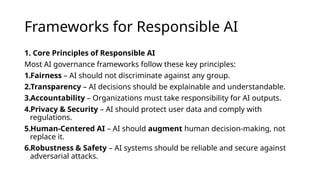
1. Core Principles of Responsible AI
Most AI governance frameworks follow these key principles:
1.Fairness – AI should not discriminate against any group.
2.Transparency – AI decisions should be explainable and understandable.
3.Accountability – Organizations must take responsibility for AI outputs.
4.Privacy & Security – AI should protect user data and comply with
regulations.
5.Human-Centered AI – AI should augment human decision-making, not
replace it.
6.Robustness & Safety – AI systems should be reliable and secure against
adversarial attacks.
115.
Frameworks for ResponsibleAI
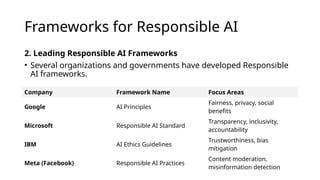
2. Leading Responsible AI Frameworks
• Several organizations and governments have developed Responsible
AI frameworks.
Company Framework Name Focus Areas
Google AI Principles
Fairness, privacy, social
benefits
Microsoft Responsible AI Standard
Transparency, inclusivity,
accountability
IBM AI Ethics Guidelines
Trustworthiness, bias
mitigation
Meta (Facebook) Responsible AI Practices
Content moderation,
misinformation detection
116.
Frameworks for ResponsibleAI
3. Implementing a Responsible AI Framework
Organizations can develop internal Responsible AI frameworks by
following these steps:
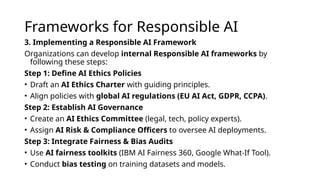
Step 1: Define AI Ethics Policies
• Draft an AI Ethics Charter with guiding principles.
• Align policies with global AI regulations (EU AI Act, GDPR, CCPA).
Step 2: Establish AI Governance
• Create an AI Ethics Committee (legal, tech, policy experts).
• Assign AI Risk & Compliance Officers to oversee AI deployments.
Step 3: Integrate Fairness & Bias Audits
• Use AI fairness toolkits (IBM AI Fairness 360, Google What-If Tool).
• Conduct bias testing on training datasets and models.
117.
Frameworks for ResponsibleAI
Step 4: Ensure Transparency & Explainability
• Implement Explainable AI (XAI) techniques (e.g.,
SHAP, LIME).
• Provide human-readable explanations for AI-
driven decisions.
118.
Frameworks for ResponsibleAI
Step 5: Enforce Security & Privacy Protections
• Use differential privacy to protect user data.
• Conduct AI adversarial testing to detect
vulnerabilities.
119.
Frameworks for ResponsibleAI
Step 6: Continuous Monitoring & Compliance
• Perform AI impact assessments before
deployment.
• Use third-party AI audits to ensure compliance.
![NLP Fundamentals
•Tokenization:
•This is the first step, it involves breaking a
sentence into individual words or parts so a
computer can understand them better.
•For example:
•Sentence: “I love NLP!”
•Tokens: ["I", "love", "NLP", "!"]](https://image.slidesharecdn.com/genai-250312111822-a0ae97ba/85/An-Introduction-to-Generative-Artificial-Intelligence-25-320.jpg)