Linux 
WHAT IS IT, AND WHY DOES IT EXIST?
Origin 
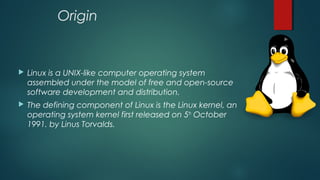
 Linux is a UNIX-like computer operating system 
assembled under the model of free and open-source 
software development and distribution. 
 The defining component of Linux is the Linux kernel, an 
operating system kernel first released on 5th October 
1991. by Linus Torvalds.
 Linux was originally developed as a free operating system for Intel 
x86-based personal computers. It has since been ported to more 
computer hardware platforms than any other operating system. 
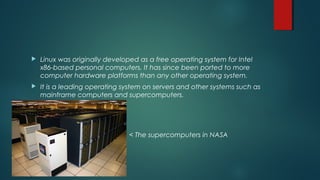
 It is a leading operating system on servers and other systems such as 
mainframe computers and supercomputers. 
< The supercomputers in NASA
Linux today 
 As of November 2014, 97% of the world's 500 fastest supercomputers 
run some variant of Linux, including the top 80. Linux also runs on 
embedded systems, which are devices whose operating system is 
typically built into the firmware and is highly tailored to the system; 
this includes mobile phones, tablet computers, network routers, 
facility automation controls, televisions and video game consoles. 
 Android, the most widely used operating system for tablets and 
smartphones, is built on top of the Linux kernel.
 The development of Linux is one of the most prominent examples of 
free and open-source software collaboration. The underlying source 
code may be used, modified, and distributed — commercially or 
non-commercially — by anyone under licenses such as the GNU 
General Public License. Typically, Linux is packaged in a form known 
as Linux distribution, for both desktop and server use. 
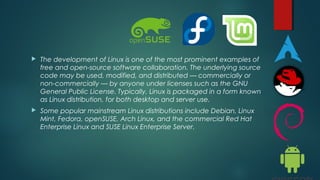
 Some popular mainstream Linux distributions include Debian, Linux 
Mint, Fedora, openSUSE, Arch Linux, and the commercial Red Hat 
Enterprise Linux and SUSE Linux Enterprise Server.
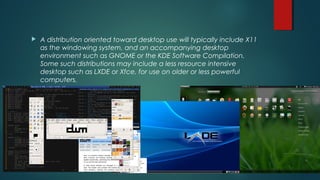
 A distribution oriented toward desktop use will typically include X11 
as the windowing system, and an accompanying desktop 
environment such as GNOME or the KDE Software Compilation. 
Some such distributions may include a less resource intensive 
desktop such as LXDE or Xfce, for use on older or less powerful 
computers.
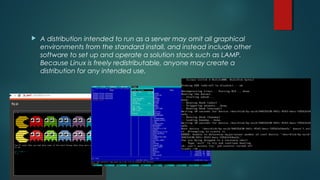
 A distribution intended to run as a server may omit all graphical 
environments from the standard install, and instead include other 
software to set up and operate a solution stack such as LAMP. 
Because Linux is freely redistributable, anyone may create a 
distribution for any intended use.

Presentation1

  • 1.
    Linux WHAT ISIT, AND WHY DOES IT EXIST?
  • 2.
    Origin  Linuxis a UNIX-like computer operating system assembled under the model of free and open-source software development and distribution.  The defining component of Linux is the Linux kernel, an operating system kernel first released on 5th October 1991. by Linus Torvalds.
  • 3.
     Linux wasoriginally developed as a free operating system for Intel x86-based personal computers. It has since been ported to more computer hardware platforms than any other operating system.  It is a leading operating system on servers and other systems such as mainframe computers and supercomputers. < The supercomputers in NASA
  • 4.
    Linux today As of November 2014, 97% of the world's 500 fastest supercomputers run some variant of Linux, including the top 80. Linux also runs on embedded systems, which are devices whose operating system is typically built into the firmware and is highly tailored to the system; this includes mobile phones, tablet computers, network routers, facility automation controls, televisions and video game consoles.  Android, the most widely used operating system for tablets and smartphones, is built on top of the Linux kernel.
  • 5.
     The developmentof Linux is one of the most prominent examples of free and open-source software collaboration. The underlying source code may be used, modified, and distributed — commercially or non-commercially — by anyone under licenses such as the GNU General Public License. Typically, Linux is packaged in a form known as Linux distribution, for both desktop and server use.  Some popular mainstream Linux distributions include Debian, Linux Mint, Fedora, openSUSE, Arch Linux, and the commercial Red Hat Enterprise Linux and SUSE Linux Enterprise Server.
  • 6.
     A distributionoriented toward desktop use will typically include X11 as the windowing system, and an accompanying desktop environment such as GNOME or the KDE Software Compilation. Some such distributions may include a less resource intensive desktop such as LXDE or Xfce, for use on older or less powerful computers.
  • 7.
     A distributionintended to run as a server may omit all graphical environments from the standard install, and instead include other software to set up and operate a solution stack such as LAMP. Because Linux is freely redistributable, anyone may create a distribution for any intended use.