Presented by
Anil Pokhrel
Bsccsit
3 semester
1
Contents
 Three essential requirements for long-term
information storage
 File Structure
 File Types
 File Access
 File Operations
 Directories
2
Three essential requirements for
long-term information storage
 It must be possible to store a very large amount of
information.
 The information must survive the termination of the
process using it.
 Multiple processes must be able to access the information
concurrently.
 Files are managed by the operating system; part of the
operating system dealing with files is known as the file
system.
3
4
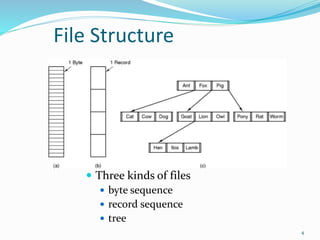
File Structure
 Three kinds of files
 byte sequence
 record sequence
 tree
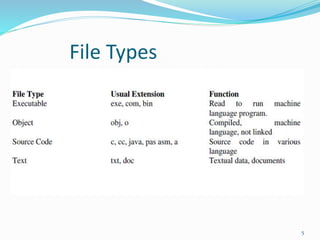
File Types
5
File Access
 Sequential access
 read all bytes/records from the beginning cannot jump
around, could rewind or back up
 convenient when medium was mag tape
 Random access
 bytes/records read in any order
 essential for data base systems
 read can be …
 move file marker (seek), then read or …
 read and then move file marker
6
7
File Operations
1. Create
2. Delete
3. Open
4. Close
5. Read
6. Write
7. Append
8. Seek
9. Get attributes
10.Set
Attributes
11. Rename
8
Directories
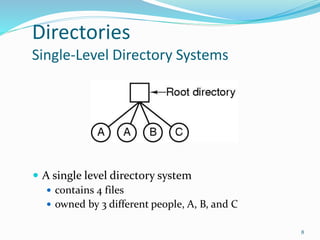
Single-Level Directory Systems
 A single level directory system
 contains 4 files
 owned by 3 different people, A, B, and C
9
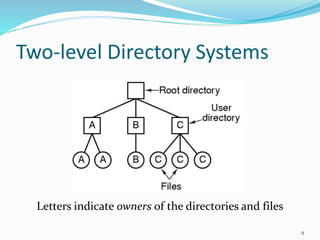
Two-level Directory Systems
Letters indicate owners of the directories and files
10
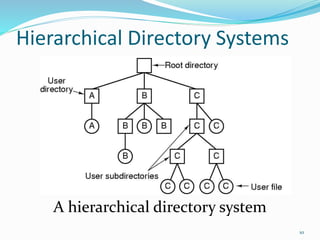
Hierarchical Directory Systems
A hierarchical directory system
Refernce
 http://download.microsoft.com/download/9/6/D/96
D0705A-003A-4CE2-B2B2-
2A437635400C/MS%20vs%20%20Red%20Hat%20WP.
pdf
 http://smallbusiness.chron.com/five-common-
operating-systems-28217.html
11
12

Operating system file system