JAYA
Introduction
 All computer applications need to store and retrieve
information.
 Things to be consider
 Store a very large amount of information.
 Information must survive after the termination of
process.
 Multiple processes must be able to access the
information concurrently.
solution
 Need to store the information on disks and other
external media in units called files.
 Process can read and write whenever needed.
 Information stored in units is persistent.
 information disappear when its owner explicitly
removes it.
File
 It is a uniform logical storage unit.
 Its a abstract mechanism.
 Named collection of related information, which is
stored on secondary storage.
 Managed by operating system.
File Naming
 It provides a way to store and retrieve the information
later.
 Used to shield the user from details of information
storage and disk working.
 Rules for file naming
 String of 1 to 8 letters
 Digits and special characters
 Some allow string from 1 to 255 characters
 Case sensitivity
 Extensions
File Naming
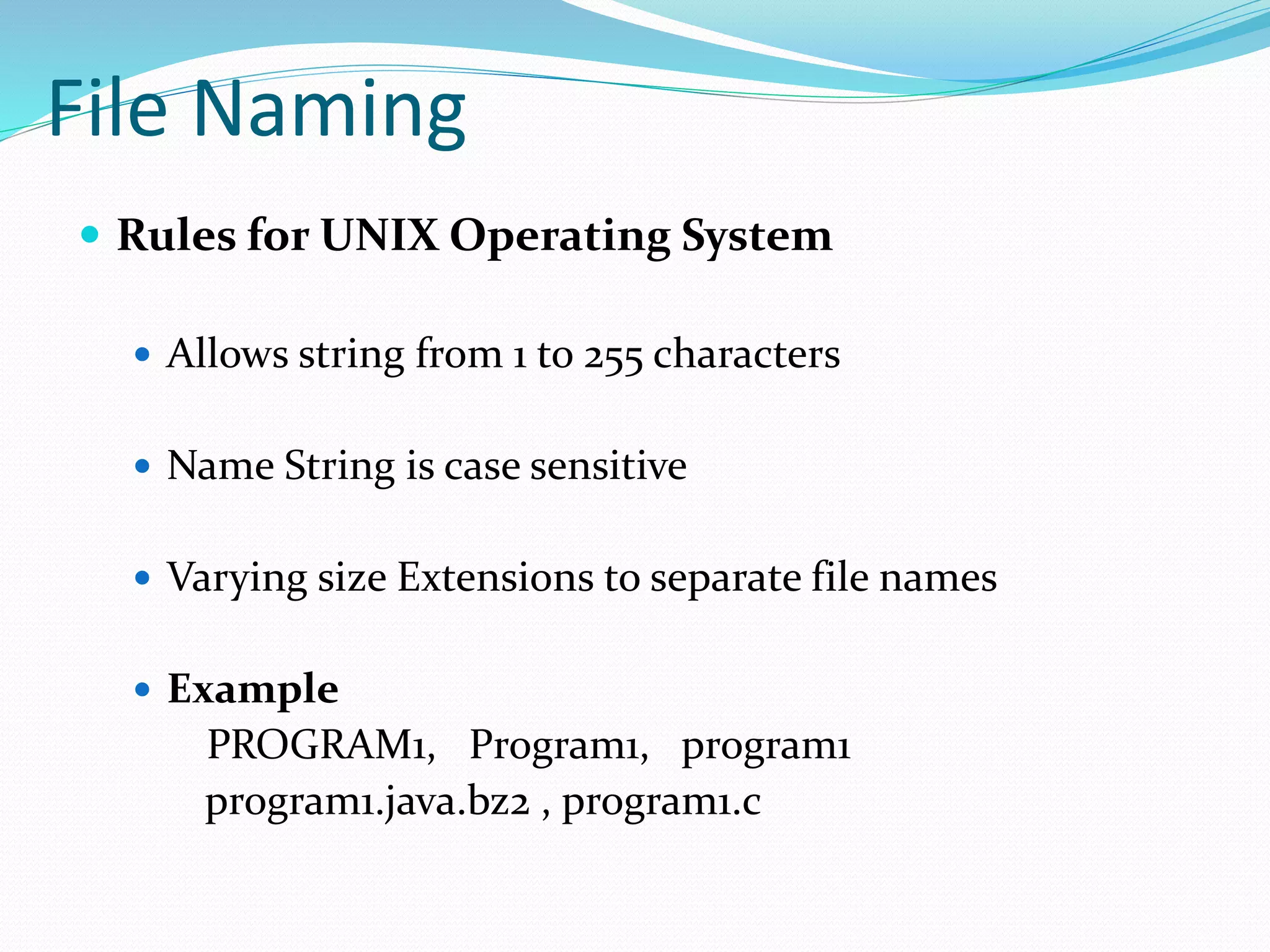
 Rules for UNIX Operating System
 Allows string from 1 to 255 characters
 Name String is case sensitive
 Varying size Extensions to separate file names
 Example
PROGRAM1, Program1, program1
program1.java.bz2 , program1.c
File Naming
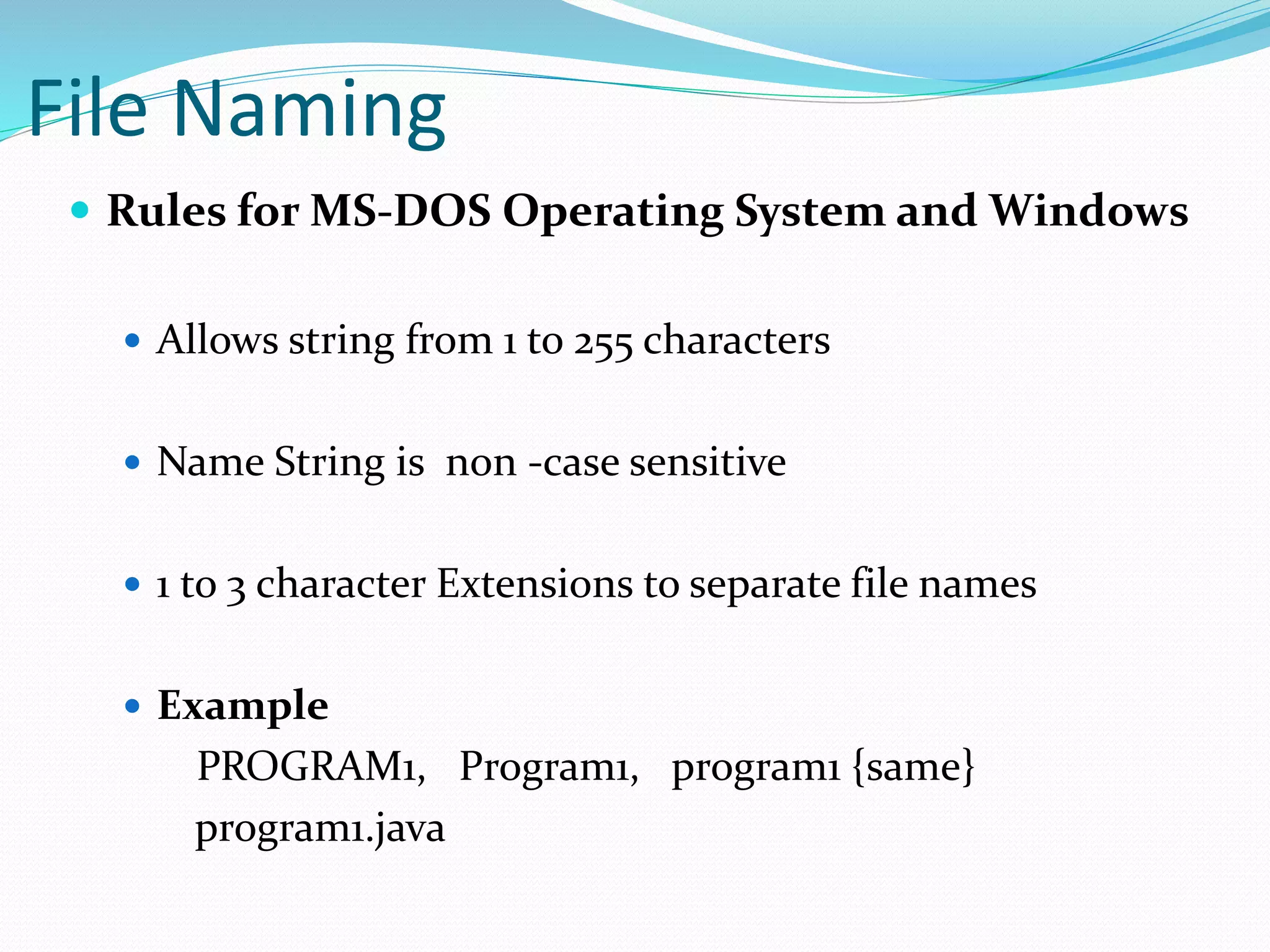
 Rules for MS-DOS Operating System and Windows
 Allows string from 1 to 255 characters
 Name String is non -case sensitive
 1 to 3 character Extensions to separate file names
 Example
PROGRAM1, Program1, program1 {same}
program1.java
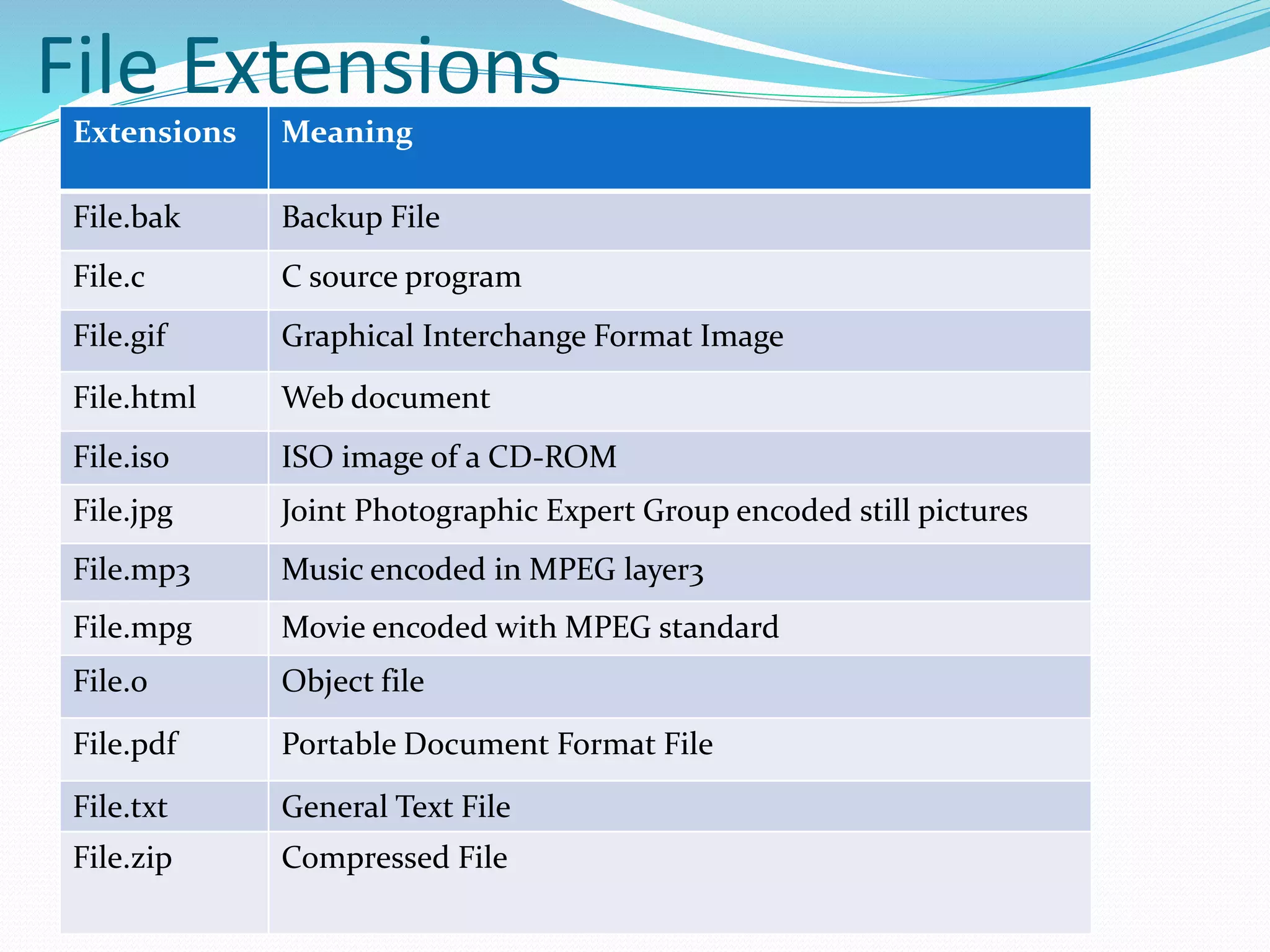
File Extensions
Extensions Meaning
File.bak Backup File
File.c C source program
File.gif Graphical Interchange Format Image
File.html Web document
File.iso ISO image of a CD-ROM
File.jpg Joint Photographic Expert Group encoded still pictures
File.mp3 Music encoded in MPEG layer3
File.mpg Movie encoded with MPEG standard
File.o Object file
File.pdf Portable Document Format File
File.txt General Text File
File.zip Compressed File
File Structure
 Ways of File Structure
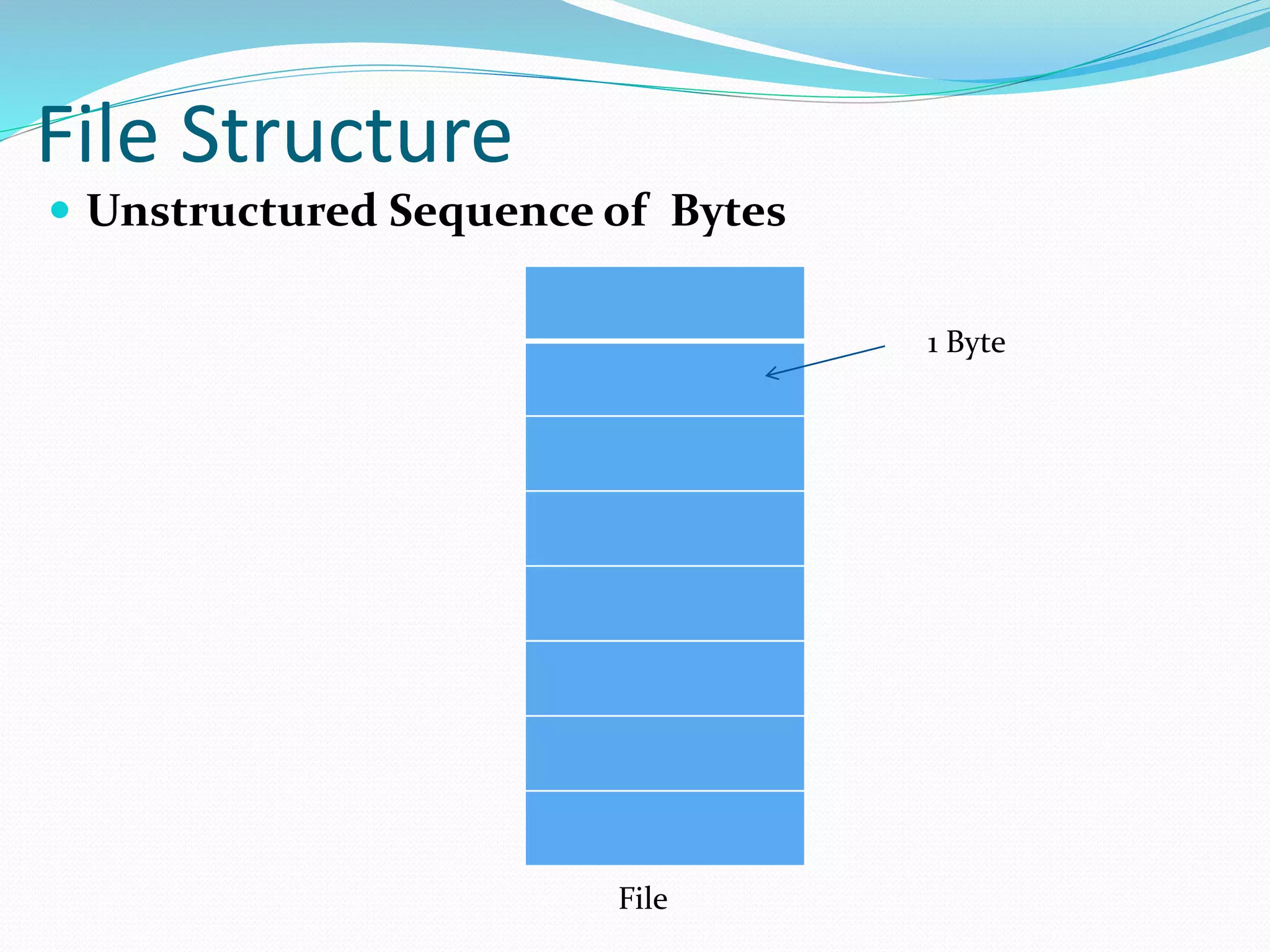
 Unstructured Sequence of Bytes
 Collection of bytes
 Operating System does not know or care what is in the
File
 Handled by user
 Used in UNIX and WIN 98
 Advantages:
 Provides maximum flexibility.
 User can save anything in it.
 Disadvantage:
 No simultaneous read and write operation .
File Structure
 Unstructured Sequence of Bytes
1 Byte
File
File Structure
 Ways of File Structure
 Sequence of Fixed length Records
 Collection of fixed length records.
 Used in older systems.
 Advantages:
 Read and write operation on different record done
simultaneously.
 Disadvantage:
 Sequential search so time consuming
File Structure
 Sequence of Fixed length Records
Record
File
File Structure
 Ways of File Structure
 Tree Structure
 File consists of a tree of records with varying size.
 Each record contains a key Field.
 Tree is sorted based on key fields.
 Used in large mainframe systems
 Advantages:
 Less time to search a record.
File Structure
 Tree Structure
Ant Fox Pig
Cat Cow Dog Goat Lion Owl Pony Rat Worm
Hen Horse Lamb
File Structure
 Four Terms
 Fields
 Records
 Files
 Database
File Structure
 Four Terms
 Fields
 Basic elements of data
 Has 3 sub fields
 Example emp_name
 Records
 Collection of related fields.
 Has sub fields like name and length
 Example emp_record
File Structure
 Four Terms
 File
 Collection of similar records.
 Treated as a single entity by user.
 Has sub fields like name, creation date ,length.
 Example : payroll system.
 Database
 Collection of related data ( one or more files).
 Has sub fields like name and length
 Example: organizations data or project
File Types
 Operating system supports several types of files
 Regular File
 Character special File
 Block Special File
 Metadata File
 Directories
File Types
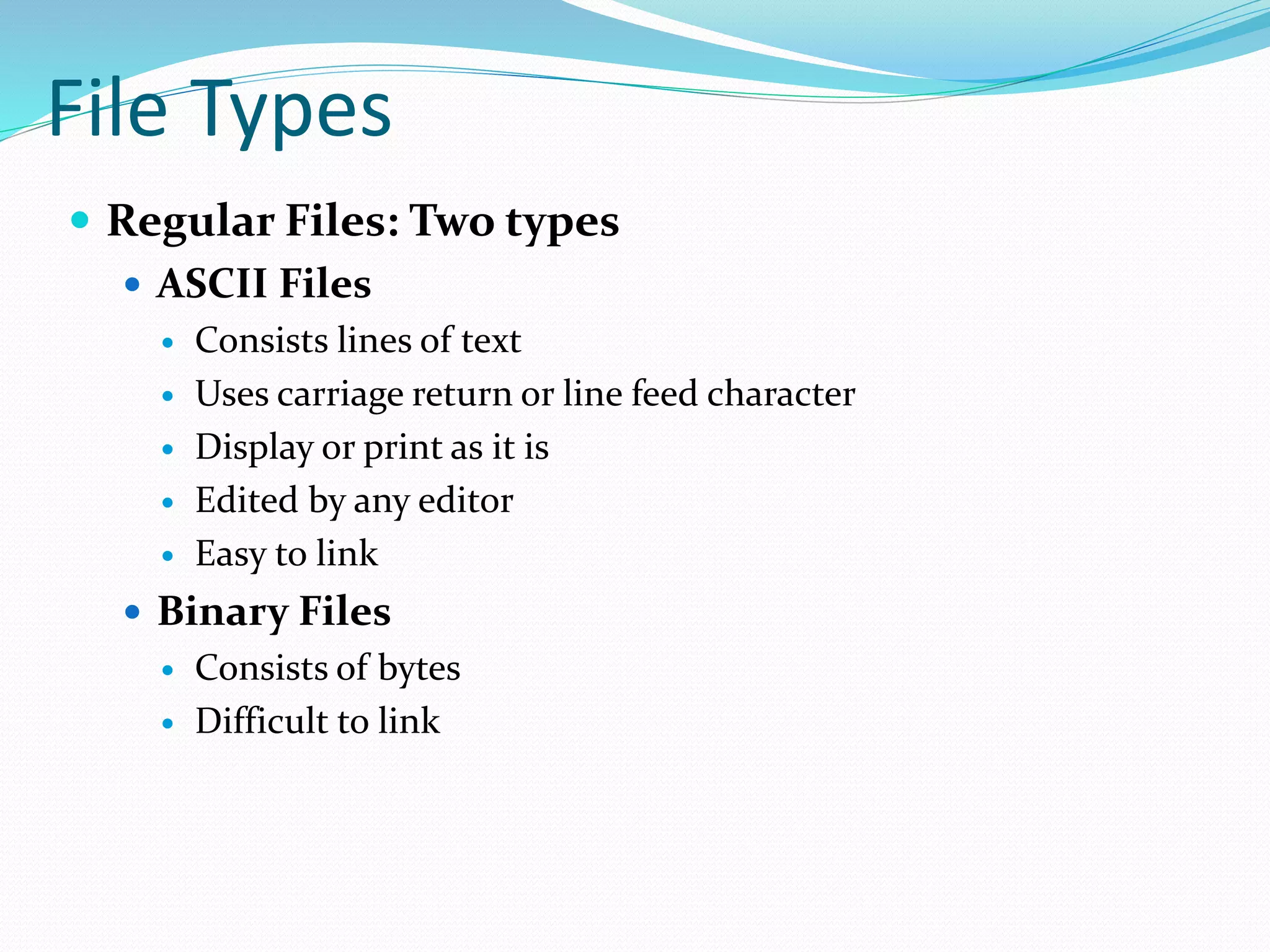
 Regular Files: Two types
 ASCII Files
 Consists lines of text
 Uses carriage return or line feed character
 Display or print as it is
 Edited by any editor
 Easy to link
 Binary Files
 Consists of bytes
 Difficult to link
File Types
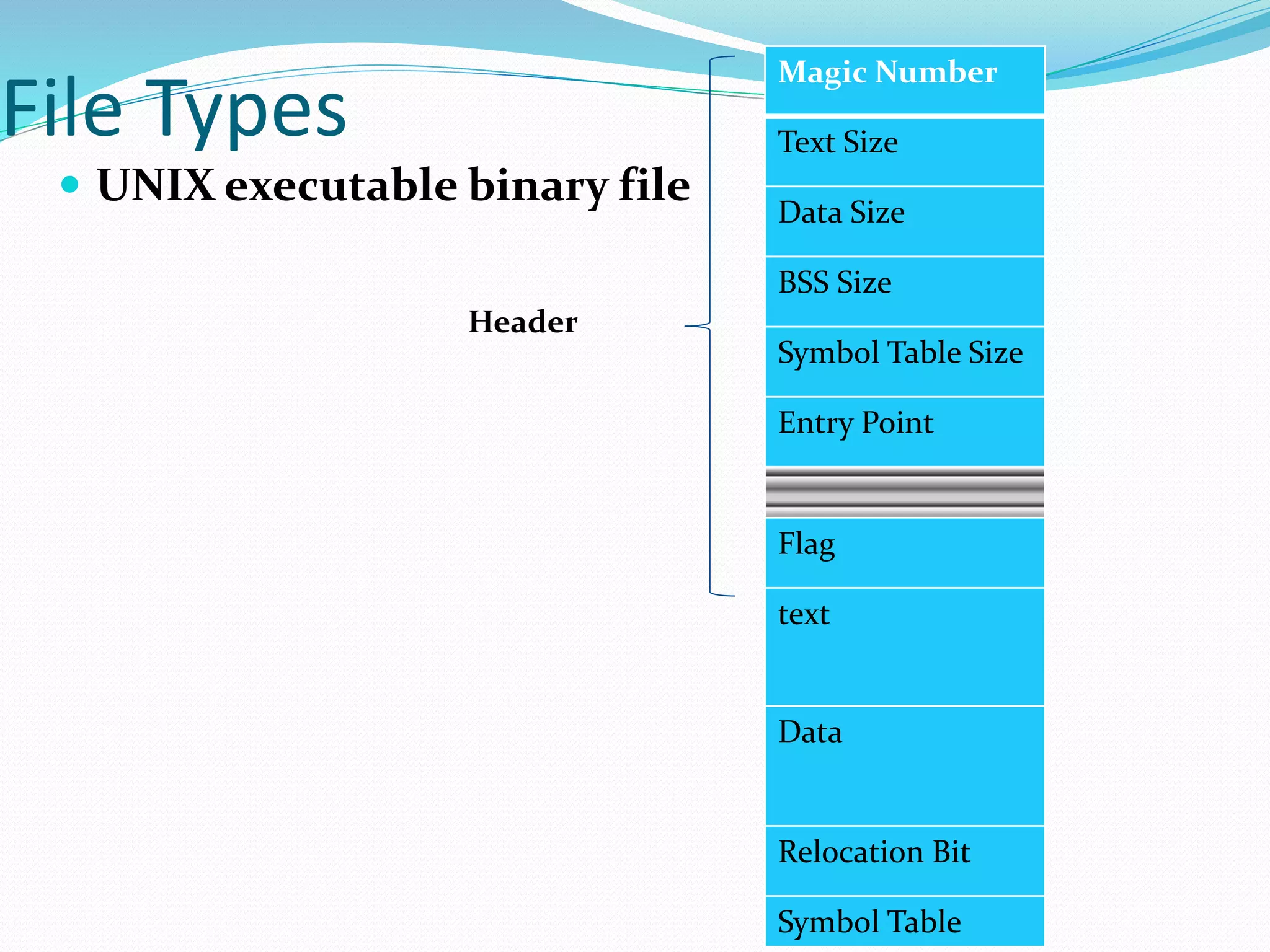
 UNIX executable binary file
Magic Number
Text Size
Data Size
BSS Size
Symbol Table Size
Entry Point
Flag
text
Data
Relocation Bit
Symbol Table
Header
File Type
 Unix Binary archive File
Header
Object module
Header
Object module
Header
Object module
Header
Object module
Module name
Date
Owner
Protection
Size
File Attribute
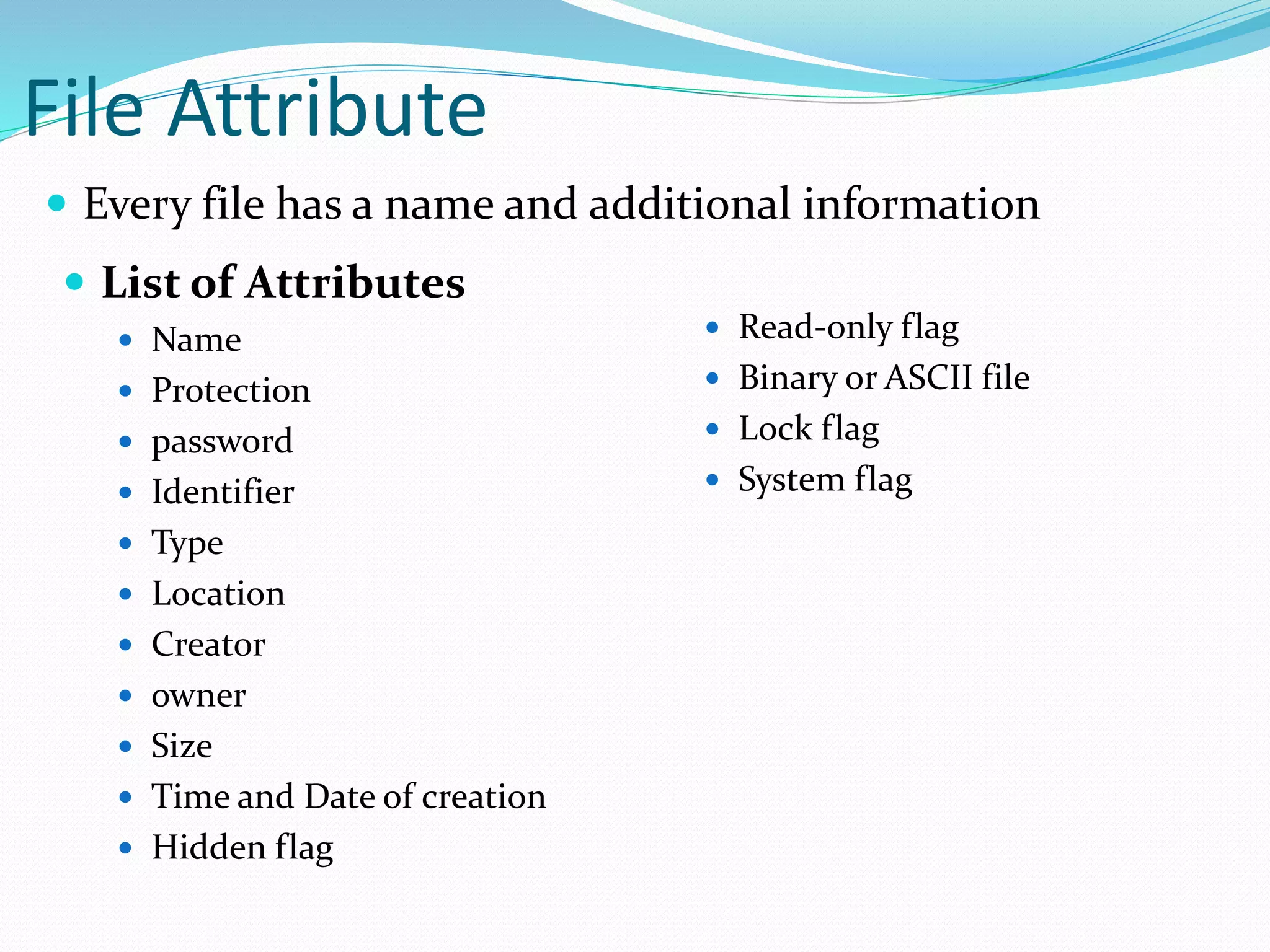
 Every file has a name and additional information
 List of Attributes
 Name
 Protection
 password
 Identifier
 Type
 Location
 Creator
 owner
 Size
 Time and Date of creation
 Hidden flag
 Read-only flag
 Binary or ASCII file
 Lock flag
 System flag
File Access Methods
 Types of File Access Methods
 Sequential Access Method
 Random or Direct Access Method
 Other Access Methods
File Access Methods
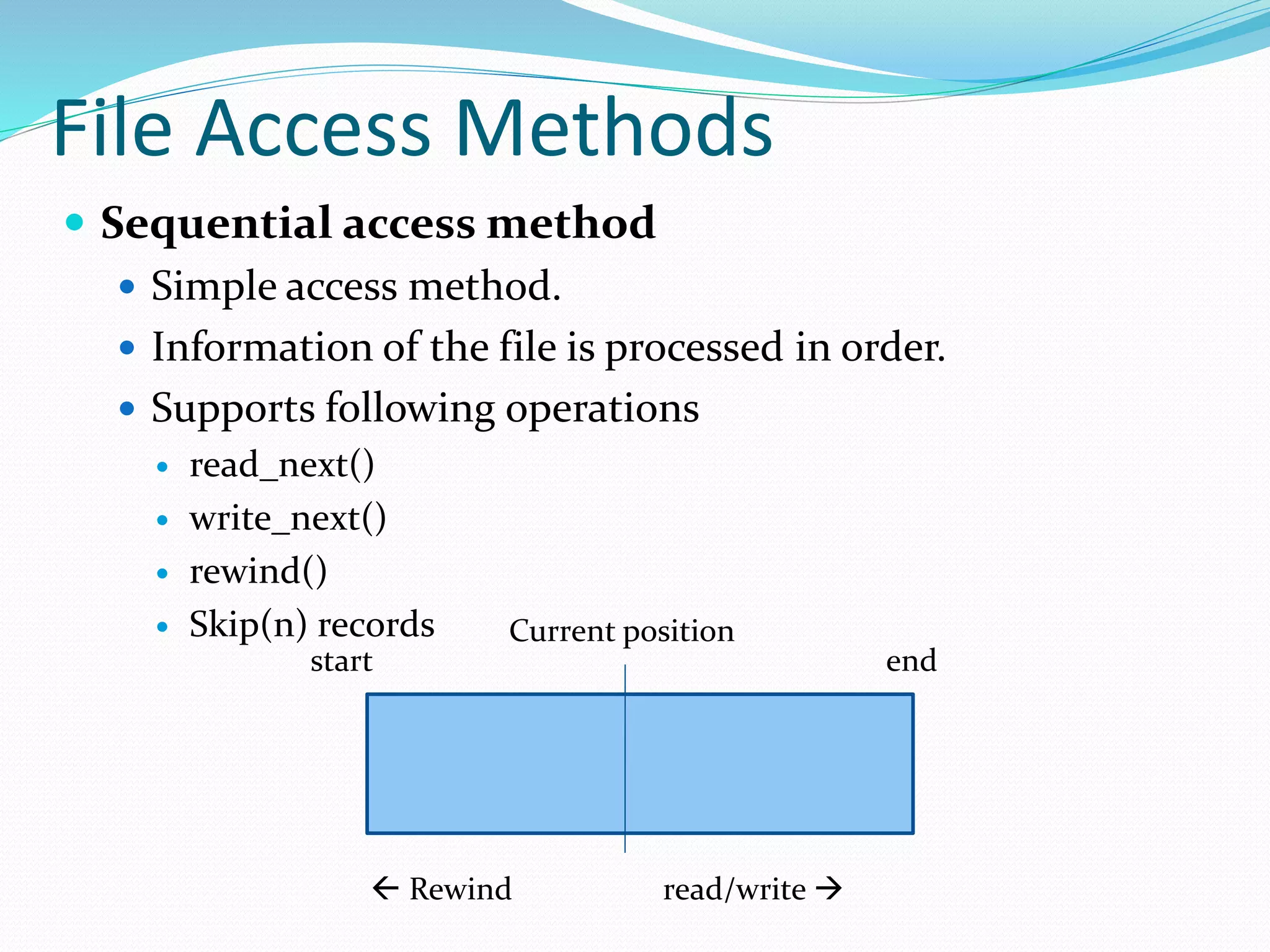
 Sequential access method
 Simple access method.
 Information of the file is processed in order.
 Supports following operations
 read_next()
 write_next()
 rewind()
 Skip(n) records Current position
 Rewind read/write 
start end
File Access Methods
 Random or Direct access method
 It is based on disk model.
 Allows random access.
 File is viewed as a numbered sequence of records.
 Used to access large amount of data.
 Supports following operations
 read(n)
 write(n)
 jump to record n
 Query current record
File Access Methods
 Other Access method(Indexed)
 Build on top of direct access method
 To search the record
 Search index for file pointer
 Search file in directory
 Search a required record
Key Field Pointer
radha ----
raj -----
Radha Social-security age --
Index Relative File
File Operations
 Operations required to define a file properly.
 Operations are nothing but OS system calls.
 List of operations
 Creating a file
 Writing a file
 Reading a file
 Append a file
 Seek operation / repositioning within a file
 Deleting a file
 Get attribute
 Set attribute
 Rename
 Truncating a File
File System Implementation
 Why to use disk
 Deals with
 How the files and directories are stored
 How they are managed
 How it work efficiently
 File system layout
MBR pt partition1 partition2 partition3 -----
Entire disk space
Boot
block
Super
block
Free space
mgmt
I-nodes Root dir Files &
directory
Unix file system

FILE MANAGEMENT.pptx

  • 1.
  • 2.
    Introduction  All computerapplications need to store and retrieve information.  Things to be consider  Store a very large amount of information.  Information must survive after the termination of process.  Multiple processes must be able to access the information concurrently.
  • 3.
    solution  Need tostore the information on disks and other external media in units called files.  Process can read and write whenever needed.  Information stored in units is persistent.  information disappear when its owner explicitly removes it.
  • 4.
    File  It isa uniform logical storage unit.  Its a abstract mechanism.  Named collection of related information, which is stored on secondary storage.  Managed by operating system.
  • 5.
    File Naming  Itprovides a way to store and retrieve the information later.  Used to shield the user from details of information storage and disk working.  Rules for file naming  String of 1 to 8 letters  Digits and special characters  Some allow string from 1 to 255 characters  Case sensitivity  Extensions
  • 6.
    File Naming  Rulesfor UNIX Operating System  Allows string from 1 to 255 characters  Name String is case sensitive  Varying size Extensions to separate file names  Example PROGRAM1, Program1, program1 program1.java.bz2 , program1.c
  • 7.
    File Naming  Rulesfor MS-DOS Operating System and Windows  Allows string from 1 to 255 characters  Name String is non -case sensitive  1 to 3 character Extensions to separate file names  Example PROGRAM1, Program1, program1 {same} program1.java
  • 8.
    File Extensions Extensions Meaning File.bakBackup File File.c C source program File.gif Graphical Interchange Format Image File.html Web document File.iso ISO image of a CD-ROM File.jpg Joint Photographic Expert Group encoded still pictures File.mp3 Music encoded in MPEG layer3 File.mpg Movie encoded with MPEG standard File.o Object file File.pdf Portable Document Format File File.txt General Text File File.zip Compressed File
  • 9.
    File Structure  Waysof File Structure  Unstructured Sequence of Bytes  Collection of bytes  Operating System does not know or care what is in the File  Handled by user  Used in UNIX and WIN 98  Advantages:  Provides maximum flexibility.  User can save anything in it.  Disadvantage:  No simultaneous read and write operation .
  • 10.
    File Structure  UnstructuredSequence of Bytes 1 Byte File
  • 11.
    File Structure  Waysof File Structure  Sequence of Fixed length Records  Collection of fixed length records.  Used in older systems.  Advantages:  Read and write operation on different record done simultaneously.  Disadvantage:  Sequential search so time consuming
  • 12.
    File Structure  Sequenceof Fixed length Records Record File
  • 13.
    File Structure  Waysof File Structure  Tree Structure  File consists of a tree of records with varying size.  Each record contains a key Field.  Tree is sorted based on key fields.  Used in large mainframe systems  Advantages:  Less time to search a record.
  • 14.
    File Structure  TreeStructure Ant Fox Pig Cat Cow Dog Goat Lion Owl Pony Rat Worm Hen Horse Lamb
  • 15.
    File Structure  FourTerms  Fields  Records  Files  Database
  • 16.
    File Structure  FourTerms  Fields  Basic elements of data  Has 3 sub fields  Example emp_name  Records  Collection of related fields.  Has sub fields like name and length  Example emp_record
  • 17.
    File Structure  FourTerms  File  Collection of similar records.  Treated as a single entity by user.  Has sub fields like name, creation date ,length.  Example : payroll system.  Database  Collection of related data ( one or more files).  Has sub fields like name and length  Example: organizations data or project
  • 18.
    File Types  Operatingsystem supports several types of files  Regular File  Character special File  Block Special File  Metadata File  Directories
  • 19.
    File Types  RegularFiles: Two types  ASCII Files  Consists lines of text  Uses carriage return or line feed character  Display or print as it is  Edited by any editor  Easy to link  Binary Files  Consists of bytes  Difficult to link
  • 20.
    File Types  UNIXexecutable binary file Magic Number Text Size Data Size BSS Size Symbol Table Size Entry Point Flag text Data Relocation Bit Symbol Table Header
  • 21.
    File Type  UnixBinary archive File Header Object module Header Object module Header Object module Header Object module Module name Date Owner Protection Size
  • 22.
    File Attribute  Everyfile has a name and additional information  List of Attributes  Name  Protection  password  Identifier  Type  Location  Creator  owner  Size  Time and Date of creation  Hidden flag  Read-only flag  Binary or ASCII file  Lock flag  System flag
  • 23.
    File Access Methods Types of File Access Methods  Sequential Access Method  Random or Direct Access Method  Other Access Methods
  • 24.
    File Access Methods Sequential access method  Simple access method.  Information of the file is processed in order.  Supports following operations  read_next()  write_next()  rewind()  Skip(n) records Current position  Rewind read/write  start end
  • 25.
    File Access Methods Random or Direct access method  It is based on disk model.  Allows random access.  File is viewed as a numbered sequence of records.  Used to access large amount of data.  Supports following operations  read(n)  write(n)  jump to record n  Query current record
  • 26.
    File Access Methods Other Access method(Indexed)  Build on top of direct access method  To search the record  Search index for file pointer  Search file in directory  Search a required record Key Field Pointer radha ---- raj ----- Radha Social-security age -- Index Relative File
  • 27.
    File Operations  Operationsrequired to define a file properly.  Operations are nothing but OS system calls.  List of operations  Creating a file  Writing a file  Reading a file  Append a file  Seek operation / repositioning within a file  Deleting a file  Get attribute  Set attribute  Rename  Truncating a File
  • 28.
    File System Implementation Why to use disk  Deals with  How the files and directories are stored  How they are managed  How it work efficiently  File system layout MBR pt partition1 partition2 partition3 ----- Entire disk space Boot block Super block Free space mgmt I-nodes Root dir Files & directory Unix file system

Editor's Notes

  • #26 Query current record – used to return back to this record later
  • #27 Query current record – used to return back to this record later