Comparing PGQL,G-Core, Cypher
Presentation at oCIM 4 on May 22-24, 2018
Stefan Plantikow (Neo4j)
Paper WG3 YTZ-030r1
Cypher
● Original (1st) declarative query language for property graphs
● "Ascii-Art" pattern syntax for graph matching
● SQL-like syntax
● Full DML
● DDL for constraints and indices
● Isomorphism by default
● Main language in actual use, 10 implementations, 5 products
● Planned: Multiple graphs, query composition, path patterns
PGQL
● Oracle's take on property graphs
● Pattern matching with "Ascii-Art"
● Path patterns / RPQs with macros
● Homomorphism by default
● Limited multiple graphs support
● 2 implementations, 1 product
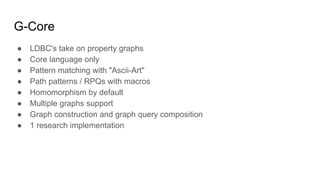
G-Core
● LDBC's take on property graphs
● Core language only
● Pattern matching with "Ascii-Art"
● Path patterns / RPQs with macros
● Homomorphism by default
● Multiple graphs support
● Graph construction and graph query composition
● 1 research implementation
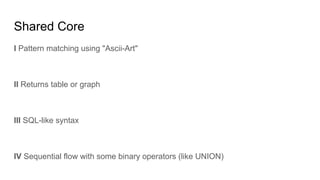
Shared Core
I Pattern matching using "Ascii-Art"
II Returns table or graph
III SQL-like syntax
IV Sequential flow with some binary operators (like UNION)
Shared Core
Scope
DQL (projecting tables and grraph construction)
DML (updating base data and views)
DDL (schema, constraints, indices)
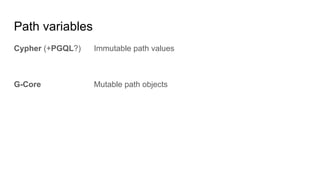
Path variables
Cypher (+PGQL?) Immutable path values
G-Core Mutable path objects
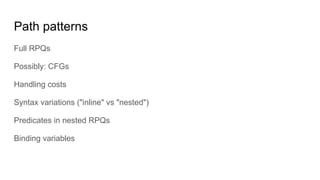
Path patterns
Full RPQs
Possibly: CFGs
Handling costs
Syntax variations ("inline" vs "nested")
Predicates in nested RPQs
Binding variables
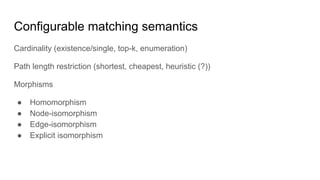
Configurable matching semantics
Cardinality (existence/single, top-k, enumeration)
Path length restriction (shortest, cheapest, heuristic (?))
Morphisms
● Homomorphism
● Node-isomorphism
● Edge-isomorphism
● Explicit isomorphism
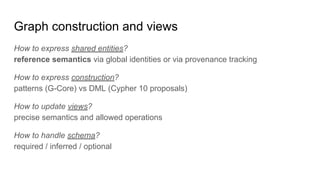
Graph construction and views
How to express shared entities?
reference semantics via global identities or via provenance tracking
How to express construction?
patterns (G-Core) vs DML (Cypher 10 proposals)
How to update views?
precise semantics and allowed operations
How to handle schema?
required / inferred / optional
Details
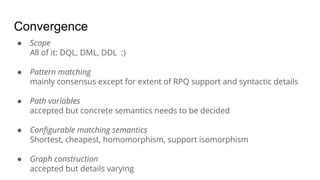
Convergence
● Scope
All of it: DQL, DML, DDL :)
● Pattern matching
mainly consensus except for extent of RPQ support and syntactic details
● Path variables
accepted but concrete semantics needs to be decided
● Configurable matching semantics
Shortest, cheapest, homomorphism, support isomorphism
● Graph construction
accepted but details varying
Other open issues
● Order of clauses
○ Top-Down => Logical and proven for property graphs
○ Bottom-Up => Nice for SQL
● Default morphism
○ homomorphism by default for rigid patterns
○ shortest paths by default for variable length patterns
○ enumeration/reachability (?)
● Type system
○ "Nice subset" of SQL, GraphQL, SPARQL, Cypher, ...
○ Extensible
○ Unicode by default?
● Support for heterogenous typing and schema-optional graphs?
Other open issues
● Semantics of DML operations (e.g. MERGE)
● Schema model (Discussed as part of SQL work)
● SQL integration
Thank you
Link to paper

Comparing PGQL, G-Core and Cypher

  • 1.
    Comparing PGQL,G-Core, Cypher Presentationat oCIM 4 on May 22-24, 2018 Stefan Plantikow (Neo4j)
  • 2.
  • 3.
    Cypher ● Original (1st)declarative query language for property graphs ● "Ascii-Art" pattern syntax for graph matching ● SQL-like syntax ● Full DML ● DDL for constraints and indices ● Isomorphism by default ● Main language in actual use, 10 implementations, 5 products ● Planned: Multiple graphs, query composition, path patterns
  • 4.
    PGQL ● Oracle's takeon property graphs ● Pattern matching with "Ascii-Art" ● Path patterns / RPQs with macros ● Homomorphism by default ● Limited multiple graphs support ● 2 implementations, 1 product
  • 5.
    G-Core ● LDBC's takeon property graphs ● Core language only ● Pattern matching with "Ascii-Art" ● Path patterns / RPQs with macros ● Homomorphism by default ● Multiple graphs support ● Graph construction and graph query composition ● 1 research implementation
  • 6.
    Shared Core I Patternmatching using "Ascii-Art" II Returns table or graph III SQL-like syntax IV Sequential flow with some binary operators (like UNION)
  • 7.
  • 8.
    Scope DQL (projecting tablesand grraph construction) DML (updating base data and views) DDL (schema, constraints, indices)
  • 9.
    Path variables Cypher (+PGQL?)Immutable path values G-Core Mutable path objects
  • 10.
    Path patterns Full RPQs Possibly:CFGs Handling costs Syntax variations ("inline" vs "nested") Predicates in nested RPQs Binding variables
  • 11.
    Configurable matching semantics Cardinality(existence/single, top-k, enumeration) Path length restriction (shortest, cheapest, heuristic (?)) Morphisms ● Homomorphism ● Node-isomorphism ● Edge-isomorphism ● Explicit isomorphism
  • 12.
    Graph construction andviews How to express shared entities? reference semantics via global identities or via provenance tracking How to express construction? patterns (G-Core) vs DML (Cypher 10 proposals) How to update views? precise semantics and allowed operations How to handle schema? required / inferred / optional
  • 13.
  • 14.
    Convergence ● Scope All ofit: DQL, DML, DDL :) ● Pattern matching mainly consensus except for extent of RPQ support and syntactic details ● Path variables accepted but concrete semantics needs to be decided ● Configurable matching semantics Shortest, cheapest, homomorphism, support isomorphism ● Graph construction accepted but details varying
  • 15.
    Other open issues ●Order of clauses ○ Top-Down => Logical and proven for property graphs ○ Bottom-Up => Nice for SQL ● Default morphism ○ homomorphism by default for rigid patterns ○ shortest paths by default for variable length patterns ○ enumeration/reachability (?) ● Type system ○ "Nice subset" of SQL, GraphQL, SPARQL, Cypher, ... ○ Extensible ○ Unicode by default? ● Support for heterogenous typing and schema-optional graphs?
  • 16.
    Other open issues ●Semantics of DML operations (e.g. MERGE) ● Schema model (Discussed as part of SQL work) ● SQL integration
  • 17.