Formal Semantics for Cypher Queries and Updates
Martin Schuster
University of Edinburgh
oCIM 4
Martin Schuster (UoE) Formal Semantics for Cypher oCIM 4 1 / 21
Overview
Background:
Ongoing project on formal definition of Cypher
Started January 2017
Edinburgh database group and Neo4j Cypher group
Status:
Core is done (to be published in SIGMOD)
Next stage: Looking at extensions
This talk: Issues discovered at this stage
Martin Schuster (UoE) Formal Semantics for Cypher oCIM 4 2 / 21
What we do, and why
What we do:
Mathematically model behaviour of Cypher
Establish formal semantics
Why we do it:
Provable insights into properties of Cypher
Formal semantics is unambiguous
Yields exact specification for implementers
Martin Schuster (UoE) Formal Semantics for Cypher oCIM 4 3 / 21
Our goals
Our semantics aims to be:
Denotational
Describes what Cypher statements do, not how
“how” left up to implementation
Deterministic
Same Cypher statement on same graph/table should always yield same
result
Not as trivial to achieve as it sounds (examples later)
Consistent
Similar Cypher statements should be formalised similarly
Example: MATCH/CREATE/MERGE
Martin Schuster (UoE) Formal Semantics for Cypher oCIM 4 4 / 21
Overview
1 Motivation
2 Our work so far
Query semantics
Reference implementation
3 Issues and open problems
Minor issues
Atomicity and determinism issues
Martin Schuster (UoE) Formal Semantics for Cypher oCIM 4 5 / 21
Overview
1 Motivation
2 Our work so far
Query semantics
Reference implementation
3 Issues and open problems
Minor issues
Atomicity and determinism issues
Martin Schuster (UoE) Formal Semantics for Cypher oCIM 4 6 / 21
Basics of query semantics (1)
Basic objects:
Property graphs
Tables (i.e. bags of records)
Query parts:
Query: (Union of) clause sequence(s) terminated with RETURN clause
Clause: “Atomic” statement, e.g.
[OPTIONAL] MATCH pattern tuple [WHERE expr ]
Subclause: Dependent part of clause, e.g. [WHERE expr ]
Martin Schuster (UoE) Formal Semantics for Cypher oCIM 4 7 / 21
Basics of query semantics (2)
Basic properties:
Tables are unordered
{(a : 1, b : 3), (a : "Martin", b : "UoE"), (a : 1, b : 3)} =
{(a : 1, b : 3), (a : 1, b : 3), (a : "Martin", b : "UoE")}
Semantics of query Q given graph G maps tables to tables:
[[Q]]G : Tables → Tables
Output of Q on a G: Result of evaluating Q on empty table given G
(i.e. [[Q]]G ({})).
More details: Nadime Francis, Formal Specification of Cypher, oCIM 2
Martin Schuster (UoE) Formal Semantics for Cypher oCIM 4 8 / 21
Basics of update semantics
For updates: Slight change to query semantics
Cypher statements (consisting of query and update clauses) map
graphs and tables to graphs and tables
[[S]] : (Graphs × Tables) → (Graphs × Tables)
Queries are statements that do not change the graph
[[Q]](G, T) = (G, [[Q]]G (T))
Martin Schuster (UoE) Formal Semantics for Cypher oCIM 4 9 / 21
Current status of query semantics
Core fragment of Cypher queries already formalised:
UNION+[OPTIONAL ]MATCH+WHERE+UNWIND+WITH
(without aggregation)
Accepted for publication in SIGMOD 2018
Current version (at published state) available at
http://arxiv.org/abs/1802.09984
Current work (so far unpublished): Adding order, aggregation, updates.
arXiv version will be updated as more features get added
Martin Schuster (UoE) Formal Semantics for Cypher oCIM 4 10 / 21
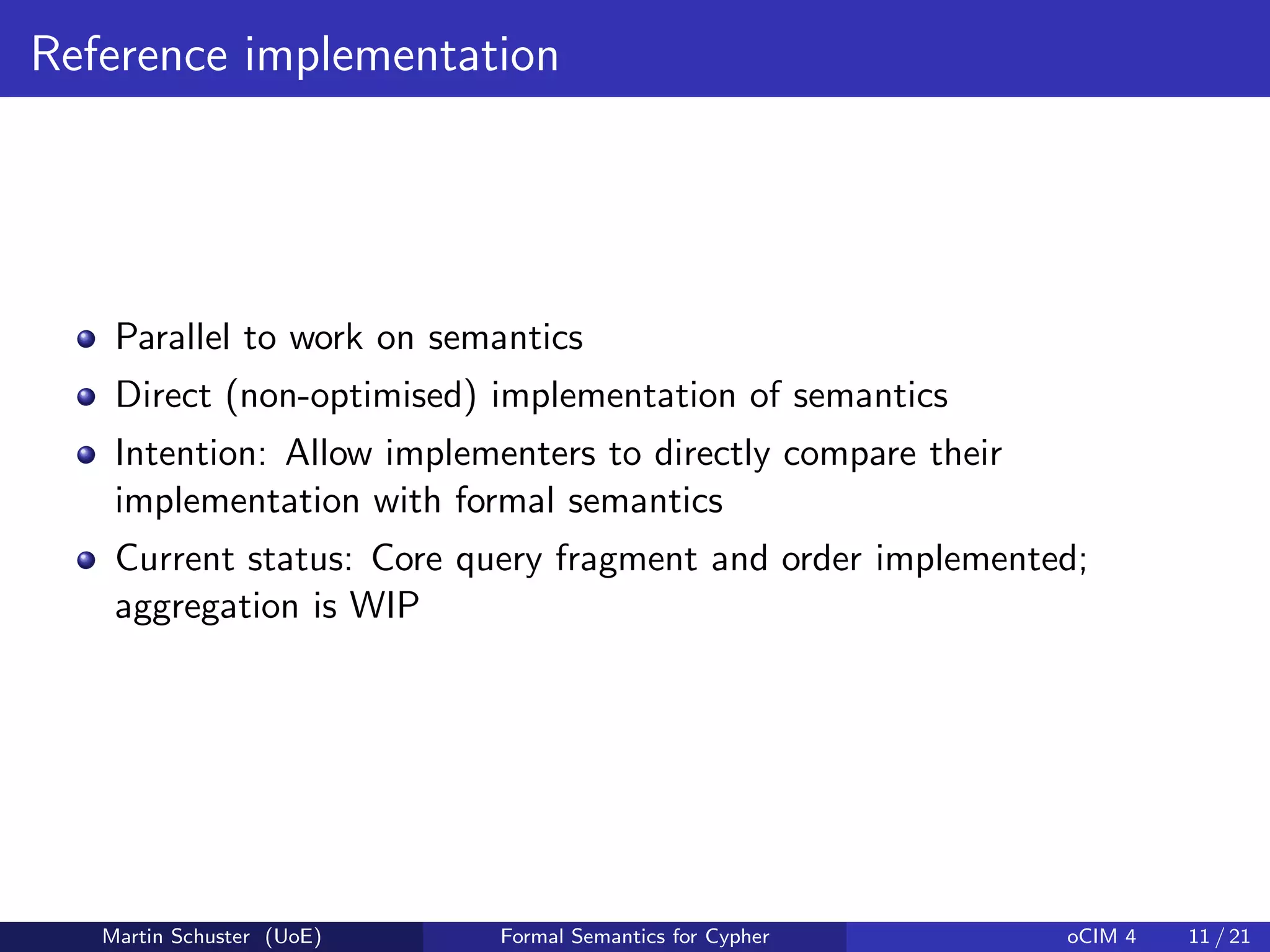
Reference implementation
Parallel to work on semantics
Direct (non-optimised) implementation of semantics
Intention: Allow implementers to directly compare their
implementation with formal semantics
Current status: Core query fragment and order implemented;
aggregation is WIP
Martin Schuster (UoE) Formal Semantics for Cypher oCIM 4 11 / 21
Overview
1 Motivation
2 Our work so far
Query semantics
Reference implementation
3 Issues and open problems
Minor issues
Atomicity and determinism issues
Martin Schuster (UoE) Formal Semantics for Cypher oCIM 4 12 / 21
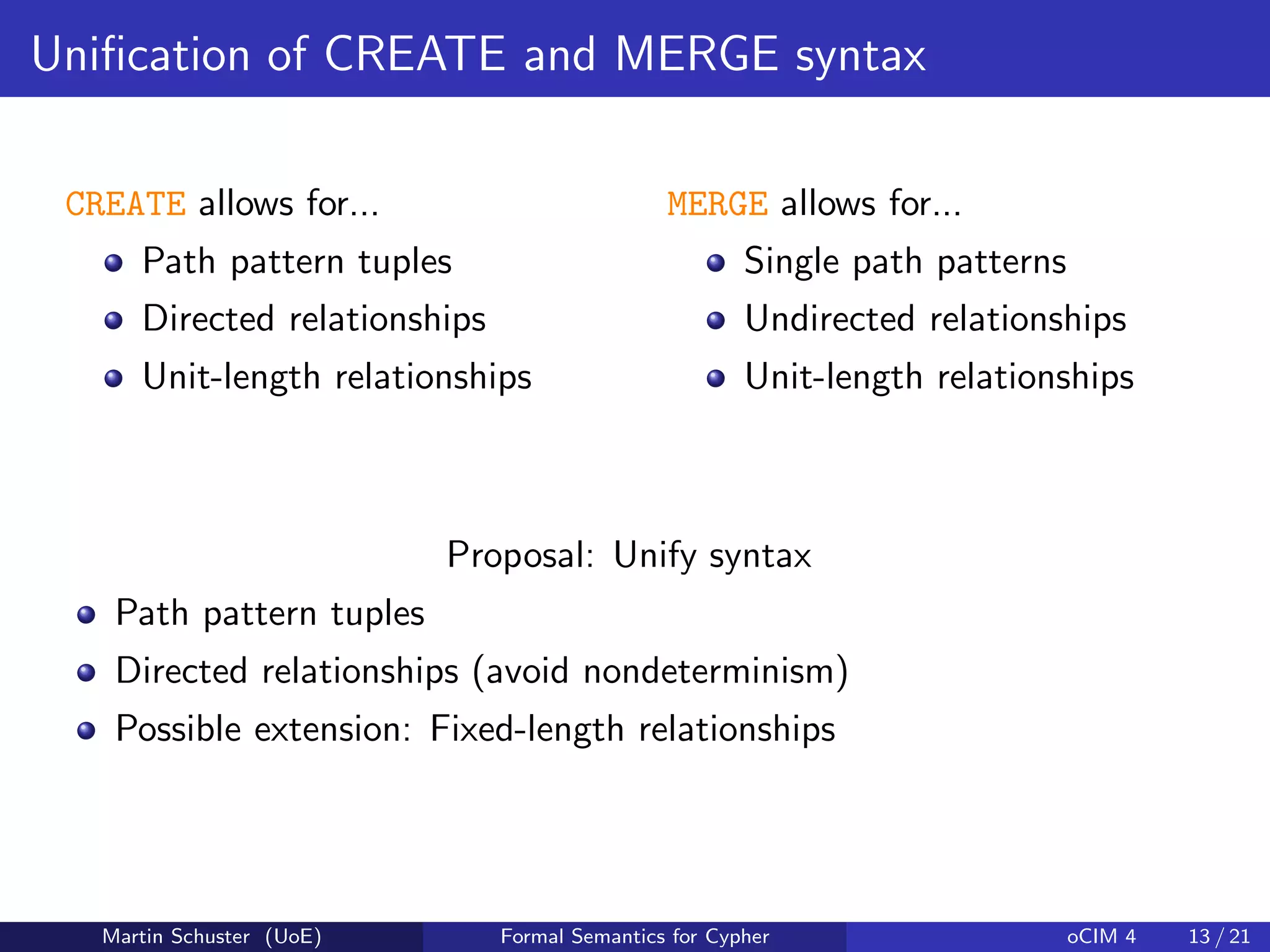
Unification of CREATE and MERGE syntax
CREATE allows for...
Path pattern tuples
Directed relationships
Unit-length relationships
MERGE allows for...
Single path patterns
Undirected relationships
Unit-length relationships
Proposal: Unify syntax
Path pattern tuples
Directed relationships (avoid nondeterminism)
Possible extension: Fixed-length relationships
Martin Schuster (UoE) Formal Semantics for Cypher oCIM 4 13 / 21
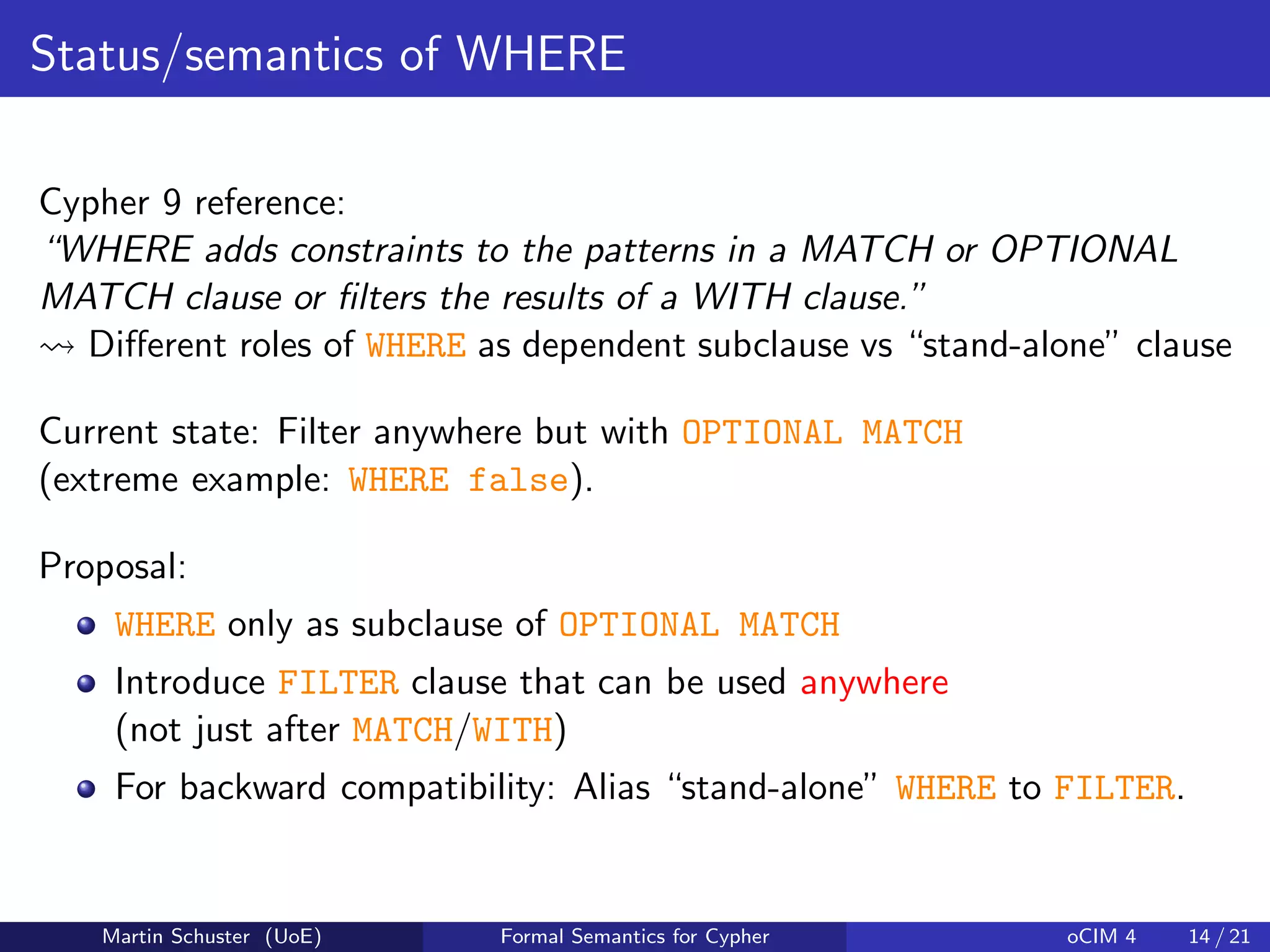
Status/semantics of WHERE
Cypher 9 reference:
“WHERE adds constraints to the patterns in a MATCH or OPTIONAL
MATCH clause or filters the results of a WITH clause.”
Different roles of WHERE as dependent subclause vs “stand-alone” clause
Current state: Filter anywhere but with OPTIONAL MATCH
(extreme example: WHERE false).
Proposal:
WHERE only as subclause of OPTIONAL MATCH
Introduce FILTER clause that can be used anywhere
(not just after MATCH/WITH)
For backward compatibility: Alias “stand-alone” WHERE to FILTER.
Martin Schuster (UoE) Formal Semantics for Cypher oCIM 4 14 / 21
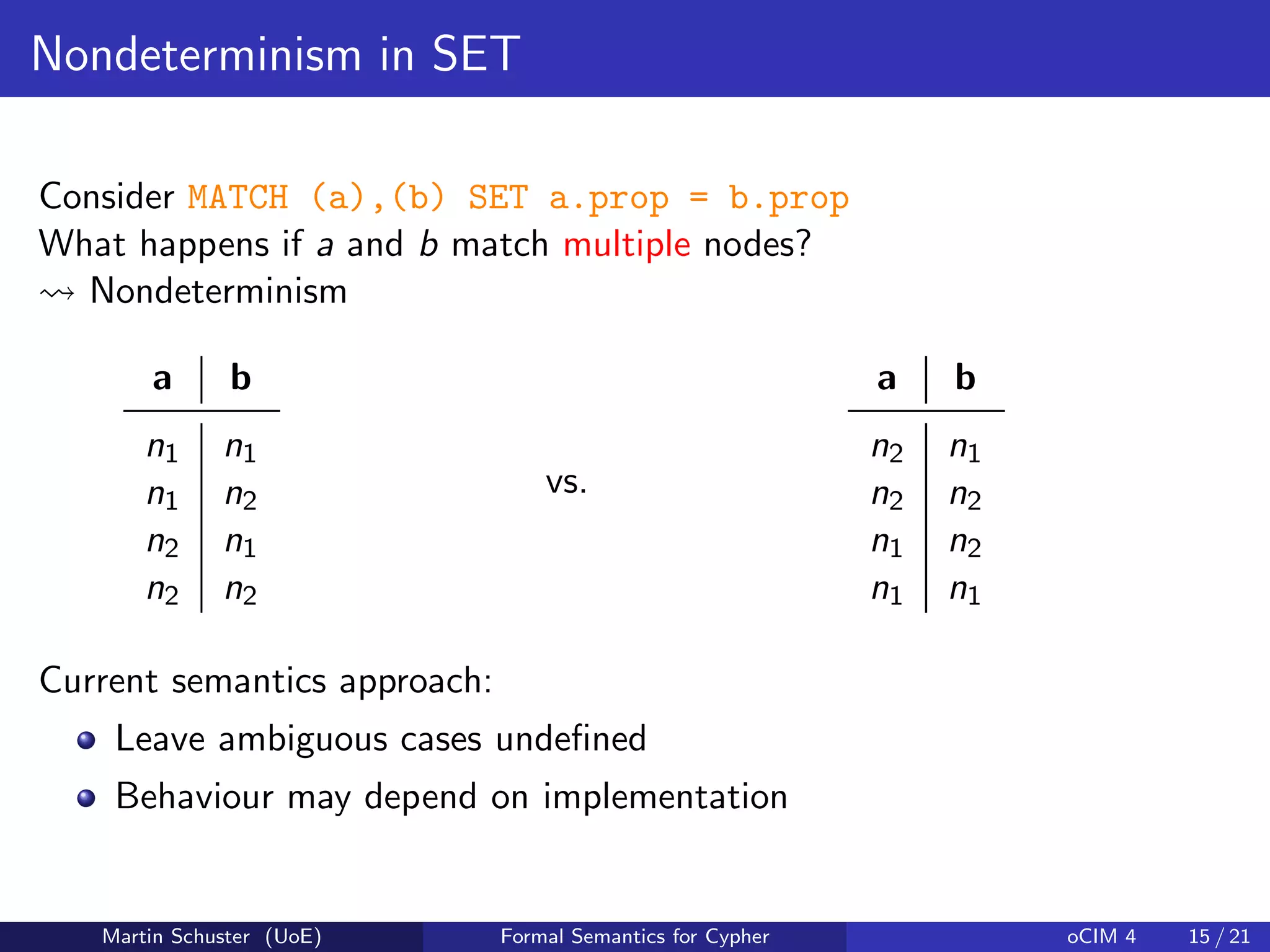
Nondeterminism in SET
Consider MATCH (a),(b) SET a.prop = b.prop
What happens if a and b match multiple nodes?
Nondeterminism
a b
n1 n1
n1 n2
n2 n1
n2 n2
vs.
a b
n2 n1
n2 n2
n1 n2
n1 n1
Current semantics approach:
Leave ambiguous cases undefined
Behaviour may depend on implementation
Martin Schuster (UoE) Formal Semantics for Cypher oCIM 4 15 / 21
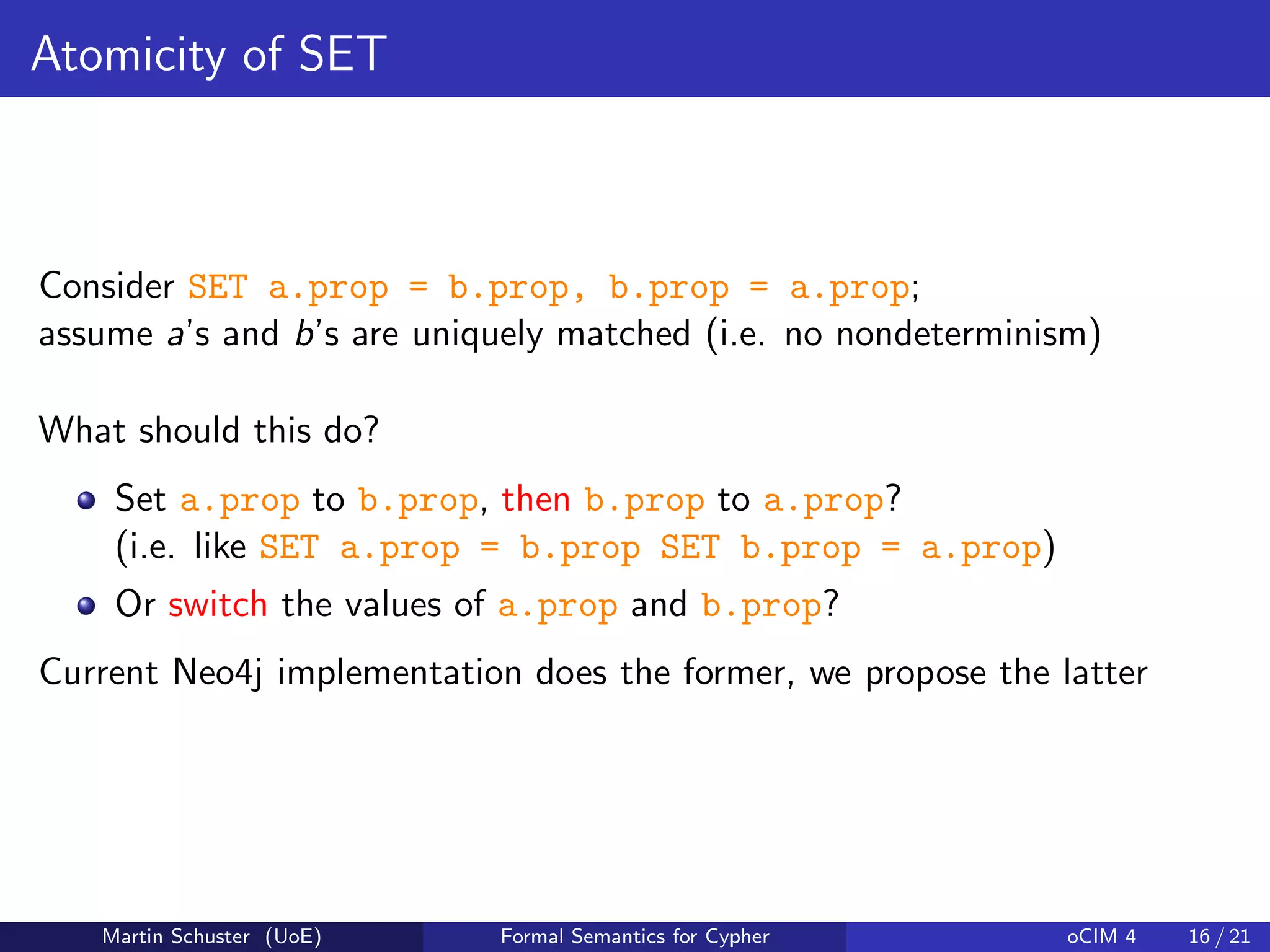
Atomicity of SET
Consider SET a.prop = b.prop, b.prop = a.prop;
assume a’s and b’s are uniquely matched (i.e. no nondeterminism)
What should this do?
Set a.prop to b.prop, then b.prop to a.prop?
(i.e. like SET a.prop = b.prop SET b.prop = a.prop)
Or switch the values of a.prop and b.prop?
Current Neo4j implementation does the former, we propose the latter
Martin Schuster (UoE) Formal Semantics for Cypher oCIM 4 16 / 21
Atomicity/semantics of DELETE
Consider MATCH (a)-[r]->(b) DELETE a,b . . . DELETE r
Should this be allowed?
What does CREATE (n :label {num:1}) DELETE n RETURN n return?
Proposal:
DELETE is atomic, but order-independent inside clauses
MATCH (a)-[r]->(b) DELETE a,b,r allowed
MATCH (a)-[r]->(b) DELETE a,b DELETE r forbidden
Strict semantics (as in CIR-2017-263): Deleted entities inaccessible
immediately after deletion, retrieval attempts yield null or fail
Martin Schuster (UoE) Formal Semantics for Cypher oCIM 4 17 / 21
Issue: Atomicity of CREATE
Consider CREATE (a {num:1})-[:r]->(b {num:a.num})
Should this be allowed?
What about CREATE (a {num:1}), (a)-[:r]->(b {num:a.num}) ?
What about CREATE (a {num:1}), (a)-[:r]->(a :label) ?
Is CREATE π1, π2 the same as CREATE π1 CREATE π2?
Proposal:
CREATE may only access the graph prior to its execution
Labels/properties of newly created nodes must be stated at “first
occurrence” of creation pattern
Martin Schuster (UoE) Formal Semantics for Cypher oCIM 4 18 / 21
Atomicity/determinism of MERGE (1)
Given graph created by CREATE (:a {num:1})-[:r]->(:a {num:2})
What should MATCH (n:a) MERGE (n)-[:r]->()-[:r]->() do?
What about MERGE (n)-[:r]-(m) with example
table (and no existing relationships)?
n m
n1 n2
n1 n2
n2 n1
Should MERGE see...
All of its own creations?
Or only some?
Or none at all?
This is still very much open (CIR-2018-296).
Martin Schuster (UoE) Formal Semantics for Cypher oCIM 4 19 / 21
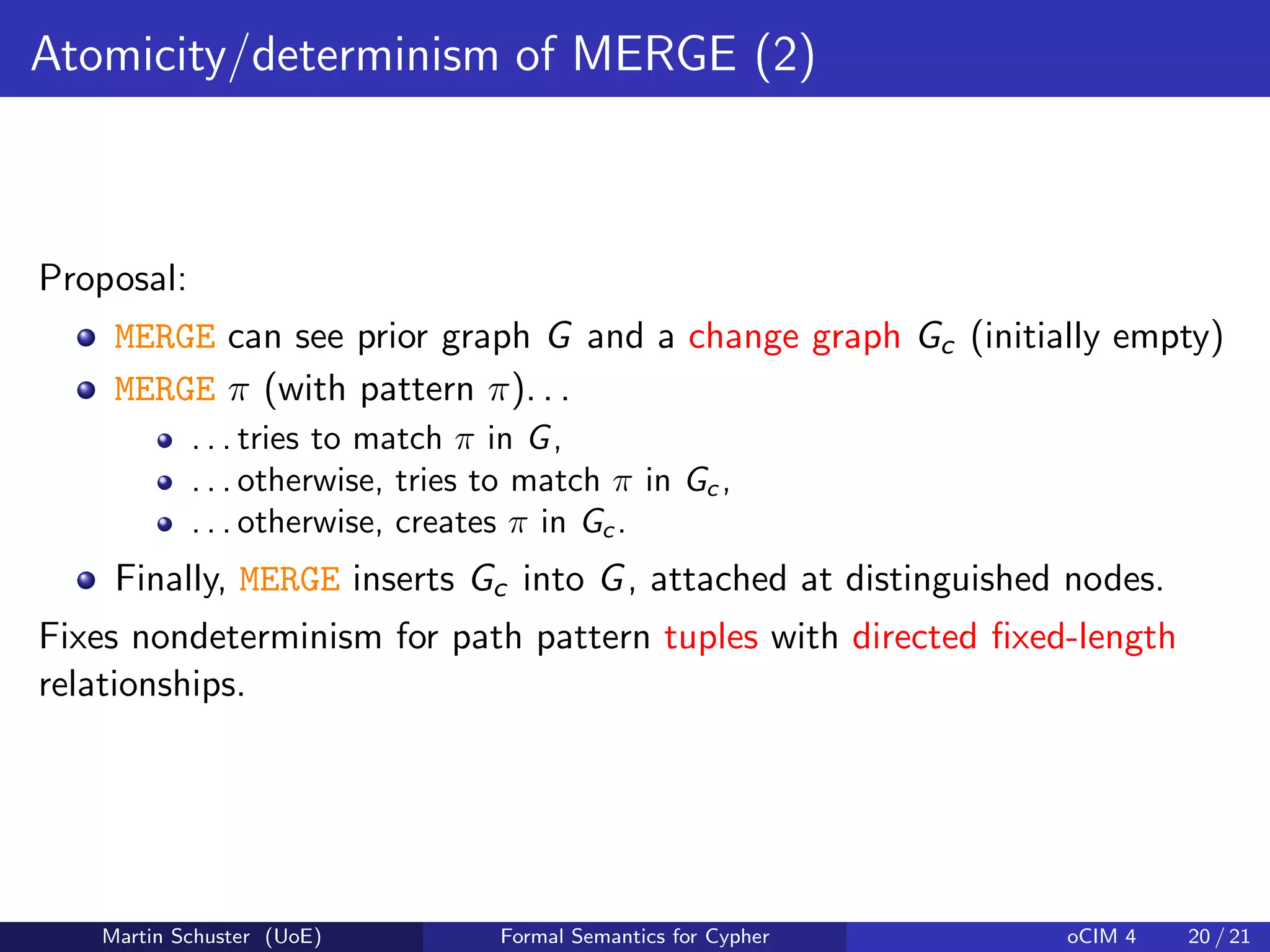
Atomicity/determinism of MERGE (2)
Proposal:
MERGE can see prior graph G and a change graph Gc (initially empty)
MERGE π (with pattern π). . .
. . . tries to match π in G,
. . . otherwise, tries to match π in Gc ,
. . . otherwise, creates π in Gc.
Finally, MERGE inserts Gc into G, attached at distinguished nodes.
Fixes nondeterminism for path pattern tuples with directed fixed-length
relationships.
Martin Schuster (UoE) Formal Semantics for Cypher oCIM 4 20 / 21
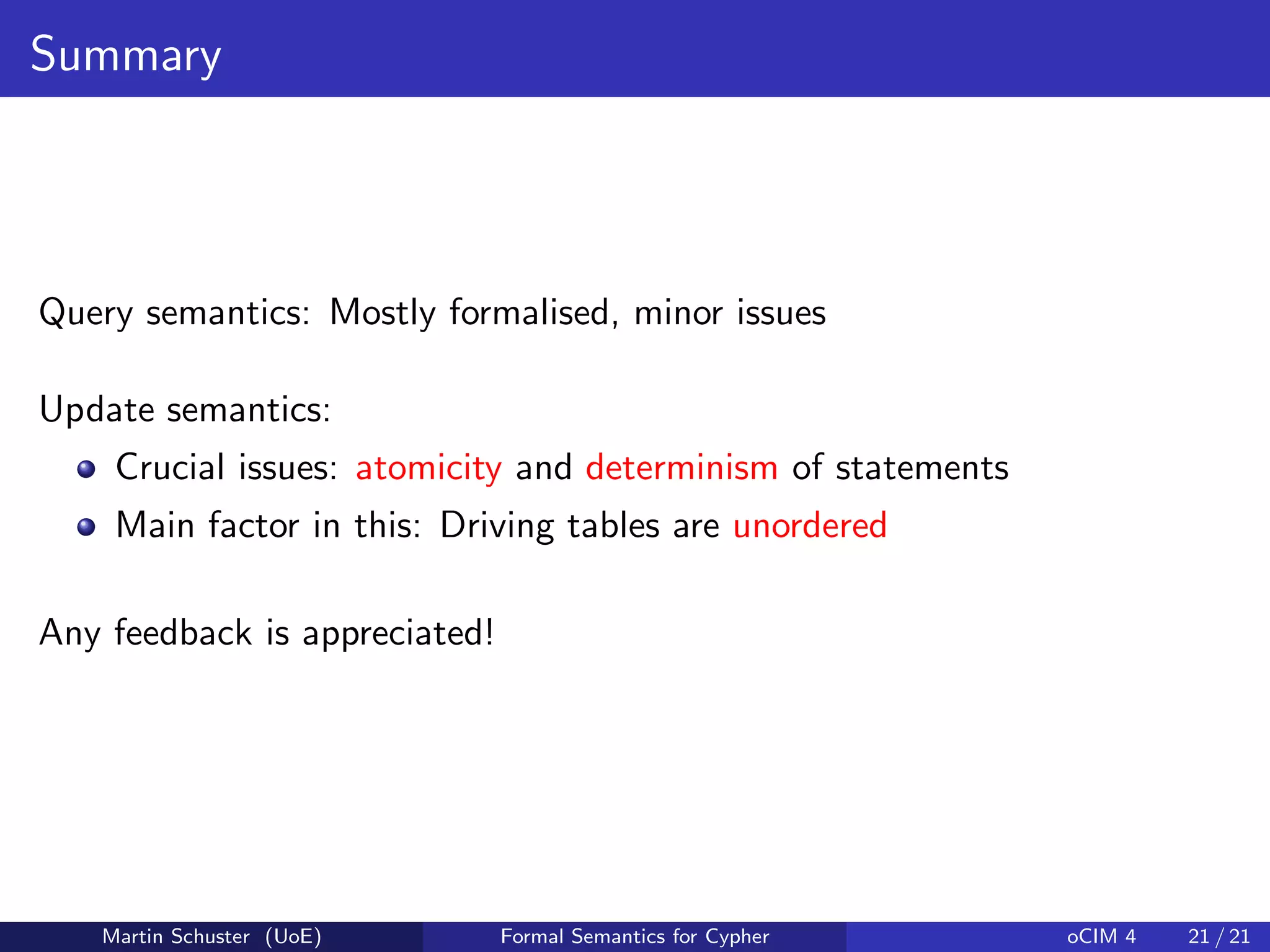
Summary
Query semantics: Mostly formalised, minor issues
Update semantics:
Crucial issues: atomicity and determinism of statements
Main factor in this: Driving tables are unordered
Any feedback is appreciated!
Martin Schuster (UoE) Formal Semantics for Cypher oCIM 4 21 / 21

Formal semantics for Cypher queries and updates

  • 1.
    Formal Semantics forCypher Queries and Updates Martin Schuster University of Edinburgh oCIM 4 Martin Schuster (UoE) Formal Semantics for Cypher oCIM 4 1 / 21
  • 2.
    Overview Background: Ongoing project onformal definition of Cypher Started January 2017 Edinburgh database group and Neo4j Cypher group Status: Core is done (to be published in SIGMOD) Next stage: Looking at extensions This talk: Issues discovered at this stage Martin Schuster (UoE) Formal Semantics for Cypher oCIM 4 2 / 21
  • 3.
    What we do,and why What we do: Mathematically model behaviour of Cypher Establish formal semantics Why we do it: Provable insights into properties of Cypher Formal semantics is unambiguous Yields exact specification for implementers Martin Schuster (UoE) Formal Semantics for Cypher oCIM 4 3 / 21
  • 4.
    Our goals Our semanticsaims to be: Denotational Describes what Cypher statements do, not how “how” left up to implementation Deterministic Same Cypher statement on same graph/table should always yield same result Not as trivial to achieve as it sounds (examples later) Consistent Similar Cypher statements should be formalised similarly Example: MATCH/CREATE/MERGE Martin Schuster (UoE) Formal Semantics for Cypher oCIM 4 4 / 21
  • 5.
    Overview 1 Motivation 2 Ourwork so far Query semantics Reference implementation 3 Issues and open problems Minor issues Atomicity and determinism issues Martin Schuster (UoE) Formal Semantics for Cypher oCIM 4 5 / 21
  • 6.
    Overview 1 Motivation 2 Ourwork so far Query semantics Reference implementation 3 Issues and open problems Minor issues Atomicity and determinism issues Martin Schuster (UoE) Formal Semantics for Cypher oCIM 4 6 / 21
  • 7.
    Basics of querysemantics (1) Basic objects: Property graphs Tables (i.e. bags of records) Query parts: Query: (Union of) clause sequence(s) terminated with RETURN clause Clause: “Atomic” statement, e.g. [OPTIONAL] MATCH pattern tuple [WHERE expr ] Subclause: Dependent part of clause, e.g. [WHERE expr ] Martin Schuster (UoE) Formal Semantics for Cypher oCIM 4 7 / 21
  • 8.
    Basics of querysemantics (2) Basic properties: Tables are unordered {(a : 1, b : 3), (a : "Martin", b : "UoE"), (a : 1, b : 3)} = {(a : 1, b : 3), (a : 1, b : 3), (a : "Martin", b : "UoE")} Semantics of query Q given graph G maps tables to tables: [[Q]]G : Tables → Tables Output of Q on a G: Result of evaluating Q on empty table given G (i.e. [[Q]]G ({})). More details: Nadime Francis, Formal Specification of Cypher, oCIM 2 Martin Schuster (UoE) Formal Semantics for Cypher oCIM 4 8 / 21
  • 9.
    Basics of updatesemantics For updates: Slight change to query semantics Cypher statements (consisting of query and update clauses) map graphs and tables to graphs and tables [[S]] : (Graphs × Tables) → (Graphs × Tables) Queries are statements that do not change the graph [[Q]](G, T) = (G, [[Q]]G (T)) Martin Schuster (UoE) Formal Semantics for Cypher oCIM 4 9 / 21
  • 10.
    Current status ofquery semantics Core fragment of Cypher queries already formalised: UNION+[OPTIONAL ]MATCH+WHERE+UNWIND+WITH (without aggregation) Accepted for publication in SIGMOD 2018 Current version (at published state) available at http://arxiv.org/abs/1802.09984 Current work (so far unpublished): Adding order, aggregation, updates. arXiv version will be updated as more features get added Martin Schuster (UoE) Formal Semantics for Cypher oCIM 4 10 / 21
  • 11.
    Reference implementation Parallel towork on semantics Direct (non-optimised) implementation of semantics Intention: Allow implementers to directly compare their implementation with formal semantics Current status: Core query fragment and order implemented; aggregation is WIP Martin Schuster (UoE) Formal Semantics for Cypher oCIM 4 11 / 21
  • 12.
    Overview 1 Motivation 2 Ourwork so far Query semantics Reference implementation 3 Issues and open problems Minor issues Atomicity and determinism issues Martin Schuster (UoE) Formal Semantics for Cypher oCIM 4 12 / 21
  • 13.
    Unification of CREATEand MERGE syntax CREATE allows for... Path pattern tuples Directed relationships Unit-length relationships MERGE allows for... Single path patterns Undirected relationships Unit-length relationships Proposal: Unify syntax Path pattern tuples Directed relationships (avoid nondeterminism) Possible extension: Fixed-length relationships Martin Schuster (UoE) Formal Semantics for Cypher oCIM 4 13 / 21
  • 14.
    Status/semantics of WHERE Cypher9 reference: “WHERE adds constraints to the patterns in a MATCH or OPTIONAL MATCH clause or filters the results of a WITH clause.” Different roles of WHERE as dependent subclause vs “stand-alone” clause Current state: Filter anywhere but with OPTIONAL MATCH (extreme example: WHERE false). Proposal: WHERE only as subclause of OPTIONAL MATCH Introduce FILTER clause that can be used anywhere (not just after MATCH/WITH) For backward compatibility: Alias “stand-alone” WHERE to FILTER. Martin Schuster (UoE) Formal Semantics for Cypher oCIM 4 14 / 21
  • 15.
    Nondeterminism in SET ConsiderMATCH (a),(b) SET a.prop = b.prop What happens if a and b match multiple nodes? Nondeterminism a b n1 n1 n1 n2 n2 n1 n2 n2 vs. a b n2 n1 n2 n2 n1 n2 n1 n1 Current semantics approach: Leave ambiguous cases undefined Behaviour may depend on implementation Martin Schuster (UoE) Formal Semantics for Cypher oCIM 4 15 / 21
  • 16.
    Atomicity of SET ConsiderSET a.prop = b.prop, b.prop = a.prop; assume a’s and b’s are uniquely matched (i.e. no nondeterminism) What should this do? Set a.prop to b.prop, then b.prop to a.prop? (i.e. like SET a.prop = b.prop SET b.prop = a.prop) Or switch the values of a.prop and b.prop? Current Neo4j implementation does the former, we propose the latter Martin Schuster (UoE) Formal Semantics for Cypher oCIM 4 16 / 21
  • 17.
    Atomicity/semantics of DELETE ConsiderMATCH (a)-[r]->(b) DELETE a,b . . . DELETE r Should this be allowed? What does CREATE (n :label {num:1}) DELETE n RETURN n return? Proposal: DELETE is atomic, but order-independent inside clauses MATCH (a)-[r]->(b) DELETE a,b,r allowed MATCH (a)-[r]->(b) DELETE a,b DELETE r forbidden Strict semantics (as in CIR-2017-263): Deleted entities inaccessible immediately after deletion, retrieval attempts yield null or fail Martin Schuster (UoE) Formal Semantics for Cypher oCIM 4 17 / 21
  • 18.
    Issue: Atomicity ofCREATE Consider CREATE (a {num:1})-[:r]->(b {num:a.num}) Should this be allowed? What about CREATE (a {num:1}), (a)-[:r]->(b {num:a.num}) ? What about CREATE (a {num:1}), (a)-[:r]->(a :label) ? Is CREATE π1, π2 the same as CREATE π1 CREATE π2? Proposal: CREATE may only access the graph prior to its execution Labels/properties of newly created nodes must be stated at “first occurrence” of creation pattern Martin Schuster (UoE) Formal Semantics for Cypher oCIM 4 18 / 21
  • 19.
    Atomicity/determinism of MERGE(1) Given graph created by CREATE (:a {num:1})-[:r]->(:a {num:2}) What should MATCH (n:a) MERGE (n)-[:r]->()-[:r]->() do? What about MERGE (n)-[:r]-(m) with example table (and no existing relationships)? n m n1 n2 n1 n2 n2 n1 Should MERGE see... All of its own creations? Or only some? Or none at all? This is still very much open (CIR-2018-296). Martin Schuster (UoE) Formal Semantics for Cypher oCIM 4 19 / 21
  • 20.
    Atomicity/determinism of MERGE(2) Proposal: MERGE can see prior graph G and a change graph Gc (initially empty) MERGE π (with pattern π). . . . . . tries to match π in G, . . . otherwise, tries to match π in Gc , . . . otherwise, creates π in Gc. Finally, MERGE inserts Gc into G, attached at distinguished nodes. Fixes nondeterminism for path pattern tuples with directed fixed-length relationships. Martin Schuster (UoE) Formal Semantics for Cypher oCIM 4 20 / 21
  • 21.
    Summary Query semantics: Mostlyformalised, minor issues Update semantics: Crucial issues: atomicity and determinism of statements Main factor in this: Driving tables are unordered Any feedback is appreciated! Martin Schuster (UoE) Formal Semantics for Cypher oCIM 4 21 / 21