AIRFLOW
An Open Source Platform to Author and
Monitor Data Pipelines
WHAT ISTHAT!?
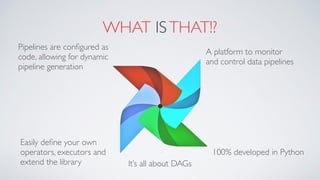
A platform to monitor
and control data pipelines
Pipelines are configured as
code, allowing for dynamic
pipeline generation
100% developed in Python
Easily define your own
operators, executors and
extend the library It’s all about DAGs
WHY DO I NEEDTHAT?
• There are several critical processes to be maintained and
monitored
• Different kinds of jobs in different tools
• Jobs require dependencies and run in a specific order
• A consistent notification method
• Action must be takes in case things go wrong
VERY FLEXIBLE!
DAGs are made in code
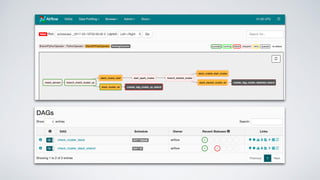
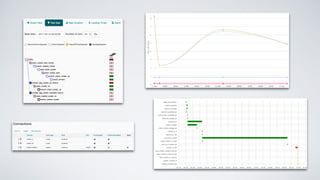
Rich User Interface
Efficient CLIEasily extensible
Allow communication between task
Backfill control
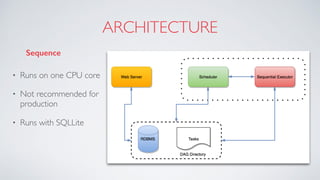
ARCHITECTURE
Sequence
• Runs on one CPU core
• Not recommended for
production
• Runs with SQLLite
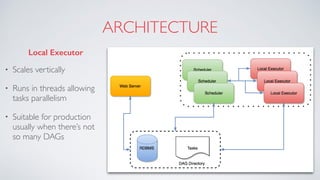
• Scales vertically
• Runs in threads allowing
tasks parallelism
• Suitable for production
usually when there’s not
so many DAGs
ARCHITECTURE
Local Executor
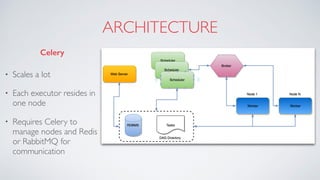
ARCHITECTURE
Celery
• Scales a lot
• Each executor resides in
one node
• Requires Celery to
manage nodes and Redis
or RabbitMQ for
communication
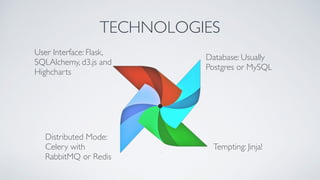
TECHNOLOGIES
User Interface: Flask,
SQLAlchemy, d3.js and
Highcharts
Tempting: Jinja!
Database: Usually
Postgres or MySQL
Distributed Mode:
Celery with
RabbitMQ or Redis
USER INTERFACE
WHAT WE ARE DOING
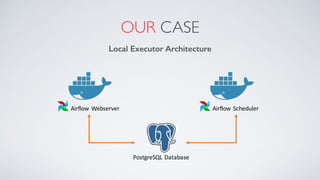
OUR CASE
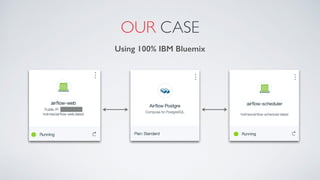
Airflow	Webserver Airflow	Scheduler
PostgreSQL	Database
Local Executor Architecture
OUR CASE
Using 100% IBM Bluemix
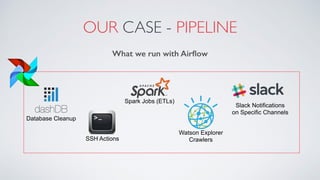
OUR CASE - PIPELINE
Database Cleanup
SSH Actions
Spark Jobs (ETLs)
Watson Explorer
Crawlers
Slack Notifications
on Specific Channels
What we run with Airflow
PROS
• We are able to run tasks in parallel ensuring
dependencies are respected
• Whole process requires less time
• We have detailed graphics views for each one of the tasks
• We get notifications from all steps of the flow in Slack
• There’s a control version using GitHub for all our flows
• We are able to repeat failed tasks after a pre-defined
time when it fails
CONS
• Lack of tutorials and detailed documentation
• Missing operators for some databases (we have
to create our own)
• DAG's sync not handled by Airflow
• Not that good for those who doesn't like
programming
SOME LINKS
• My Airflow implementation using Docker container - https://github.com/
brunocfnba/docker-airflow
• Airflow official website - https://airflow.incubator.apache.org/
• Airflow GitHub - https://github.com/apache/incubator-airflow

Introducing Apache Airflow and how we are using it

  • 1.
    AIRFLOW An Open SourcePlatform to Author and Monitor Data Pipelines
  • 2.
    WHAT ISTHAT!? A platformto monitor and control data pipelines Pipelines are configured as code, allowing for dynamic pipeline generation 100% developed in Python Easily define your own operators, executors and extend the library It’s all about DAGs
  • 3.
    WHY DO INEEDTHAT? • There are several critical processes to be maintained and monitored • Different kinds of jobs in different tools • Jobs require dependencies and run in a specific order • A consistent notification method • Action must be takes in case things go wrong
  • 4.
    VERY FLEXIBLE! DAGs aremade in code Rich User Interface Efficient CLIEasily extensible Allow communication between task Backfill control
  • 5.
    ARCHITECTURE Sequence • Runs onone CPU core • Not recommended for production • Runs with SQLLite
  • 6.
    • Scales vertically •Runs in threads allowing tasks parallelism • Suitable for production usually when there’s not so many DAGs ARCHITECTURE Local Executor
  • 7.
    ARCHITECTURE Celery • Scales alot • Each executor resides in one node • Requires Celery to manage nodes and Redis or RabbitMQ for communication
  • 8.
    TECHNOLOGIES User Interface: Flask, SQLAlchemy,d3.js and Highcharts Tempting: Jinja! Database: Usually Postgres or MySQL Distributed Mode: Celery with RabbitMQ or Redis
  • 9.
  • 12.
  • 13.
  • 14.
  • 15.
    OUR CASE -PIPELINE Database Cleanup SSH Actions Spark Jobs (ETLs) Watson Explorer Crawlers Slack Notifications on Specific Channels What we run with Airflow
  • 16.
    PROS • We areable to run tasks in parallel ensuring dependencies are respected • Whole process requires less time • We have detailed graphics views for each one of the tasks • We get notifications from all steps of the flow in Slack • There’s a control version using GitHub for all our flows • We are able to repeat failed tasks after a pre-defined time when it fails
  • 17.
    CONS • Lack oftutorials and detailed documentation • Missing operators for some databases (we have to create our own) • DAG's sync not handled by Airflow • Not that good for those who doesn't like programming
  • 18.
    SOME LINKS • MyAirflow implementation using Docker container - https://github.com/ brunocfnba/docker-airflow • Airflow official website - https://airflow.incubator.apache.org/ • Airflow GitHub - https://github.com/apache/incubator-airflow