CIP2017-06-18 and related
Multiple Graphs
Updatable views & Choices
Presentation at oCIM 4 on May 22-24, 2018
Stefan Plantikow, Andrés Taylor, Petra Selmer (Neo4j)
History
● Started working on multiple graphs early 2017
● Parallel work in LDBC query language task force
● Built first non-prototype proposal for oCIM 3 in Nancy (Nov 2017)
● Lots of great feedback but outcome incomplete
● Inspired by Nancy we started to reconstruct the MG proposal
○ Starting from first principles (data model, execution model, language semantics)
○ Incrementally add orthogonal concern
○ Aim for simple, minimal design
○ Reduce scope of work
● Today: Primer for core of new proposal draft => Input to GQL
Outline
● Multiple property graphs model
● Query processing model (Catalog and working graph)
● Working with multiple graphs (Matching, updating, returning graphs)
● Graph operations (Graph projection and graph union)
● Updating the catalog
● Examples
● Discussion (Status, timeline, next steps)
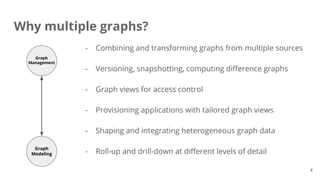
Why multiple graphs?
- Combining and transforming graphs from multiple sources
- Versioning, snapshotting, computing difference graphs
- Graph views for access control
- Provisioning applications with tailored graph views
- Shaping and integrating heterogeneous graph data
- Roll-up and drill-down at different levels of detail
Graph
Management
Graph
Modeling
4
Multiple Property Graphs Model
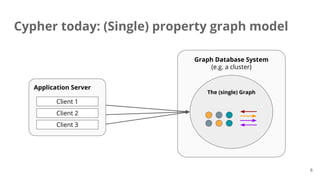
Cypher today: (Single) property graph model
Graph Database System
(e.g. a cluster)
The (single) Graph
Application Server
Client 1
Client 2
Client 3
6
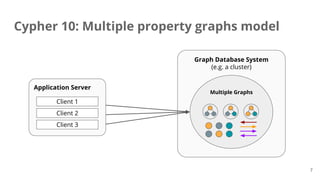
Cypher 10: Multiple property graphs model
Graph Database System
(e.g. a cluster)
Multiple Graphs
Application Server
Client 1
Client 2
Client 3
7
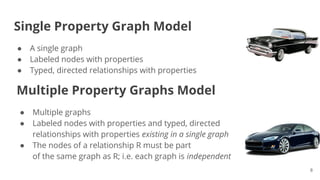
Single Property Graph Model
● A single graph
● Labeled nodes with properties
● Typed, directed relationships with properties
8
Multiple Property Graphs Model
● Multiple graphs
● Labeled nodes with properties and typed, directed
relationships with properties existing in a single graph
● The nodes of a relationship R must be part
of the same graph as R; i.e. each graph is independent
● The graph(entity) function returns the graph id of the entity
○ An entity (a node or a relationship) in Cypher 10 needs to track its graph
(to differentiate whether or not two entities are from the same graph)
○ graph(entity) is a value that uniquely identifies a graph within the
implementation
○ This is a two-way process: a graph will also be aware of the entities it contains
● The id(entity) function returns the (entity) id of entity in graph(entity)
○ id(entity) is a value that uniquely identifies an entity within its graph and types
(i.e. nodes and relationships do not share the id space)
○ The format of ids is implementation specific
○ This does not change between Cypher 9 and Cypher 10
Graph and entity ids
9
Id validity and comparability
10
Validity of ids describes the duration for which an id is not assigned to another object.
Validity of graph and entity ids are only guaranteed for the duration of a query!
Validity of entity ids is only guaranteed from the matching of an entity to the consumption of a
query result. In other words: for the duration of the query.
Validity, entity ids are guaranteed to not be re-used per graph for the duration of the query.
These are the minimal lifetime guarantees mandated by Cypher 10.
Implementations may provide extended validity guarantees as they see fit.
Comparability of ids
Graph and entity ids are suggested to be comparable values,
i.e. can be compared with <, <=, =, >=, >
Query Processing Model
Query processor
12
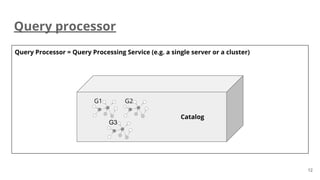
Query Processor = Query Processing Service (e.g. a single server or a cluster)
G1 G2
G3
Catalog
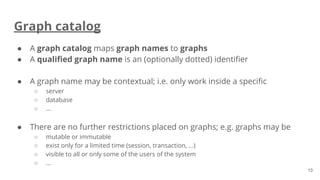
Graph catalog
● A graph catalog maps graph names to graphs
● A qualified graph name is an (optionally dotted) identifier
● A graph name may be contextual; i.e. only work inside a specific
○ server
○ database
○ ...
● There are no further restrictions placed on graphs; e.g. graphs may be
○ mutable or immutable
○ exist only for a limited time (session, transaction, ...)
○ visible to all or only some of the users of the system
○ ...
13
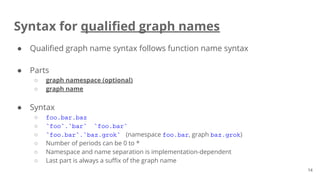
Syntax for qualified graph names
● Qualified graph name syntax follows function name syntax
● Parts
○ graph namespace (optional)
○ graph name
● Syntax
○ foo.bar.baz
○ `foo`.`bar` `foo.bar`
○ `foo.bar`.`baz.grok` (namespace foo.bar, graph baz.grok)
○ Number of periods can be 0 to *
○ Namespace and name separation is implementation-dependent
○ Last part is always a suffix of the graph name
14
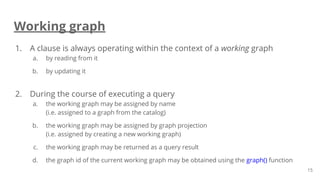
1. A clause is always operating within the context of a working graph
a. by reading from it
b. by updating it
2. During the course of executing a query
a. the working graph may be assigned by name
(i.e. assigned to a graph from the catalog)
b. the working graph may be assigned by graph projection
(i.e. assigned by creating a new working graph)
c. the working graph may be returned as a query result
d. the graph id of the current working graph may be obtained using the graph() function
Working graph
15
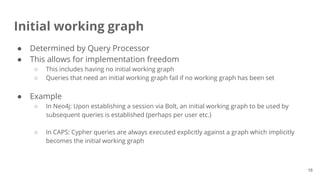
Initial working graph
● Determined by Query Processor
● This allows for implementation freedom
○ This includes having no initial working graph
○ Queries that need an initial working graph fail if no working graph has been set
● Example
○ In Neo4j: Upon establishing a session via Bolt, an initial working graph to be used by
subsequent queries is established (perhaps per user etc.)
○ In CAPS: Cypher queries are always executed explicitly against a graph which implicitly
becomes the initial working graph
16
Working graph operations
● Assign working graph by name (from catalog lookup)
○ Access multiple graphs within one query
● Assign working graph by graph projection (next section)
○ Consolidate data from one or more data sets into one graph
● Return (working) graph from query
○ Construct temporary graph via multiple update queries
(e.g. during interactive workflow)
○ Return (export) graphs (e.g. system graph)
17
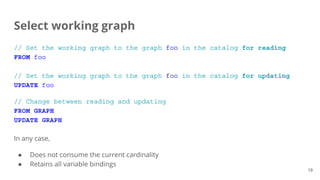
Working with multiple graphs
// Set the working graph to the graph foo in the catalog for reading
FROM foo
// Set the working graph to the graph foo in the catalog for updating
UPDATE foo
// Change between reading and updating
FROM GRAPH
UPDATE GRAPH
In any case,
● Does not consume the current cardinality
● Retains all variable bindings
Select working graph
19
Example: Reading from multiple graphs
Which friends to invite to my next dinner party?
[1] FROM social_graph
[2] MATCH (a:Person {ssn: $ssn})-[:FRIEND]-(friend)
[3] FROM salary_graph
[4] MATCH (f:Entity {ssn: friend.ssn})<-[:INCOME]-(event)
[5] WHERE $startDate < event.date < $endDate
[6] RETURN friend.name, sum(event.amount) as incomes
20
Matching with multiple graphs
FROM persons
MATCH (a:Person)
FROM cars
MATCH (b:Car)-[:OWNED_BY]->(a) // Does NOT match
Updating multiple graphs
FROM persons
MATCH (a:Person)
UPDATE cars
CREATE (b:Car)-[:OWNED_BY]->(a) // Error
Handling multiple graphs: Copy patterns
How to copy data between graphs?
FROM persons
MATCH (a:Person)
UPDATE cars
CREATE (b:Car)-[:OWNED_BY]->(x COPY OF a) // This works
● COPY OF node Copies labels, properties
● COPY OF rel Copies relationship type, properties (ignores start, end!)
Also usable in matching: MATCH (COPY OF a) ...
22
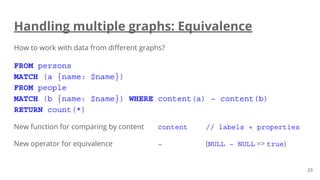
Handling multiple graphs: Equivalence
How to work with data from different graphs?
FROM persons
MATCH (a {name: $name})
FROM people
MATCH (b {name: $name}) WHERE content(a) ~ content(b)
RETURN count(*)
New function for comparing by content content // labels + properties
New operator for equivalence ~ (NULL ~ NULL => true)
23
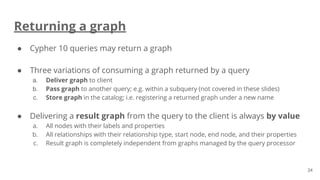
Returning a graph
● Cypher 10 queries may return a graph
● Three variations of consuming a graph returned by a query
a. Deliver graph to client
b. Pass graph to another query; e.g. within a subquery (not covered in these slides)
c. Store graph in the catalog; i.e. registering a returned graph under a new name
● Delivering a result graph from the query to the client is always by value
a. All nodes with their labels and properties
b. All relationships with their relationship type, start node, end node, and their properties
c. Result graph is completely independent from graphs managed by the query processor
24
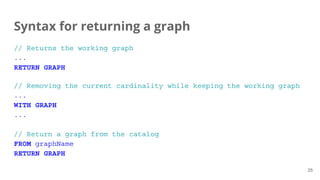
Syntax for returning a graph
// Returns the working graph
...
RETURN GRAPH
// Removing the current cardinality while keeping the working graph
...
WITH GRAPH
...
// Return a graph from the catalog
FROM graphName
RETURN GRAPH
25
Graph operations
Graph operations
● Graph construction
● Common graph union
● Disjoint graph union
Graph construction
Graph construction dynamically constructs a new working graph
● for querying, storing in the catalog, later updating
● using entities from other graphs (this is called replication in this proposal)
Simple example
MATCH (a)-[:KNOWS {from: "Berlin"}]->(b)
CONSTRUCT
MERGE (a), (b) // replication, aka "shared entities"
CREATE (a)-[:MET_IN_BERLIN]->(b)
RETURN GRAPH
Compare and contrast
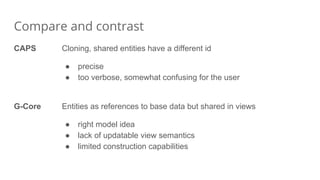
CAPS Cloning, shared entities have a different id
● precise
● too verbose, somewhat confusing for the user
G-Core Entities as references to base data but shared in views
● right model idea
● lack of updatable view semantics
● limited construction capabilities
Compare and contrast
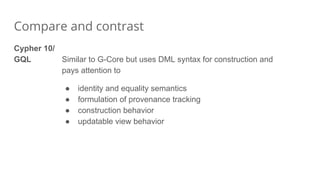
Cypher 10/
GQL Similar to G-Core but uses DML syntax for construction and
pays attention to
● identity and equality semantics
● formulation of provenance tracking
● construction behavior
● updatable view behavior
Replicating nodes
Take an original entity and create a representative replica in the constructed graph
MATCH (a)
CONSTRUCT
MERGE (a)
Replicating the same original multiple times still only creates a single replica
MATCH (root)-[:PARENT_OF*]->(child)
CONSTRUCT
MERGE (root), (child)
CREATE (root)-[:ANCESTOR_OF]->(child)
...
Replicating relationships
Replicating a relationship r implicitly replicates startNode(r)
and endNode(r)
Replication is powerful enough to reconstruct whole subgraphs!
FROM car_owners
MATCH (a:Person {city: "Berlin"})-[r:OWNERS]->(c:Car)
CONSTRUCT
MERGE r
// cars and their owners from berlin
RETURN GRAPH
Replicating paths and complex values
● Cloning a path p clones all nodes(p) and rels(p)
● More generally, cloning a value clones all contained entities!
MATCH (a:Person), (b:Person)
MATCH p = (a)-[:KNOWS*]-(b)
CONSTRUCT
MERGE a, b, p // must be variables (not any expr)!
CREATE (a)<-[:START]-(x:Path {steps: size(p)})-[:END]->(b)
RETURN GRAPH
Replicating graphs
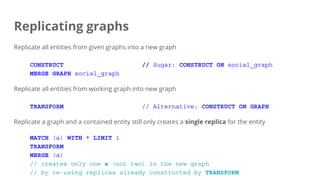
Replicate all entities from given graphs into a new graph
CONSTRUCT // Sugar: CONSTRUCT ON social_graph
MERGE GRAPH social_graph
Replicate all entities from working graph into new graph
TRANSFORM // Alternative: CONSTRUCT ON GRAPH
Replicate a graph and a contained entity still only creates a single replica for the entity
MATCH (a) WITH * LIMIT 1
TRANSFORM
MERGE (a)
// creates only one a (not two) in the new graph
// by re-using replicas already constructed by TRANSFORM
Multi-step graph construction
So far, we've only looked at one step of graph construction. What about?
[1] MATCH (a) // single node a
[2] CONSTRUCT
[3] MERGE (a) // replicate node a at most once
[4] TRANSFORM
[5] MERGE (a) // replicate node a at most once
[6] ...
There is at most one replica per original. This is achieved via provenance tracking.
It's useful for updatable views and graph union.
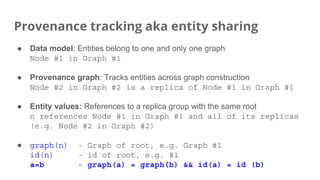
Provenance tracking aka entity sharing
● Data model: Entities belong to one and only one graph
Node #1 in Graph #1
● Provenance graph: Tracks entities across graph construction
Node #2 in Graph #2 is a replica of Node #1 in Graph #1
● Entity values: References to a replica group with the same root
n references Node #1 in Graph #1 and all of its replicas
(e.g. Node #2 in Graph #2)
● graph(n) - Graph of root, e.g. Graph #1
id(n) - id of root, e.g. #1
a=b - graph(a) = graph(b) && id(a) = id (b)
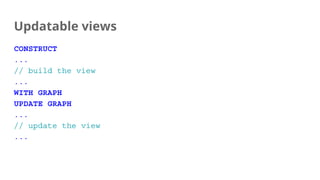
Updatable views
CONSTRUCT
...
// build the view
...
WITH GRAPH
UPDATE GRAPH
...
// update the view
...
Updates during graph construction
General rule: Maintain logical consistency regarding provenance tracking
CREATE Create in the constructed graph
MERGE Merge in the constructed graph
SET|REMOVE Not allowed on replicas
[DETACH] DELETE Delete from the constructed graph
Updates after graph construction
General rule: Only allow updates that can be propagated safely
CREATE Not allowed
MERGE
Not allowed
SET|REMOVE Update replica group
[DETACH] DELETE Update all graphs
General form of graph construction
CONSTRUCT [ON graph1, graph2, ...]|TRANSFORM
[MERGE GRAPH [name]]
[MERGE variable, pattern, ... | * ]
<updating clause 1>
<updating clause 2>
...
WITH ... | WITH GRAPH | RETURN ... | RETURN GRAPH
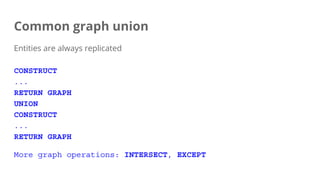
Common graph union
Entities are always replicated
CONSTRUCT
...
RETURN GRAPH
UNION
CONSTRUCT
...
RETURN GRAPH
More graph operations: INTERSECT, EXCEPT
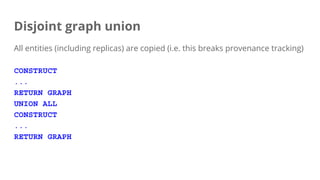
Disjoint graph union
All entities (including replicas) are copied (i.e. this breaks provenance tracking)
CONSTRUCT
...
RETURN GRAPH
UNION ALL
CONSTRUCT
...
RETURN GRAPH
Updating the catalog
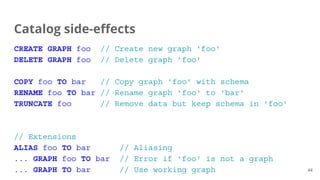
CREATE GRAPH foo // Create new graph 'foo'
DELETE GRAPH foo // Delete graph 'foo'
COPY foo TO bar // Copy graph 'foo' with schema
RENAME foo TO bar // Rename graph 'foo' to 'bar'
TRUNCATE foo // Remove data but keep schema in 'foo'
// Extensions
ALIAS foo TO bar // Aliasing
... GRAPH foo TO bar // Error if 'foo' is not a graph
... GRAPH TO bar // Use working graph
Catalog side-effects
44
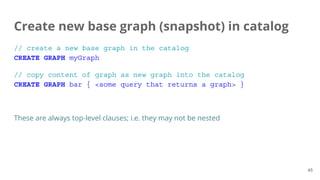
// create a new base graph in the catalog
CREATE GRAPH myGraph
// copy content of graph as new graph into the catalog
CREATE GRAPH bar { <some query that returns a graph> }
These are always top-level clauses; i.e. they may not be nested
Create new base graph (snapshot) in catalog
45
Copy data from one base graph to another
We can accomplish this by using DML and hand crafting the queries
MATCH (a)-[r]->(b)
UPDATE foo
CREATE ...
MERGE ...
SET ...
46
global graphs & view definitions
CREATE GRAPH name { ... RETURN GRAPH }
CREATE QUERY name { ... RETURN GRAPH }
CREATE QUERY name(params) {
WITH a, b
MATCH (a)-[:X]->(b)<-[:Y]-(c {name: $param})
RETURN GRAPH
}
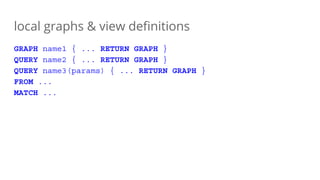
local graphs & view definitions
GRAPH name1 { ... RETURN GRAPH }
QUERY name2 { ... RETURN GRAPH }
QUERY name3(params) { ... RETURN GRAPH }
FROM ...
MATCH ...
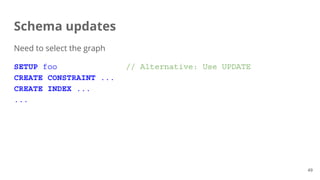
Schema updates
Need to select the graph
SETUP foo // Alternative: Use UPDATE
CREATE CONSTRAINT ...
CREATE INDEX ...
...
49
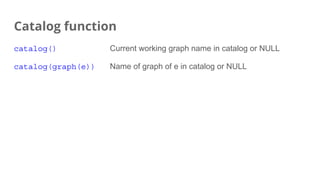
Catalog function
catalog() Current working graph name in catalog or NULL
catalog(graph(e)) Name of graph of e in catalog or NULL
Nested subqueries
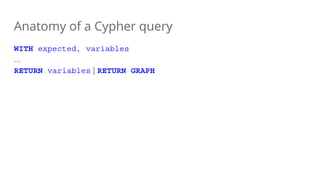
Anatomy of a Cypher query
WITH expected, variables
...
RETURN variables | RETURN GRAPH
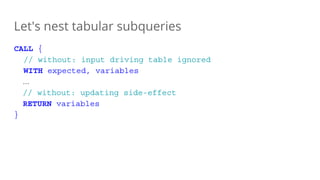
Let's nest tabular subqueries
CALL {
// without: input driving table ignored
WITH expected, variables
...
// without: updating side-effect
RETURN variables
}
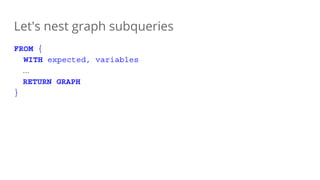
Let's nest graph subqueries
FROM {
WITH expected, variables
...
RETURN GRAPH
}
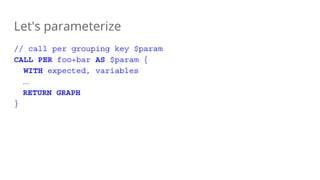
Let's parameterize
// call per grouping key $param
CALL PER foo+bar AS $param {
WITH expected, variables
...
RETURN GRAPH
}
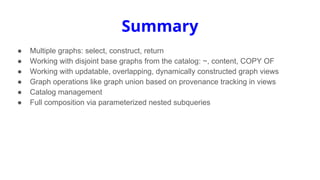
Summary
● Multiple graphs: select, construct, return
● Working with disjoint base graphs from the catalog: ~, content, COPY OF
● Working with updatable, overlapping, dynamically constructed graph views
● Graph operations like graph union based on provenance tracking in views
● Catalog management
● Full composition via parameterized nested subqueries
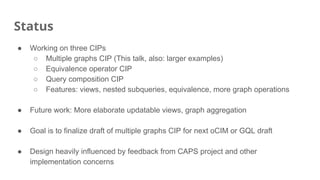
Status
● Working on three CIPs
○ Multiple graphs CIP (This talk, also: larger examples)
○ Equivalence operator CIP
○ Query composition CIP
○ Features: views, nested subqueries, equivalence, more graph operations
● Future work: More elaborate updatable views, graph aggregation
● Goal is to finalize draft of multiple graphs CIP for next oCIM or GQL draft
● Design heavily influenced by feedback from CAPS project and other
implementation concerns
Feedback
Please feedback by commenting on
● slides or
● CIP or
● openCypher implementers slack
Thanks!

Multiple Graphs: Updatable Views

  • 1.
    CIP2017-06-18 and related MultipleGraphs Updatable views & Choices Presentation at oCIM 4 on May 22-24, 2018 Stefan Plantikow, Andrés Taylor, Petra Selmer (Neo4j)
  • 2.
    History ● Started workingon multiple graphs early 2017 ● Parallel work in LDBC query language task force ● Built first non-prototype proposal for oCIM 3 in Nancy (Nov 2017) ● Lots of great feedback but outcome incomplete ● Inspired by Nancy we started to reconstruct the MG proposal ○ Starting from first principles (data model, execution model, language semantics) ○ Incrementally add orthogonal concern ○ Aim for simple, minimal design ○ Reduce scope of work ● Today: Primer for core of new proposal draft => Input to GQL
  • 3.
    Outline ● Multiple propertygraphs model ● Query processing model (Catalog and working graph) ● Working with multiple graphs (Matching, updating, returning graphs) ● Graph operations (Graph projection and graph union) ● Updating the catalog ● Examples ● Discussion (Status, timeline, next steps)
  • 4.
    Why multiple graphs? -Combining and transforming graphs from multiple sources - Versioning, snapshotting, computing difference graphs - Graph views for access control - Provisioning applications with tailored graph views - Shaping and integrating heterogeneous graph data - Roll-up and drill-down at different levels of detail Graph Management Graph Modeling 4
  • 5.
  • 6.
    Cypher today: (Single)property graph model Graph Database System (e.g. a cluster) The (single) Graph Application Server Client 1 Client 2 Client 3 6
  • 7.
    Cypher 10: Multipleproperty graphs model Graph Database System (e.g. a cluster) Multiple Graphs Application Server Client 1 Client 2 Client 3 7
  • 8.
    Single Property GraphModel ● A single graph ● Labeled nodes with properties ● Typed, directed relationships with properties 8 Multiple Property Graphs Model ● Multiple graphs ● Labeled nodes with properties and typed, directed relationships with properties existing in a single graph ● The nodes of a relationship R must be part of the same graph as R; i.e. each graph is independent
  • 9.
    ● The graph(entity)function returns the graph id of the entity ○ An entity (a node or a relationship) in Cypher 10 needs to track its graph (to differentiate whether or not two entities are from the same graph) ○ graph(entity) is a value that uniquely identifies a graph within the implementation ○ This is a two-way process: a graph will also be aware of the entities it contains ● The id(entity) function returns the (entity) id of entity in graph(entity) ○ id(entity) is a value that uniquely identifies an entity within its graph and types (i.e. nodes and relationships do not share the id space) ○ The format of ids is implementation specific ○ This does not change between Cypher 9 and Cypher 10 Graph and entity ids 9
  • 10.
    Id validity andcomparability 10 Validity of ids describes the duration for which an id is not assigned to another object. Validity of graph and entity ids are only guaranteed for the duration of a query! Validity of entity ids is only guaranteed from the matching of an entity to the consumption of a query result. In other words: for the duration of the query. Validity, entity ids are guaranteed to not be re-used per graph for the duration of the query. These are the minimal lifetime guarantees mandated by Cypher 10. Implementations may provide extended validity guarantees as they see fit. Comparability of ids Graph and entity ids are suggested to be comparable values, i.e. can be compared with <, <=, =, >=, >
  • 11.
  • 12.
    Query processor 12 Query Processor= Query Processing Service (e.g. a single server or a cluster) G1 G2 G3 Catalog
  • 13.
    Graph catalog ● Agraph catalog maps graph names to graphs ● A qualified graph name is an (optionally dotted) identifier ● A graph name may be contextual; i.e. only work inside a specific ○ server ○ database ○ ... ● There are no further restrictions placed on graphs; e.g. graphs may be ○ mutable or immutable ○ exist only for a limited time (session, transaction, ...) ○ visible to all or only some of the users of the system ○ ... 13
  • 14.
    Syntax for qualifiedgraph names ● Qualified graph name syntax follows function name syntax ● Parts ○ graph namespace (optional) ○ graph name ● Syntax ○ foo.bar.baz ○ `foo`.`bar` `foo.bar` ○ `foo.bar`.`baz.grok` (namespace foo.bar, graph baz.grok) ○ Number of periods can be 0 to * ○ Namespace and name separation is implementation-dependent ○ Last part is always a suffix of the graph name 14
  • 15.
    1. A clauseis always operating within the context of a working graph a. by reading from it b. by updating it 2. During the course of executing a query a. the working graph may be assigned by name (i.e. assigned to a graph from the catalog) b. the working graph may be assigned by graph projection (i.e. assigned by creating a new working graph) c. the working graph may be returned as a query result d. the graph id of the current working graph may be obtained using the graph() function Working graph 15
  • 16.
    Initial working graph ●Determined by Query Processor ● This allows for implementation freedom ○ This includes having no initial working graph ○ Queries that need an initial working graph fail if no working graph has been set ● Example ○ In Neo4j: Upon establishing a session via Bolt, an initial working graph to be used by subsequent queries is established (perhaps per user etc.) ○ In CAPS: Cypher queries are always executed explicitly against a graph which implicitly becomes the initial working graph 16
  • 17.
    Working graph operations ●Assign working graph by name (from catalog lookup) ○ Access multiple graphs within one query ● Assign working graph by graph projection (next section) ○ Consolidate data from one or more data sets into one graph ● Return (working) graph from query ○ Construct temporary graph via multiple update queries (e.g. during interactive workflow) ○ Return (export) graphs (e.g. system graph) 17
  • 18.
  • 19.
    // Set theworking graph to the graph foo in the catalog for reading FROM foo // Set the working graph to the graph foo in the catalog for updating UPDATE foo // Change between reading and updating FROM GRAPH UPDATE GRAPH In any case, ● Does not consume the current cardinality ● Retains all variable bindings Select working graph 19
  • 20.
    Example: Reading frommultiple graphs Which friends to invite to my next dinner party? [1] FROM social_graph [2] MATCH (a:Person {ssn: $ssn})-[:FRIEND]-(friend) [3] FROM salary_graph [4] MATCH (f:Entity {ssn: friend.ssn})<-[:INCOME]-(event) [5] WHERE $startDate < event.date < $endDate [6] RETURN friend.name, sum(event.amount) as incomes 20
  • 21.
    Matching with multiplegraphs FROM persons MATCH (a:Person) FROM cars MATCH (b:Car)-[:OWNED_BY]->(a) // Does NOT match Updating multiple graphs FROM persons MATCH (a:Person) UPDATE cars CREATE (b:Car)-[:OWNED_BY]->(a) // Error
  • 22.
    Handling multiple graphs:Copy patterns How to copy data between graphs? FROM persons MATCH (a:Person) UPDATE cars CREATE (b:Car)-[:OWNED_BY]->(x COPY OF a) // This works ● COPY OF node Copies labels, properties ● COPY OF rel Copies relationship type, properties (ignores start, end!) Also usable in matching: MATCH (COPY OF a) ... 22
  • 23.
    Handling multiple graphs:Equivalence How to work with data from different graphs? FROM persons MATCH (a {name: $name}) FROM people MATCH (b {name: $name}) WHERE content(a) ~ content(b) RETURN count(*) New function for comparing by content content // labels + properties New operator for equivalence ~ (NULL ~ NULL => true) 23
  • 24.
    Returning a graph ●Cypher 10 queries may return a graph ● Three variations of consuming a graph returned by a query a. Deliver graph to client b. Pass graph to another query; e.g. within a subquery (not covered in these slides) c. Store graph in the catalog; i.e. registering a returned graph under a new name ● Delivering a result graph from the query to the client is always by value a. All nodes with their labels and properties b. All relationships with their relationship type, start node, end node, and their properties c. Result graph is completely independent from graphs managed by the query processor 24
  • 25.
    Syntax for returninga graph // Returns the working graph ... RETURN GRAPH // Removing the current cardinality while keeping the working graph ... WITH GRAPH ... // Return a graph from the catalog FROM graphName RETURN GRAPH 25
  • 26.
  • 27.
    Graph operations ● Graphconstruction ● Common graph union ● Disjoint graph union
  • 28.
    Graph construction Graph constructiondynamically constructs a new working graph ● for querying, storing in the catalog, later updating ● using entities from other graphs (this is called replication in this proposal) Simple example MATCH (a)-[:KNOWS {from: "Berlin"}]->(b) CONSTRUCT MERGE (a), (b) // replication, aka "shared entities" CREATE (a)-[:MET_IN_BERLIN]->(b) RETURN GRAPH
  • 29.
    Compare and contrast CAPSCloning, shared entities have a different id ● precise ● too verbose, somewhat confusing for the user G-Core Entities as references to base data but shared in views ● right model idea ● lack of updatable view semantics ● limited construction capabilities
  • 30.
    Compare and contrast Cypher10/ GQL Similar to G-Core but uses DML syntax for construction and pays attention to ● identity and equality semantics ● formulation of provenance tracking ● construction behavior ● updatable view behavior
  • 31.
    Replicating nodes Take anoriginal entity and create a representative replica in the constructed graph MATCH (a) CONSTRUCT MERGE (a) Replicating the same original multiple times still only creates a single replica MATCH (root)-[:PARENT_OF*]->(child) CONSTRUCT MERGE (root), (child) CREATE (root)-[:ANCESTOR_OF]->(child) ...
  • 32.
    Replicating relationships Replicating arelationship r implicitly replicates startNode(r) and endNode(r) Replication is powerful enough to reconstruct whole subgraphs! FROM car_owners MATCH (a:Person {city: "Berlin"})-[r:OWNERS]->(c:Car) CONSTRUCT MERGE r // cars and their owners from berlin RETURN GRAPH
  • 33.
    Replicating paths andcomplex values ● Cloning a path p clones all nodes(p) and rels(p) ● More generally, cloning a value clones all contained entities! MATCH (a:Person), (b:Person) MATCH p = (a)-[:KNOWS*]-(b) CONSTRUCT MERGE a, b, p // must be variables (not any expr)! CREATE (a)<-[:START]-(x:Path {steps: size(p)})-[:END]->(b) RETURN GRAPH
  • 34.
    Replicating graphs Replicate allentities from given graphs into a new graph CONSTRUCT // Sugar: CONSTRUCT ON social_graph MERGE GRAPH social_graph Replicate all entities from working graph into new graph TRANSFORM // Alternative: CONSTRUCT ON GRAPH Replicate a graph and a contained entity still only creates a single replica for the entity MATCH (a) WITH * LIMIT 1 TRANSFORM MERGE (a) // creates only one a (not two) in the new graph // by re-using replicas already constructed by TRANSFORM
  • 35.
    Multi-step graph construction Sofar, we've only looked at one step of graph construction. What about? [1] MATCH (a) // single node a [2] CONSTRUCT [3] MERGE (a) // replicate node a at most once [4] TRANSFORM [5] MERGE (a) // replicate node a at most once [6] ... There is at most one replica per original. This is achieved via provenance tracking. It's useful for updatable views and graph union.
  • 36.
    Provenance tracking akaentity sharing ● Data model: Entities belong to one and only one graph Node #1 in Graph #1 ● Provenance graph: Tracks entities across graph construction Node #2 in Graph #2 is a replica of Node #1 in Graph #1 ● Entity values: References to a replica group with the same root n references Node #1 in Graph #1 and all of its replicas (e.g. Node #2 in Graph #2) ● graph(n) - Graph of root, e.g. Graph #1 id(n) - id of root, e.g. #1 a=b - graph(a) = graph(b) && id(a) = id (b)
  • 37.
    Updatable views CONSTRUCT ... // buildthe view ... WITH GRAPH UPDATE GRAPH ... // update the view ...
  • 38.
    Updates during graphconstruction General rule: Maintain logical consistency regarding provenance tracking CREATE Create in the constructed graph MERGE Merge in the constructed graph SET|REMOVE Not allowed on replicas [DETACH] DELETE Delete from the constructed graph
  • 39.
    Updates after graphconstruction General rule: Only allow updates that can be propagated safely CREATE Not allowed MERGE Not allowed SET|REMOVE Update replica group [DETACH] DELETE Update all graphs
  • 40.
    General form ofgraph construction CONSTRUCT [ON graph1, graph2, ...]|TRANSFORM [MERGE GRAPH [name]] [MERGE variable, pattern, ... | * ] <updating clause 1> <updating clause 2> ... WITH ... | WITH GRAPH | RETURN ... | RETURN GRAPH
  • 41.
    Common graph union Entitiesare always replicated CONSTRUCT ... RETURN GRAPH UNION CONSTRUCT ... RETURN GRAPH More graph operations: INTERSECT, EXCEPT
  • 42.
    Disjoint graph union Allentities (including replicas) are copied (i.e. this breaks provenance tracking) CONSTRUCT ... RETURN GRAPH UNION ALL CONSTRUCT ... RETURN GRAPH
  • 43.
  • 44.
    CREATE GRAPH foo// Create new graph 'foo' DELETE GRAPH foo // Delete graph 'foo' COPY foo TO bar // Copy graph 'foo' with schema RENAME foo TO bar // Rename graph 'foo' to 'bar' TRUNCATE foo // Remove data but keep schema in 'foo' // Extensions ALIAS foo TO bar // Aliasing ... GRAPH foo TO bar // Error if 'foo' is not a graph ... GRAPH TO bar // Use working graph Catalog side-effects 44
  • 45.
    // create anew base graph in the catalog CREATE GRAPH myGraph // copy content of graph as new graph into the catalog CREATE GRAPH bar { <some query that returns a graph> } These are always top-level clauses; i.e. they may not be nested Create new base graph (snapshot) in catalog 45
  • 46.
    Copy data fromone base graph to another We can accomplish this by using DML and hand crafting the queries MATCH (a)-[r]->(b) UPDATE foo CREATE ... MERGE ... SET ... 46
  • 47.
    global graphs &view definitions CREATE GRAPH name { ... RETURN GRAPH } CREATE QUERY name { ... RETURN GRAPH } CREATE QUERY name(params) { WITH a, b MATCH (a)-[:X]->(b)<-[:Y]-(c {name: $param}) RETURN GRAPH }
  • 48.
    local graphs &view definitions GRAPH name1 { ... RETURN GRAPH } QUERY name2 { ... RETURN GRAPH } QUERY name3(params) { ... RETURN GRAPH } FROM ... MATCH ...
  • 49.
    Schema updates Need toselect the graph SETUP foo // Alternative: Use UPDATE CREATE CONSTRAINT ... CREATE INDEX ... ... 49
  • 50.
    Catalog function catalog() Currentworking graph name in catalog or NULL catalog(graph(e)) Name of graph of e in catalog or NULL
  • 51.
  • 52.
    Anatomy of aCypher query WITH expected, variables ... RETURN variables | RETURN GRAPH
  • 53.
    Let's nest tabularsubqueries CALL { // without: input driving table ignored WITH expected, variables ... // without: updating side-effect RETURN variables }
  • 54.
    Let's nest graphsubqueries FROM { WITH expected, variables ... RETURN GRAPH }
  • 55.
    Let's parameterize // callper grouping key $param CALL PER foo+bar AS $param { WITH expected, variables ... RETURN GRAPH }
  • 56.
    Summary ● Multiple graphs:select, construct, return ● Working with disjoint base graphs from the catalog: ~, content, COPY OF ● Working with updatable, overlapping, dynamically constructed graph views ● Graph operations like graph union based on provenance tracking in views ● Catalog management ● Full composition via parameterized nested subqueries
  • 57.
    Status ● Working onthree CIPs ○ Multiple graphs CIP (This talk, also: larger examples) ○ Equivalence operator CIP ○ Query composition CIP ○ Features: views, nested subqueries, equivalence, more graph operations ● Future work: More elaborate updatable views, graph aggregation ● Goal is to finalize draft of multiple graphs CIP for next oCIM or GQL draft ● Design heavily influenced by feedback from CAPS project and other implementation concerns
  • 58.
    Feedback Please feedback bycommenting on ● slides or ● CIP or ● openCypher implementers slack Thanks!