


Open P2P Design:
                       background,
                    application, process
                      and an example
openp2pdesign.org
Design for Open Systems, Processes, Projects, Places.
01.
  Internet and
mass-collaboration
  (and Design)
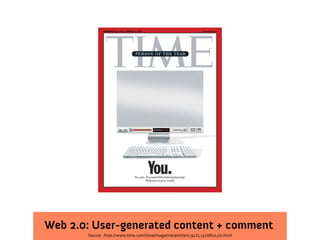
Web 2.0: User-generated content + comment
       Source: http://www.time.com/time/magazine/article/0,9171,1570810,00.html
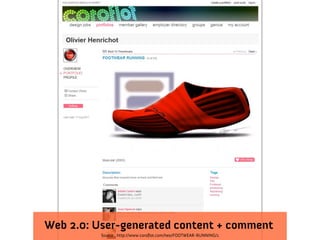
Web 2.0: User-generated content + comment
          Source: http://www.coroflot.com/heo/FOOTWEAR-RUNNING/1
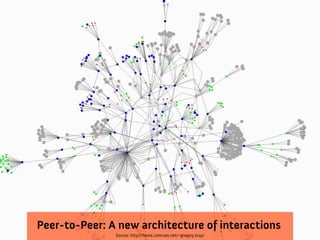
Peer-to-Peer: A new architecture of interactions
               Source: http://home.comcast.net/~gregory.bray/
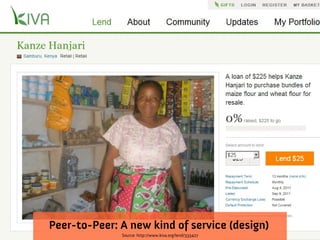
Peer-to-Peer: A new kind of service (design)
              Source: http://www.kiva.org/lend/333427
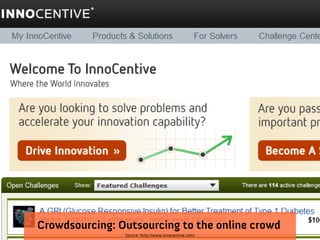
Crowdsourcing: Outsourcing to the online crowd
                Source: http://www.innocentive.com/
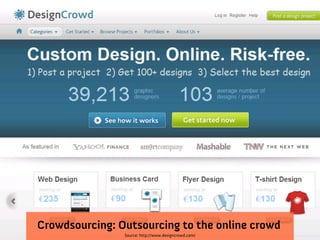
Crowdsourcing: Outsourcing to the online crowd
                Source: http://www.designcrowd.com/
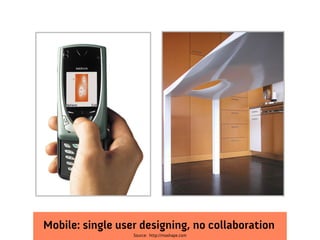
Mobile: single user designing, no collaboration
                  Source: http://mashape.com
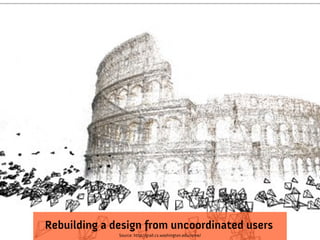
Rebuilding a design from uncoordinated users
              Source: http://grail.cs.washington.edu/rome/
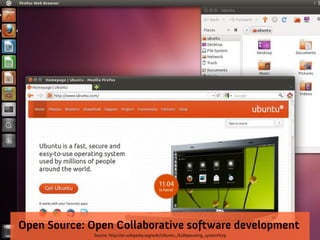
Open Source: Open Collaborative software development
              Source: http://en.wikipedia.org/wiki/Ubuntu_%28operating_system%29
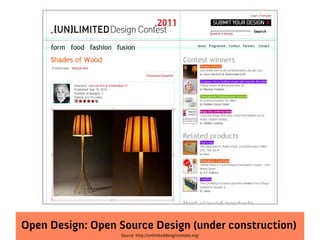
Open Design: Open Source Design (under construction)
                  Source: http://unlimiteddesigncontest.org/
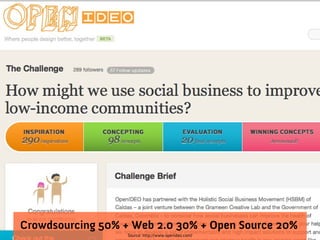
Crowdsourcing 50% + Web 2.0 30% + Open Source 20%
                   Source: http://www.openideo.com/
02.
  Open Source:
Mass collaboration
   everywhere
A (software) project published with a license that facilitates
its access + modifying + sharing in a collaborative way.


A (software) project developed collaboratively by a
community, based not on hierarchy but on reputation.


  What is Open Source (Software)? A generic definition
“Software is just the beginning … open source is doing for
    mass innovation what the assembly line did for mass
production. Get ready for the era when collaboration replaces
                        the corporation.”
                 Thomas Goetz, Wired November 2003
             http://www.wired.com/wired/archive/11.11/opensource.html


                  Open Source Everywhere...
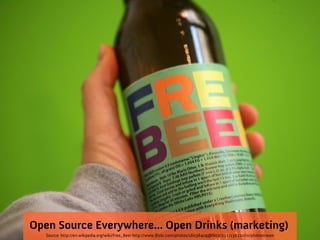
Open Source Everywhere... Open Drinks (marketing)
   Source: http://en.wikipedia.org/wiki/Free_Beer http://www.flickr.com/photos/16038409@N02/2327138220/in/photostream
Open Movies + Open Videogames with Open Software
        Source: http://www.elephantsdream.org/ http://www.bigbuckbunny.org/ http://www.sintel.org/
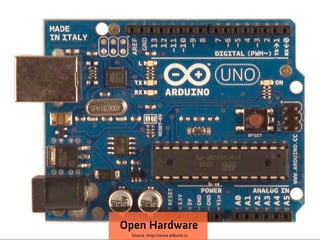
Open Hardware
 Source: http://www.arduino.cc
Open Science, Open Biotechnology
          Source: http://www.cambia.org/
Open Science, Open Biotechnology
           Source: http://www.dndi.org/
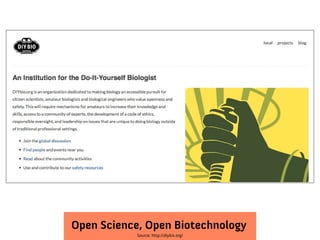
Open Science, Open Biotechnology
            Source: http://diybio.org/
03.
Open Design:
Open Projects
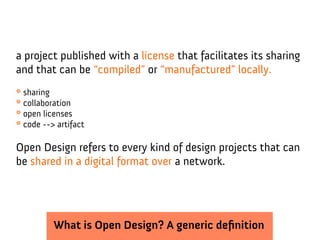
a project published with a license that facilitates its sharing
and that can be “compiled” or “manufactured” locally.
* sharing
* collaboration
* open licenses
* code --> artifact

Open Design refers to every kind of design projects that can
be shared in a digital format over a network.


          What is Open Design? A generic definition
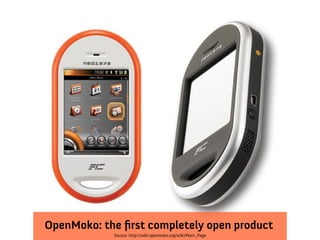
OpenMoko: the first completely open product
             Source: http://wiki.openmoko.org/wiki/Main_Page
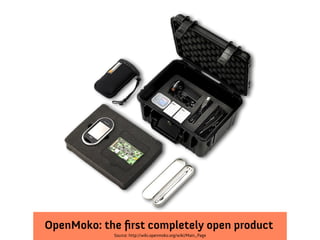
OpenMoko: the first completely open product
             Source: http://wiki.openmoko.org/wiki/Main_Page
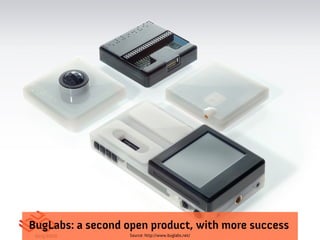
BugLabs: a second open product, with more success
                   Source: http://www.buglabs.net/
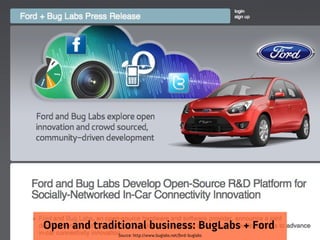
Open and traditional business: BugLabs + Ford
              Source: http://www.buglabs.net/ford-buglabs
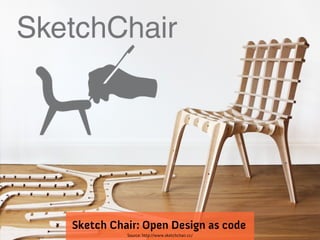
Sketch Chair: Open Design as code
          Source: http://www.sketchchair.cc/
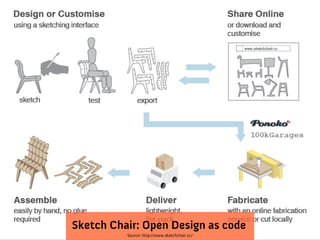
Sketch Chair: Open Design as code
          Source: http://www.sketchchair.cc/
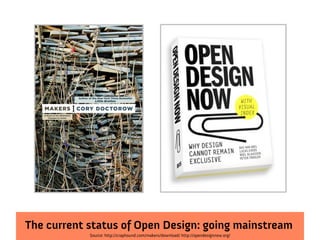
The current status of Open Design: going mainstream
            Source: http://craphound.com/makers/download/ http://opendesignnow.org/
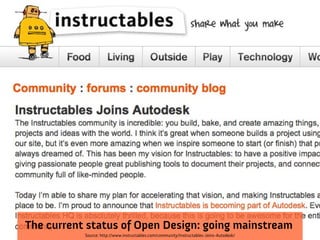
The current status of Open Design: going mainstream
           Source: http://www.instructables.com/community/Instructables-Joins-Autodesk/
* single persons or small groups design a project and then
  just publish it online
* lack of new tools, processes, systems that enable
  designers and users in developing open design projects


--> where is the collaboration?
--> where are the open processes?
--> where are the communities?


            The current status of Open Design
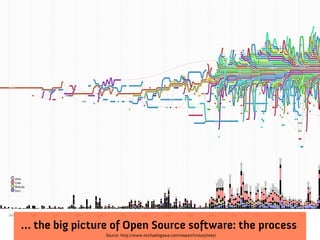
… the big picture of Open Source software: the process
                Source: http://www.michaelogawa.com/research/storylines/
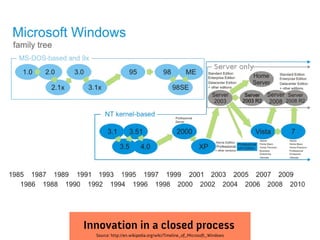
Innovation in a closed process
  Source: http://en.wikipedia.org/wiki/Timeline_of_Microsoft_Windows
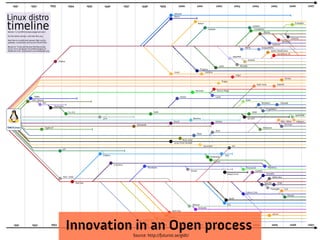
Innovation in an Open process
          Source: http://futurist.se/gldt/
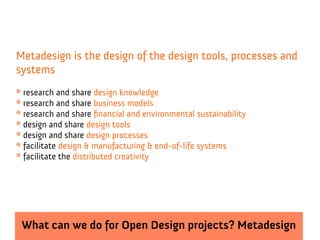
Metadesign is the design of the design tools, processes and
systems
* research and share design knowledge
* research and share business models
* research and share financial and environmental sustainability
* design and share design tools
* design and share design processes
* facilitate design & manufacturing & end-of-life systems
* facilitate the distributed creativity


 What can we do for Open Design projects? Metadesign
04.
  Open P2P Design:
metadesign of open and
    p2p systems
* March 2005, Milan (Polytechnic)
* a master degree thesis in industrial + service design

* Design researchers were studying Design+Locality:
    * Spark! Design and Locality (Europe) http://www2.uiah.fi/virtu/spark/index.html
    * Me.Design (Italy) http://www.sistemadesignitalia.it/sdi/ricerche/medesign/index.php


--> How can we design for a locality and its community?
--> How can we enable the participation of a community in
    the design process?


  Open P2P Design and openp2pdesign.org come from...
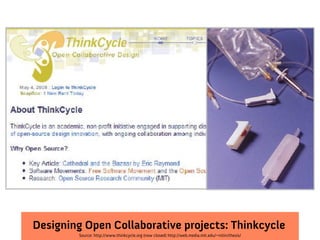
Designing Open Collaborative projects: Thinkcycle
         Source: http://www.thinkcycle.org (now closed) http://web.media.mit.edu/~nitin/thesis/
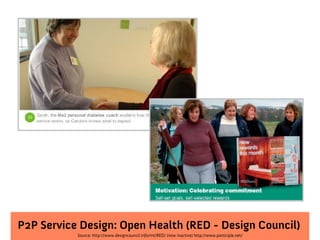
P2P Service Design: Open Health (RED - Design Council)
           Source: http://www.designcouncil.info/mt/RED/ (now inactive) http://www.participle.net/
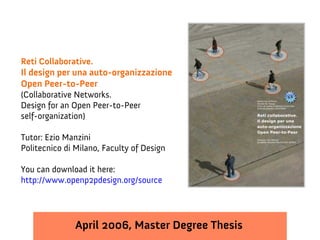
Reti Collaborative.
Il design per una auto-organizzazione
Open Peer-to-Peer
(Collaborative Networks.
Design for an Open Peer-to-Peer
self-organization)

Tutor: Ezio Manzini
Politecnico di Milano, Faculty of Design

You can download it here:
http://www.openp2pdesign.org/source


               April 2006, Master Degree Thesis
There's also a short (and updated) version
in English (and Spanish and Italian) too!

openp2pdesign.org_1.1

http://www.issuu.com/openp2pdesign
http://www.scribd.com/openp2pdesign
http://stores.lulu.com/openp2pdesign


               September 2008, a shorter book
                     Source: http://www.coroflot.com/heo/FOOTWEAR-RUNNING/1
* for community-centered projects
* for community-based services / businesses
* for projects that are distributed in a territory / locality
* for complex projects
* for participatory processes
* for open processes and projects


In Open Design, Open Innovation, Open Business, Open
Government...


         Where should we use Open P2P Design?
* mass-collaboration/crowdsourcing --> change in the role
  of designers
* being subjected to mass collaboration --> designing it
* communities generate innovations --> more opportunities
  for designers


--> designers can be enablers / facilitators of distributed
   creativity
--> designers still have more knowledge and expertise, just
   now they are part of collaborative networks
--> designers could even adopt open strategies


                 Why Open P2P Design?
Design by author -->
Design by marketing -->
User-centred Design -->
User-experience Design -->
Activity-centred Design -->
Co-Design --> …

* Researching how to design better projects for the people
 that use them


    And the Design research and practice is changing
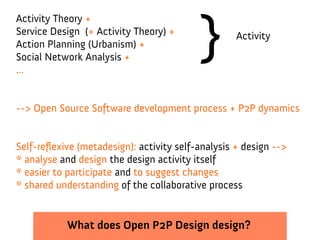
}
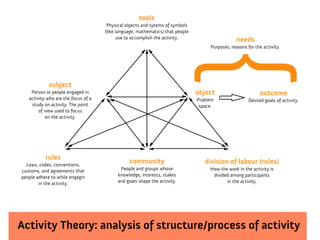
Activity Theory +
Service Design (+ Activity Theory) +                Activity
Action Planning (Urbanism) +
Social Network Analysis +
...


--> Open Source Software development process + P2P dynamics


Self-reflexive (metadesign): activity self-analysis + design -->
* analyse and design the design activity itself
* easier to participate and to suggest changes
* shared understanding of the collaborative process


            What does Open P2P Design design?
Activity Theory: analysis of structure/process of activity
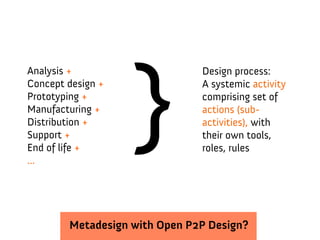
}
Analysis +                     Design process:
Concept design +               A systemic activity
Prototyping +                  comprising set of
Manufacturing +                actions (sub-
Distribution +                 activities), with
Support +                      their own tools,
End of life +                  roles, rules
...


        Metadesign with Open P2P Design?
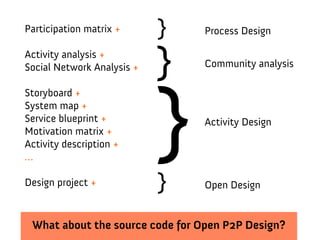
Participation matrix +      }    Process Design

Activity analysis +
Social Network Analysis +   }    Community analysis


                            }
Storyboard +
System map +
Service blueprint +              Activity Design
Motivation matrix +
Activity description +
…

Design project +            }    Open Design


 What about the source code for Open P2P Design?
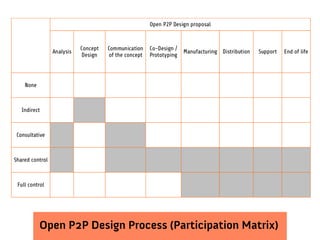
Open P2P Design Process (Participation Matrix)
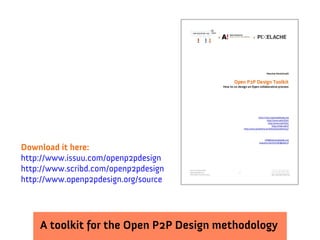
Download it here:
http://www.issuu.com/openp2pdesign
http://www.scribd.com/openp2pdesign
http://www.openp2pdesign.org/source


    A toolkit for the Open P2P Design methodology
05.
The Open P2P Design
      process
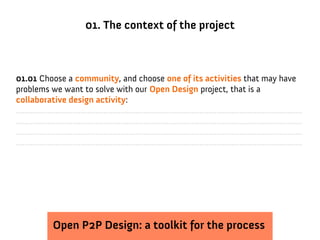
01. The context of the project


01.01 Choose a community, and choose one of its activities that may have
problems we want to solve with our Open Design project, that is a
collaborative design activity:
.........................................................................................................................................
.........................................................................................................................................
.........................................................................................................................................
.........................................................................................................................................


                 Open P2P Design: a toolkit for the process
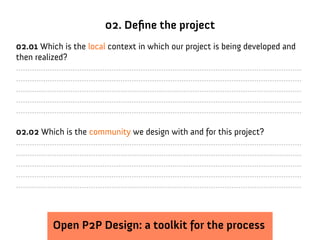
02. Define the project
02.01 Which is the local context in which our project is being developed and
then realized?
..............................................................................................................................
..............................................................................................................................
..............................................................................................................................
..............................................................................................................................
..............................................................................................................................

02.02 Which is the community we design with and for this project?
..............................................................................................................................
..............................................................................................................................
..............................................................................................................................
..............................................................................................................................
..............................................................................................................................


                Open P2P Design: a toolkit for the process
02. Define the project
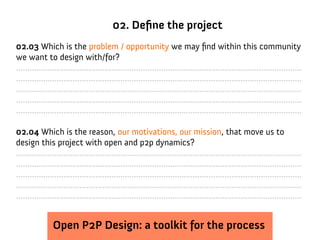
02.03 Which is the problem / opportunity we may find within this community
we want to design with/for?
..............................................................................................................................
..............................................................................................................................
..............................................................................................................................
..............................................................................................................................
..............................................................................................................................

02.04 Which is the reason, our motivations, our mission, that move us to
design this project with open and p2p dynamics?
..............................................................................................................................
..............................................................................................................................
..............................................................................................................................
..............................................................................................................................
..............................................................................................................................


                Open P2P Design: a toolkit for the process
02. Define the project
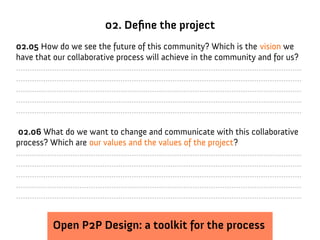
02.05 How do we see the future of this community? Which is the vision we
have that our collaborative process will achieve in the community and for us?
..............................................................................................................................
..............................................................................................................................
..............................................................................................................................
..............................................................................................................................
..............................................................................................................................

 02.06 What do we want to change and communicate with this collaborative
process? Which are our values and the values of the project?
..............................................................................................................................
..............................................................................................................................
..............................................................................................................................
..............................................................................................................................
..............................................................................................................................


                Open P2P Design: a toolkit for the process
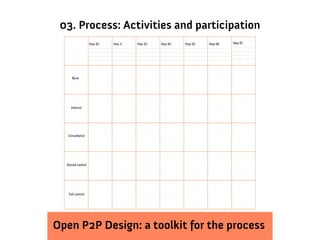
03. Process: Activities and participation


Open P2P Design: a toolkit for the process
04. Activity Analysis
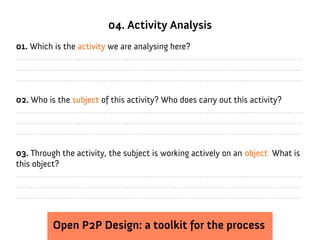
01. Which is the activity we are analysing here?
.........................................................................................................................................
.........................................................................................................................................
.........................................................................................................................................

02. Who is the subject of this activity? Who does carry out this activity?
..................................................................................................................................... ....
.........................................................................................................................................
.........................................................................................................................................

03. Through the activity, the subject is working actively on an object. What is
this object?
.........................................................................................................................................
.........................................................................................................................................
.........................................................................................................................................


                 Open P2P Design: a toolkit for the process
04. Activity Analysis
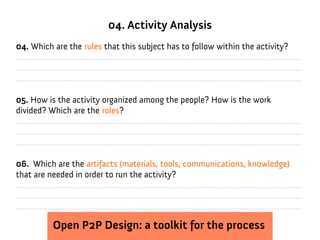
04. Which are the rules that this subject has to follow within the activity?
.........................................................................................................................................
.........................................................................................................................................
.........................................................................................................................................

05. How is the activity organized among the people? How is the work
divided? Which are the roles?
.........................................................................................................................................
.........................................................................................................................................
.........................................................................................................................................

06. Which are the artifacts (materials, tools, communications, knowledge)
that are needed in order to run the activity?
.........................................................................................................................................
.........................................................................................................................................
.........................................................................................................................................

                 Open P2P Design: a toolkit for the process
04. Activity Analysis
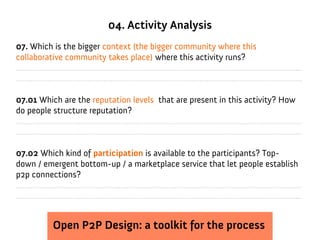
07. Which is the bigger context (the bigger community where this
collaborative community takes place) where this activity runs?
.........................................................................................................................................
.........................................................................................................................................

07.01 Which are the reputation levels that are present in this activity? How
do people structure reputation?
.........................................................................................................................................
.........................................................................................................................................

07.02 Which kind of participation is available to the participants? Top-
down / emergent bottom-up / a marketplace service that let people establish
p2p connections?
.........................................................................................................................................
.........................................................................................................................................


                 Open P2P Design: a toolkit for the process
04. Activity Analysis
08. What does the activity gets in the end? Which are the results, objectives,
outcomes the activity looks for?
.........................................................................................................................................
.........................................................................................................................................

09. Are there any contradictions (that is, sources of possible changes) within
one of the previous elements? [Primary contradictions]
.........................................................................................................................................
.........................................................................................................................................

10. Are there any contradictions (that is, sources of possible changes)
between two (or more) of the previous elements? [Secondary contradictions]
.........................................................................................................................................
.........................................................................................................................................


                 Open P2P Design: a toolkit for the process
04. Activity Analysis
11. Are there any contradictions (sources of possible changes) between the
existing results, objectives, outcomes and probably new ones, coming from
outside? [Tertiary contradictions]
.........................................................................................................................................
.........................................................................................................................................

12. Are there any contradictions (sources of possible changes) between this
activity and its neighbor activities? [Quaternary contradictions]
.........................................................................................................................................
.........................................................................................................................................

13. Which are the possible changes that these contradictions can bring?
.........................................................................................................................................
.........................................................................................................................................


                 Open P2P Design: a toolkit for the process
                                        Source: http://www.coroflot.com/heo/FOOTWEAR-RUNNING/1
05. Activity Design: Open Design Activity
01. Which is the activity we are analysing here?
.........................................................................................................................................
.........................................................................................................................................
.........................................................................................................................................

02. Who is the subject of this activity? Who does carry out this activity?
..................................................................................................................................... ....
.........................................................................................................................................
.........................................................................................................................................

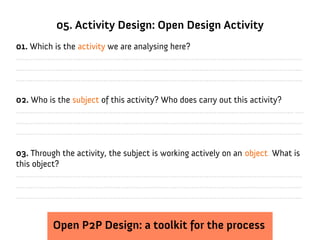
03. Through the activity, the subject is working actively on an object. What is
this object?
.........................................................................................................................................
.........................................................................................................................................
.........................................................................................................................................


                 Open P2P Design: a toolkit for the process
05. Activity Design: Open Design Activity
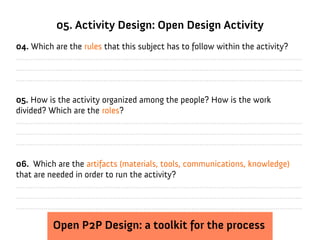
04. Which are the rules that this subject has to follow within the activity?
.........................................................................................................................................
.........................................................................................................................................
.........................................................................................................................................

05. How is the activity organized among the people? How is the work
divided? Which are the roles?
.........................................................................................................................................
.........................................................................................................................................
.........................................................................................................................................

06. Which are the artifacts (materials, tools, communications, knowledge)
that are needed in order to run the activity?
.........................................................................................................................................
.........................................................................................................................................
.........................................................................................................................................

                 Open P2P Design: a toolkit for the process
05. Activity Design: Open Design Activity
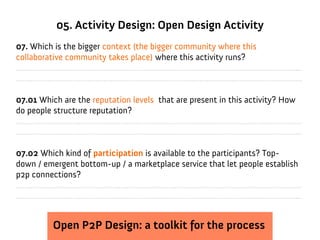
07. Which is the bigger context (the bigger community where this
collaborative community takes place) where this activity runs?
.........................................................................................................................................
.........................................................................................................................................

07.01 Which are the reputation levels that are present in this activity? How
do people structure reputation?
.........................................................................................................................................
.........................................................................................................................................

07.02 Which kind of participation is available to the participants? Top-
down / emergent bottom-up / a marketplace service that let people establish
p2p connections?
.........................................................................................................................................
.........................................................................................................................................


                 Open P2P Design: a toolkit for the process
05. Activity Design: Open Design Activity


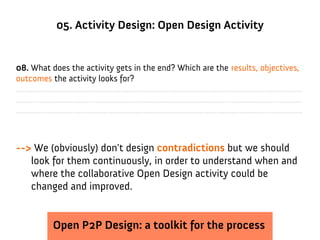
08. What does the activity gets in the end? Which are the results, objectives,
outcomes the activity looks for?
.........................................................................................................................................
.........................................................................................................................................
.........................................................................................................................................


--> We (obviously) don't design contradictions but we should
   look for them continuously, in order to understand when and
   where the collaborative Open Design activity could be
   changed and improved.


                 Open P2P Design: a toolkit for the process
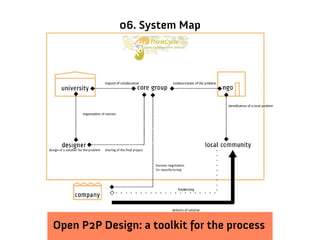
06. System Map
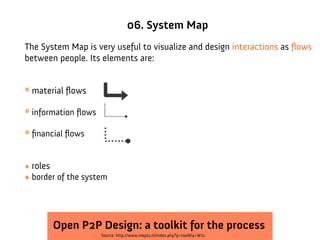
The System Map is very useful to visualize and design interactions as flows
between people. Its elements are:


* material flows

* information flows

* financial flows


+ roles
+ border of the system


        Open P2P Design: a toolkit for the process
                      Source: http://www.mepss.nl/index.php?p=tool&l4=W21
06. System Map


Open P2P Design: a toolkit for the process
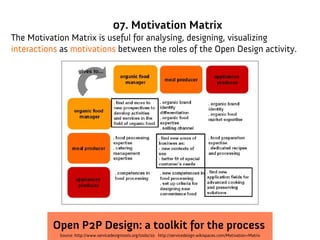
07. Motivation Matrix
The Motivation Matrix is useful for analysing, designing, visualizing
interactions as motivations between the roles of the Open Design activity.


          Open P2P Design: a toolkit for the process
            Source: http://www.servicedesigntools.org/tools/20 http://servicedesign.wikispaces.com/Motivation+Matrix
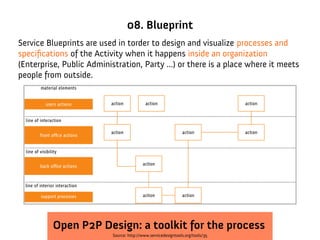
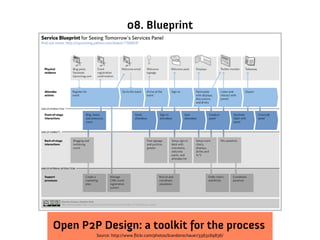
08. Blueprint
Service Blueprints are used in torder to design and visualize processes and
specifications of the Activity when it happens inside an organization
(Enterprise, Public Administration, Party ...) or there is a place where it meets
people from outside.


          Open P2P Design: a toolkit for the process
                           Source: http://www.servicedesigntools.org/tools/35
08. Blueprint


Open P2P Design: a toolkit for the process
        Source: http://www.flickr.com/photos/brandonschauer/3363169836/
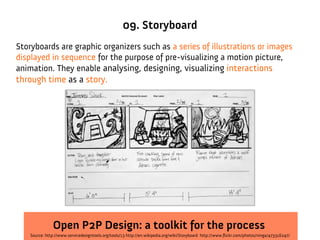
09. Storyboard
Storyboards are graphic organizers such as a series of illustrations or images
displayed in sequence for the purpose of pre-visualizing a motion picture,
animation. They enable analysing, designing, visualizing interactions
through time as a story.


               Open P2P Design: a toolkit for the process
    Source: http://www.servicedesigntools.org/tools/13 http://en.wikipedia.org/wiki/Storyboard http://www.flickr.com/photos/ninga/473316247/
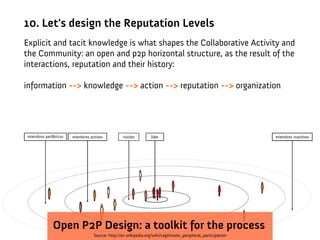
10. Let's design the Reputation Levels
Explicit and tacit knowledge is what shapes the Collaborative Activity and
the Community: an open and p2p horizontal structure, as the result of the
interactions, reputation and their history:

information --> knowledge --> action --> reputation --> organization


       Open P2P Design: a toolkit for the process
                   Source: http://en.wikipedia.org/wiki/Legitimate_peripheral_participation
11. License
In order to be able to design or to modify the project in a collaborative way,
we need a legal License that let us:
* share and distribute the project
* modify the project
* create a new project from another one

The License is
* a legal tool and a social contract that manage the results and the goals


        Open P2P Design: a toolkit for the process
            Source: http://en.wikipedia.org/wiki/Creative_commons http://en.wikipedia.org/wiki/Public_domain
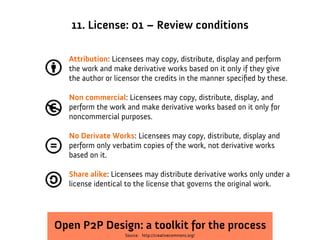
11. License: 01 – Review conditions

  Attribution: Licensees may copy, distribute, display and perform
  the work and make derivative works based on it only if they give
  the author or licensor the credits in the manner specified by these.

  Non commercial: Licensees may copy, distribute, display, and
  perform the work and make derivative works based on it only for
  noncommercial purposes.

  No Derivate Works: Licensees may copy, distribute, display and
  perform only verbatim copies of the work, not derivative works
  based on it.

  Share alike: Licensees may distribute derivative works only under a
  license identical to the license that governs the original work.


Open P2P Design: a toolkit for the process
                   Source: http://creativecommons.org/
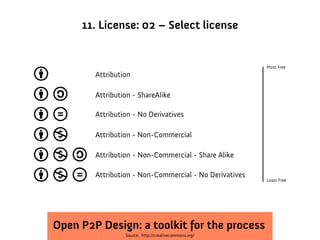
11. License: 02 – Select license


Open P2P Design: a toolkit for the process
              Source: http://creativecommons.org/
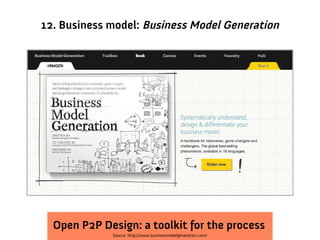
12. Business model: Business Model Generation


  Open P2P Design: a toolkit for the process
             Source: http://www.businessmodelgeneration.com/
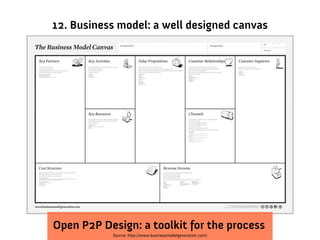
12. Business model: a well designed canvas


Open P2P Design: a toolkit for the process
           Source: http://www.businessmodelgeneration.com/
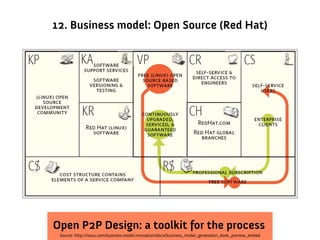
12. Business model: Open Source (Red Hat)


Open P2P Design: a toolkit for the process
 Source: http://issuu.com/business.model.innovation/docs/business_model_generation_book_preview_embed
06.
Open P2P Design:
  An example
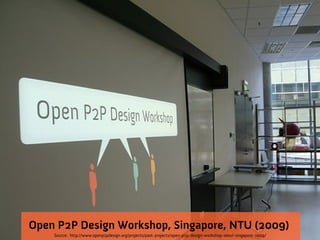
Open P2P Design Workshop, Singapore, NTU (2009)
    Source: http://www.openp2pdesign.org/projects/past-projects/open-p2p-design-workshop-seoul-singapore-2009/
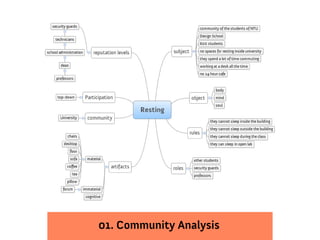
01. Community Analysis
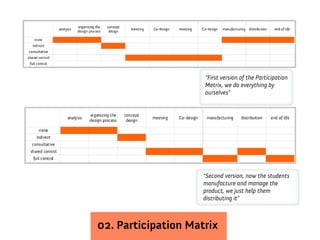
“First version of the Participation
                     Matrix, we do everything by
                     ourselves”


                     “Second version, now the students
                     manufacture and manage the
                     product, we just help them
                     distributing it”


02. Participation Matrix
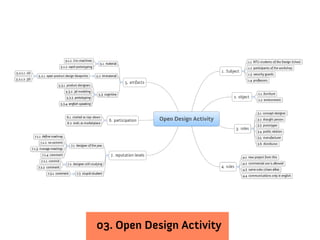
03. Open Design Activity
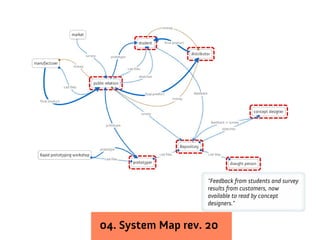
“Feedback from students and survey
                    results from customers, now
                    available to read by concept
                    designers.”


04. System Map rev. 20
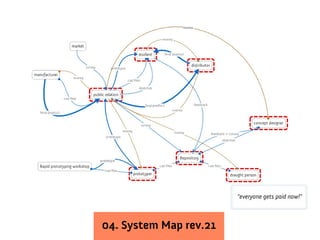
“everyone gets paid now!”


04. System Map rev.21
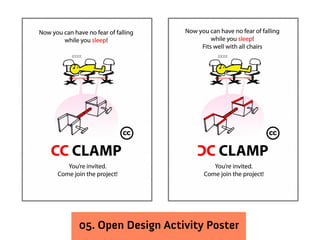
05. Open Design Activity Poster
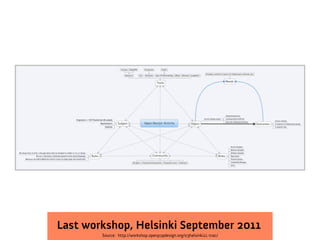
Last workshop, Helsinki September 2011
        Source: http://workshop.openp2pdesign.org/03helsinki11-trac/
Thank you!

info@openp2pdesign.org
   openp2pdesign.org
    @openp2pdesign

Open P2P Design

  • 1.
    Open P2P Design: background, application, process and an example openp2pdesign.org Design for Open Systems, Processes, Projects, Places.
  • 2.
    01. Internetand mass-collaboration (and Design)
  • 3.
    Web 2.0: User-generatedcontent + comment Source: http://www.time.com/time/magazine/article/0,9171,1570810,00.html
  • 4.
    Web 2.0: User-generatedcontent + comment Source: http://www.coroflot.com/heo/FOOTWEAR-RUNNING/1
  • 5.
    Peer-to-Peer: A newarchitecture of interactions Source: http://home.comcast.net/~gregory.bray/
  • 6.
    Peer-to-Peer: A newkind of service (design) Source: http://www.kiva.org/lend/333427
  • 7.
    Crowdsourcing: Outsourcing tothe online crowd Source: http://www.innocentive.com/
  • 8.
    Crowdsourcing: Outsourcing tothe online crowd Source: http://www.designcrowd.com/
  • 9.
    Mobile: single userdesigning, no collaboration Source: http://mashape.com
  • 10.
    Rebuilding a designfrom uncoordinated users Source: http://grail.cs.washington.edu/rome/
  • 11.
    Open Source: OpenCollaborative software development Source: http://en.wikipedia.org/wiki/Ubuntu_%28operating_system%29
  • 12.
    Open Design: OpenSource Design (under construction) Source: http://unlimiteddesigncontest.org/
  • 13.
    Crowdsourcing 50% +Web 2.0 30% + Open Source 20% Source: http://www.openideo.com/
  • 14.
    02. OpenSource: Mass collaboration everywhere
  • 15.
    A (software) projectpublished with a license that facilitates its access + modifying + sharing in a collaborative way. A (software) project developed collaboratively by a community, based not on hierarchy but on reputation. What is Open Source (Software)? A generic definition
  • 16.
    “Software is justthe beginning … open source is doing for mass innovation what the assembly line did for mass production. Get ready for the era when collaboration replaces the corporation.” Thomas Goetz, Wired November 2003 http://www.wired.com/wired/archive/11.11/opensource.html Open Source Everywhere...
  • 17.
    Open Source Everywhere...Open Drinks (marketing) Source: http://en.wikipedia.org/wiki/Free_Beer http://www.flickr.com/photos/16038409@N02/2327138220/in/photostream
  • 18.
    Open Movies +Open Videogames with Open Software Source: http://www.elephantsdream.org/ http://www.bigbuckbunny.org/ http://www.sintel.org/
  • 19.
    Open Hardware Source:http://www.arduino.cc
  • 20.
    Open Science, OpenBiotechnology Source: http://www.cambia.org/
  • 21.
    Open Science, OpenBiotechnology Source: http://www.dndi.org/
  • 22.
    Open Science, OpenBiotechnology Source: http://diybio.org/
  • 23.
  • 24.
    a project publishedwith a license that facilitates its sharing and that can be “compiled” or “manufactured” locally. * sharing * collaboration * open licenses * code --> artifact Open Design refers to every kind of design projects that can be shared in a digital format over a network. What is Open Design? A generic definition
  • 25.
    OpenMoko: the firstcompletely open product Source: http://wiki.openmoko.org/wiki/Main_Page
  • 26.
    OpenMoko: the firstcompletely open product Source: http://wiki.openmoko.org/wiki/Main_Page
  • 27.
    BugLabs: a secondopen product, with more success Source: http://www.buglabs.net/
  • 28.
    Open and traditionalbusiness: BugLabs + Ford Source: http://www.buglabs.net/ford-buglabs
  • 29.
    Sketch Chair: OpenDesign as code Source: http://www.sketchchair.cc/
  • 30.
    Sketch Chair: OpenDesign as code Source: http://www.sketchchair.cc/
  • 31.
    The current statusof Open Design: going mainstream Source: http://craphound.com/makers/download/ http://opendesignnow.org/
  • 32.
    The current statusof Open Design: going mainstream Source: http://www.instructables.com/community/Instructables-Joins-Autodesk/
  • 33.
    * single personsor small groups design a project and then just publish it online * lack of new tools, processes, systems that enable designers and users in developing open design projects --> where is the collaboration? --> where are the open processes? --> where are the communities? The current status of Open Design
  • 34.
    … the bigpicture of Open Source software: the process Source: http://www.michaelogawa.com/research/storylines/
  • 35.
    Innovation in aclosed process Source: http://en.wikipedia.org/wiki/Timeline_of_Microsoft_Windows
  • 36.
    Innovation in anOpen process Source: http://futurist.se/gldt/
  • 37.
    Metadesign is thedesign of the design tools, processes and systems * research and share design knowledge * research and share business models * research and share financial and environmental sustainability * design and share design tools * design and share design processes * facilitate design & manufacturing & end-of-life systems * facilitate the distributed creativity What can we do for Open Design projects? Metadesign
  • 38.
    04. OpenP2P Design: metadesign of open and p2p systems
  • 39.
    * March 2005,Milan (Polytechnic) * a master degree thesis in industrial + service design * Design researchers were studying Design+Locality: * Spark! Design and Locality (Europe) http://www2.uiah.fi/virtu/spark/index.html * Me.Design (Italy) http://www.sistemadesignitalia.it/sdi/ricerche/medesign/index.php --> How can we design for a locality and its community? --> How can we enable the participation of a community in the design process? Open P2P Design and openp2pdesign.org come from...
  • 40.
    Designing Open Collaborativeprojects: Thinkcycle Source: http://www.thinkcycle.org (now closed) http://web.media.mit.edu/~nitin/thesis/
  • 41.
    P2P Service Design:Open Health (RED - Design Council) Source: http://www.designcouncil.info/mt/RED/ (now inactive) http://www.participle.net/
  • 42.
    Reti Collaborative. Il designper una auto-organizzazione Open Peer-to-Peer (Collaborative Networks. Design for an Open Peer-to-Peer self-organization) Tutor: Ezio Manzini Politecnico di Milano, Faculty of Design You can download it here: http://www.openp2pdesign.org/source April 2006, Master Degree Thesis
  • 43.
    There's also ashort (and updated) version in English (and Spanish and Italian) too! openp2pdesign.org_1.1 http://www.issuu.com/openp2pdesign http://www.scribd.com/openp2pdesign http://stores.lulu.com/openp2pdesign September 2008, a shorter book Source: http://www.coroflot.com/heo/FOOTWEAR-RUNNING/1
  • 44.
    * for community-centeredprojects * for community-based services / businesses * for projects that are distributed in a territory / locality * for complex projects * for participatory processes * for open processes and projects In Open Design, Open Innovation, Open Business, Open Government... Where should we use Open P2P Design?
  • 45.
    * mass-collaboration/crowdsourcing -->change in the role of designers * being subjected to mass collaboration --> designing it * communities generate innovations --> more opportunities for designers --> designers can be enablers / facilitators of distributed creativity --> designers still have more knowledge and expertise, just now they are part of collaborative networks --> designers could even adopt open strategies Why Open P2P Design?
  • 46.
    Design by author--> Design by marketing --> User-centred Design --> User-experience Design --> Activity-centred Design --> Co-Design --> … * Researching how to design better projects for the people that use them And the Design research and practice is changing
  • 47.
    } Activity Theory + ServiceDesign (+ Activity Theory) + Activity Action Planning (Urbanism) + Social Network Analysis + ... --> Open Source Software development process + P2P dynamics Self-reflexive (metadesign): activity self-analysis + design --> * analyse and design the design activity itself * easier to participate and to suggest changes * shared understanding of the collaborative process What does Open P2P Design design?
  • 48.
    Activity Theory: analysisof structure/process of activity
  • 49.
    } Analysis + Design process: Concept design + A systemic activity Prototyping + comprising set of Manufacturing + actions (sub- Distribution + activities), with Support + their own tools, End of life + roles, rules ... Metadesign with Open P2P Design?
  • 50.
    Participation matrix + } Process Design Activity analysis + Social Network Analysis + } Community analysis } Storyboard + System map + Service blueprint + Activity Design Motivation matrix + Activity description + … Design project + } Open Design What about the source code for Open P2P Design?
  • 51.
    Open P2P DesignProcess (Participation Matrix)
  • 52.
  • 53.
    05. The Open P2PDesign process
  • 54.
    01. The contextof the project 01.01 Choose a community, and choose one of its activities that may have problems we want to solve with our Open Design project, that is a collaborative design activity: ......................................................................................................................................... ......................................................................................................................................... ......................................................................................................................................... ......................................................................................................................................... Open P2P Design: a toolkit for the process
  • 55.
    02. Define theproject 02.01 Which is the local context in which our project is being developed and then realized? .............................................................................................................................. .............................................................................................................................. .............................................................................................................................. .............................................................................................................................. .............................................................................................................................. 02.02 Which is the community we design with and for this project? .............................................................................................................................. .............................................................................................................................. .............................................................................................................................. .............................................................................................................................. .............................................................................................................................. Open P2P Design: a toolkit for the process
  • 56.
    02. Define theproject 02.03 Which is the problem / opportunity we may find within this community we want to design with/for? .............................................................................................................................. .............................................................................................................................. .............................................................................................................................. .............................................................................................................................. .............................................................................................................................. 02.04 Which is the reason, our motivations, our mission, that move us to design this project with open and p2p dynamics? .............................................................................................................................. .............................................................................................................................. .............................................................................................................................. .............................................................................................................................. .............................................................................................................................. Open P2P Design: a toolkit for the process
  • 57.
    02. Define theproject 02.05 How do we see the future of this community? Which is the vision we have that our collaborative process will achieve in the community and for us? .............................................................................................................................. .............................................................................................................................. .............................................................................................................................. .............................................................................................................................. .............................................................................................................................. 02.06 What do we want to change and communicate with this collaborative process? Which are our values and the values of the project? .............................................................................................................................. .............................................................................................................................. .............................................................................................................................. .............................................................................................................................. .............................................................................................................................. Open P2P Design: a toolkit for the process
  • 58.
    03. Process: Activitiesand participation Open P2P Design: a toolkit for the process
  • 59.
    04. Activity Analysis 01.Which is the activity we are analysing here? ......................................................................................................................................... ......................................................................................................................................... ......................................................................................................................................... 02. Who is the subject of this activity? Who does carry out this activity? ..................................................................................................................................... .... ......................................................................................................................................... ......................................................................................................................................... 03. Through the activity, the subject is working actively on an object. What is this object? ......................................................................................................................................... ......................................................................................................................................... ......................................................................................................................................... Open P2P Design: a toolkit for the process
  • 60.
    04. Activity Analysis 04.Which are the rules that this subject has to follow within the activity? ......................................................................................................................................... ......................................................................................................................................... ......................................................................................................................................... 05. How is the activity organized among the people? How is the work divided? Which are the roles? ......................................................................................................................................... ......................................................................................................................................... ......................................................................................................................................... 06. Which are the artifacts (materials, tools, communications, knowledge) that are needed in order to run the activity? ......................................................................................................................................... ......................................................................................................................................... ......................................................................................................................................... Open P2P Design: a toolkit for the process
  • 61.
    04. Activity Analysis 07.Which is the bigger context (the bigger community where this collaborative community takes place) where this activity runs? ......................................................................................................................................... ......................................................................................................................................... 07.01 Which are the reputation levels that are present in this activity? How do people structure reputation? ......................................................................................................................................... ......................................................................................................................................... 07.02 Which kind of participation is available to the participants? Top- down / emergent bottom-up / a marketplace service that let people establish p2p connections? ......................................................................................................................................... ......................................................................................................................................... Open P2P Design: a toolkit for the process
  • 62.
    04. Activity Analysis 08.What does the activity gets in the end? Which are the results, objectives, outcomes the activity looks for? ......................................................................................................................................... ......................................................................................................................................... 09. Are there any contradictions (that is, sources of possible changes) within one of the previous elements? [Primary contradictions] ......................................................................................................................................... ......................................................................................................................................... 10. Are there any contradictions (that is, sources of possible changes) between two (or more) of the previous elements? [Secondary contradictions] ......................................................................................................................................... ......................................................................................................................................... Open P2P Design: a toolkit for the process
  • 63.
    04. Activity Analysis 11.Are there any contradictions (sources of possible changes) between the existing results, objectives, outcomes and probably new ones, coming from outside? [Tertiary contradictions] ......................................................................................................................................... ......................................................................................................................................... 12. Are there any contradictions (sources of possible changes) between this activity and its neighbor activities? [Quaternary contradictions] ......................................................................................................................................... ......................................................................................................................................... 13. Which are the possible changes that these contradictions can bring? ......................................................................................................................................... ......................................................................................................................................... Open P2P Design: a toolkit for the process Source: http://www.coroflot.com/heo/FOOTWEAR-RUNNING/1
  • 64.
    05. Activity Design:Open Design Activity 01. Which is the activity we are analysing here? ......................................................................................................................................... ......................................................................................................................................... ......................................................................................................................................... 02. Who is the subject of this activity? Who does carry out this activity? ..................................................................................................................................... .... ......................................................................................................................................... ......................................................................................................................................... 03. Through the activity, the subject is working actively on an object. What is this object? ......................................................................................................................................... ......................................................................................................................................... ......................................................................................................................................... Open P2P Design: a toolkit for the process
  • 65.
    05. Activity Design:Open Design Activity 04. Which are the rules that this subject has to follow within the activity? ......................................................................................................................................... ......................................................................................................................................... ......................................................................................................................................... 05. How is the activity organized among the people? How is the work divided? Which are the roles? ......................................................................................................................................... ......................................................................................................................................... ......................................................................................................................................... 06. Which are the artifacts (materials, tools, communications, knowledge) that are needed in order to run the activity? ......................................................................................................................................... ......................................................................................................................................... ......................................................................................................................................... Open P2P Design: a toolkit for the process
  • 66.
    05. Activity Design:Open Design Activity 07. Which is the bigger context (the bigger community where this collaborative community takes place) where this activity runs? ......................................................................................................................................... ......................................................................................................................................... 07.01 Which are the reputation levels that are present in this activity? How do people structure reputation? ......................................................................................................................................... ......................................................................................................................................... 07.02 Which kind of participation is available to the participants? Top- down / emergent bottom-up / a marketplace service that let people establish p2p connections? ......................................................................................................................................... ......................................................................................................................................... Open P2P Design: a toolkit for the process
  • 67.
    05. Activity Design:Open Design Activity 08. What does the activity gets in the end? Which are the results, objectives, outcomes the activity looks for? ......................................................................................................................................... ......................................................................................................................................... ......................................................................................................................................... --> We (obviously) don't design contradictions but we should look for them continuously, in order to understand when and where the collaborative Open Design activity could be changed and improved. Open P2P Design: a toolkit for the process
  • 68.
    06. System Map TheSystem Map is very useful to visualize and design interactions as flows between people. Its elements are: * material flows * information flows * financial flows + roles + border of the system Open P2P Design: a toolkit for the process Source: http://www.mepss.nl/index.php?p=tool&l4=W21
  • 69.
    06. System Map OpenP2P Design: a toolkit for the process
  • 70.
    07. Motivation Matrix TheMotivation Matrix is useful for analysing, designing, visualizing interactions as motivations between the roles of the Open Design activity. Open P2P Design: a toolkit for the process Source: http://www.servicedesigntools.org/tools/20 http://servicedesign.wikispaces.com/Motivation+Matrix
  • 71.
    08. Blueprint Service Blueprintsare used in torder to design and visualize processes and specifications of the Activity when it happens inside an organization (Enterprise, Public Administration, Party ...) or there is a place where it meets people from outside. Open P2P Design: a toolkit for the process Source: http://www.servicedesigntools.org/tools/35
  • 72.
    08. Blueprint Open P2PDesign: a toolkit for the process Source: http://www.flickr.com/photos/brandonschauer/3363169836/
  • 73.
    09. Storyboard Storyboards aregraphic organizers such as a series of illustrations or images displayed in sequence for the purpose of pre-visualizing a motion picture, animation. They enable analysing, designing, visualizing interactions through time as a story. Open P2P Design: a toolkit for the process Source: http://www.servicedesigntools.org/tools/13 http://en.wikipedia.org/wiki/Storyboard http://www.flickr.com/photos/ninga/473316247/
  • 74.
    10. Let's designthe Reputation Levels Explicit and tacit knowledge is what shapes the Collaborative Activity and the Community: an open and p2p horizontal structure, as the result of the interactions, reputation and their history: information --> knowledge --> action --> reputation --> organization Open P2P Design: a toolkit for the process Source: http://en.wikipedia.org/wiki/Legitimate_peripheral_participation
  • 75.
    11. License In orderto be able to design or to modify the project in a collaborative way, we need a legal License that let us: * share and distribute the project * modify the project * create a new project from another one The License is * a legal tool and a social contract that manage the results and the goals Open P2P Design: a toolkit for the process Source: http://en.wikipedia.org/wiki/Creative_commons http://en.wikipedia.org/wiki/Public_domain
  • 76.
    11. License: 01– Review conditions Attribution: Licensees may copy, distribute, display and perform the work and make derivative works based on it only if they give the author or licensor the credits in the manner specified by these. Non commercial: Licensees may copy, distribute, display, and perform the work and make derivative works based on it only for noncommercial purposes. No Derivate Works: Licensees may copy, distribute, display and perform only verbatim copies of the work, not derivative works based on it. Share alike: Licensees may distribute derivative works only under a license identical to the license that governs the original work. Open P2P Design: a toolkit for the process Source: http://creativecommons.org/
  • 77.
    11. License: 02– Select license Open P2P Design: a toolkit for the process Source: http://creativecommons.org/
  • 78.
    12. Business model:Business Model Generation Open P2P Design: a toolkit for the process Source: http://www.businessmodelgeneration.com/
  • 79.
    12. Business model:a well designed canvas Open P2P Design: a toolkit for the process Source: http://www.businessmodelgeneration.com/
  • 80.
    12. Business model:Open Source (Red Hat) Open P2P Design: a toolkit for the process Source: http://issuu.com/business.model.innovation/docs/business_model_generation_book_preview_embed
  • 81.
  • 82.
    Open P2P DesignWorkshop, Singapore, NTU (2009) Source: http://www.openp2pdesign.org/projects/past-projects/open-p2p-design-workshop-seoul-singapore-2009/
  • 83.
  • 84.
    “First version ofthe Participation Matrix, we do everything by ourselves” “Second version, now the students manufacture and manage the product, we just help them distributing it” 02. Participation Matrix
  • 85.
  • 86.
    “Feedback from studentsand survey results from customers, now available to read by concept designers.” 04. System Map rev. 20
  • 87.
    “everyone gets paidnow!” 04. System Map rev.21
  • 88.
    05. Open DesignActivity Poster
  • 89.
    Last workshop, HelsinkiSeptember 2011 Source: http://workshop.openp2pdesign.org/03helsinki11-trac/
  • 90.
    Thank you! info@openp2pdesign.org openp2pdesign.org @openp2pdesign