THE DECENTRALIZATION TURNS IN
DESIGN:
AN EXPLORATION THROUGH THE
MAKER MOVEMENT
RMIT University
Aalto University
massimo.menichinelli@rmit.edu.au
massimo.menichinelli@aalto.fi
Massimo
Menichinelli
University of Illinois at Urbana
Champaign - Illinois Informatics
Institute
pf4@illinois.edu
Priscilla
Ferronato
1. INTRODUCTION
FOCUS + GOALS
FOCUS:
Evolution of Science by shifting the center:
● Paradigms: epoch-making shifts that bring
revolutions (Kuhn, T.S 1962)
● Turns: parallel and overlapping smaller-scale
changes (Marttila, S., Botero, A. 2013)
GOALS:
● To trace a timeline of turns in the design
research and practice
● To identify and explain a new set of turns
taking place in Design practice
RESEARCH QUESTION:
What are the decentralizations that have been
emerging in the design research and practice,
and how they can possibly characterize new
turns in Design?
METHOD:
Literature review of publications and cases.
RESEARCH QUESTION + METHOD
2. A REVIEW OF
PARADIGMS AND TURNS
IN DESIGN
PARADIGMS
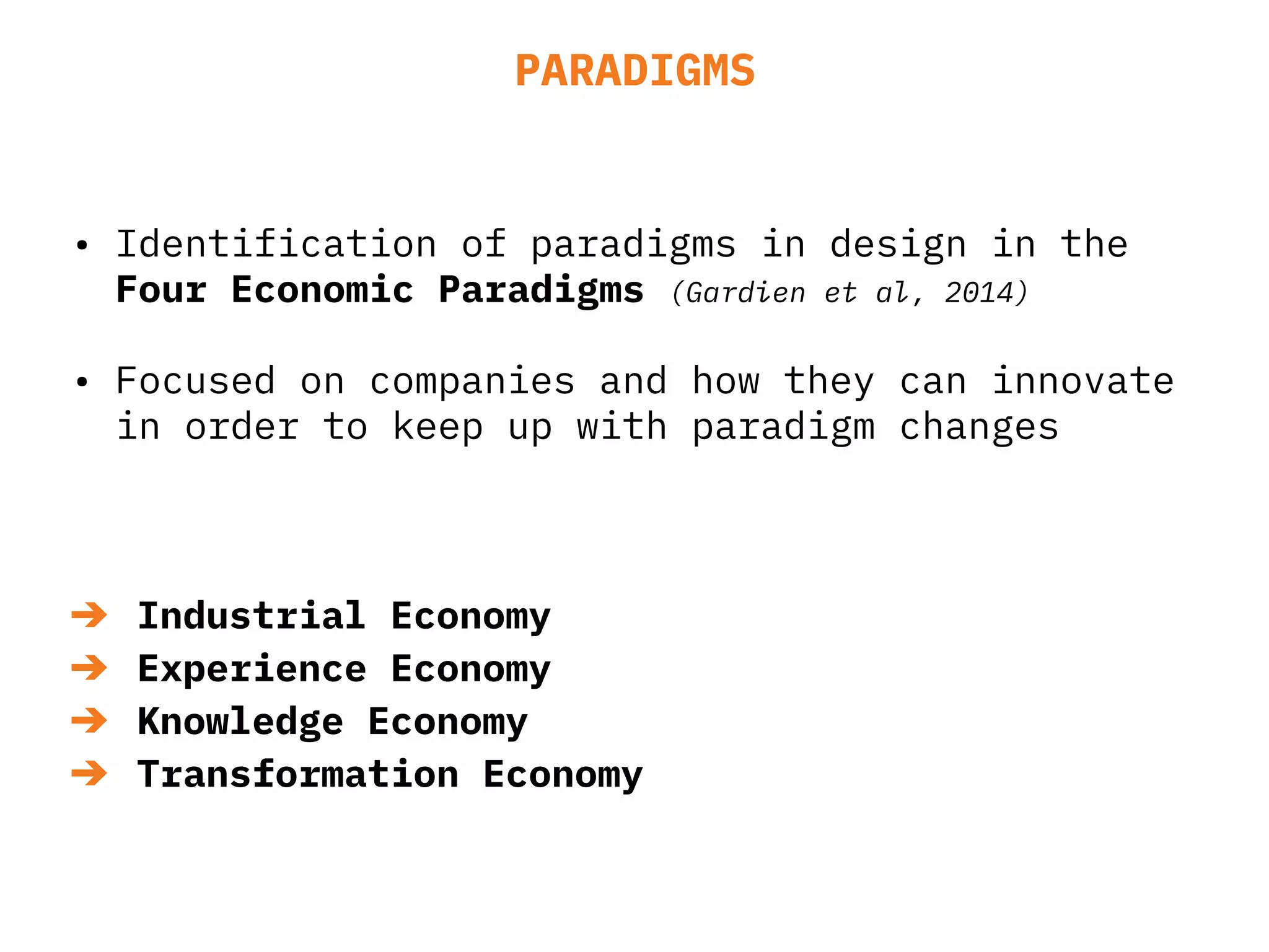
• Identification of paradigms in design in the
Four Economic Paradigms (Gardien et al, 2014)
• Focused on companies and how they can innovate
in order to keep up with paradigm changes
➔ Industrial Economy
➔ Experience Economy
➔ Knowledge Economy
➔ Transformation Economy
TURNS
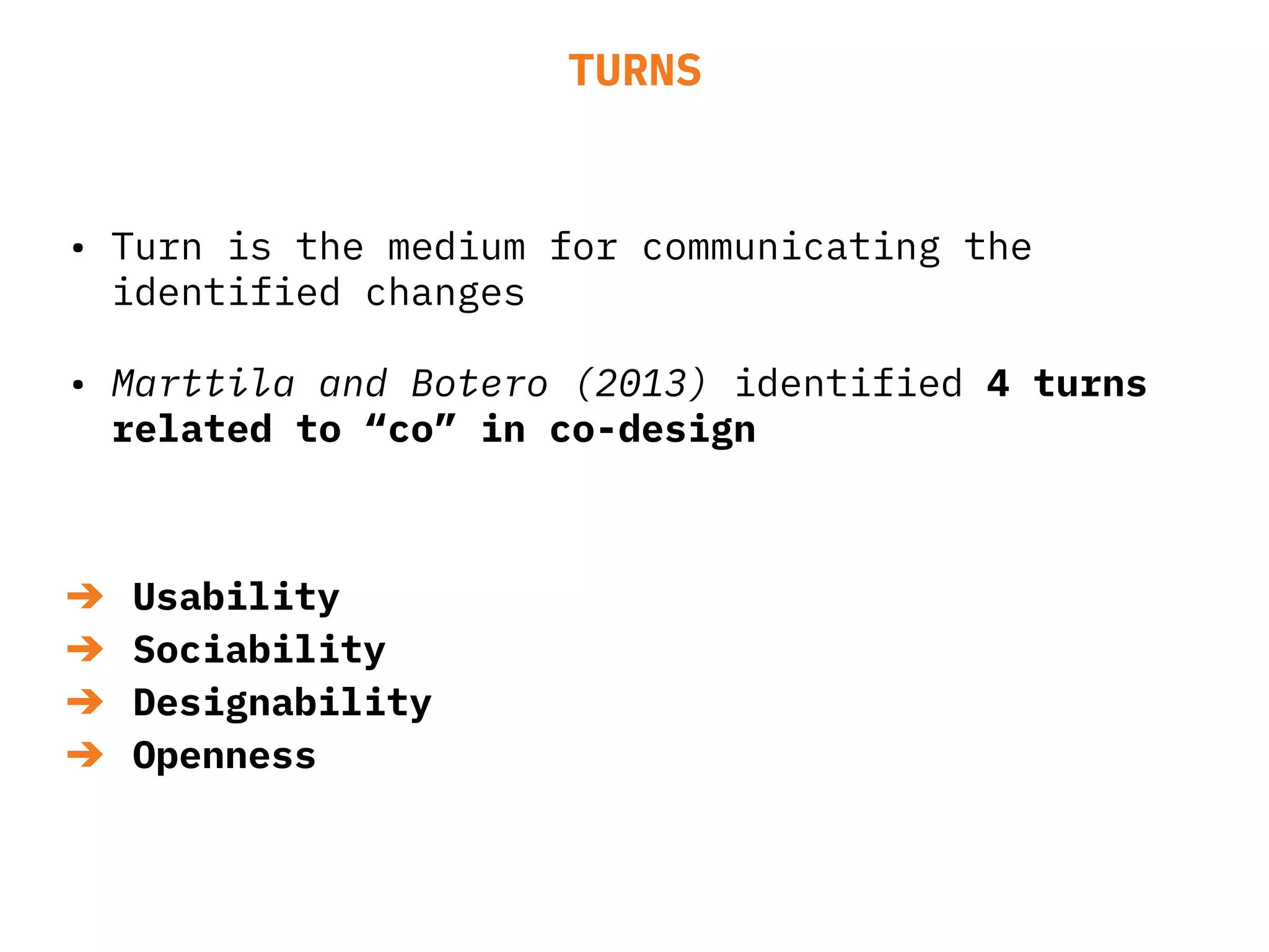
• Turn is the medium for communicating the
identified changes
• Marttila and Botero (2013) identified 4 turns
related to “co” in co-design
➔ Usability
➔ Sociability
➔ Designability
➔ Openness
TURNS++
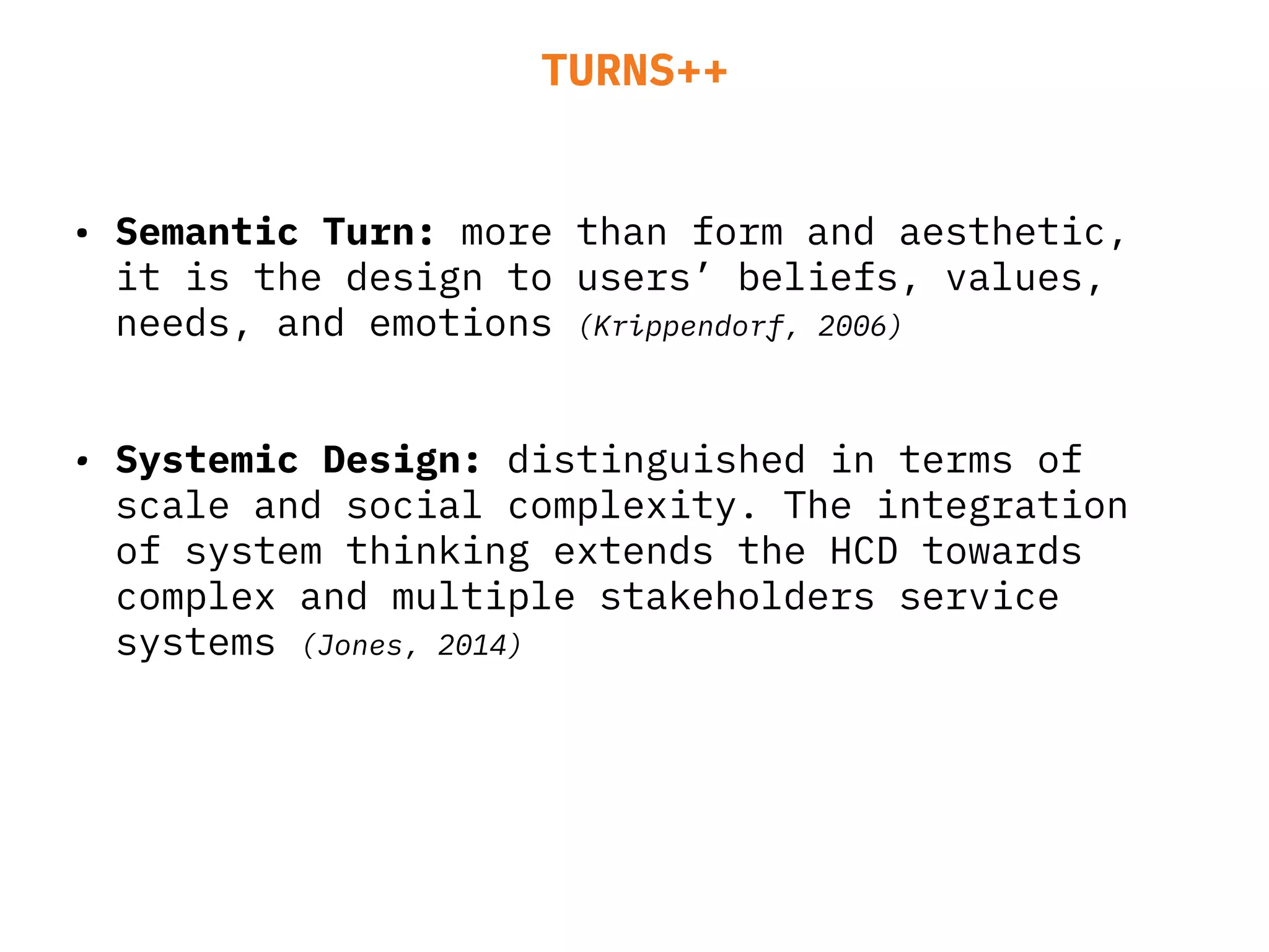
• Semantic Turn: more than form and aesthetic,
it is the design to users’ beliefs, values,
needs, and emotions (Krippendorf, 2006)
• Systemic Design: distinguished in terms of
scale and social complexity. The integration
of system thinking extends the HCD towards
complex and multiple stakeholders service
systems (Jones, 2014)
TURNS++
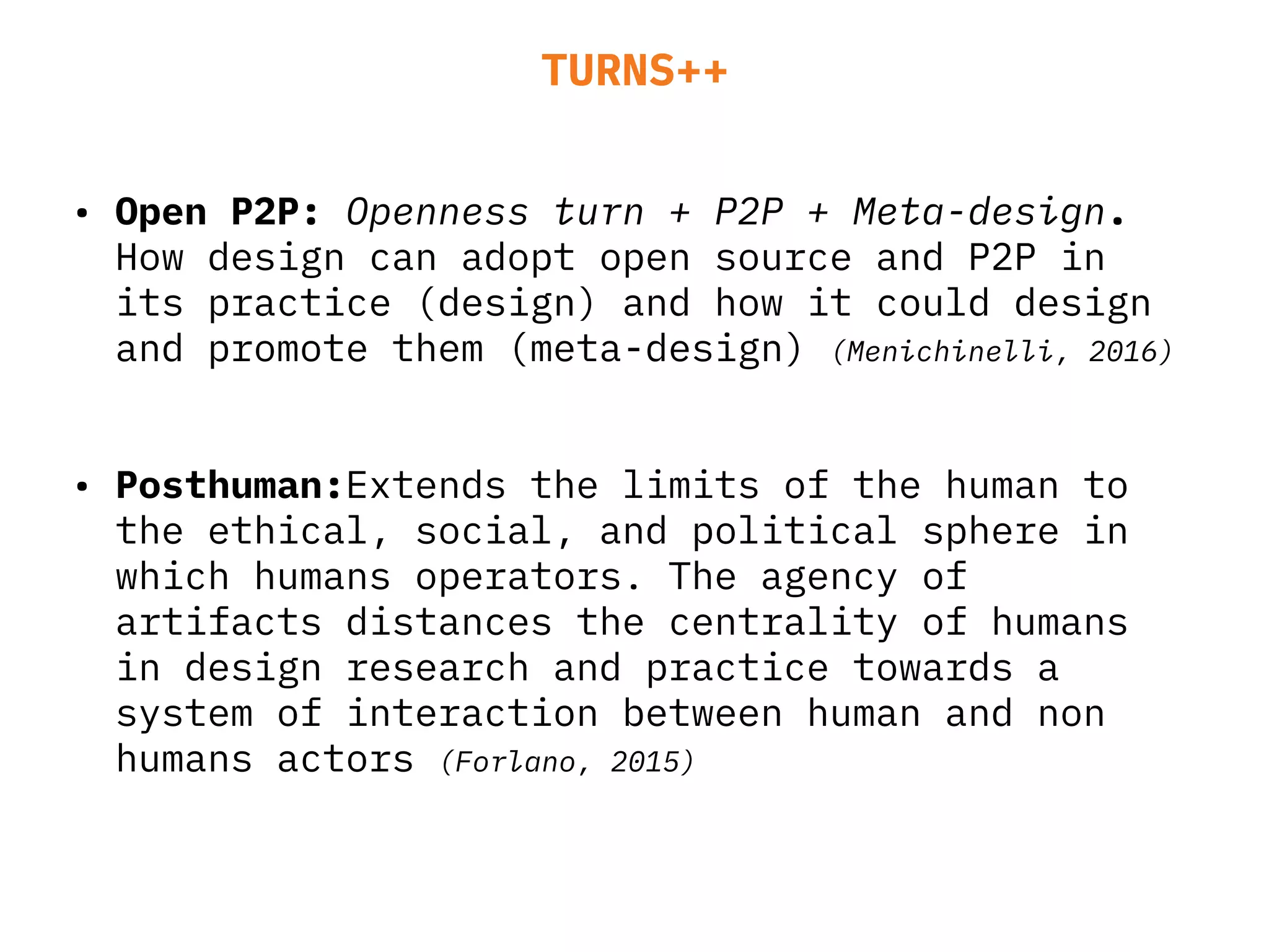
• Open P2P: Openness turn + P2P + Meta-design.
How design can adopt open source and P2P in
its practice (design) and how it could design
and promote them (meta-design) (Menichinelli, 2016)
• Posthuman:Extends the limits of the human to
the ethical, social, and political sphere in
which humans operators. The agency of
artifacts distances the centrality of humans
in design research and practice towards a
system of interaction between human and non
humans actors (Forlano, 2015)
3. THE
DECENTRALIZATION
TURNS IN DESIGN AND
THE MAKER MOVEMENT
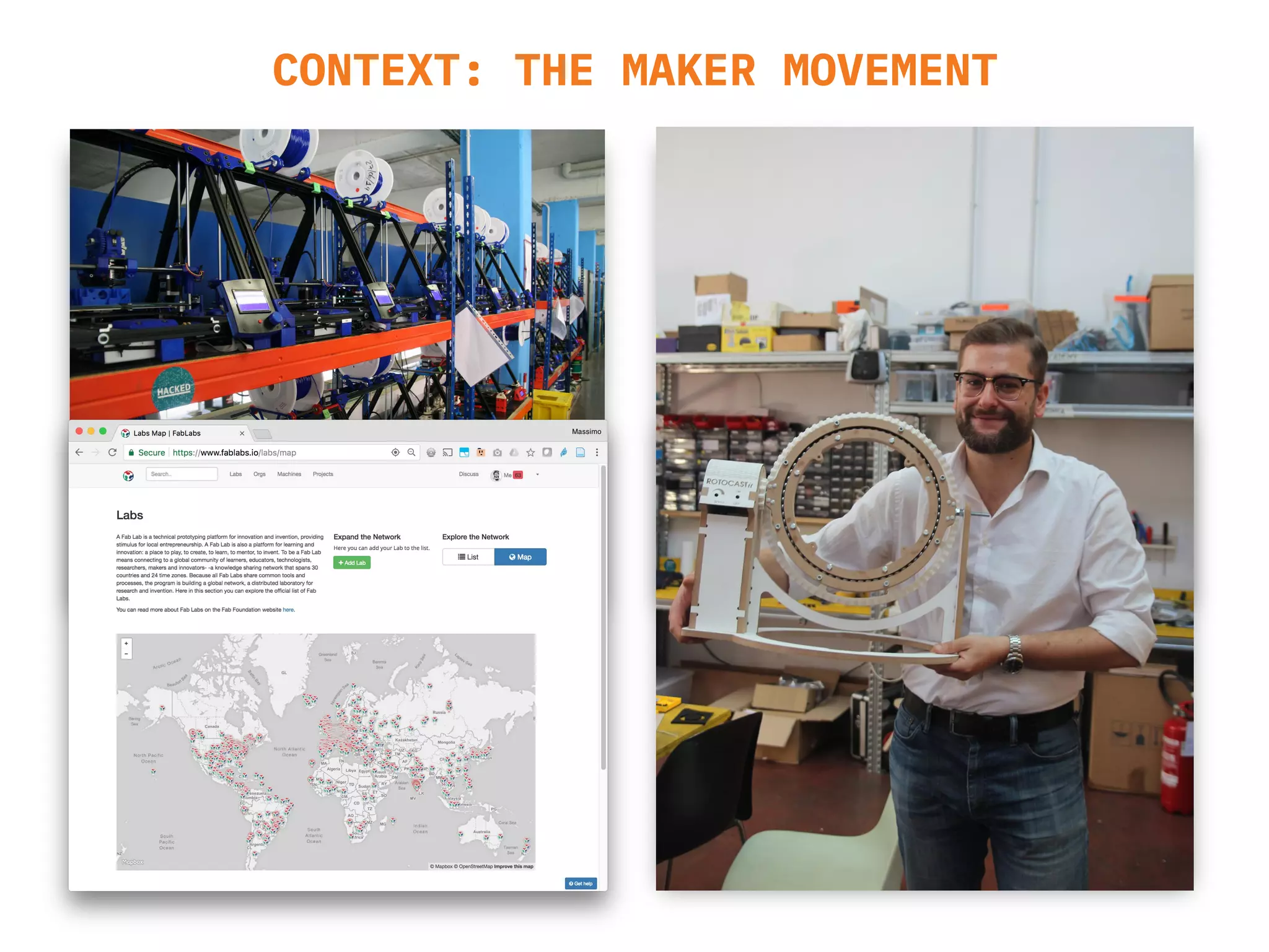
CONTEXT: THE MAKER MOVEMENT
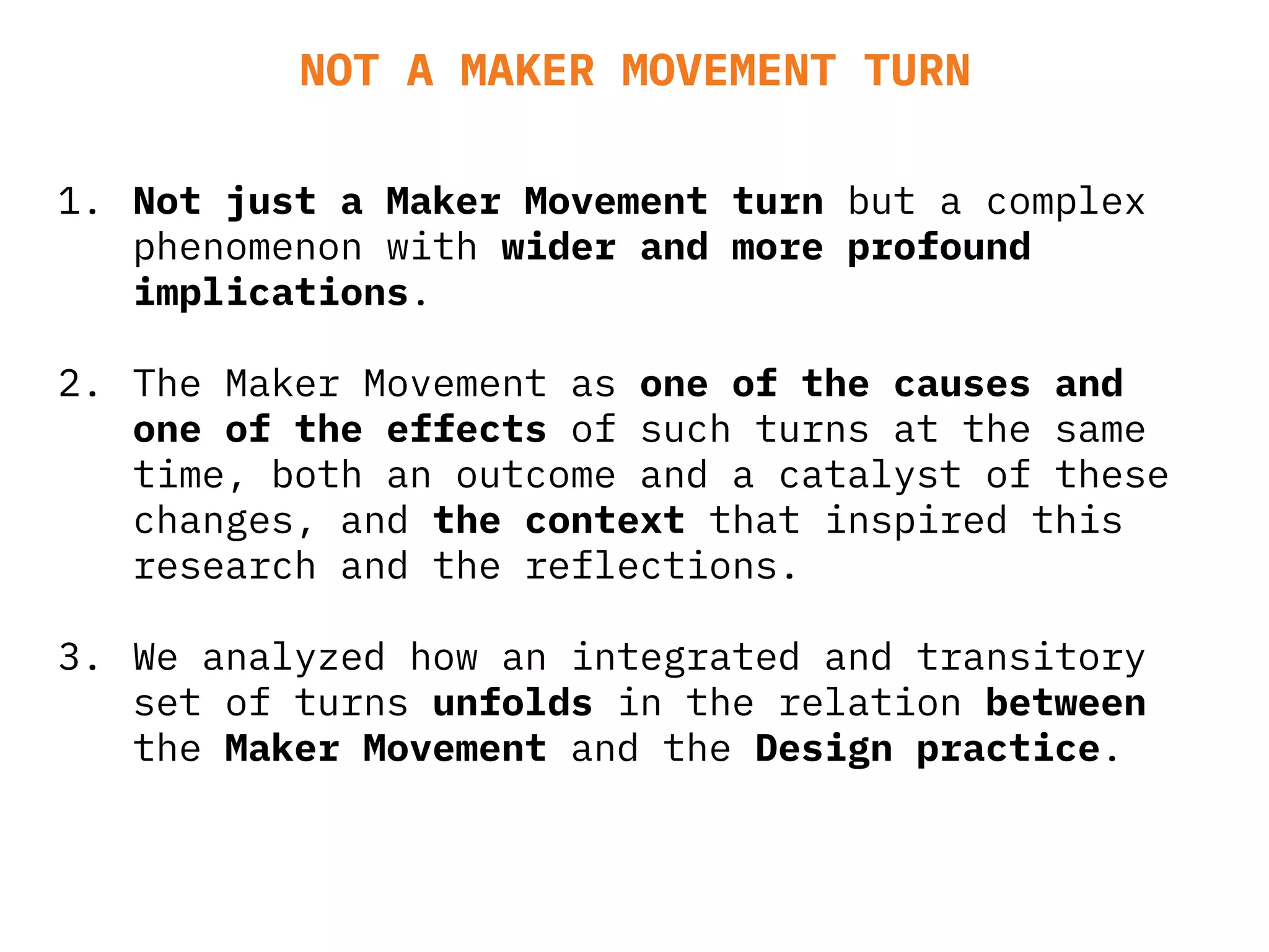
1. Not just a Maker Movement turn but a complex
phenomenon with wider and more profound
implications.
2. The Maker Movement as one of the causes and
one of the effects of such turns at the same
time, both an outcome and a catalyst of these
changes, and the context that inspired this
research and the reflections.
3. We analyzed how an integrated and transitory
set of turns unfolds in the relation between
the Maker Movement and the Design practice.
NOT A MAKER MOVEMENT TURN
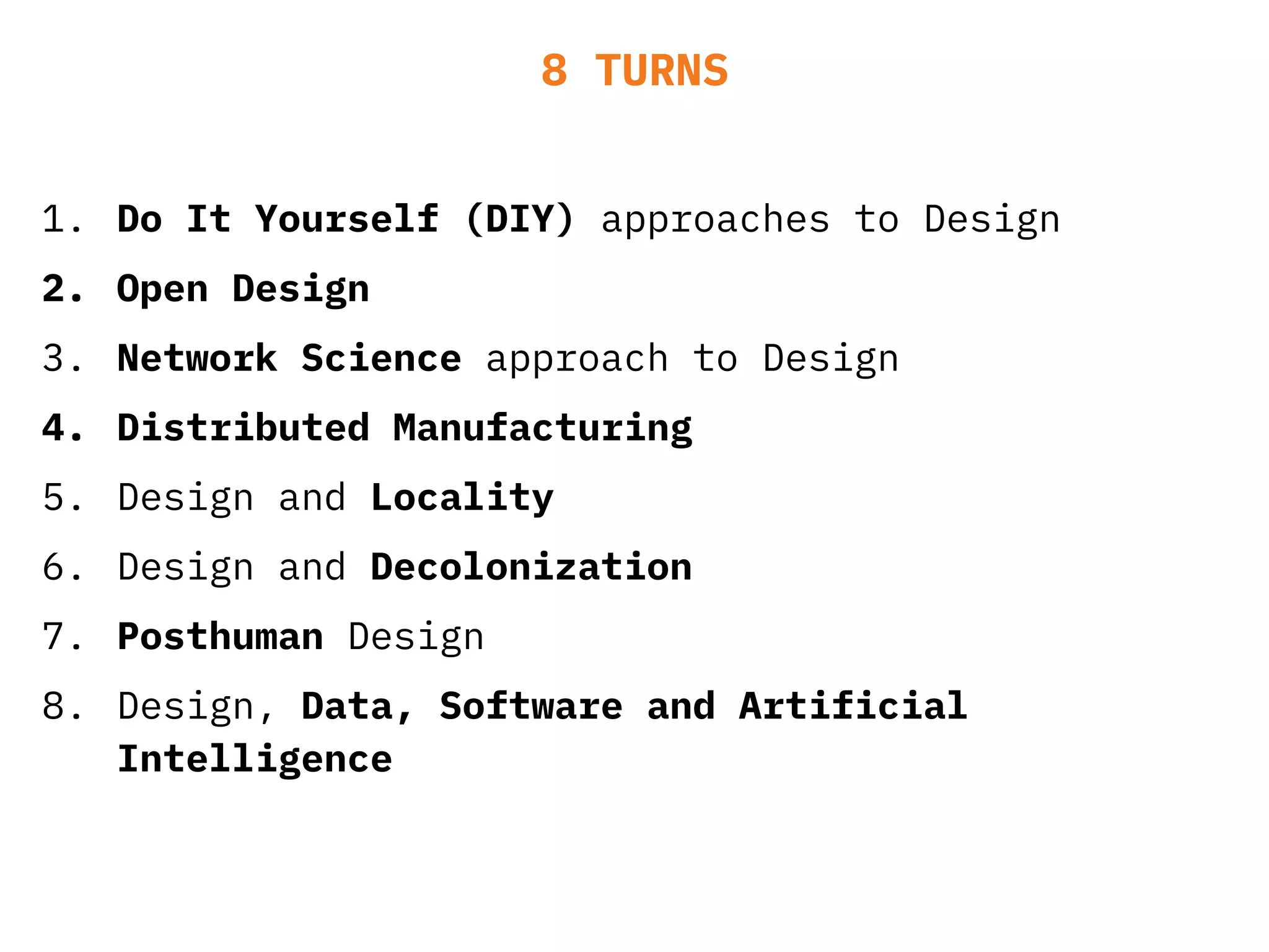
1. Do It Yourself (DIY) approaches to Design
2. Open Design
3. Network Science approach to Design
4. Distributed Manufacturing
5. Design and Locality
6. Design and Decolonization
7. Posthuman Design
8. Design, Data, Software and Artificial
Intelligence
8 TURNS
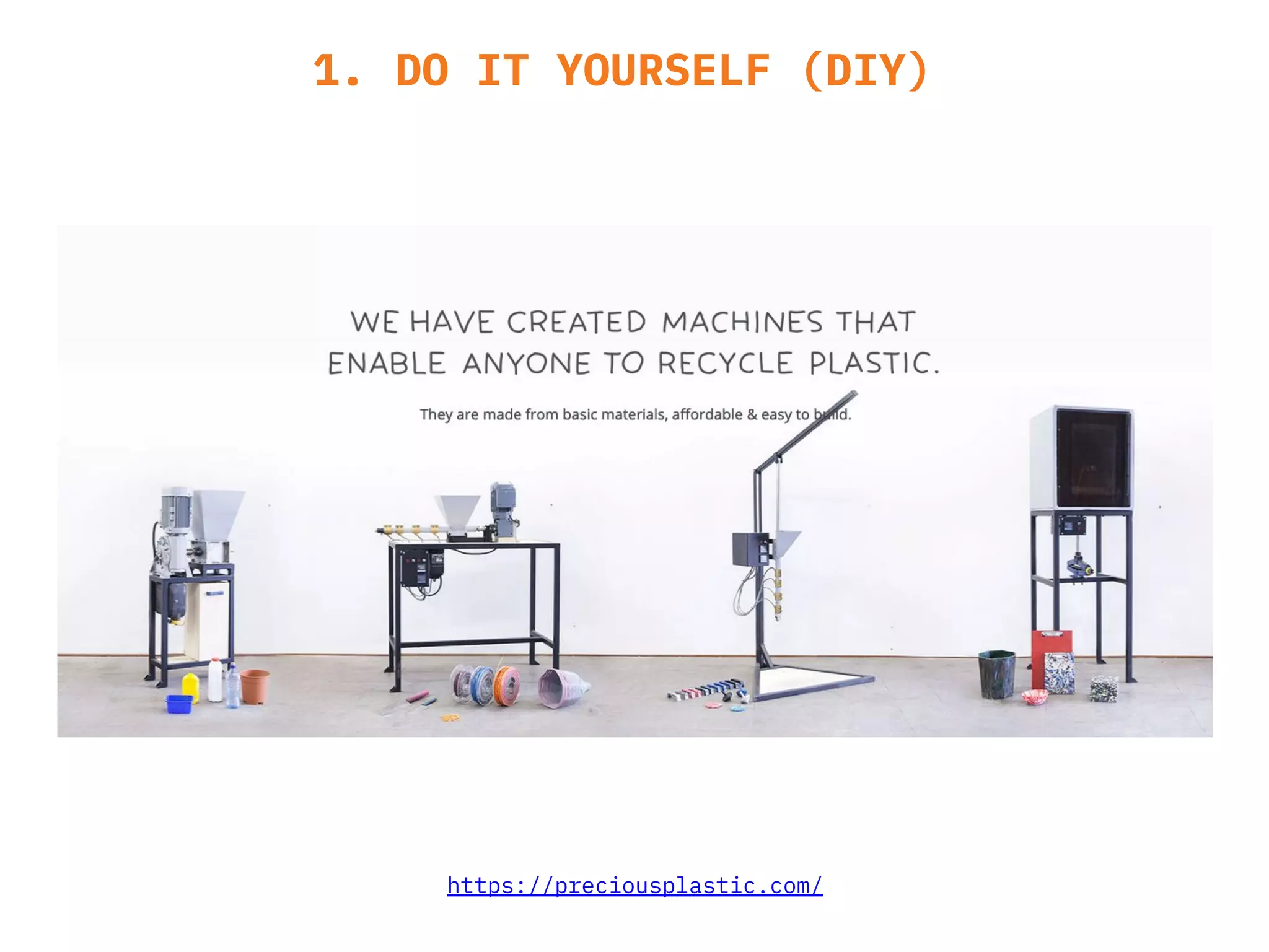
1. DO IT YOURSELF (DIY)
https://preciousplastic.com/
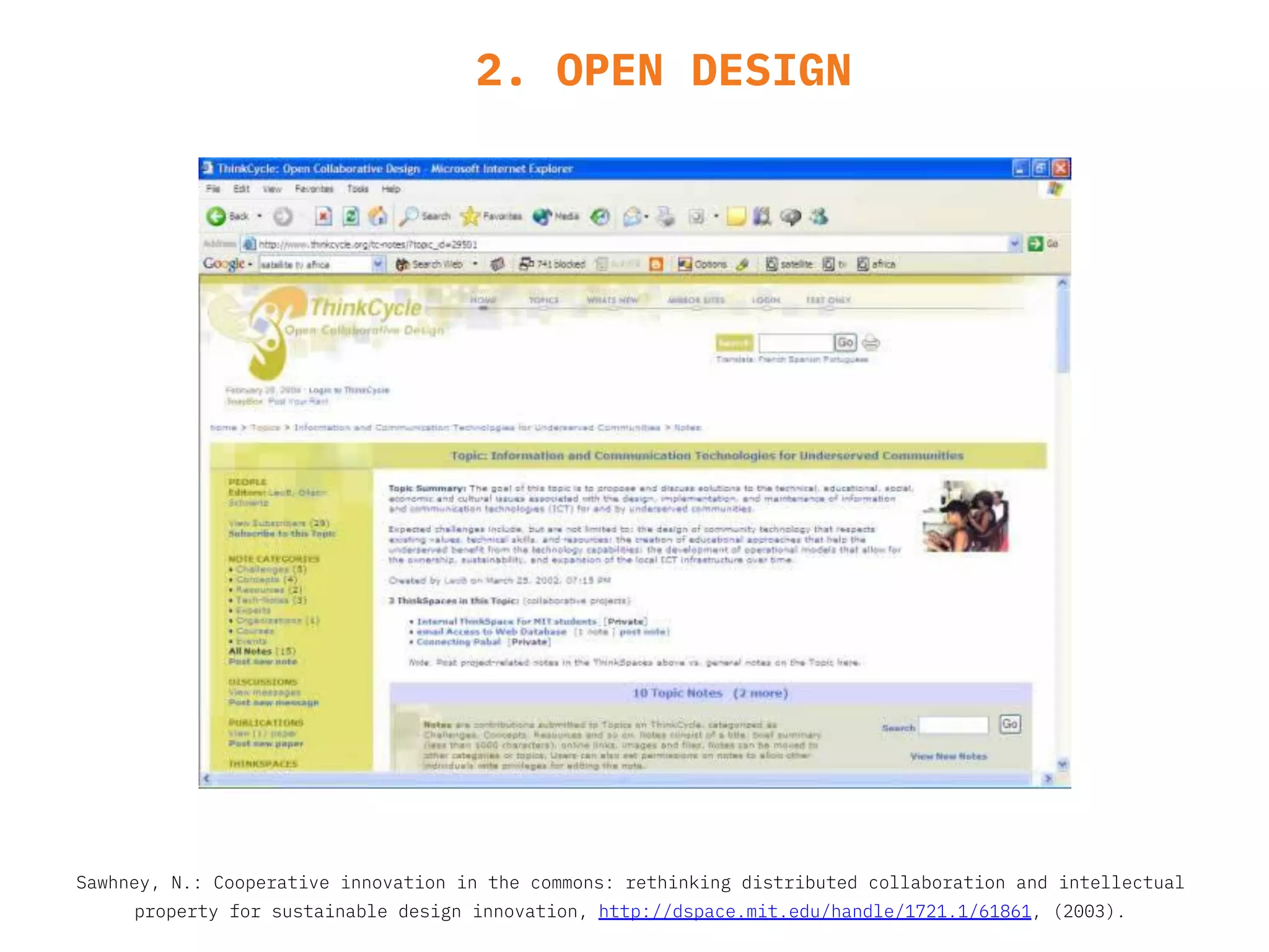
2. OPEN DESIGN
Sawhney, N.: Cooperative innovation in the commons: rethinking distributed collaboration and intellectual
property for sustainable design innovation, http://dspace.mit.edu/handle/1721.1/61861, (2003).
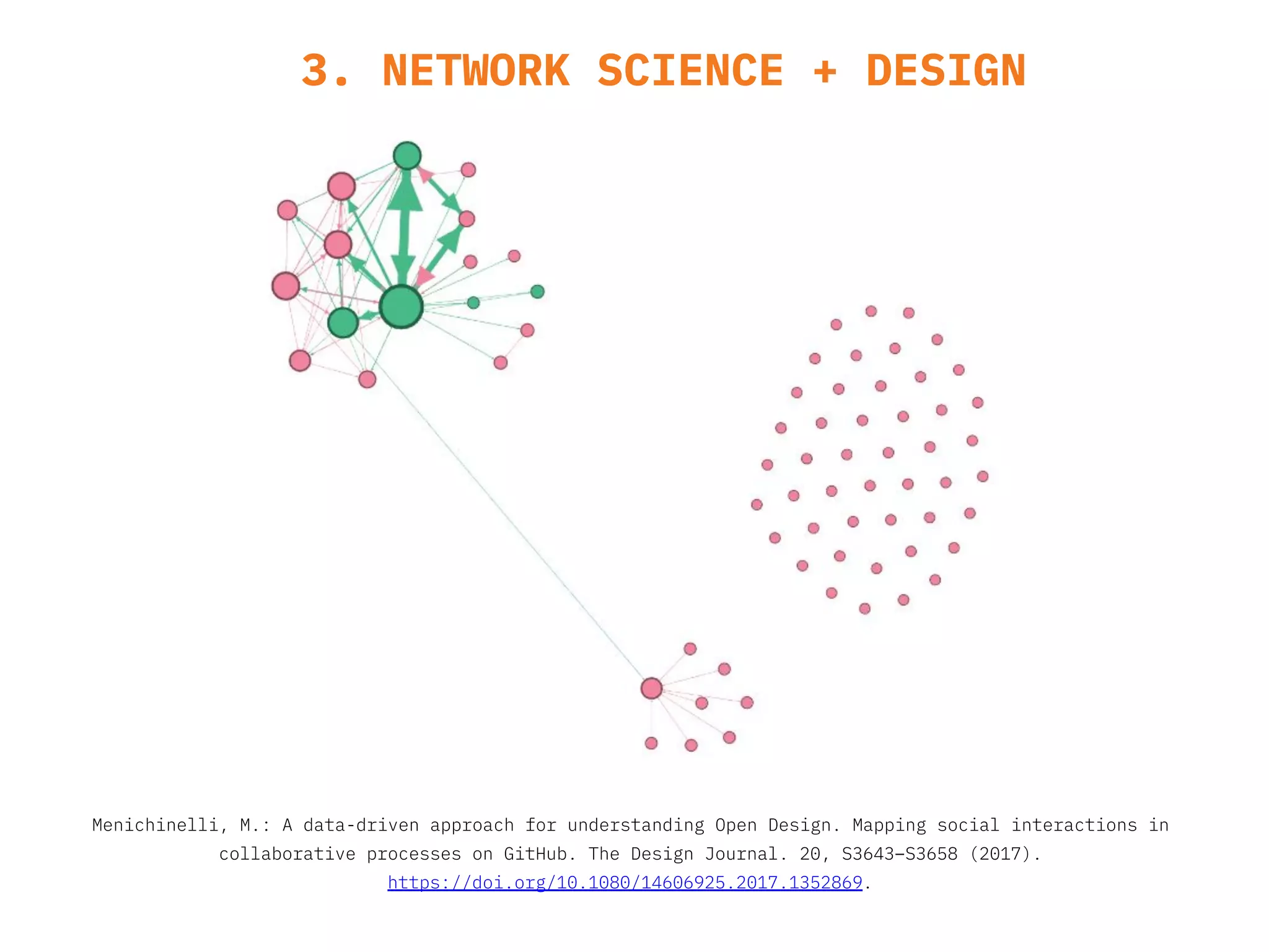
3. NETWORK SCIENCE + DESIGN
Menichinelli, M.: A data-driven approach for understanding Open Design. Mapping social interactions in
collaborative processes on GitHub. The Design Journal. 20, S3643–S3658 (2017).
https://doi.org/10.1080/14606925.2017.1352869.
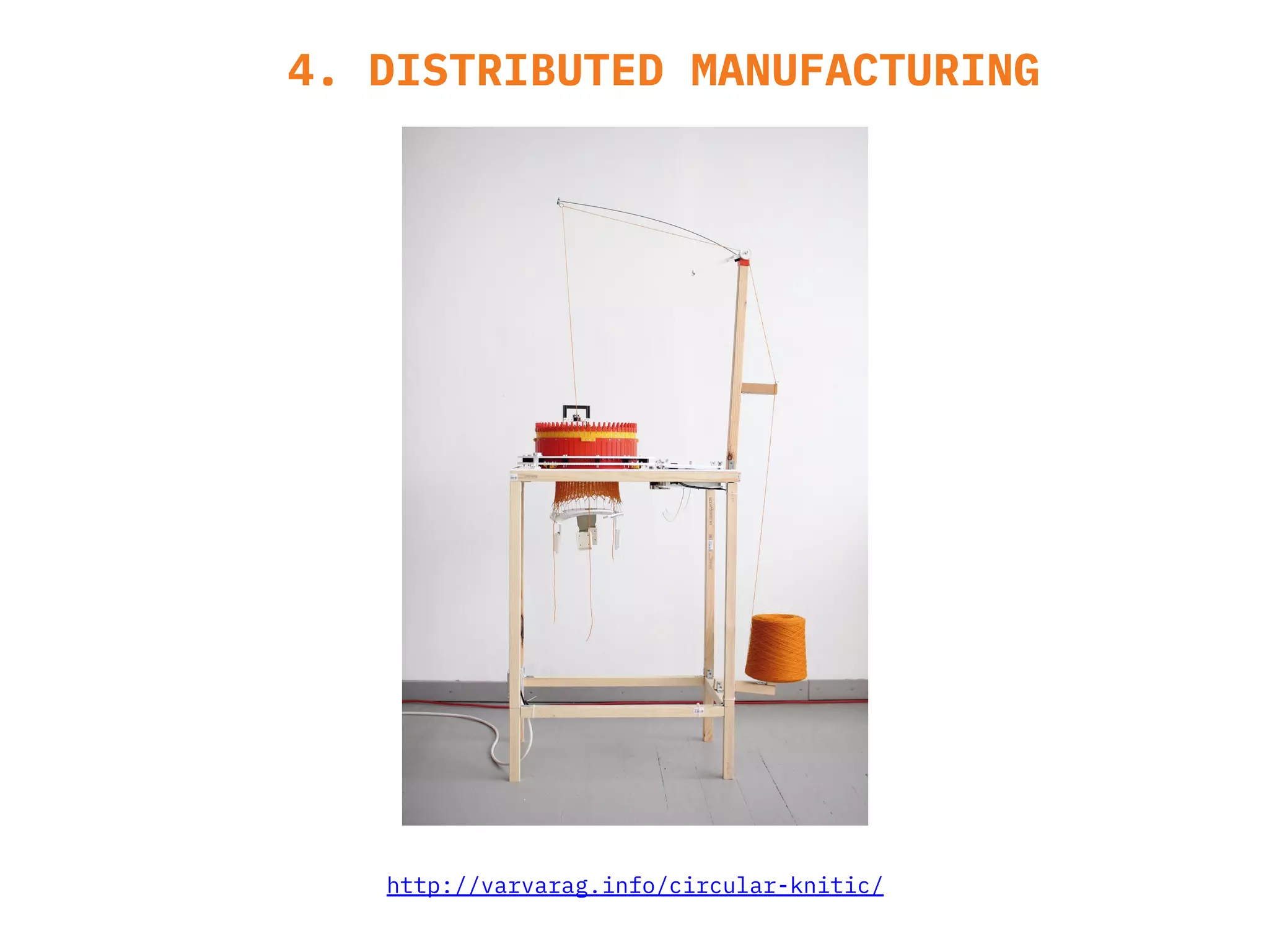
4. DISTRIBUTED MANUFACTURING
http://varvarag.info/circular-knitic/
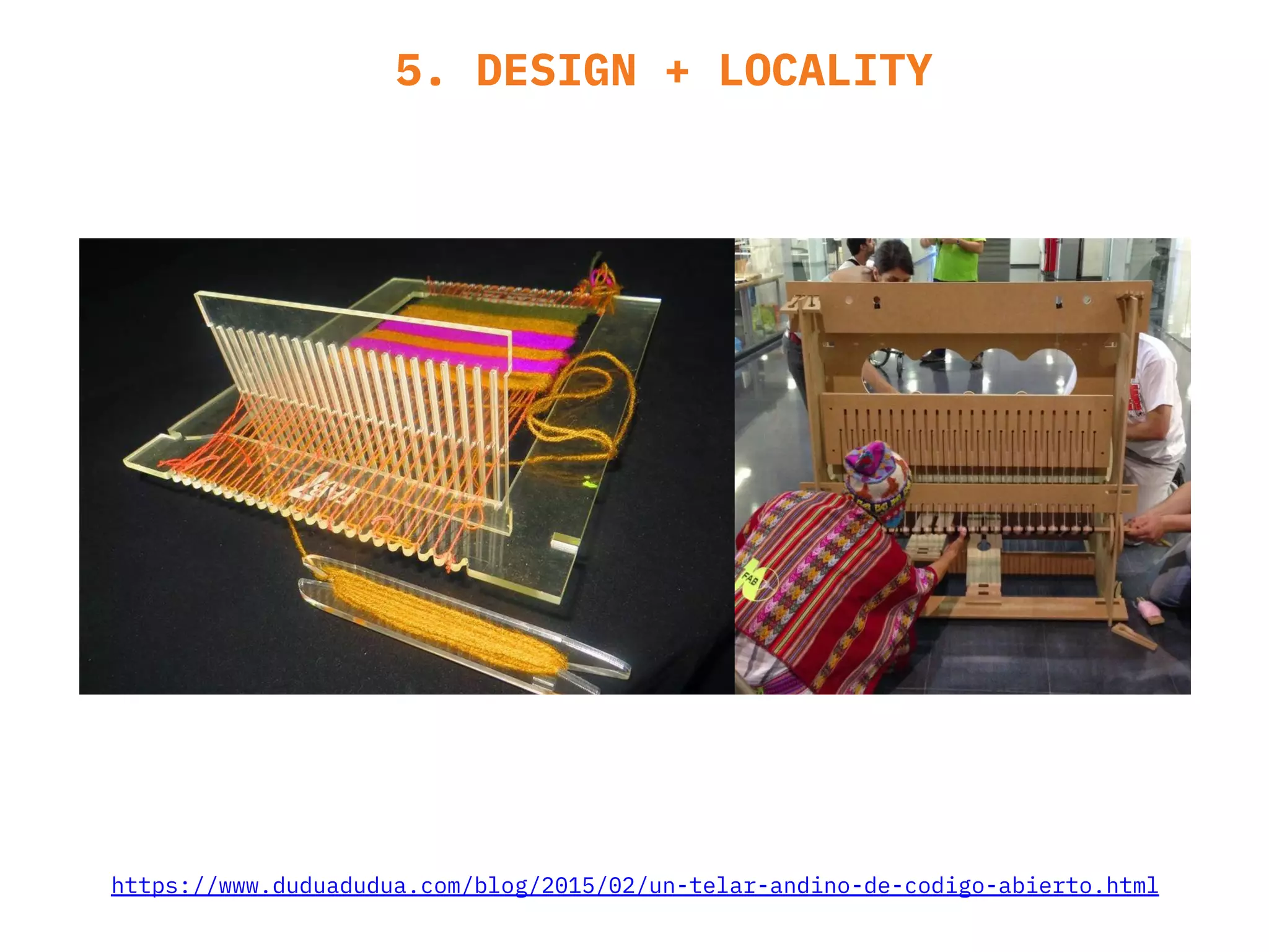
5. DESIGN + LOCALITY
https://www.duduadudua.com/blog/2015/02/un-telar-andino-de-codigo-abierto.html
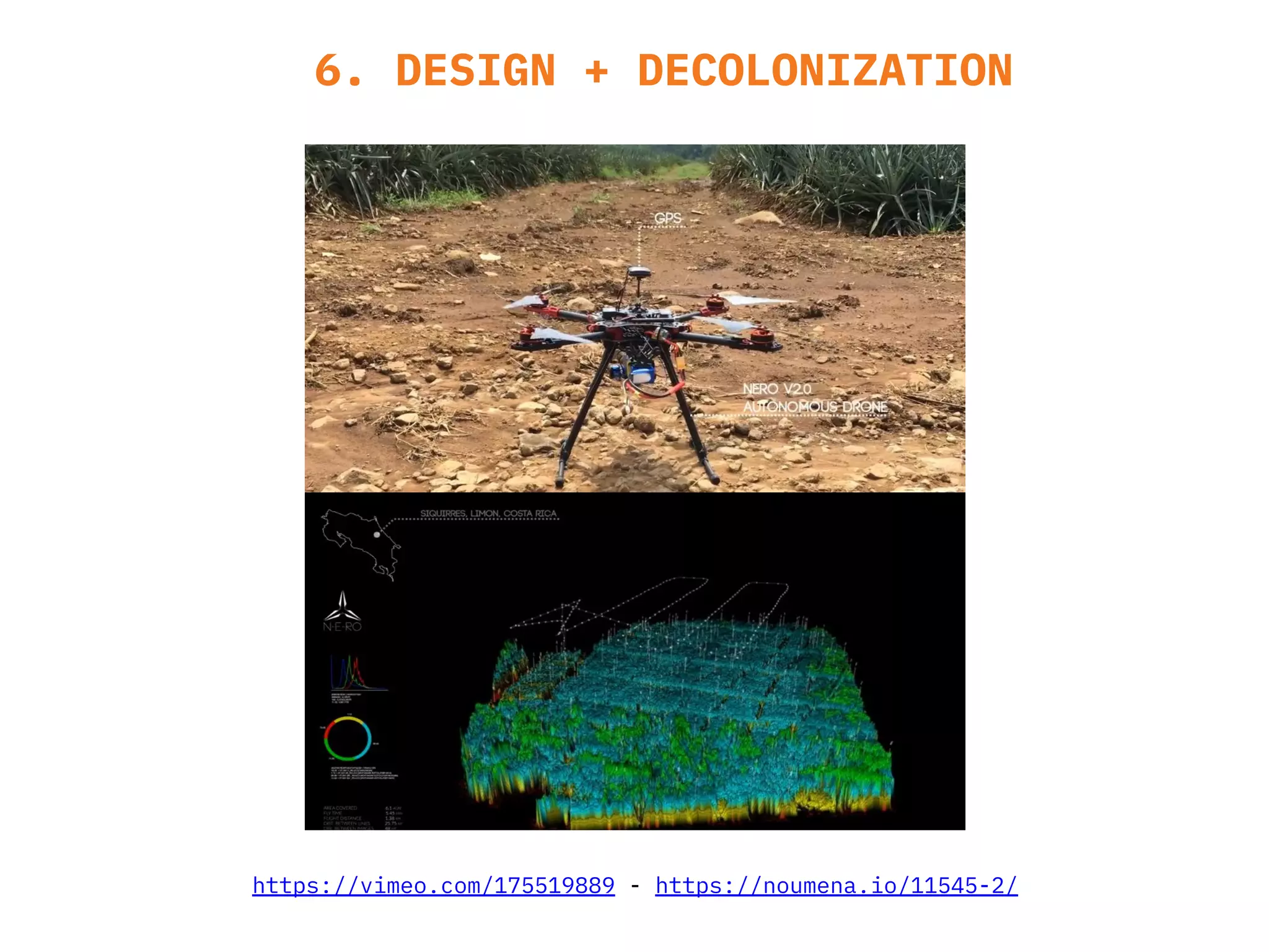
6. DESIGN + DECOLONIZATION
https://vimeo.com/175519889 - https://noumena.io/11545-2/
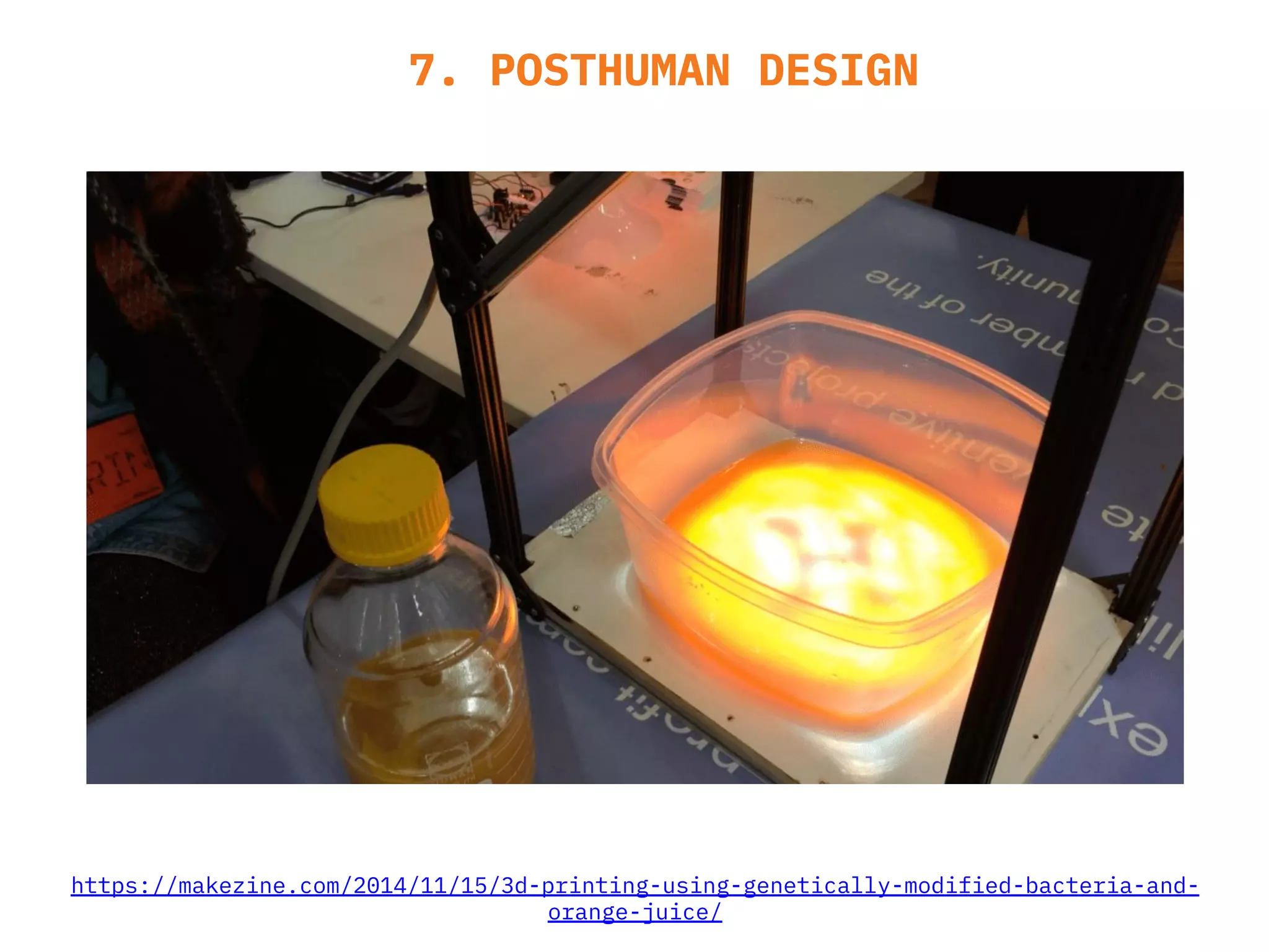
7. POSTHUMAN DESIGN
https://makezine.com/2014/11/15/3d-printing-using-genetically-modified-bacteria-and-
orange-juice/
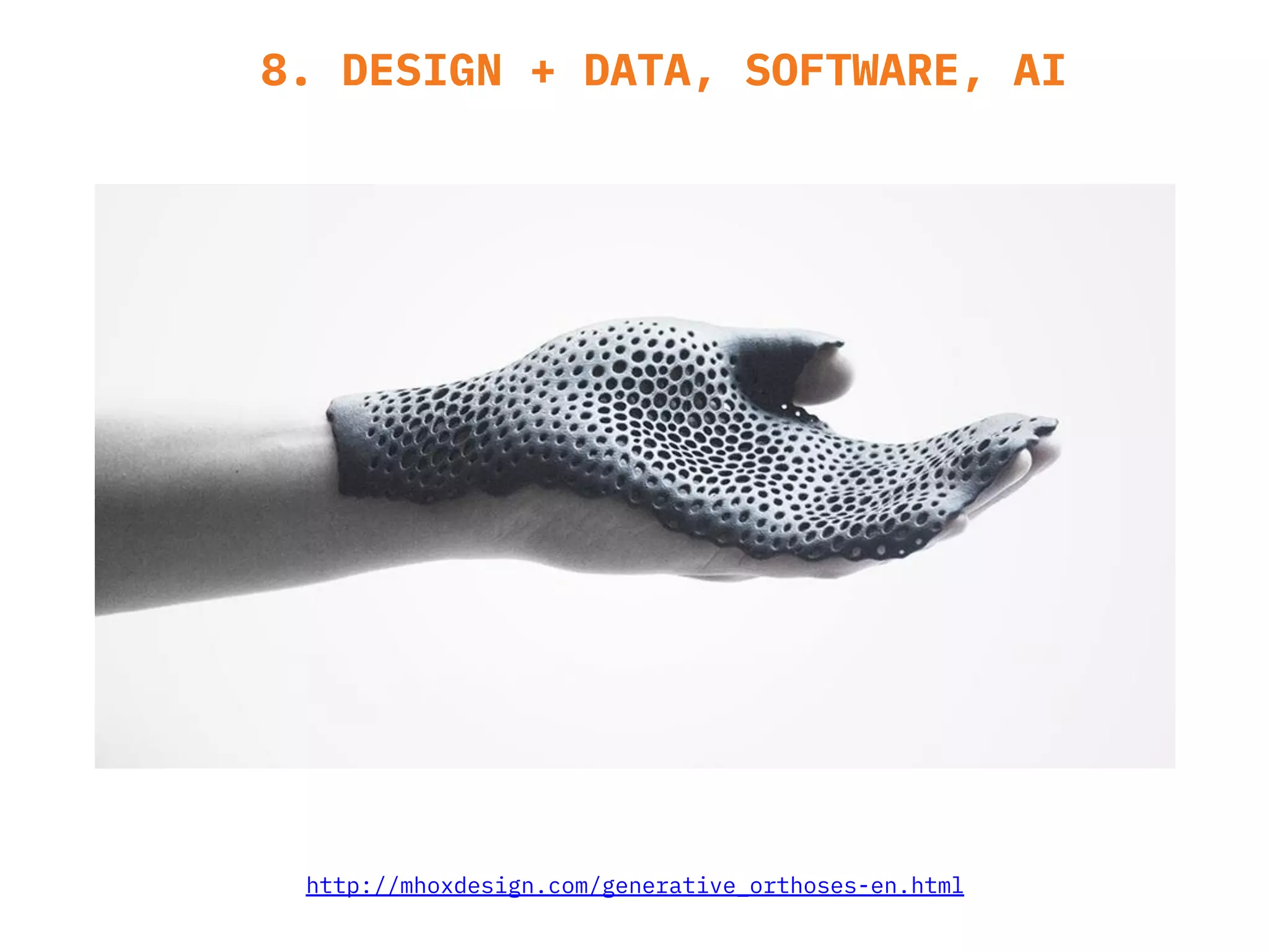
8. DESIGN + DATA, SOFTWARE, AI
http://mhoxdesign.com/generative_orthoses-en.html
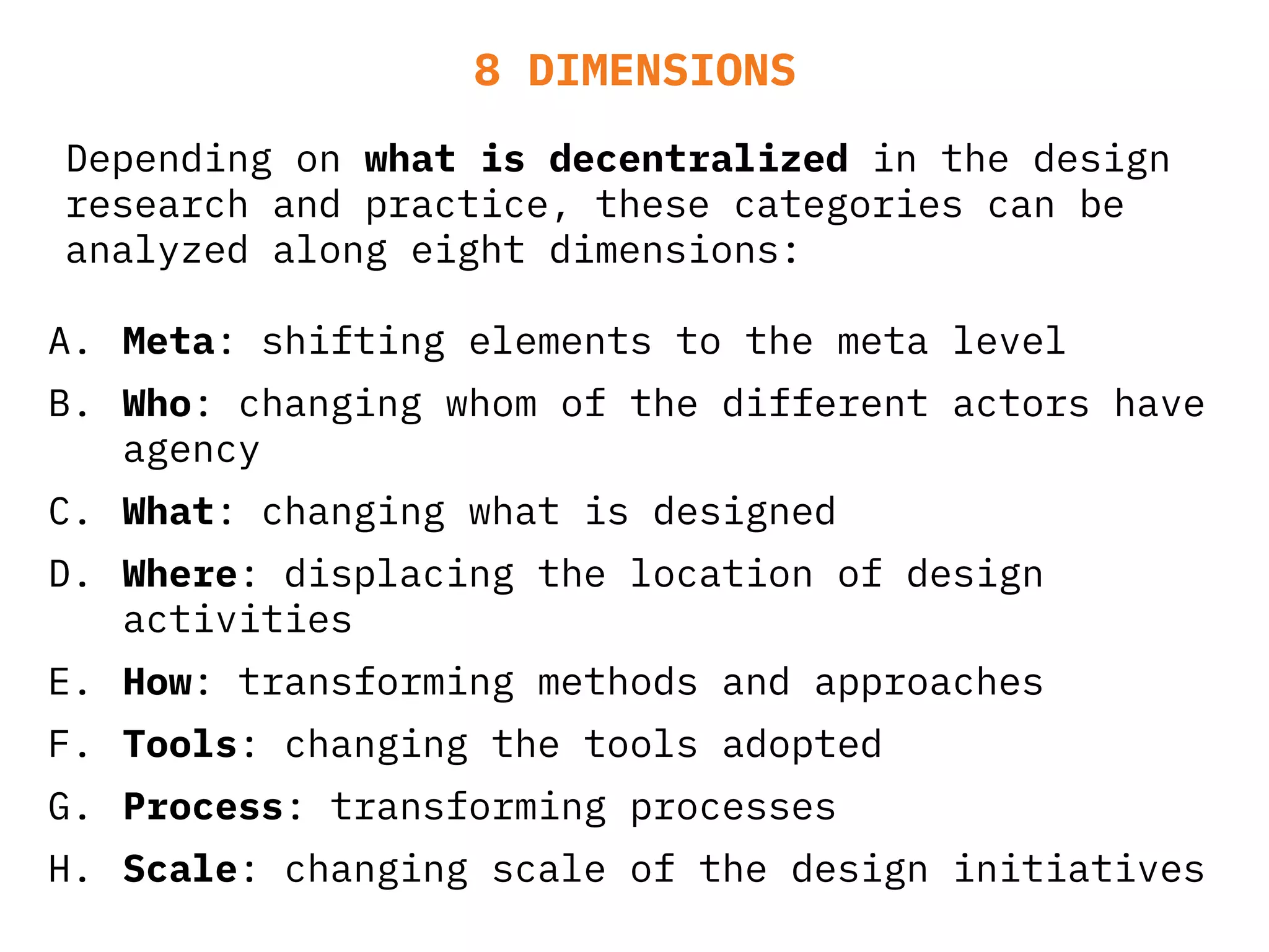
Depending on what is decentralized in the design
research and practice, these categories can be
analyzed along eight dimensions:
A. Meta: shifting elements to the meta level
B. Who: changing whom of the different actors have
agency
C. What: changing what is designed
D. Where: displacing the location of design
activities
E. How: transforming methods and approaches
F. Tools: changing the tools adopted
G. Process: transforming processes
H. Scale: changing scale of the design initiatives
8 DIMENSIONS
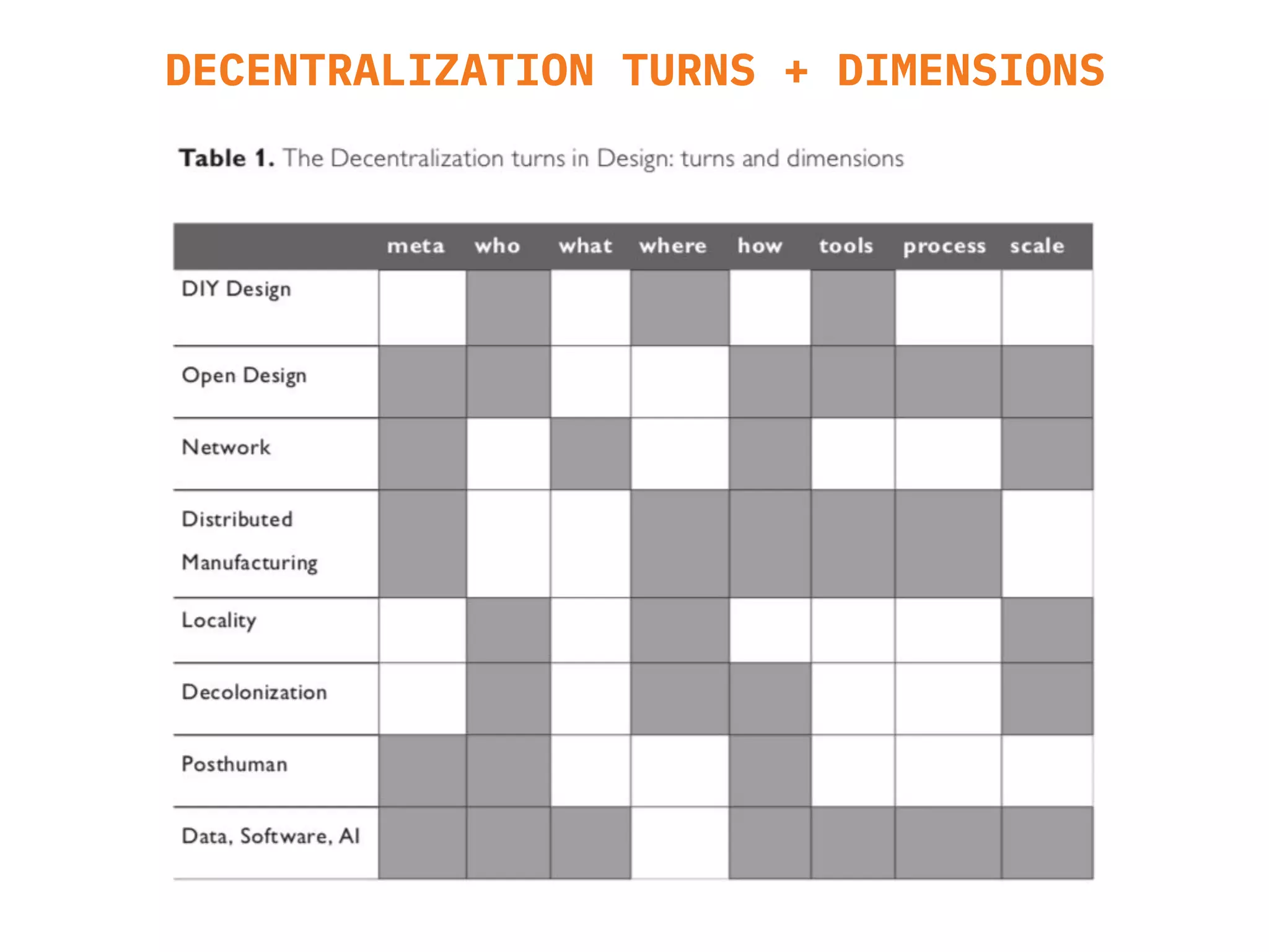
DECENTRALIZATION TURNS + DIMENSIONS
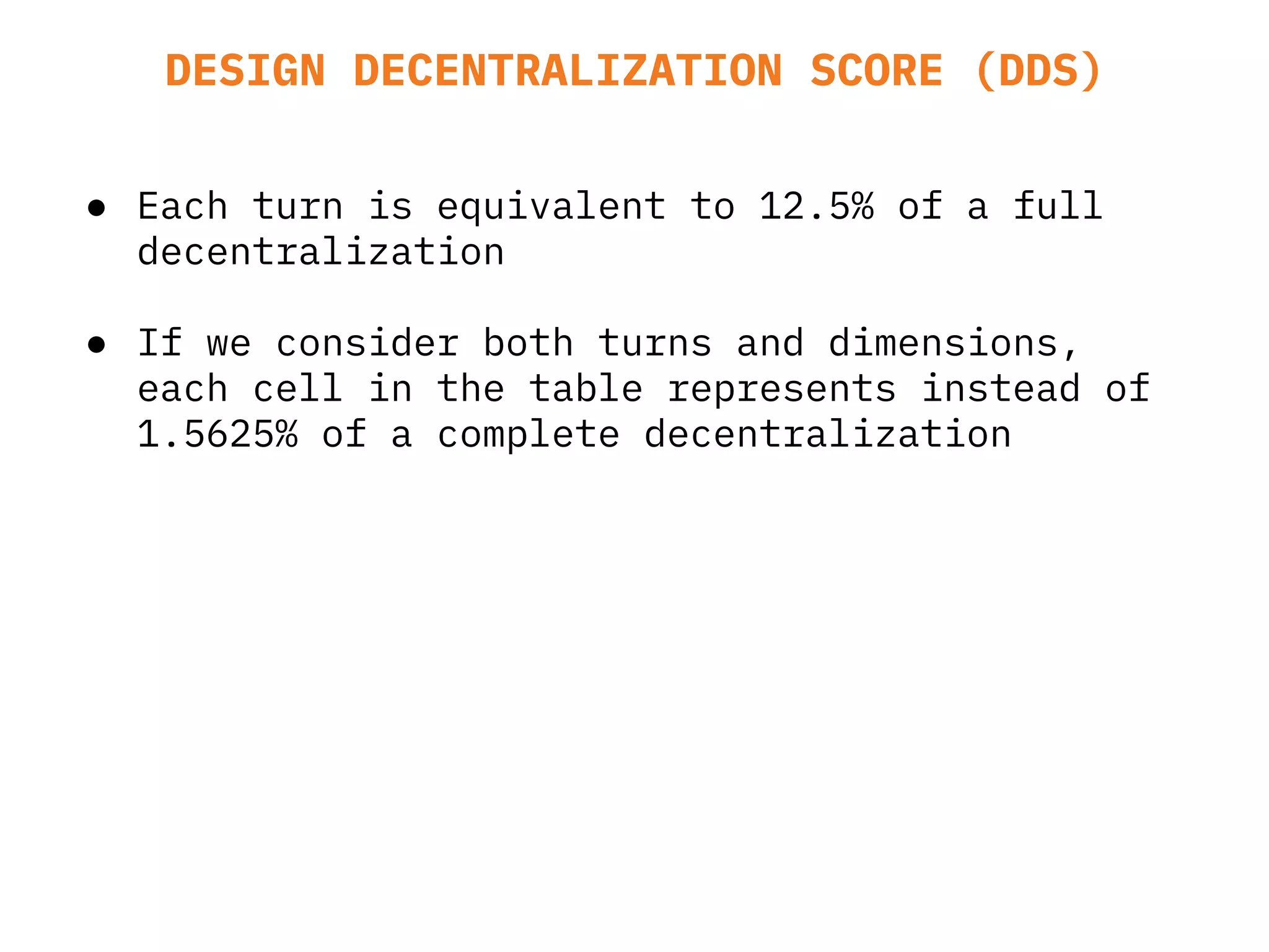
● Each turn is equivalent to 12.5% of a full
decentralization
● If we consider both turns and dimensions,
each cell in the table represents instead of
1.5625% of a complete decentralization
DESIGN DECENTRALIZATION SCORE (DDS)
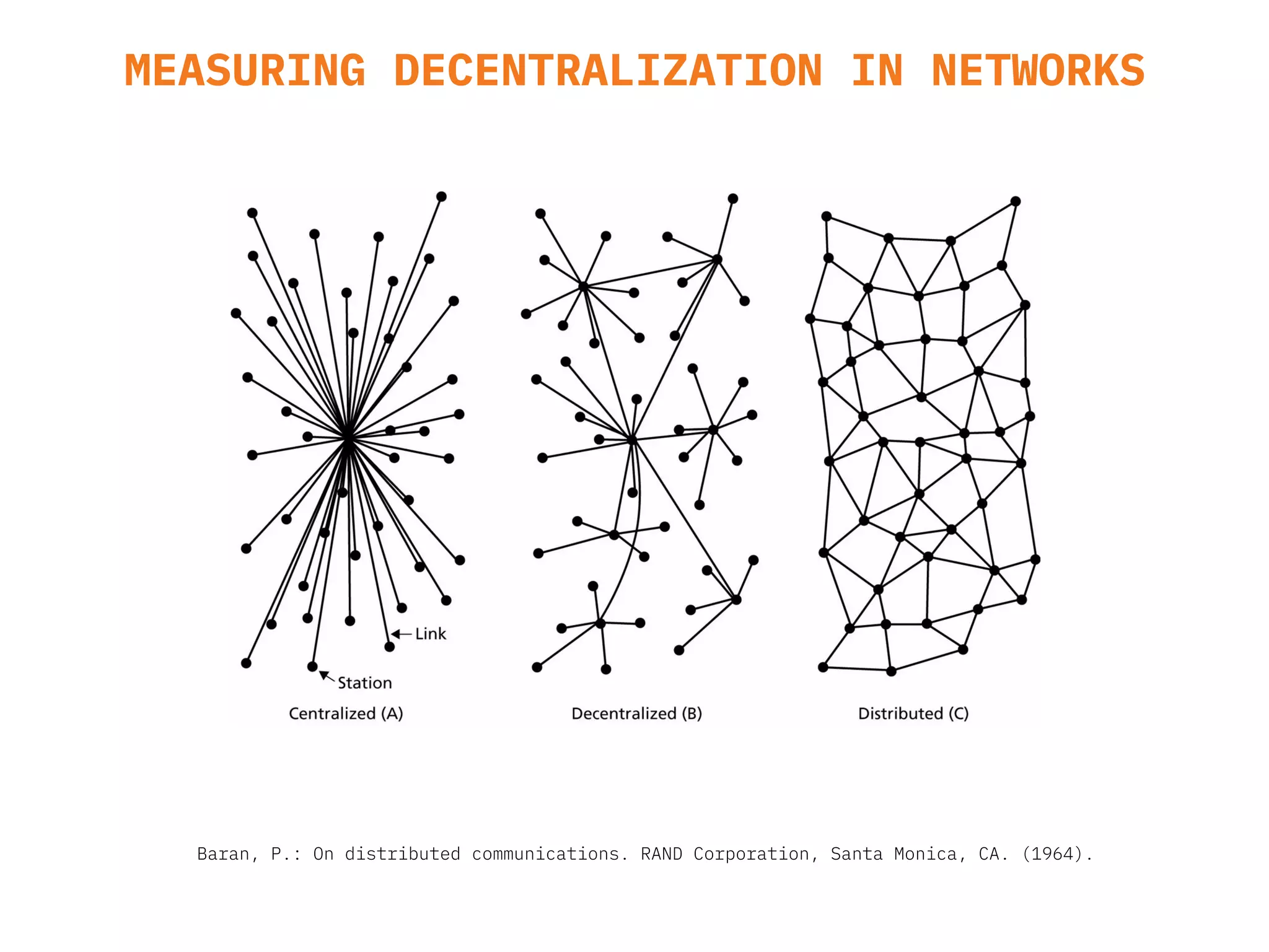
MEASURING DECENTRALIZATION IN NETWORKS
Baran, P.: On distributed communications. RAND Corporation, Santa Monica, CA. (1964).
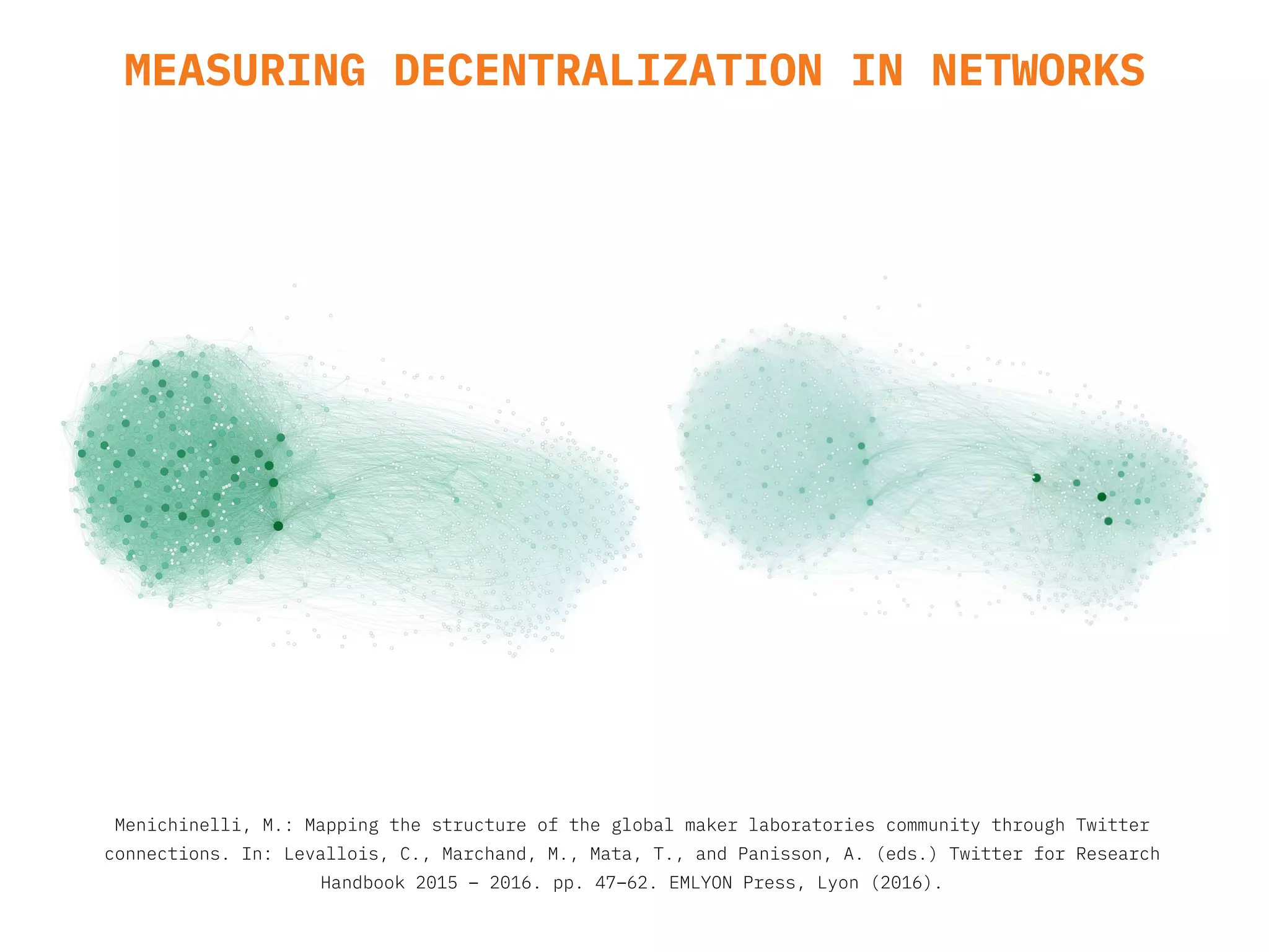
MEASURING DECENTRALIZATION IN NETWORKS
Menichinelli, M.: Mapping the structure of the global maker laboratories community through Twitter
connections. In: Levallois, C., Marchand, M., Mata, T., and Panisson, A. (eds.) Twitter for Research
Handbook 2015 – 2016. pp. 47–62. EMLYON Press, Lyon (2016).
4. CONCLUSIONS
OVERVIEW
Design + Maker Movement: more than just 3D
printing → agency, intelligence, processes, …
Reflection on the Maker Movement + reflection
on Decentralization in Design
Meta-Design: a framework for understanding how
to organize the practice
Not a new turn, but a set of turns called the
Decentralization turns that integrate and
extend the previous turns
→ Future role of designers in designing for
complexity and society with technology for
social innovation
LIMITATIONS -> FURTHER RESEARCH
● Lack of consensus on the concept of turns
and paradigms in design, there is not a
strong theoretical background → a more
rigorous identification + analysis of
turns and paradigms in design research
and practice
● Explore the impacts on the design
process, user experience, social
consequences, and the role of designers
● Elaborate and validate the score through
the developing a composite index based on
multiple data sources + network science
approach
THANK YOU.
RMIT University
Aalto University
massimo.menichinelli@rmit.edu.au
massimo.menichinelli@aalto.fi
Massimo
Menichinelli
University of Illinois Urbana
Champaign - Illinois Informatics
Institute
pf4@illinois.edu
Priscilla
Ferronato

The Decentralization Turns In Design: An Exploration Through The Maker Movement @ DeSForM19

  • 1.
    THE DECENTRALIZATION TURNSIN DESIGN: AN EXPLORATION THROUGH THE MAKER MOVEMENT RMIT University Aalto University massimo.menichinelli@rmit.edu.au massimo.menichinelli@aalto.fi Massimo Menichinelli University of Illinois at Urbana Champaign - Illinois Informatics Institute pf4@illinois.edu Priscilla Ferronato
  • 2.
  • 3.
    FOCUS + GOALS FOCUS: Evolutionof Science by shifting the center: ● Paradigms: epoch-making shifts that bring revolutions (Kuhn, T.S 1962) ● Turns: parallel and overlapping smaller-scale changes (Marttila, S., Botero, A. 2013) GOALS: ● To trace a timeline of turns in the design research and practice ● To identify and explain a new set of turns taking place in Design practice
  • 4.
    RESEARCH QUESTION: What arethe decentralizations that have been emerging in the design research and practice, and how they can possibly characterize new turns in Design? METHOD: Literature review of publications and cases. RESEARCH QUESTION + METHOD
  • 5.
    2. A REVIEWOF PARADIGMS AND TURNS IN DESIGN
  • 6.
    PARADIGMS • Identification ofparadigms in design in the Four Economic Paradigms (Gardien et al, 2014) • Focused on companies and how they can innovate in order to keep up with paradigm changes ➔ Industrial Economy ➔ Experience Economy ➔ Knowledge Economy ➔ Transformation Economy
  • 7.
    TURNS • Turn isthe medium for communicating the identified changes • Marttila and Botero (2013) identified 4 turns related to “co” in co-design ➔ Usability ➔ Sociability ➔ Designability ➔ Openness
  • 8.
    TURNS++ • Semantic Turn:more than form and aesthetic, it is the design to users’ beliefs, values, needs, and emotions (Krippendorf, 2006) • Systemic Design: distinguished in terms of scale and social complexity. The integration of system thinking extends the HCD towards complex and multiple stakeholders service systems (Jones, 2014)
  • 9.
    TURNS++ • Open P2P:Openness turn + P2P + Meta-design. How design can adopt open source and P2P in its practice (design) and how it could design and promote them (meta-design) (Menichinelli, 2016) • Posthuman:Extends the limits of the human to the ethical, social, and political sphere in which humans operators. The agency of artifacts distances the centrality of humans in design research and practice towards a system of interaction between human and non humans actors (Forlano, 2015)
  • 10.
    3. THE DECENTRALIZATION TURNS INDESIGN AND THE MAKER MOVEMENT
  • 11.
  • 12.
    1. Not justa Maker Movement turn but a complex phenomenon with wider and more profound implications. 2. The Maker Movement as one of the causes and one of the effects of such turns at the same time, both an outcome and a catalyst of these changes, and the context that inspired this research and the reflections. 3. We analyzed how an integrated and transitory set of turns unfolds in the relation between the Maker Movement and the Design practice. NOT A MAKER MOVEMENT TURN
  • 13.
    1. Do ItYourself (DIY) approaches to Design 2. Open Design 3. Network Science approach to Design 4. Distributed Manufacturing 5. Design and Locality 6. Design and Decolonization 7. Posthuman Design 8. Design, Data, Software and Artificial Intelligence 8 TURNS
  • 14.
    1. DO ITYOURSELF (DIY) https://preciousplastic.com/
  • 15.
    2. OPEN DESIGN Sawhney,N.: Cooperative innovation in the commons: rethinking distributed collaboration and intellectual property for sustainable design innovation, http://dspace.mit.edu/handle/1721.1/61861, (2003).
  • 16.
    3. NETWORK SCIENCE+ DESIGN Menichinelli, M.: A data-driven approach for understanding Open Design. Mapping social interactions in collaborative processes on GitHub. The Design Journal. 20, S3643–S3658 (2017). https://doi.org/10.1080/14606925.2017.1352869.
  • 17.
  • 18.
    5. DESIGN +LOCALITY https://www.duduadudua.com/blog/2015/02/un-telar-andino-de-codigo-abierto.html
  • 19.
    6. DESIGN +DECOLONIZATION https://vimeo.com/175519889 - https://noumena.io/11545-2/
  • 20.
  • 21.
    8. DESIGN +DATA, SOFTWARE, AI http://mhoxdesign.com/generative_orthoses-en.html
  • 22.
    Depending on whatis decentralized in the design research and practice, these categories can be analyzed along eight dimensions: A. Meta: shifting elements to the meta level B. Who: changing whom of the different actors have agency C. What: changing what is designed D. Where: displacing the location of design activities E. How: transforming methods and approaches F. Tools: changing the tools adopted G. Process: transforming processes H. Scale: changing scale of the design initiatives 8 DIMENSIONS
  • 23.
  • 24.
    ● Each turnis equivalent to 12.5% of a full decentralization ● If we consider both turns and dimensions, each cell in the table represents instead of 1.5625% of a complete decentralization DESIGN DECENTRALIZATION SCORE (DDS)
  • 25.
    MEASURING DECENTRALIZATION INNETWORKS Baran, P.: On distributed communications. RAND Corporation, Santa Monica, CA. (1964).
  • 26.
    MEASURING DECENTRALIZATION INNETWORKS Menichinelli, M.: Mapping the structure of the global maker laboratories community through Twitter connections. In: Levallois, C., Marchand, M., Mata, T., and Panisson, A. (eds.) Twitter for Research Handbook 2015 – 2016. pp. 47–62. EMLYON Press, Lyon (2016).
  • 27.
  • 28.
    OVERVIEW Design + MakerMovement: more than just 3D printing → agency, intelligence, processes, … Reflection on the Maker Movement + reflection on Decentralization in Design Meta-Design: a framework for understanding how to organize the practice Not a new turn, but a set of turns called the Decentralization turns that integrate and extend the previous turns → Future role of designers in designing for complexity and society with technology for social innovation
  • 29.
    LIMITATIONS -> FURTHERRESEARCH ● Lack of consensus on the concept of turns and paradigms in design, there is not a strong theoretical background → a more rigorous identification + analysis of turns and paradigms in design research and practice ● Explore the impacts on the design process, user experience, social consequences, and the role of designers ● Elaborate and validate the score through the developing a composite index based on multiple data sources + network science approach
  • 30.
    THANK YOU. RMIT University AaltoUniversity massimo.menichinelli@rmit.edu.au massimo.menichinelli@aalto.fi Massimo Menichinelli University of Illinois Urbana Champaign - Illinois Informatics Institute pf4@illinois.edu Priscilla Ferronato