Cable Green                  Paul Stacey
Director of Global Learning   Senior Project Manager
“Our vision is nothing less than realizing the full potential of the
Internet – universal access to research, education, and full
participation in culture, driving a new era of
development, growth, and productivity.”
“Creative Commons develops, supports, and stewards
     legal and technical infrastructure that maximizes
         digital creativity, sharing, and innovation.”


           Version 4.0 License
Crowd Source CC Ideas
 http://bit.ly/ccideas
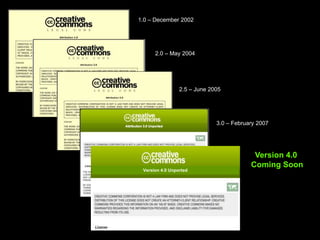
1.0 – December 2002


      2.0 – May 2004


                 2.5 – June 2005


                              3.0 – February 2007


                                           Version 4.0
                                          Coming Soon
 Version 4.0 Unported
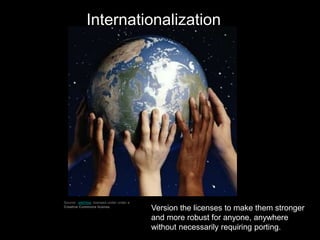
Internationalization


Source: wikiHow, licensed under under a
Creative Commons license.
                                          Version the licenses to make them stronger
                                          and more robust for anyone, anywhere
                                          without necessarily requiring porting.
European Union
Sui Generis Database Rights
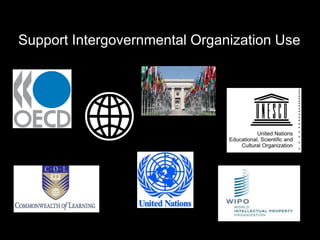
Support Intergovernmental Organization Use
4.0 for Educators
What You Can Expect


Clarified, more flexible, still respectful;
Easier compliance for teachers, students

ShareAlike as before, no expansion;
Reliable re-use with Wikipedia/media content


No change in definition;
No disruption of existing sharing models
What’s Still Open
         (inside & outside of licenses)

o Compatibility with Free Art License, GPL

o Porting

o Non-Commercial guidelines, stewardship

o Attribution and marking guidelines and
  best practices
Version 4 - What’s Next & Community Input?

 Draft 3 published Oct/Nov

 Porting, deed and license chooser discussion pre-launch

 Launch Q4-2012/Q1-2013

                           Participate!

  Subscribe: http://lists.ibiblio.org/mailman/listinfo/cc-licenses
  Share ideas: http://wiki.creativecommons.org/4.0
Platform & Learning support   Community coordination & Logistics
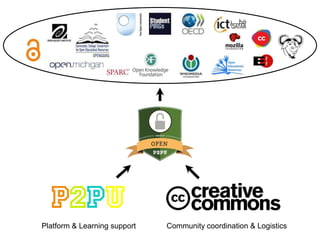
Open Communities


Platform & Learning support   Community coordination & Logistics
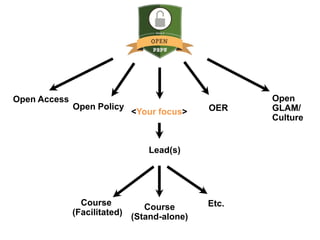
Open Access                                        Open
              Open Policy                   OER    GLAM/
                            <Your focus>
                                                   Culture


                               Lead(s)


                Course         Course       Etc.
              (Facilitated) (Stand-alone)
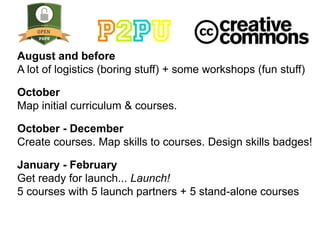
August and before
A lot of logistics (boring stuff) + some workshops (fun stuff)

October
Map initial curriculum & courses.

October - December
Create courses. Map skills to courses. Design skills badges!

January - February
Get ready for launch... Launch!
5 courses with 5 launch partners + 5 stand-alone courses
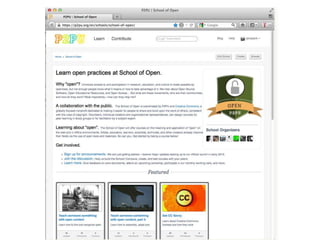
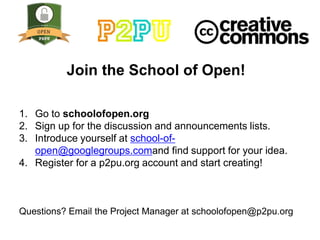
Join the School of Open!

1. Go to schoolofopen.org
2. Sign up for the discussion and announcements lists.
3. Introduce yourself at school-of-
   open@googlegroups.comand find support for your idea.
4. Register for a p2pu.org account and start creating!


Questions? Email the Project Manager at schoolofopen@p2pu.org
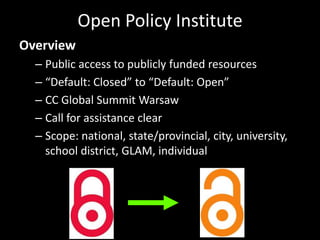
Open Policy Institute
Overview
  – Public access to publicly funded resources
  – “Default: Closed” to “Default: Open”
  – CC Global Summit Warsaw
  – Call for assistance clear
  – Scope: national, state/provincial, city, university,
    school district, GLAM, individual
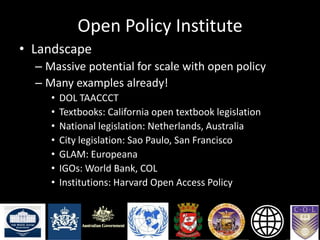
Open Policy Institute
• Landscape
  – Massive potential for scale with open policy
  – Many examples already!
     •   DOL TAACCCT
     •   Textbooks: California open textbook legislation
     •   National legislation: Netherlands, Australia
     •   City legislation: Sao Paulo, San Francisco
     •   GLAM: Europeana
     •   IGOs: World Bank, COL
     •   Institutions: Harvard Open Access Policy
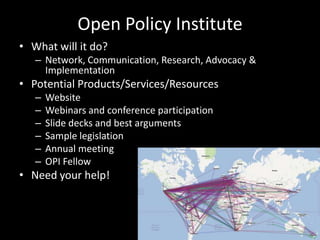
Open Policy Institute
• What will it do?
   – Network, Communication, Research, Advocacy &
     Implementation
• Potential Products/Services/Resources
   –   Website
   –   Webinars and conference participation
   –   Slide decks and best arguments
   –   Sample legislation
   –   Annual meeting
   –   OPI Fellow
• Need your help!
http://open4us.org
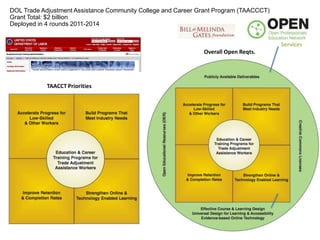
DOL Trade Adjustment Assistance Community College and Career Grant Program (TAACCCT)
Grant Total: $2 billion
Deployed in 4 rounds 2011-2014


                                                                                       Services
                                                              Overall Open Reqts.


            TAACCT Priorities
“In order to ensure that the Federal investment of these funds has as broad
an impact as possible and to encourage innovation in the development of
new learning materials, as a condition of the receipt of a TAACCCT grant, the
grantee will be required to license to the public (not including the Federal
Government) all work created with the support of the grant (Work) under a
Creative Commons Attribution 3.0 (CCBY) license. Work that must be licensed
under the CCBY includes both new content created with the grant funds and
modifications made to pre-existing, grantee-owned content using grant
funds. This license allows subsequent users to copy, distribute, transmit and
adapt the copyrighted Work and requires such users to attribute the Work in
the manner specified by the grantee.”
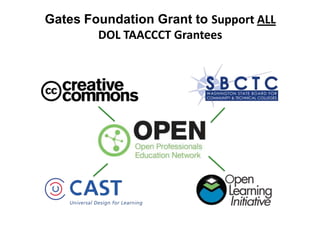
Gates Foundation Grant to Support ALL
        DOL TAACCCT Grantees
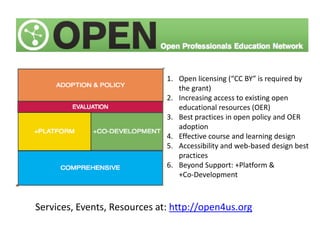
1. Open licensing (“CC BY” is required by
                                 the grant)
                              2. Increasing access to existing open
                                 educational resources (OER)
                              3. Best practices in open policy and OER
                                 adoption
                              4. Effective course and learning design
                              5. Accessibility and web-based design best
                                 practices
                              6. Beyond Support: +Platform &
                                 +Co-Development


Services, Events, Resources at: http://open4us.org
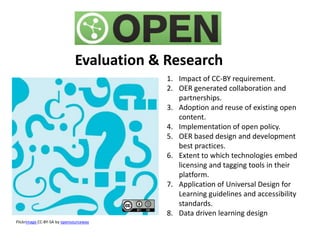
Evaluation & Research
                                          1. Impact of CC-BY requirement.
                                          2. OER generated collaboration and
                                             partnerships.
                                          3. Adoption and reuse of existing open
                                             content.
                                          4. Implementation of open policy.
                                          5. OER based design and development
                                             best practices.
                                          6. Extent to which technologies embed
                                             licensing and tagging tools in their
                                             platform.
                                          7. Application of Universal Design for
                                             Learning guidelines and accessibility
                                             standards.
                                          8. Data driven learning design
Flickrimage CC-BY-SA by opensourceway
Mark up educational resources:
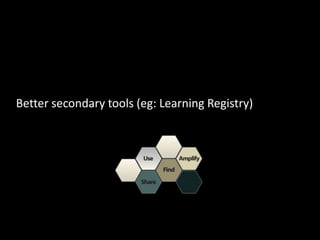
   Better search engine results
Better secondary tools (eg: Learning Registry)
Open standard compatible with Schema.org
   (Google, Bing Yahoo)

Also, compatible with your current metadata standard
(most likely)
We want to help you.
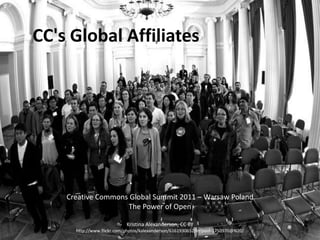
CC's Global Affiliates


    Creative Commons Global Summit 2011 – Warsaw Poland
                    The Power of Open

                            Kristina Alexanderson, CC BY
      http://www.flickr.com/photos/kalexanderson/6161930652/in/pool-1750970@N20/
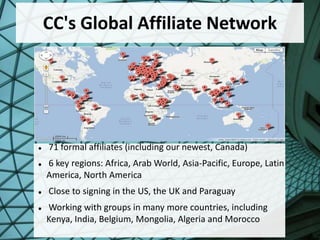
CC's Global Affiliate Network


   71 formal affiliates (including our newest, Canada)
   6 key regions: Africa, Arab World, Asia-Pacific, Europe, Latin
    America, North America
   Close to signing in the US, the UK and Paraguay
   Working with groups in many more countries, including
    Kenya, India, Belgium, Mongolia, Algeria and Morocco
Opportunities&Challenges
     Our network is CC's greatest          Still many gaps in network (eg
    asset                                   India)
     Diverse global coverage               All volunteers (some have local
     Huge local expertise and              funding)
    knowledge
                                            Great variation in strength and
     Includes global leaders in            capacity of teams
    copyright, open, education
    and culture                             Most of the world still hasn't
                                            heard of CC
     Long history of successful
    collaboration
     Incredible adoption
    success, from 1m objects in
    first year to 500m now
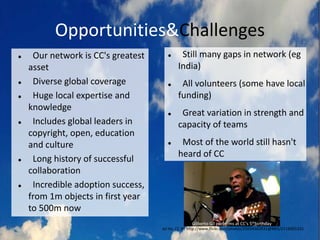
                                                   Gilberto Gil performs at CC's 5thbirthday
                                     Joi Ito, CC BY http://www.flickr.com/photos/35034362831@N01/2116005332
Growth and support
    Global Network team: 8 Regional Coordinators working across 5 regions;
    1 Global Network Manager

    Regular meetings and communication: alternate annually between
    Regional Meetings and Global Summit

    Affiliate support and training: more resources, workshops, exchange of
    ideas and information

    Collaborative projects: 10th birthday, Librebus, Power of Open

    Increased profile for our global community: news stories, case
    studies, representation at prominent meetings

    Work more with friends: other open organisations and communities with
    an interest in open (eg OER)

    Find new affiliates! target priority countries and regions (eg Canada)
#cc10 december 7-16
  10.creativecommons.org
cc10@creativecommons.org
Social Media Campaign

• CC Facts and Trivia
• Essays about CC from
  community leaders
• Music contest
Parties and meetups
Amman       Rabat/Casablanca
Cairo       Rio de Janeiro
Göteborg    San Francisco
Jakarta     Stockholm
Muscat      And more in the works
Creative Commons Open Education Conference 2012

Creative Commons Open Education Conference 2012

  • 1.
    Cable Green Paul Stacey Director of Global Learning Senior Project Manager
  • 2.
    “Our vision isnothing less than realizing the full potential of the Internet – universal access to research, education, and full participation in culture, driving a new era of development, growth, and productivity.”
  • 3.
    “Creative Commons develops,supports, and stewards legal and technical infrastructure that maximizes digital creativity, sharing, and innovation.” Version 4.0 License
  • 4.
    Crowd Source CCIdeas http://bit.ly/ccideas
  • 6.
    1.0 – December2002 2.0 – May 2004 2.5 – June 2005 3.0 – February 2007 Version 4.0 Coming Soon Version 4.0 Unported
  • 7.
    Internationalization Source: wikiHow, licensedunder under a Creative Commons license. Version the licenses to make them stronger and more robust for anyone, anywhere without necessarily requiring porting.
  • 8.
  • 9.
  • 10.
  • 11.
    What You CanExpect Clarified, more flexible, still respectful; Easier compliance for teachers, students ShareAlike as before, no expansion; Reliable re-use with Wikipedia/media content No change in definition; No disruption of existing sharing models
  • 12.
    What’s Still Open (inside & outside of licenses) o Compatibility with Free Art License, GPL o Porting o Non-Commercial guidelines, stewardship o Attribution and marking guidelines and best practices
  • 13.
    Version 4 -What’s Next & Community Input?  Draft 3 published Oct/Nov  Porting, deed and license chooser discussion pre-launch  Launch Q4-2012/Q1-2013 Participate! Subscribe: http://lists.ibiblio.org/mailman/listinfo/cc-licenses Share ideas: http://wiki.creativecommons.org/4.0
  • 14.
    Platform & Learningsupport Community coordination & Logistics
  • 15.
    Open Communities Platform &Learning support Community coordination & Logistics
  • 18.
    Open Access Open Open Policy OER GLAM/ <Your focus> Culture Lead(s) Course Course Etc. (Facilitated) (Stand-alone)
  • 20.
    August and before Alot of logistics (boring stuff) + some workshops (fun stuff) October Map initial curriculum & courses. October - December Create courses. Map skills to courses. Design skills badges! January - February Get ready for launch... Launch! 5 courses with 5 launch partners + 5 stand-alone courses
  • 21.
    Join the Schoolof Open! 1. Go to schoolofopen.org 2. Sign up for the discussion and announcements lists. 3. Introduce yourself at school-of- open@googlegroups.comand find support for your idea. 4. Register for a p2pu.org account and start creating! Questions? Email the Project Manager at schoolofopen@p2pu.org
  • 22.
  • 23.
    Open Policy Institute Overview – Public access to publicly funded resources – “Default: Closed” to “Default: Open” – CC Global Summit Warsaw – Call for assistance clear – Scope: national, state/provincial, city, university, school district, GLAM, individual
  • 24.
    Open Policy Institute •Landscape – Massive potential for scale with open policy – Many examples already! • DOL TAACCCT • Textbooks: California open textbook legislation • National legislation: Netherlands, Australia • City legislation: Sao Paulo, San Francisco • GLAM: Europeana • IGOs: World Bank, COL • Institutions: Harvard Open Access Policy
  • 25.
    Open Policy Institute •What will it do? – Network, Communication, Research, Advocacy & Implementation • Potential Products/Services/Resources – Website – Webinars and conference participation – Slide decks and best arguments – Sample legislation – Annual meeting – OPI Fellow • Need your help!
  • 26.
  • 27.
    DOL Trade AdjustmentAssistance Community College and Career Grant Program (TAACCCT) Grant Total: $2 billion Deployed in 4 rounds 2011-2014 Services Overall Open Reqts. TAACCT Priorities
  • 28.
    “In order toensure that the Federal investment of these funds has as broad an impact as possible and to encourage innovation in the development of new learning materials, as a condition of the receipt of a TAACCCT grant, the grantee will be required to license to the public (not including the Federal Government) all work created with the support of the grant (Work) under a Creative Commons Attribution 3.0 (CCBY) license. Work that must be licensed under the CCBY includes both new content created with the grant funds and modifications made to pre-existing, grantee-owned content using grant funds. This license allows subsequent users to copy, distribute, transmit and adapt the copyrighted Work and requires such users to attribute the Work in the manner specified by the grantee.”
  • 29.
    Gates Foundation Grantto Support ALL DOL TAACCCT Grantees
  • 30.
    1. Open licensing(“CC BY” is required by the grant) 2. Increasing access to existing open educational resources (OER) 3. Best practices in open policy and OER adoption 4. Effective course and learning design 5. Accessibility and web-based design best practices 6. Beyond Support: +Platform & +Co-Development Services, Events, Resources at: http://open4us.org
  • 31.
    Evaluation & Research 1. Impact of CC-BY requirement. 2. OER generated collaboration and partnerships. 3. Adoption and reuse of existing open content. 4. Implementation of open policy. 5. OER based design and development best practices. 6. Extent to which technologies embed licensing and tagging tools in their platform. 7. Application of Universal Design for Learning guidelines and accessibility standards. 8. Data driven learning design Flickrimage CC-BY-SA by opensourceway
  • 33.
    Mark up educationalresources: Better search engine results
  • 35.
    Better secondary tools(eg: Learning Registry)
  • 36.
    Open standard compatiblewith Schema.org (Google, Bing Yahoo) Also, compatible with your current metadata standard (most likely)
  • 37.
    We want tohelp you.
  • 38.
    CC's Global Affiliates Creative Commons Global Summit 2011 – Warsaw Poland The Power of Open Kristina Alexanderson, CC BY http://www.flickr.com/photos/kalexanderson/6161930652/in/pool-1750970@N20/
  • 39.
    CC's Global AffiliateNetwork  71 formal affiliates (including our newest, Canada)  6 key regions: Africa, Arab World, Asia-Pacific, Europe, Latin America, North America  Close to signing in the US, the UK and Paraguay  Working with groups in many more countries, including Kenya, India, Belgium, Mongolia, Algeria and Morocco
  • 40.
    Opportunities&Challenges  Our network is CC's greatest  Still many gaps in network (eg asset India)  Diverse global coverage  All volunteers (some have local  Huge local expertise and funding) knowledge  Great variation in strength and  Includes global leaders in capacity of teams copyright, open, education and culture  Most of the world still hasn't heard of CC  Long history of successful collaboration  Incredible adoption success, from 1m objects in first year to 500m now Gilberto Gil performs at CC's 5thbirthday Joi Ito, CC BY http://www.flickr.com/photos/35034362831@N01/2116005332
  • 41.
    Growth and support  Global Network team: 8 Regional Coordinators working across 5 regions; 1 Global Network Manager  Regular meetings and communication: alternate annually between Regional Meetings and Global Summit  Affiliate support and training: more resources, workshops, exchange of ideas and information  Collaborative projects: 10th birthday, Librebus, Power of Open  Increased profile for our global community: news stories, case studies, representation at prominent meetings  Work more with friends: other open organisations and communities with an interest in open (eg OER)  Find new affiliates! target priority countries and regions (eg Canada)
  • 42.
    #cc10 december 7-16 10.creativecommons.org cc10@creativecommons.org
  • 43.
    Social Media Campaign •CC Facts and Trivia • Essays about CC from community leaders • Music contest
  • 44.
    Parties and meetups Amman Rabat/Casablanca Cairo Rio de Janeiro Göteborg San Francisco Jakarta Stockholm Muscat And more in the works

Editor's Notes

  • #2 Presentation slide deck for Creative Commons plenary at 9th annual Open Education Conference Oct 16-18, 2012 in Vancouver BC CanadaCC plenary is on Tuesday Oct 16 at 3 pm.Presentation slides provided by and presented as follows: Diane (4.0) – CableJane (SSO) – PaulTim (OPI) – CablePaul (OPEN) – PaulGreg (LRMI) – CableJess: Affiliates - growth &amp; increasing focus on global role of CC – PaulElliot: CC 10 Birthday - Cable
  • #3 Expect most people will be familiar with CC but always good to emphasize what CC is all about – vision is inspiring.
  • #4 CC mission statement identifies our role around legal and technical providing good lead in to speaking about Version 4 licenses Compelling drivers for versioning the license suite now.
  • #7 Evolution of the CC license suite – a quick overview of why we version, and when.License versioning is a core responsibility of license stewardship -- to keep pace with and anticipate important changes in the legal and technology ecosystem, as well as the needs of our growing adopter base.Each prior versioning effort has be driven by important needs. Some examples from the two major versions to date1.0 – 2.0: CC learned a lot its first year in existence, and with experience came recognition that adjustments were needed relatively soon after launch of 1.0. Among other things * no demand for the non BY licenses in the original suite of 11 licenses; took the opportunity to drop those from the 2.0 suite * dropped affirmative representations and warranties on the part of licensors, to bring us in line with what other providers of free content were doing. We recognized (and encouraged then as well as today) that licensors can offer warranties with or without a fee where those are sought. This is a common model throughout the open publishing landscape, and one embraced by the open source community as well. * other important changes: improving the attribution requirement, addressing music-related issues including how the CC licenses work with collecting societies, and introducing compatibility between ported versions of BY-SA.2.0 to 3.0: second major upgrade * endorsement: concern by licensors that when others reused their works, the licensor endorsed those uses through attribution statements. Introduced “no endorsement” provision, introduced provision requiring removal of attribution when requested and reasonably possible, and clarified moral rights * internationalization-related issues: the generic license was one in the same as the US license, wanted to change that by creating a more international license using international terminology to ease adoption issues; other issues also were in play, including the need to harmonize still further treatment of moral rights. * compatibility: other major issue was compatibility with other copy-left or ShareAlike licenses. Recognized problems associated with having incompatible silos of content that could not be remixed; introduced a provision that would allow CC to declare other licenses sufficiently compatible such that content could be remixed between them and licensed under one or the other license easily.
  • #8 InternationalizationCC wants to enable anyone, anywhere to leverage our licenses to share educational and other works under legally sound terms that operate around the globe.While all CC licenses are designed to work anywhere and be used by anyone, the reality is that some who want to participate in our shared commons feel they cannot, for one or more reasons. CC has had a tradition of “porting” its licenses – legally adapting and translating the licenses for the needs to certain jurisdictions and language communities. But the porting project, however successful in some countries, has led those in countries where “ported” licenses do not exist to question the utility of the licenses for their use, and some see it as a limit on their ability to participate in the commons. This results in a “divide” between those in countries where licenses have been ported, and those who do not have ported licenses for any number of reasons, including lack of resources or expertise to “port.”CC’s experience with porting has taught us that we have all but maximized on the number of ported license suites possible – presently about 60 jurisdictions +/- have a ported suite. Of the 196 +/- countries in the world, that leaves more than 2/3 without a ported CC license that they can call their own. To maximize reach of the licenses and inclusion of as many people as possible, we are versioning the licenses to make them stronger and more robust still for anyone, anywhere, to bridge the divide. We are doing this through:Language – yet more internationalAddressing © issues that may exist in some places but not everywhere (more on this next)Legal code is more neutral still, and more accessible by humans as well as lawyersProcess-wise, affirmatively soliciting input from those countries where no ported licenses exist.As for the future of porting once 4.0 is published, CC will consult with its affiliates and others following publication of the next 4.0 draft. Our hope is that the international licenses are completed in a way way that obviates the need for porting almost everywhere. Regardless of how that decision comes out, we do plan on producing official translations of the 4.0 international license suite in collaboration with our affiliates and others.
  • #9 Other rights, new and existing.A second compelling reason to version is the complications that exist as a result of rights other than © that impede the use of CC works, most immediately Sui Generis Database Rights, but also other new rights that are being developed at the country, regional or international treaty level.CC licenses are fundamentally © licenses, and as such we took care in the first 4 versions to limit their reach to granting permissions where copyright automatically prevented sharing and reuse,. While we knew about other rights – including rights established by the European Union for non creative database rights – we kept our focus on © and instead took the strategic decision to oppose the creation and maintenance of other rights closely related to ©. This included the Sui Generis Database Right that protects non copyrightable databases throughout the European Union.Yes, in the past several years we have felt the consequences of not doing so. Many governments and providers of databases want to license those rights, and could not use the CC licenses to do so effectively.As a result, many important adopters have felt compelled to develop their own licenses in lieu of adopting CC licenses, particularly for databases and data.The consequence is that other specialized data and database licenses have proliferated. This causes confusion (among other things) about what licenses are best for which types of content and materials, and has created silos of incompatibly licensed content that cannot be remixed and reused together easily.
  • #10 A third factor compelling CC to version is the opportunity to make adjustments that accommodate needs of intergovernmental organizations who want to participate in the learning and education commons but cannot do so because our licenses to date have been insufficiently clear on how they operate relative to IGOs.These IGOs represent important policy makers as well as contributors of learning materials they seek to share broadly with the public under standard terms and conditions. CC licenses can accommodate the needs of many through the versioning process without substantively changing how our licenses operate. This should avoid the creation of custom licenses by IGOs that would compound the proliferation and interoperability problems.CC is working currently with a group of IGOs on a 3.0 port of the CC licenses. Our expectation is that 4.0 will address most if not all of their concerns so that the 4.0 licenses may be used in lieu of the 3.0 IGO ported licenses.
  • #12 Attribution requirements have been aggregated and greatly simplified, with more flexibility built in such that all requirements are subject to a “reasonable to the means, medium and context” standard;ShareAlike remains unchanged, which means your BY and BY-SA works can still be uploaded to Wikipedia/media as before, and you can remix content with your own from Wikipedia/media as before, with same rules SharingAlike applyingNo change in NC – this is a relief for many and a disappointment for others, but no compelling case with substantial consensus emerged; for those in the education with models based on –NC, you can continue to rely on the same definition applying
  • #13 One of our highest goals for 4.0 is to bridge divides between incompatible silos of content. We continue our discussions with the stewards of GPl and FAL in particular, so that remixes are possible, expanding the commons of reusable content.The need for and criteria for porting is still being explored, with a formal process starting after publication of the next draft of the licenses. For many, CC’s proliferation of licenses (we steward 550 +/- at present) is confusing, problematic, and an issue to take seriously. We will be doing that in collaboration with our affiliates starting in November.We promised NC guidelines for communities to enhance clarity around the existing definition – look for those efforts in the education arena in particular, starting late this year and early 2013. We also continue to evaluate NC stewardship questions such as license naming and branding. That will take place outside of the 4.0 process, and you can expect more on that later this year.Our improved attribution requirements provide an opportunity for helping licensees easily comply with those wanting to do the right thing. We plan to roll out best practices and guidelines – perhaps even technical solutions – that simplify compliance.
  • #14 Self-explanatory.
  • #24 By “Open Policy” we mean that publicly funded resources are openly licensed resources. To do this we need to flip the default of “closed” on its head to that the fundamental expectation is “open”we heard from the CC Affiliates at our Global Summit in Warsaw last yearAffiliates are on board with the power and potential of open policy to scale efficient sharing of education, science, data resourcesBut we need to be able to be more effective!We (the broadly “open” community) need the tools, like slides, talking points, FAQs, sample policies and legislation, etc.We need to be able to communicate and network with open policy advocates and sector-specific experts around the worldWe need to think about “Open Policy” broadlyPolicy happens at many different level, from national policies about sharing public sector information to personal policies about sharing the educational content you createLet’s not recreate the wheelLet’s leverage the best and brightest from the open world, whether it be in open licensing, open access, open science to provide assistanceWe’ll be in a support role; a hubWhere there is gaps, we’ll take the lead
  • #25 We don’t have to start from scratchThere’s already a lot of good policies out there for us to build upon and shareYou all know the innovative Department of Labor Community College and Career Training grant program$2 billion for the creation of course content to for community college students and worker retraining – CC BYRecently announced California open textbook legislation - $10 million to create highest enrolled higher ed digital textbooks and share for free under CC BYNational PSI legislation in Netherlands and Australia – public data is “open by default”City legislation in Sao Paulo, San Francisco that shares educational resources and city level data under open licensesGalleries, libraries, archives, museums adopting open policies to share metadata about their rich cultural collectionsIntergovernmental orgs adopting open licensing to share more appropriately aligned with their public interest missionInstitutions and universities like Harvard and many others ensuring that faculty and researchers are able to share their articles and research in open repositoriesThere are tools to track these policies like such as OER Policy Registry, ROARMAP
  • #26 The Open Policy Institute is still in the formative stageWe had a meeting in California 2 weeks ago bringing together “leaders of the open world”High level goals of the institute will be to provide 1) networking and connecting individuals and projects with others that can assist them2) communicate news, briefing kits, and “state of the field” for various sectors, such as OER, OA, etc. 3) coordinate needed economic and social research and solicit solid evidence for open that can be presented to policymakers4) provide real-time support in advocacy and ensure that once open policies are passed they continuePotential services could includePlease join in this important work!http://wiki.creativecommons.org/Open_Policy_Institute
  • #27 CC involved in DOL TAACCCT program
  • #28 DOL TAACCCT program largestOER initiative everCore priorities and purpose of programTAACCCT program open requirements and areas where CC/OPEN providing services
  • #29 TAACCCT specific wording around open and requirement for CC license
  • #31 Main services being provided by OPEN
  • #32 Evaluation and research component of OPEN
  • #44 Lots of surprises planned for the ten-day period.Music contest being planned with our friends at Free Music Archive.
  • #45 People can find information about all of these on the Events page(There’s also be a link to CC10 on the homepage banner)Again, email us if you want to get involved. Can host your own meetup and we’ll help promote it.