<name> Ahmad Haghighi </name>
<e-mail> haghighi.ahmad@gmail.com </e-mail>
<date> Apr. 2014 </date>
<title>OpenLdap vs. Active Directory</title>
WHAT IS A DIRECTORY SERVICE?
 A directory service is the software system that stores, organizes
and provides access to information in a directory.
 In software engineering, a directory is a map between names and
values.
 A Directory is organized and/or optimized for lookup, searching,
browsing and other ‘Read’ activities.
 It allows the lookup of values given a name, similar to a dictionary.
 In a directory, a name may be associated with multiple, different
pieces of information
DIRECTORYVS. DATABASE
 Typically optimized for a very high ratio of searches to updates
 Not suited for information that changes rapidly
 Read-write ratio - LDAP is read optimized
 Extensibility - LDAP schemas are more easily changed
 Distribution - with LDAP data can be near where it is Needed
 Different performance - databases are generally deployed for
limited amount of applications
WHAT IS LDAP?
 LDAP=Lightweight Directory Access Protocol
 BasedonX.500
 Directory Service (RFC1777)
 Stores attribute based data
 Data generally read more than written
 Client-server model
 Based on entries
 Collection of attributes
WHY USE LDAP?
 Centrally manage users, groups and other data
 Don’t have to manage separate directories for each application
 Distribute management of data to appropriate people
 Allow users to find data that they need
 Authentication
 Authorization
 Auditing & Monitoring
SOME LDAPVENDORS
 Fedora DS
 OpenDS
 OpenLDAP
 Microsoft Active Directory
 Sun
 Novell
 HP
 CA
 Red Hat
 IBM
 Lotus
COMPARISON
Based on some common features
SUPPORTED INTERNET STANDARD
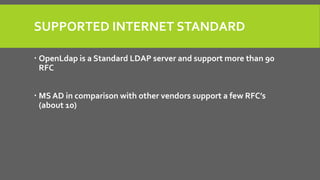
 OpenLdap is a Standard LDAP server and support more than 90
RFC
 MS AD in comparison with other vendors support a few RFC’s
(about 10)
SUPPORTED PLATFORMS
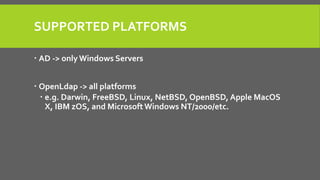
 AD -> only Windows Servers
 OpenLdap -> all platforms
 e.g. Darwin, FreeBSD, Linux, NetBSD, OpenBSD, Apple MacOS
X, IBM zOS, and MicrosoftWindows NT/2000/etc.
SIMPLE BIND BENCHMARK DATA
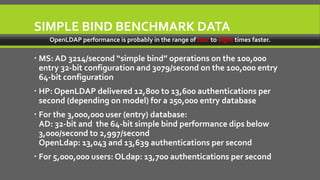
 MS: AD 3214/second “simple bind” operations on the 100,000
entry 32-bit configuration and 3079/second on the 100,000 entry
64-bit configuration
 HP: OpenLDAP delivered 12,800 to 13,600 authentications per
second (depending on model) for a 250,000 entry database
 For the 3,000,000 user (entry) database:
AD: 32-bit and the 64-bit simple bind performance dips below
3,000/second to 2,997/second
OpenLdap: 13,043 and 13,639 authentications per second
 For 5,000,000 users: OLdap: 13,700 authentications per second
OpenLDAP performance is probably in the range of four to eight times faster.
PERFORMANCE
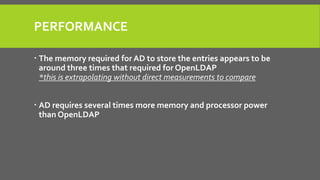
 The memory required for AD to store the entries appears to be
around three times that required for OpenLDAP
*this is extrapolating without direct measurements to compare
 AD requires several times more memory and processor power
than OpenLDAP
EASE OF USE
 AD is much easier to use and have pre designed schema and
policies (less flexibility)
 In OpenLDAP admin must define every thing manually and from
base
QUERY LIMIT
 AD has a default query limit of 10,000/1,000
 Admin can change this value in configuration
 For retrieving large amount of information we need paging
PROMINENT LIMITATIONS OF
ADAM
Neither the LDAP standard nor the OpenLDAP product imposes any of the limitations described next
SCHEMA LIMITATIONS
 # Page 19
 Attribute Character Length
 AttributeValue Limits
 Relative Distinguished Names
 OU Limitations
 Distinguished Name Syntax Attributes
 Objectclass and Attribute Definitions
DATA ACCESS LIMITATIONS
 # Page 21
 Anonymous Binding
 Access Control
PERFORMANCE LIMITATIONS
 # Page 21
 Indexing
 Caching
FINAL NOTE
This is a clear and unambiguous statement that AD fails to provide
the flexibility, extensibility, and other attributes needed to be a
true directory services technology. AD may be excellent as a NOS
directory, but this is an admission that it is NOT an LDAP directory.
It is a NOS directory that supports LDAP access to its data
There is no particular demand on most LDAP servers to run in any
mode or under a specific user ID or restrictions. AD is inflexible in
this and that means that experimental or educational instances are
difficult to use
Q&A
REFERENCES
 http://en.wikipedia.org/wiki/Directory_services
 http://en.wikipedia.org/wiki/Ldap
 http://en.wikipedia.org/wiki/Active_Directory
 http://en.wikipedia.org/wiki/Openldap
 “Assessment of Microsoft’s Active Directory Application Mode
(ADAM) as a Potential Enterprise DirectoryTechnology versus
OpenLDAP and Other LDAP Offerings”, Symas Corporation,
Version: 1.0, Published: October 2007
http://symas.com/documents/Adam-Eval1-0.pdf
REFERENCES
 http://www.microsoft.com/downloads/details.aspx?FamilyID=52e7c3bd-570a-475c-96e0-
316dc821e3e7&DisplayLang=en
 http://www.symas.com/benchmark.shtml
 http://www.connexitor.com/blog/archives/archive_2007-m04.php#e130
 http://www.connexitor.com/blog/archives/archive_2007-m04.php#e131
 http://h71019.www7.hp.com/ActiveAnswers/cache/393495-0-0-0-121.html
 How ADAM works: http://technet2.microsoft.com/WindowsServer/en/library/7cfc8997-bab2-4770-aff2-
be424fd03cda1033.mspx?mfr=true
 FAQ: http://www.microsoft.com/windowsserver2003/adam/ADAMfaq.mspx
 AD Schema reference: http://technet2.microsoft.com/windowsserver/en/library/97cae647-d996-48ff-b478-
c96193abeadb1033.mspx?mfr=true
 SANS Institute Internet Storm Center for Port 135: http://isc.sans.org/port.html?port=135
tnx ;)

Open LDAP vs. Active Directory

  • 1.
    <name> Ahmad Haghighi</name> <e-mail> haghighi.ahmad@gmail.com </e-mail> <date> Apr. 2014 </date> <title>OpenLdap vs. Active Directory</title>
  • 2.
    WHAT IS ADIRECTORY SERVICE?  A directory service is the software system that stores, organizes and provides access to information in a directory.  In software engineering, a directory is a map between names and values.  A Directory is organized and/or optimized for lookup, searching, browsing and other ‘Read’ activities.  It allows the lookup of values given a name, similar to a dictionary.  In a directory, a name may be associated with multiple, different pieces of information
  • 3.
    DIRECTORYVS. DATABASE  Typicallyoptimized for a very high ratio of searches to updates  Not suited for information that changes rapidly  Read-write ratio - LDAP is read optimized  Extensibility - LDAP schemas are more easily changed  Distribution - with LDAP data can be near where it is Needed  Different performance - databases are generally deployed for limited amount of applications
  • 4.
    WHAT IS LDAP? LDAP=Lightweight Directory Access Protocol  BasedonX.500  Directory Service (RFC1777)  Stores attribute based data  Data generally read more than written  Client-server model  Based on entries  Collection of attributes
  • 5.
    WHY USE LDAP? Centrally manage users, groups and other data  Don’t have to manage separate directories for each application  Distribute management of data to appropriate people  Allow users to find data that they need  Authentication  Authorization  Auditing & Monitoring
  • 6.
    SOME LDAPVENDORS  FedoraDS  OpenDS  OpenLDAP  Microsoft Active Directory  Sun  Novell  HP  CA  Red Hat  IBM  Lotus
  • 7.
    COMPARISON Based on somecommon features
  • 8.
    SUPPORTED INTERNET STANDARD OpenLdap is a Standard LDAP server and support more than 90 RFC  MS AD in comparison with other vendors support a few RFC’s (about 10)
  • 9.
    SUPPORTED PLATFORMS  AD-> only Windows Servers  OpenLdap -> all platforms  e.g. Darwin, FreeBSD, Linux, NetBSD, OpenBSD, Apple MacOS X, IBM zOS, and MicrosoftWindows NT/2000/etc.
  • 10.
    SIMPLE BIND BENCHMARKDATA  MS: AD 3214/second “simple bind” operations on the 100,000 entry 32-bit configuration and 3079/second on the 100,000 entry 64-bit configuration  HP: OpenLDAP delivered 12,800 to 13,600 authentications per second (depending on model) for a 250,000 entry database  For the 3,000,000 user (entry) database: AD: 32-bit and the 64-bit simple bind performance dips below 3,000/second to 2,997/second OpenLdap: 13,043 and 13,639 authentications per second  For 5,000,000 users: OLdap: 13,700 authentications per second OpenLDAP performance is probably in the range of four to eight times faster.
  • 11.
    PERFORMANCE  The memoryrequired for AD to store the entries appears to be around three times that required for OpenLDAP *this is extrapolating without direct measurements to compare  AD requires several times more memory and processor power than OpenLDAP
  • 12.
    EASE OF USE AD is much easier to use and have pre designed schema and policies (less flexibility)  In OpenLDAP admin must define every thing manually and from base
  • 13.
    QUERY LIMIT  ADhas a default query limit of 10,000/1,000  Admin can change this value in configuration  For retrieving large amount of information we need paging
  • 14.
    PROMINENT LIMITATIONS OF ADAM Neitherthe LDAP standard nor the OpenLDAP product imposes any of the limitations described next
  • 15.
    SCHEMA LIMITATIONS  #Page 19  Attribute Character Length  AttributeValue Limits  Relative Distinguished Names  OU Limitations  Distinguished Name Syntax Attributes  Objectclass and Attribute Definitions
  • 16.
    DATA ACCESS LIMITATIONS # Page 21  Anonymous Binding  Access Control
  • 17.
    PERFORMANCE LIMITATIONS  #Page 21  Indexing  Caching
  • 18.
    FINAL NOTE This isa clear and unambiguous statement that AD fails to provide the flexibility, extensibility, and other attributes needed to be a true directory services technology. AD may be excellent as a NOS directory, but this is an admission that it is NOT an LDAP directory. It is a NOS directory that supports LDAP access to its data There is no particular demand on most LDAP servers to run in any mode or under a specific user ID or restrictions. AD is inflexible in this and that means that experimental or educational instances are difficult to use
  • 19.
  • 20.
    REFERENCES  http://en.wikipedia.org/wiki/Directory_services  http://en.wikipedia.org/wiki/Ldap http://en.wikipedia.org/wiki/Active_Directory  http://en.wikipedia.org/wiki/Openldap  “Assessment of Microsoft’s Active Directory Application Mode (ADAM) as a Potential Enterprise DirectoryTechnology versus OpenLDAP and Other LDAP Offerings”, Symas Corporation, Version: 1.0, Published: October 2007 http://symas.com/documents/Adam-Eval1-0.pdf
  • 21.
    REFERENCES  http://www.microsoft.com/downloads/details.aspx?FamilyID=52e7c3bd-570a-475c-96e0- 316dc821e3e7&DisplayLang=en  http://www.symas.com/benchmark.shtml http://www.connexitor.com/blog/archives/archive_2007-m04.php#e130  http://www.connexitor.com/blog/archives/archive_2007-m04.php#e131  http://h71019.www7.hp.com/ActiveAnswers/cache/393495-0-0-0-121.html  How ADAM works: http://technet2.microsoft.com/WindowsServer/en/library/7cfc8997-bab2-4770-aff2- be424fd03cda1033.mspx?mfr=true  FAQ: http://www.microsoft.com/windowsserver2003/adam/ADAMfaq.mspx  AD Schema reference: http://technet2.microsoft.com/windowsserver/en/library/97cae647-d996-48ff-b478- c96193abeadb1033.mspx?mfr=true  SANS Institute Internet Storm Center for Port 135: http://isc.sans.org/port.html?port=135
  • 22.