WEBINAR
Understanding Akka Streams, Back Pressure
and Asynchronous Architectures
by Konrad Malawski (@ktosopl)
Konrad `ktoso` Malawski
Akka Team,
Reactive Streams TCK,
Persistence, HTTP
Konrad `@ktosopl` Malawski
akka.io
typesafe.com
geecon.org
Java.pl / KrakowScala.pl
sckrk.com
GDGKrakow.pl
lambdakrk.pl
“Stream”
“Stream”
What does it mean?!
Akka Streams
Akka Streams && Reactive Streams
Why back-pressure?
?
Why back-pressure?
So you’ve built your app and it’s awesome.
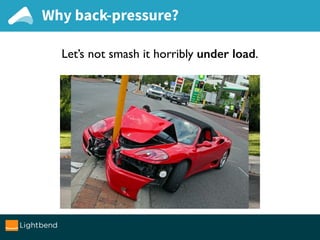
Why back-pressure?
Let’s not smash it horribly under load.
What is back-pressure?
?
What is back-pressure?
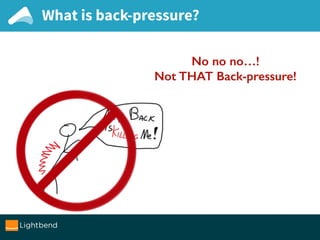
No no no…!
Not THAT Back-pressure!
No no no…!
Not THAT Back-pressure!
What is back-pressure?
Publisher[T] Subscriber[T]
Back-pressure explained
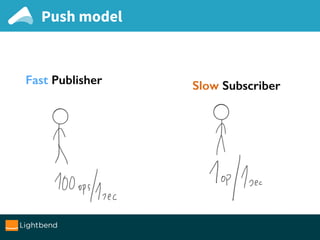
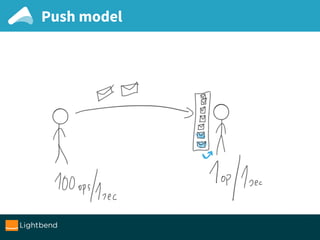
Fast Publisher Slow Subscriber
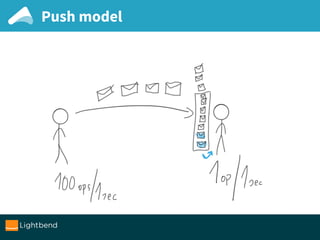
Push model
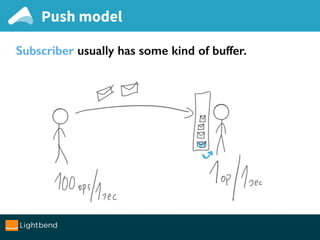
Subscriber usually has some kind of buffer.
Push model
Push model
Push model
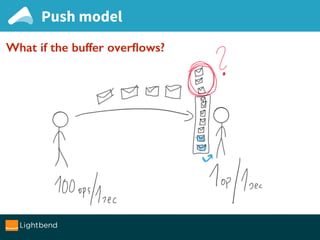
What if the buffer overflows?
Push model
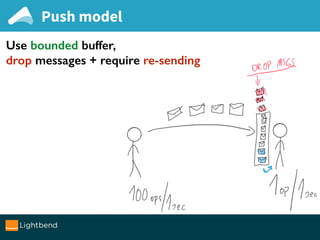
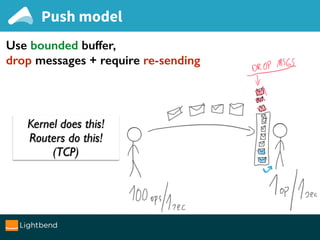
Use bounded buffer,
drop messages + require re-sending
Push model
Kernel does this!
Routers do this!
(TCP)
Use bounded buffer,
drop messages + require re-sending
Push model
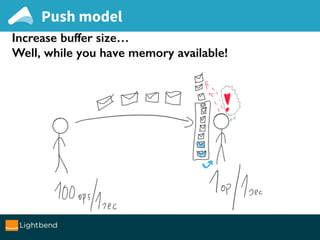
Increase buffer size…
Well, while you have memory available!
Push model
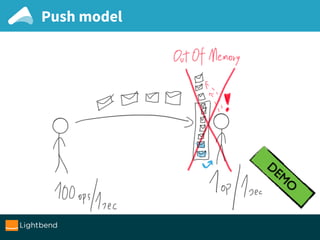
Push model
D
EM
O
Reactive Streams explained
Reactive Streams
explained in 1 slide
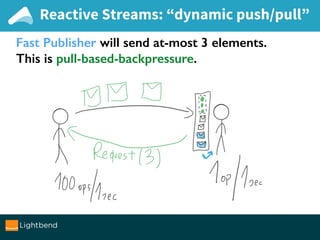
Fast Publisher will send at-most 3 elements.
This is pull-based-backpressure.
Reactive Streams: “dynamic push/pull”
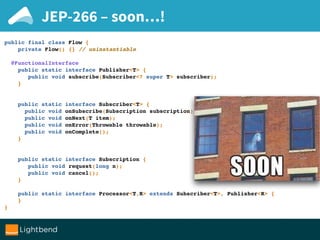
JEP-266 – soon…!
public final class Flow {
private Flow() {} // uninstantiable
@FunctionalInterface
public static interface Publisher<T> {
public void subscribe(Subscriber<? super T> subscriber);
}
public static interface Subscriber<T> {
public void onSubscribe(Subscription subscription);
public void onNext(T item);
public void onError(Throwable throwable);
public void onComplete();
}
public static interface Subscription {
public void request(long n);
public void cancel();
}
public static interface Processor<T,R> extends Subscriber<T>, Publisher<R> {
}
}
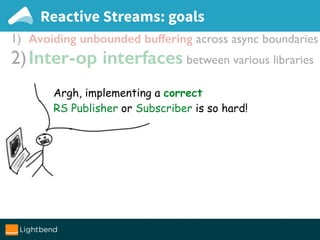
Reactive Streams: goals
1) Avoiding unbounded buffering across async boundaries
2)Inter-op interfaces between various libraries
Reactive Streams: goals
1) Avoiding unbounded buffering across async boundaries
2)Inter-op interfaces between various libraries
Argh, implementing a correct RS Publisher
or Subscriber is so hard!
Reactive Streams: goals
1) Avoiding unbounded buffering across async boundaries
2)Inter-op interfaces between various libraries
Argh, implementing a correct
RS Publisher or Subscriber is so hard!
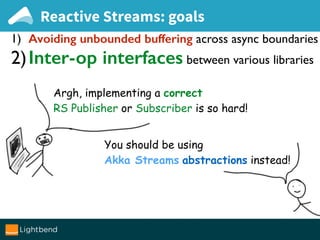
Reactive Streams: goals
1) Avoiding unbounded buffering across async boundaries
2)Inter-op interfaces between various libraries
Argh, implementing a correct
RS Publisher or Subscriber is so hard!
You should be using
Akka Streams abstractions instead!
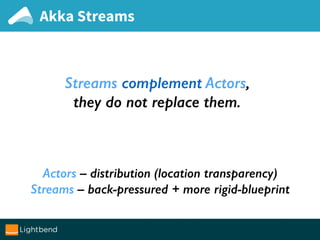
Akka Streams
Streams complement Actors,
they do not replace them.
Actors – distribution (location transparency)
Streams – back-pressured + more rigid-blueprint
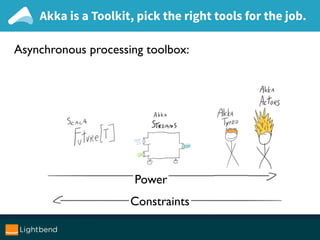
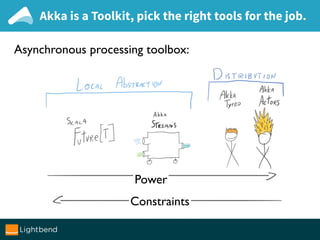
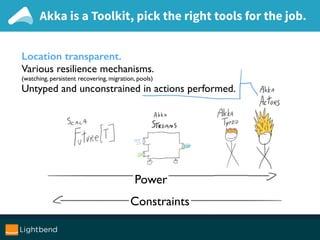
Akka is a Toolkit, pick the right tools for the job.
Runar’s excellent talk @ Scala.World 2015
Asynchronous processing toolbox:
Power
Constraints
Akka is a Toolkit, pick the right tools for the job.
Asynchronous processing toolbox:
Constraints
Power
Akka is a Toolkit, pick the right tools for the job.
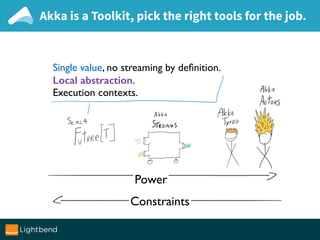
Single value, no streaming by definition.
Local abstraction.

Execution contexts.
Power
Constraints
Akka is a Toolkit, pick the right tools for the job.
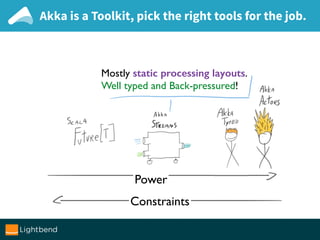
Mostly static processing layouts.
Well typed and Back-pressured!
Constraints
Power
Akka is a Toolkit, pick the right tools for the job.
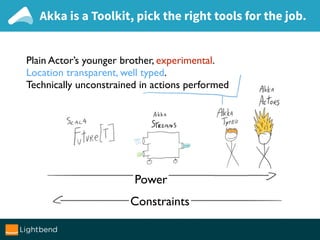
Plain Actor’s younger brother, experimental.
Location transparent, well typed.
Technically unconstrained in actions performed
Constraints
Power
Akka is a Toolkit, pick the right tools for the job.
Runar’s excellent talk @ Scala.World 2015
Location transparent.
Various resilience mechanisms.
(watching, persistent recovering, migration, pools)
Untyped and unconstrained in actions performed.
Constraints
Power
Akka Streams
streams
Akka Streams in 20 seconds:
// types:
Source[Out, Mat]
Flow[In, Out, Mat]
Sink[In, Mat]
// generally speaking, it's always:
val ready = Source(???).via(flow).map(_ * 2).to(sink)
val mat: Mat = ready.run()
// the usual example:
val f: Future[String] =
Source.single(1).map(_.toString).runWith(Sink.head)
Proper static typing!
Akka Streams in 20 seconds:
// types: _
Source[Int, Unit]
Flow[Int, String, Unit]
Sink[String, Future[String]]
Source.single(1).map(_.toString).runWith(Sink.head)
Akka Streams in 20 seconds:
// types: _
Source[Int, Unit]
Flow[Int, String, Unit]
Sink[String, Future[String]]
Source.single(1).map(_.toString).runWith(Sink.head)
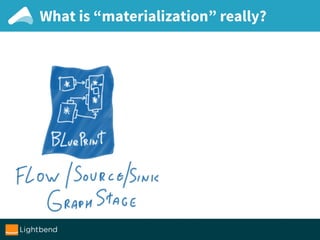
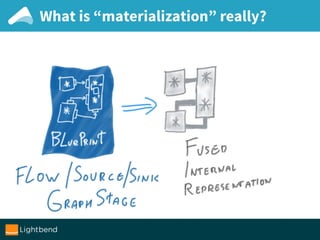
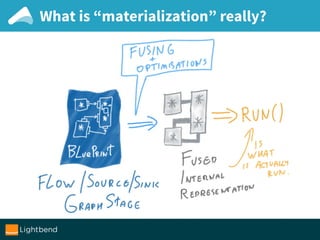
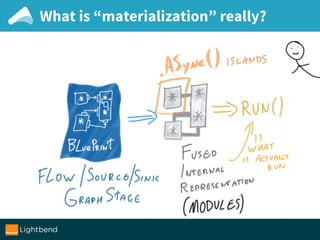
Materialization
Gears from GeeCON.org, did I mention it’s an awesome conf?
What is “materialization” really?
Akka Streams & HTTP
streams
& HTTP
Akka HTTP
Joint effort of Spray and Akka teams.
Complete HTTP Server/Client implementation.
Learns from Spray’s 3-4 years history.
Since the beginning with
streaming as first class citizen.
Side note:
Lagom also utilises Akka Streams for streaming.
Streaming in Akka HTTP
DEMO
http://doc.akka.io/docs/akka/2.4.7/scala/stream/stream-customize.html#graphstage-scala
“Framed entity streaming” https://github.com/akka/akka/pull/20778
HttpServer as a:
Flow[HttpRequest, HttpResponse]
Streaming in Akka HTTP
DEMO
http://doc.akka.io/docs/akka/2.4.7/scala/stream/stream-customize.html#graphstage-scala
“Framed entity streaming” https://github.com/akka/akka/pull/20778
HttpServer as a:
Flow[HttpRequest, HttpResponse]
HTTP Entity as a:
Source[ByteString, _]
Streaming in Akka HTTP
DEMO
http://doc.akka.io/docs/akka/2.4.7/scala/stream/stream-customize.html#graphstage-scala
“Framed entity streaming” https://github.com/akka/akka/pull/20778
HttpServer as a:
Flow[HttpRequest, HttpResponse]
HTTP Entity as a:
Source[ByteString, _]
Websocket connection as a:
Flow[ws.Message, ws.Message]
Persistence Query (experimental)
“The Query Side”
of Akka Persistence
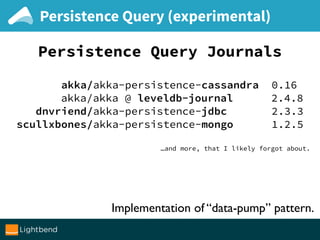
Persistence Query (experimental)
Persistence Query Journals
akka/akka-persistence-cassandra 0.16
akka/akka @ leveldb-journal 2.4.8
dnvriend/akka-persistence-jdbc 2.3.3
scullxbones/akka-persistence-mongo 1.2.5
…and more, that I likely forgot about.
Implementation of “data-pump” pattern.
Akka + Kafka = BFF
Reactive Kafka
+
Started by Krzysiek Ciesielski & Adam Warski @ SofwareMill.com
“ACKnowladged streams”
happy ACKing!
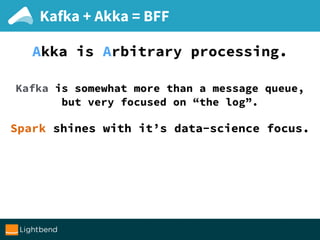
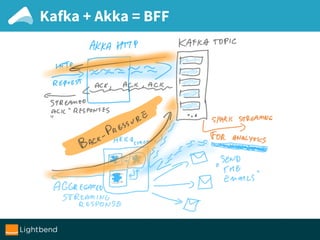
Kafka + Akka = BFF
Akka is Arbitrary processing.
Kafka is somewhat more than a message queue,
but very focused on “the log”.
Spark shines with it’s data-science focus.
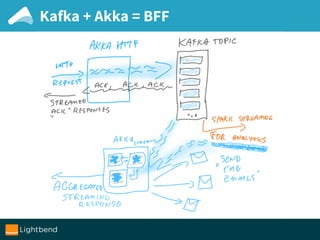
Kafka + Akka = BFF
Kafka + Akka = BFF
Streams talking to Actors
&&
Actors talking to Streams
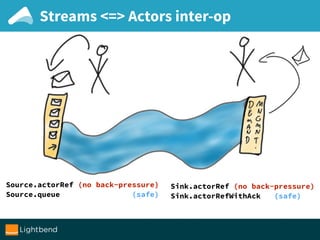
Streams <=> Actors inter-op
Source.actorRef (no back-pressure)
Source.queue (safe)
Sink.actorRef (no back-pressure)
Sink.actorRefWithAck (safe)
Exciting times ahead!
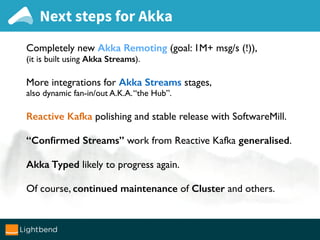
Next steps for Akka
Completely new Akka Remoting (goal: 1M+ msg/s (!)),
(it is built using Akka Streams).
More integrations for Akka Streams stages,
also dynamic fan-in/out A.K.A.“the Hub”.
Reactive Kafka polishing and stable release with SoftwareMill.
“Confirmed Streams” work from Reactive Kafka generalised.
Akka Typed likely to progress again.
Of course, continued maintenance of Cluster and others.
Upgrade your grey matter

Two free O’Reilly eBooks by Lightbend
DOWNLOAD	NOWDOWNLOAD	NOW
lightbend.com/pov
Reactive Roundtable

World Tour by Lightbend
lightbend.com/reactive-roundtable
Proof of Value Service

Accelerate Project Success
Q/A
ktoso @ lightbend.com
twitter: ktosopl
github: ktoso
team blog: letitcrash.com
home: akka.io

Understanding Akka Streams, Back Pressure, and Asynchronous Architectures

  • 1.
    WEBINAR Understanding Akka Streams,Back Pressure and Asynchronous Architectures by Konrad Malawski (@ktosopl)
  • 2.
    Konrad `ktoso` Malawski AkkaTeam, Reactive Streams TCK, Persistence, HTTP
  • 3.
    Konrad `@ktosopl` Malawski akka.io typesafe.com geecon.org Java.pl/ KrakowScala.pl sckrk.com GDGKrakow.pl lambdakrk.pl
  • 5.
  • 6.
  • 7.
    Akka Streams Akka Streams&& Reactive Streams
  • 8.
  • 9.
    Why back-pressure? So you’vebuilt your app and it’s awesome.
  • 10.
    Why back-pressure? Let’s notsmash it horribly under load.
  • 11.
  • 12.
  • 13.
    No no no…! NotTHAT Back-pressure! No no no…! Not THAT Back-pressure! What is back-pressure?
  • 14.
  • 15.
    Fast Publisher SlowSubscriber Push model
  • 16.
    Subscriber usually hassome kind of buffer. Push model
  • 17.
  • 18.
  • 19.
    What if thebuffer overflows? Push model
  • 20.
    Use bounded buffer, dropmessages + require re-sending Push model
  • 21.
    Kernel does this! Routersdo this! (TCP) Use bounded buffer, drop messages + require re-sending Push model
  • 22.
    Increase buffer size… Well,while you have memory available! Push model
  • 23.
  • 24.
    Reactive Streams explained ReactiveStreams explained in 1 slide
  • 25.
    Fast Publisher willsend at-most 3 elements. This is pull-based-backpressure. Reactive Streams: “dynamic push/pull”
  • 26.
    JEP-266 – soon…! publicfinal class Flow { private Flow() {} // uninstantiable @FunctionalInterface public static interface Publisher<T> { public void subscribe(Subscriber<? super T> subscriber); } public static interface Subscriber<T> { public void onSubscribe(Subscription subscription); public void onNext(T item); public void onError(Throwable throwable); public void onComplete(); } public static interface Subscription { public void request(long n); public void cancel(); } public static interface Processor<T,R> extends Subscriber<T>, Publisher<R> { } }
  • 27.
    Reactive Streams: goals 1)Avoiding unbounded buffering across async boundaries 2)Inter-op interfaces between various libraries
  • 28.
    Reactive Streams: goals 1)Avoiding unbounded buffering across async boundaries 2)Inter-op interfaces between various libraries Argh, implementing a correct RS Publisher or Subscriber is so hard!
  • 29.
    Reactive Streams: goals 1)Avoiding unbounded buffering across async boundaries 2)Inter-op interfaces between various libraries Argh, implementing a correct RS Publisher or Subscriber is so hard!
  • 30.
    Reactive Streams: goals 1)Avoiding unbounded buffering across async boundaries 2)Inter-op interfaces between various libraries Argh, implementing a correct RS Publisher or Subscriber is so hard! You should be using Akka Streams abstractions instead!
  • 31.
    Akka Streams Streams complementActors, they do not replace them. Actors – distribution (location transparency) Streams – back-pressured + more rigid-blueprint
  • 32.
    Akka is aToolkit, pick the right tools for the job. Runar’s excellent talk @ Scala.World 2015 Asynchronous processing toolbox: Power Constraints
  • 33.
    Akka is aToolkit, pick the right tools for the job. Asynchronous processing toolbox: Constraints Power
  • 34.
    Akka is aToolkit, pick the right tools for the job. Single value, no streaming by definition. Local abstraction.
 Execution contexts. Power Constraints
  • 35.
    Akka is aToolkit, pick the right tools for the job. Mostly static processing layouts. Well typed and Back-pressured! Constraints Power
  • 36.
    Akka is aToolkit, pick the right tools for the job. Plain Actor’s younger brother, experimental. Location transparent, well typed. Technically unconstrained in actions performed Constraints Power
  • 37.
    Akka is aToolkit, pick the right tools for the job. Runar’s excellent talk @ Scala.World 2015 Location transparent. Various resilience mechanisms. (watching, persistent recovering, migration, pools) Untyped and unconstrained in actions performed. Constraints Power
  • 38.
  • 39.
    Akka Streams in20 seconds: // types: Source[Out, Mat] Flow[In, Out, Mat] Sink[In, Mat] // generally speaking, it's always: val ready = Source(???).via(flow).map(_ * 2).to(sink) val mat: Mat = ready.run() // the usual example: val f: Future[String] = Source.single(1).map(_.toString).runWith(Sink.head) Proper static typing!
  • 40.
    Akka Streams in20 seconds: // types: _ Source[Int, Unit] Flow[Int, String, Unit] Sink[String, Future[String]] Source.single(1).map(_.toString).runWith(Sink.head)
  • 41.
    Akka Streams in20 seconds: // types: _ Source[Int, Unit] Flow[Int, String, Unit] Sink[String, Future[String]] Source.single(1).map(_.toString).runWith(Sink.head)
  • 42.
    Materialization Gears from GeeCON.org,did I mention it’s an awesome conf?
  • 43.
  • 44.
  • 45.
  • 46.
  • 47.
    Akka Streams &HTTP streams & HTTP
  • 48.
    Akka HTTP Joint effortof Spray and Akka teams. Complete HTTP Server/Client implementation. Learns from Spray’s 3-4 years history. Since the beginning with streaming as first class citizen. Side note: Lagom also utilises Akka Streams for streaming.
  • 49.
    Streaming in AkkaHTTP DEMO http://doc.akka.io/docs/akka/2.4.7/scala/stream/stream-customize.html#graphstage-scala “Framed entity streaming” https://github.com/akka/akka/pull/20778 HttpServer as a: Flow[HttpRequest, HttpResponse]
  • 50.
    Streaming in AkkaHTTP DEMO http://doc.akka.io/docs/akka/2.4.7/scala/stream/stream-customize.html#graphstage-scala “Framed entity streaming” https://github.com/akka/akka/pull/20778 HttpServer as a: Flow[HttpRequest, HttpResponse] HTTP Entity as a: Source[ByteString, _]
  • 51.
    Streaming in AkkaHTTP DEMO http://doc.akka.io/docs/akka/2.4.7/scala/stream/stream-customize.html#graphstage-scala “Framed entity streaming” https://github.com/akka/akka/pull/20778 HttpServer as a: Flow[HttpRequest, HttpResponse] HTTP Entity as a: Source[ByteString, _] Websocket connection as a: Flow[ws.Message, ws.Message]
  • 52.
    Persistence Query (experimental) “TheQuery Side” of Akka Persistence
  • 53.
    Persistence Query (experimental) PersistenceQuery Journals akka/akka-persistence-cassandra 0.16 akka/akka @ leveldb-journal 2.4.8 dnvriend/akka-persistence-jdbc 2.3.3 scullxbones/akka-persistence-mongo 1.2.5 …and more, that I likely forgot about. Implementation of “data-pump” pattern.
  • 54.
    Akka + Kafka= BFF Reactive Kafka + Started by Krzysiek Ciesielski & Adam Warski @ SofwareMill.com
  • 55.
  • 56.
    Kafka + Akka= BFF Akka is Arbitrary processing. Kafka is somewhat more than a message queue, but very focused on “the log”. Spark shines with it’s data-science focus.
  • 57.
  • 58.
  • 59.
    Streams talking toActors && Actors talking to Streams
  • 60.
    Streams <=> Actorsinter-op Source.actorRef (no back-pressure) Source.queue (safe) Sink.actorRef (no back-pressure) Sink.actorRefWithAck (safe)
  • 61.
  • 62.
    Next steps forAkka Completely new Akka Remoting (goal: 1M+ msg/s (!)), (it is built using Akka Streams). More integrations for Akka Streams stages, also dynamic fan-in/out A.K.A.“the Hub”. Reactive Kafka polishing and stable release with SoftwareMill. “Confirmed Streams” work from Reactive Kafka generalised. Akka Typed likely to progress again. Of course, continued maintenance of Cluster and others.
  • 63.
    Upgrade your greymatter
 Two free O’Reilly eBooks by Lightbend DOWNLOAD NOWDOWNLOAD NOW
  • 64.
    lightbend.com/pov Reactive Roundtable
 World Tourby Lightbend lightbend.com/reactive-roundtable Proof of Value Service
 Accelerate Project Success
  • 65.
    Q/A ktoso @ lightbend.com twitter:ktosopl github: ktoso team blog: letitcrash.com home: akka.io