Directory & Naming Services
CS-328
Dick Steflik
A Directory
Directory Services
• Services provided by special network
databases that map names to addresses
• Same idea as a telephone directory
– unique key (name)
– set of attributes (name value pairs)
• address: 12 Beethoven Street
• phone: 777-1234
Example Directories
• Domain Naming System (DNS)
– maps IP address to Host names
• ARP/RARP
– map NIC addresses to IP addresses
• File System
– maps file names to disk addresses
• RMI Registry
– maps servers to IP addresses
Example Directories
• CORBA Naming Service
– maps CORBA servers to IP addresses
Directory Uses
• Corporate Address Book for e-mail
• Corporate Phone Directories
• Web user authentication
• Corporate Asset Management System
• Persistent Object Storage for Java Objects
• Web Enabled Work Flow Management
X.500
• ISO Specification for Directory Services
• Defined for the OSI Protocol Stack
– very heavy weight Directory Access Protocol
• US implementation for TCP/IP stack kept
same data model but defined Light-weight
Directory Access Protocol (LDAP) for
accessing data repository.
Data Model
• Distributed Hierarchical Database
• Data Store
– usually on proprietary file based database
• optimized for fast tree searches
– Oracle and IBM DB2 are both LDAP enabled
(searchable using LDAP )
– Netscape currently has fastest Directory Server
– OpenLDAP (Berkley Database)
Schema
• Every node is keyed uniquely with a
distinguished name
• the distinguished names is made up of
name/value pairs that reflect the
hierarchical relationship between the
name/value pairs
• attribute names can be freely assigned but
there are some standard ones that have been
defined by common usage
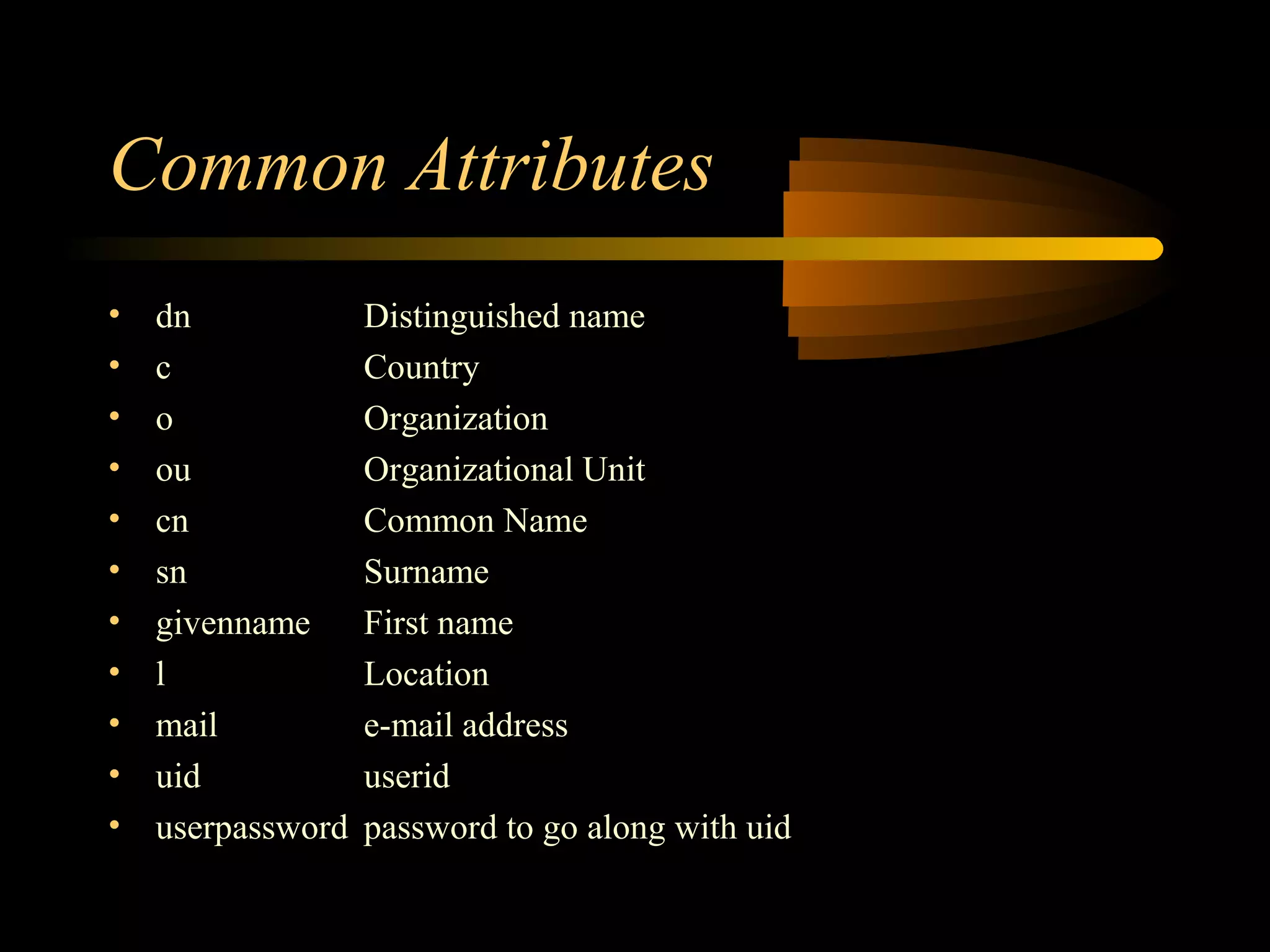
Common Attributes
• dn Distinguished name
• c Country
• o Organization
• ou Organizational Unit
• cn Common Name
• sn Surname
• givenname First name
• l Location
• mail e-mail address
• uid userid
• userpassword password to go along with uid
Airius Corporation
LDAP URLS
• ldap://host:port/dn[?attributes[?scope[?filter]]]
– host - the dns name of the server (or IP address)
– port - 389 (well known port or whatever port that
LDAP is installed on)
– dn - distinguished name of of the entity of interest
– attributes - comma separated list of ldap attributes
types to be returned
– scope - base, one, sub
– filter - search filter for entity selection
Search Filter Examples
• RFC 1960
• (sn=Jensen) - Entries with a surname of Jensen
• (objectclass=*) - All entries
• (cn=*bert*) - All entries containing the string “bert” in the common
name attribute
• (cn>=Fred) - all entries with a common name lexicographically greater
than Fred
• (&(objectclass=person)(mail=*)) - all people with an email address
• (&(objectclass=person)( | (title=*director*)(title=*executive*))) - all
people with the string director or executive in the title attribute
Filters
• Six basic filters
– Equality - (<attr> = <value>)
– Approximate - (<attr> -= <value>)
– Substring - (<attr> = [<leading>* (sn=*Jensen*) [<any>*[<trailing>])
– Greater than or equal - <attr> <= <value>
– Less than or equal - <attr> <= <value>
– Presence - <attr> = *
• Booleans
– AND - & - (&([<filter1>])(<filter2>))
– OR - | - ( | (<filter1>)(<filter2>))
– NOT ! - (! (<filter>))
Popular APIs
• University of Michigan - C language for LDAP - free - de facto
standard, solid and ubiquitous
• Netscape LDAP SDK - C, Java and Perl - included with Netscape
Communicator, or a free download
• Java Naming and Directory Interface (JNDI) - Sun, part of J2EE,
provides common interface to all Directory servers and Naming
Services
• Active Directory Service Interface (ADSI) Microsoft, C++ and
Microsoft Java versions
• ColdFusion - tags for LDAP Queries (comes with Cold Fusion)
• PHP - Libraries built in for doing LDAP queries
• Perl - Netscape PerLDAP SDK and Net::LDAP (free and open source)
JNDI Architecture
The Naming package
• classes and interfaces for accessing naming
services.
• Create a hash table for passing environment
information
• Set up environment info
• Get a reference to the Directory Context
The Naming package (more)
• Once you have the reference to the
Directory context use the methods and
classes in the Directory package to do
things like searching and retrieve and/or
modify entry attributes
The Directory Package
• extends the naming package to provide
functionality for accessing directory
services in addition to naming services.
• This package allows applications to retrieve
attributes associated with objects stored in
the directory and to search for objects using
specified attributes.
The Service Provider package
• Service providers are classes and services
provided by OEMs that provide a consistent
API for accessing their Naming/Directory
product.
• These are like JDBCs database drivers; i.e.
they abstract the interface to the product to
a consistent API across all service providers

Directory services by SAJID

  • 1.
    Directory & NamingServices CS-328 Dick Steflik
  • 2.
  • 3.
    Directory Services • Servicesprovided by special network databases that map names to addresses • Same idea as a telephone directory – unique key (name) – set of attributes (name value pairs) • address: 12 Beethoven Street • phone: 777-1234
  • 4.
    Example Directories • DomainNaming System (DNS) – maps IP address to Host names • ARP/RARP – map NIC addresses to IP addresses • File System – maps file names to disk addresses • RMI Registry – maps servers to IP addresses
  • 5.
    Example Directories • CORBANaming Service – maps CORBA servers to IP addresses
  • 6.
    Directory Uses • CorporateAddress Book for e-mail • Corporate Phone Directories • Web user authentication • Corporate Asset Management System • Persistent Object Storage for Java Objects • Web Enabled Work Flow Management
  • 7.
    X.500 • ISO Specificationfor Directory Services • Defined for the OSI Protocol Stack – very heavy weight Directory Access Protocol • US implementation for TCP/IP stack kept same data model but defined Light-weight Directory Access Protocol (LDAP) for accessing data repository.
  • 8.
    Data Model • DistributedHierarchical Database • Data Store – usually on proprietary file based database • optimized for fast tree searches – Oracle and IBM DB2 are both LDAP enabled (searchable using LDAP ) – Netscape currently has fastest Directory Server – OpenLDAP (Berkley Database)
  • 9.
    Schema • Every nodeis keyed uniquely with a distinguished name • the distinguished names is made up of name/value pairs that reflect the hierarchical relationship between the name/value pairs • attribute names can be freely assigned but there are some standard ones that have been defined by common usage
  • 10.
    Common Attributes • dnDistinguished name • c Country • o Organization • ou Organizational Unit • cn Common Name • sn Surname • givenname First name • l Location • mail e-mail address • uid userid • userpassword password to go along with uid
  • 11.
  • 13.
    LDAP URLS • ldap://host:port/dn[?attributes[?scope[?filter]]] –host - the dns name of the server (or IP address) – port - 389 (well known port or whatever port that LDAP is installed on) – dn - distinguished name of of the entity of interest – attributes - comma separated list of ldap attributes types to be returned – scope - base, one, sub – filter - search filter for entity selection
  • 14.
    Search Filter Examples •RFC 1960 • (sn=Jensen) - Entries with a surname of Jensen • (objectclass=*) - All entries • (cn=*bert*) - All entries containing the string “bert” in the common name attribute • (cn>=Fred) - all entries with a common name lexicographically greater than Fred • (&(objectclass=person)(mail=*)) - all people with an email address • (&(objectclass=person)( | (title=*director*)(title=*executive*))) - all people with the string director or executive in the title attribute
  • 15.
    Filters • Six basicfilters – Equality - (<attr> = <value>) – Approximate - (<attr> -= <value>) – Substring - (<attr> = [<leading>* (sn=*Jensen*) [<any>*[<trailing>]) – Greater than or equal - <attr> <= <value> – Less than or equal - <attr> <= <value> – Presence - <attr> = * • Booleans – AND - & - (&([<filter1>])(<filter2>)) – OR - | - ( | (<filter1>)(<filter2>)) – NOT ! - (! (<filter>))
  • 16.
    Popular APIs • Universityof Michigan - C language for LDAP - free - de facto standard, solid and ubiquitous • Netscape LDAP SDK - C, Java and Perl - included with Netscape Communicator, or a free download • Java Naming and Directory Interface (JNDI) - Sun, part of J2EE, provides common interface to all Directory servers and Naming Services • Active Directory Service Interface (ADSI) Microsoft, C++ and Microsoft Java versions • ColdFusion - tags for LDAP Queries (comes with Cold Fusion) • PHP - Libraries built in for doing LDAP queries • Perl - Netscape PerLDAP SDK and Net::LDAP (free and open source)
  • 17.
  • 19.
    The Naming package •classes and interfaces for accessing naming services. • Create a hash table for passing environment information • Set up environment info • Get a reference to the Directory Context
  • 20.
    The Naming package(more) • Once you have the reference to the Directory context use the methods and classes in the Directory package to do things like searching and retrieve and/or modify entry attributes
  • 21.
    The Directory Package •extends the naming package to provide functionality for accessing directory services in addition to naming services. • This package allows applications to retrieve attributes associated with objects stored in the directory and to search for objects using specified attributes.
  • 22.
    The Service Providerpackage • Service providers are classes and services provided by OEMs that provide a consistent API for accessing their Naming/Directory product. • These are like JDBCs database drivers; i.e. they abstract the interface to the product to a consistent API across all service providers