Commonwealth Educational
Media Centre for Asia


Information for
Sustainable Development
Sanjaya Mishra
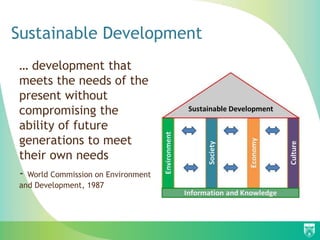
Sustainable Development
… development that
meets the needs of the
present without
compromising the
ability of future
generations to meet
their own needs
- World Commission on Environment
and Development, 1987
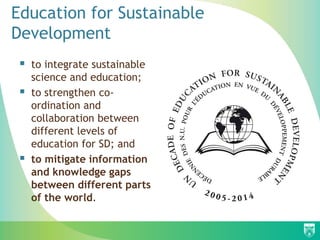
Education for Sustainable
Development
  to integrate sustainable
     science and education;
    to strengthen co-
     ordination and
     collaboration between
     different levels of
     education for SD; and
    to mitigate information
     and knowledge gaps
     between different parts
     of the world.
The Future We Want
 to improve the capacity of our education
    systems to prepare people to pursue
    sustainable development
   enhance teacher training, develop
    sustainability curricula, develop training
    programmes
   prepare students for careers in fields related
    to sustainability
   use of information and communications
    technologies to enhance learning outcomes.
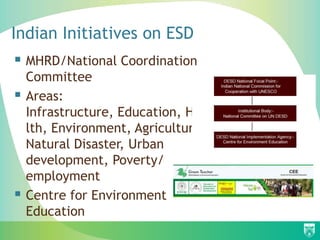
Indian Initiatives on ESD
 MHRD/National Coordination
    Committee
   Areas:
    Infrastructure, Education, Hea
    lth, Environment, Agriculture,
    Natural Disaster, Urban
    development, Poverty/
    employment
   Centre for Environment
    Education
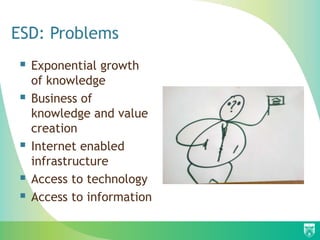
ESD: Problems
   Exponential growth
    of knowledge
   Business of
    knowledge and value
    creation
   Internet enabled
    infrastructure
   Access to technology
   Access to information
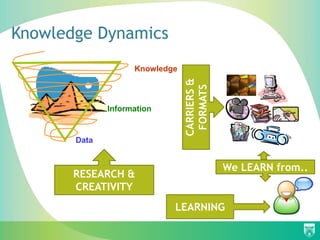
Knowledge Dynamics
                    Knowledge


                                CARRIERS &
                                 FORMATS
              Information


       Data


                                             We LEARN from..
       RESEARCH &
       CREATIVITY
                            LEARNING
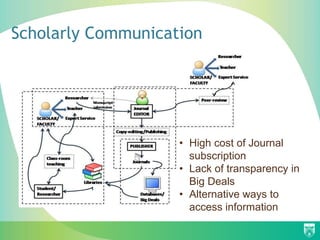
Scholarly Communication


                    • High cost of Journal
                      subscription
                    • Lack of transparency in
                      Big Deals
                    • Alternative ways to
                      access information
Open Access
Open Access is the provision of
free access to peer-
reviewed, scholarly and
research information to all. It
envisages that the rights
holder grants worldwide
irrevocable right of access to
copy, use, distribute, transmit,
and make derivative works in
any format for any lawful
activities with proper
attribution to the original
author.
Foundations of Open Access
   Freedom (as in free
    of cost and free
    speech)
   Flexibility ( choice of
    licensing
    mechanisms)
   Fairness ( to
    authors, funding
    bodies and society)
Philosophy of Open Access
        Knowledge is Free and should be shared amongst
        those who need it

        Access to past knowledge is essential to create new
        knowledge

        Everyone has a right to knowledge, and authors
        exercise their rights to share

        Open Access is not contrary to Copyright

        No individual should be discriminated due to
        various disadvantages

        Foster development of knowledge societies
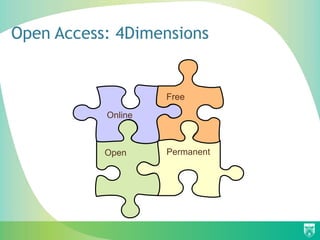
Open Access: 4Dimensions


                    Free

           Online


           Open     Permanent
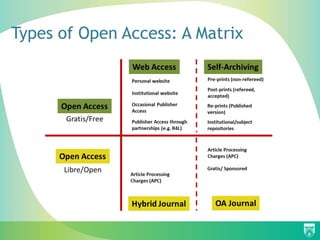
Types of Open Access: A Matrix
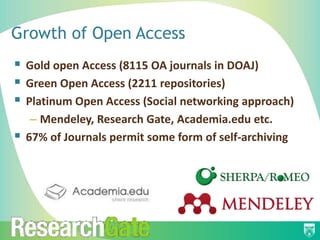
Growth of Open Access
   Gold open Access (8115 OA journals in DOAJ)
   Green Open Access (2211 repositories)
   Platinum Open Access (Social networking approach)
     – Mendeley, Research Gate, Academia.edu etc.
   67% of Journals permit some form of self-archiving
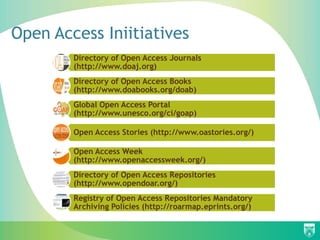
Open Access Iniitiatives
        Directory of Open Access Journals
        (http://www.doaj.org)
        Directory of Open Access Books
        (http://www.doabooks.org/doab)
        Global Open Access Portal
        (http://www.unesco.org/ci/goap)

        Open Access Stories (http://www.oastories.org/)

        Open Access Week
        (http://www.openaccessweek.org/)
        Directory of Open Access Repositories
        (http://www.opendoar.org/)
        Registry of Open Access Repositories Mandatory
        Archiving Policies (http://roarmap.eprints.org/)
Information Sources on SD
 UN: Division of Sustainable Development
(http://www.un.org/esa/dsd/agenda21/res_agenda21_40.shtml)

 Rio+20 (http://www.uncsd2012.org/)
 IISD: SD-Cite (http://sd-cite.iisd.org/)
 FAO: GIS in SD (http://www.fao.org/sd/EIdirect/gis/EIgis000.htm)
 Ipl2 (http://www.ipl.org/div/pf/entry/48534)
 World Bank (http://www.worldbank.org/depweb/english/sd.html)
What Libraries can do for
Sustainable Development?
• Promote OA journals and repositories
• Ask our institutions to create OA repositories
• Publish in OA journals
• Submit our papers to OA repositories, especially
  institutional repositories (if your institution does not
  have a repository, you can still submit at
• Encourage institutions to adopt OA policies
• Encourage setting up of OA funds
• Promote quality of OA journals
THANK YOU

Information for Development

  • 1.
    Commonwealth Educational Media Centrefor Asia Information for Sustainable Development Sanjaya Mishra
  • 2.
    Sustainable Development … developmentthat meets the needs of the present without compromising the ability of future generations to meet their own needs - World Commission on Environment and Development, 1987
  • 3.
    Education for Sustainable Development  to integrate sustainable science and education;  to strengthen co- ordination and collaboration between different levels of education for SD; and  to mitigate information and knowledge gaps between different parts of the world.
  • 4.
    The Future WeWant  to improve the capacity of our education systems to prepare people to pursue sustainable development  enhance teacher training, develop sustainability curricula, develop training programmes  prepare students for careers in fields related to sustainability  use of information and communications technologies to enhance learning outcomes.
  • 5.
    Indian Initiatives onESD  MHRD/National Coordination Committee  Areas: Infrastructure, Education, Hea lth, Environment, Agriculture, Natural Disaster, Urban development, Poverty/ employment  Centre for Environment Education
  • 6.
    ESD: Problems  Exponential growth of knowledge  Business of knowledge and value creation  Internet enabled infrastructure  Access to technology  Access to information
  • 7.
    Knowledge Dynamics Knowledge CARRIERS & FORMATS Information Data We LEARN from.. RESEARCH & CREATIVITY LEARNING
  • 8.
    Scholarly Communication • High cost of Journal subscription • Lack of transparency in Big Deals • Alternative ways to access information
  • 9.
    Open Access Open Accessis the provision of free access to peer- reviewed, scholarly and research information to all. It envisages that the rights holder grants worldwide irrevocable right of access to copy, use, distribute, transmit, and make derivative works in any format for any lawful activities with proper attribution to the original author.
  • 10.
    Foundations of OpenAccess  Freedom (as in free of cost and free speech)  Flexibility ( choice of licensing mechanisms)  Fairness ( to authors, funding bodies and society)
  • 11.
    Philosophy of OpenAccess Knowledge is Free and should be shared amongst those who need it Access to past knowledge is essential to create new knowledge Everyone has a right to knowledge, and authors exercise their rights to share Open Access is not contrary to Copyright No individual should be discriminated due to various disadvantages Foster development of knowledge societies
  • 12.
    Open Access: 4Dimensions Free Online Open Permanent
  • 13.
    Types of OpenAccess: A Matrix
  • 14.
    Growth of OpenAccess  Gold open Access (8115 OA journals in DOAJ)  Green Open Access (2211 repositories)  Platinum Open Access (Social networking approach) – Mendeley, Research Gate, Academia.edu etc.  67% of Journals permit some form of self-archiving
  • 15.
    Open Access Iniitiatives Directory of Open Access Journals (http://www.doaj.org) Directory of Open Access Books (http://www.doabooks.org/doab) Global Open Access Portal (http://www.unesco.org/ci/goap) Open Access Stories (http://www.oastories.org/) Open Access Week (http://www.openaccessweek.org/) Directory of Open Access Repositories (http://www.opendoar.org/) Registry of Open Access Repositories Mandatory Archiving Policies (http://roarmap.eprints.org/)
  • 16.
    Information Sources onSD  UN: Division of Sustainable Development (http://www.un.org/esa/dsd/agenda21/res_agenda21_40.shtml)  Rio+20 (http://www.uncsd2012.org/)  IISD: SD-Cite (http://sd-cite.iisd.org/)  FAO: GIS in SD (http://www.fao.org/sd/EIdirect/gis/EIgis000.htm)  Ipl2 (http://www.ipl.org/div/pf/entry/48534)  World Bank (http://www.worldbank.org/depweb/english/sd.html)
  • 17.
    What Libraries cando for Sustainable Development? • Promote OA journals and repositories • Ask our institutions to create OA repositories • Publish in OA journals • Submit our papers to OA repositories, especially institutional repositories (if your institution does not have a repository, you can still submit at • Encourage institutions to adopt OA policies • Encourage setting up of OA funds • Promote quality of OA journals
  • 18.