Ashish K Awadhiya
Asst. Director, Training and Development
IUC, IGNOU, India
knowledge should be
 open &
 shared for networking, community building,
cultural binding, global distribution.
“Digitized materials offered freely and openly for
educators, students and self-learners to use and
reuse for teaching, learning and research”.
 OER includes learning content, software tools to
develop, use and distribute content, and
implementation resources such as open licenses.
 Refers to accumulated digital assets that can be
adjusted and which provide benefits without
restricting the possibilities for others to enjoy
them.
http://www.oecd.org/edu/ceri/38654317.pdf
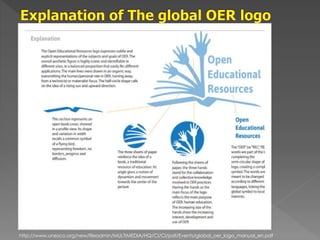
http://www.unesco.org/new/fileadmin/MULTIMEDIA/HQ/CI/CI/pdf/Events/global_oer_logo_manual_en.pdf
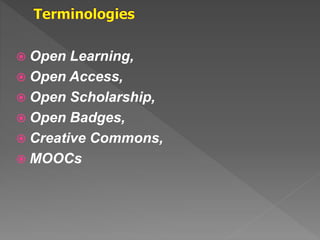
 Open Learning,
 Open Access,
 Open Scholarship,
 Open Badges,
 Creative Commons,
 MOOCs
 reducing or removing the barriers to
education.
 Such as (but not limited to) access to
 institute, learning-teaching community,
peers, tutor, learning content etc.
 providing ceaseless access of
knowledge resources and educational
resources to all class of people
 an extended form of Open Access
 limitless access of the scholarly
resource/ content to the scholars
 who may need it for generating or
disseminating knowledge, or for any
other scholarly purposes
 providing due and appropriate
recognition
 to any kind of informal learning and
making it recognized by a
 competent/approving agency
http://www.openbadges.org/
 type of copy right
 which provides creator to decide
 how his/her content may be used by
others
http://creativecommons.org/
 Massive Open Online Course (s)
 Online courses
 For unlimited participants &
 connect the through various forums
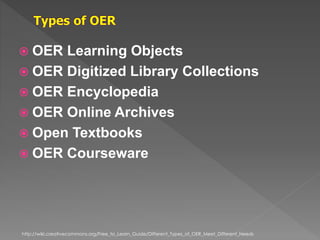
 OER Learning Objects
 OER Digitized Library Collections
 OER Encyclopedia
 OER Online Archives
 Open Textbooks
 OER Courseware
http://wiki.creativecommons.org/Free_to_Learn_Guide/Different_Types_of_OER_Meet_Different_Needs
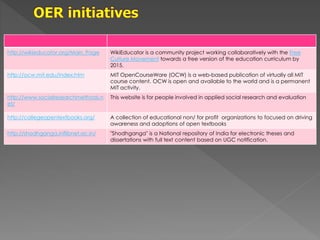
http://wikieducator.org/Main_Page WikiEducator is a community project working collaboratively with the Free
Culture Movement towards a free version of the education curriculum by
2015.
http://ocw.mit.edu/index.htm MIT OpenCourseWare (OCW) is a web-based publication of virtually all MIT
course content. OCW is open and available to the world and is a permanent
MIT activity.
http://www.socialresearchmethods.n
et/
This website is for people involved in applied social research and evaluation
http://collegeopentextbooks.org/ A collection of educational non/ for profit organizations to focused on driving
awareness and adoptions of open textbooks
http://shodhganga.inflibnet.ac.in/ "Shodhganga" is a National repository of India for electronic theses and
dissertations with full text content based on UGC notification.
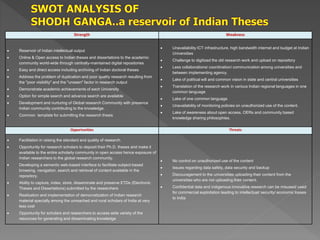
Strength Weakness
 Reservoir of Indian intellectual output
 Online & Open access to Indian theses and dissertations to the academic
community world-wide through centrally-maintained digital repositories
 Easy and direct access including archiving of Indian doctoral theses
 Address the problem of duplication and poor quality research resulting from
the "poor visibility" and the "unseen" factor in research output
 Demonstrate academic achievements of each University
 Option for simple search and advance search are available
 Development and nurturing of Global research Community with presence
Indian community contributing to the knowledge.
 Common template for submitting the research thesis
 Unavailability ICT infrastructure, high bandwidth internet and budget at Indian
Universities
 Challenge to digitized the old research work and upload on repository
 Less collaborations/ coordination/ communication among universities and
between implementing agency.
 Lake of political will and common vision in state and central universities
 Translation of the research work in various Indian regional languages in one
common language
 Lake of one common language
 Unavailability of monitoring policies on unauthorized use of the content.
 Lake of awareness about open access, OERs and community based
knowledge sharing philosophies.
Opportunities Threats
 Facilitation in raising the standard and quality of research.
 Opportunity for research scholars to deposit their Ph.D. theses and make it
available to the entire scholarly community in open access hence exposure of
Indian researchers to the global research community.
 Developing a semantic web-based interface to facilitate subject-based
browsing, navigation, search and retrieval of content available in the
repository.
 Ability to capture, index, store, disseminate and preserve ETDs (Electronic
Theses and Dissertations) submitted by the researchers
 Realization and implementation of democratization of Indian research
material specially among the unreached and rural scholars of India at very
less cost
 Opportunity for scholars and researchers to access wide variety of the
resources for generating and disseminating knowledge
 No control on unauthorized use of the content
 Issues regarding data safety, data security and backup
 Discouragement to the universities uploading their content from the
universities who are not uploading their content.
 Confidential data and indigenous innovative research can be misused/ used
for commercial exploitation leading to intellectual/ security/ economic losses
to India
 Thanks You..

Introduction to Open Education Resources (OER)

  • 1.
    Ashish K Awadhiya Asst.Director, Training and Development IUC, IGNOU, India
  • 2.
    knowledge should be open &  shared for networking, community building, cultural binding, global distribution.
  • 3.
    “Digitized materials offeredfreely and openly for educators, students and self-learners to use and reuse for teaching, learning and research”.  OER includes learning content, software tools to develop, use and distribute content, and implementation resources such as open licenses.  Refers to accumulated digital assets that can be adjusted and which provide benefits without restricting the possibilities for others to enjoy them. http://www.oecd.org/edu/ceri/38654317.pdf
  • 4.
  • 5.
  • 7.
     Open Learning, Open Access,  Open Scholarship,  Open Badges,  Creative Commons,  MOOCs
  • 8.
     reducing orremoving the barriers to education.  Such as (but not limited to) access to  institute, learning-teaching community, peers, tutor, learning content etc.
  • 9.
     providing ceaselessaccess of knowledge resources and educational resources to all class of people
  • 10.
     an extendedform of Open Access  limitless access of the scholarly resource/ content to the scholars  who may need it for generating or disseminating knowledge, or for any other scholarly purposes
  • 11.
     providing dueand appropriate recognition  to any kind of informal learning and making it recognized by a  competent/approving agency http://www.openbadges.org/
  • 12.
     type ofcopy right  which provides creator to decide  how his/her content may be used by others http://creativecommons.org/
  • 13.
     Massive OpenOnline Course (s)  Online courses  For unlimited participants &  connect the through various forums
  • 14.
     OER LearningObjects  OER Digitized Library Collections  OER Encyclopedia  OER Online Archives  Open Textbooks  OER Courseware http://wiki.creativecommons.org/Free_to_Learn_Guide/Different_Types_of_OER_Meet_Different_Needs
  • 15.
    http://wikieducator.org/Main_Page WikiEducator isa community project working collaboratively with the Free Culture Movement towards a free version of the education curriculum by 2015. http://ocw.mit.edu/index.htm MIT OpenCourseWare (OCW) is a web-based publication of virtually all MIT course content. OCW is open and available to the world and is a permanent MIT activity. http://www.socialresearchmethods.n et/ This website is for people involved in applied social research and evaluation http://collegeopentextbooks.org/ A collection of educational non/ for profit organizations to focused on driving awareness and adoptions of open textbooks http://shodhganga.inflibnet.ac.in/ "Shodhganga" is a National repository of India for electronic theses and dissertations with full text content based on UGC notification.
  • 17.
    Strength Weakness  Reservoirof Indian intellectual output  Online & Open access to Indian theses and dissertations to the academic community world-wide through centrally-maintained digital repositories  Easy and direct access including archiving of Indian doctoral theses  Address the problem of duplication and poor quality research resulting from the "poor visibility" and the "unseen" factor in research output  Demonstrate academic achievements of each University  Option for simple search and advance search are available  Development and nurturing of Global research Community with presence Indian community contributing to the knowledge.  Common template for submitting the research thesis  Unavailability ICT infrastructure, high bandwidth internet and budget at Indian Universities  Challenge to digitized the old research work and upload on repository  Less collaborations/ coordination/ communication among universities and between implementing agency.  Lake of political will and common vision in state and central universities  Translation of the research work in various Indian regional languages in one common language  Lake of one common language  Unavailability of monitoring policies on unauthorized use of the content.  Lake of awareness about open access, OERs and community based knowledge sharing philosophies. Opportunities Threats  Facilitation in raising the standard and quality of research.  Opportunity for research scholars to deposit their Ph.D. theses and make it available to the entire scholarly community in open access hence exposure of Indian researchers to the global research community.  Developing a semantic web-based interface to facilitate subject-based browsing, navigation, search and retrieval of content available in the repository.  Ability to capture, index, store, disseminate and preserve ETDs (Electronic Theses and Dissertations) submitted by the researchers  Realization and implementation of democratization of Indian research material specially among the unreached and rural scholars of India at very less cost  Opportunity for scholars and researchers to access wide variety of the resources for generating and disseminating knowledge  No control on unauthorized use of the content  Issues regarding data safety, data security and backup  Discouragement to the universities uploading their content from the universities who are not uploading their content.  Confidential data and indigenous innovative research can be misused/ used for commercial exploitation leading to intellectual/ security/ economic losses to India
  • 18.