EDUC E-107
Spring 2011


Unless otherwise specified, Copyright 2011, Vijay Kumar and Brandon Muramatsu.
Unless otherwise specified this work is licensed under a Creative Commons Attribution 3.0 United
States License (creativecommons.org/licenses/by/3.0/us/).
Cite as: Kumar, V. & Muramatsu, B. (2011). Open Education” Practice and Potential.
                                                                                                   1
    Recap
     ◦  Logistics and expectations, news, glossary, new
        student introductions, News
  Review student interests (Assignment 0)
  Continue discussing open education in a
   historical context (and Assignment 1)
  Next Week
     ◦  Assignment 2 and David Wiley


                                                          2
    We’ve designed the course seminar-style
    Participate in the discussions, in class, etc.
    We want this to be an enjoyable experience
     ◦  Be professional, but keep it light
    One of the aspects of open is the idea of
     collaboration and sharing
     ◦  We’re trying to include your input into each class
     ◦  We’re going to try and improve what we do during the
        course
     ◦  If you have any suggestions, please share them

     ◦  To help us improve the experience for everyone,
        we’re moving up assignment due dates to Monday
        11:59pm
                                                               3
  Nearly finalized
  2 In-Person Guest Speakers
     ◦  Steve Carson, MIT OpenCourseWare, 2/24
     ◦  Mike Smith, Public Policy, 3/31

     Please consider joining us on 3/31 for Mike Smith


                                                         4
  Success is when you have internalized
   open education in a very personal way
  …in what you do on a day-to-day basis
  …in ways you want to make change, in
   your job, your organization or the world-at-
   large


                                                  5
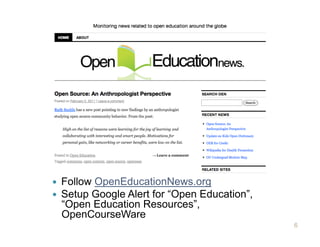
    Follow OpenEducationNews.org
    Setup Google Alert for “Open Education”,
     “Open Education Resources”,
     OpenCourseWare
                                                6
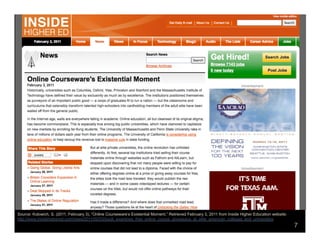
    Historically, universities such as Columbia, Oxford, Yale,
                               Princeton and Stanford and the Massachusetts Institute
                               of Technology have defined their value by exclusivity as
                               much as by excellence. The institutions positioned
                               themselves as purveyors of an important public good —
                               a corps of graduates fit to run a nation — but the
                               classrooms and curriculums that ostensibly transform
                               talented high-schoolers into cardholding members of the
                               adult elite have been walled off from the general public.

                              “If you take away OCW completely,” said Ira Fuchs,
                               former vice president at the Andrew W. Mellon
                               Foundation, of MIT’s celebrated
                               OpenCourseWare project, “I’m not sure that higher
                               education would be noticeably different.” In that light,
                               free online courseware might seem little more than
                               noblesse oblige of a sort that is, not coincidentally, a
                               boon to elite universities’ overseas branding and
                               recruiting efforts.

Source: Kolowich, S. (2011, February 3). “Online Courseware’s Existential Moment.” Retrieved February 3, 2011 from Inside Higher Education website:
http://www.insidehighered.com/news/2011/02/03/book_examines_free_online_course_giveaways_at_elite_american_colleges_and_universities
                                                                                                                                                      7
    OCW => OpenCourseWare
     ◦  Typically in the style of MIT OCW with published
        courses
    OER => Open Educational Resources
     ◦  Includes more types of resources
    LMS => Learning Management System
     ◦  Typically technology to support course administration,
        and dissemination of materials (they can be much
        more but usually aren’t)
     ◦  Examples: iSites (which hosts the class website),
        Blackboard, Moodle, Sakai
    CC => Creative Commons
     ◦  Set of licenses that permit reuse, also a movement


                                                             8
    Introduce yourselves
     ◦  What’s your background?
     ◦  What do you hope to get from the class? Is there
        something you are specifically interested in?
     ◦  What’s one thing interesting thing about yourself
        to help us get to know you better?


                                                            9
10
  Building a new building
  Implications for the publishing industry
  Implications for science and math education
  Access and quality


                                             11
  “How can I…improve my students’
   experience today but to also prepare them
   for college?”
  “I hope to…[understand] the concepts and
   pedagogical approaches to educational
   delivery.”

     ◦  Guest speakers on designing Open
        curriculum, courses and course materials


                  Source: E107 Students. (2011). Assignment 0 Responses.
                       Open Education Practice and Potential. Spring 2011.   12
  “…help design and improve educational
   activities for outreach programs”
  “I hope to…learn about…methods in which I
   can apply it to science education.”
  “…teaching practices that can make me
   more effective as an educator”

     ◦  Midterm and final projects are designed to
        develop personal action plans


                   Source: E107 Students. (2011). Assignment 0 Responses.
                        Open Education Practice and Potential. Spring 2011.   13
    “Does Open CourseWare promote learning
     for the sake of learning?”

     ◦  Guest speaker from MIT OCW: Uses of MIT
        OCW, and others

    “Will people ever look at these courses as
     being at par with formal degrees?”

     ◦  Guest speaker from P2PU (and others Kaplan,
        Scholastic, Nixty)

                  Source: E107 Students. (2011). Assignment 0 Responses.
                       Open Education Practice and Potential. Spring 2011.   14
    “What [do] people mean when they talk
     about the open education ‘movement.’”

     ◦  Guest speakers from K-12, higher education
        and international perspectives


                  Source: E107 Students. (2011). Assignment 0 Responses.
                       Open Education Practice and Potential. Spring 2011.   15
16
    Open Education is not new
     ◦  Primarily access to education opportunity
     ◦  “University without walls”, “Universities without
        borders”
     ◦  Not just formal education at traditional colleges
        and universities


                                                            17
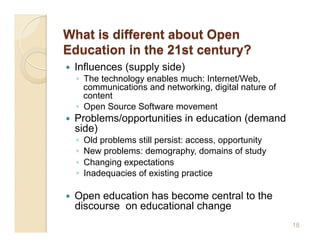
    Influences (supply side)
     ◦  The technology enables much: Internet/Web,
        communications and networking, digital nature of
        content
     ◦  Open Source Software movement
    Problems/opportunities in education (demand
     side)
     ◦    Old problems still persist: access, opportunity
     ◦    New problems: demography, domains of study
     ◦    Changing expectations
     ◦    Inadequacies of existing practice

    Open education has become central to the
     discourse on educational change
                                                            18
    What has changed in…
     ◦  Technology
     ◦  Demographics
     ◦  social norms and expectations

     …that gives a different flavor to Open
     Education today?


                                              19
Generation Y Perspectives


Source: ashwinl (Poster) (2008). Generation Y Perspectives. [Slides] Retrieved
from http://www.slideshare.net/ashwinl/nasa-geny-perspectives

                                                                                 20
  Open Educational Resources Movement
  Creative Commons
  Consortia and National Movements


                                         21
  Many said that they now think of open
   education more broadly
  You identified…
     ◦  A number of difficult issues with how
        organizations approach education and the
        enablers and barriers to open education
     ◦  The competing agendas and issues
  Open education is being seen as
   synonymous with online education
  Is open education about the content, or the
   experience, or something else?

                                                   22
    What are 3 characteristics of quality in
     traditional education settings?
     ◦  Which of these are different when you think
        about open education?
    What are criteria that define Open
     Education?


                                                      23
    If you could pick one problem in education
     today that open education could help
     substantially address, what would it be?


                                                  24
25
    Assignment 2 is a two-part assignment:
     ◦  “Open education is…”
         Define open education in the context of your
          interests or with respect to a big problem in
          education
     ◦  What are three key characteristics of learning
        and learners in the 21st century?


    David Wiley is our guest speaker
     ◦  http://davidwiley.org/


                                                          26
27


     flickr/pr0teins All Rights Reserved. Used with permission.

E107 Open Education Practice and Potential: Session 2

  • 1.
    EDUC E-107 Spring 2011 Unlessotherwise specified, Copyright 2011, Vijay Kumar and Brandon Muramatsu. Unless otherwise specified this work is licensed under a Creative Commons Attribution 3.0 United States License (creativecommons.org/licenses/by/3.0/us/). Cite as: Kumar, V. & Muramatsu, B. (2011). Open Education” Practice and Potential. 1
  • 2.
      Recap ◦  Logistics and expectations, news, glossary, new student introductions, News   Review student interests (Assignment 0)   Continue discussing open education in a historical context (and Assignment 1)   Next Week ◦  Assignment 2 and David Wiley 2
  • 3.
      We’ve designed the course seminar-style   Participate in the discussions, in class, etc.   We want this to be an enjoyable experience ◦  Be professional, but keep it light   One of the aspects of open is the idea of collaboration and sharing ◦  We’re trying to include your input into each class ◦  We’re going to try and improve what we do during the course ◦  If you have any suggestions, please share them ◦  To help us improve the experience for everyone, we’re moving up assignment due dates to Monday 11:59pm 3
  • 4.
      Nearly finalized  2 In-Person Guest Speakers ◦  Steve Carson, MIT OpenCourseWare, 2/24 ◦  Mike Smith, Public Policy, 3/31 Please consider joining us on 3/31 for Mike Smith 4
  • 5.
      Success iswhen you have internalized open education in a very personal way   …in what you do on a day-to-day basis   …in ways you want to make change, in your job, your organization or the world-at- large 5
  • 6.
      Follow OpenEducationNews.org   Setup Google Alert for “Open Education”, “Open Education Resources”, OpenCourseWare 6
  • 7.
      Historically, universities such as Columbia, Oxford, Yale, Princeton and Stanford and the Massachusetts Institute of Technology have defined their value by exclusivity as much as by excellence. The institutions positioned themselves as purveyors of an important public good — a corps of graduates fit to run a nation — but the classrooms and curriculums that ostensibly transform talented high-schoolers into cardholding members of the adult elite have been walled off from the general public.   “If you take away OCW completely,” said Ira Fuchs, former vice president at the Andrew W. Mellon Foundation, of MIT’s celebrated OpenCourseWare project, “I’m not sure that higher education would be noticeably different.” In that light, free online courseware might seem little more than noblesse oblige of a sort that is, not coincidentally, a boon to elite universities’ overseas branding and recruiting efforts. Source: Kolowich, S. (2011, February 3). “Online Courseware’s Existential Moment.” Retrieved February 3, 2011 from Inside Higher Education website: http://www.insidehighered.com/news/2011/02/03/book_examines_free_online_course_giveaways_at_elite_american_colleges_and_universities 7
  • 8.
      OCW => OpenCourseWare ◦  Typically in the style of MIT OCW with published courses   OER => Open Educational Resources ◦  Includes more types of resources   LMS => Learning Management System ◦  Typically technology to support course administration, and dissemination of materials (they can be much more but usually aren’t) ◦  Examples: iSites (which hosts the class website), Blackboard, Moodle, Sakai   CC => Creative Commons ◦  Set of licenses that permit reuse, also a movement 8
  • 9.
      Introduce yourselves ◦  What’s your background? ◦  What do you hope to get from the class? Is there something you are specifically interested in? ◦  What’s one thing interesting thing about yourself to help us get to know you better? 9
  • 10.
  • 11.
      Building anew building   Implications for the publishing industry   Implications for science and math education   Access and quality 11
  • 12.
      “How canI…improve my students’ experience today but to also prepare them for college?”   “I hope to…[understand] the concepts and pedagogical approaches to educational delivery.” ◦  Guest speakers on designing Open curriculum, courses and course materials Source: E107 Students. (2011). Assignment 0 Responses. Open Education Practice and Potential. Spring 2011. 12
  • 13.
      “…help designand improve educational activities for outreach programs”   “I hope to…learn about…methods in which I can apply it to science education.”   “…teaching practices that can make me more effective as an educator” ◦  Midterm and final projects are designed to develop personal action plans Source: E107 Students. (2011). Assignment 0 Responses. Open Education Practice and Potential. Spring 2011. 13
  • 14.
      “Does Open CourseWare promote learning for the sake of learning?” ◦  Guest speaker from MIT OCW: Uses of MIT OCW, and others   “Will people ever look at these courses as being at par with formal degrees?” ◦  Guest speaker from P2PU (and others Kaplan, Scholastic, Nixty) Source: E107 Students. (2011). Assignment 0 Responses. Open Education Practice and Potential. Spring 2011. 14
  • 15.
      “What [do] people mean when they talk about the open education ‘movement.’” ◦  Guest speakers from K-12, higher education and international perspectives Source: E107 Students. (2011). Assignment 0 Responses. Open Education Practice and Potential. Spring 2011. 15
  • 16.
  • 17.
      Open Education is not new ◦  Primarily access to education opportunity ◦  “University without walls”, “Universities without borders” ◦  Not just formal education at traditional colleges and universities 17
  • 18.
      Influences (supply side) ◦  The technology enables much: Internet/Web, communications and networking, digital nature of content ◦  Open Source Software movement   Problems/opportunities in education (demand side) ◦  Old problems still persist: access, opportunity ◦  New problems: demography, domains of study ◦  Changing expectations ◦  Inadequacies of existing practice   Open education has become central to the discourse on educational change 18
  • 19.
      What has changed in… ◦  Technology ◦  Demographics ◦  social norms and expectations …that gives a different flavor to Open Education today? 19
  • 20.
    Generation Y Perspectives Source:ashwinl (Poster) (2008). Generation Y Perspectives. [Slides] Retrieved from http://www.slideshare.net/ashwinl/nasa-geny-perspectives 20
  • 21.
      Open EducationalResources Movement   Creative Commons   Consortia and National Movements 21
  • 22.
      Many saidthat they now think of open education more broadly   You identified… ◦  A number of difficult issues with how organizations approach education and the enablers and barriers to open education ◦  The competing agendas and issues   Open education is being seen as synonymous with online education   Is open education about the content, or the experience, or something else? 22
  • 23.
      What are 3 characteristics of quality in traditional education settings? ◦  Which of these are different when you think about open education?   What are criteria that define Open Education? 23
  • 24.
      If you could pick one problem in education today that open education could help substantially address, what would it be? 24
  • 25.
  • 26.
      Assignment 2 is a two-part assignment: ◦  “Open education is…”   Define open education in the context of your interests or with respect to a big problem in education ◦  What are three key characteristics of learning and learners in the 21st century?   David Wiley is our guest speaker ◦  http://davidwiley.org/ 26
  • 27.
    27 flickr/pr0teins All Rights Reserved. Used with permission.