Open Culture Data:
Opening GLAM Data Bottom-Up
Johan Oomen | Manager R&D |
Netherlands Institute for Sound and Vision
t: @johanoomen
MW2013 | Portland OR, 20 April 2013
t: @OpenCultuurData | #opencultuurdata
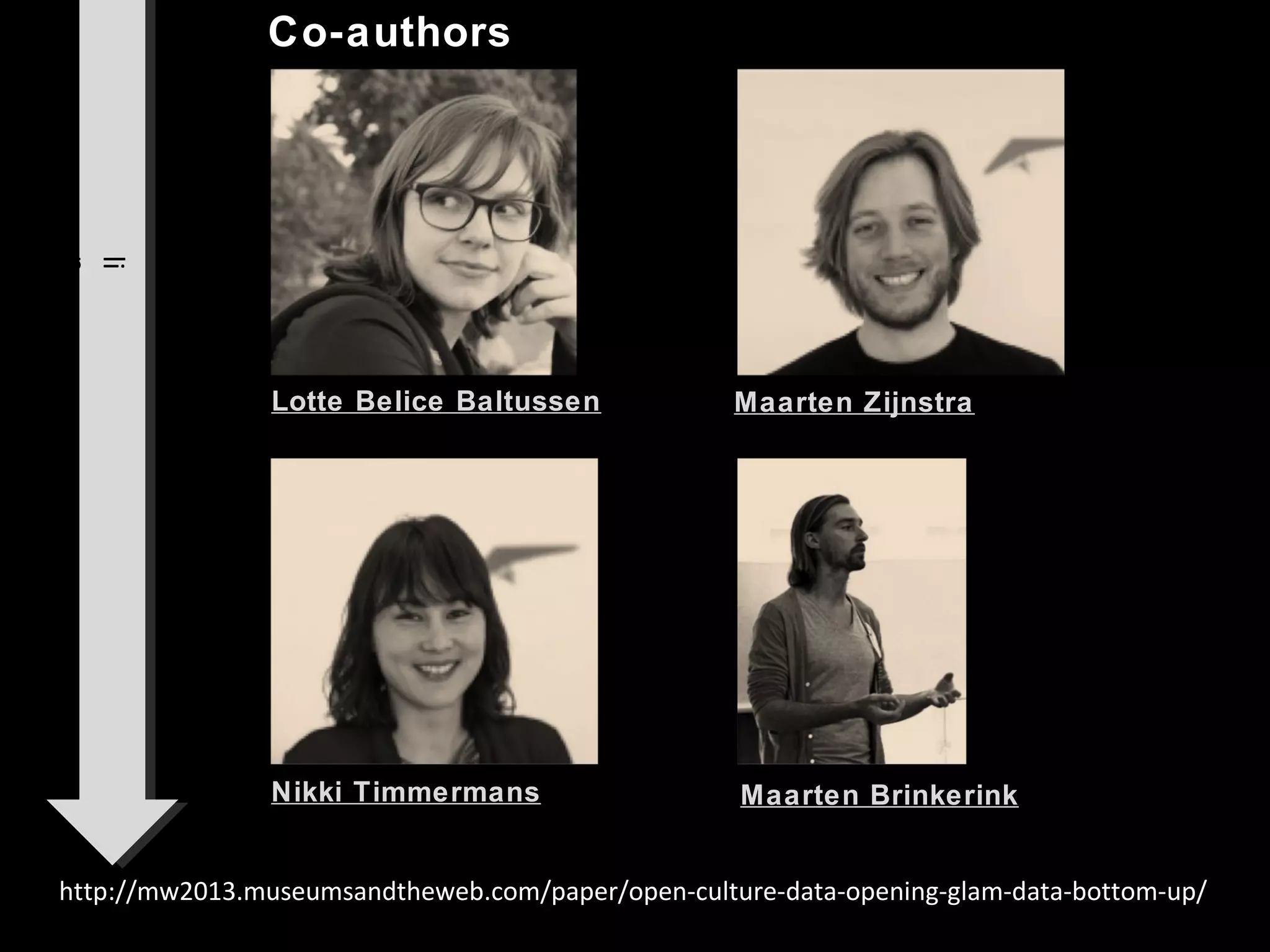
Lotte Belice Baltussen Maarten Zijnstra
Nikki Timmermans
Co-authors
Maarten Brinkerink
http://mw2013.museumsandtheweb.com/paper/open-culture-data-opening-glam-data-bottom-up/
li
n
k
1. Open Culture Data NL
2. Lessons learned
3. Stuff you can do today!
source: http://www.flickr.com/photos/sdasmarchives/8477565056/
Outline
STIMULATING COLLABORATION AND CREATIVITY
“No matter who you are,
most of the smartest people work for someone else.” Joy’s Law
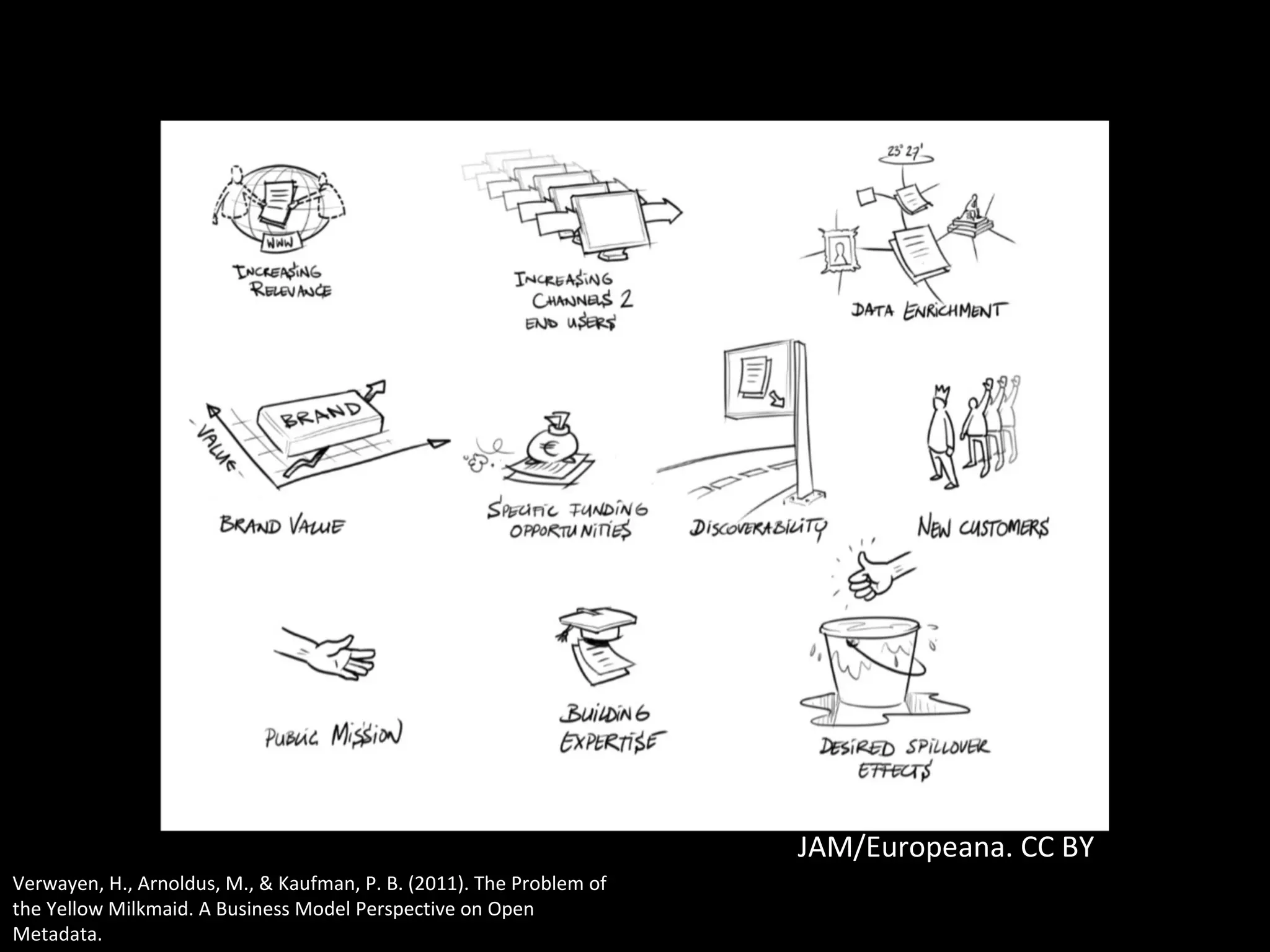
The “WHY” of open data in GLAMS
PUBLIC MISSION
“For [GLAM] content to be truly accessible, it needs to be where the users
are, embedded in their daily networked lives.” Waibel and Erway, 2009
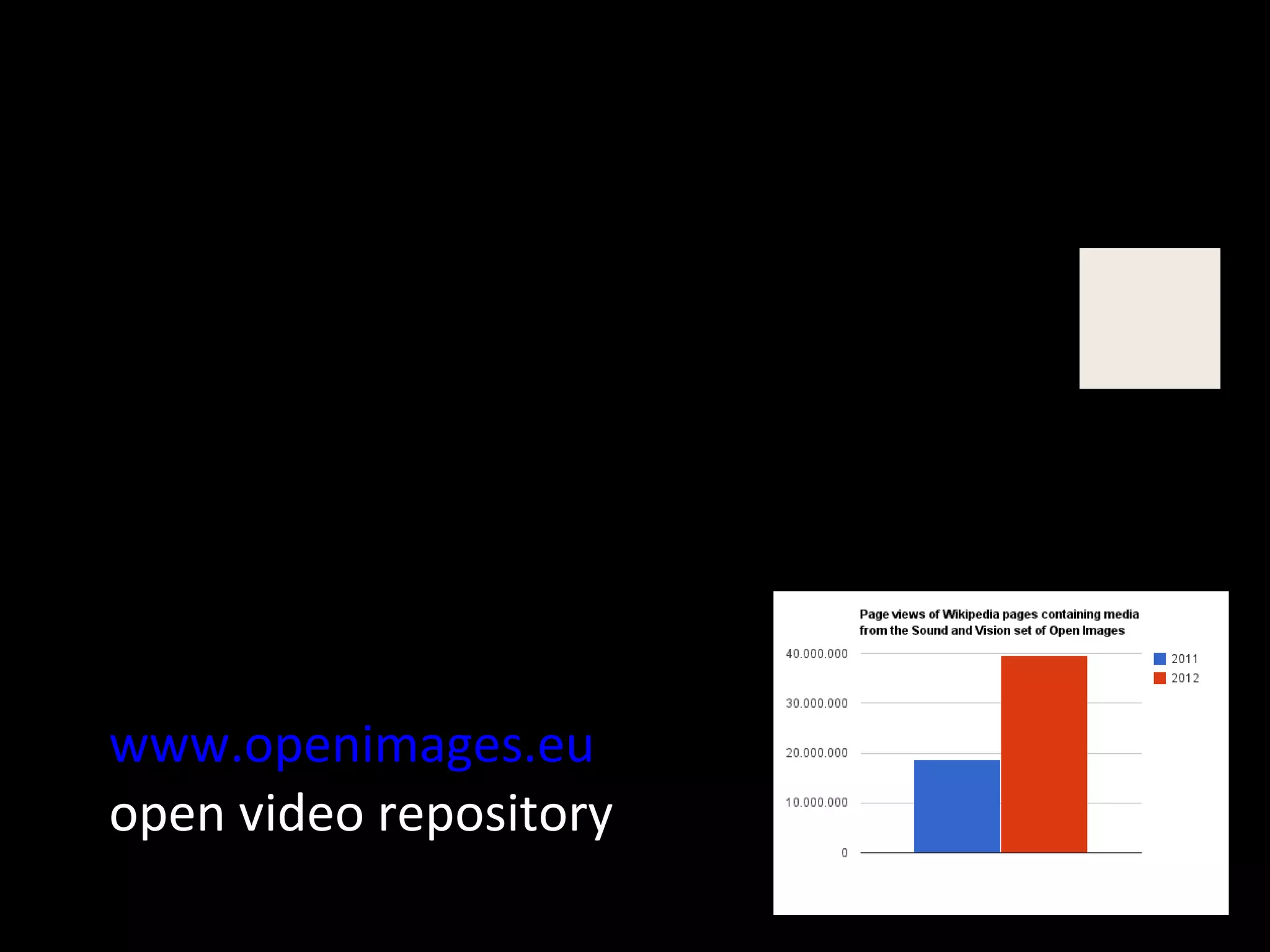
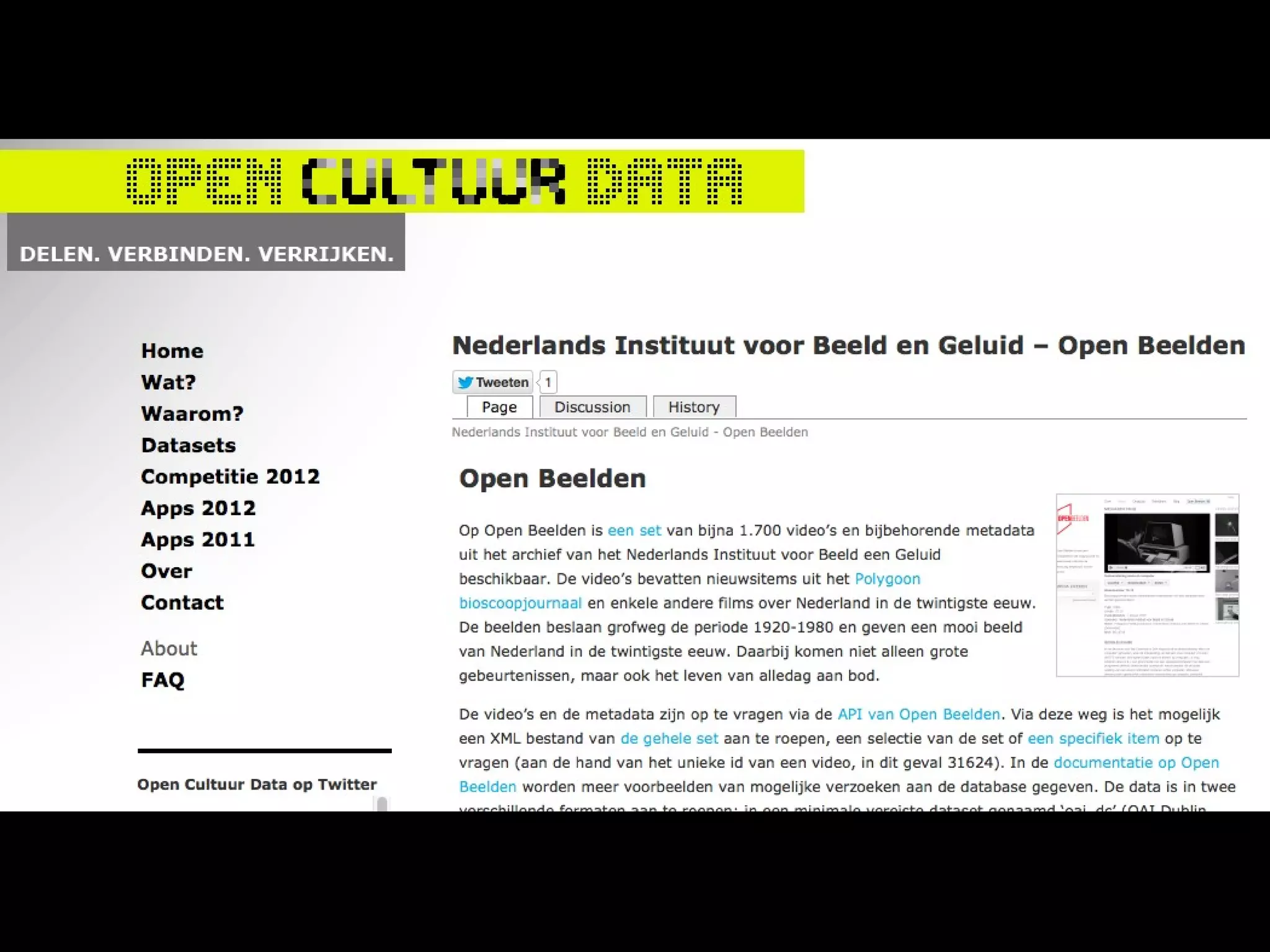
www.openimages.eu
open video repository
Neelie Kroes - Vice President for the Digital Agenda of the European Commission
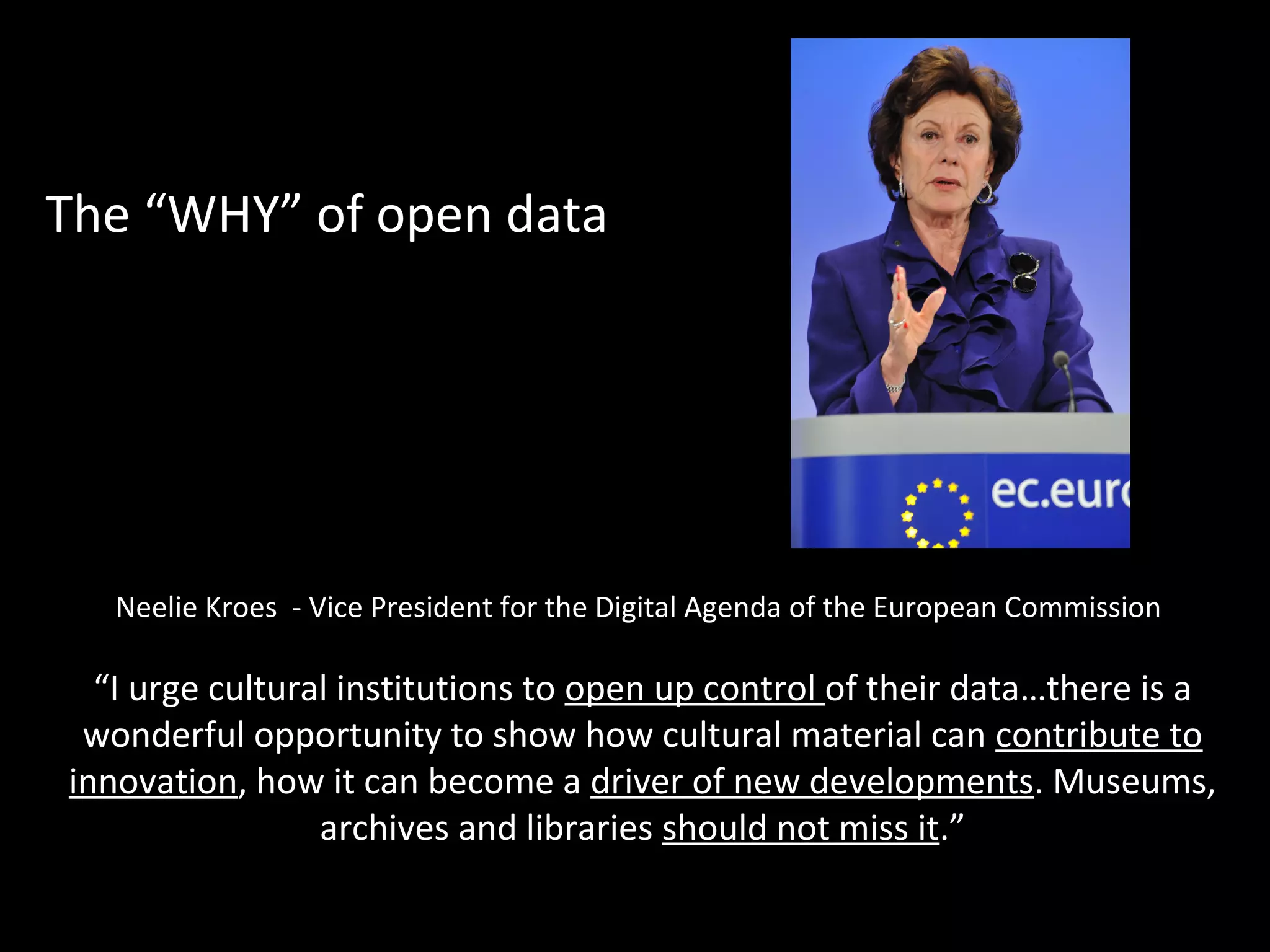
“I urge cultural institutions to open up control of their data…there is a
wonderful opportunity to show how cultural material can contribute to
innovation, how it can become a driver of new developments. Museums,
archives and libraries should not miss it.”
The “WHY” of open data
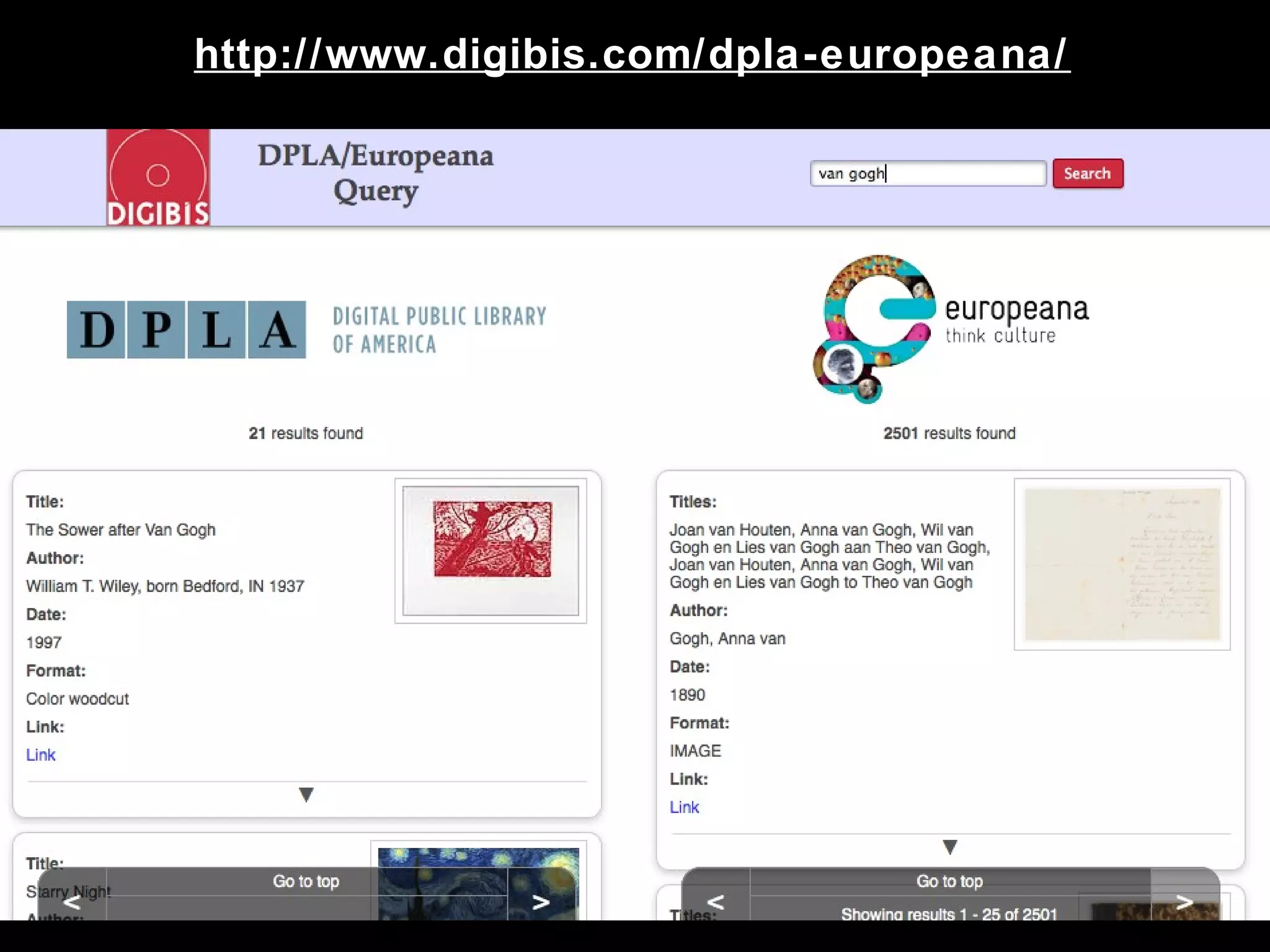
http://www.digibis.com/dpla-europeana/
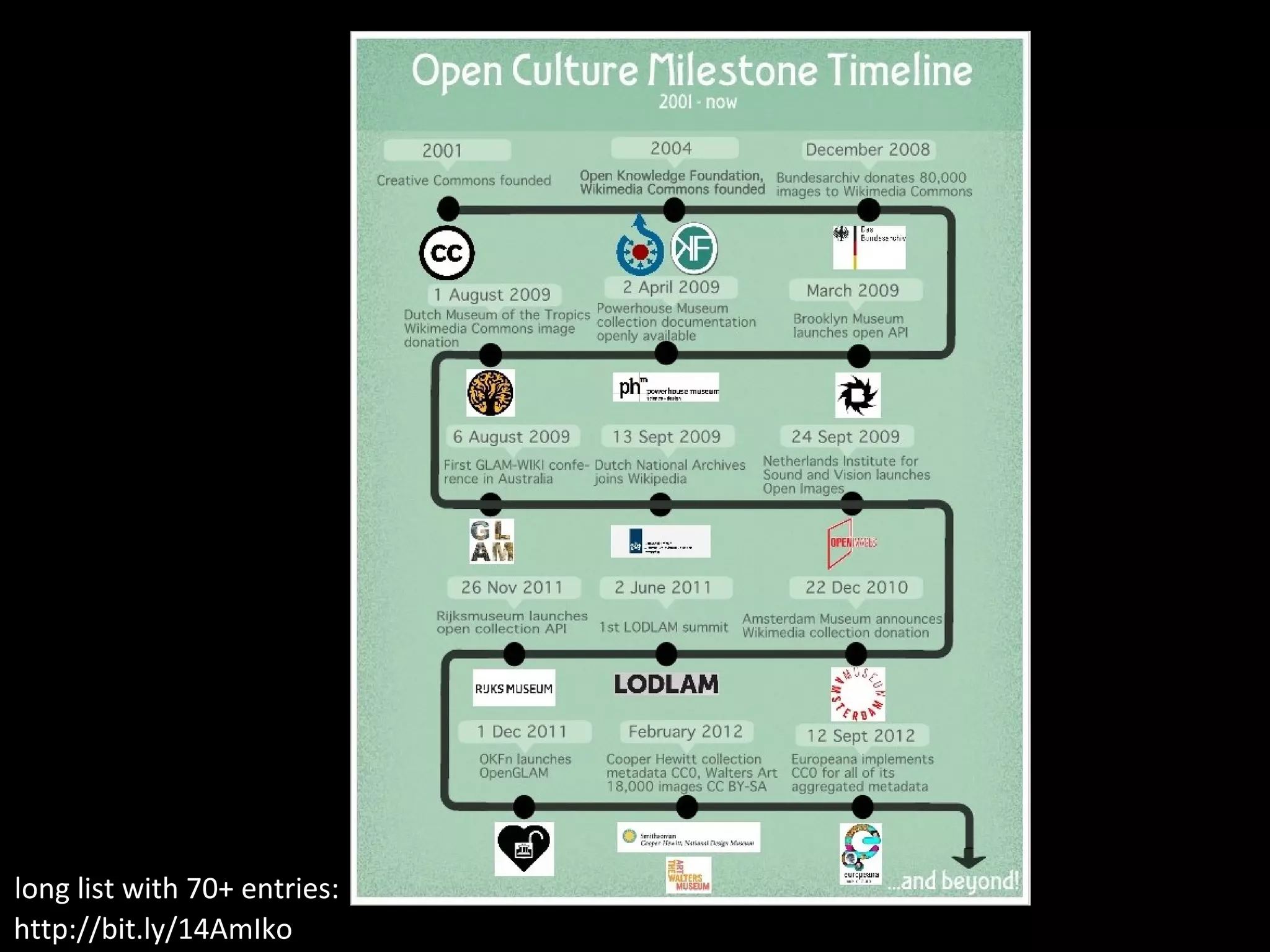
http://bit.ly/14AmIko
long list with 70+ entries:
Verwayen, H., Arnoldus, M., & Kaufman, P. B. (2011). The Problem of
the Yellow Milkmaid. A Business Model Perspective on Open
Metadata.
JAM/Europeana. CC BY
not
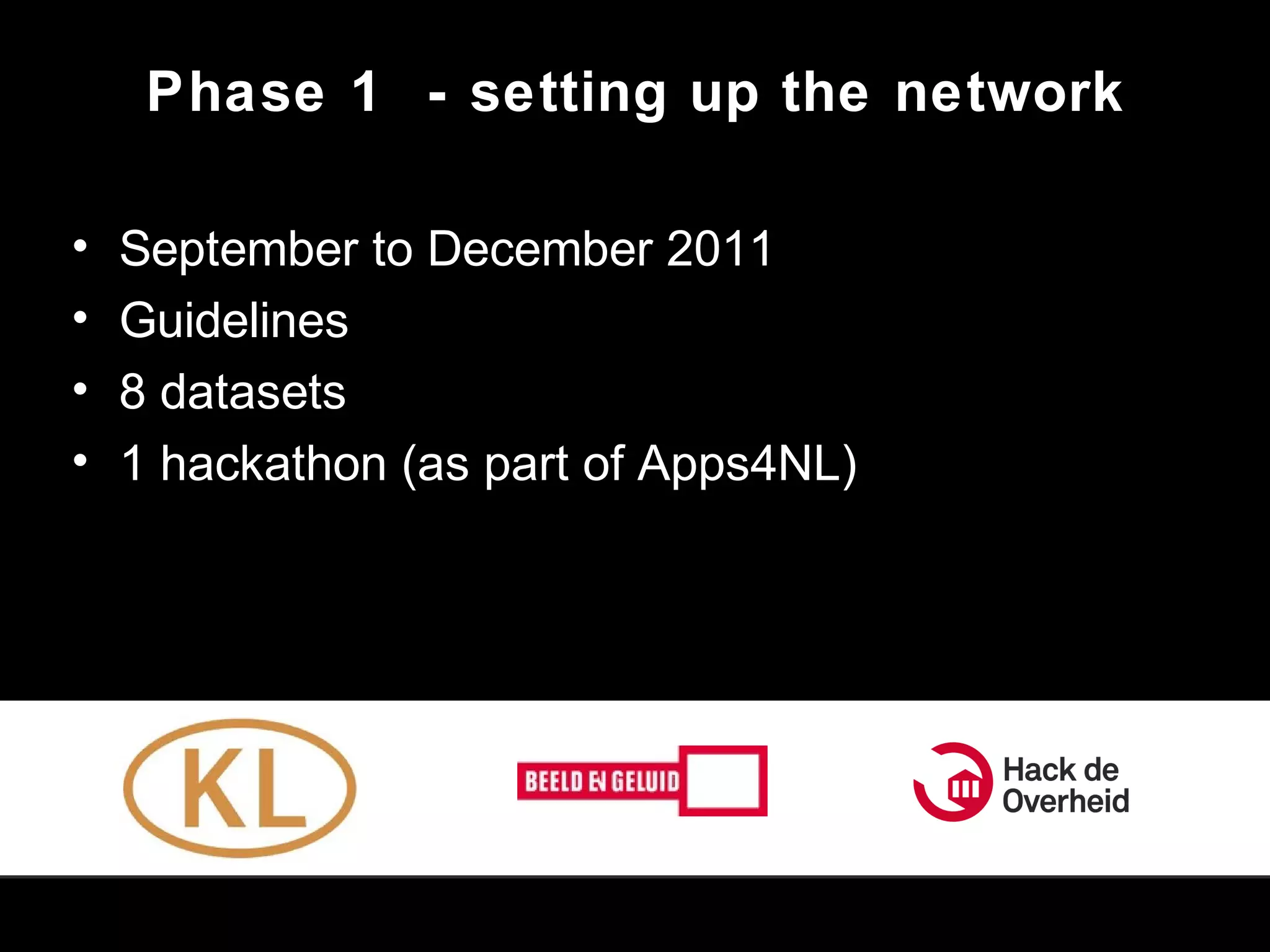
• September to December 2011
• Guidelines
• 8 datasets
• 1 hackathon (as part of Apps4NL)
Phase 1 - setting up the network
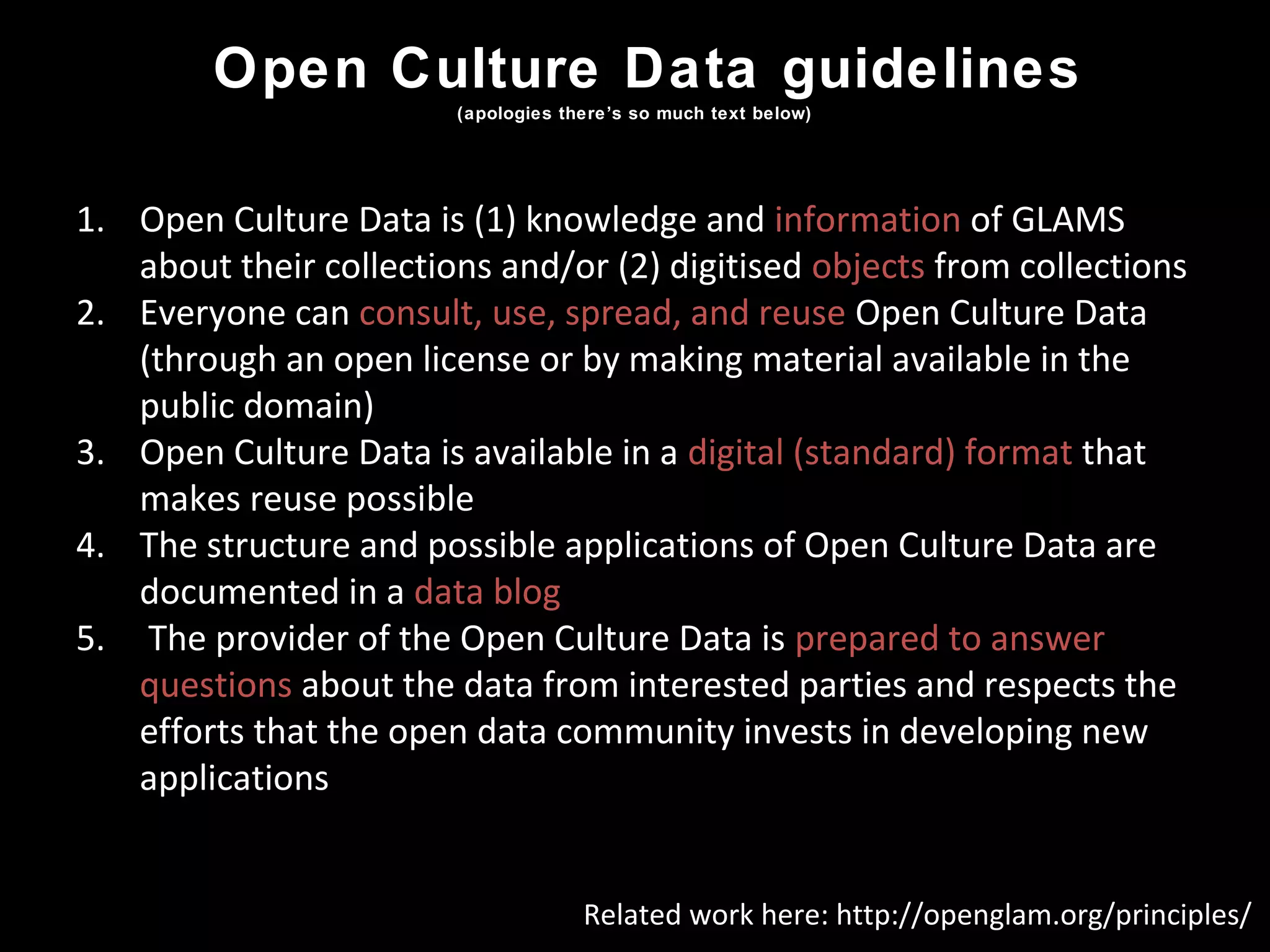
Open Culture Data guidelines
(apologies there’s so much text below)
1. Open Culture Data is (1) knowledge and information of GLAMS
about their collections and/or (2) digitised objects from collections
2. Everyone can consult, use, spread, and reuse Open Culture Data
(through an open license or by making material available in the
public domain)
3. Open Culture Data is available in a digital (standard) format that
makes reuse possible
4. The structure and possible applications of Open Culture Data are
documented in a data blog
5. The provider of the Open Culture Data is prepared to answer
questions about the data from interested parties and respects the
efforts that the open data community invests in developing new
applications
Related work here: http://openglam.org/principles/
http://www.flickr.com/people/cartercomics/
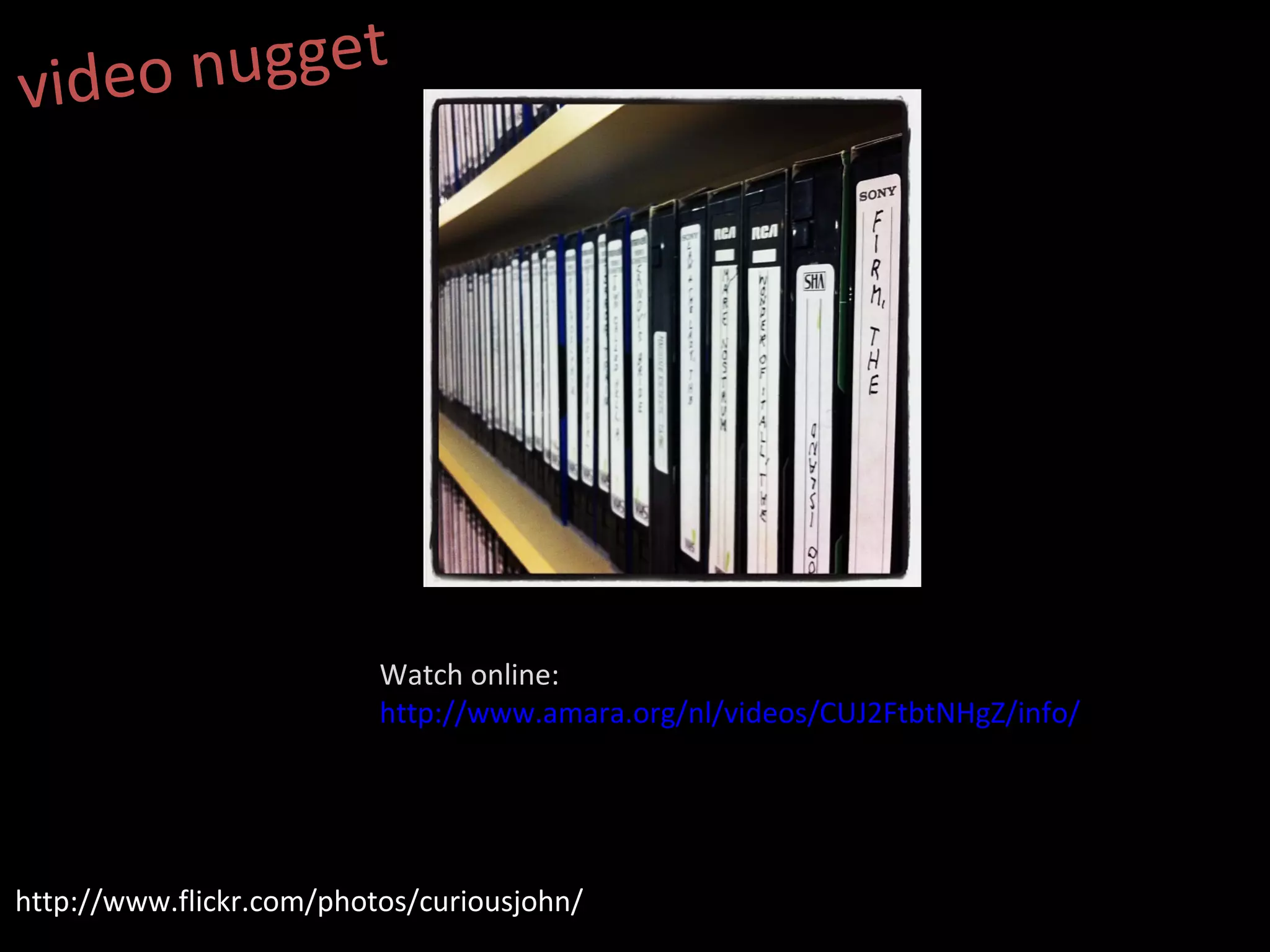
Watch online:
http://www.amara.org/nl/videos/9TKW2zyxThkN/info/
video nugget
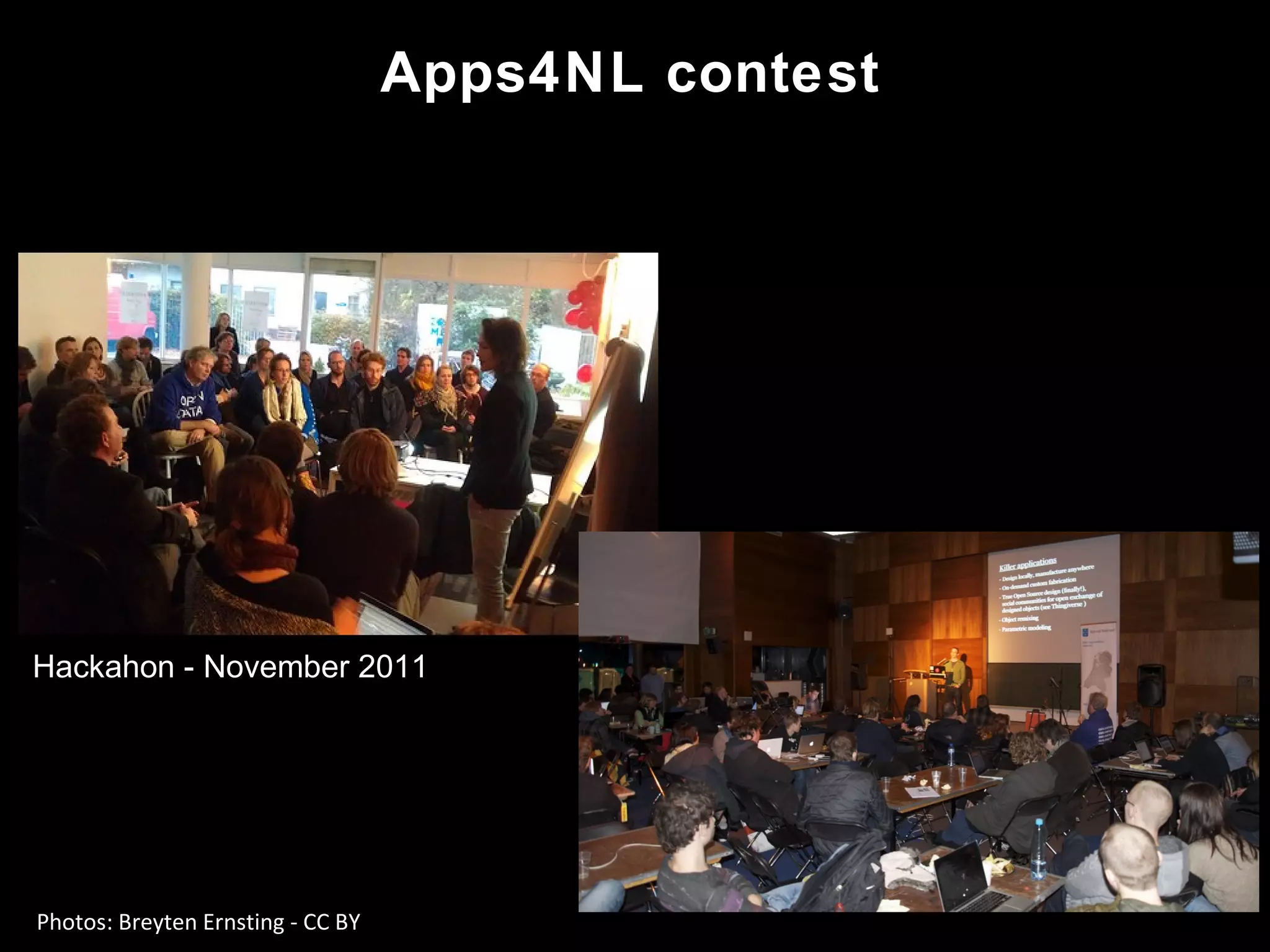
Apps4NL contest
Photos: Breyten Ernsting - CC BY
Hackahon - November 2011
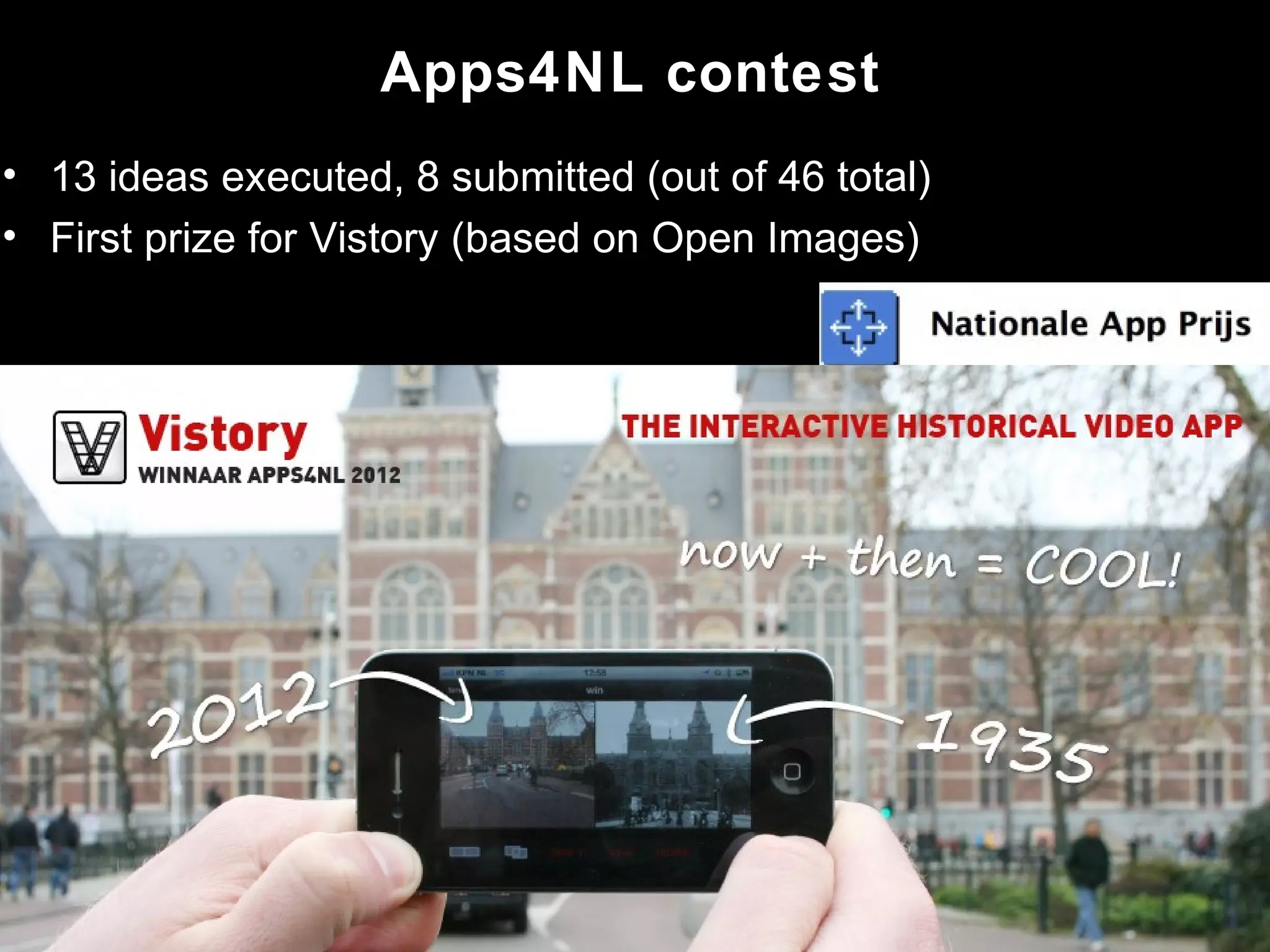
• 13 ideas executed, 8 submitted (out of 46 total)
• First prize for Vistory (based on Open Images)
Source: Glimworm IT
Apps4NL contest
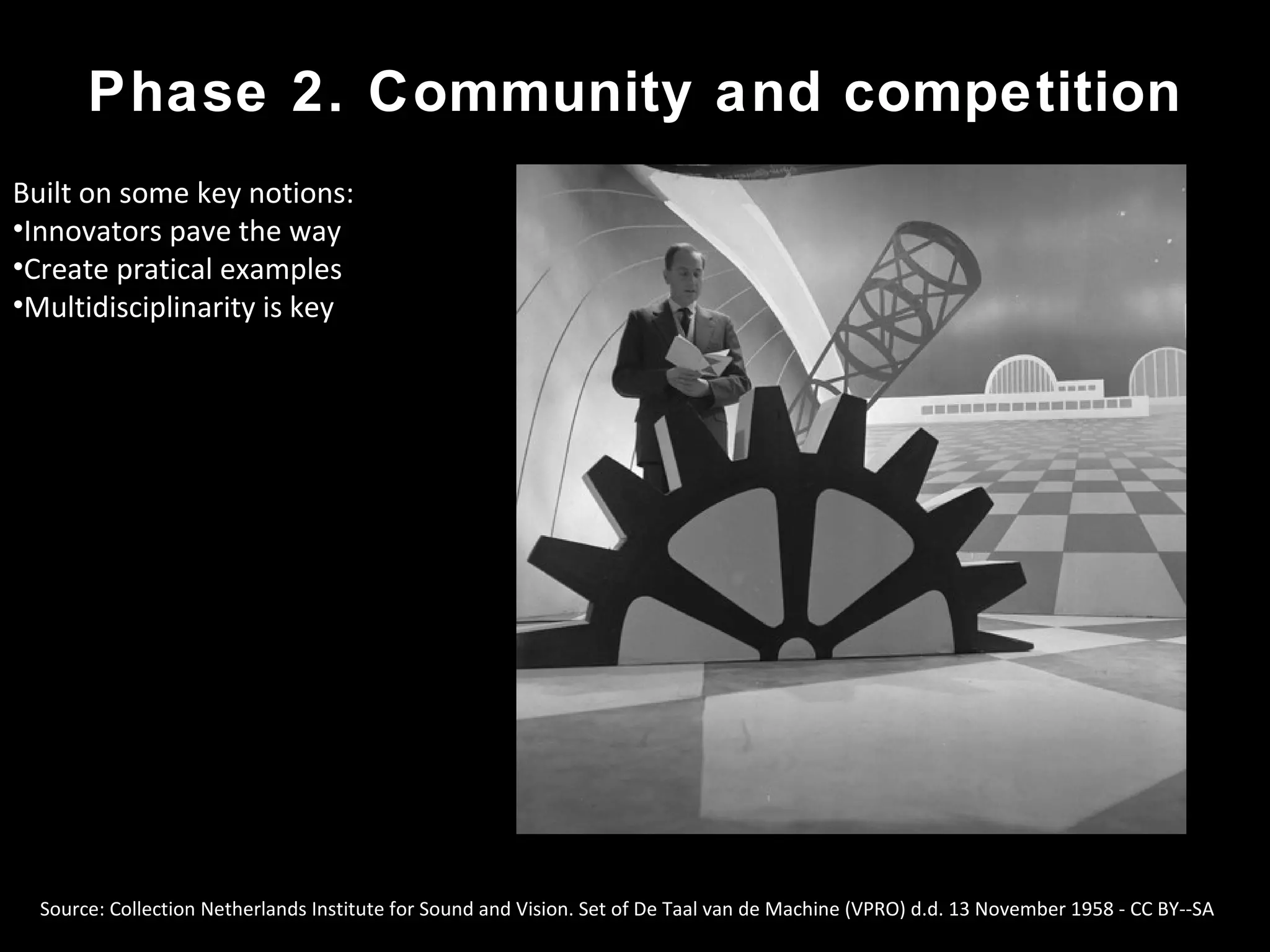
Source: Collection Netherlands Institute for Sound and Vision. Set of De Taal van de Machine (VPRO) d.d. 13 November 1958 - CC BY--SA
Phase 2. Community and competition
Built on some key notions:
•Innovators pave the way
•Create pratical examples
•Multidisciplinarity is key
• April 2012: start masterclasses
• June 2012: start competition / hackathon 1
• October/November 2012: hackathon 2
• January 2013: awards ceremony
Activities in 2012
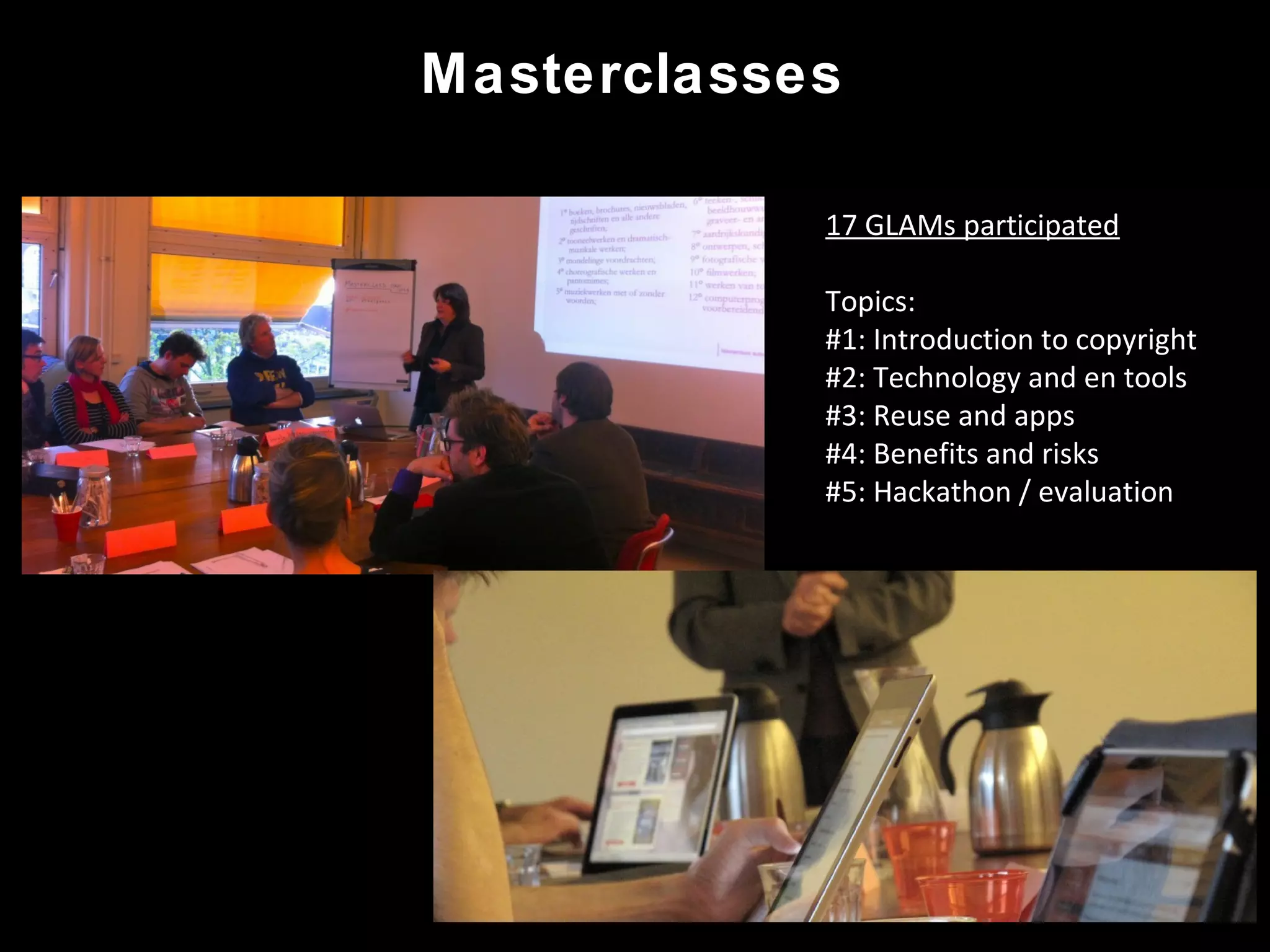
Masterclasses
17 GLAMs participated
Topics:
#1: Introduction to copyright
#2: Technology and en tools
#3: Reuse and apps
#4: Benefits and risks
#5: Hackathon / evaluation
Defining the ‘app challenge’
…make an app:
•that expands audience reach (online, offline, on
site)
•in which the audience is reached in novel ways
•that utilises and connects different datasets
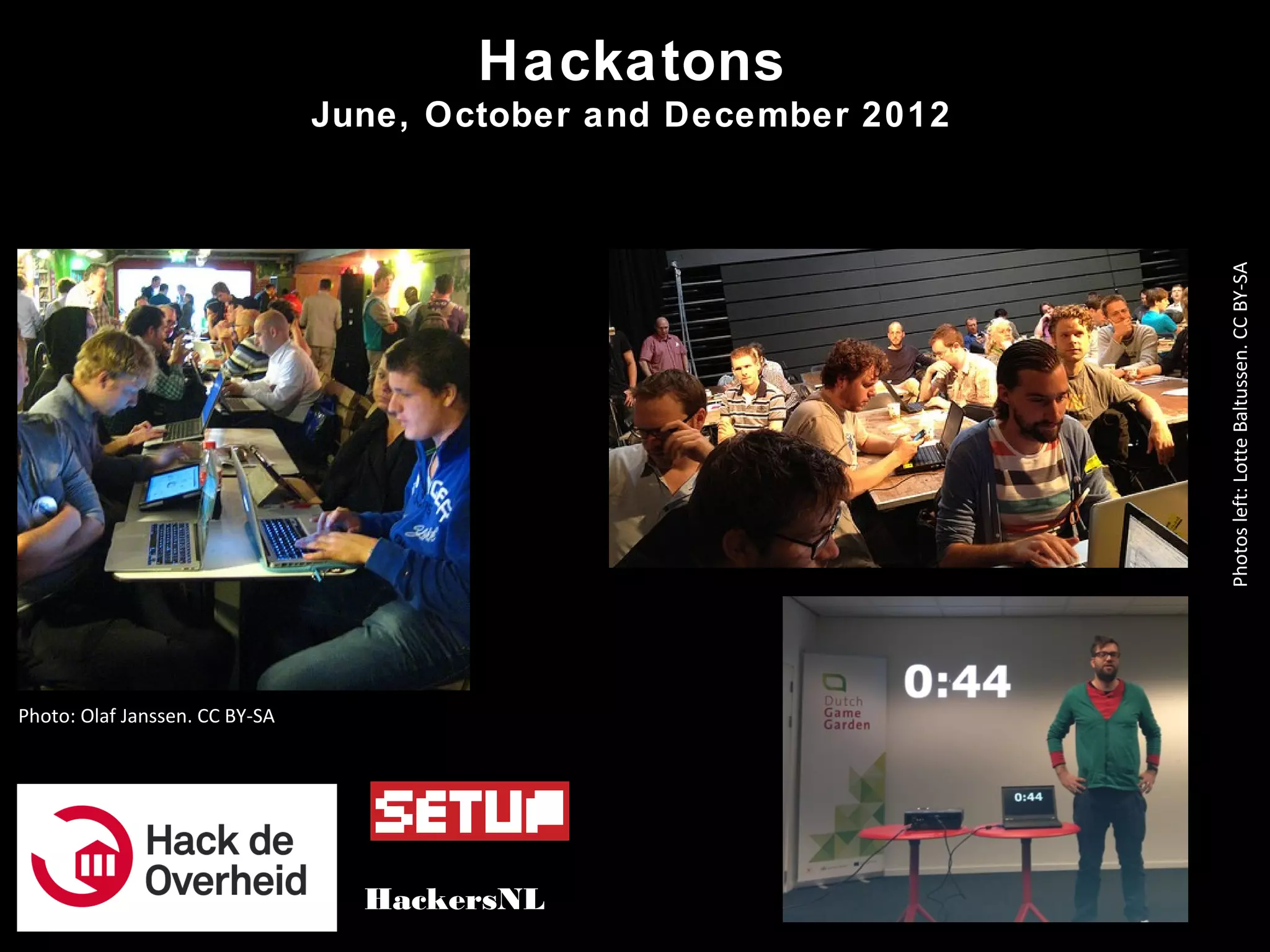
Hackatons
June, October and December 2012
HackersNL
Photo: Olaf Janssen. CC BY-SA
Photosleft:LotteBaltussen.CCBY-SA
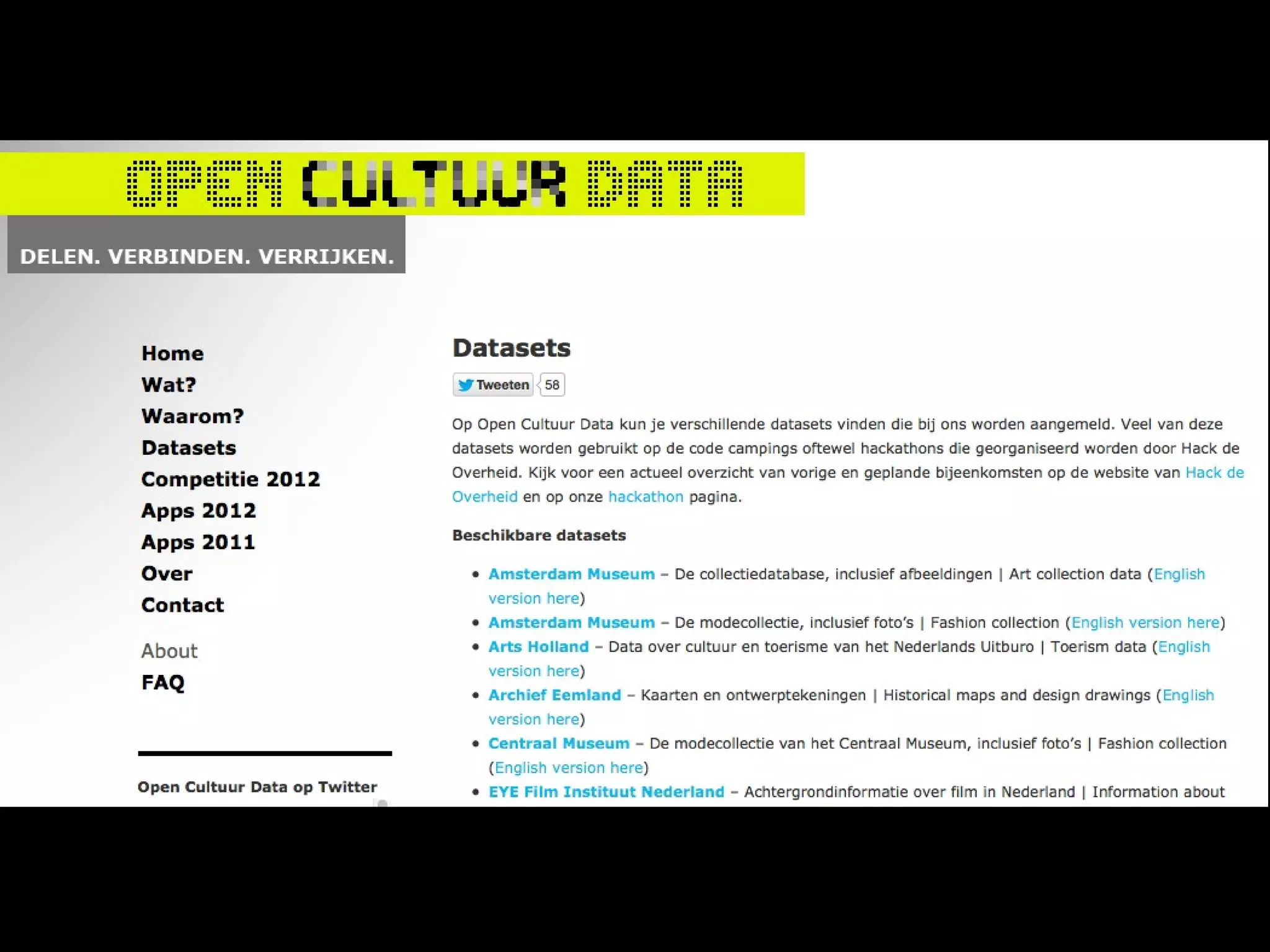
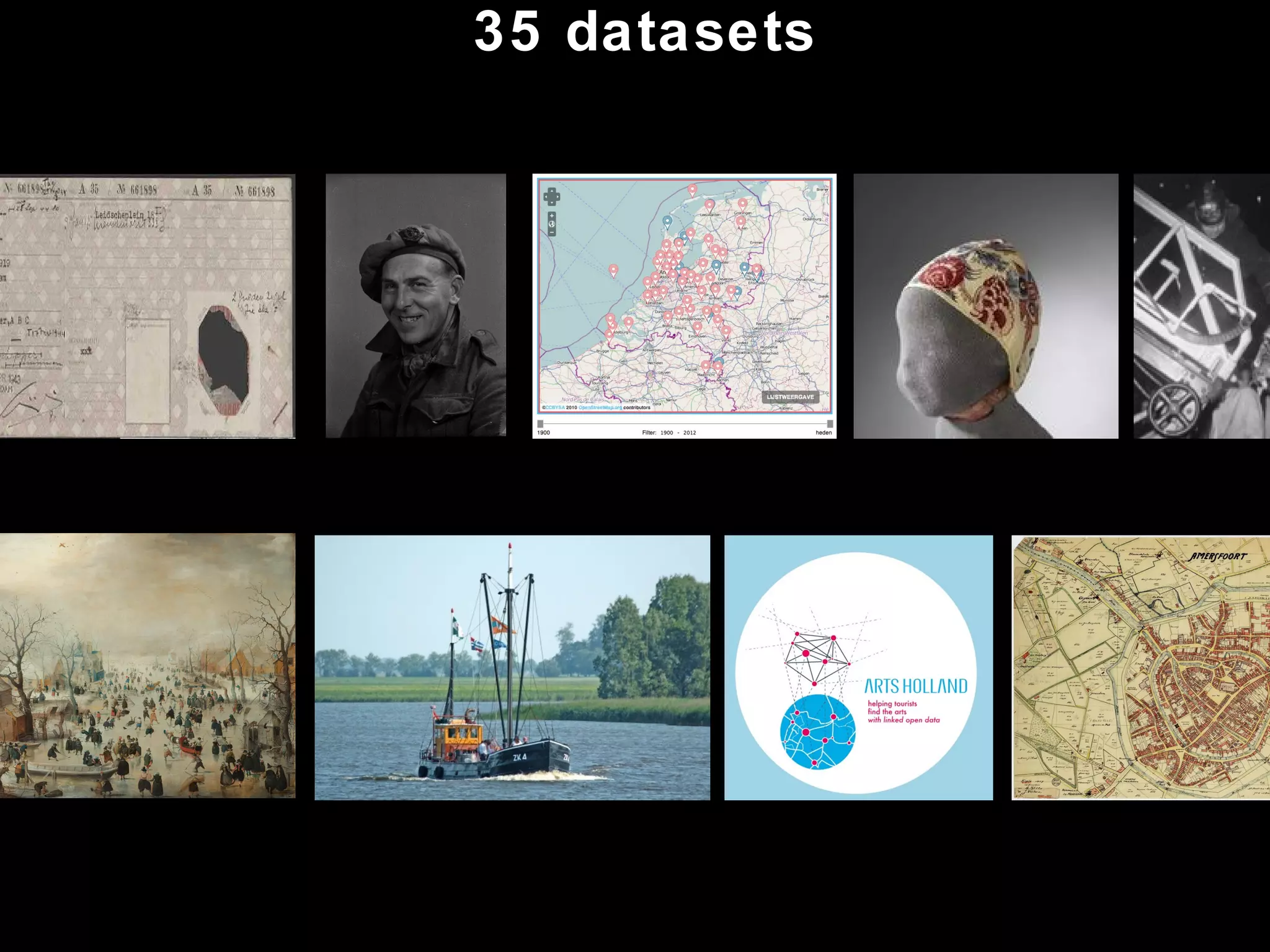
35 datasets
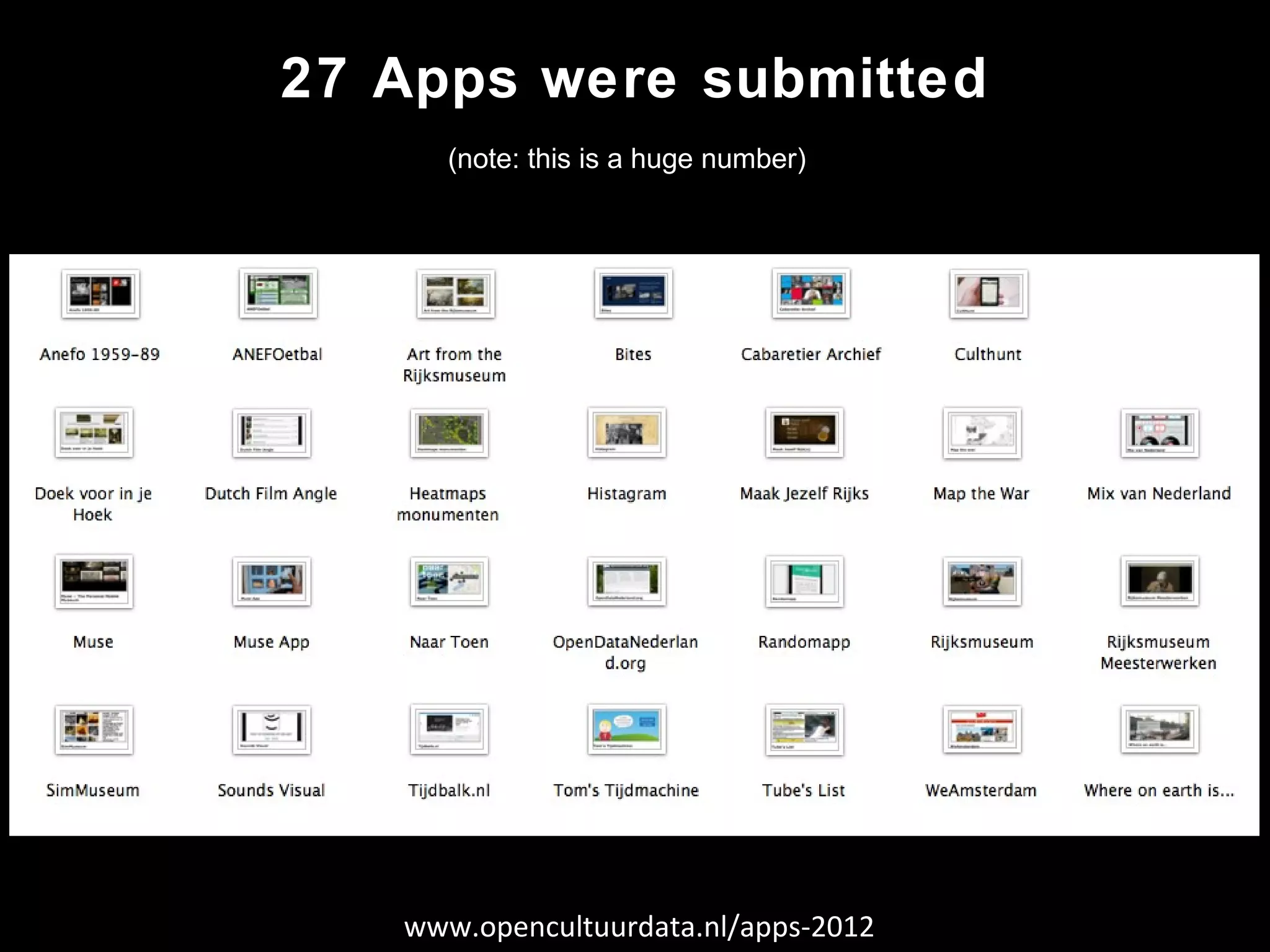
27 Apps were submitted
(note: this is a huge number)
www.opencultuurdata.nl/apps-2012
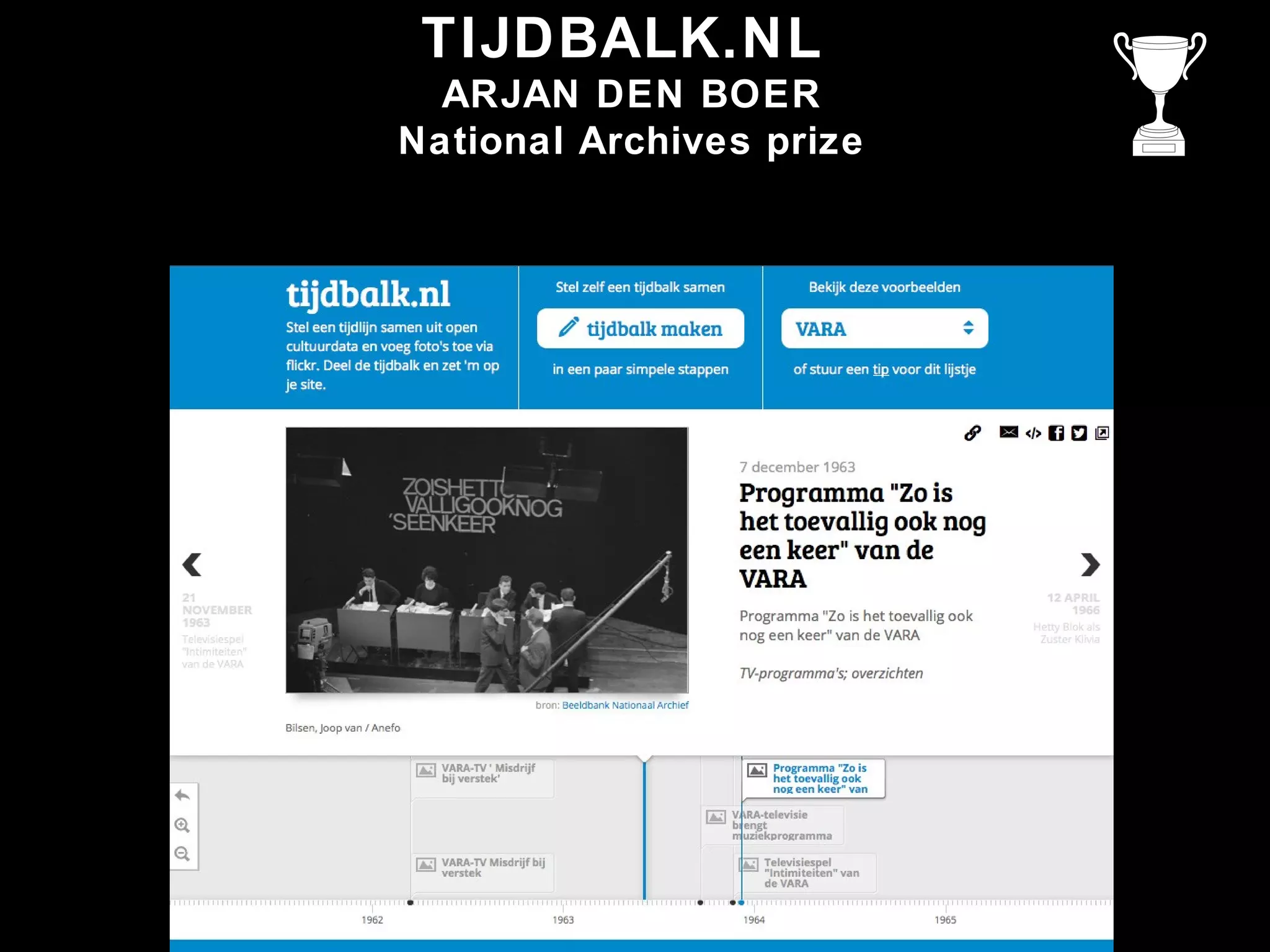
TIJDBALK.NL
ARJAN DEN BOER
National Archives prize
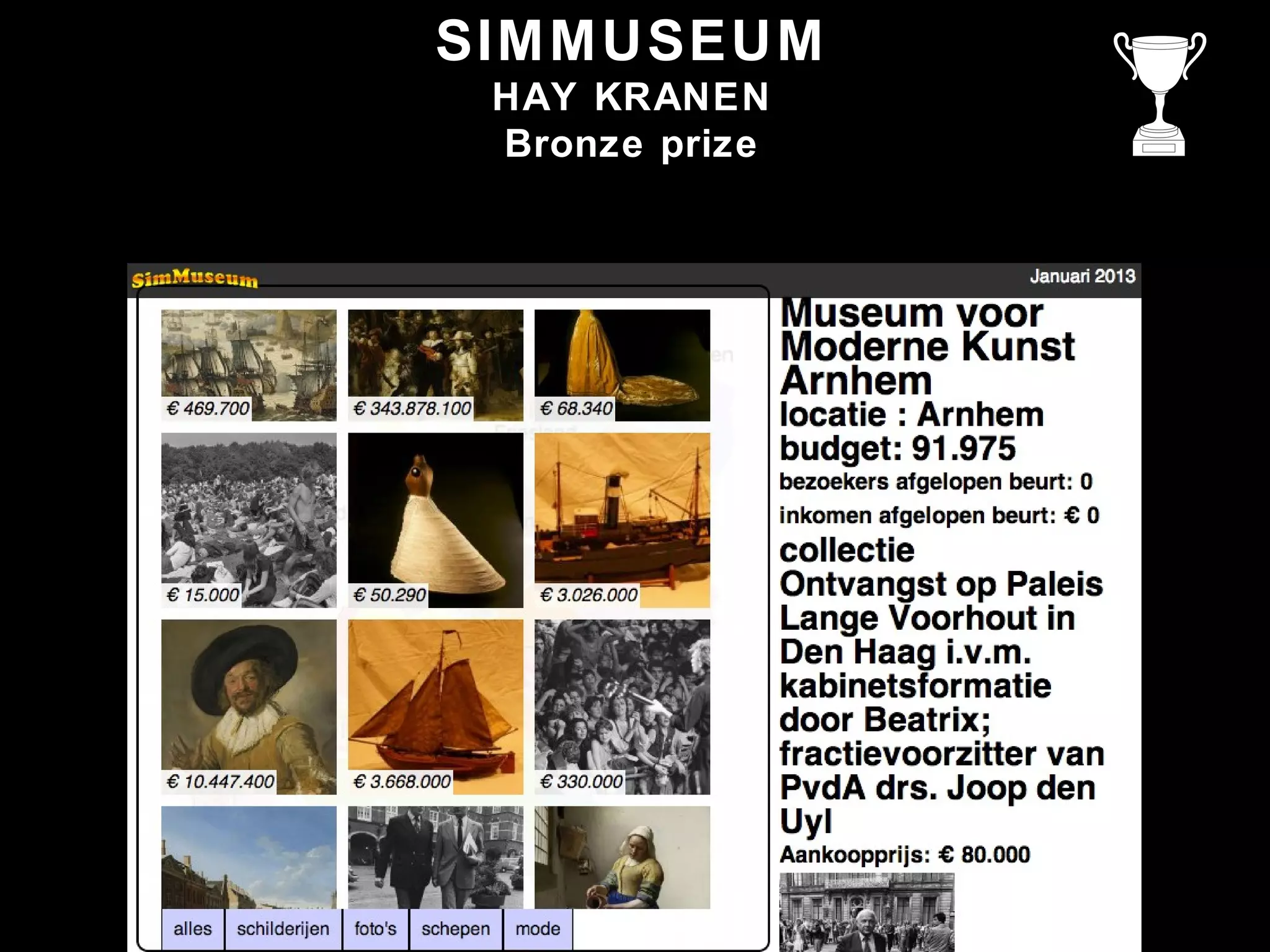
SIMMUSEUM
HAY KRANEN
Bronze prize
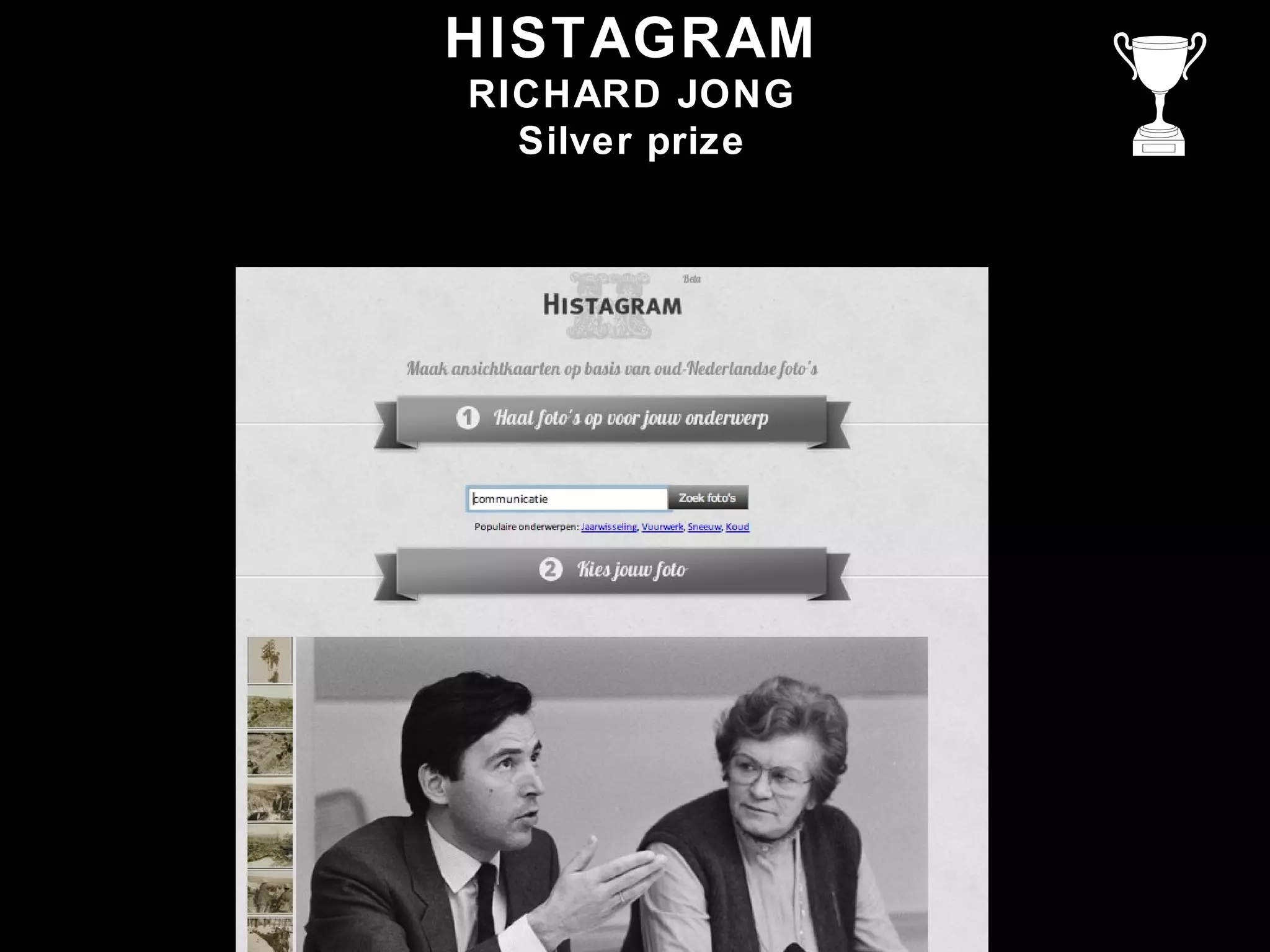
HISTAGRAM
RICHARD JONG
Silver prize
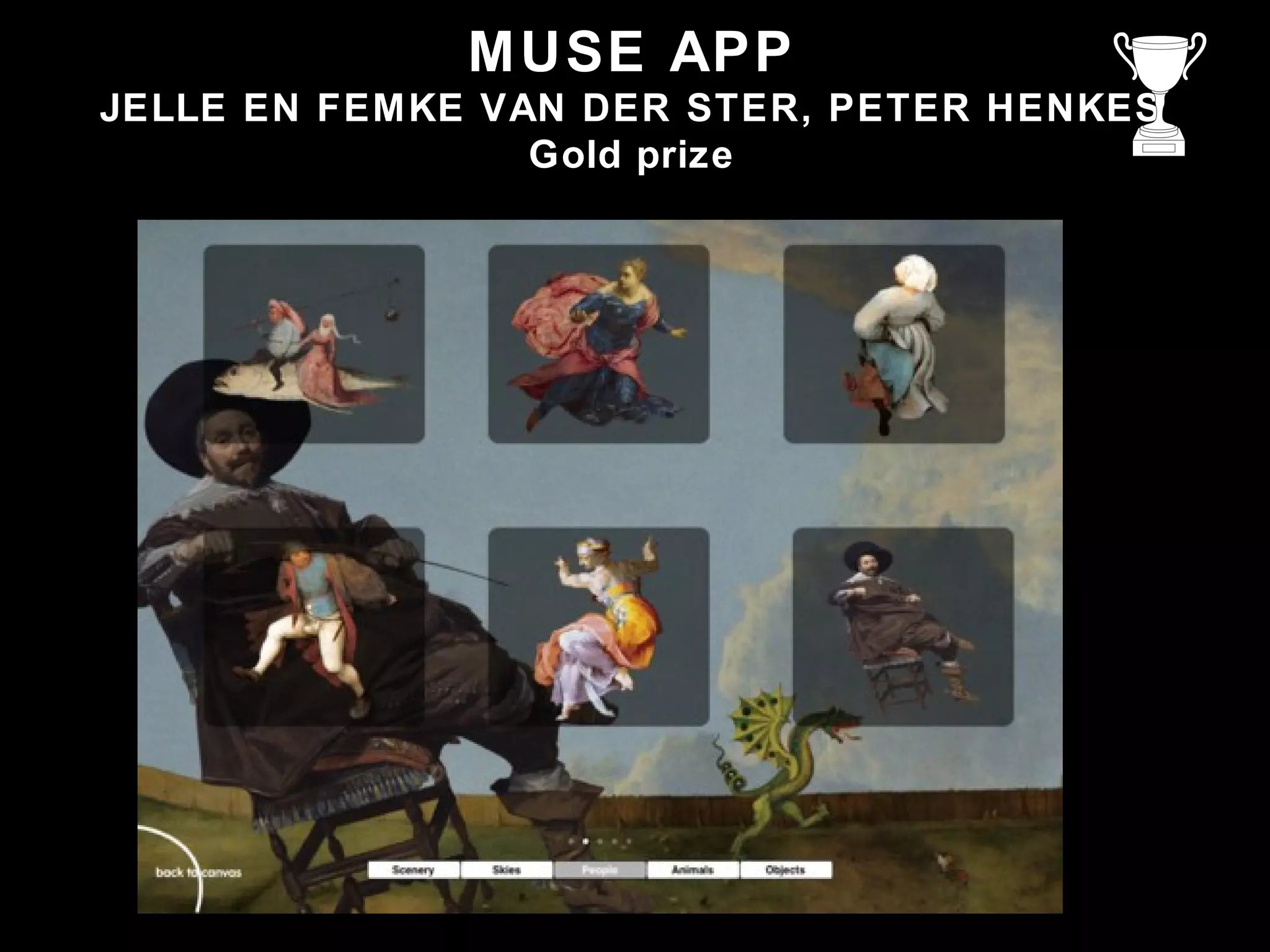
MUSE APP
JELLE EN FEMKE VAN DER STER, PETER HENKES
Gold prize
http://www.flickr.com/photos/curiousjohn/
Watch online:
http://www.amara.org/nl/videos/CUJ2FtbtNHgZ/info/
video nugget
Some lessons learned
• Have access to expertise on the dimensions of
collection
• Buy-in from the senior management is essential =>
focus on value add
• Necessity to invest in engagement with third parties
• Face to face meetups are extremely valuable
(masterclasses f.i.)
• Start with something sweet and small
• On hackatons • It doesn’t just happen – lots and lots of effort
• Search for sustainability
• Not all data is equally popular
Future Work
• GLAMetrics
• Improve API search
• Executive track
• Focussed challenges (education etc.)
• OpenCultuurData.be
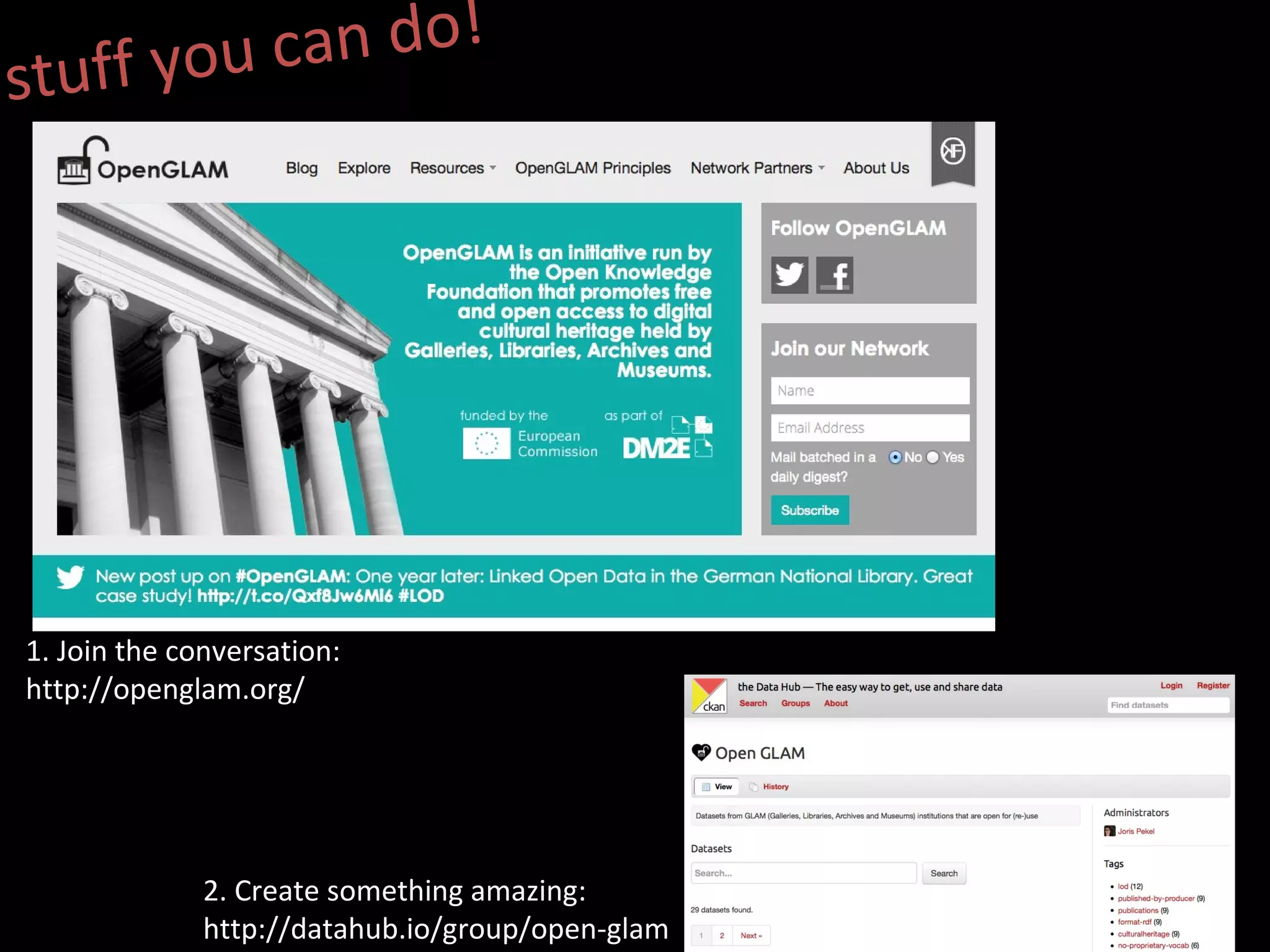
2. Create something amazing:
http://datahub.io/group/open-glam
1. Join the conversation:
http://openglam.org/
stuff you can do!
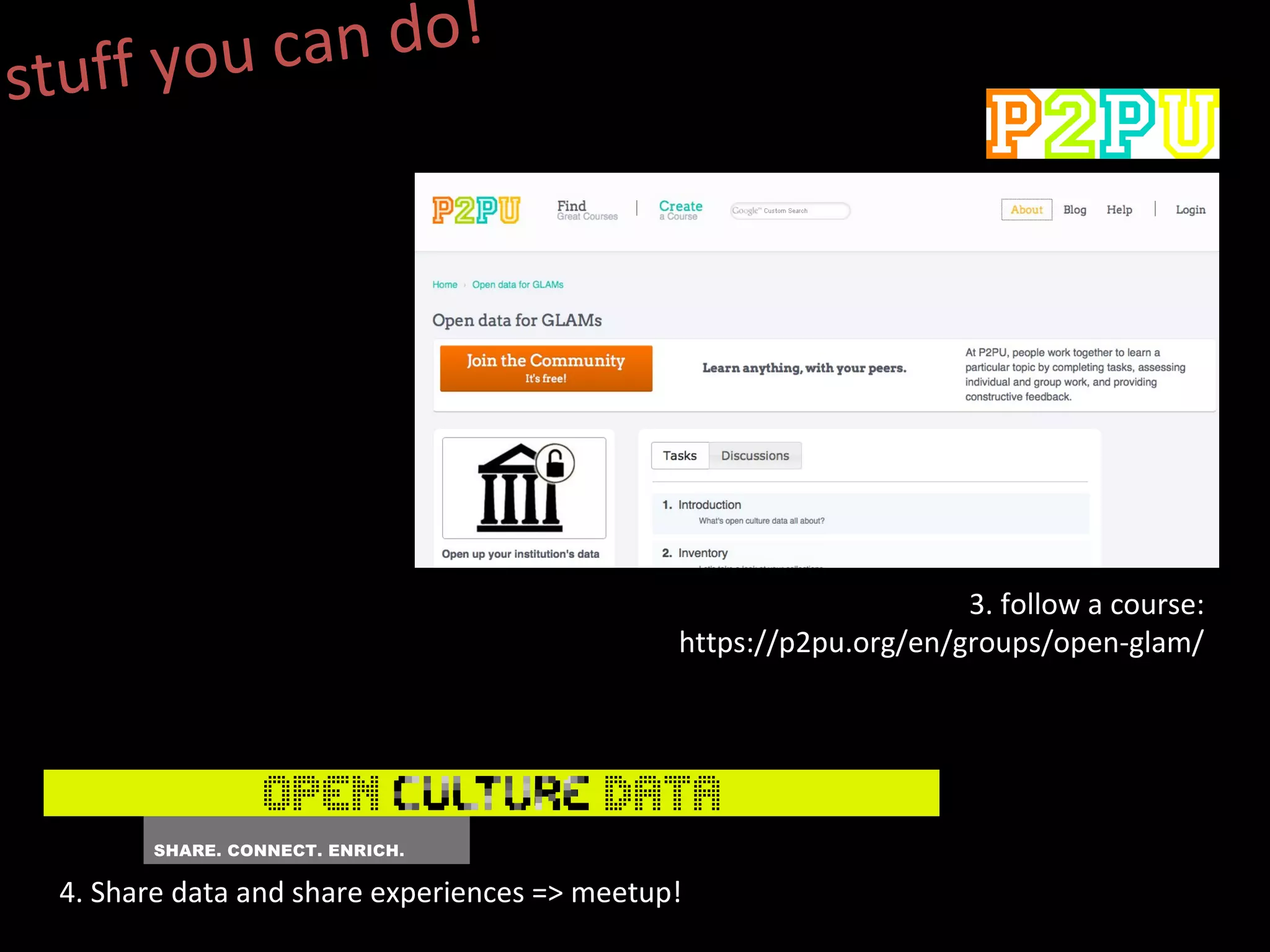
3. follow a course:
https://p2pu.org/en/groups/open-glam/
stuff you can do!
4. Share data and share experiences => meetup!
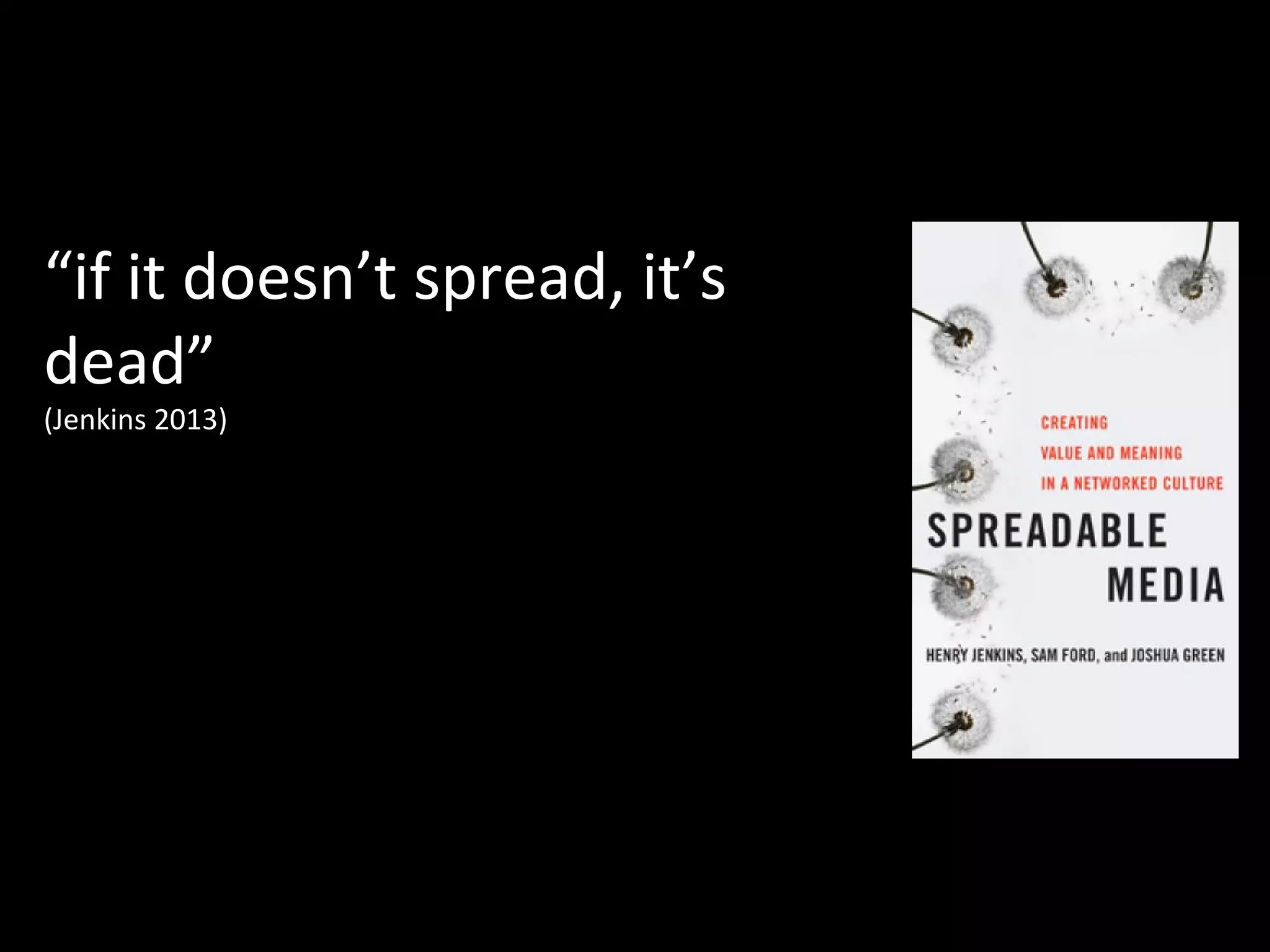
“if it doesn’t spread, it’s
dead”
(Jenkins 2013)
www.opencultuurdata.nl/en
@opencultuurdata
@johanoomen
L. B. Baltussen, M.Brinkerink, N.Timmermans, M. Zeinstra, J. Oomen.
Open Culture Data: Opening GLAM Data Bottom-up. Museums and the Web 2013.
http://mw2013.museumsandtheweb.com/paper/open-culture-data-opening-glam-data-bottom-up/

Open Culture Data: Opening GLAM Data Bottom-up

  • 1.
    Open Culture Data: OpeningGLAM Data Bottom-Up Johan Oomen | Manager R&D | Netherlands Institute for Sound and Vision t: @johanoomen MW2013 | Portland OR, 20 April 2013 t: @OpenCultuurData | #opencultuurdata
  • 2.
    Lotte Belice BaltussenMaarten Zijnstra Nikki Timmermans Co-authors Maarten Brinkerink http://mw2013.museumsandtheweb.com/paper/open-culture-data-opening-glam-data-bottom-up/ li n k
  • 3.
    1. Open CultureData NL 2. Lessons learned 3. Stuff you can do today! source: http://www.flickr.com/photos/sdasmarchives/8477565056/ Outline
  • 4.
    STIMULATING COLLABORATION ANDCREATIVITY “No matter who you are, most of the smartest people work for someone else.” Joy’s Law The “WHY” of open data in GLAMS PUBLIC MISSION “For [GLAM] content to be truly accessible, it needs to be where the users are, embedded in their daily networked lives.” Waibel and Erway, 2009
  • 5.
  • 6.
    Neelie Kroes -Vice President for the Digital Agenda of the European Commission “I urge cultural institutions to open up control of their data…there is a wonderful opportunity to show how cultural material can contribute to innovation, how it can become a driver of new developments. Museums, archives and libraries should not miss it.” The “WHY” of open data
  • 7.
  • 8.
  • 9.
    Verwayen, H., Arnoldus,M., & Kaufman, P. B. (2011). The Problem of the Yellow Milkmaid. A Business Model Perspective on Open Metadata. JAM/Europeana. CC BY
  • 10.
  • 11.
    • September toDecember 2011 • Guidelines • 8 datasets • 1 hackathon (as part of Apps4NL) Phase 1 - setting up the network
  • 12.
    Open Culture Dataguidelines (apologies there’s so much text below) 1. Open Culture Data is (1) knowledge and information of GLAMS about their collections and/or (2) digitised objects from collections 2. Everyone can consult, use, spread, and reuse Open Culture Data (through an open license or by making material available in the public domain) 3. Open Culture Data is available in a digital (standard) format that makes reuse possible 4. The structure and possible applications of Open Culture Data are documented in a data blog 5. The provider of the Open Culture Data is prepared to answer questions about the data from interested parties and respects the efforts that the open data community invests in developing new applications Related work here: http://openglam.org/principles/
  • 13.
  • 14.
    Apps4NL contest Photos: BreytenErnsting - CC BY Hackahon - November 2011
  • 15.
    • 13 ideasexecuted, 8 submitted (out of 46 total) • First prize for Vistory (based on Open Images) Source: Glimworm IT Apps4NL contest
  • 16.
    Source: Collection NetherlandsInstitute for Sound and Vision. Set of De Taal van de Machine (VPRO) d.d. 13 November 1958 - CC BY--SA Phase 2. Community and competition Built on some key notions: •Innovators pave the way •Create pratical examples •Multidisciplinarity is key
  • 17.
    • April 2012:start masterclasses • June 2012: start competition / hackathon 1 • October/November 2012: hackathon 2 • January 2013: awards ceremony Activities in 2012
  • 18.
    Masterclasses 17 GLAMs participated Topics: #1:Introduction to copyright #2: Technology and en tools #3: Reuse and apps #4: Benefits and risks #5: Hackathon / evaluation
  • 21.
    Defining the ‘appchallenge’ …make an app: •that expands audience reach (online, offline, on site) •in which the audience is reached in novel ways •that utilises and connects different datasets
  • 22.
    Hackatons June, October andDecember 2012 HackersNL Photo: Olaf Janssen. CC BY-SA Photosleft:LotteBaltussen.CCBY-SA
  • 23.
  • 24.
    27 Apps weresubmitted (note: this is a huge number) www.opencultuurdata.nl/apps-2012
  • 25.
  • 26.
  • 27.
  • 28.
    MUSE APP JELLE ENFEMKE VAN DER STER, PETER HENKES Gold prize
  • 29.
  • 30.
    Some lessons learned •Have access to expertise on the dimensions of collection • Buy-in from the senior management is essential => focus on value add • Necessity to invest in engagement with third parties • Face to face meetups are extremely valuable (masterclasses f.i.) • Start with something sweet and small • On hackatons • It doesn’t just happen – lots and lots of effort • Search for sustainability • Not all data is equally popular
  • 31.
    Future Work • GLAMetrics •Improve API search • Executive track • Focussed challenges (education etc.) • OpenCultuurData.be
  • 32.
    2. Create somethingamazing: http://datahub.io/group/open-glam 1. Join the conversation: http://openglam.org/ stuff you can do!
  • 33.
    3. follow acourse: https://p2pu.org/en/groups/open-glam/ stuff you can do! 4. Share data and share experiences => meetup!
  • 34.
    “if it doesn’tspread, it’s dead” (Jenkins 2013)
  • 35.
    www.opencultuurdata.nl/en @opencultuurdata @johanoomen L. B. Baltussen,M.Brinkerink, N.Timmermans, M. Zeinstra, J. Oomen. Open Culture Data: Opening GLAM Data Bottom-up. Museums and the Web 2013. http://mw2013.museumsandtheweb.com/paper/open-culture-data-opening-glam-data-bottom-up/

Editor's Notes

  • #5 GLAMs increasingly realize that open access to data helps drive users to online content, for instance by providing content for reuse on Wikipedia articles. Hence, open data supports cultural institutions in the fulfilment of their public mission to open up access to our collective heritage, not just through their own channels, but outside as well. As Waibel and Erway (2009) state: “ for [GLAM] content to be truly accessible, it needs to be where the users are, embedded in their daily networked lives. ” It also stimulates collaboration in the GLAM world and beyond. This allows the creation of new services and supports creative reuse of material in new productions. As Bill Joy notes in “ Joy ’ s law ” : “ No matter who you are, most of the smartest people work for someone else ” (Lakhani & Panetta, 2007). Thus, encouraging external parties to reuse publicly available sources stimulates innovation in the GLAM sector and results in services of higher quality and diversity that contribute to the public mission of making collections broadly available.
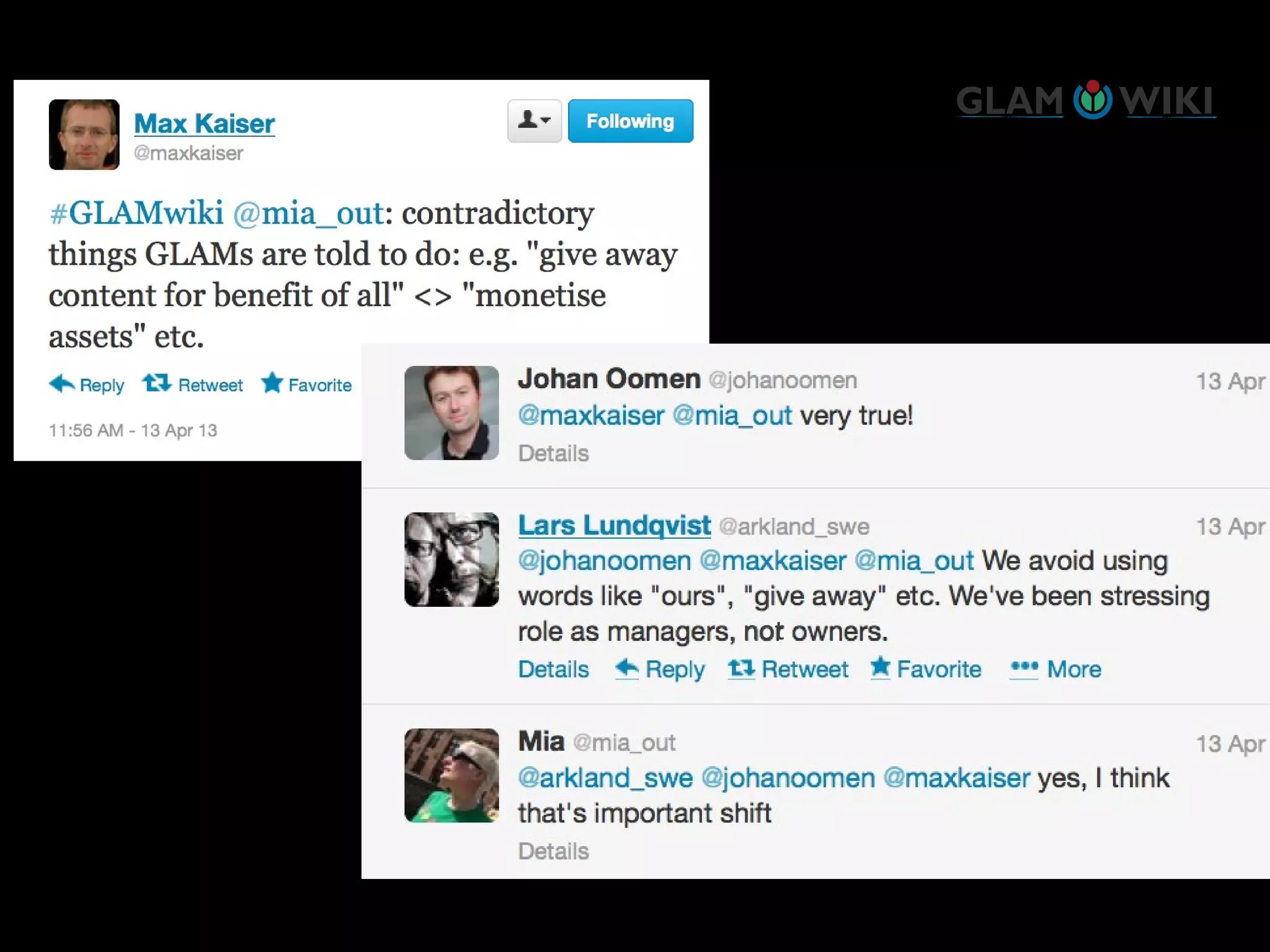
  • #9 We ’ ve followed and built upon important milestones in the open culture movement. Notably the foundation of CC in 2011, large-scale content donations to Wikimedia by GLAMs and the GLAMWIKI and OpenGLAM movement. At S&V we started our own open video platform in 2009.
  • #12 We started the Open Culture Data network (http://www.opencultuurdata.nl) by participating in a national Apps for the Netherlands competition (http://nationaleappprijs.nl), which was primarily aimed at reusing open governmental data. Within three months, the network identified, described, and contributed eight open datasets from six individual data providers to the competition: ab-c media, Amsterdam Museum, Dutch National Archives, EYE Film Institute Netherlands, Netherlands Institute for Sound and Vision, and Rijksmuseum. Open Culture Data is knowledge and information of cultural institutions, organisations or initiatives about their collections and/or works Everyone can consult, use, spread and re-use Open Culture Data through an open license or by making it available in the public domain Open Culture Data is available in a digital (standard) format that makes re-use possible The structure and possible applications of Open Culture Data are documented, for instance in a Datablog The provider of the Open Culture Data is prepared to answer questions about the data from interested parties and respects the efforts the open data community invests in developing new applications
  • #13 We started the Open Culture Data network (http://www.opencultuurdata.nl) by participating in a national Apps for the Netherlands competition (http://nationaleappprijs.nl), which was primarily aimed at reusing open governmental data. Within three months, the network identified, described, and contributed eight open datasets from six individual data providers to the competition: ab-c media, Amsterdam Museum, Dutch National Archives, EYE Film Institute Netherlands, Netherlands Institute for Sound and Vision, and Rijksmuseum. Open Culture Data is knowledge and information of cultural institutions, organisations or initiatives about their collections and/or works Everyone can consult, use, spread and re-use Open Culture Data through an open license or by making it available in the public domain Open Culture Data is available in a digital (standard) format that makes re-use possible The structure and possible applications of Open Culture Data are documented, for instance in a Datablog The provider of the Open Culture Data is prepared to answer questions about the data from interested parties and respects the efforts the open data community invests in developing new applications
  • #15 We held workshops for heritage professionals and promoted the 8 datasets at a one-day hackathon.
  • #16 Surprisingly for an app competition aimed at reuse of governmental data, three of the apps made with culture data won prizes in the competition, including the overall winner. Glimworm IT won the contest with its app, Vistory (an app to recreate historical footage scenes with your smartphone camera
  • #17 Although Open Culture Data started out as ad hoc and experimental, it was clear that there was a need for culture data that could be openly reused and a strong network to position and promote culture in the (inter)national open data arena. Due to this need, combined with the enthusiasm of the developers, we concluded that we should continue and expand the Open Culture Data activities.
  • #19 The masterclass open data for cultural organisations organised together with Creative Commons Netherlands started in April 2012. In this masterclass, representatives of various GLAM organizations took part in order to assist them with courseware and lectures that would guide them through the process of opening up a cultural dataset. [themes on slide]
  • #22 In order to create interest in the open culture datasets and stimulate reuse, we launched our own app competition that ran from June 16 to December 31, 2012. We set out three main challenges for the developer community: Four prizes: a general gold, silver and bronze one, and a special National Archives prize.
  • #24 We now have a great, diverse range of datasets: 35 in total of 22 different institutions. met de klok mee: Regionaal Archief Nijmegen (WOII soldaat), Anefo van NA, Geluid van NL, Mode (Fries Museum, Centraal Museum, Adam Museum), Kaarten (Archief Eemland), Toeristische data (Arts Holland), Rijksmuseum, Visserijmuseum Zoutkamp, Regionaal Archief Leiden (WOII documenten)
  • #25 In total, twenty-seven apps were submitted for the competition, a lot more than we had bargained for, and the quality of the apps also exceeded our expectations. A jury of five (two GLAM and two open data professionals, and one developer) picked the winners.
  • #26 The Dutch National Archives prize went to Tijdbalk.nl, made by Arjan den Boer. Users can make their own timeline with historical photos photos and add their own content as well.
  • #27 Third prize went to SimMuseum by Hay Kranen, a Web game in which you can play a museum director, collect work of arts, and build your own museum.
  • #28 The silver went to Histagram by Frontwise (Richard Jong), an app where you can make digital postcards based on historical pictures
  • #29 First prize went to Muse app made by Femke van der Ster, Peter Henkes, and Jelle van der Ster. Muse app allows you to create your own work of art with cutouts from world-famous old masters: sceneries, people, animals, objects, and skies. You can bring the cutouts to your own canvas, pinch, move, duplicate them to make a collage, and share your masterpiece through Facebook, e-mail, put it on your camera-roll, or put it in an online Web gallery where it can be reviewed by art critics and other Muse-app creators.
  • #30 It doesn ’ t just happen: It will always take time and resources to get the results that we did. During the competition period, we continuously raised awareness in the developer community and asked them what they wanted and needed, and we were always available for questions and input. Sustainability: More needs to be done to make sure that app competitions result in something sustainable. Developers, data providers, and networks like Open Culture Data need to join forces and make sure that they understand one another so that supply and demand are more aligned to each other. We have seen in both the national and international open data movement that a majority of apps developed within competitions will disappear, because they cannot be sustained in the long run and often remain in the prototype stage. Before you have a real killer app, a lot of other and similar apps will come along first. This is why Open Culture Data will focus on the development of sustainable business models with possible revenue streams for both the developers and the cultural institutions in the future. Not all data is equally popular: Fourteen of the thirty-four available datasets were actually used. The Rijksmuseum dataset, with its well-known collection, 125,000 high-resolution images, and easy-to-use API, was the most popular and used in nine out of twenty-seven apps submitted for the competition. In general, collections that offer both metadata and content were more popular than open datasets that only contained metadata. When metadata-only data was used, this was usually done in combination with other datasets that did have images or videos. One exception was the Arts Holland set that contains up-to-date information about cultural events in the Netherlands.
  • #31 Innovators lead the way. By gathering the right group of professionals in the cultural domain who believed in the (potential) power of open and were willing to experiment, we created a small but very powerful vanguard. For example: When the prestigious Dutch Rijksmuseum joined the initiative, this inspired other institutions like the National Museum of Antiquities to also participate. Create practical examples. The fact that cultural institutions are hesitant to join the open data movement has a lot to do with either a lack of knowledge or a fear of the consequences for their current way of operating: fear that their business model might be endangered and fear of people abusing their data, or reusing it for purposes they don ’ t agree with, like misrepresenting the data. These fears are not per se grounded in fact and experience (see for instance Verwayen et al., 2011), and it withholds institutions from what they can gain by opening up, like experimenting with innovative concepts for new services or applications. We have learned that by putting open culture data in practice and actively stimulating the reuse of the data, cultural institutions can be convinced to join the movement. Thinking about open culture data requires a multidisciplinary perspective. Many cultural institutions have particular ideas about new applications and services for their data, but this is only one way of looking at it. We have learned that connecting cultural institutions with the “ outside world ” —the world of hackers, designers, and students, but also other data providers and commercial companies—is not only a lot of fun, but is also very helpful to institutions in finding new ways to make arts and culture meaningful in the digital era.