An Introduction to Open Development
Open Development Camp
Image: Open for Change
Image: Getty Images
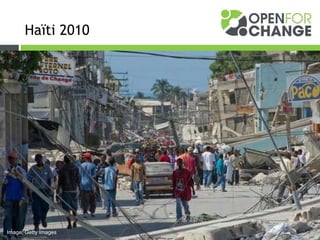
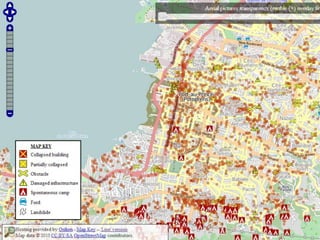
Haïti 2010
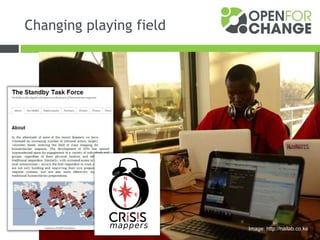
Changing playing field
Image: http://nailab.co.ke
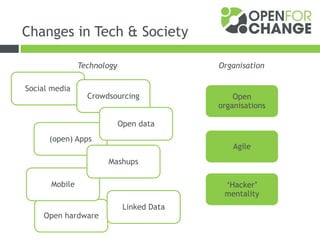
Open hardware
Social media
Crowdsourcing
Linked Data
Mobile
(open) Apps
Mashups
Open
organisations
Agile
‘Hacker’
mentality
Technology Organisation
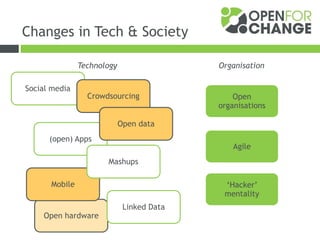
Changes in Tech & Society
Open data
Open development embraces these new ways of
working for a new international cooperation model:
• one that is more inclusive
• wisdom experts and wisdom of the crowd
• accountability to collaboration
• transparency to openness
What is Open Development
Why Open?
Image https://www.flickr.com/photos/opensourceway
Example via @rolfkleef
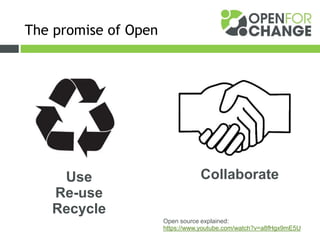
The promise of Open
Use
Re-use
Recycle
Collaborate
Open source explained:
https://www.youtube.com/watch?v=a8fHgx9mE5U
Open hardware
Social media
Crowdsourcing
Linked Data
Mobile
(open) Apps
Mashups
Open
organisations
Agile
‘Hacker’
mentality
Technology Organisation
Changes in Tech & Society
Open data
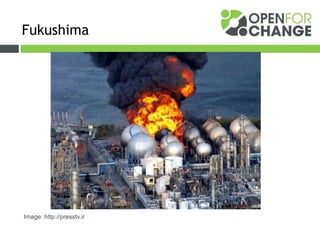
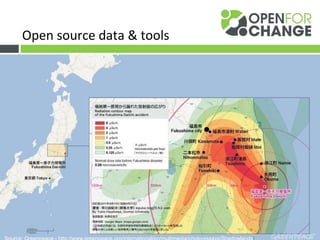
Fukushima
Image: http://presstv.ir
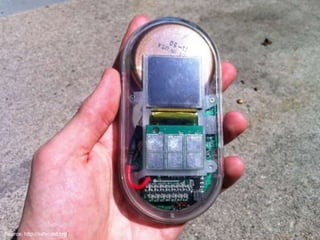
Source: http://safecast.org/
Open source data & tools
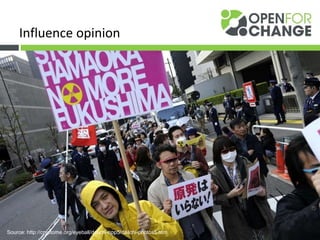
Influence opinion
Source: http://cryptome.org/eyeball/daiichi-npp5/daiichi-photos5.htm
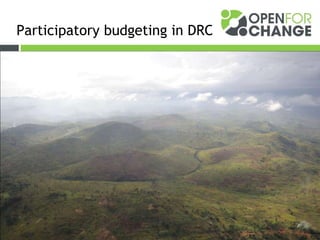
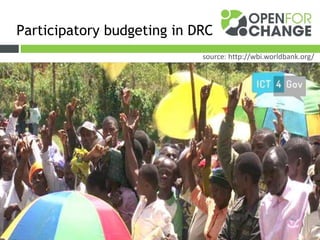
Participatory budgeting in DRC
…
…
source: http://wbi.worldbank.org/
Participatory budgeting in DRC
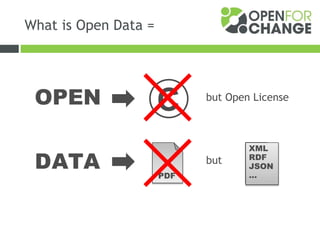
What is Open Data =
OPEN
DATA
C
PDF
XML
RDF
JSON
…
but
but Open License
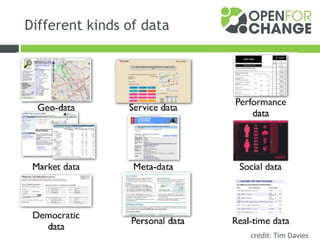
Different kinds of data
credit: Tim Davies
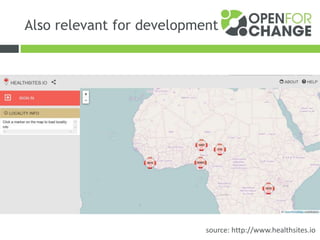
Also relevant for development
source: http://www.healthsites.io
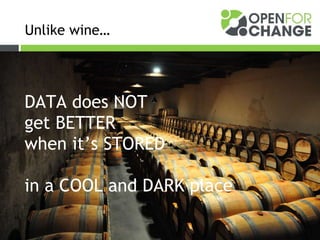
Unlike wine…
DATA does NOT
get BETTER
when it’s STORED
in a COOL and DARK place
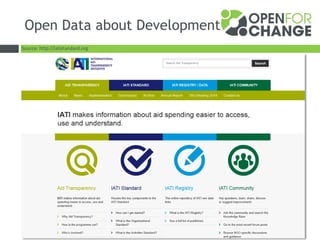
Open Data about Development
Source: http://iatistandard.org
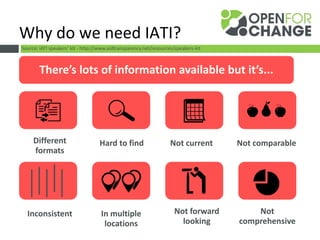
Why do we need IATI?
Different
formats
Hard to find Not current
Not
comprehensive
Inconsistent In multiple
locations
Not forward
looking
Not comparable
There’s lots of information available but it’s...
Source: IATI speakers’ kit - http://www.aidtransparency.net/resources/speakers-kit
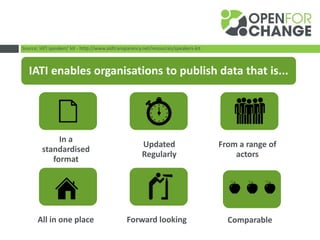
In a
standardised
format
Updated
Regularly
From a range of
actors
All in one place Forward looking Comparable
IATI enables organisations to publish data that is...
Source: IATI speakers’ kit - http://www.aidtransparency.net/resources/speakers-kit
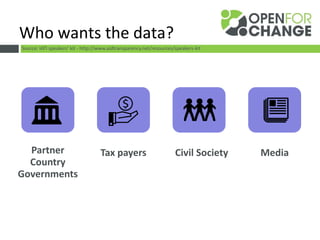
Who wants the data?
Partner
Country
Governments
Tax payers Civil Society Media
Source: IATI speakers’ kit - http://www.aidtransparency.net/resources/speakers-kit
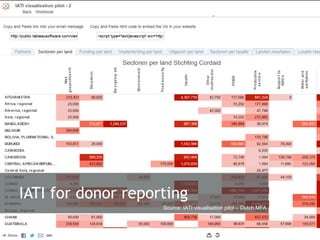
IATI for donor reporting
Source: IATI visualisation pilot – Dutch MFA
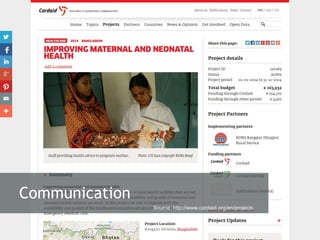
Communication
Source: http://www.cordaid.org/en/projects
GAIN INSIGHT IN NETWORKS1. SHOW PROJECTS ON A MAP
Source: http://mali.publishwhatyoufund.org
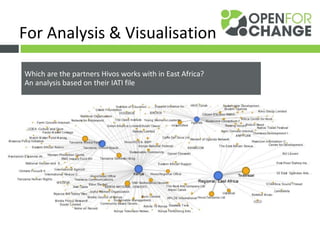
Which are the partners Hivos works with in East Africa?
An analysis based on their IATI file
For Analysis & Visualisation
LINK WITH OTHER DATA
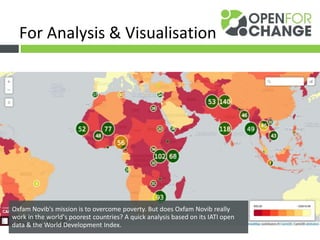
Oxfam Novib's mission is to overcome poverty. But does Oxfam Novib really
work in the world's poorest countries? A quick analysis based on its IATI open
data & the World Development Index.
For Analysis & Visualisation
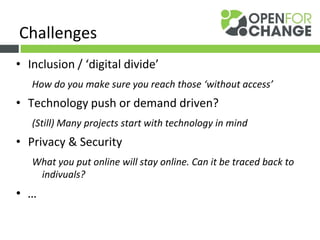
• Inclusion / ‘digital divide’
How do you make sure you reach those ‘without access’
• Technology push or demand driven?
(Still) Many projects start with technology in mind
• Privacy & Security
What you put online will stay online. Can it be traced back to
indivuals?
• …
Challenges
The Open Development movement
is a learning community:
• Sharing resources, e.g.
https://responsibledata.io
• Sharing knowledge through events
& online, e.g.
http://opendevelopmentcamp.org
and http://okfestival.org
Learning community...
• There’s something going on
• In fact it’s more than one ‘thing’…
• and it’s changing development cooperation
• Why ‘Open’ is important…
• So stop hiding your ‘gold’!!
• There’s a community you can connect with
• That will help you overcome the difficult parts
Now you know...
Pelle Aardema
pelle@openforchange.info
@pelleaardema
More about Open for
Change :
http://openforchange.info
info@openforchange.info
@open_for_change
This work is licensed under a Creative Commons
Attribution-ShareAlike 4.0 International License.
How Crisis Mapping Saved Lives in Haïti - http://voices.nationalgeographic.com/2012/07/02/crisis-mapping-
haiti/
Standby Task Force - http://blog.standbytaskforce.com/
CrisisMappers - http://crisismappers.net/
Open Source Explained (in LEGO) - https://www.youtube.com/watch?v=a8fHgx9mE5U
Fukushima disaster - https://en.wikipedia.org/wiki/Fukushima_Daiichi_nuclear_disaster
Safecast - http://safecast.org
Participatory budgeting in DRC - http://blogs.worldbank.org/ic4d/mobile-enhanced-participatory-budgeting-in-
the-drc
Participatory budgeting in DRC video - https://www.youtube.com/watch?v=5ByBEpqVTTo
What is open data - http://opendefinition.org/
Healthsites - http://healthsites.io
IATI - http://iatistandard.org
IATI pilot for donor reporting (Dutch MOFA) - http://bit.ly/iati-dash-pilot
Open data for communication - https://www.cordaid.org/en/projects/
Links (1)
Visualising / Analysing IATI open data:
7 Ways to use IATI data - http://openworks.me/2014/04/7-ways-to-use-iati-data/
Hivos network visualisation - http://bit.ly/hivos-network
DOWNLOAD: Recipe to do it yourself (using free/open source tools)
Oxfam Novib visualisation - https://pelleaardema.cartodb.com/viz/1bbba4be-8492-11e4-9ca9-
0e018d66dc29/public_map
DOWNLOAD: Recipe to do it yourself (using free/open source tools)
Challenges : Why I've given up on the Digital Divide, Michael Gurstein -
https://gurstein.wordpress.com/2015/04/15/why-im-giving-up-on-the-digital-divide/
Open development community:
Responsible Data Forum - https://responsibledata.io/
Open Development Camp - http://opendevelopmentcamp.org
Open Knowledge Festival - http://okfestival.org
Open Development Toolkit - http://opendevtoolkit.net
Open Development working group - http://open-development.okfn.org/
Open for Change - http://openforchange.info, twitter: @open_for_change
Links (2)

Introduction to Open Development

  • 1.
    An Introduction toOpen Development
  • 3.
  • 4.
  • 6.
    Changing playing field Image:http://nailab.co.ke
  • 7.
    Open hardware Social media Crowdsourcing LinkedData Mobile (open) Apps Mashups Open organisations Agile ‘Hacker’ mentality Technology Organisation Changes in Tech & Society Open data
  • 8.
    Open development embracesthese new ways of working for a new international cooperation model: • one that is more inclusive • wisdom experts and wisdom of the crowd • accountability to collaboration • transparency to openness What is Open Development
  • 9.
  • 10.
  • 11.
    The promise ofOpen Use Re-use Recycle Collaborate Open source explained: https://www.youtube.com/watch?v=a8fHgx9mE5U
  • 12.
    Open hardware Social media Crowdsourcing LinkedData Mobile (open) Apps Mashups Open organisations Agile ‘Hacker’ mentality Technology Organisation Changes in Tech & Society Open data
  • 13.
  • 14.
  • 15.
  • 16.
  • 17.
  • 18.
  • 19.
    What is OpenData = OPEN DATA C PDF XML RDF JSON … but but Open License
  • 20.
    Different kinds ofdata credit: Tim Davies
  • 21.
    Also relevant fordevelopment source: http://www.healthsites.io
  • 22.
    Unlike wine… DATA doesNOT get BETTER when it’s STORED in a COOL and DARK place
  • 23.
    Open Data aboutDevelopment Source: http://iatistandard.org
  • 24.
    Why do weneed IATI? Different formats Hard to find Not current Not comprehensive Inconsistent In multiple locations Not forward looking Not comparable There’s lots of information available but it’s... Source: IATI speakers’ kit - http://www.aidtransparency.net/resources/speakers-kit
  • 25.
    In a standardised format Updated Regularly From arange of actors All in one place Forward looking Comparable IATI enables organisations to publish data that is... Source: IATI speakers’ kit - http://www.aidtransparency.net/resources/speakers-kit
  • 26.
    Who wants thedata? Partner Country Governments Tax payers Civil Society Media Source: IATI speakers’ kit - http://www.aidtransparency.net/resources/speakers-kit
  • 27.
    IATI for donorreporting Source: IATI visualisation pilot – Dutch MFA
  • 28.
  • 29.
    GAIN INSIGHT INNETWORKS1. SHOW PROJECTS ON A MAP Source: http://mali.publishwhatyoufund.org Which are the partners Hivos works with in East Africa? An analysis based on their IATI file For Analysis & Visualisation
  • 30.
    LINK WITH OTHERDATA Oxfam Novib's mission is to overcome poverty. But does Oxfam Novib really work in the world's poorest countries? A quick analysis based on its IATI open data & the World Development Index. For Analysis & Visualisation
  • 31.
    • Inclusion /‘digital divide’ How do you make sure you reach those ‘without access’ • Technology push or demand driven? (Still) Many projects start with technology in mind • Privacy & Security What you put online will stay online. Can it be traced back to indivuals? • … Challenges
  • 32.
    The Open Developmentmovement is a learning community: • Sharing resources, e.g. https://responsibledata.io • Sharing knowledge through events & online, e.g. http://opendevelopmentcamp.org and http://okfestival.org Learning community...
  • 33.
    • There’s somethinggoing on • In fact it’s more than one ‘thing’… • and it’s changing development cooperation • Why ‘Open’ is important… • So stop hiding your ‘gold’!! • There’s a community you can connect with • That will help you overcome the difficult parts Now you know...
  • 34.
    Pelle Aardema pelle@openforchange.info @pelleaardema More aboutOpen for Change : http://openforchange.info info@openforchange.info @open_for_change This work is licensed under a Creative Commons Attribution-ShareAlike 4.0 International License.
  • 35.
    How Crisis MappingSaved Lives in Haïti - http://voices.nationalgeographic.com/2012/07/02/crisis-mapping- haiti/ Standby Task Force - http://blog.standbytaskforce.com/ CrisisMappers - http://crisismappers.net/ Open Source Explained (in LEGO) - https://www.youtube.com/watch?v=a8fHgx9mE5U Fukushima disaster - https://en.wikipedia.org/wiki/Fukushima_Daiichi_nuclear_disaster Safecast - http://safecast.org Participatory budgeting in DRC - http://blogs.worldbank.org/ic4d/mobile-enhanced-participatory-budgeting-in- the-drc Participatory budgeting in DRC video - https://www.youtube.com/watch?v=5ByBEpqVTTo What is open data - http://opendefinition.org/ Healthsites - http://healthsites.io IATI - http://iatistandard.org IATI pilot for donor reporting (Dutch MOFA) - http://bit.ly/iati-dash-pilot Open data for communication - https://www.cordaid.org/en/projects/ Links (1)
  • 36.
    Visualising / AnalysingIATI open data: 7 Ways to use IATI data - http://openworks.me/2014/04/7-ways-to-use-iati-data/ Hivos network visualisation - http://bit.ly/hivos-network DOWNLOAD: Recipe to do it yourself (using free/open source tools) Oxfam Novib visualisation - https://pelleaardema.cartodb.com/viz/1bbba4be-8492-11e4-9ca9- 0e018d66dc29/public_map DOWNLOAD: Recipe to do it yourself (using free/open source tools) Challenges : Why I've given up on the Digital Divide, Michael Gurstein - https://gurstein.wordpress.com/2015/04/15/why-im-giving-up-on-the-digital-divide/ Open development community: Responsible Data Forum - https://responsibledata.io/ Open Development Camp - http://opendevelopmentcamp.org Open Knowledge Festival - http://okfestival.org Open Development Toolkit - http://opendevtoolkit.net Open Development working group - http://open-development.okfn.org/ Open for Change - http://openforchange.info, twitter: @open_for_change Links (2)

Editor's Notes

  • #19 In addition to using word of mouth and community postings to publicize when participatory budgeting assemblies were to happen, ICT4Gov sends SMS messages directly to households in the community announcing when and where the meetings would take place. Citizens are able to use their mobile phones to vote via SMS on what priorities they would like to see addressed in their community. Community leaders use SMS to announce voting outcomes. This has served to promote transparency and squelch misleading rumors. Finally, mobile phones are being used as monitoring and evaluation tools. Using SMS citizens are able to provide feedback in totally new ways about the projects being implemented.
  • #25 A number of systems and databases for reporting and capturing data on development cooperation already exist. A lot of information on development cooperation is already available, but is very problematic to use. This is because many systems tend to be producer, rather than user, oriented. This means that: N.B. Select 2 or 3 of the most relevant elements to present, not all. Data in different formats makes it difficult to mash up different data sets with each other. It can take a lot of time and effort for data users to find where information is kept. Data is often out of date, meaning that relevant, timely analysis and use of data is a challenge. Different systems use different vocabularies, definitions and measures of data making it difficult to compare between different datasets. Data can be inconsistent, with different elements or fields being reported or not reported. Data is not accessible from one single source, and must be searched for in different locations. Forward-looking development data is essential to support developing country governments in, but most data that is currently available is only reporting past activities and not planned, forward-looking ones. Existing data sets often don’t provide data from organisations beyond traditional bilateral and multilateral donors meaning the picture of development provided by the data is not comprehensive.
  • #26 IATI has been designed to ensure that data is published in a user-centric way. At the beginning, IATI held consultations with government and civil society stakeholders from over 70 partner countries, about their information needs. The consultations confirmed that the priority needs were for timely, up-to-date and reliable information on current and future development cooperation. They also stressed the need for better coverage, including information from non-traditional providers, such as foundations, NGOs and technical cooperation providers. Taking this on board, IATI was designed in a particular way that enables all organisations to: N.B. Select 2 or 3 of the most relevant elements to present, not all. Publish in the same format as other organisations so it is easy to combine data sets from different organisations. Update their data on a monthly, quarterly or six-monthly basis, to ensure information is as up to date as possible. All different kinds of development cooperation providers to publish data – the standard is flexible, and we are working with different organisations all the time to make this easier. Publish in one central location. The IATI Registry provides links to the data published by all organisations using the IATI Standard. Provide, where possible, forward-looking information on their development project – this is particularly vital for developing country governments, who need this information to enable a more comprehensive and budgeting and national planning process. Publish in the same format, to enable easy comparison of data from many different kinds of organisations.
  • #27 A diverse group of organisations and individuals demand IATI data for a variety of purposes. Partner country governments are one of the potential users of IATI data. When a country receives large volumes of development assistance, detailed information on current and future cooperation is essential to enable governments to generate budgets and national plans with a clear picture of all the resources coming in from different places. Taxpayers in countries whose government’s provide development cooperation from their budget want to know how their tax money is being spent, and that it is being put to its best use. Civil Society Organisations around the world need information on development cooperation to enable better monitoring of development resources, and to have the right information that they can use to hold governments and assistance providers to account for the way they spend resources. The media and journalists want the data so that they can investigate how development resources are applied and what impact they are having.