Community building in DM2E 
Lieke Ploeger, Open Knowledge 
co-funded by the European Union
Why? 
Building an environment in which the DM2E tools can flourish and 
create the value of scholarship and the wider public that they 
promise 
➢ promote the value of open data for cultural heritage and 
humanities research 
➢ a community that is broad, connected and sustainable after the 
project ends 
➢ a global cultural commons in which gatekeepers to cultural 
heritage adopt open principles 
*
Main activities 
➔ Build up and support the OpenGLAM network of open culture 
advocates for raising awareness of legal and technical best 
practises around open cultural data 
➔ Engage with developers, researchers and end users in the 
humanities through a series of events and awards 
➔ Strengthen and expand the online community around Europeana 
(engage new stakeholders, enable content holders to contribute 
new material) 
➔ Provide extensive and varied documentation on project outputs 
(video, user manuals, website, wiki) 
*
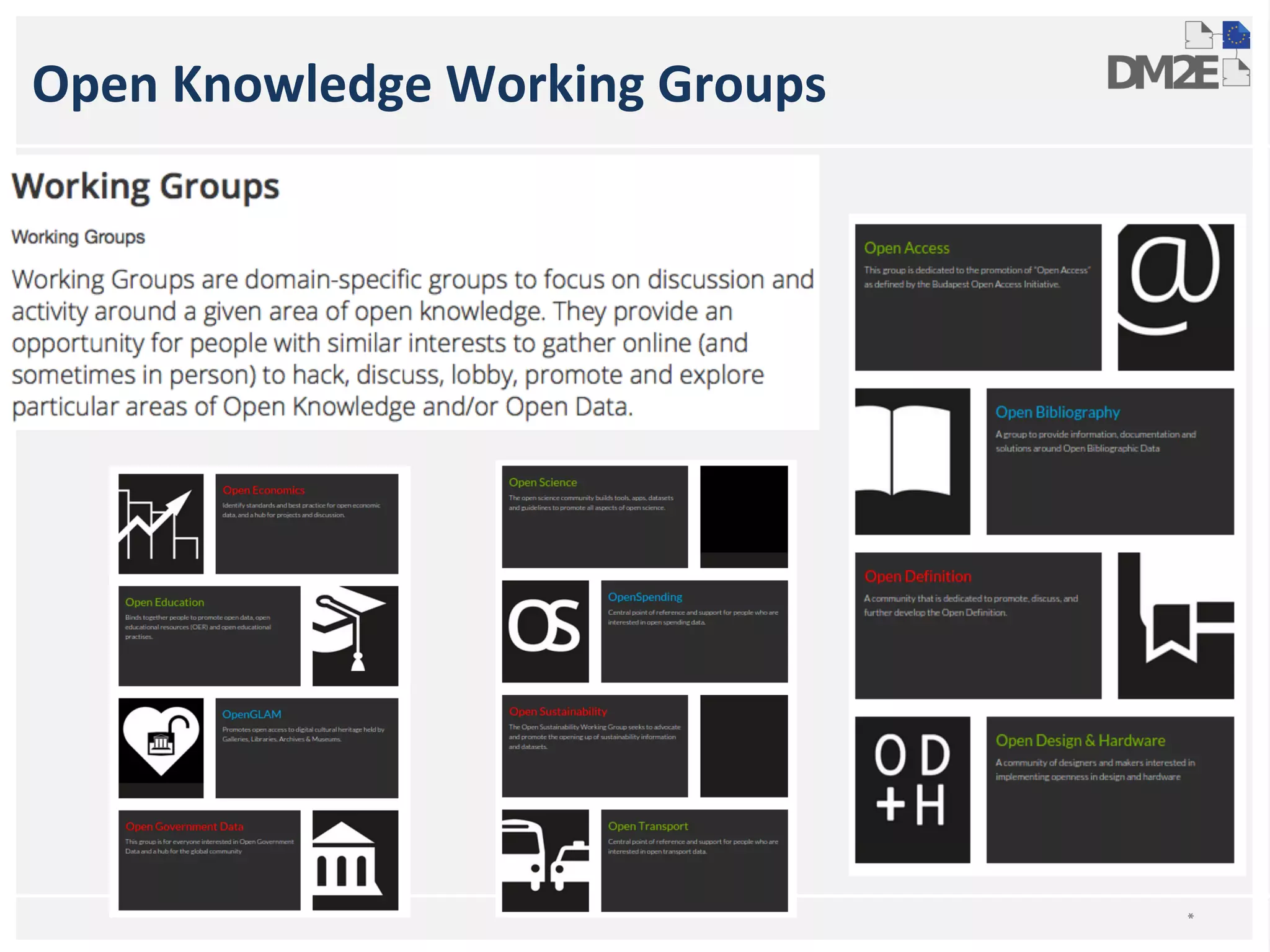
OpenGLAM 
Set up as one of the Working Groups in the Open Knowledge 
portfolio in early 2012 
➔ Gives the community significant autonomy as these Working 
Groups are volunteer led 
➔ Allows the community to benefit from the technical and 
community support the Open Knowledge Foundation offers to all 
groups (even beyond the lifetime of the project) 
➔ Enables the community to share skills and 
knowledge with other groups at international 
open knowledge events like OKCon and OKFestival 
*
* 
Open Knowledge Working Groups
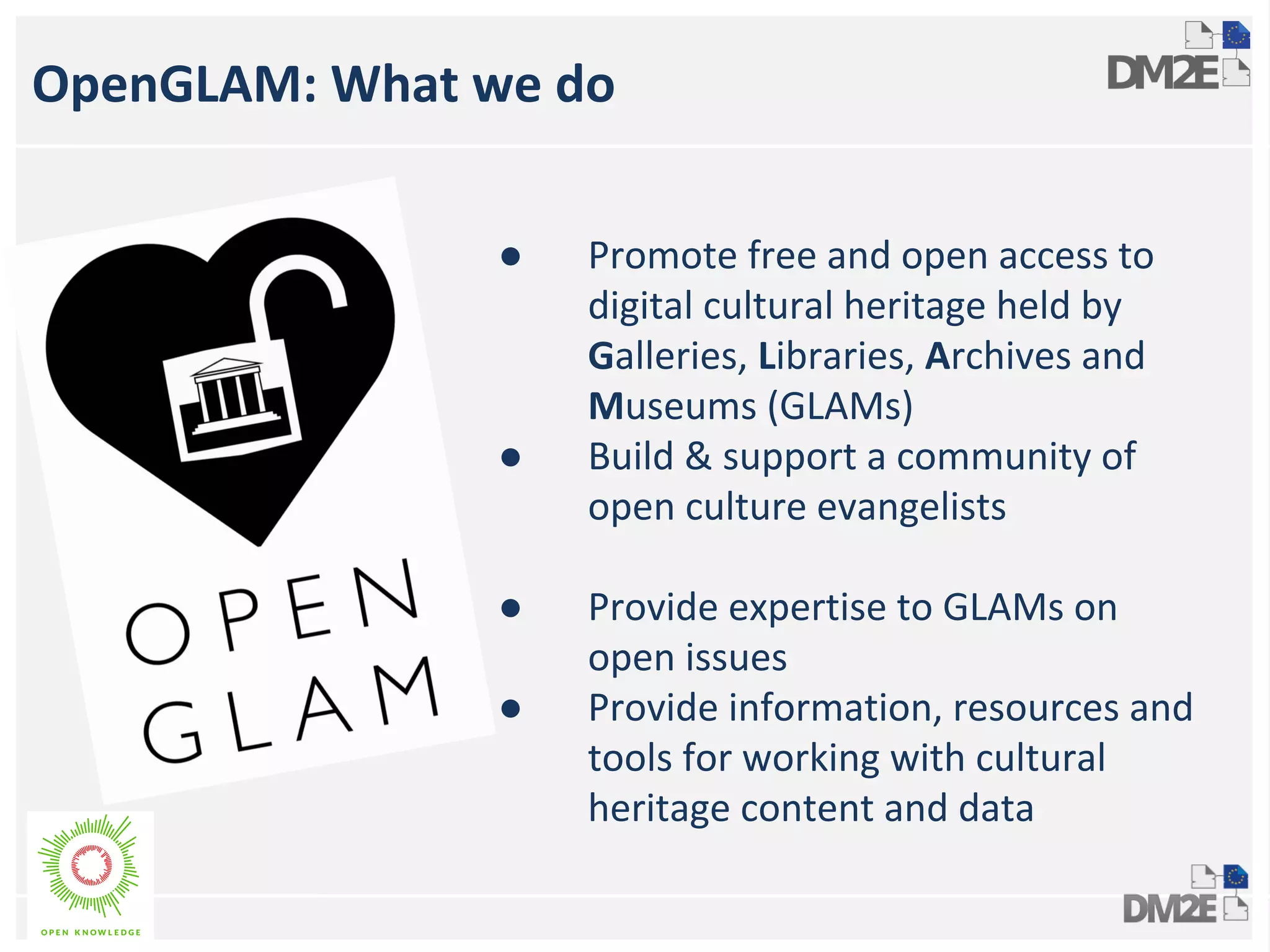
OpenGLAM: What we do 
* 
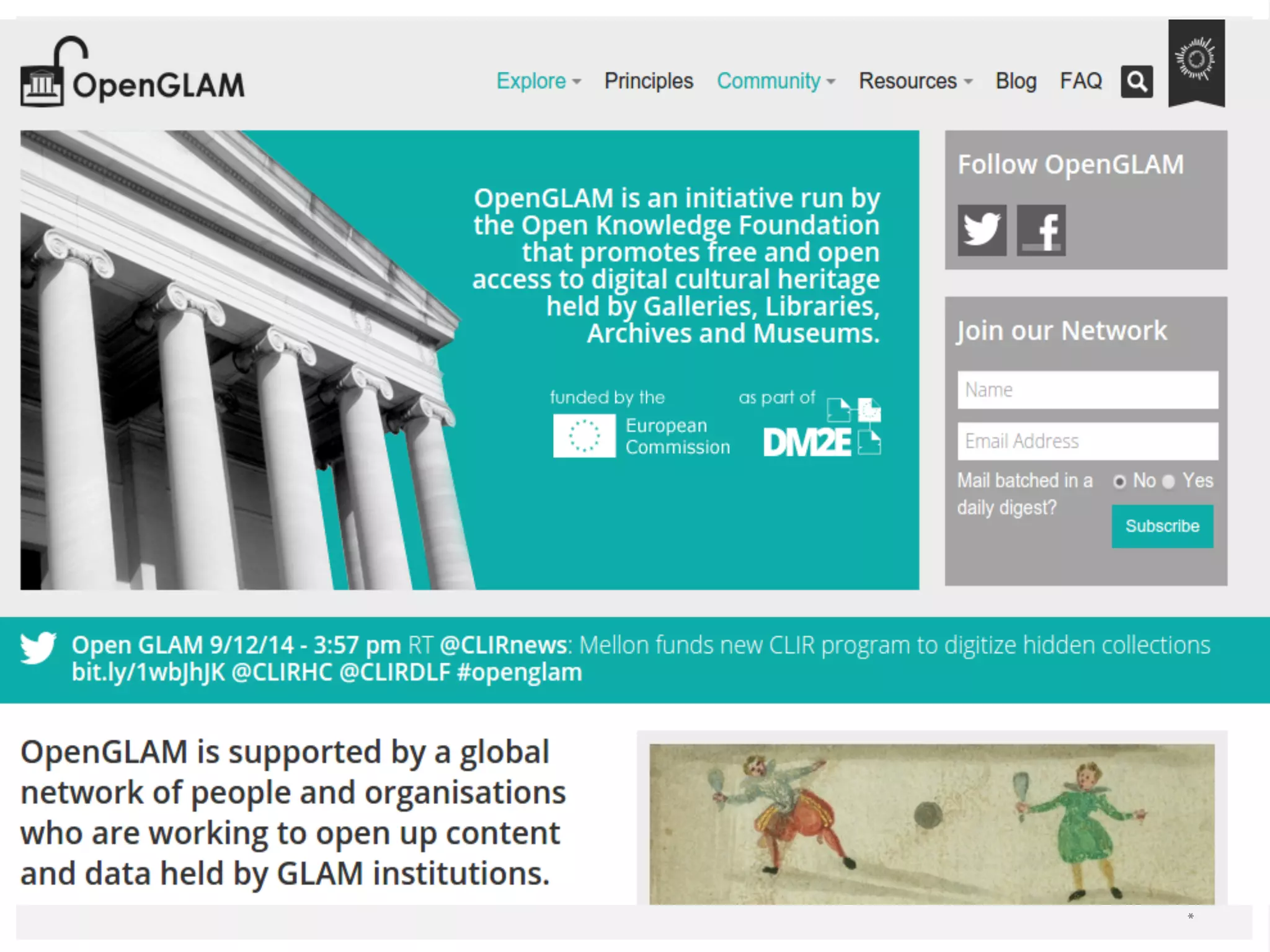
● Promote free and open access to 
digital cultural heritage held by 
Galleries, Libraries, Archives and 
Museums (GLAMs) 
● Build & support a community of 
open culture evangelists 
● Provide expertise to GLAMs on 
open issues 
● Provide information, resources and 
tools for working with cultural 
heritage content and data
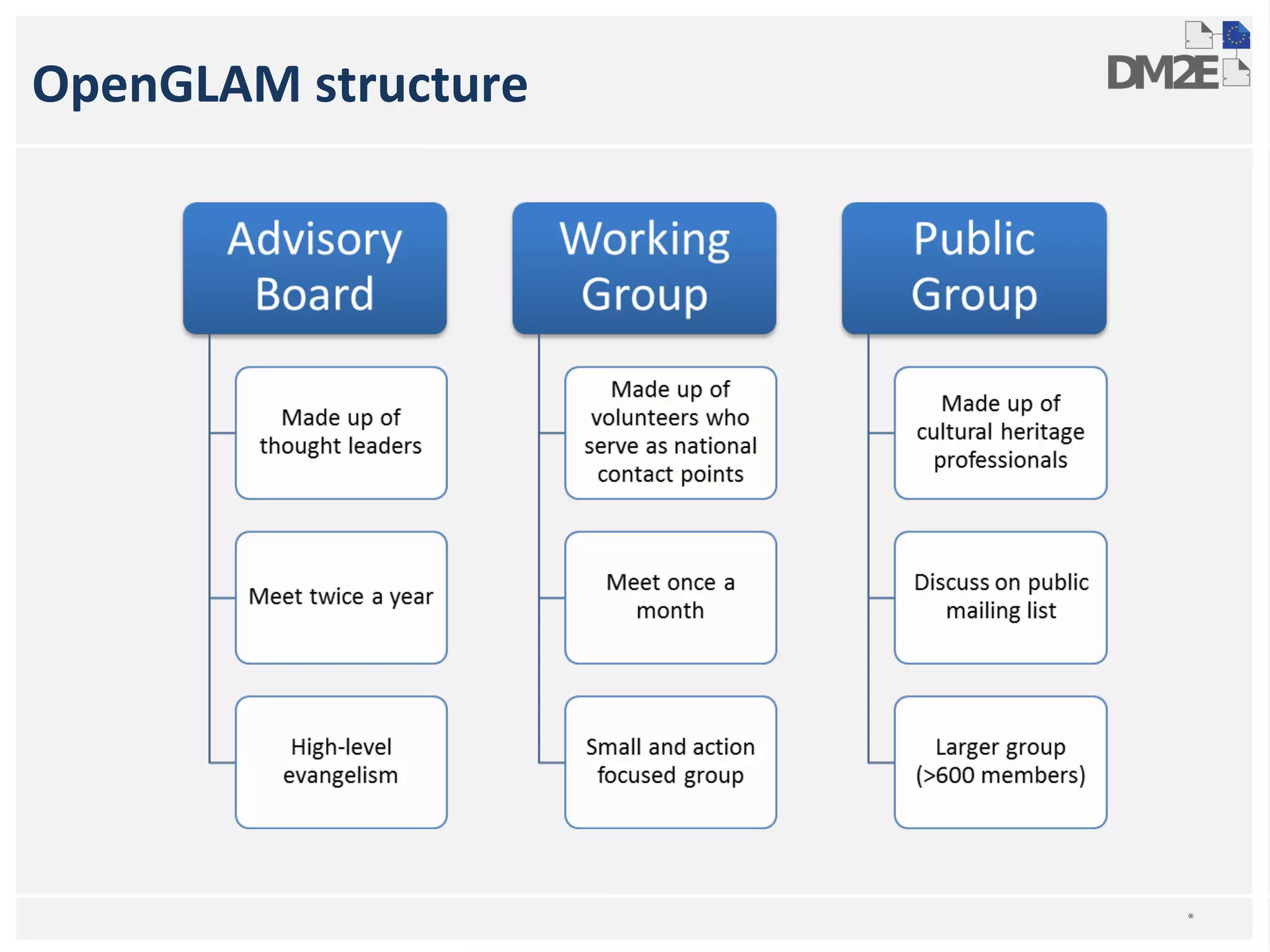
OpenGLAM structure 
*
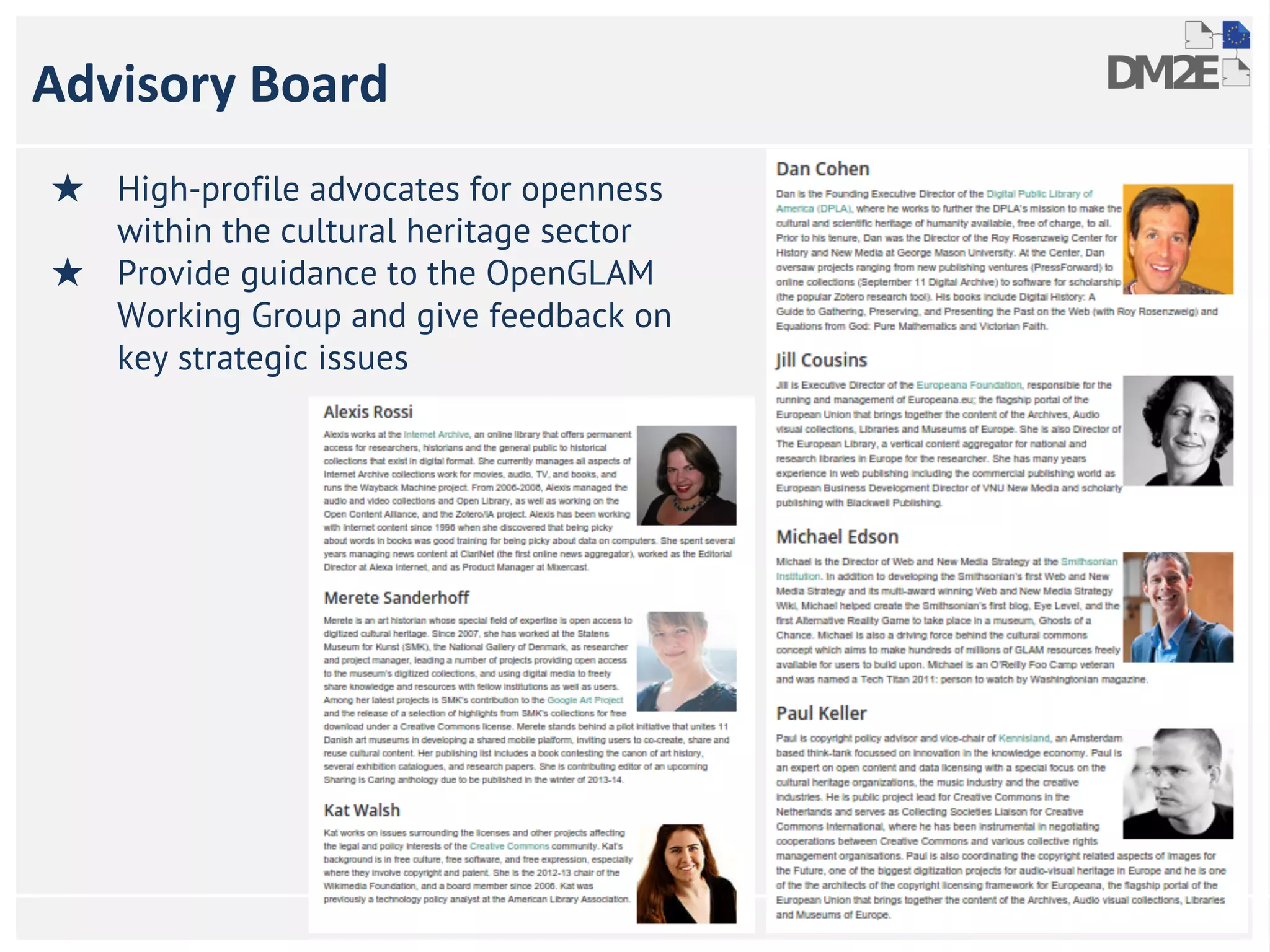
Advisory Board 
★ High-profile advocates for openness 
within the cultural heritage sector 
★ Provide guidance to the OpenGLAM 
Working Group and give feedback on 
key strategic issues 
*
* 
How can OpenGLAM help? 
Network 
● Mailinglist, twitter (#openglam) 
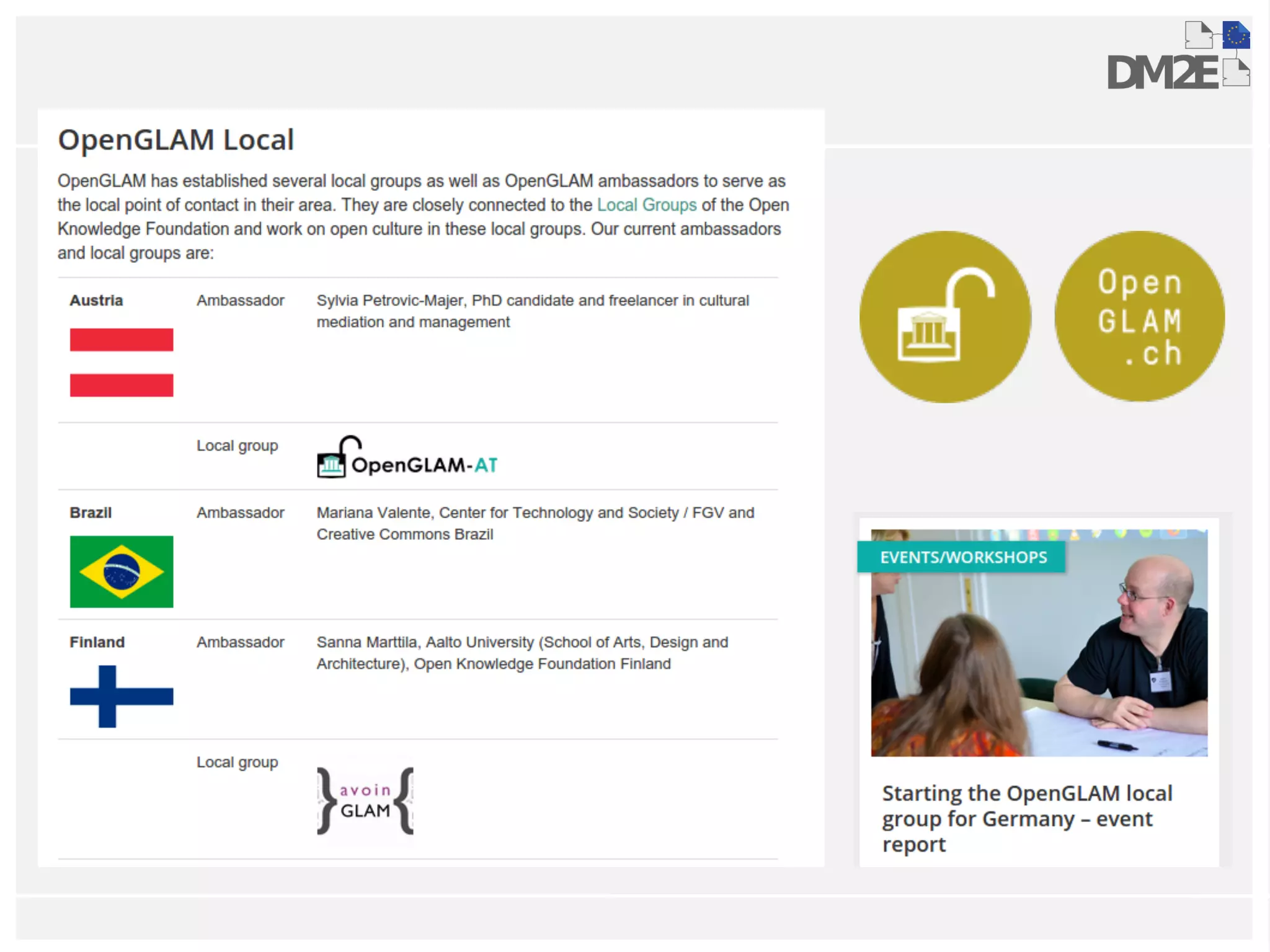
● Local groups & ambassadors 
● Working group and Advisory Board 
Information 
● Documentation 
● OpenGLAM Principles 
● Events 
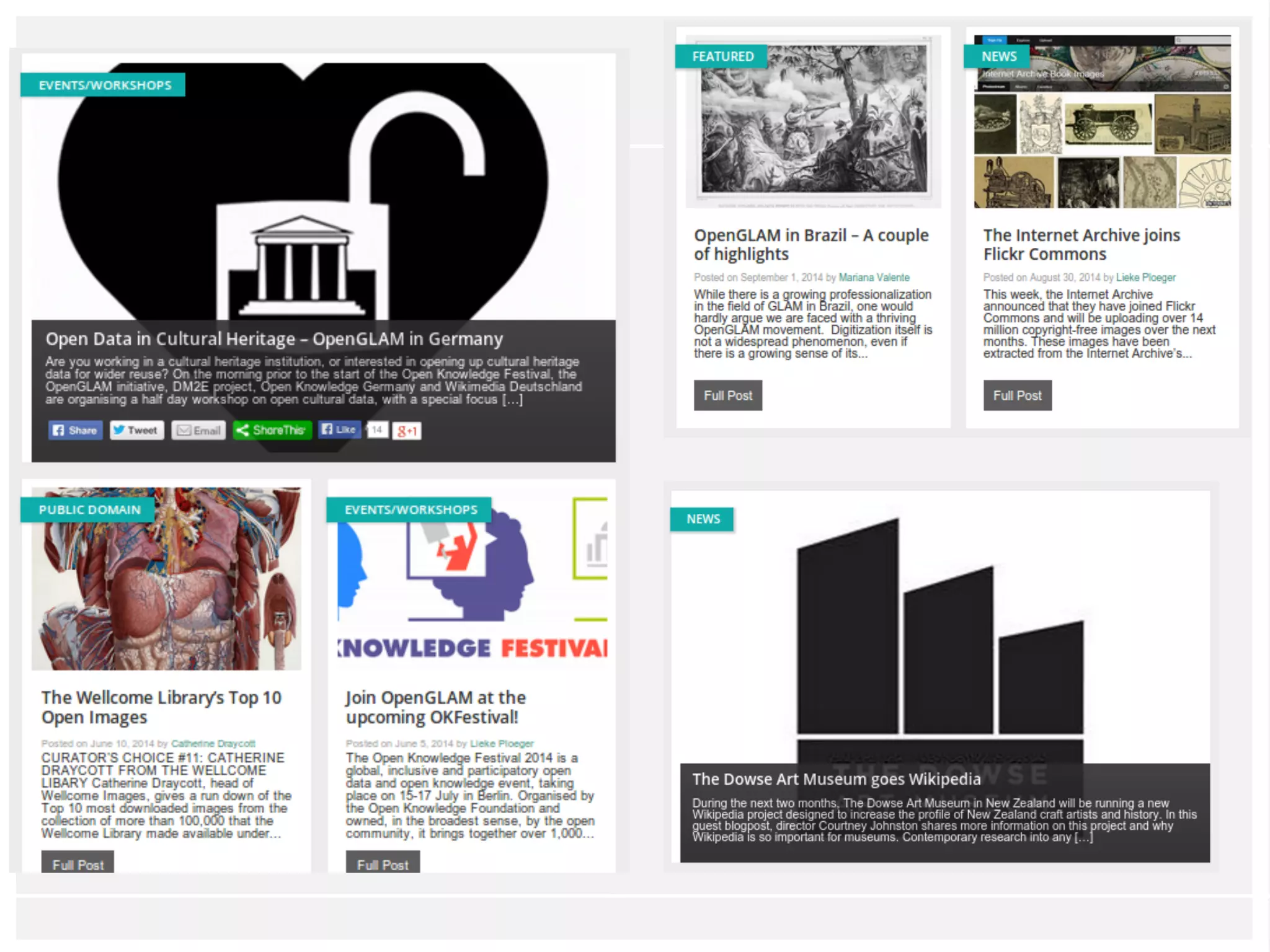
● News and blogs 
Resources 
● Open collections 
● Culture labs
*
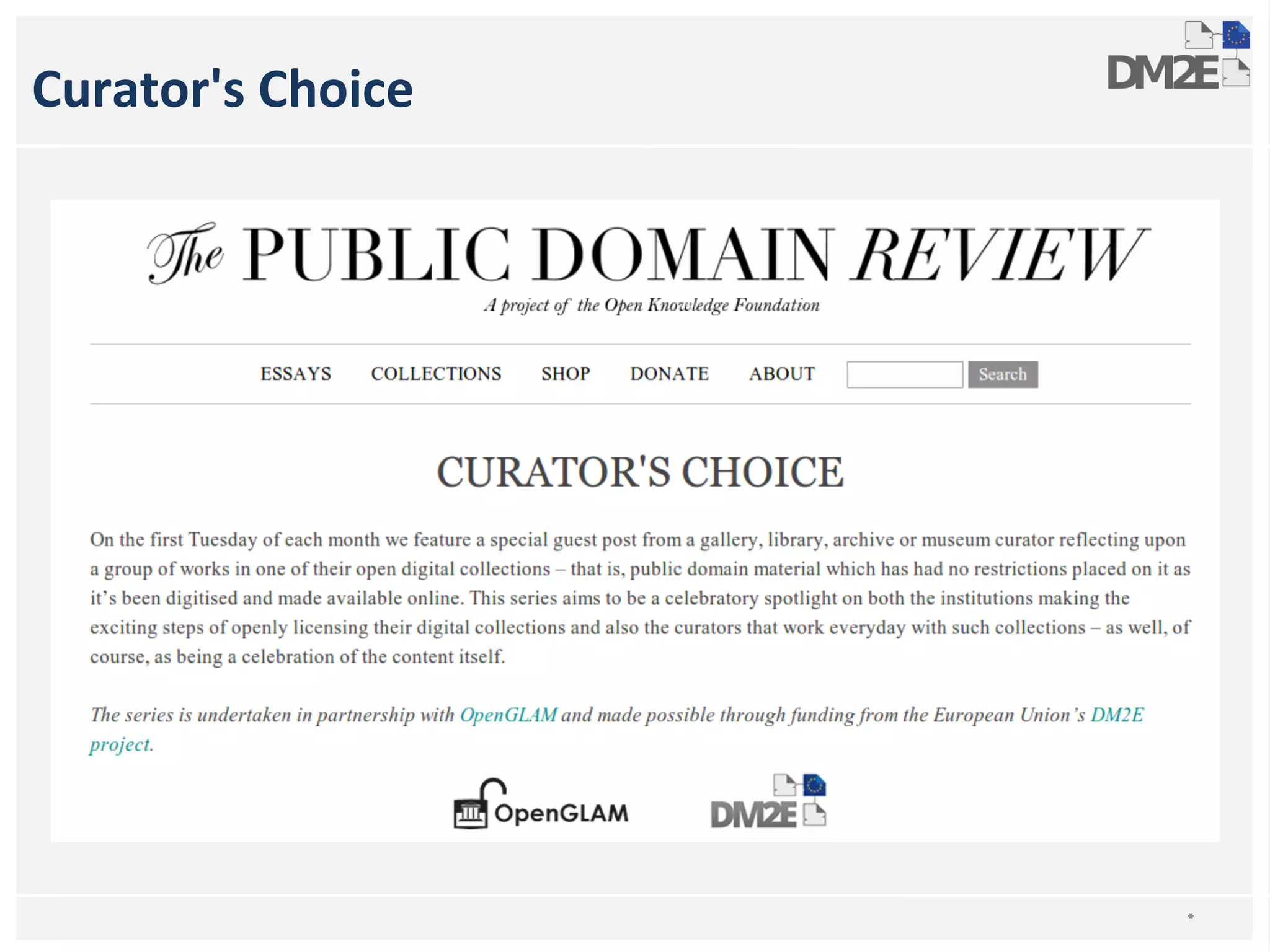
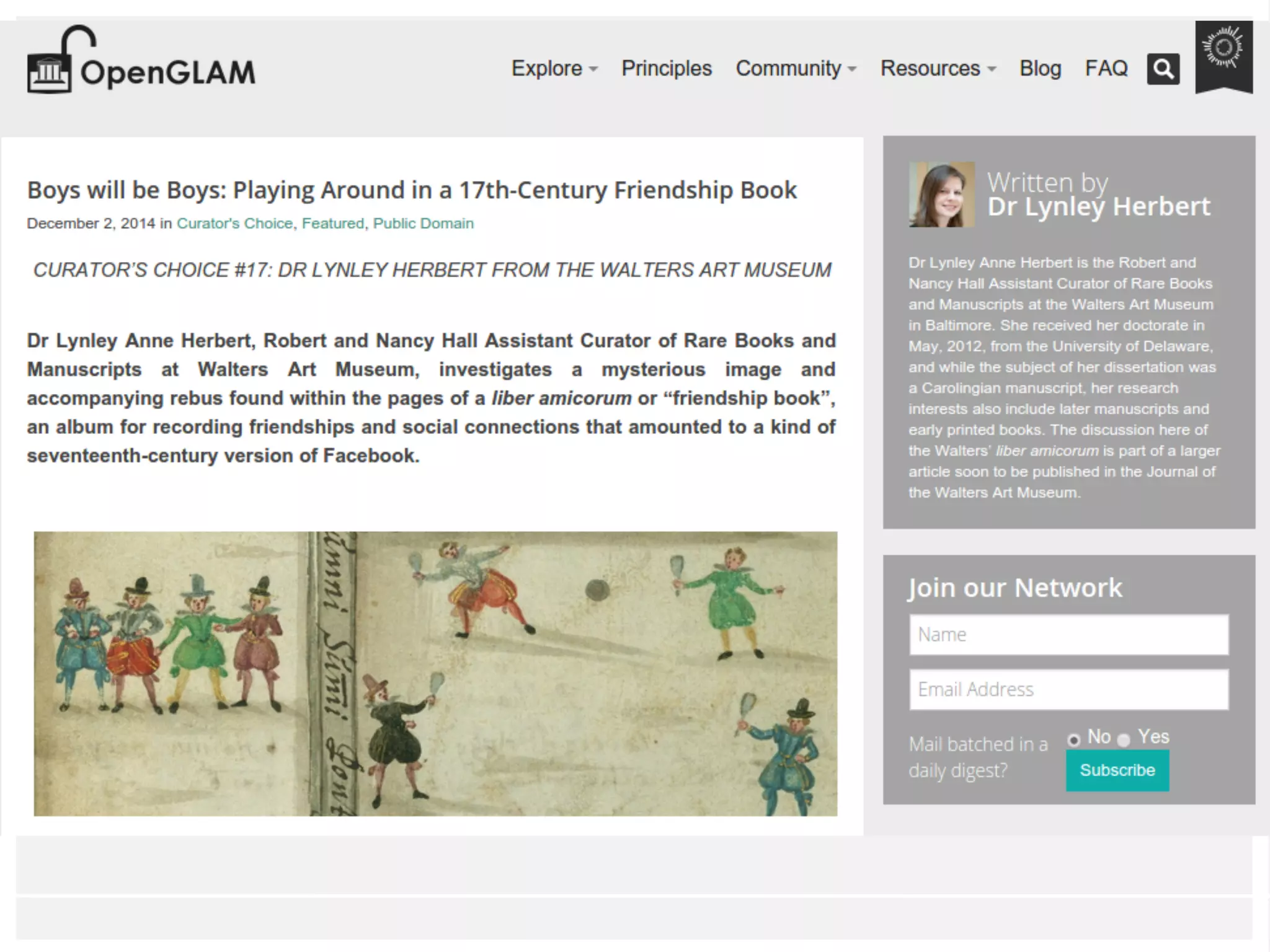
Curator's Choice 
*
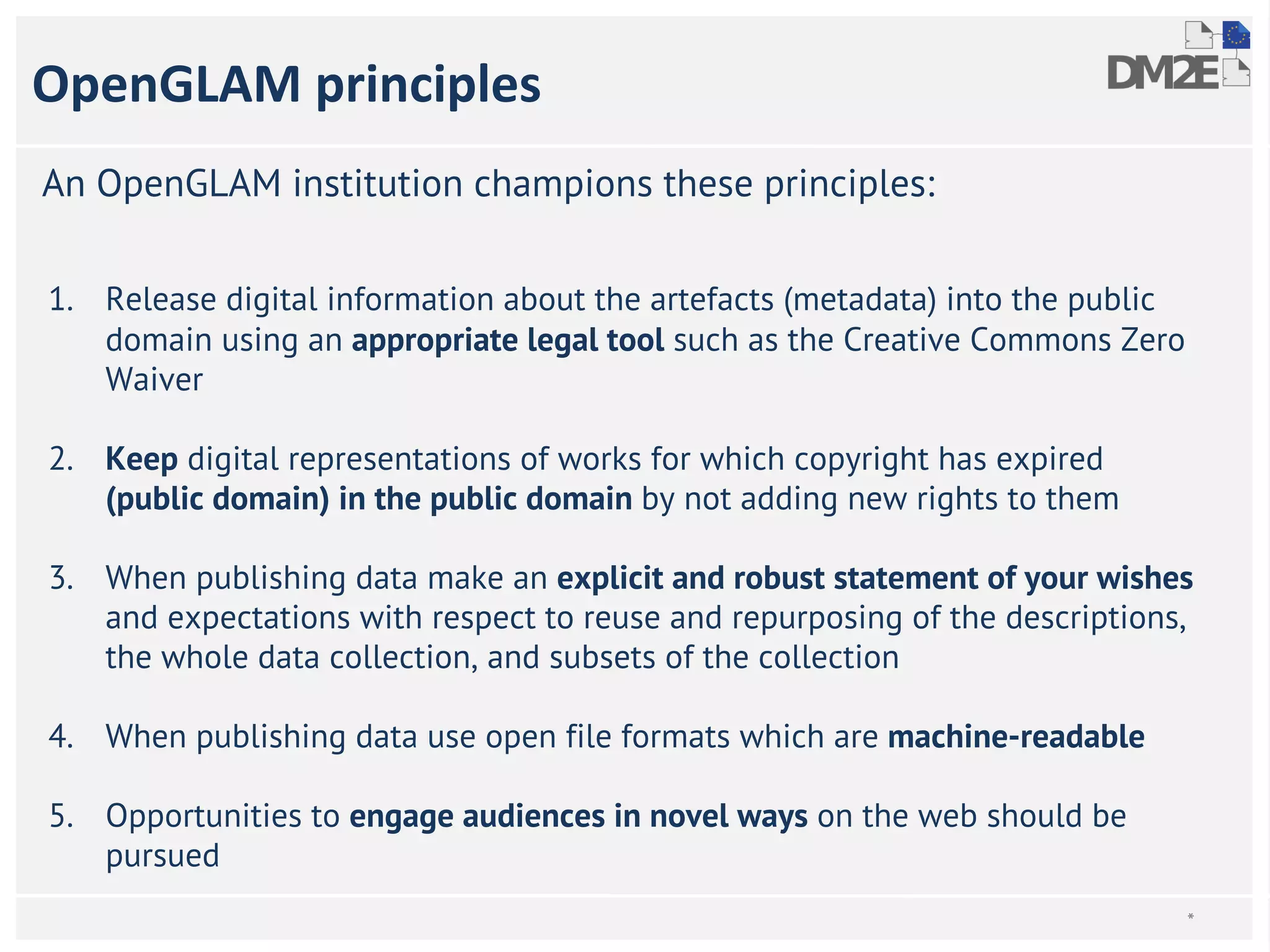
OpenGLAM principles 
An OpenGLAM institution champions these principles: 
1. Release digital information about the artefacts (metadata) into the public 
domain using an appropriate legal tool such as the Creative Commons Zero 
Waiver 
2. Keep digital representations of works for which copyright has expired 
(public domain) in the public domain by not adding new rights to them 
3. When publishing data make an explicit and robust statement of your wishes 
and expectations with respect to reuse and repurposing of the descriptions, 
the whole data collection, and subsets of the collection 
4. When publishing data use open file formats which are machine-readable 
5. Opportunities to engage audiences in novel ways on the web should be 
pursued 
*
OpenGLAM local group: Switzerland 
– Promote and facilitate the adoption of the OpenGLAM 
principles in Switzerland 
– Members include NGOs (Open Knowledge; Wikimedia; Creative 
Commons), GLAMs, Research and educational institutions and 
service providers 
– Around 20-25 people actively participating in real-life 
meetings and events 
– Active task forces: Open Cultural Data Hackathon (Feb 2014), 
Outreach to smaller institutions 
*
OpenGLAM local group: Finland 
• Finnish network of people working on opening up data and content 
• Various events: seminars, workshops, meetups, hackathons 
• Open Cultural Data Masterclass (spring 2014) 
– Participants from different cultural and memory institutions 
– Leading experts and practitioners as tutors 
– 6 thematic one day sessions with various themes, e.g. copyrights, open 
licenses, creative reuse and applications, demos and prototypes. 
– Main objective: every organization would open up data and develop a small 
demo or prototype using open cultural data. 
DM2E Annual meeting, 12-13 June 2014, Bergen Norway
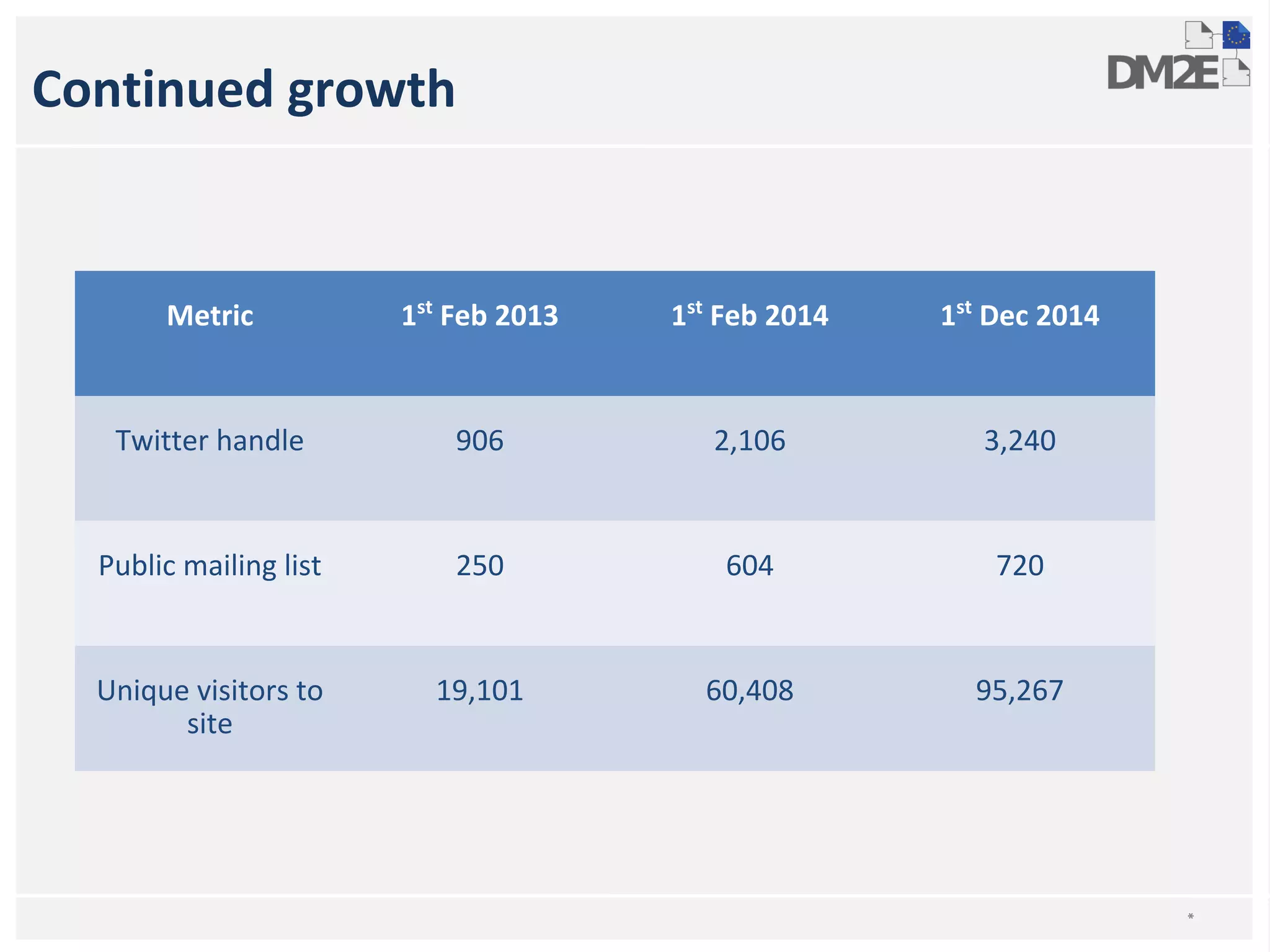
Continued growth 
Metric 1st Feb 2013 1st Feb 2014 1st Dec 2014 
Twitter handle 906 2,106 3,240 
Public mailing list 250 604 720 
Unique visitors to 
site 
19,101 60,408 95,267 
*
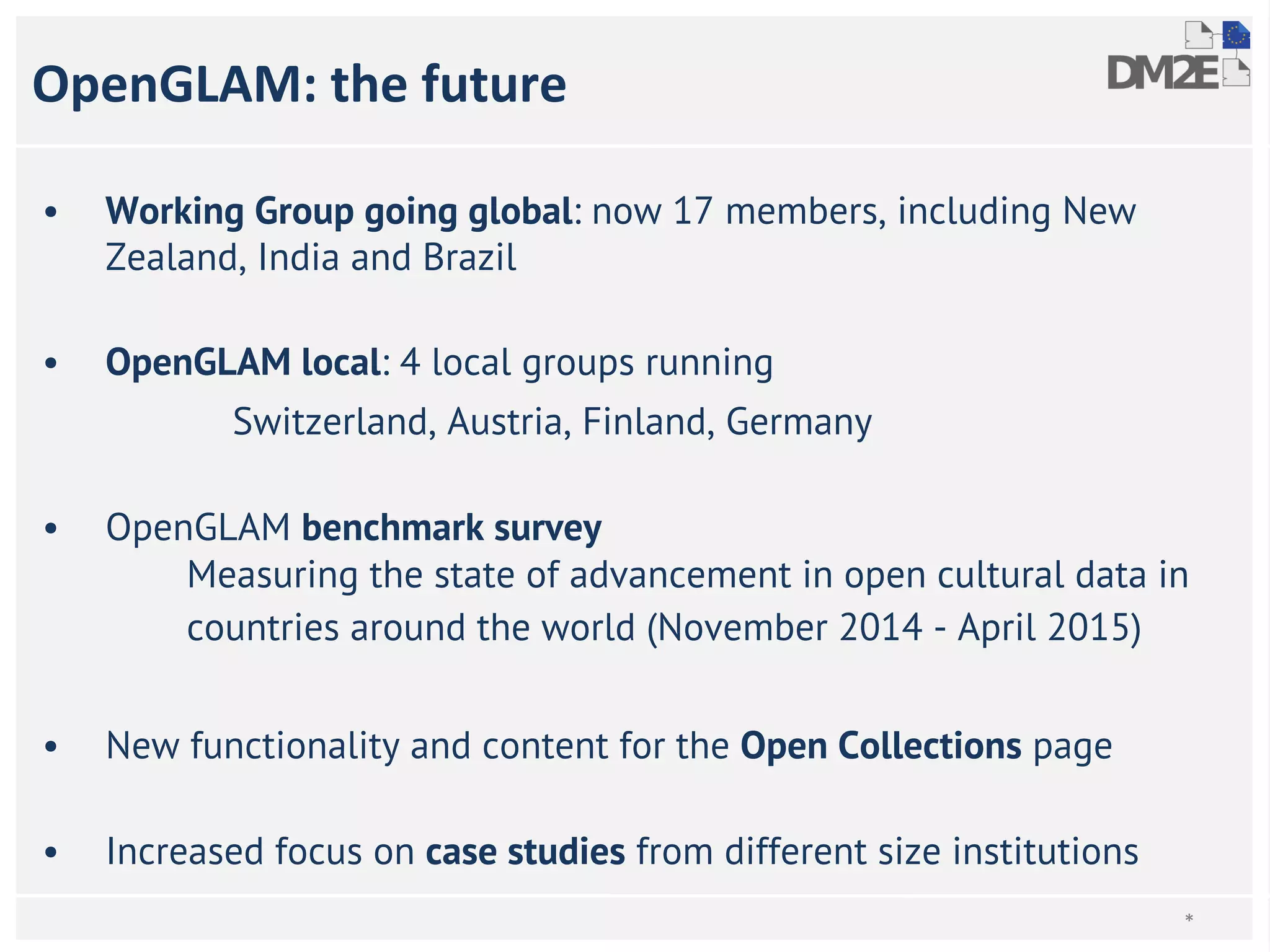
OpenGLAM: the future 
• Working Group going global: now 17 members, including New 
Zealand, India and Brazil 
• OpenGLAM local: 4 local groups running 
Switzerland, Austria, Finland, Germany 
• OpenGLAM benchmark survey 
Measuring the state of advancement in open cultural data in 
countries around the world (November 2014 - April 2015) 
• New functionality and content for the Open Collections page 
• Increased focus on case studies from different size institutions 
*
DM2E: Active web presence 
➔ Regular blogging through both www.dm2e.eu and www. 
openglam.org - around 100 blogs a year combined 
➔ Twitter @dm2europeana 
➔ DM2E wiki 
➔ Additional channels for sharing content: Slideshare and Vimeo 
*
Events 
18 DM2E events in 3 years: 500+ participants, 9 countries 
➔ Demonstration and training with tools 
◆ Pundit workshops 
◆ The Web as Literature conference 
➔ Best practices in open cultural data 
◆ Open Data in Cultural Heritage workshops 
◆ OpenGLAM legal workshop 
◆ Putting Linked Library Data to Work 
➔ Coding sprints and hackdays 
◆ Open cultural hack 
◆ Open Humanities hack 
◆ Pundit hackday 
*
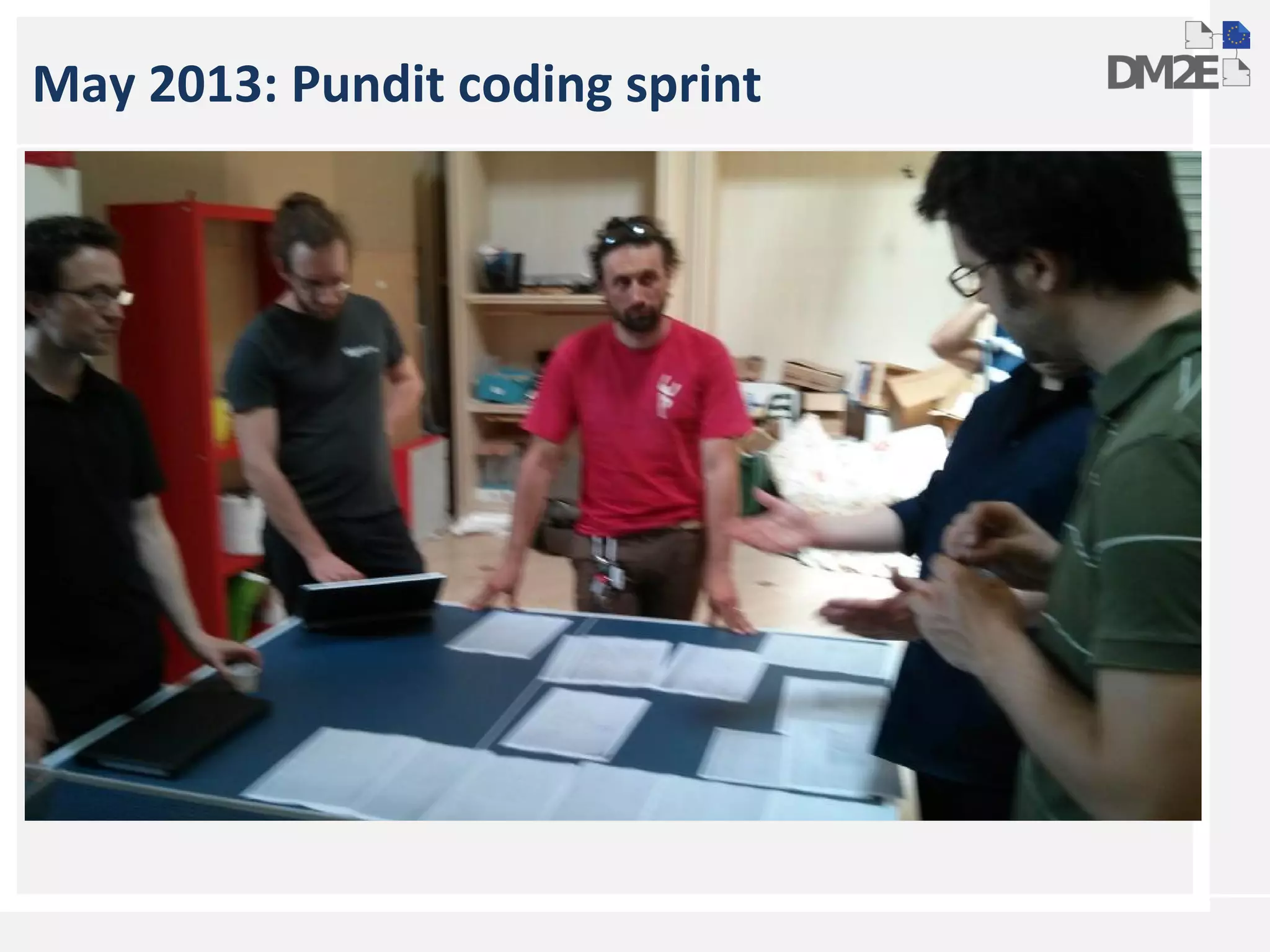
May 2013: Pundit coding sprint
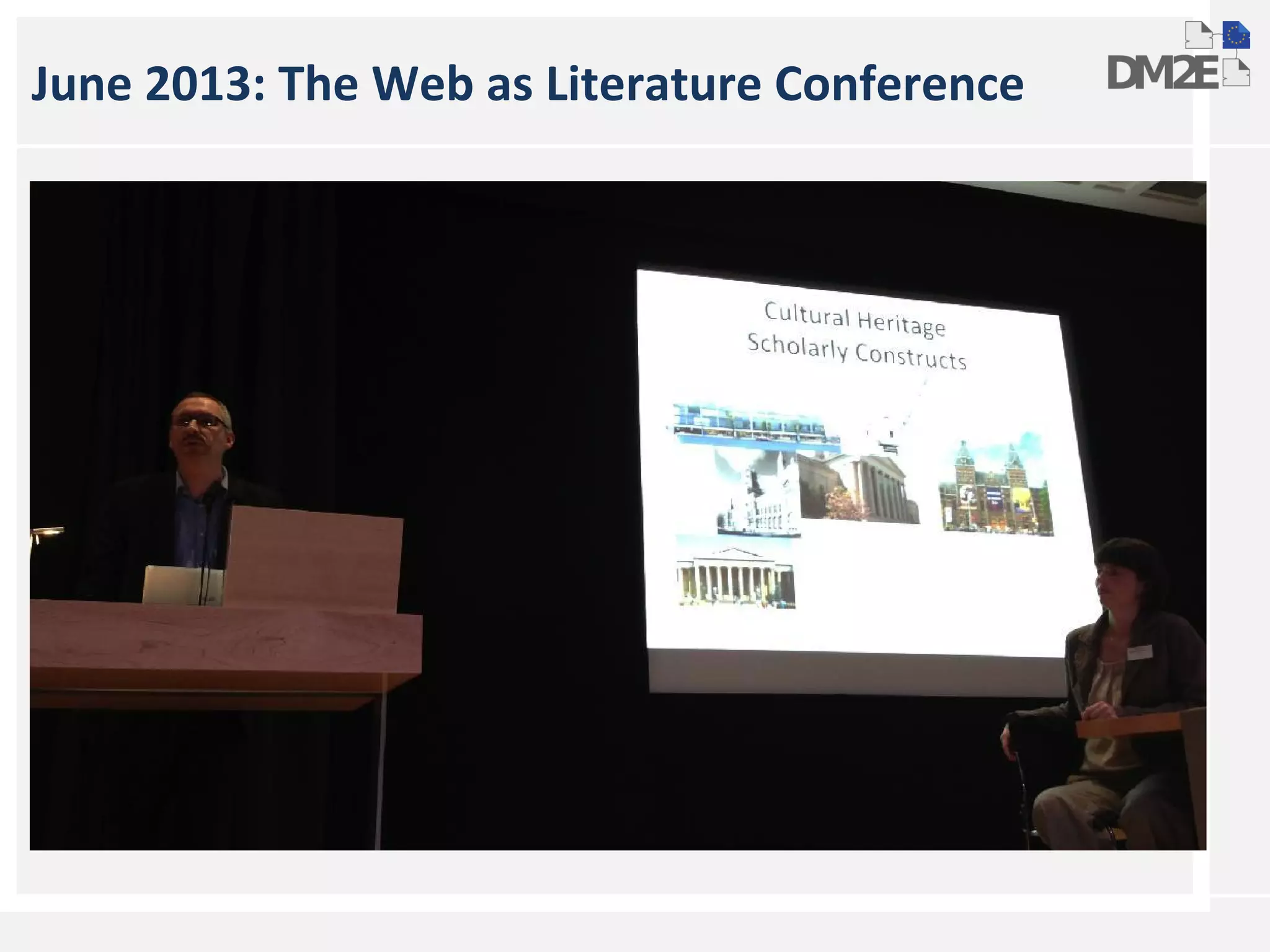
June 2013: The Web as Literature Conference
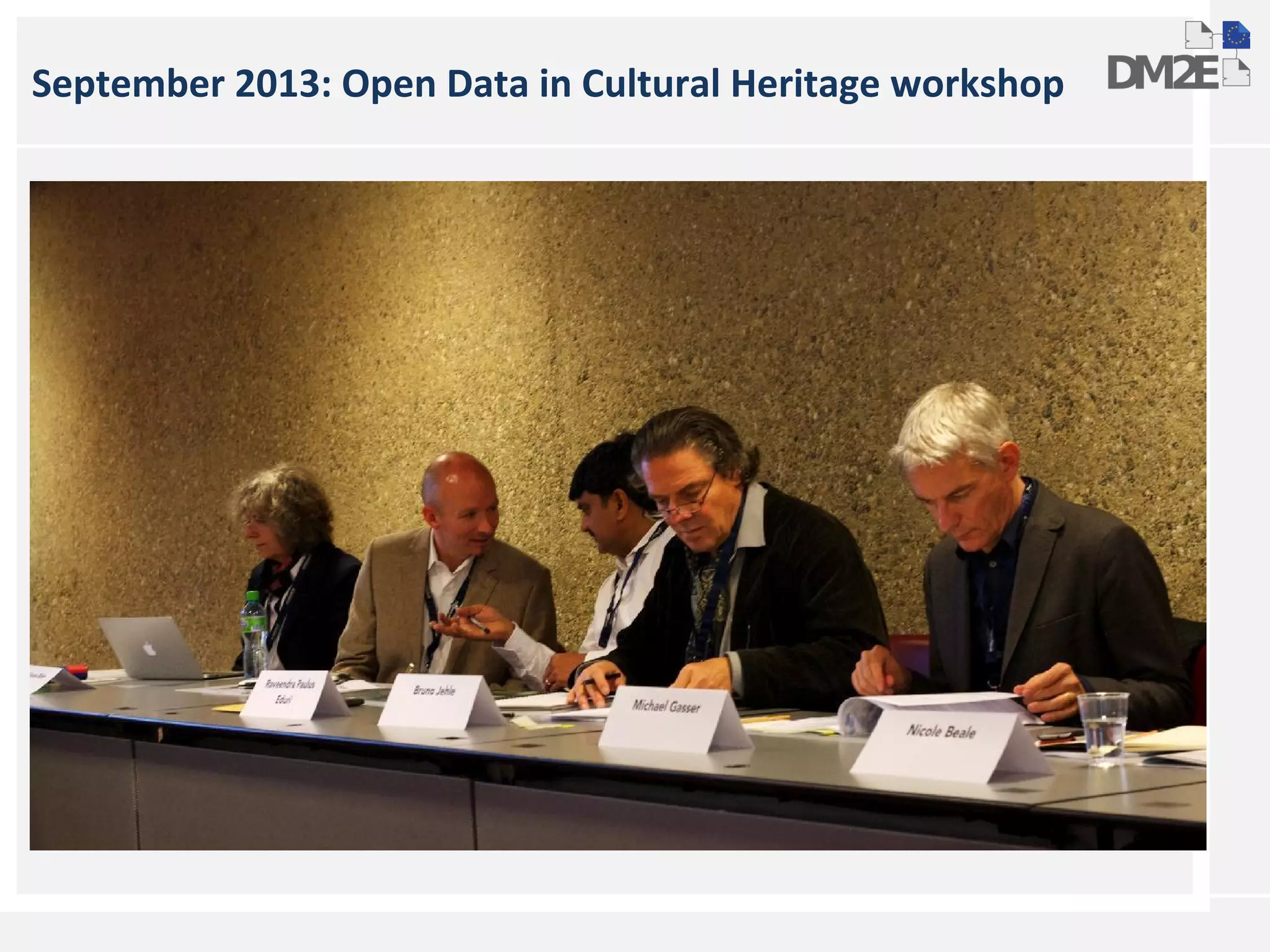
September 2013: Open Data in Cultural Heritage workshop
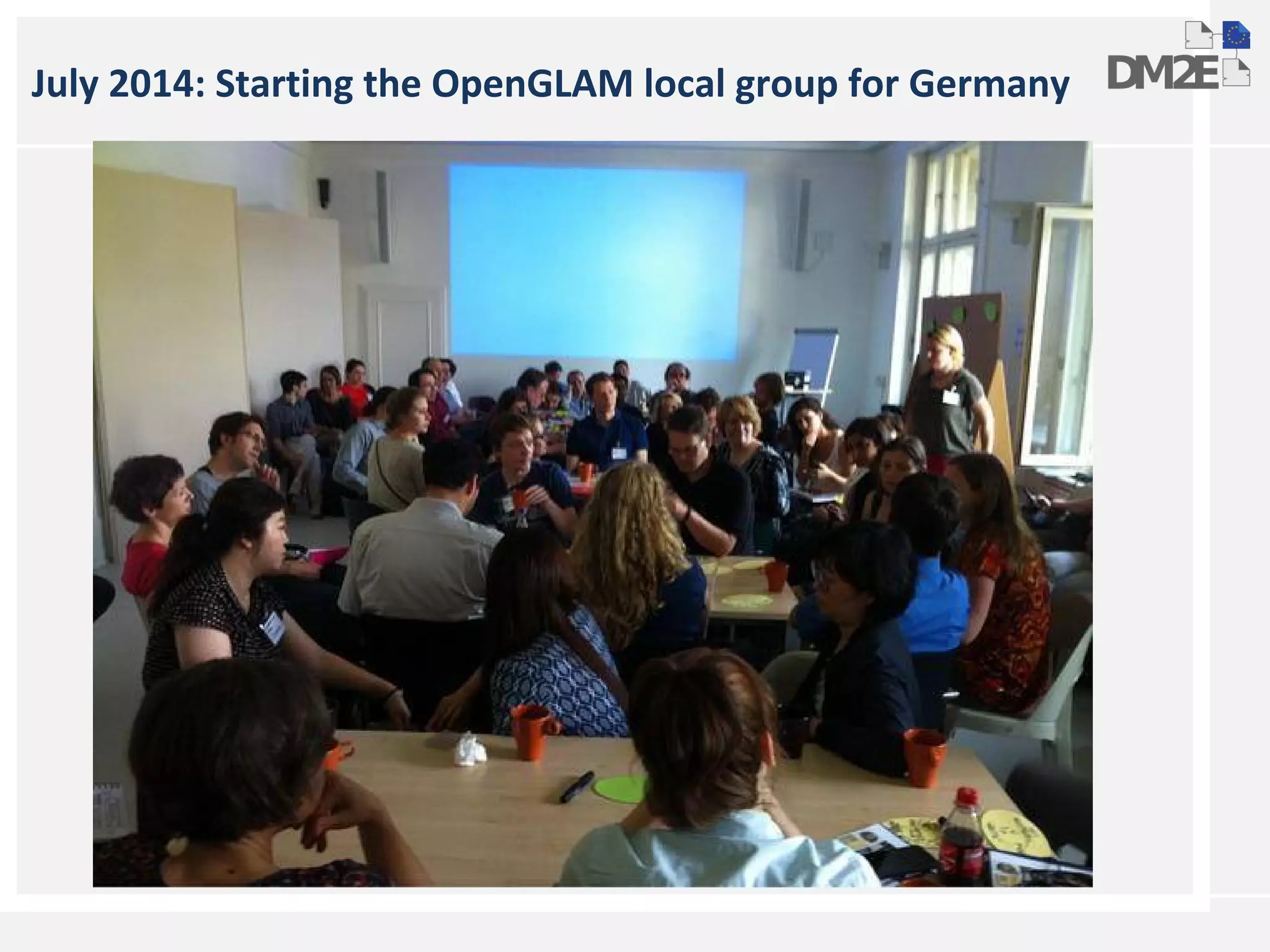
July 2014: Starting the OpenGLAM local group for Germany
Participation in conferences and events 
★ 54 DM2E-focused presentations at international 
conferences and events in the digital humanities and library 
field 
★ 14 journal articles on DM2E research 
★ … and counting 
★ Important DM2E mention in The Guardian (2012): http: 
//www.theguardian. 
com/news/datablog/2012/sep/12/europeana-cultural-heritage- 
library-europe 
*
Participation in conferences and events 
◆ DM2E and its toolset represented at the Culture Hack Panel 
of SXSW festival in Austin, Texas (together with Digital 
Public Library of America and Europeana) 
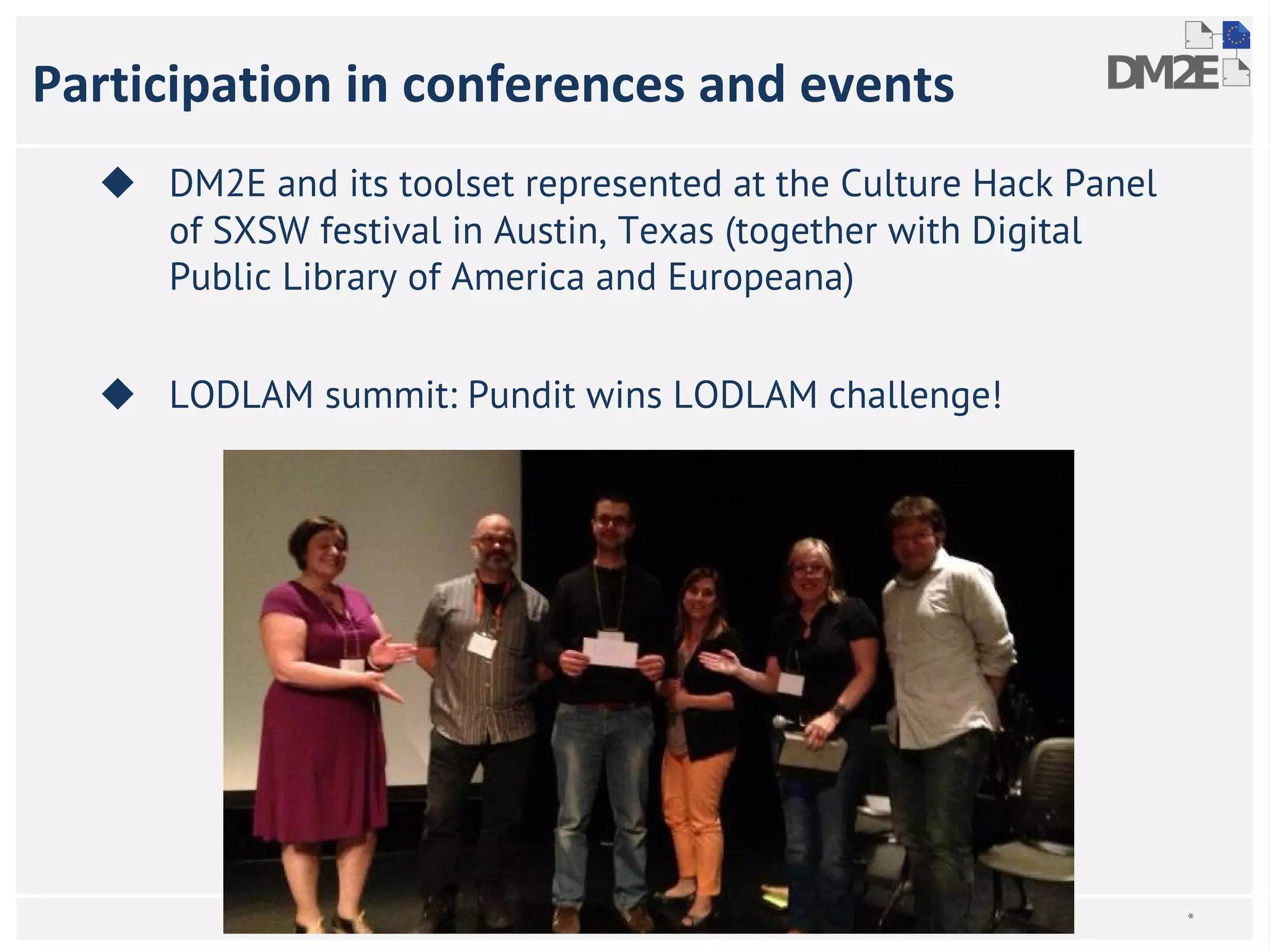
◆ LODLAM summit: Pundit wins LODLAM challenge! 
*
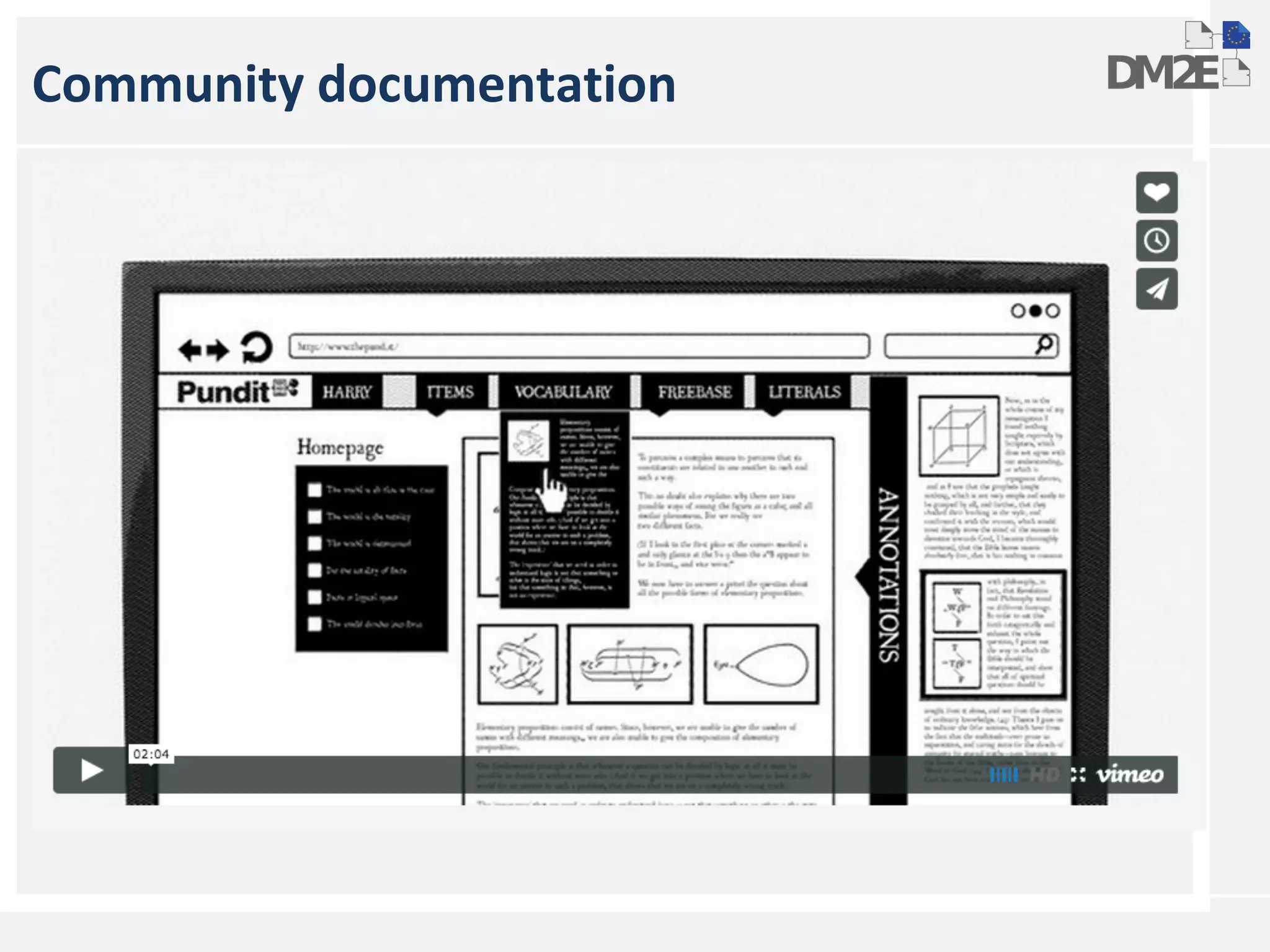
Community documentation 
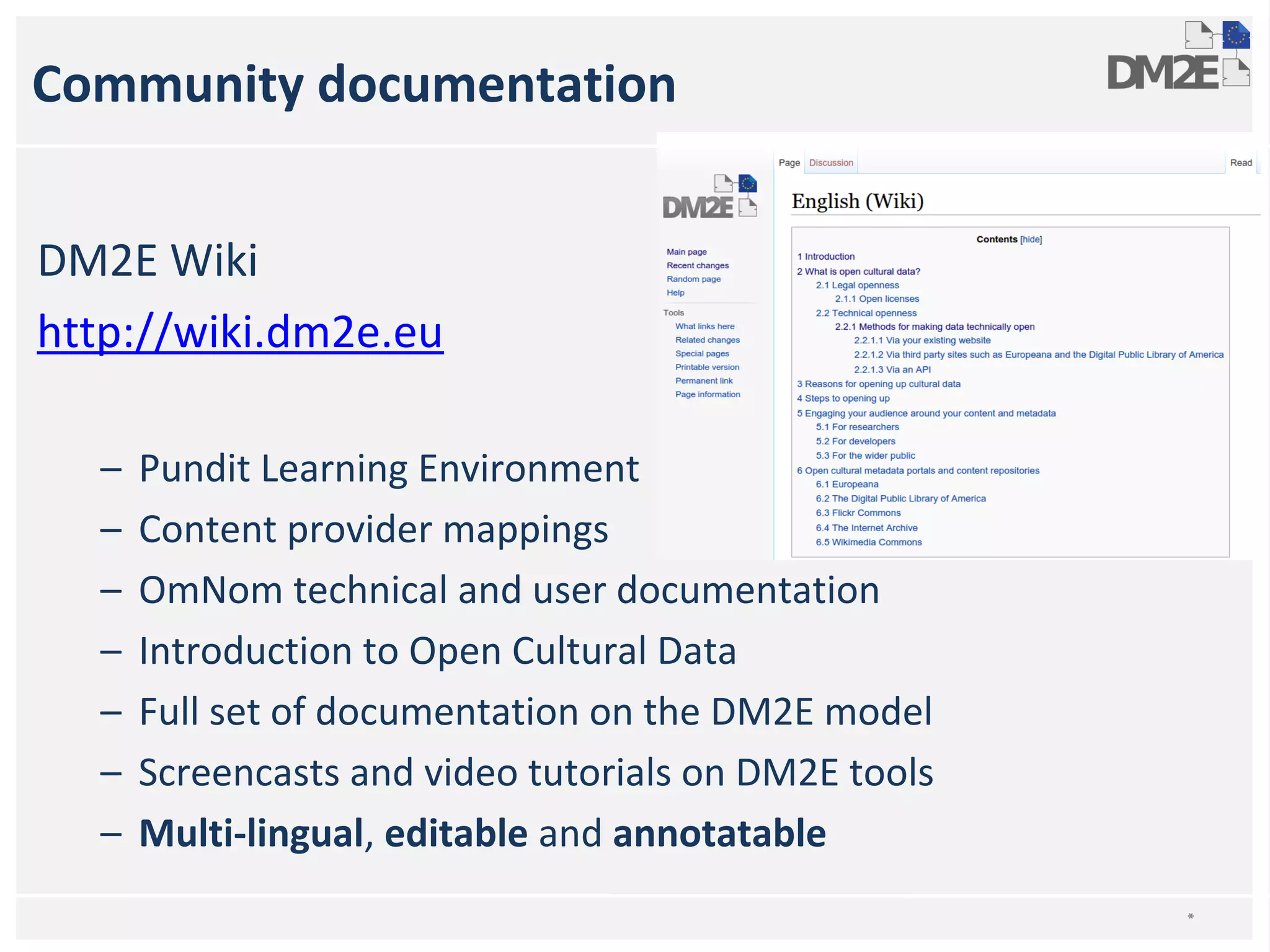
DM2E Wiki 
http://wiki.dm2e.eu 
– Pundit Learning Environment 
– Content provider mappings 
– OmNom technical and user documentation 
– Introduction to Open Cultural Data 
– Full set of documentation on the DM2E model 
– Screencasts and video tutorials on DM2E tools 
– Multi-lingual, editable and annotatable 
*
Community documentation
Engagement with researchers 
• In contact with Digital Humanities departments e.g. Kings College 
London, UCL Centre for Editing Lives and Letters 
• Regular online contact with key Digital Humanities websites and 
mailing lists e.g. Digital Humlab 
• Active involvement in leading Digital Humanities networks and 
projects e.g. DARIAH, LODLAM, Europeana Tech, MarineLives, 
CENDARI 
• Joint organisation of events 
– Open Humanities Hack (with KCL) 
– Pundit workshop held at DARIAH annual meeting
Contest Awards 
Support innovative projects that use 
open data, open content or open source 
to further teaching or research 
in the humanities
Contest Awards – round 1 
Round 1: 2012-2013 
Applications received = 50 
Entries from over 30 different academic 
institutions 
*
Contest Awards – round 1 
* 
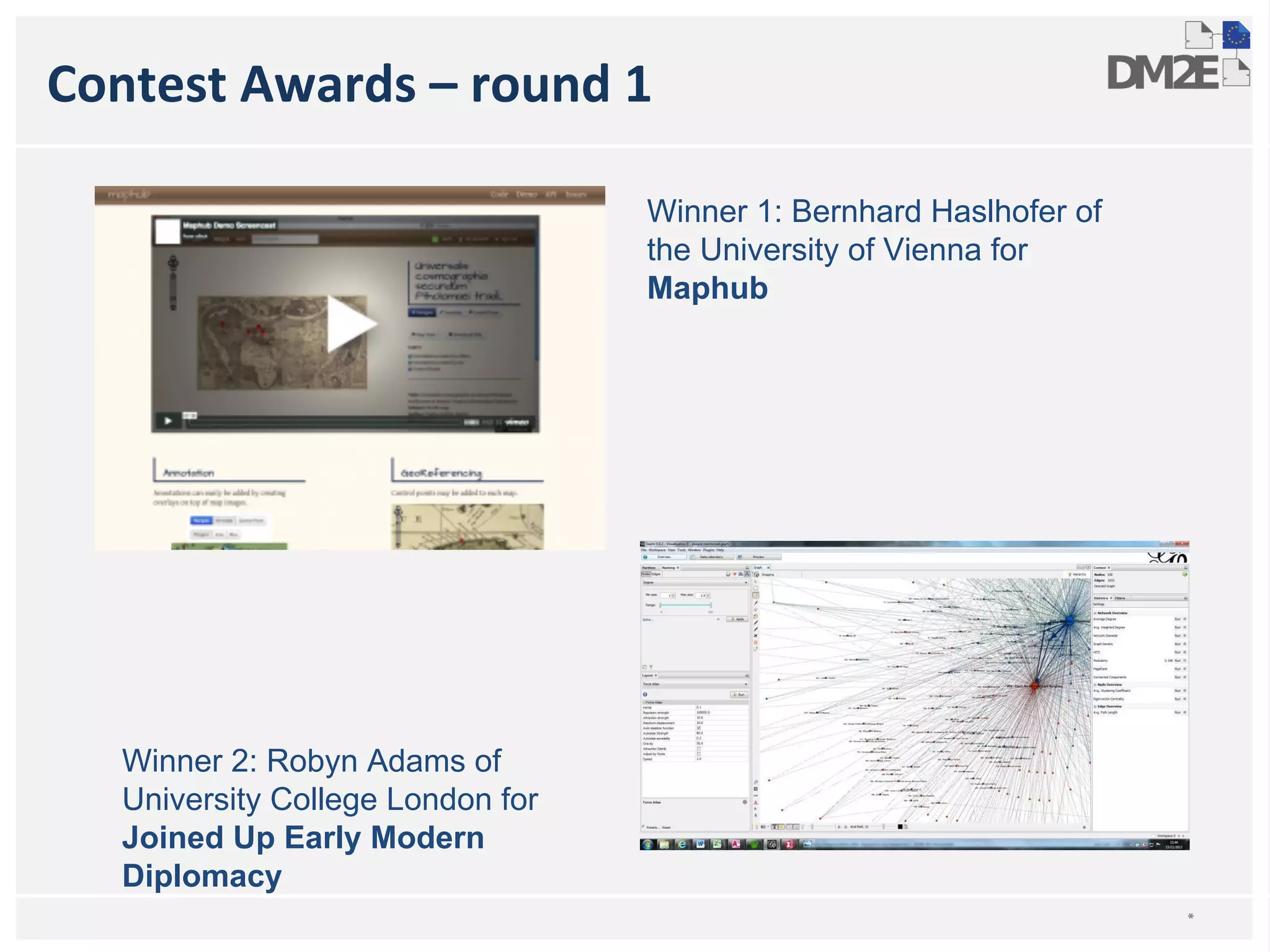
Winner 1: Bernhard Haslhofer of 
the University of Vienna for 
Maphub 
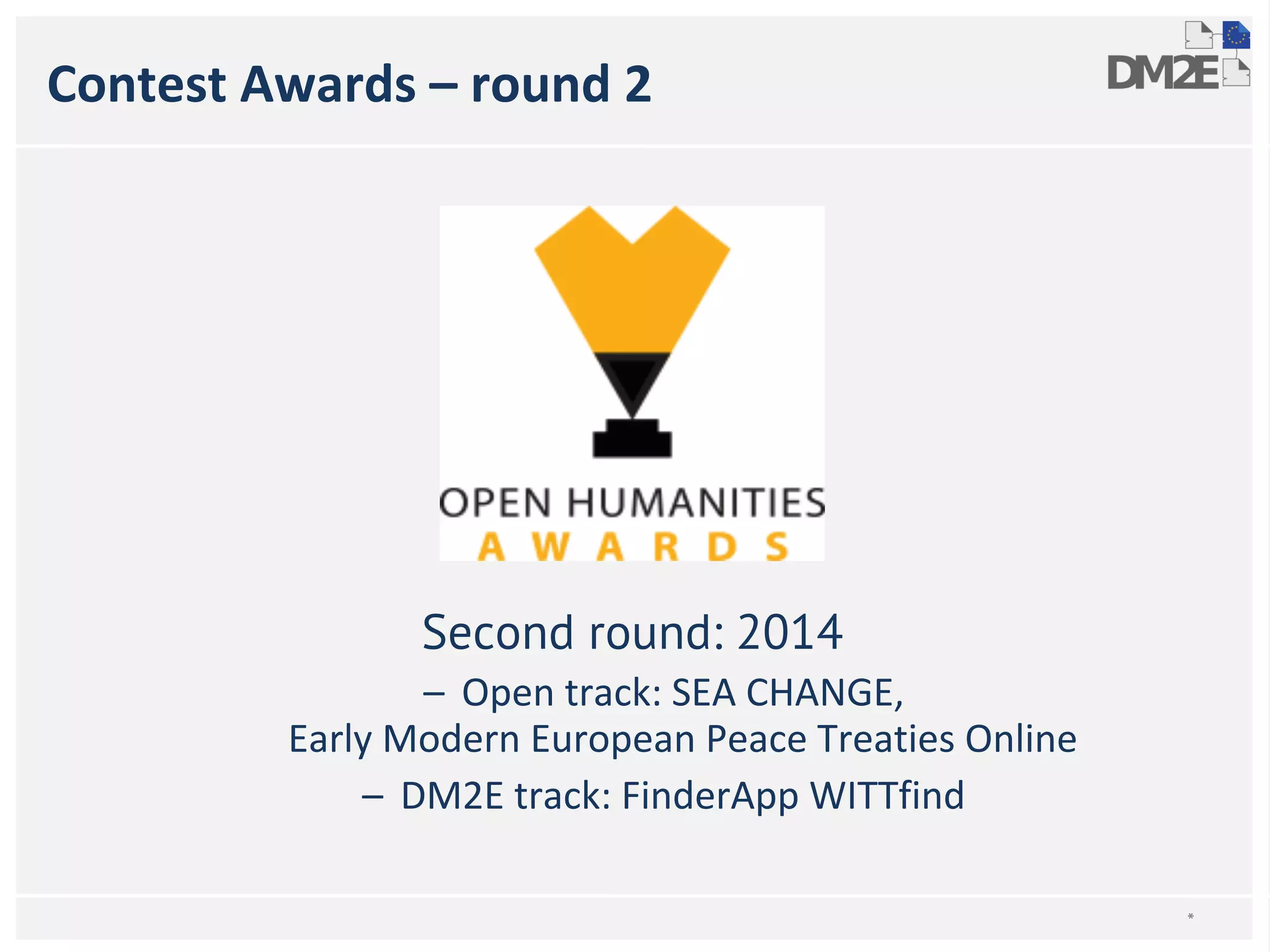
Winner 2: Robyn Adams of 
University College London for 
Joined Up Early Modern 
Diplomacy
Contest Awards – round 2 
Second round: 2014 
– Open track: SEA CHANGE, 
Early Modern European Peace Treaties Online 
– DM2E track: FinderApp WITTfind 
*
Beyond DM2E... 
OpenGLAM established as a sustainable, volunteer-led community 
that will continue to push for openness in digital cultural heritage 
➔ One of the most prominent Open Knowledge Working Groups 
➔ Supported by a network of organisations working to open up cultural 
content and data (including Europeana, the Digital Public Library of 
America, Creative Commons and Wikimedia) 
➔ Grew into a large, global, active volunteer-led community 
*
The digital dream 
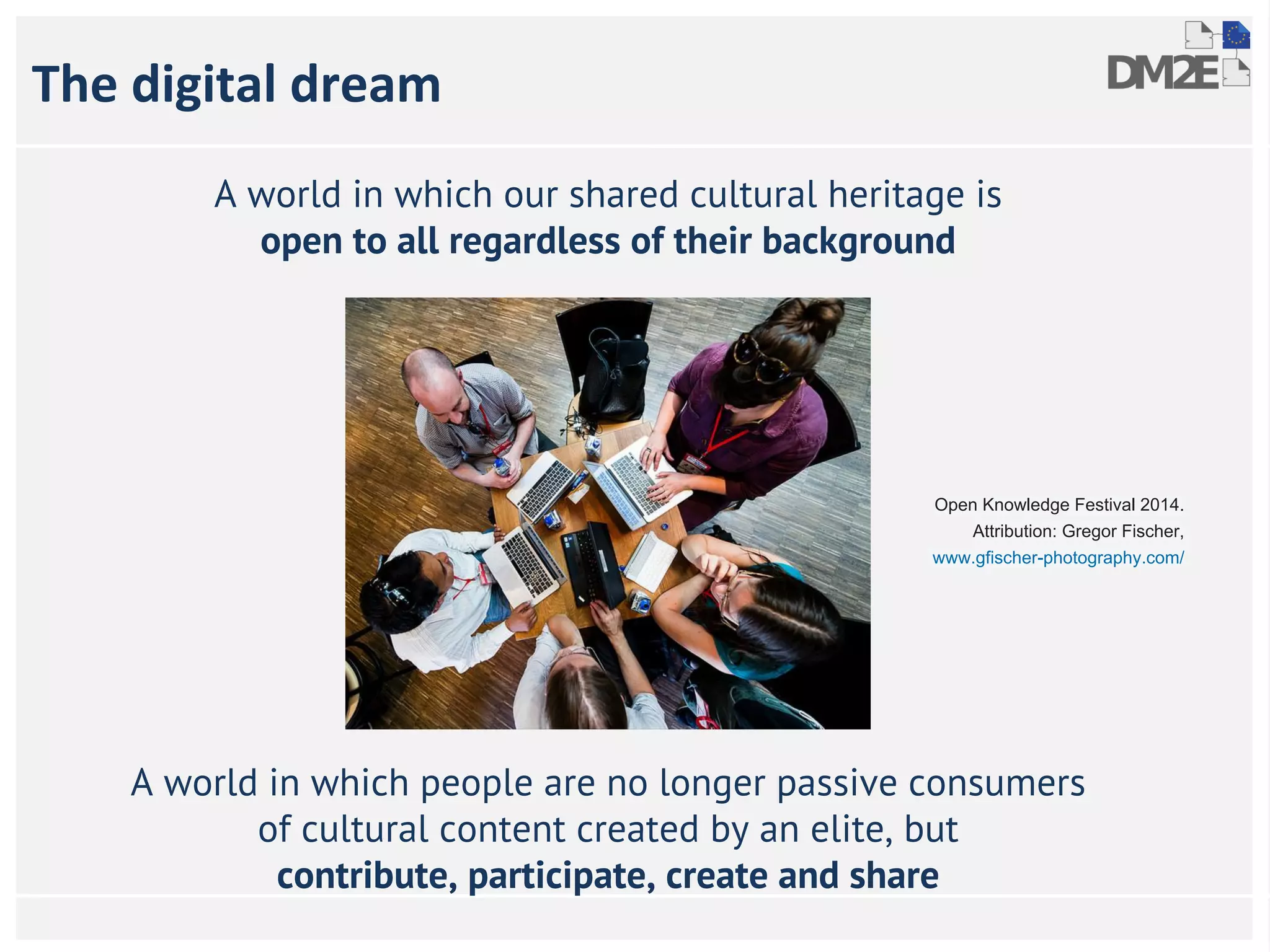
A world in which our shared cultural heritage is 
open to all regardless of their background 
Open Knowledge Festival 2014. 
Attribution: Gregor Fischer, 
www.gfischer-photography.com/ 
A world in which people are no longer passive consumers 
of cultural content created by an elite, but 
contribute, participate, create and share

10 wp4 community building

  • 1.
    Community building inDM2E Lieke Ploeger, Open Knowledge co-funded by the European Union
  • 2.
    Why? Building anenvironment in which the DM2E tools can flourish and create the value of scholarship and the wider public that they promise ➢ promote the value of open data for cultural heritage and humanities research ➢ a community that is broad, connected and sustainable after the project ends ➢ a global cultural commons in which gatekeepers to cultural heritage adopt open principles *
  • 3.
    Main activities ➔Build up and support the OpenGLAM network of open culture advocates for raising awareness of legal and technical best practises around open cultural data ➔ Engage with developers, researchers and end users in the humanities through a series of events and awards ➔ Strengthen and expand the online community around Europeana (engage new stakeholders, enable content holders to contribute new material) ➔ Provide extensive and varied documentation on project outputs (video, user manuals, website, wiki) *
  • 4.
    OpenGLAM Set upas one of the Working Groups in the Open Knowledge portfolio in early 2012 ➔ Gives the community significant autonomy as these Working Groups are volunteer led ➔ Allows the community to benefit from the technical and community support the Open Knowledge Foundation offers to all groups (even beyond the lifetime of the project) ➔ Enables the community to share skills and knowledge with other groups at international open knowledge events like OKCon and OKFestival *
  • 5.
    * Open KnowledgeWorking Groups
  • 6.
    OpenGLAM: What wedo * ● Promote free and open access to digital cultural heritage held by Galleries, Libraries, Archives and Museums (GLAMs) ● Build & support a community of open culture evangelists ● Provide expertise to GLAMs on open issues ● Provide information, resources and tools for working with cultural heritage content and data
  • 7.
  • 8.
    Advisory Board ★High-profile advocates for openness within the cultural heritage sector ★ Provide guidance to the OpenGLAM Working Group and give feedback on key strategic issues *
  • 9.
    * How canOpenGLAM help? Network ● Mailinglist, twitter (#openglam) ● Local groups & ambassadors ● Working group and Advisory Board Information ● Documentation ● OpenGLAM Principles ● Events ● News and blogs Resources ● Open collections ● Culture labs
  • 10.
  • 12.
  • 14.
    OpenGLAM principles AnOpenGLAM institution champions these principles: 1. Release digital information about the artefacts (metadata) into the public domain using an appropriate legal tool such as the Creative Commons Zero Waiver 2. Keep digital representations of works for which copyright has expired (public domain) in the public domain by not adding new rights to them 3. When publishing data make an explicit and robust statement of your wishes and expectations with respect to reuse and repurposing of the descriptions, the whole data collection, and subsets of the collection 4. When publishing data use open file formats which are machine-readable 5. Opportunities to engage audiences in novel ways on the web should be pursued *
  • 16.
    OpenGLAM local group:Switzerland – Promote and facilitate the adoption of the OpenGLAM principles in Switzerland – Members include NGOs (Open Knowledge; Wikimedia; Creative Commons), GLAMs, Research and educational institutions and service providers – Around 20-25 people actively participating in real-life meetings and events – Active task forces: Open Cultural Data Hackathon (Feb 2014), Outreach to smaller institutions *
  • 17.
    OpenGLAM local group:Finland • Finnish network of people working on opening up data and content • Various events: seminars, workshops, meetups, hackathons • Open Cultural Data Masterclass (spring 2014) – Participants from different cultural and memory institutions – Leading experts and practitioners as tutors – 6 thematic one day sessions with various themes, e.g. copyrights, open licenses, creative reuse and applications, demos and prototypes. – Main objective: every organization would open up data and develop a small demo or prototype using open cultural data. DM2E Annual meeting, 12-13 June 2014, Bergen Norway
  • 18.
    Continued growth Metric1st Feb 2013 1st Feb 2014 1st Dec 2014 Twitter handle 906 2,106 3,240 Public mailing list 250 604 720 Unique visitors to site 19,101 60,408 95,267 *
  • 19.
    OpenGLAM: the future • Working Group going global: now 17 members, including New Zealand, India and Brazil • OpenGLAM local: 4 local groups running Switzerland, Austria, Finland, Germany • OpenGLAM benchmark survey Measuring the state of advancement in open cultural data in countries around the world (November 2014 - April 2015) • New functionality and content for the Open Collections page • Increased focus on case studies from different size institutions *
  • 20.
    DM2E: Active webpresence ➔ Regular blogging through both www.dm2e.eu and www. openglam.org - around 100 blogs a year combined ➔ Twitter @dm2europeana ➔ DM2E wiki ➔ Additional channels for sharing content: Slideshare and Vimeo *
  • 21.
    Events 18 DM2Eevents in 3 years: 500+ participants, 9 countries ➔ Demonstration and training with tools ◆ Pundit workshops ◆ The Web as Literature conference ➔ Best practices in open cultural data ◆ Open Data in Cultural Heritage workshops ◆ OpenGLAM legal workshop ◆ Putting Linked Library Data to Work ➔ Coding sprints and hackdays ◆ Open cultural hack ◆ Open Humanities hack ◆ Pundit hackday *
  • 22.
    May 2013: Punditcoding sprint
  • 23.
    June 2013: TheWeb as Literature Conference
  • 24.
    September 2013: OpenData in Cultural Heritage workshop
  • 25.
    July 2014: Startingthe OpenGLAM local group for Germany
  • 26.
    Participation in conferencesand events ★ 54 DM2E-focused presentations at international conferences and events in the digital humanities and library field ★ 14 journal articles on DM2E research ★ … and counting ★ Important DM2E mention in The Guardian (2012): http: //www.theguardian. com/news/datablog/2012/sep/12/europeana-cultural-heritage- library-europe *
  • 27.
    Participation in conferencesand events ◆ DM2E and its toolset represented at the Culture Hack Panel of SXSW festival in Austin, Texas (together with Digital Public Library of America and Europeana) ◆ LODLAM summit: Pundit wins LODLAM challenge! *
  • 28.
    Community documentation DM2EWiki http://wiki.dm2e.eu – Pundit Learning Environment – Content provider mappings – OmNom technical and user documentation – Introduction to Open Cultural Data – Full set of documentation on the DM2E model – Screencasts and video tutorials on DM2E tools – Multi-lingual, editable and annotatable *
  • 29.
  • 30.
    Engagement with researchers • In contact with Digital Humanities departments e.g. Kings College London, UCL Centre for Editing Lives and Letters • Regular online contact with key Digital Humanities websites and mailing lists e.g. Digital Humlab • Active involvement in leading Digital Humanities networks and projects e.g. DARIAH, LODLAM, Europeana Tech, MarineLives, CENDARI • Joint organisation of events – Open Humanities Hack (with KCL) – Pundit workshop held at DARIAH annual meeting
  • 31.
    Contest Awards Supportinnovative projects that use open data, open content or open source to further teaching or research in the humanities
  • 32.
    Contest Awards –round 1 Round 1: 2012-2013 Applications received = 50 Entries from over 30 different academic institutions *
  • 33.
    Contest Awards –round 1 * Winner 1: Bernhard Haslhofer of the University of Vienna for Maphub Winner 2: Robyn Adams of University College London for Joined Up Early Modern Diplomacy
  • 34.
    Contest Awards –round 2 Second round: 2014 – Open track: SEA CHANGE, Early Modern European Peace Treaties Online – DM2E track: FinderApp WITTfind *
  • 35.
    Beyond DM2E... OpenGLAMestablished as a sustainable, volunteer-led community that will continue to push for openness in digital cultural heritage ➔ One of the most prominent Open Knowledge Working Groups ➔ Supported by a network of organisations working to open up cultural content and data (including Europeana, the Digital Public Library of America, Creative Commons and Wikimedia) ➔ Grew into a large, global, active volunteer-led community *
  • 36.
    The digital dream A world in which our shared cultural heritage is open to all regardless of their background Open Knowledge Festival 2014. Attribution: Gregor Fischer, www.gfischer-photography.com/ A world in which people are no longer passive consumers of cultural content created by an elite, but contribute, participate, create and share