UNIT -IV COMMUNICATION
UNIT -IV
COMMUNICATION
• COMMUNICATION: Meaning, Types and Characteristics
of Communication
• EFFECTIVE COMMUNICATION: Verbal and Non-
verbal, Inter-cultural and Group Communications,
Classroom Communication.
• Barriers to Effective Communication.
• Mass Media and Society
2
3
COMMUNICATION
• The root of the word " Communication" in Latin is
Communicare or Communis , which means to share, or to
make common
• Communication is the sending and receiving of information
and can be one-on-one or between groups of people and can
be face-to-face or through communication devices.
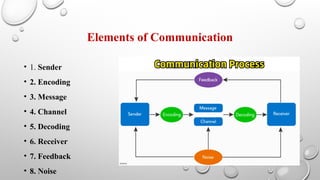
• Communication requires a sender , the person who initiates
the communication, to transfer their thoughts or encode a
message . this message is send to the receiver, a person who
receives the message , and finally, the receiver must decode,
or interpret the message.
4
Elements of Communication
• 1. Sender
• 2. Encoding
• 3. Message
• 4. Channel
• 5. Decoding
• 6. Receiver
• 7. Feedback
• 8. Noise
5
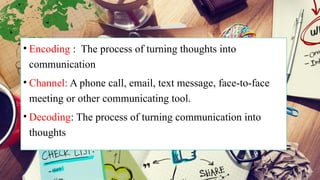
• Encoding : The process of turning thoughts into
communication
• Channel: A phone call, email, text message, face-to-face
meeting or other communicating tool.
• Decoding: The process of turning communication into
thoughts
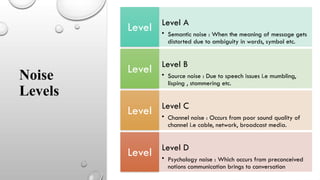
Noise
Levels
6
Level A
• Semantic noise : When the meaning of message gets
distorted due to ambiguity in words, symbol etc.
Level
Level B
• Source noise : Due to speech issues i.e mumbling,
lisping , stammering etc.
Level
Level C
• Channel noise : Occurs from poor sound quality of
channel i.e cable, network, broadcast media.
Level
Level D
• Psychology noise : Which occurs from preconceived
notions communication brings to conversation
Level
7
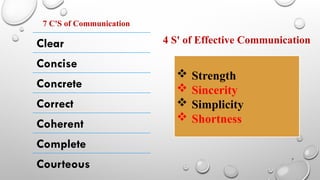
7 C'S of Communication
Clear
Concise
Concrete
Correct
Coherent
Complete
Courteous
 Strength
 Sincerity
 Simplicity
 Shortness
4 S' of Effective Communication
8
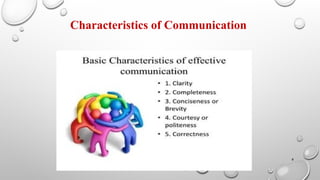
Characteristics of Communication
9
Question…
The elements as related to communication in the ancient paradigm of
everyday life are ?
A.Physiological
B.Economic
C.Ethical
D. Self- Realization
E.Ego Clashes
Choose the most appropriate
answer from the options given
below:
• 1. A,B,C,D ONLY
• 2. B,C,D,E ONLY
• 3. A,C,D, E ONLY
• 4. A,B,D,E ONLY
Question…
The Sender's responsibility in communication
process includes: ?
1. Interrupting the receiver to clarify misunderstandings
immediately
2. Ensuring the message is clear, complete, and understood
by the receiver
3. Avoiding feedback from the receiver to ensure message
integrity.
4. Using technical jargon whenever possible to demonstrate
expertise
10
11
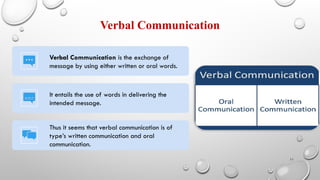
Verbal Communication
Verbal Communication is the exchange of
message by using either written or oral words.
It entails the use of words in delivering the
intended message.
Thus it seems that verbal communication is of
type’s written communication and oral
communication.
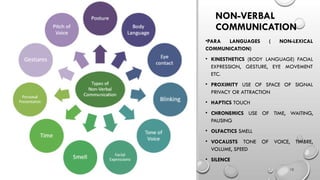
NON-VERBAL
COMMUNICATION
•PARA LANGUAGES ( NON-LEXICAL
COMMUNICATION)
• KINESTHETICS (BODY LANGUAGE) FACIAL
EXPRESSION, GESTURE, EYE MOVEMENT
ETC.
• PROXIMITY USE OF SPACE OF SIGNAL
PRIVACY OR ATTRACTION
• HAPTICS TOUCH
• CHRONEMICS USE OF TIME, WAITING,
PAUSING
• OLFACTICS SMELL
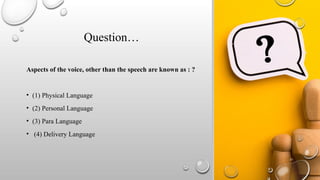
• VOCALISTS TONE OF VOICE, TIMBRE,
VOLUME, SPEED
• SILENCE
12
Question…
Which of the following signifies non-verbal
communication essential way ?
1) Instructions written on a question paper
2) Learner attending an online class
3) The dress code followed by an individual
4) Yoga instructor teaching yoga poses to the pupil
13
Question…
Attitudes, actions and appearances in the context
of classroom communication are considered as:
1. Verbal
2. Non-verbal
3. Impersonal
4. Irrational
14
15
 Horizontal Communication
 Vertical Communication
 Download Communication
 Upward Communication
 Diagonal Communication
Types Of
Communication
16
Horizontal Communication
17
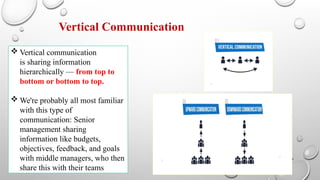
Vertical Communication
 Vertical communication
is sharing information
hierarchically — from top to
bottom or bottom to top.
 We're probably all most familiar
with this type of
communication: Senior
management sharing
information like budgets,
objectives, feedback, and goals
with middle managers, who then
share this with their teams
18
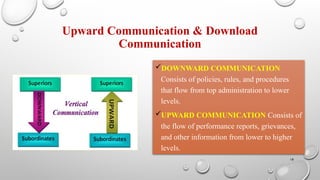
Upward Communication & Download
Communication
DOWNWARD COMMUNICATION
Consists of policies, rules, and procedures
that flow from top administration to lower
levels.
UPWARD COMMUNICATION Consists of
the flow of performance reports, grievances,
and other information from lower to higher
levels.
19
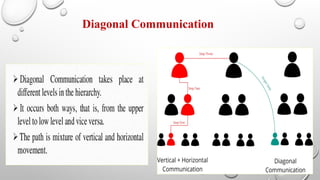
Diagonal Communication
20
Question…
Imagine you are working in an educational institution where people are of
equal status. Which method of communication is best suited and normally
employed in such a context ?
• A. Horizontal Communication
• B. Vertical Communication
• C. Cross Communication
• D. Corporate Communication
21
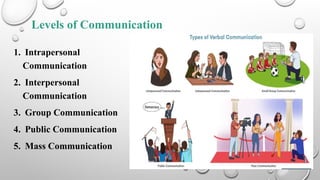
Levels of Communication
1. Intrapersonal
Communication
2. Interpersonal
Communication
3. Group Communication
4. Public Communication
5. Mass Communication
22
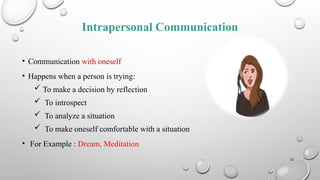
Intrapersonal Communication
• Communication with oneself
• Happens when a person is trying:
 To make a decision by reflection
 To introspect
 To analyze a situation
 To make oneself comfortable with a situation
• For Example : Dream, Meditation
23
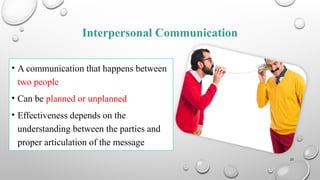
Interpersonal Communication
• A communication that happens between
two people
• Can be planned or unplanned
• Effectiveness depends on the
understanding between the parties and
proper articulation of the message
Group
Communication
24
Communication that happens between three
or more members in a group
Can be formal or informal
Used to discuss and finalize an outcome,
based on shared objectives.
For Example: Company Parties, Group
Project Discussions, Team-building Events
Public Communication
• The sender broadcast a message to a select
audience
• Can be formal or informal
• Used to discuss and finalize the outcome, based
on shared objectives
• FOR EXAMPLE: Seminars, Press
Conferences, Political Campaigns, And Public
Speaking Events
25
Mass
Communication
• Address a large audience
• No personal connect
• For Example: Radio, Social Media,
Advertising, Journalism,
Newspaper, Television, Film, Print
Media, Book, Magazines.
26
27
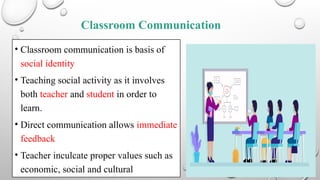
Classroom Communication
• Classroom communication is basis of
social identity
• Teaching social activity as it involves
both teacher and student in order to
learn.
• Direct communication allows immediate
feedback
• Teacher inculcate proper values such as
economic, social and cultural
Question…
Organizational communication can
also be equated with
(A) Intra-personal Communication.
(B) Inter-personal Communication.
(C) Group Communication.
(D) Mass Communication.
28
29
Question…
Which of the following are the criteria for public communication ?
A. Personal bias
B. Ideological slant
C. Accuracy
D. Comprehensiveness
E. Separation of opinion and facts
• choose the correct answer from the
options given below:
• 1. A,B,C ONLY
• 2. B,C,D ONLY
• 3. C,D,E ONLY
• 4. A,D,E ONLY
Question…
From the Communication viewpoint which one of the
following is a Cultural Institute?
1. Trade organization
2. Political party
3. Military alliance
4. Family
30
31
Effective Communication
• DEFINITION:
Effective communication is
a process of exchanging ideas,
thoughts, knowledge, and information
so that the purpose or intention is
fulfilled in the best possible manner.
In simple words, it is nothing but
the presentation of views by the sender in
a way best understood by the receiver
32
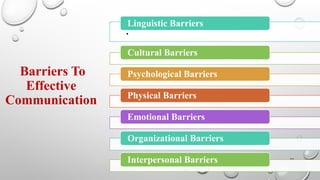
Barriers To
Effective
Communication
•
Linguistic Barriers
Cultural Barriers
Psychological Barriers
Physical Barriers
Emotional Barriers
Organizational Barriers
Interpersonal Barriers
Linguistic Barriers
33
The language barrier is one of the main barriers that limit
effective communication.
Language is the most commonly employed tool of
communication.
The fact that each major region has its own language is one of
the barriers to effective communication.
Sometimes even a thick dialect may render the communication
ineffective.
34
Cultural Barriers of Communication
Culture is a shared set of values and
attributes of a group; it is the total of the
ways of living built up by a group and
transmitted from one generation to
another.
Culture is so much a part of an
individual’s manner of talking, behaving
and thinking, that communication style
and competence are influenced by it.
35
PSYCHOLOGICAL
BARRIERS
Selective Perception
Halo Effect
Status Relationship
Poor Attention And Retention
Closed Mind
State Of Health
PHYSICAL BARRIERS
• Physical distractions cause a lot of noise, often
literally: insufficiently insulated rooms with car
noises filtering through, poor lighting, and such
things as frequent movement of bodies postures,
with a pen in the hand, even the arrival of coffee at
a critical stage on the communication process are
the causes of communication barriers in
organizations.
1. NOISE
2. ENVIRONMENT
3. DEFECTS IN THE MEDIUM
Emotional Barriers
 The emotional IQ of a person determines the ease and
comfort with which they can communicate. a person who
is emotionally mature will be able to communicate
effectively. on the other hand, people who let their
emotions take over will face certain difficulties.
 A perfect mixture of emotions and facts is necessary for
effective communication. emotions like anger, frustration,
and senses of humour, can blur the decision-making
capacities of a person Emotions like anger, frustration, and
humour can blur a person's decision-making capacities and
thus limit the effectiveness of their communication.
36
37
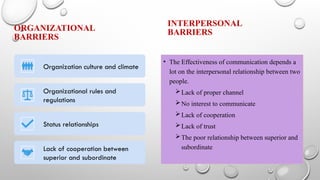
ORGANIZATIONAL
BARRIERS
Organization culture and climate
Organizational rules and
regulations
Status relationships
Lack of cooperation between
superior and subordinate
INTERPERSONAL
BARRIERS
• The Effectiveness of communication depends a
lot on the interpersonal relationship between two
people.
Lack of proper channel
No interest to communicate
Lack of cooperation
Lack of trust
The poor relationship between superior and
subordinate
38
Question…
Which of the following is excluded from the list of communication
barriers ?
1. Physical
2. Semantic
3. Philosophical
4. Psychological
Mass Communication
• Large audience
• Fairly undifferentiated audience
composition
• Some form of message reproduction
• Rapid distribution and delivery
• Low cost to the consumers 39
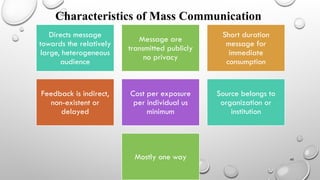
Characteristics of Mass Communication
40
Directs message
towards the relatively
large, heterogeneous
audience
Message are
transmitted publicly
no privacy
Short duration
message for
immediate
consumption
Feedback is indirect,
non-existent or
delayed
Cost per exposure
per individual us
minimum
Source belongs to
organization or
institution
Mostly one way
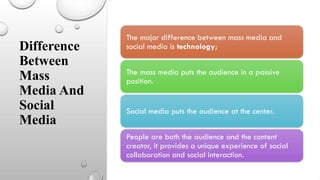
Difference
Between
Mass
Media And
Social
Media
41
The major difference between mass media and
social media is technology;
The mass media puts the audience in a passive
position.
Social media puts the audience at the center.
People are both the audience and the content
creator, it provides a unique experience of social
collaboration and social interaction.
42
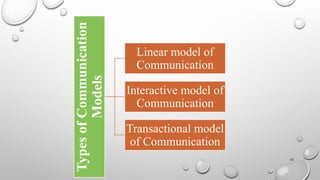
Types
of
Communication
Models
Linear model of
Communication
Interactive model of
Communication
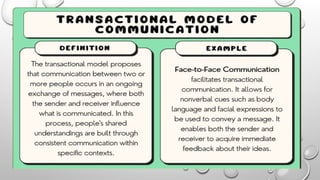
Transactional model
of Communication
43
44
45
46
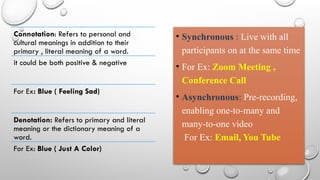
Connotation: Refers to personal and
cultural meanings in addition to their
primary , literal meaning of a word.
it could be both positive & negative
For Ex: Blue ( Feeling Sad)
Denotation: Refers to primary and literal
meaning or the dictionary meaning of a
word.
For Ex: Blue ( Just A Color)
• Synchronous : Live with all
participants on at the same time
• For Ex: Zoom Meeting ,
Conference Call
• Asynchronous: Pre-recording,
enabling one-to-many and
many-to-one video
For Ex: Email, You Tube
47
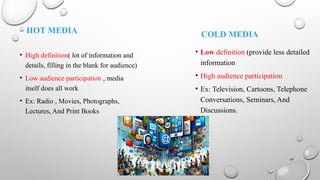
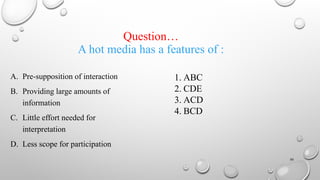
HOT MEDIA
• High definition( lot of information and
details, filling in the blank for audience)
• Low audience participation , media
itself does all work
• Ex: Radio , Movies, Photographs,
Lectures, And Print Books
COLD MEDIA
• Low definition (provide less detailed
information
• High audience participation
• Ex: Television, Cartoons, Telephone
Conversations, Seminars, And
Discussions.
48
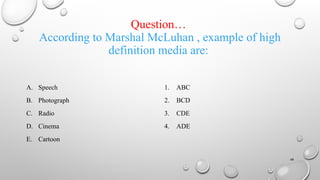
Question…
According to Marshal McLuhan , example of high
definition media are:
A. Speech
B. Photograph
C. Radio
D. Cinema
E. Cartoon
1. ABC
2. BCD
3. CDE
4. ADE
Question…
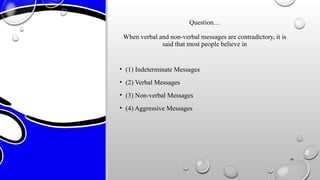
When verbal and non-verbal messages are contradictory, it is
said that most people believe in
• (1) Indeterminate Messages
• (2) Verbal Messages
• (3) Non-verbal Messages
• (4) Aggressive Messages
49
50
Question…
A hot media has a features of :
A. Pre-supposition of interaction
B. Providing large amounts of
information
C. Little effort needed for
interpretation
D. Less scope for participation
1. ABC
2. CDE
3. ACD
4. BCD
Question…
Aspects of the voice, other than the speech are known as : ?
• (1) Physical Language
• (2) Personal Language
• (3) Para Language
• (4) Delivery Language
51
52
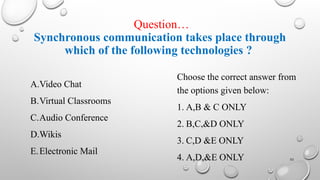
Question…
Synchronous communication takes place through
which of the following technologies ?
A.Video Chat
B.Virtual Classrooms
C.Audio Conference
D.Wikis
E.Electronic Mail
Choose the correct answer from
the options given below:
1. A,B & C ONLY
2. B,C,&D ONLY
3. C,D &E ONLY
4. A,D,&E ONLY
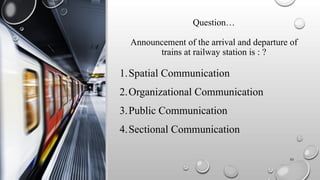
Question…
Announcement of the arrival and departure of
trains at railway station is : ?
1.Spatial Communication
2.Organizational Communication
3.Public Communication
4.Sectional Communication
53
54
55
ALL THE BEST