Open access  for researchers, policy makers and research managers Iryna Kuchma, eIFL Open Access program manager, eIFL.net Presented at Open Access: Maximising Research Impact, April 23 2009,  New Bulgarian University Library, Sofia
Why Open Access (OA)? Open access for researchers:  enlarged audience  citation impact tenure  and promotion
Why OA? Open access for policy makers  and research managers:  new tools  to manage  a university’s image  and impact
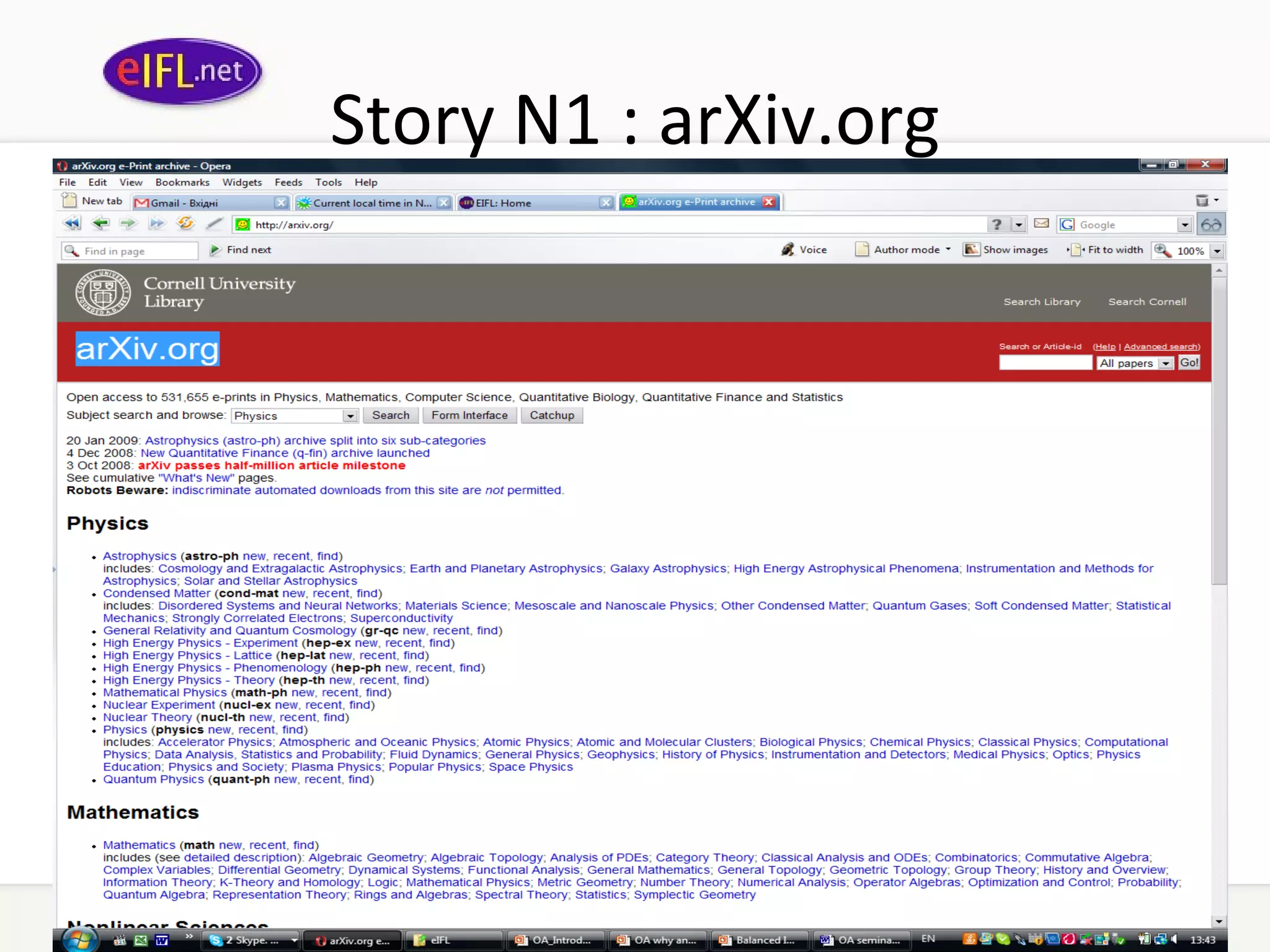
Story N1  :  arXiv.org
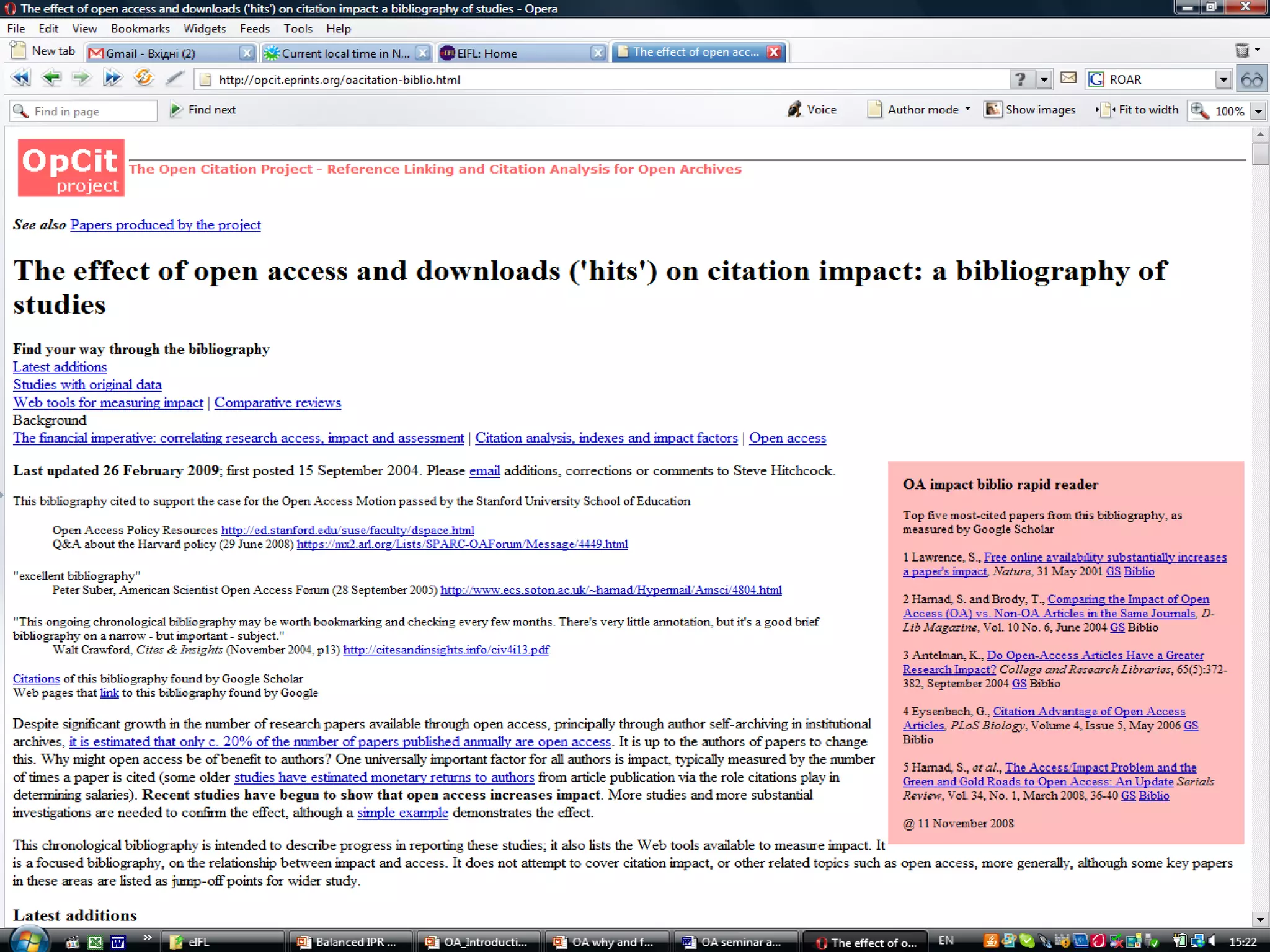
Open Access Impact Open access brings more rapid and more efficient progress for scholarly research http:// arxiv .org/   “ Brody has looked at the pattern of citations to articles deposited in arXiv, specifically at the length of the delay between when an article is deposited and when it is cited, and has published the aggregated data for each year from 1991.” Brody, Tim; Harnad, Stevan; Carr, Leslie. Earlier web usage statistics as predictors of later citation impact.  Journal of the American Association for Information Science and Technology  (JASIST), 2005, Vol. 57  no.  8 pp. 1060-1072. http://eprints.ecs.soton.ac.uk/10713/01/timcorr.htm (accessed 30 October 2006) Open Access: What is it and why should we have it? - ECS EPrints ...Open Access: What is it and why should we have it? Swan, A. (2006) Open Access: What is it and why should we have it?  http:// eprints . ecs . soton .ac. uk /13028/
Open Access Impact “ As more papers are deposited and more scientists use the repository, the time between an article being deposited and being cited has been shrinking dramatically, year upon year.  This is important for research uptake and progress, because it means that in this area of research, where articles are made available at – or frequently before – publication,  the research cycle is accelerating .  the research cycle in high energy physics is approaching maximum efficiency  as a result of the early and free availability of articles that scientists in the field can use and build upon rapidly.” Brody, Tim; Harnad, Stevan; Carr, Leslie. Earlier web usage statistics as predictors of later citation impact.  Journal of the American Association for Information Science and Technology  (JASIST), 2005, Vol. 57  no.  8 pp. 1060-1072. http://eprints.ecs.soton.ac.uk/10713/01/timcorr.htm (accessed 30 October 2006) Open Access: What is it and why should we have it? - ECS EPrints ...Open Access: What is it and why should we have it? Swan, A. (2006) Open Access: What is it and why should we have it?  http:// eprints . ecs . soton .ac. uk /13028/
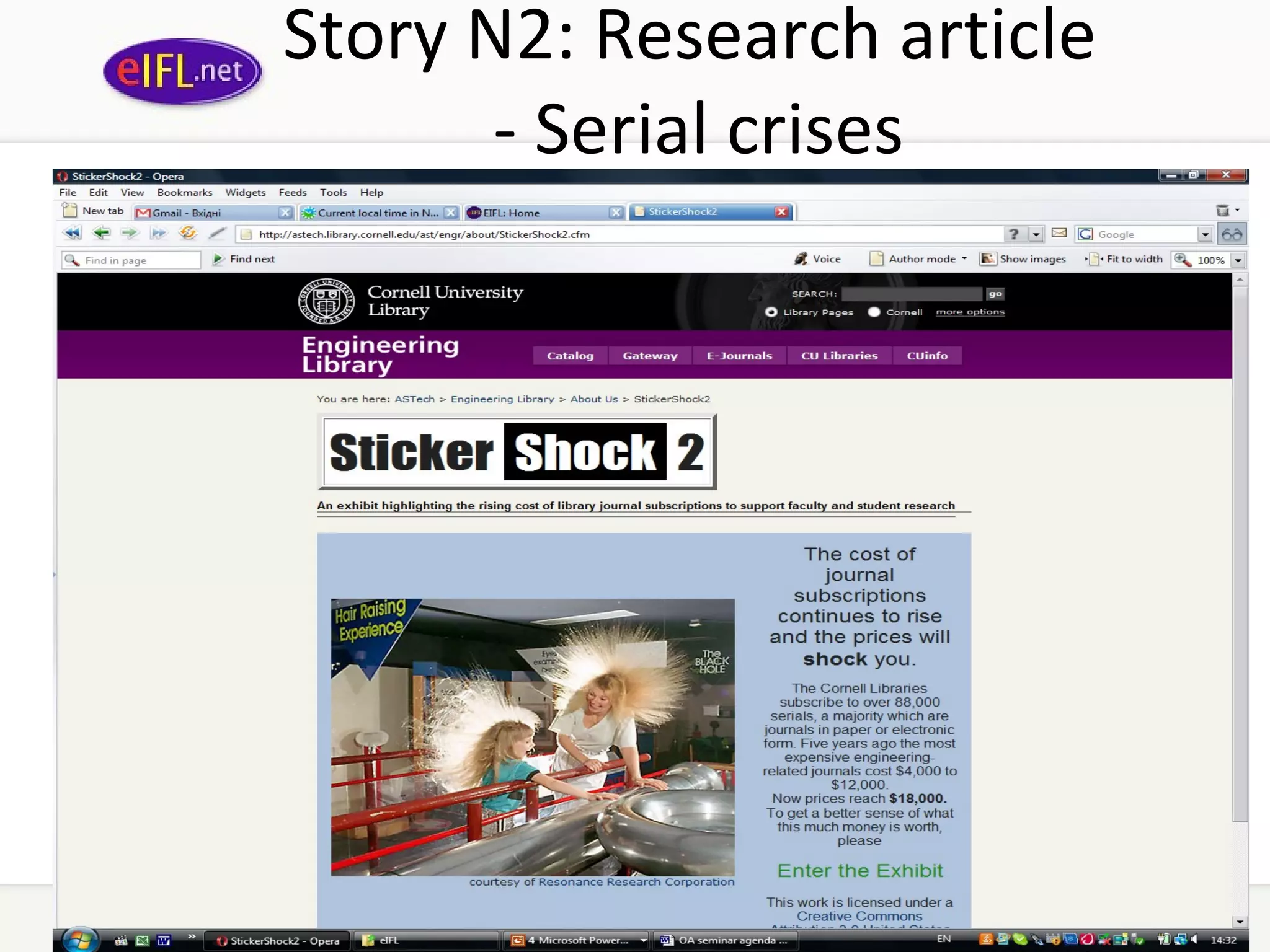
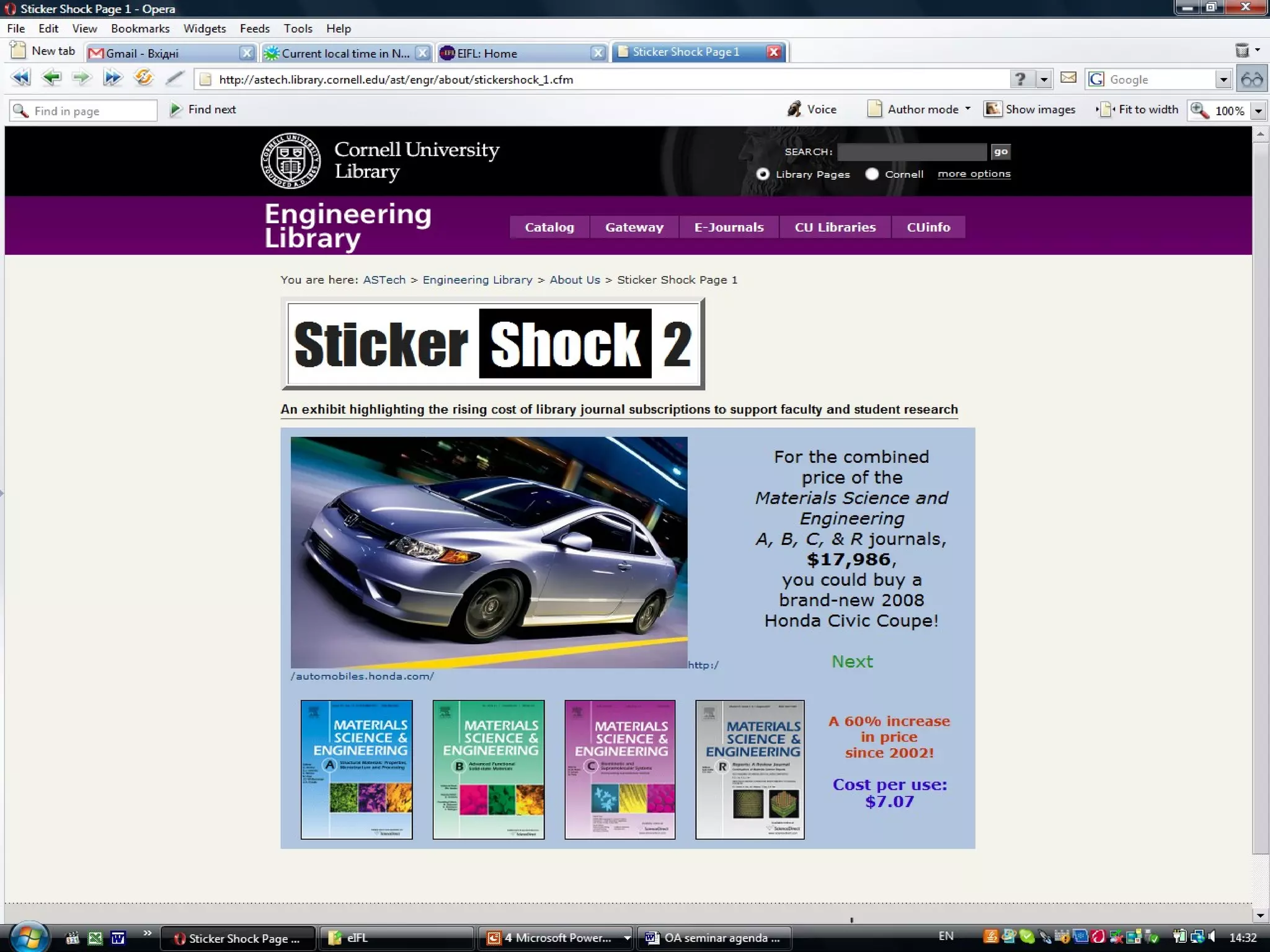
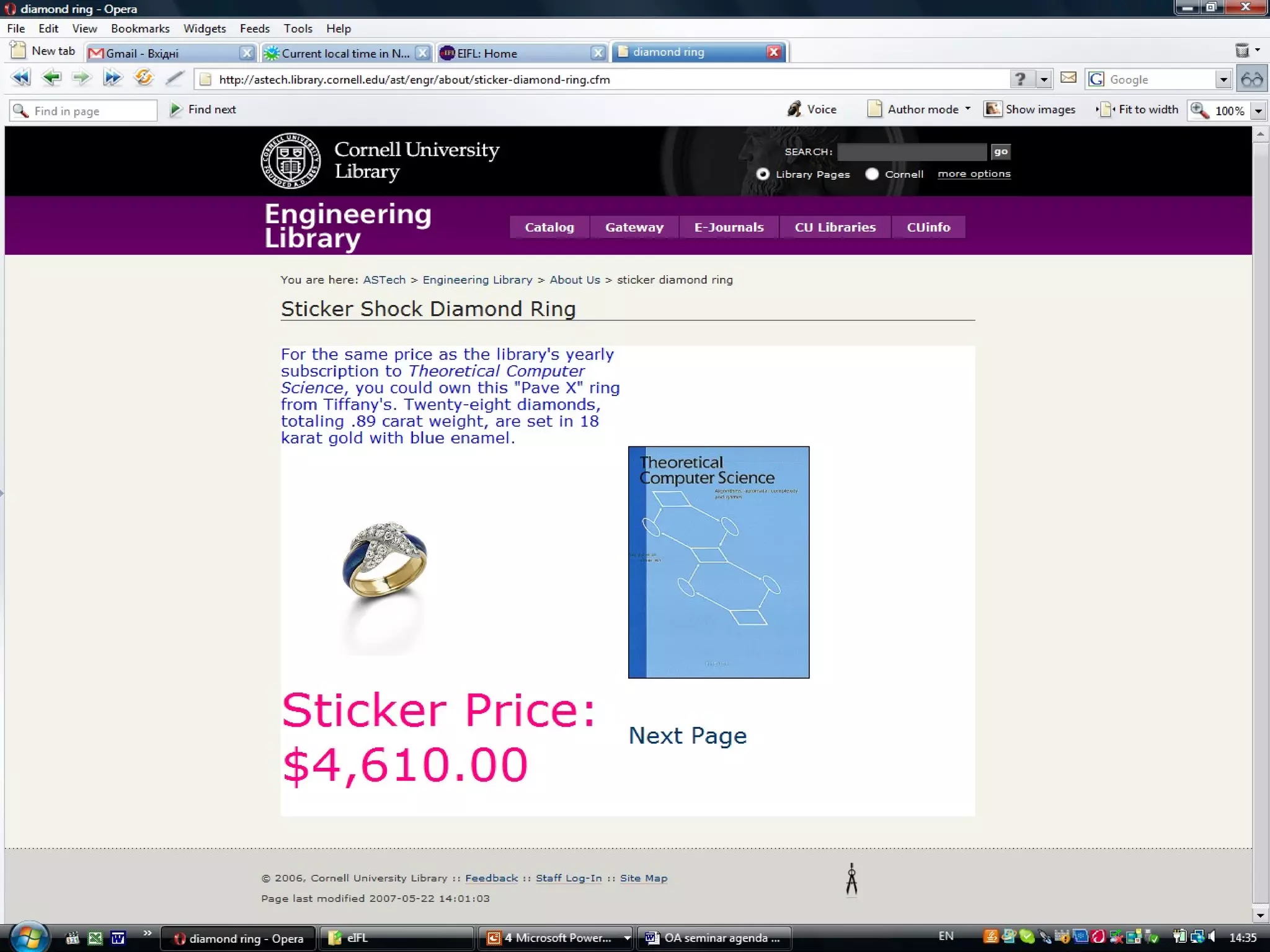
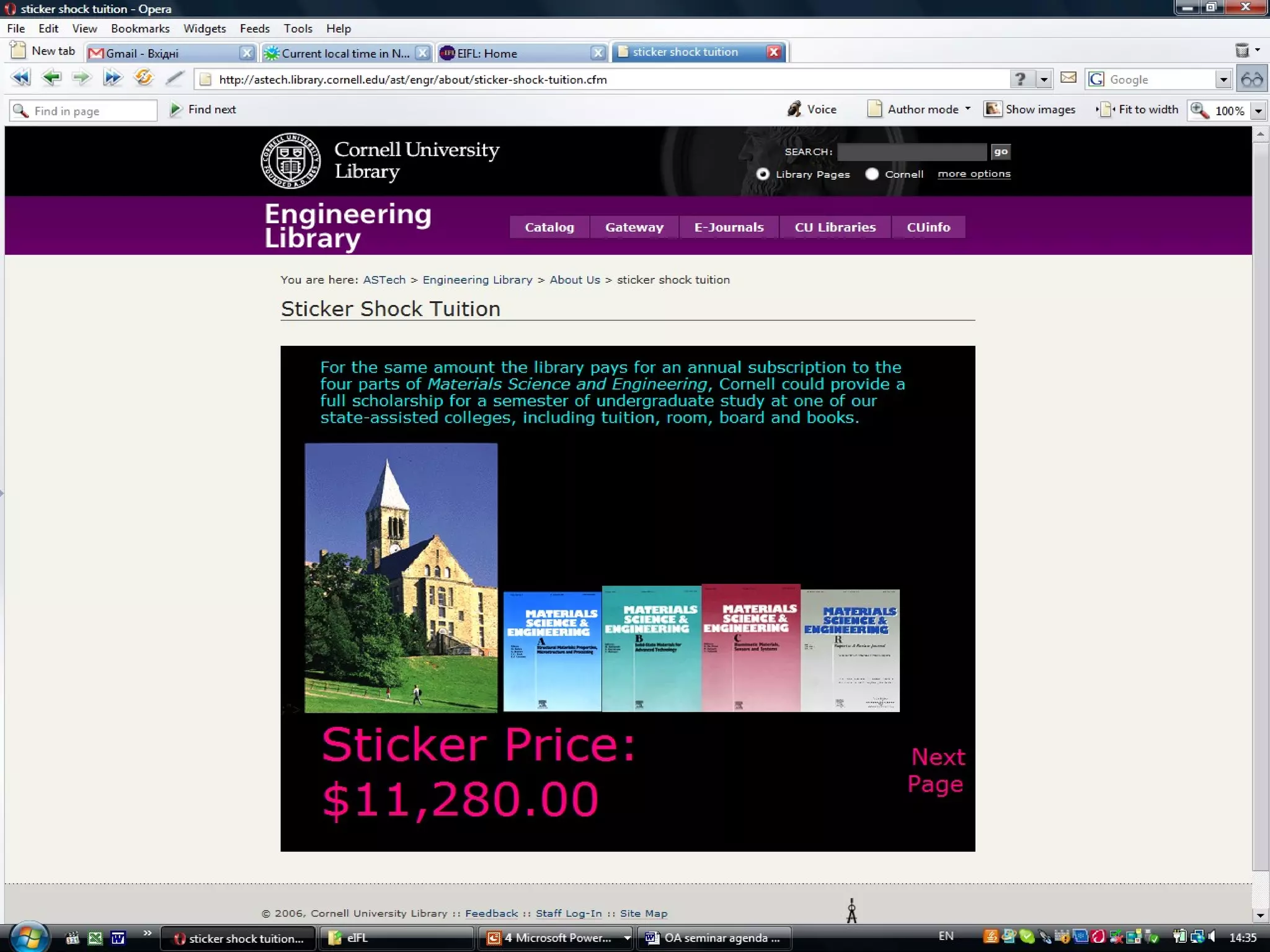
Story N2 :  Research article  - Serial crises


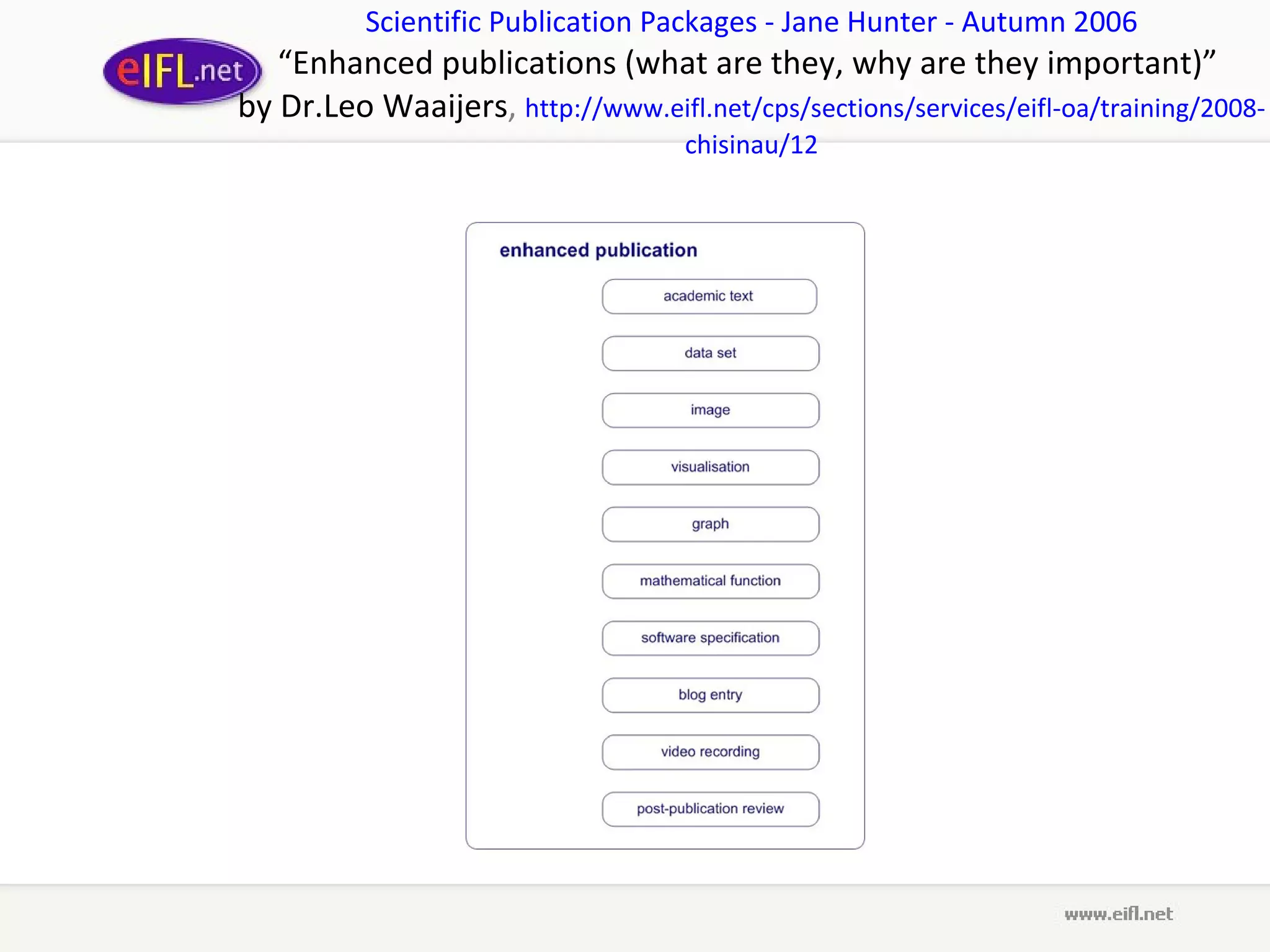
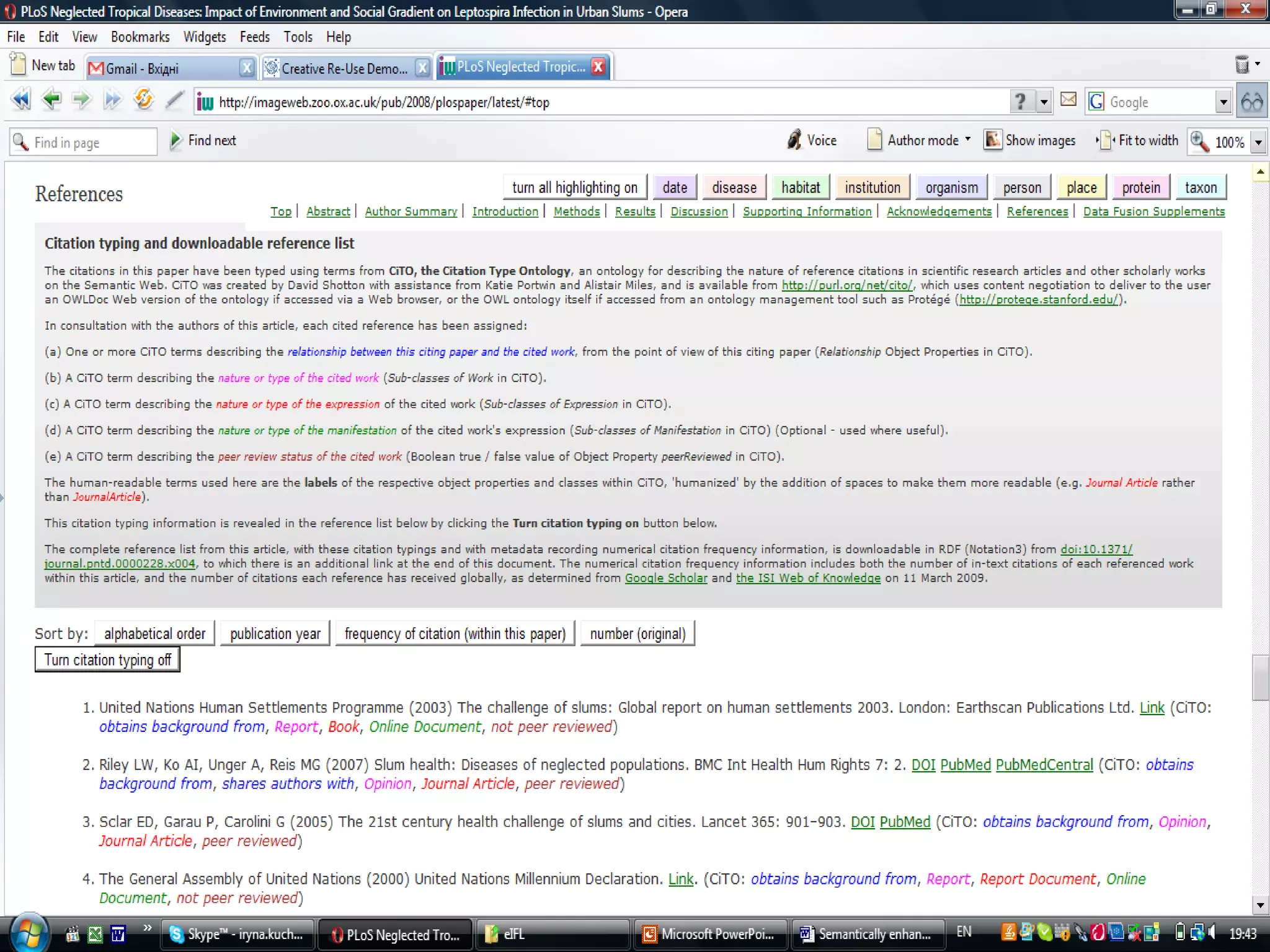
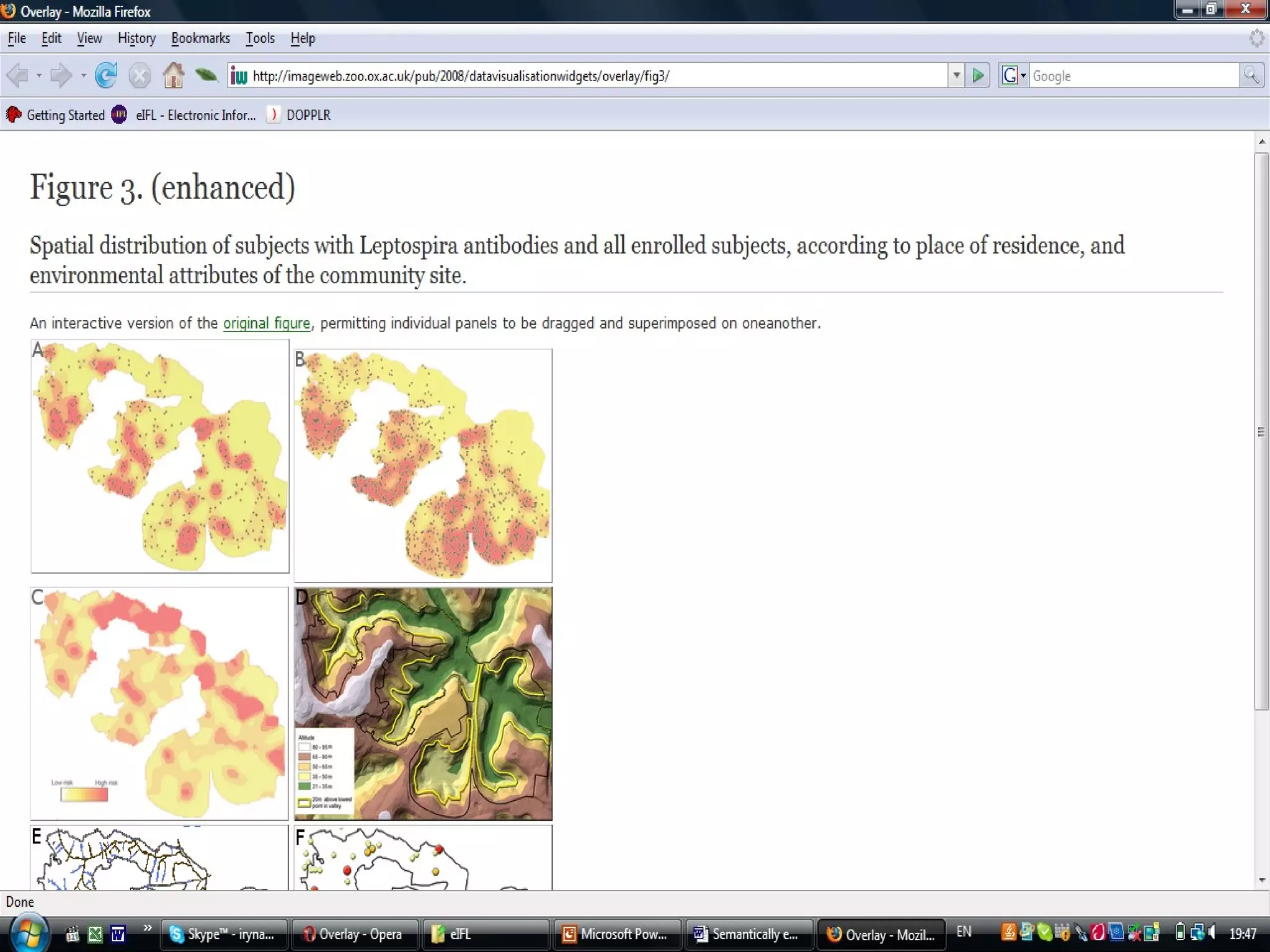
Scientific Publication Packages - Jane Hunter - Autumn 2006 “ Enhanced publications (what are they, why are they important)”  by Dr.Leo Waaijers ,   http://www. eifl .net/cps/sections/services/ eifl - oa /training/2008- chisinau /12


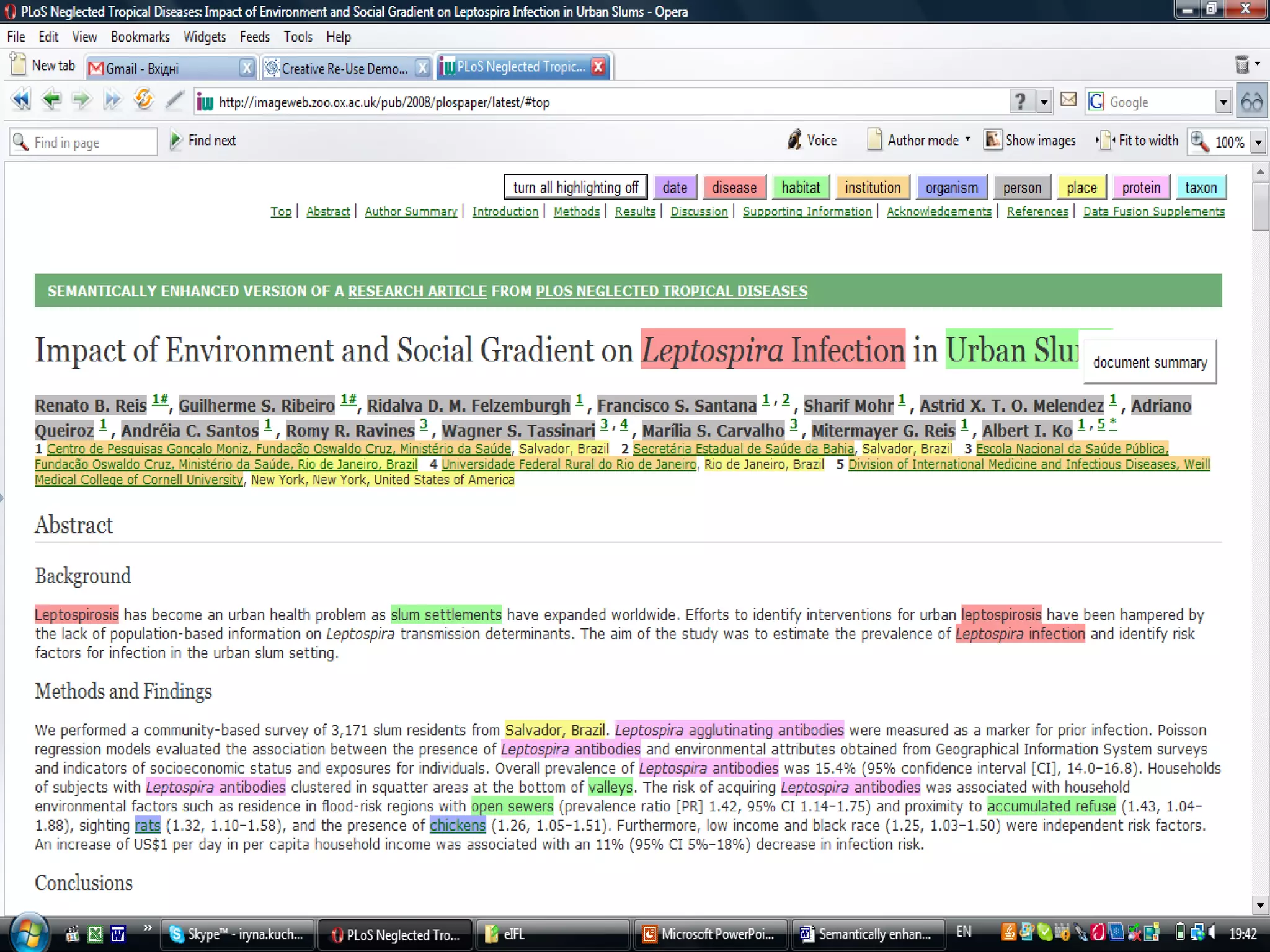
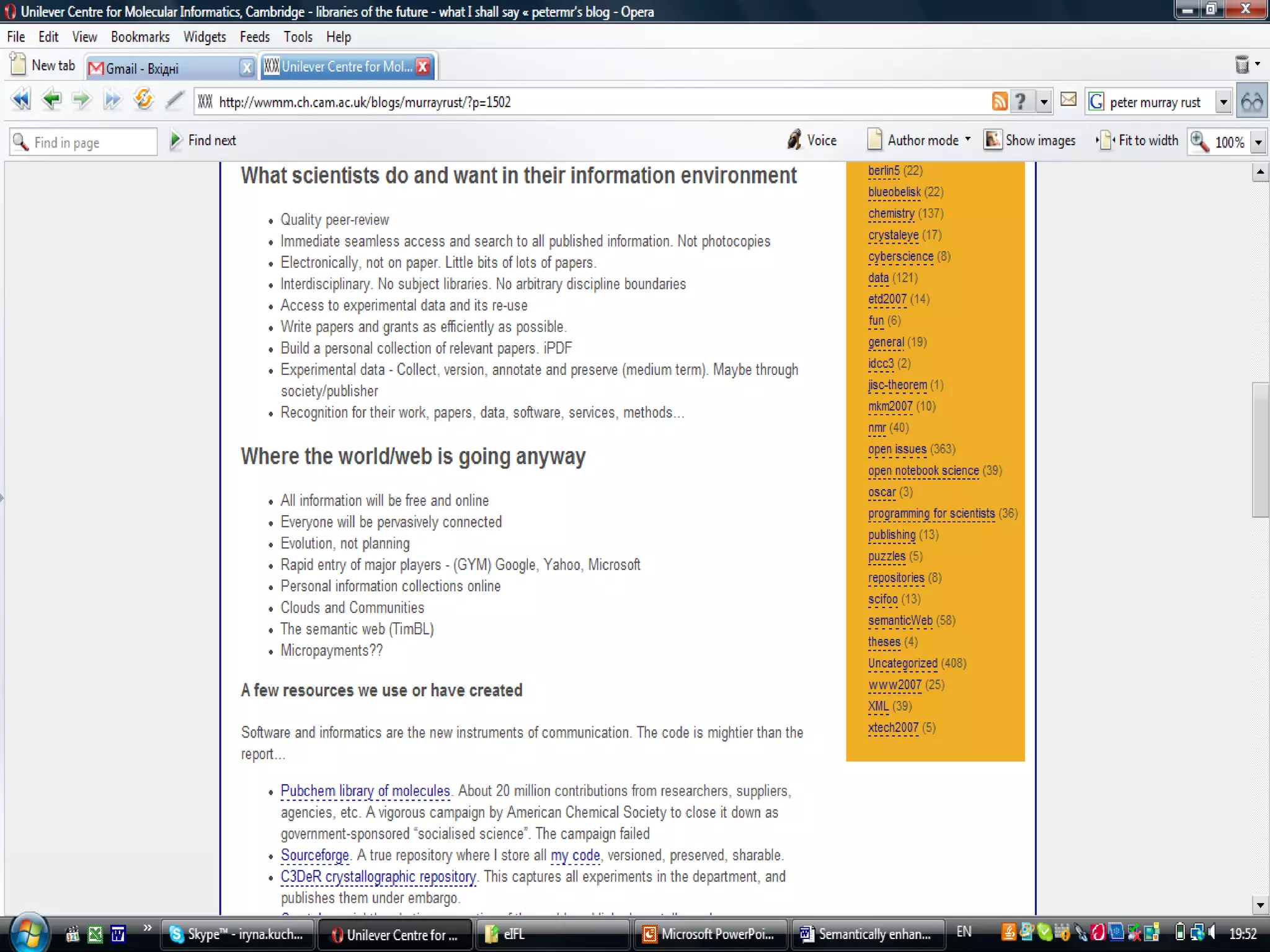
Story N3 What scientists want?  Where the world/web is going anyway? (thank you  Peter Murray-Rust !)
 
Story N4  –  Library  (thank you  Leo Waaijers!) Traditional library:  Importer Expensive Limited Students use  Google (Scholar) Library of the future:  Exporter Much cheaper Unlimited Students use  Google (Scholar)
OA is the free online availability  of peer reviewed literature  permitting any user to read ,   download,  copy,  distribute,  print,  search,  or link to the full texts of articles
OA “ It is important to stress here that  publishing is a fundamental part of the process of doing science . Moreover,  as a scientist I am not writing for money  — like my wife, who was a professional writer at one time — but I am writing for fame: I want everyone to read what I write… Everybody who writes a scientific paper is writing to be read, not to make money. For that reason we volunteer our services, and we don’t get paid.  That is what makes Open Access a powerful concept for scientists.  It means, for instance, that anyone anywhere in the world who searches for oncogenes, mouse models, or any other search term that applies to my own work, will find it, and will be able to have immediate access to it. That is the goal we are hoping to achieve.” The Basement Interviews Freeing the scientific literature Harold Varmus, Nobel laureate, former director of the US National Institutes of Health, and co-founder of open access publisher Public Library of Science, talks to Richard Poynder.  Published on June 5th 2006  http:// poynder . blogspot .com/2006/06/interview-with- harold - varmus .html
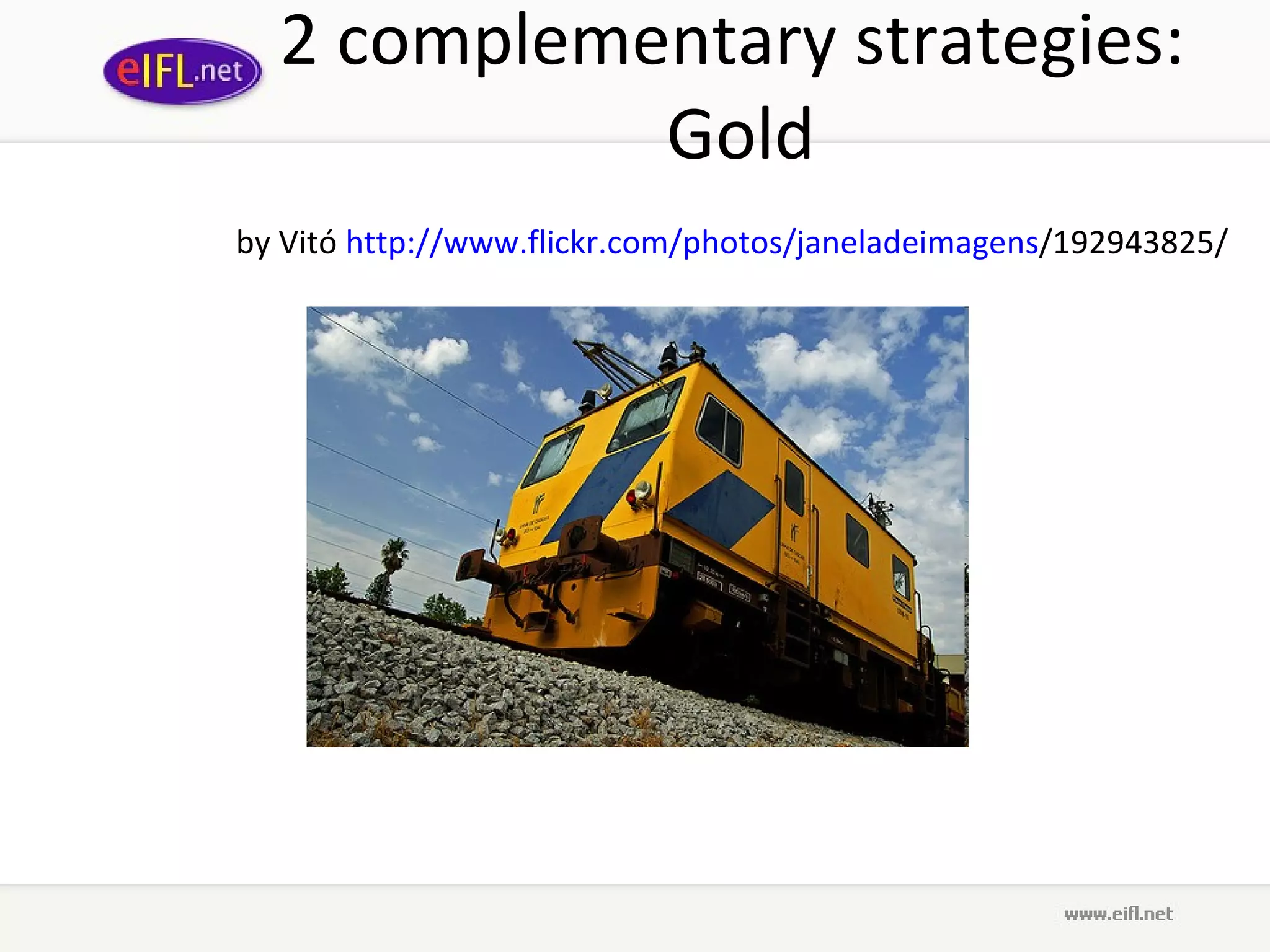
2  complementary strategies:  Gold by Vitó   http :// www . flickr . com / photos / janeladeimagens /192943825/
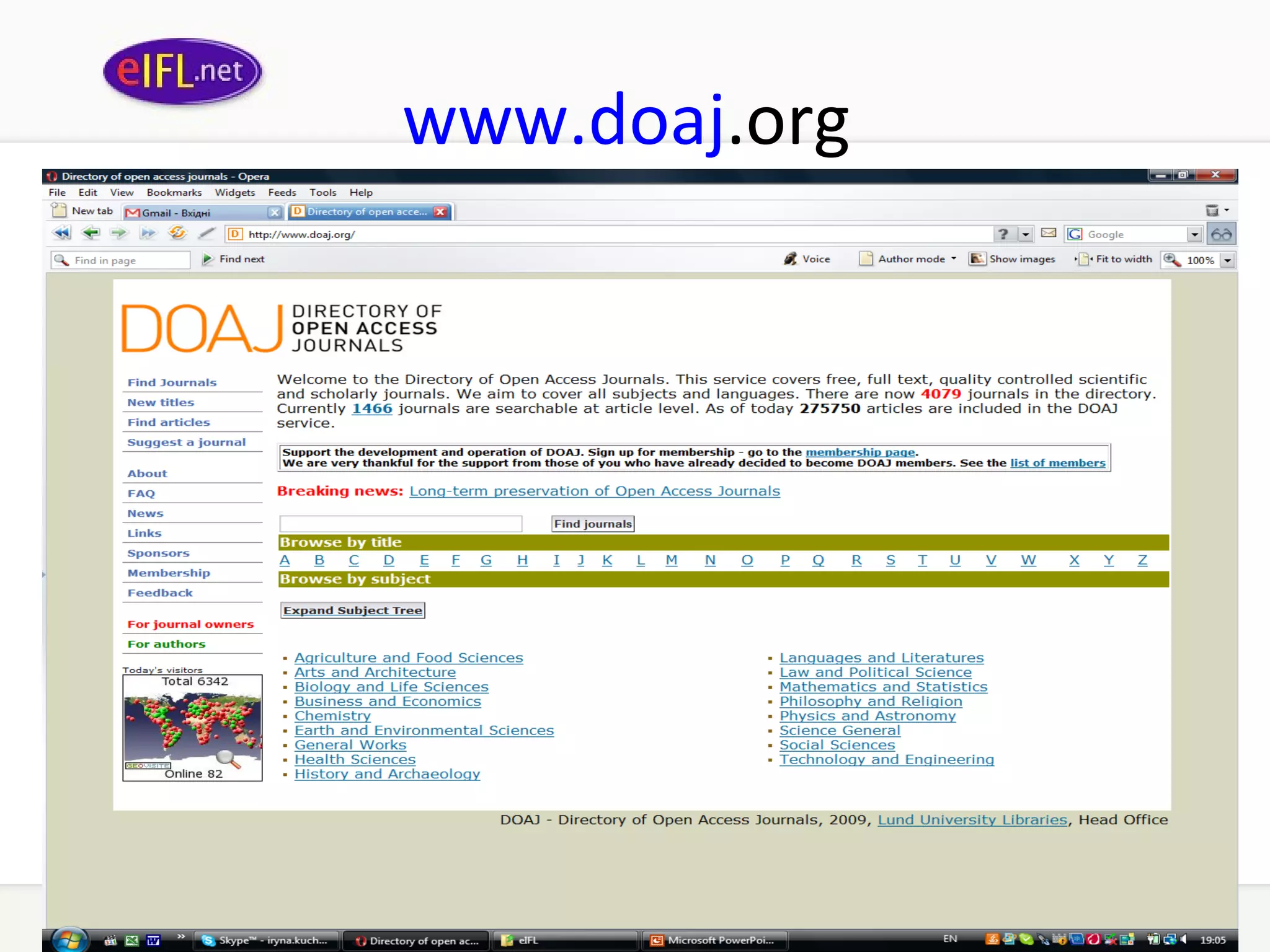
www. doaj .org
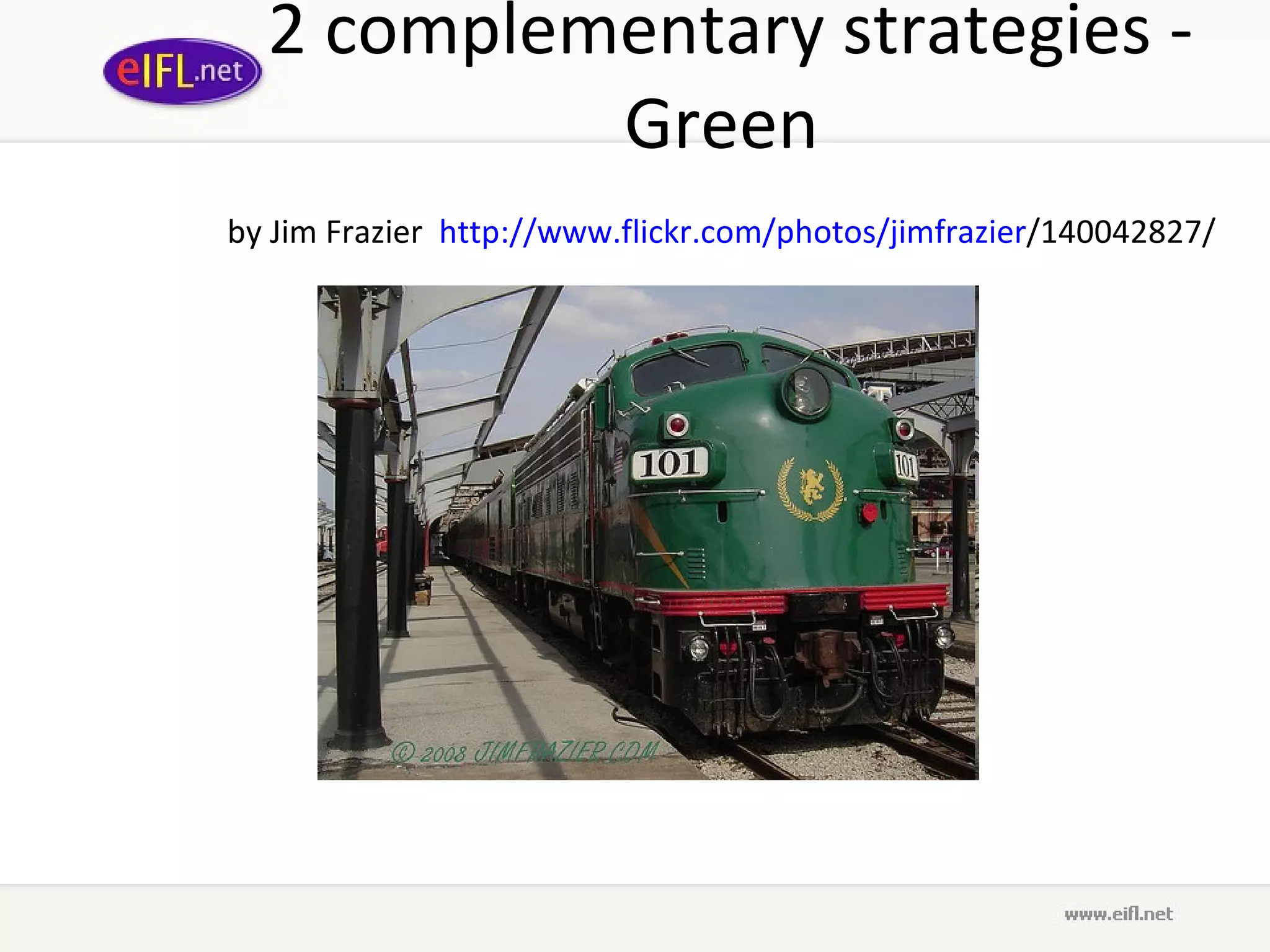
2  complementary strategies - Green   by Jim Frazier   http :// www . flickr . com / photos / jimfrazier /140042827/
Open repositories A digital repository is defined as  containing research output,  institutional or thematic and OAI compliant ( http://www. openarchives .org/OAI/ openarchivesprotocol .html )  (From The European Repository Landscape Inventory Study into the Present Type and Level of OAI-Compliant Digital Repository Activities in the EU by Maurits van der Graaf and Kwame van Eijndhoven
Content Peer-reviewed articles Conference presentations Books Course packs Annotated images Audio and video clips Research data
Content Gray literature : Preprints  /  working materials  / theses and dissertations /  reports  /  conference materials   /  bulletins   /  grant applications   /  reports to the donors   /  memorandums   /  statistical reports   /  technical documentation   /  questionnaires…
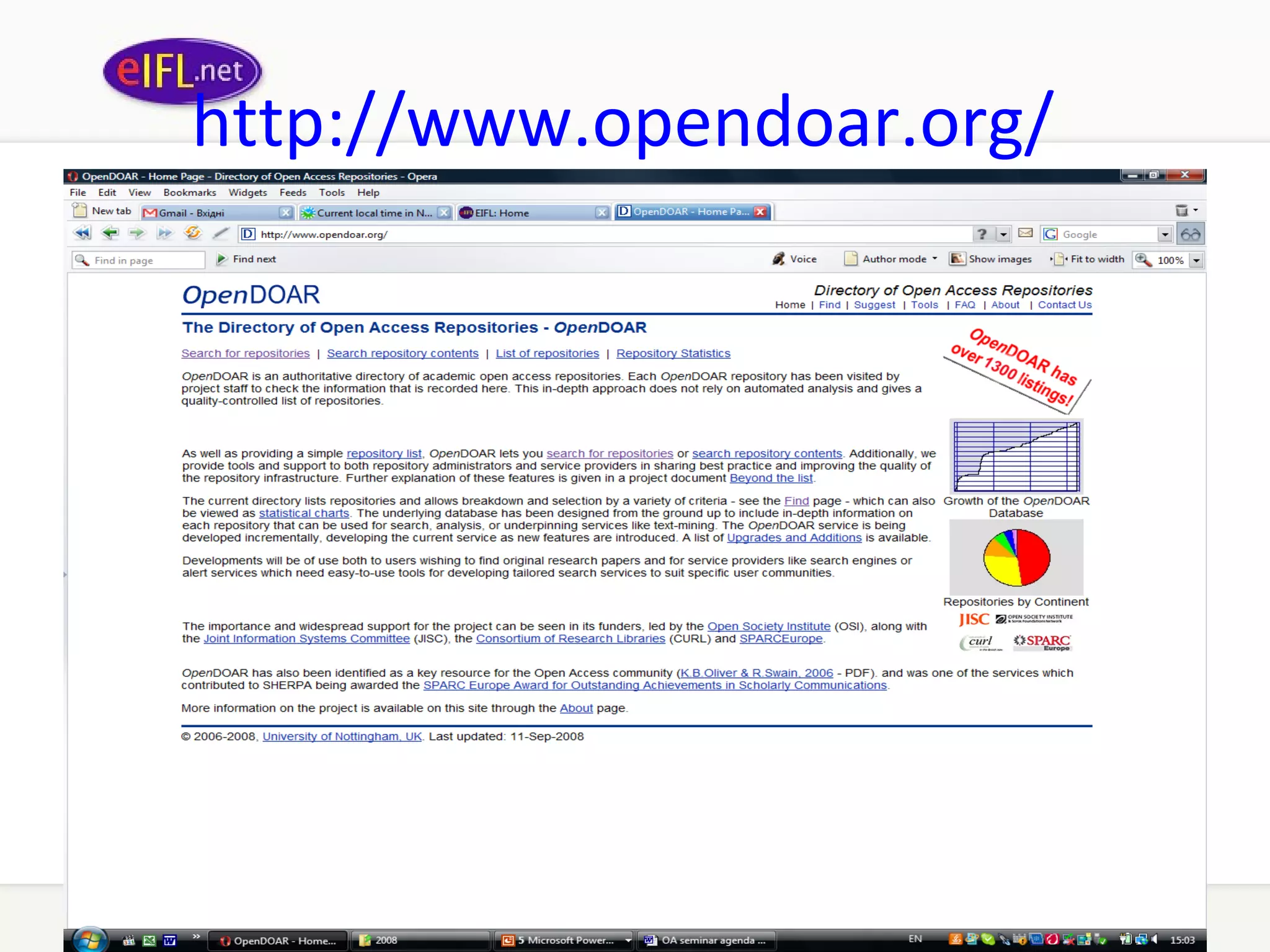
http :// www . opendoar . org /
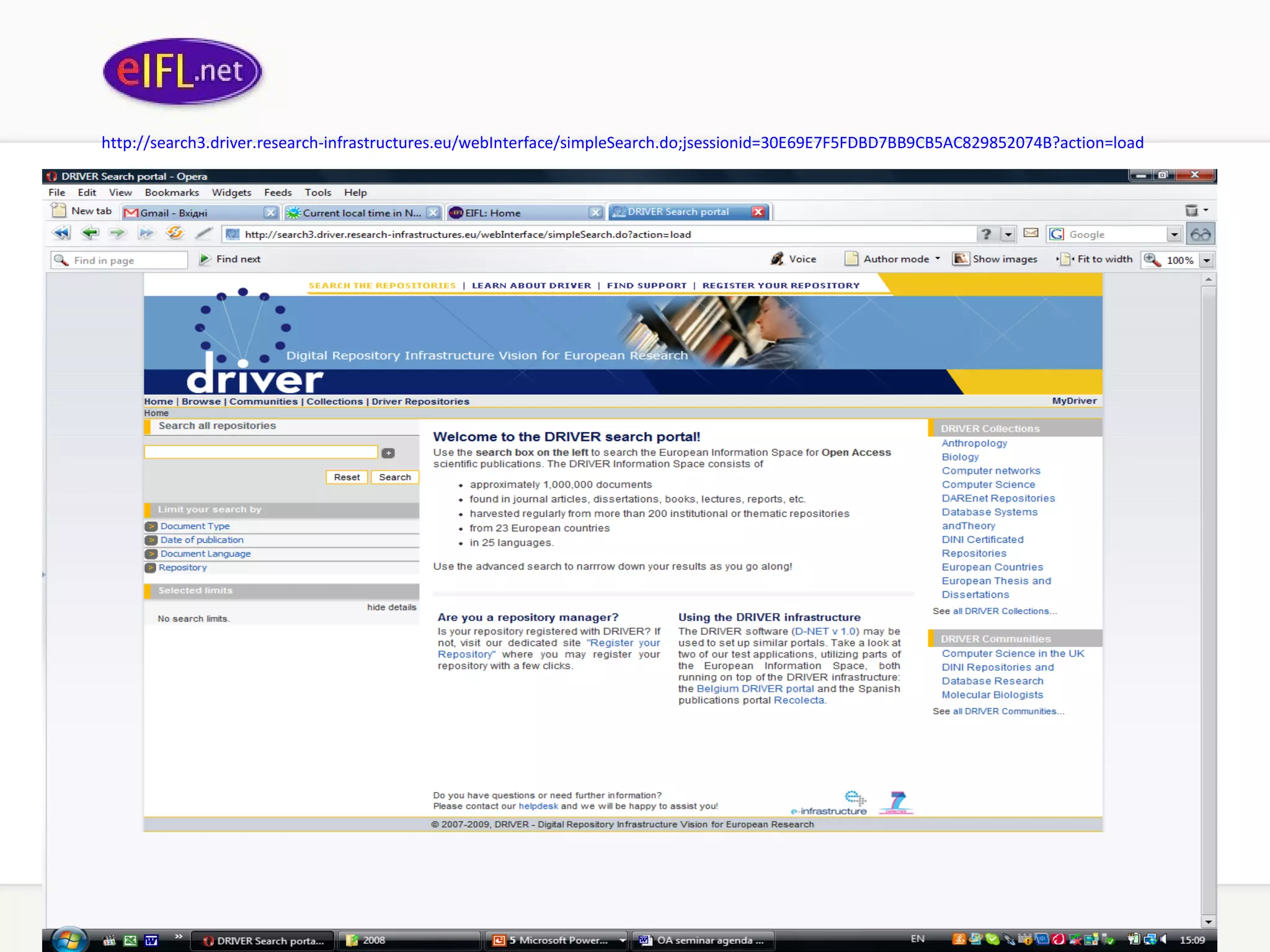
http ://search3. driver .research- infrastructures . eu / webInterface / simpleSearch . do ; jsessionid =30E69E7F5FDBD7BB9CB5AC829852074B? action = load
 
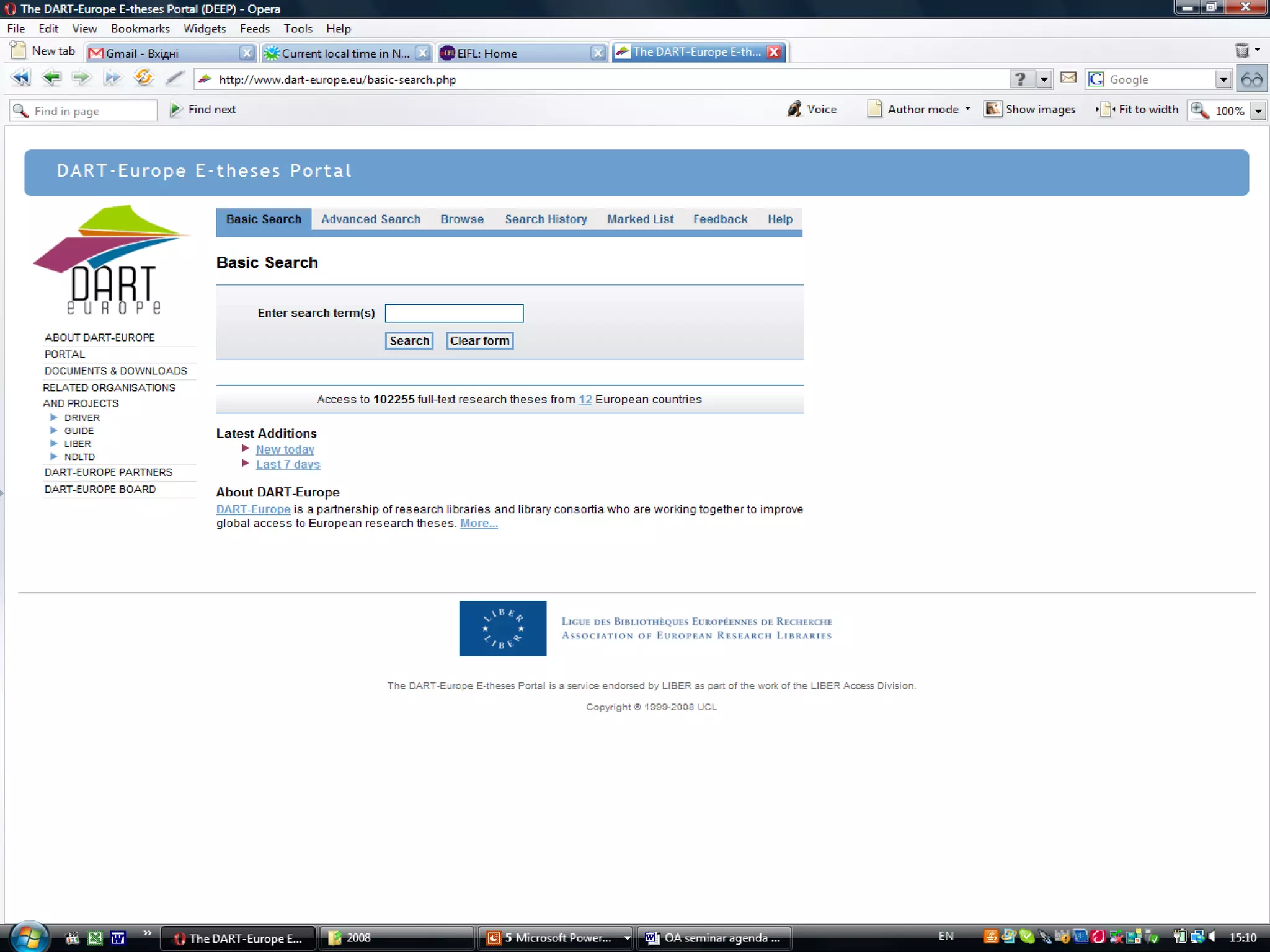
Theses and dissertations John Hagen, West Virginia University :  Moving from print to electronic  –  usage growth  145%  The most popular theses and dissertations were downloaded  37,501 times (history ) and 33,752 times (engineering); history one was published and was a long seller 69% of students from the creative writing   department had more successful careers if they went OA with their dissertations – a good marketing tool for them
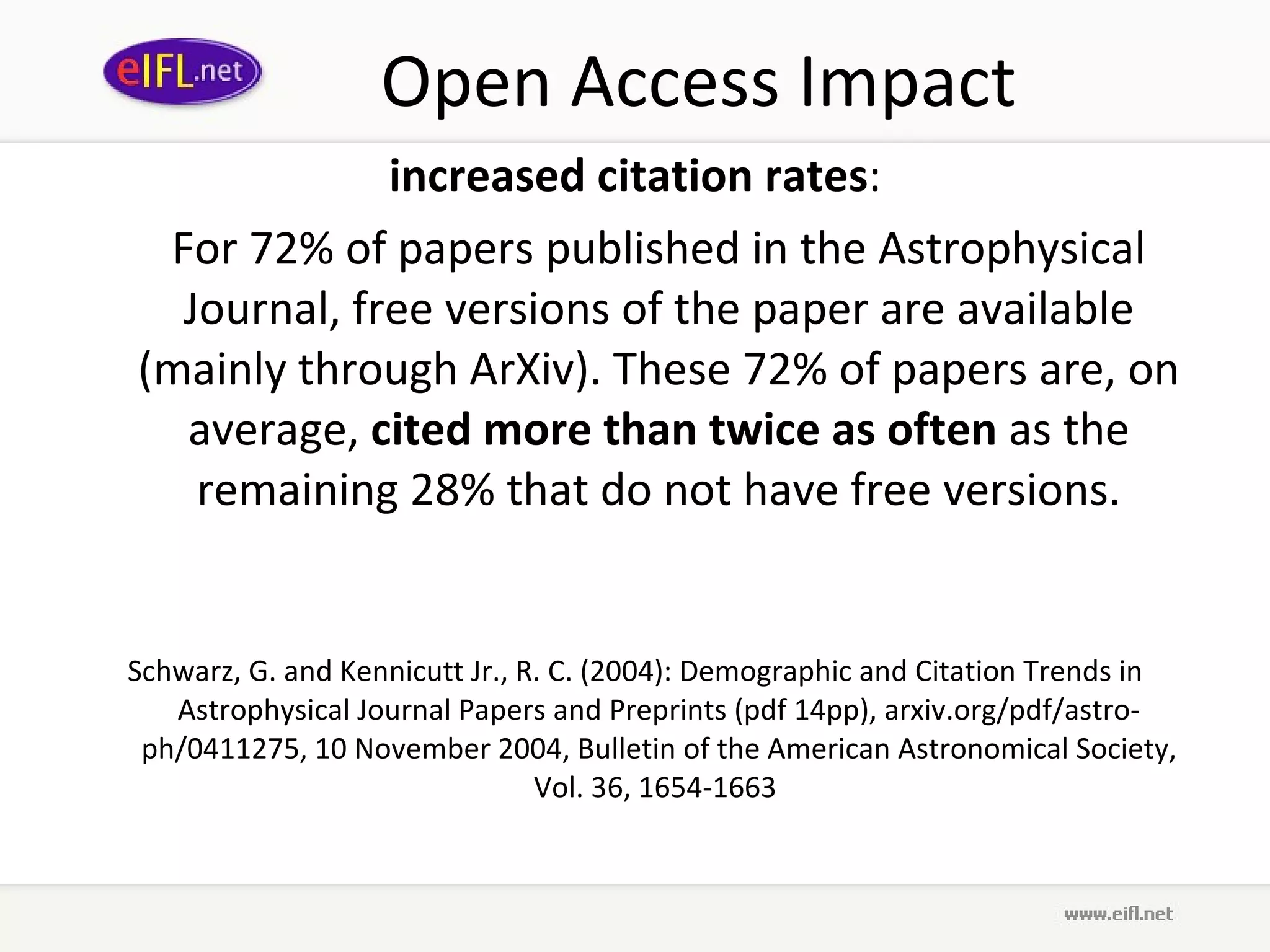
Open Access Impact increased citation rates : For 72% of papers published in the Astrophysical Journal, free versions of the paper are available (mainly through ArXiv). These 72% of papers are, on average,  cited more than twice as often  as the remaining 28% that do not have free versions. Schwarz, G. and Kennicutt Jr., R. C. (2004): Demographic and Citation Trends in Astrophysical Journal Papers and Preprints (pdf 14pp), arxiv.org/pdf/astro-ph/0411275, 10 November 2004, Bulletin of the American Astronomical Society, Vol. 36, 1654-1663
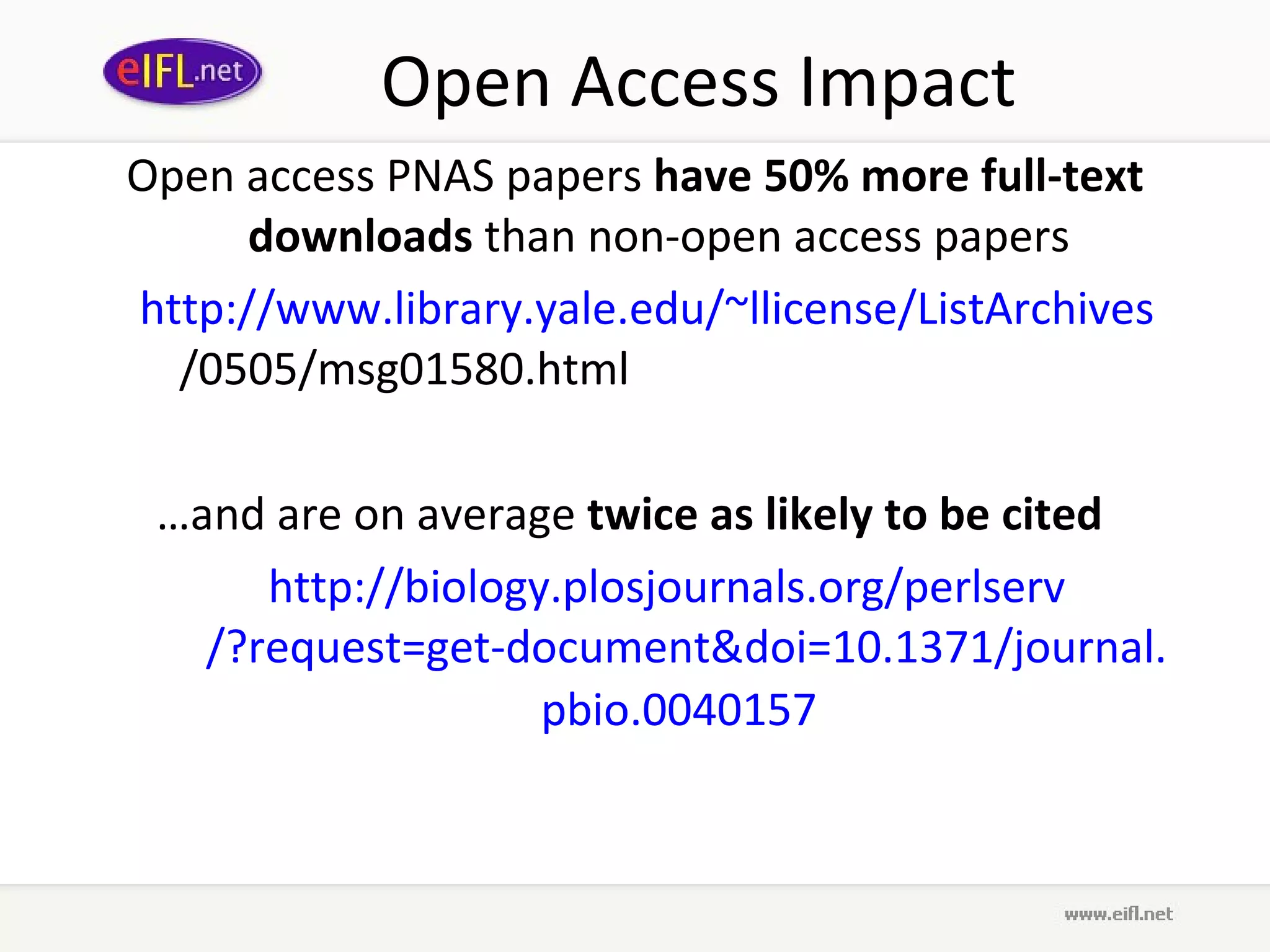
Open Access Impact Open access PNAS papers  have 50% more full-text downloads  than non-open access papers http://www.library. yale . edu /~ llicense / ListArchives /0505/msg01580.html   … and are on average  twice as likely to be cited   http://biology. plosjournals .org/ perlserv /?request=get-document& doi =10.1371/journal. pbio .0040157
 
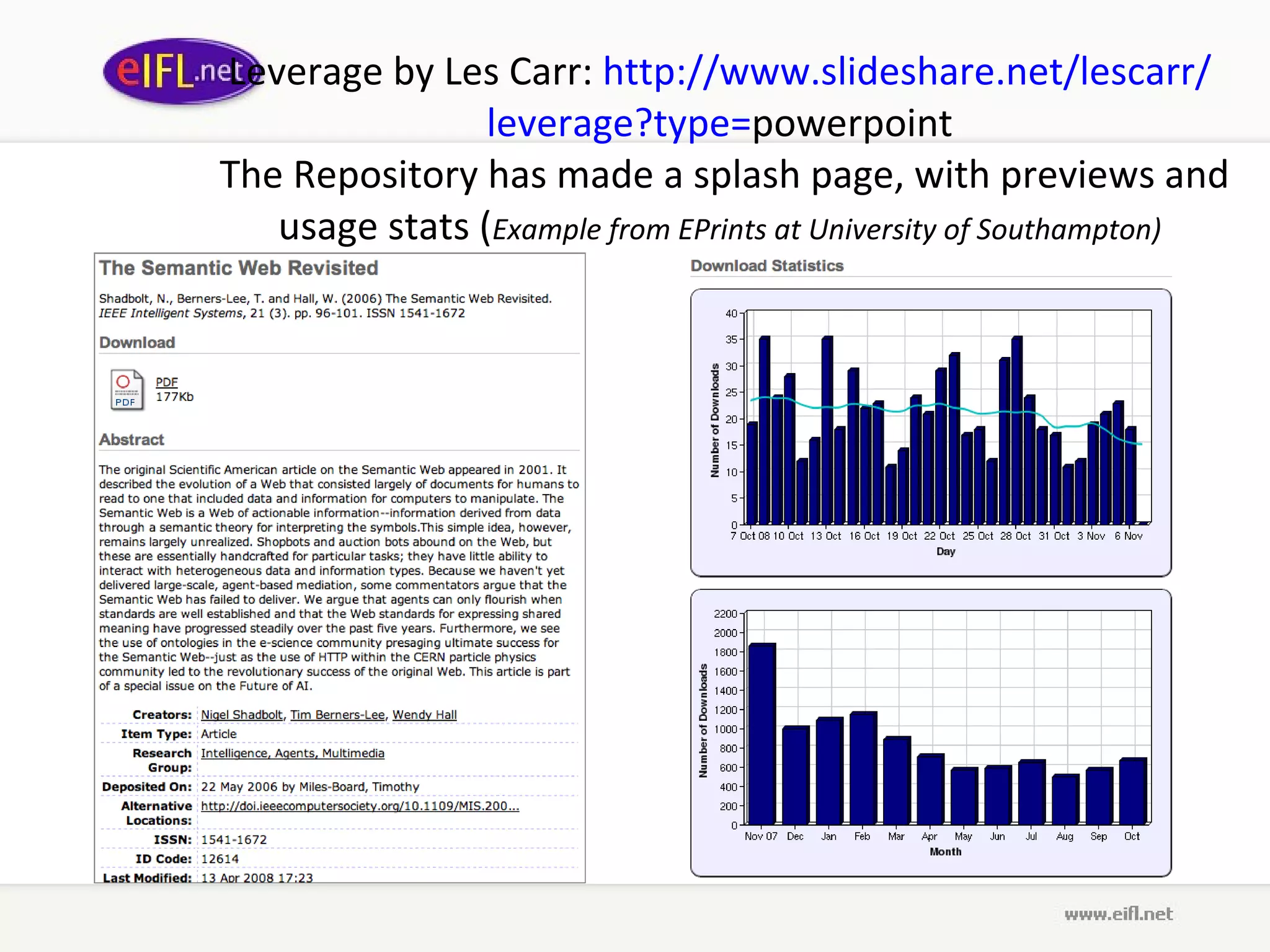
Leverage  by L es  C arr :  http :// www . slideshare . net / lescarr / leverage ? type = powerpoint  The Repository has made a splash page, with previews and usage stats ( Example from EPrints at University of Southampton)
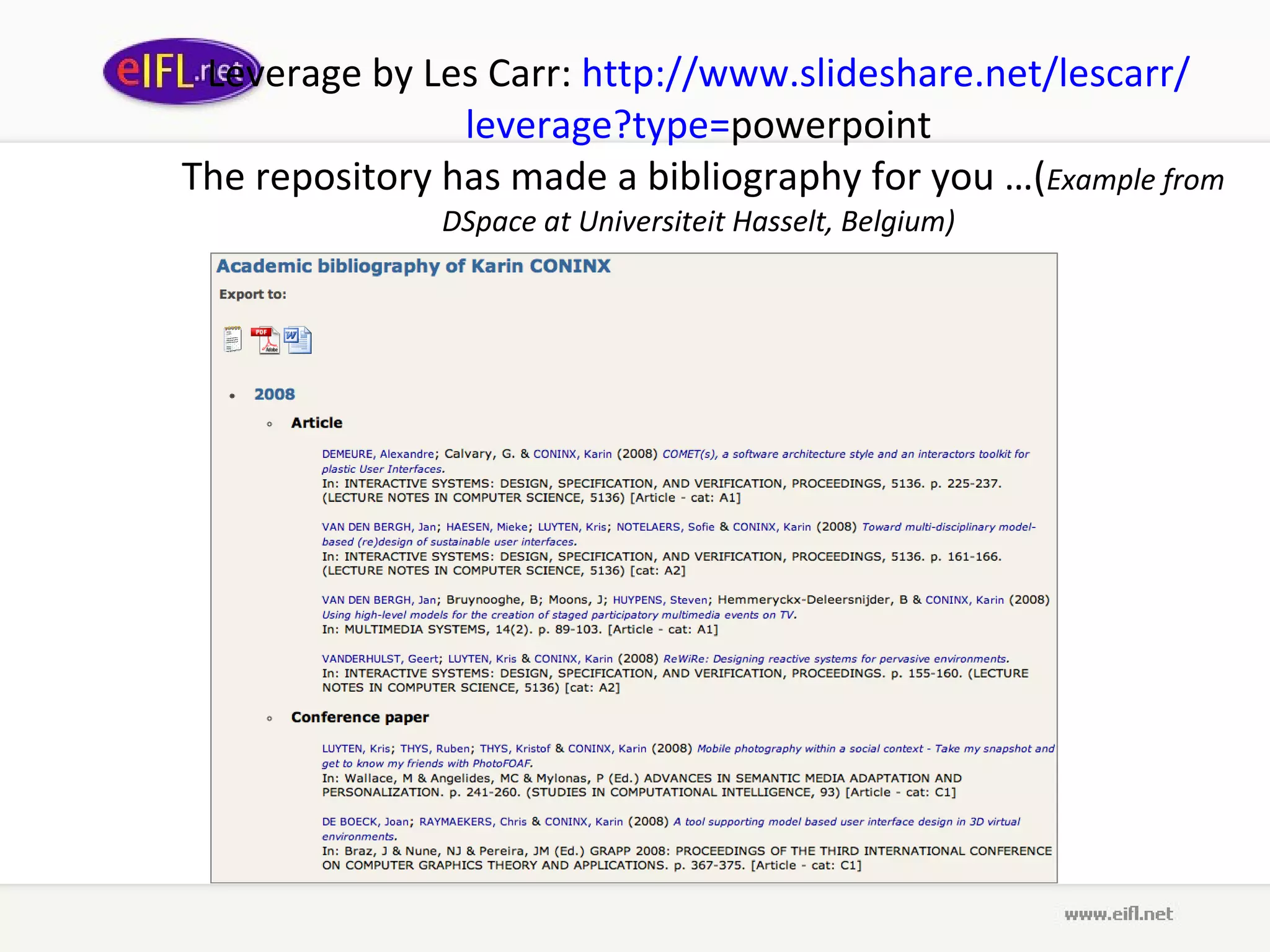
Leverage  by L es  C arr :  http :// www . slideshare . net / lescarr / leverage ? type = powerpoint  The repository has made a bibliography for you …( Example from DSpace at Universiteit Hasselt, Belgium)
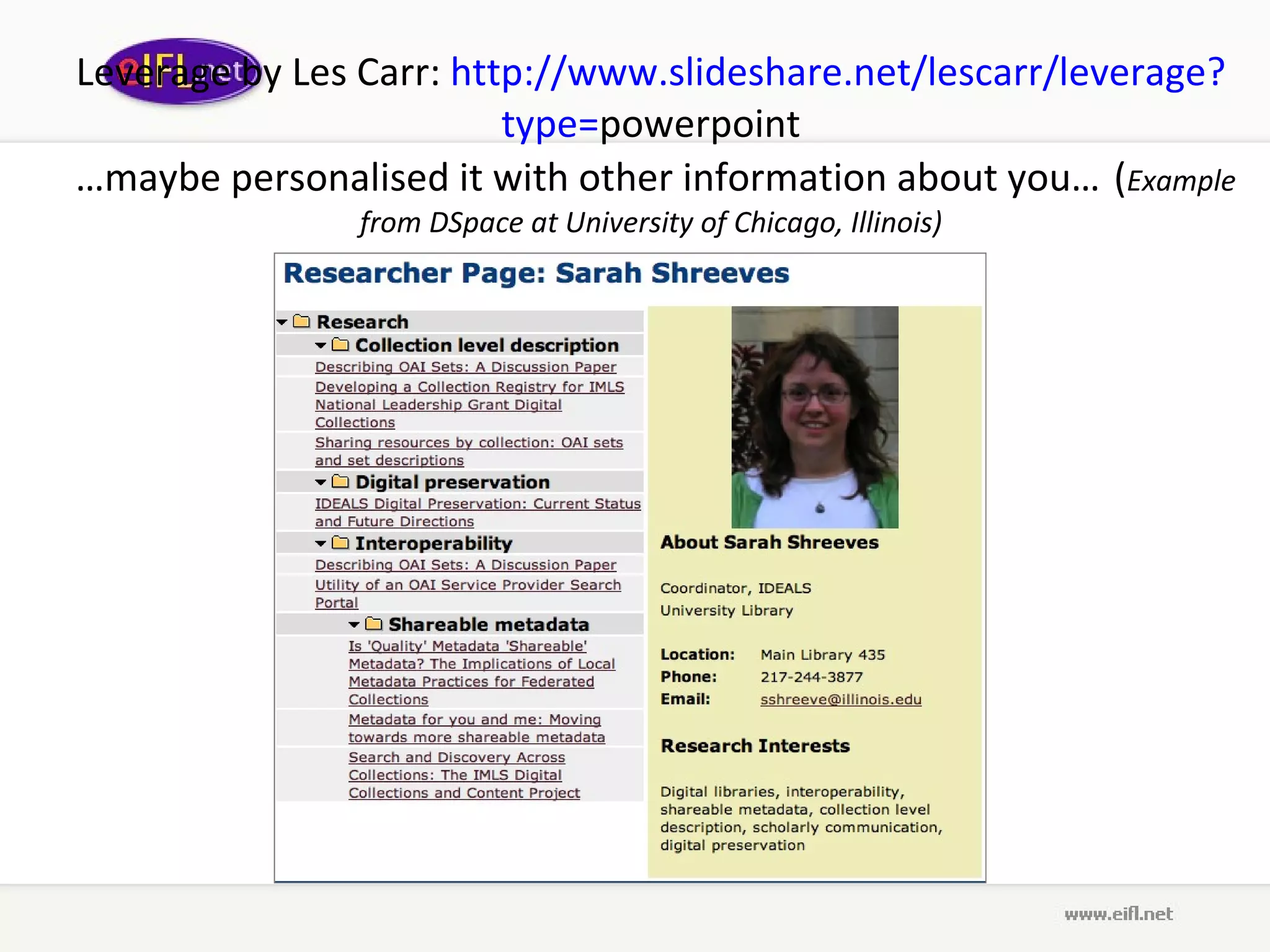
Leverage  by L es  C arr :  http :// www . slideshare . net / lescarr / leverage ? type = powerpoint  …maybe personalised it with other information about you…   ( Example from DSpace at University of Chicago, Illinois)
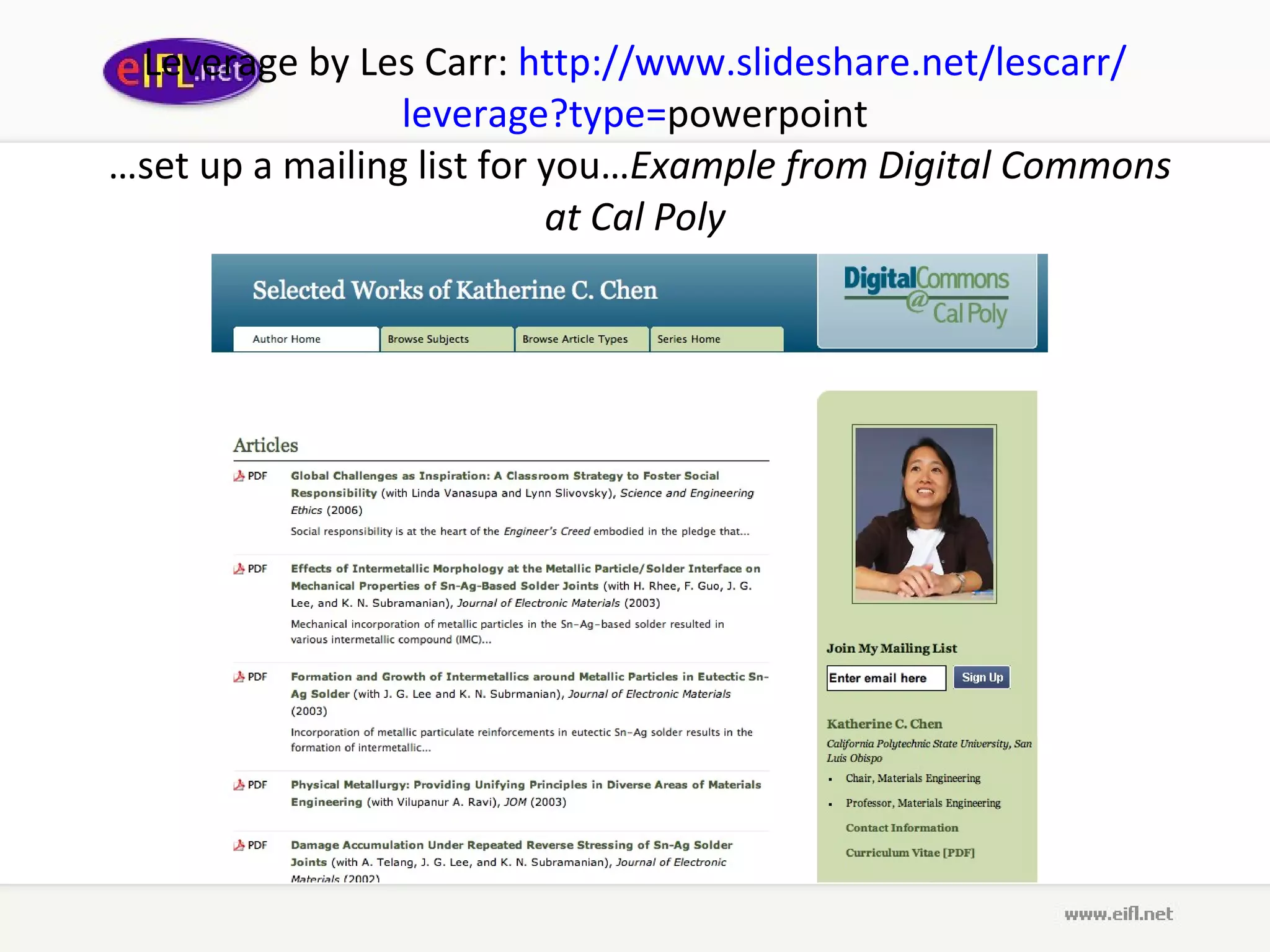
Leverage  by L es  C arr :  http :// www . slideshare . net / lescarr / leverage ? type = powerpoint  …set up a mailing list for you… Example from Digital Commons at Cal Poly
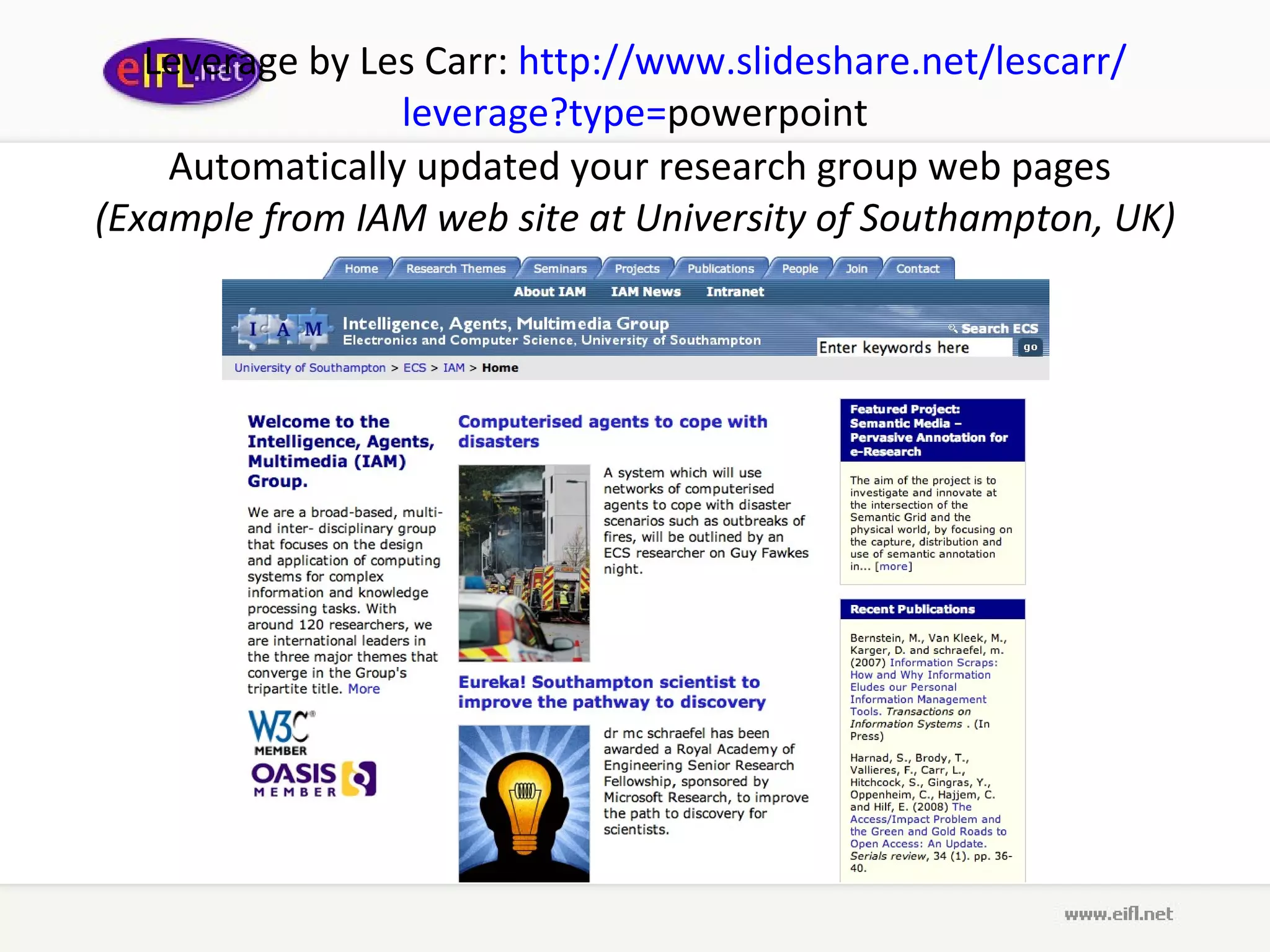
Leverage  by L es  C arr :  http :// www . slideshare . net / lescarr / leverage ? type = powerpoint  Automatically updated your research group web pages   (Example from IAM web site at University of Southampton, UK)
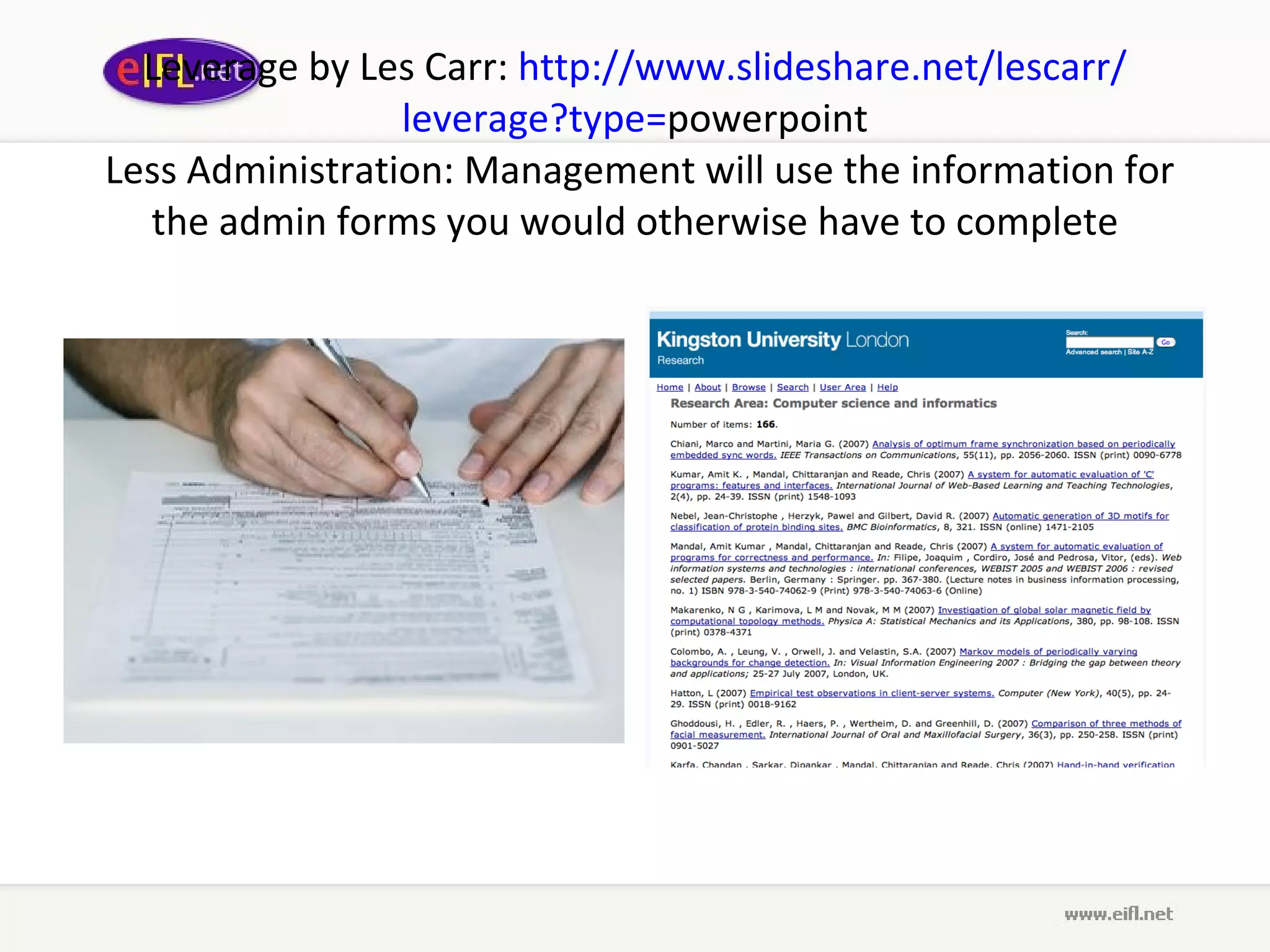
Leverage  by L es  C arr :  http :// www . slideshare . net / lescarr / leverage ? type = powerpoint  Less Administration: Management will use the information for the admin forms you would otherwise have to complete
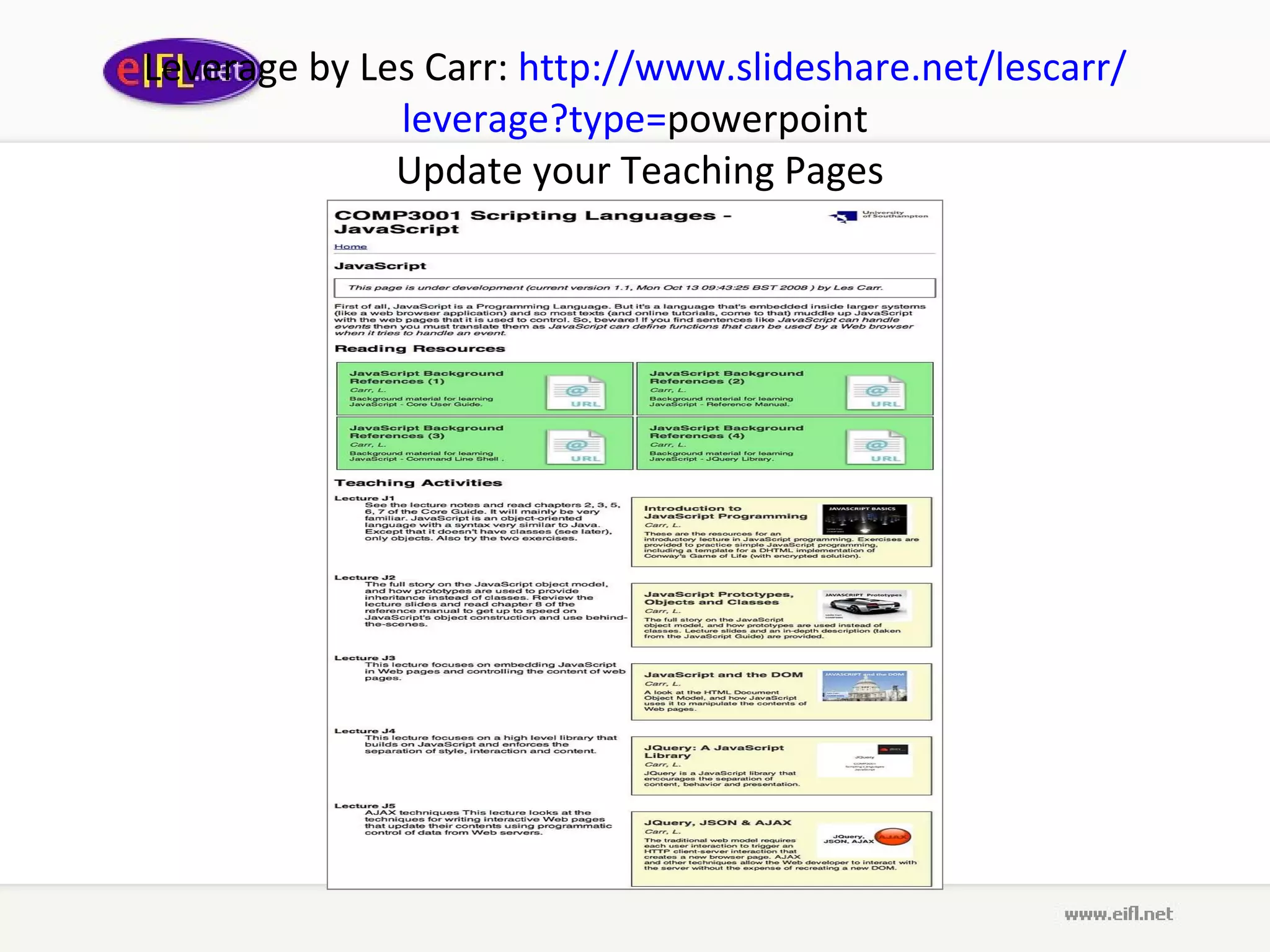
Leverage  by L es  C arr :  http :// www . slideshare . net / lescarr / leverage ? type = powerpoint  Update your Teaching Pages
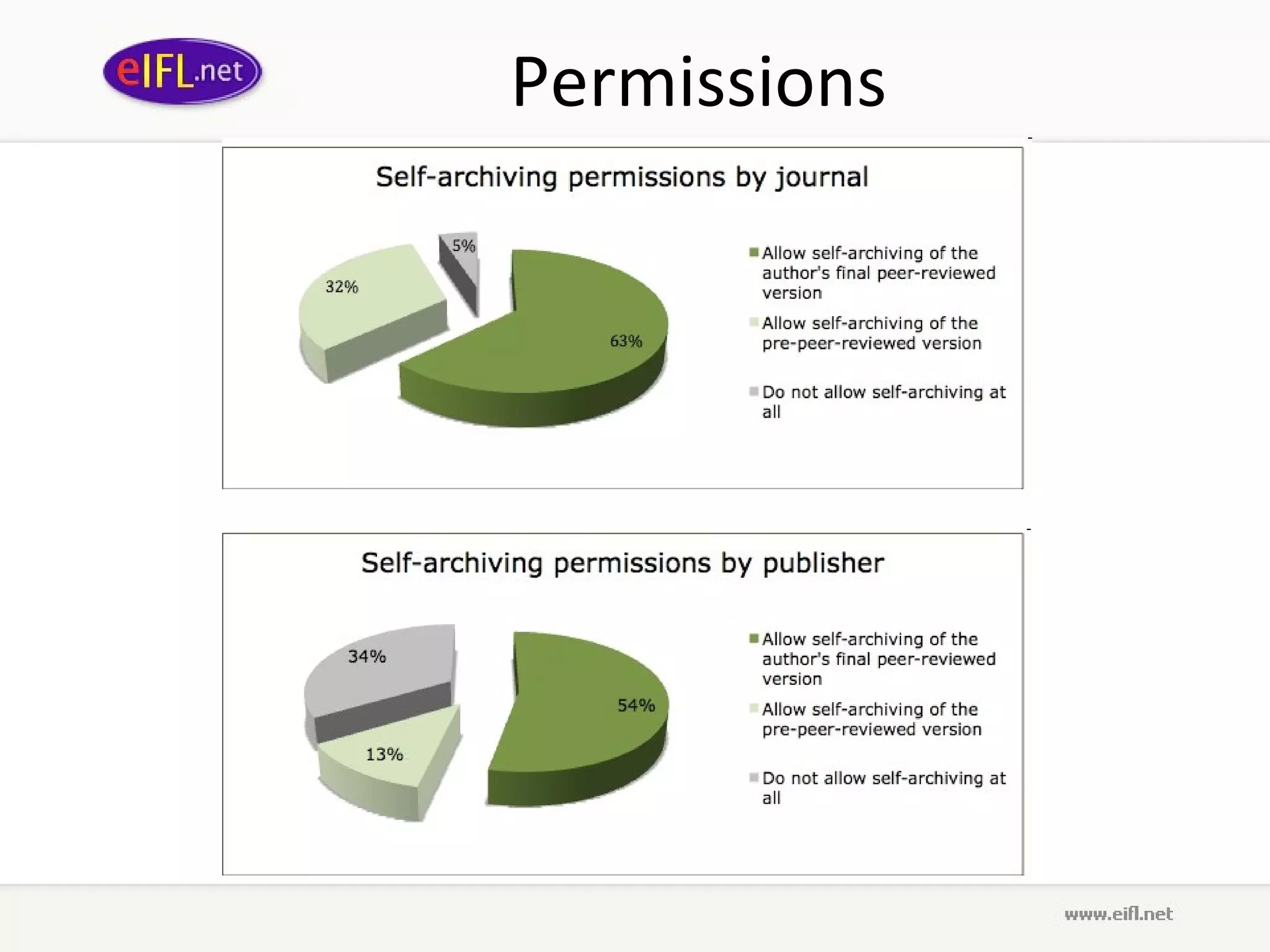
Permissions
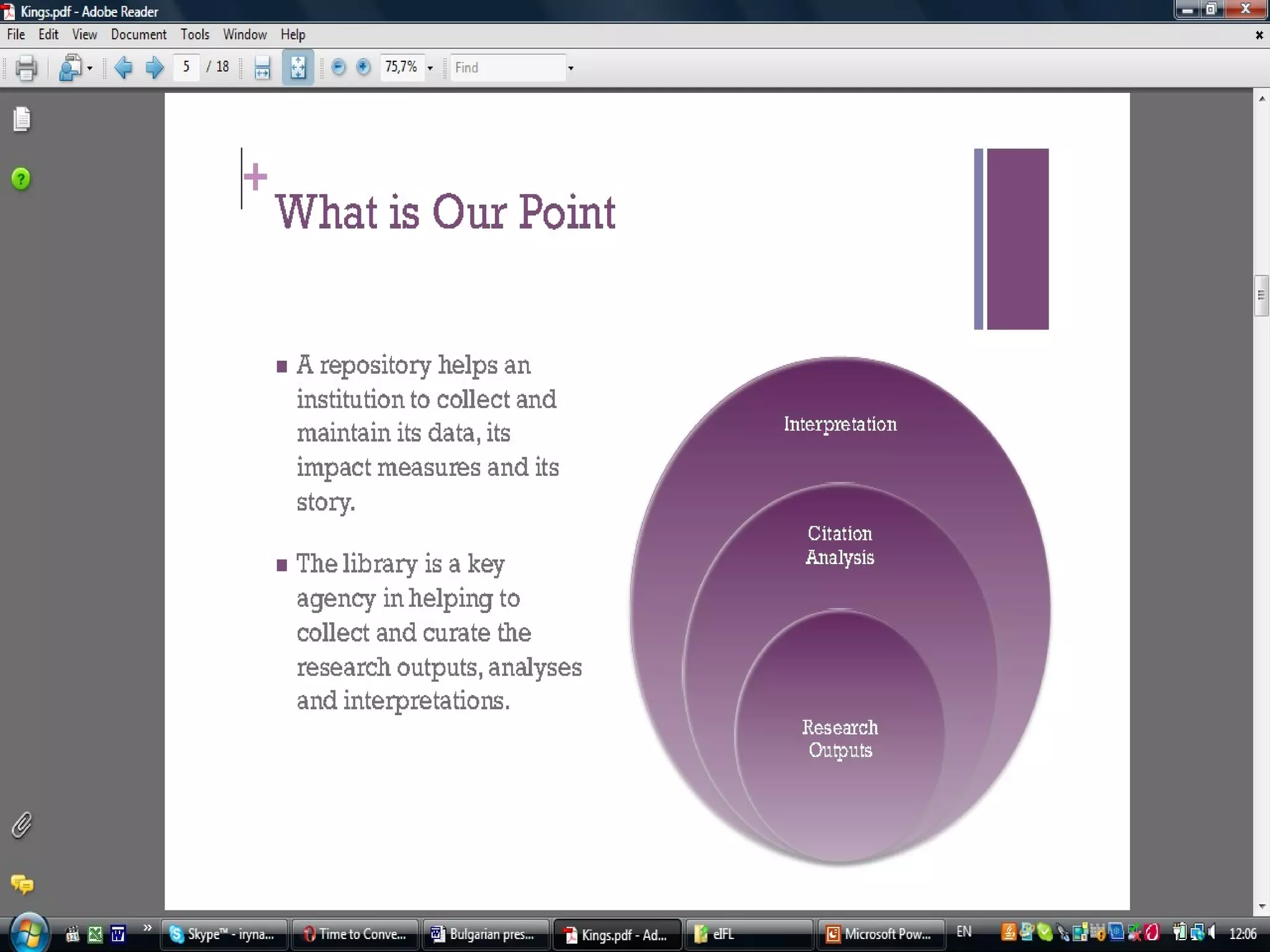
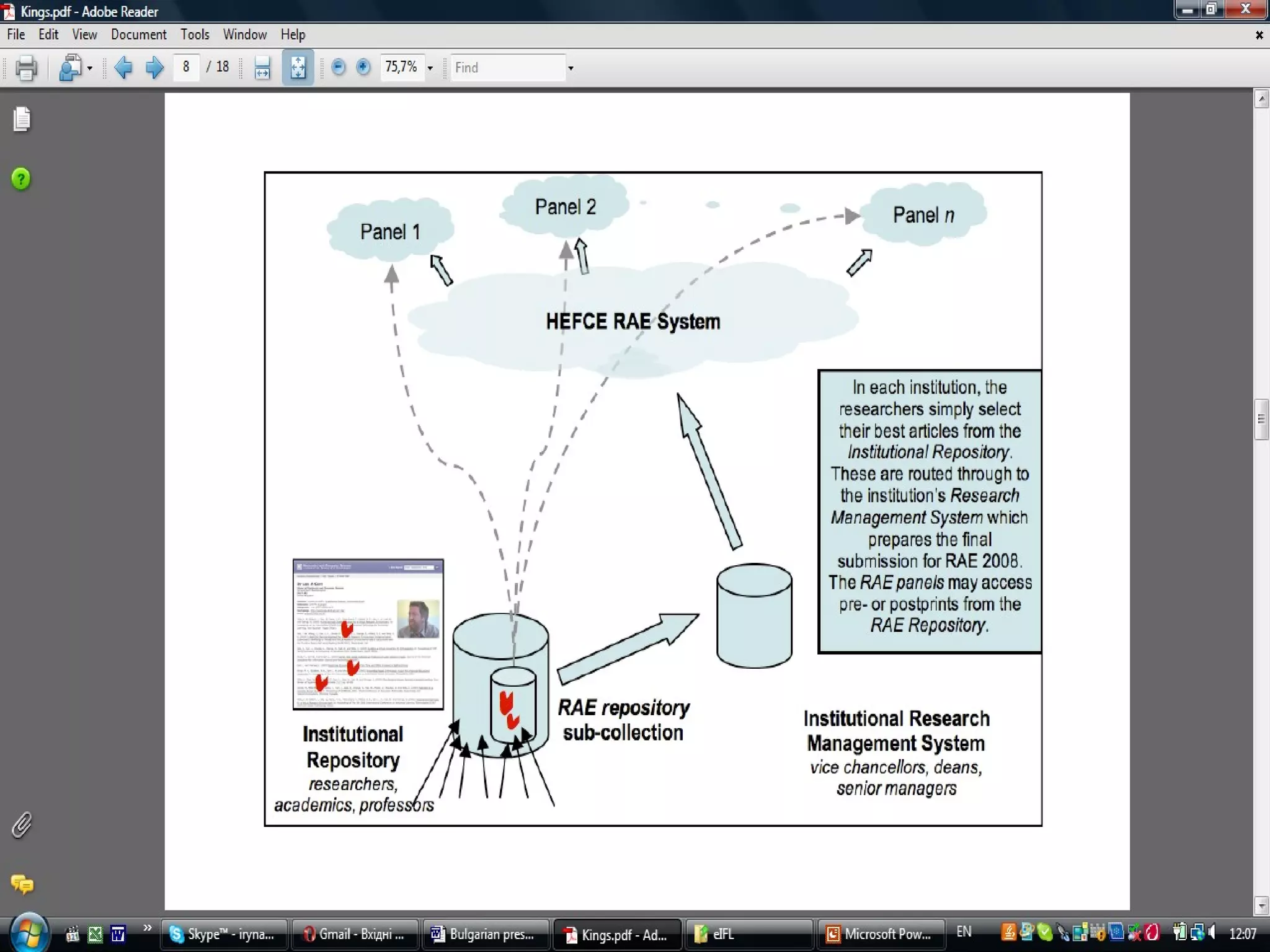
Why open repositories?  Academic and research institutions – and research funders –  find open repositories valuable  in  generating management information   and reports  on their research programmes, enabling  better research assessment ,  and in  raising awareness  of their  research profile and transparency
Why open repositories?  Opening up the outputs of the institution to the world  Maximizing the visibility and impact of these outputs  Showcasing the quality of the research in the institution
Why open repositories?  Collecting and curating the digital outputs of the institution  Managing and measuring research and teaching activities  Providing a workspace for work-in-progress and for collaborative and large-scale projects
Why open repositories?  Enabling and encouraging interdisciplinary approaches to research  Facilitating the development and sharing of digital teaching materials and aids  Supporting student endeavours, providing access to theses and dissertations and a location for the development of e-portfolios
Why open repositories?  Institutional and national level research assessment and research management, bringing together research expertise across the institution and country  Information rich collaboration, effective decision-making and successful research activity Improved governmental policy and public health care outcomes
Institutional Advantages from Open Access:   http :// www . openoasis . org / index . php ? option = com _ content & view = article & id =142& Itemid =337
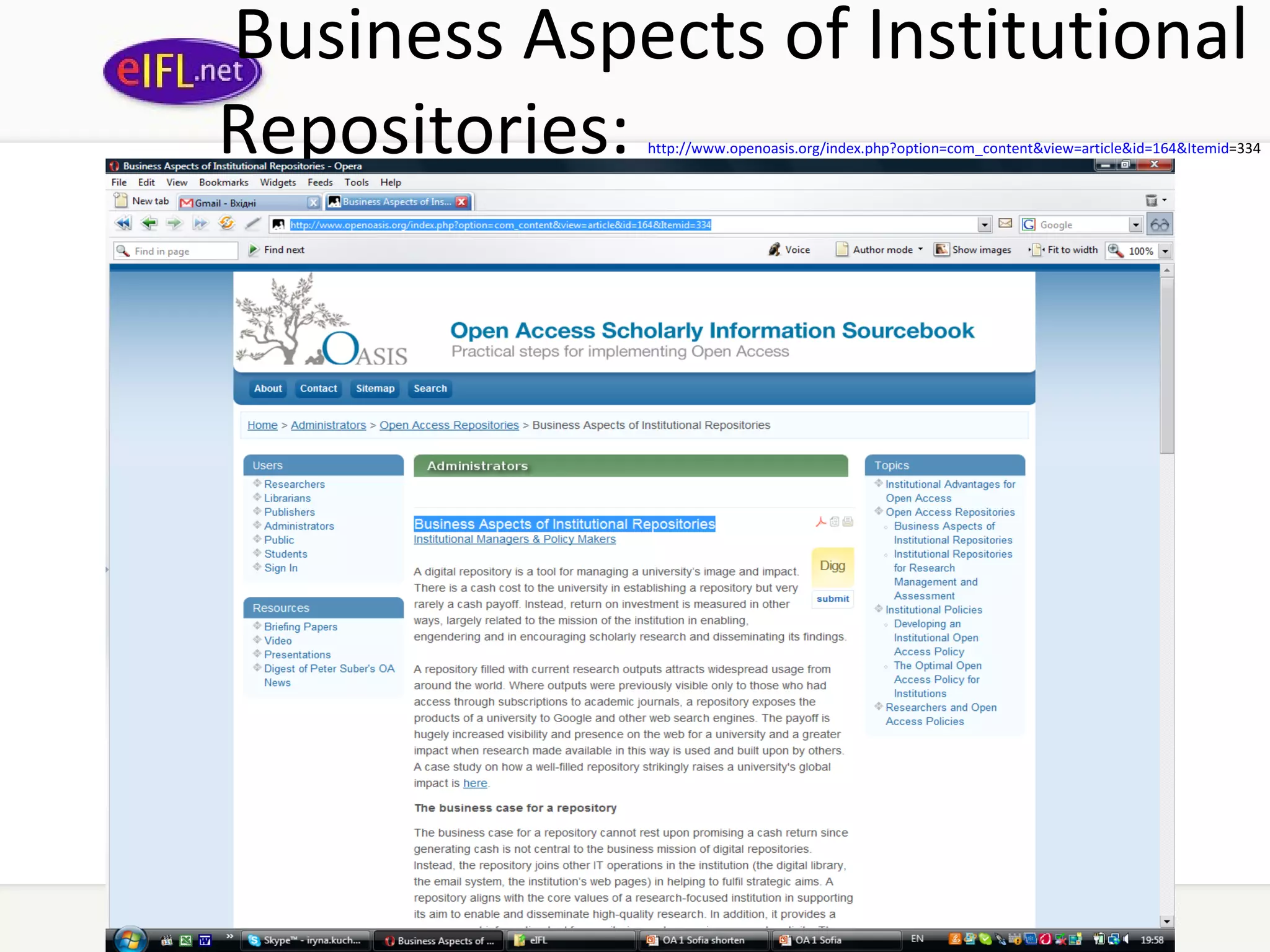
Business Aspects of Institutional Repositories :   http :// www . openoasis . org / index . php ? option = com _ content & view = article & id =164& Itemid =334
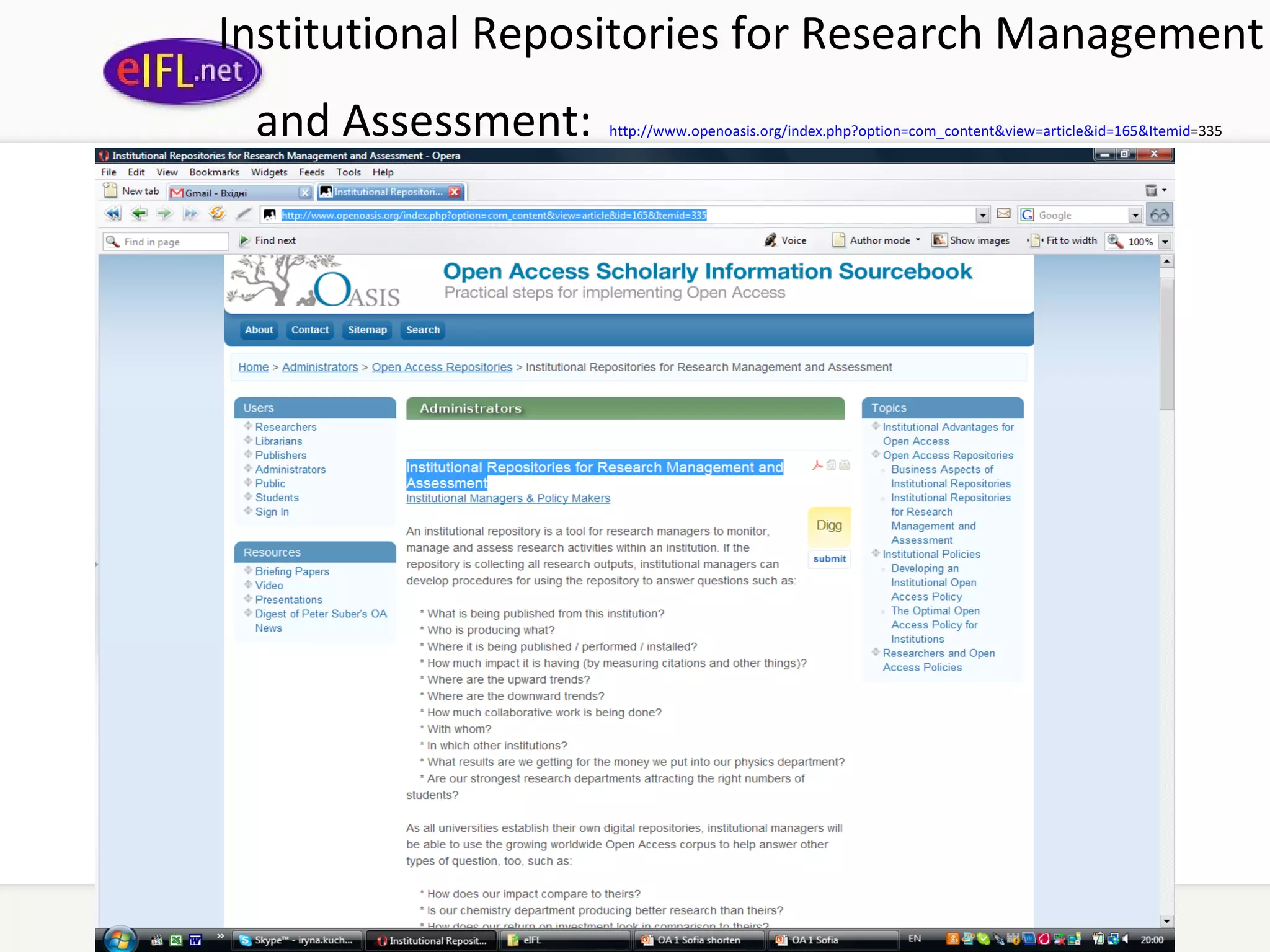
Institutional Repositories for Research Management and Assessment :   http :// www . openoasis . org / index . php ? option = com _ content & view = article & id =165& Itemid =335


The Power of Open Access There are considerable  economic,  social  and educational benefits  to making research and other outputs available without financial,  legal  and technical barriers to access
 
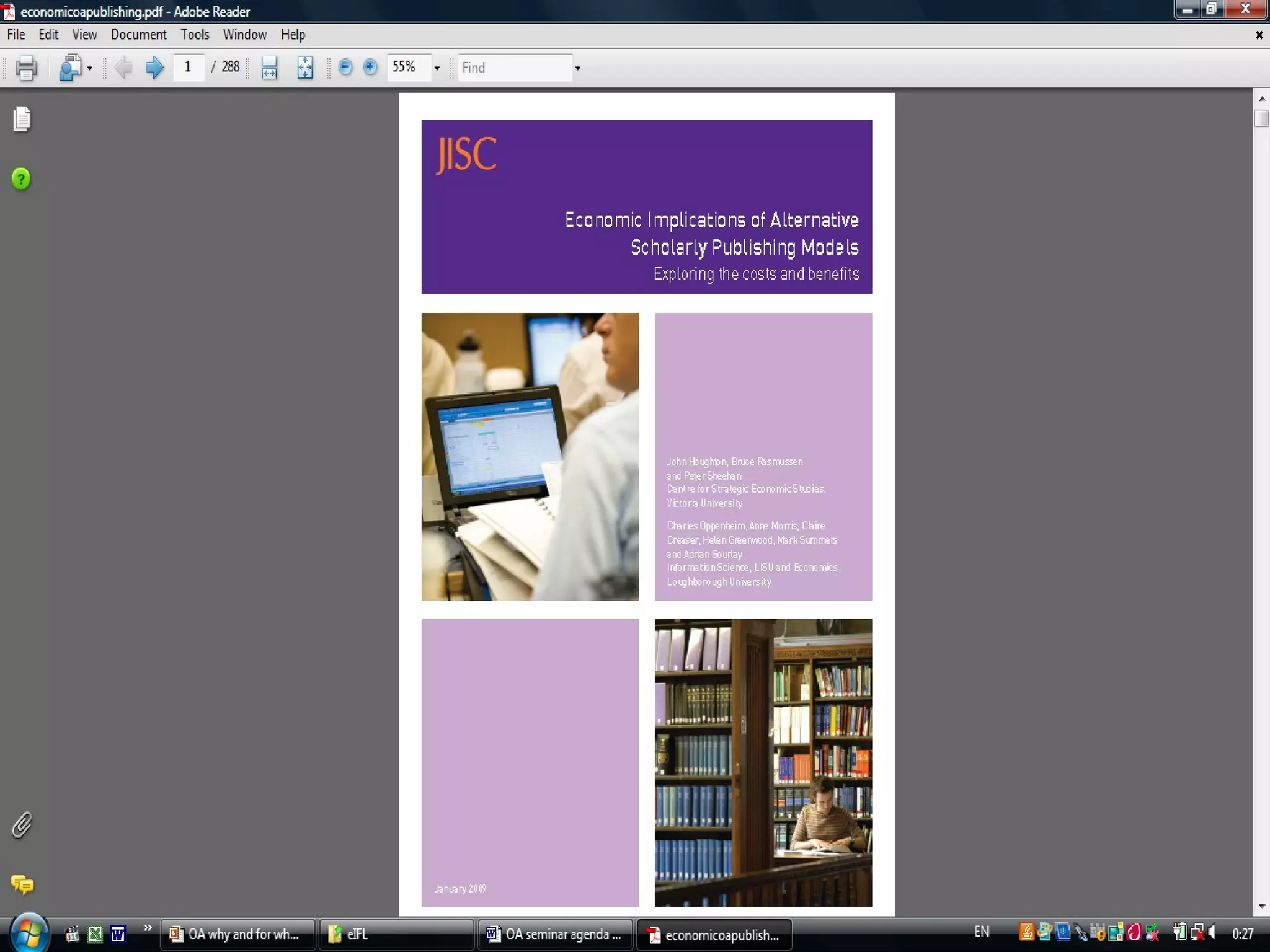
http://www. jisc .ac. uk /publications/publications/ economicpublishingmodelsfinalreport . aspx   “… open access publishing for journal articles might bring system savings of around £215 million per annum nationally in the UK (at 2007 prices and levels of publishing activity), of which around £165 million would accrue in higher education.  … a repositories and overlay services model may well produce greater cost savings than open access publishing – with our estimates suggesting system savings of perhaps £260 million nationally, of which around £205 might accrue in higher education.” And the increase in returns to R&D resulting from enhanced access may be substantial.”
Next steps  –  researchers and students Publish articles in OA journals Self-archive in open repositories Spread a word about OA
Next steps  –  researcher managers Introduce OA polices Transform the journals into OA journals Set-up open repositories Spread a word about OA
Next steps  –  libraries Set-up open repositories Help researchers and students to self-archive Help to publish OA journals Spread a word about OA
Thank you ! Questions ? Iryna Kuchma iryna.kuchma[at]eifl.net;  www. eifl .net The presentation is licensed with  Creative Commons Attribution 3.0 License

Open access for researchers, policy makers and research managers - Short version.

  • 1.
    Open access for researchers, policy makers and research managers Iryna Kuchma, eIFL Open Access program manager, eIFL.net Presented at Open Access: Maximising Research Impact, April 23 2009, New Bulgarian University Library, Sofia
  • 2.
    Why Open Access(OA)? Open access for researchers: enlarged audience citation impact tenure and promotion
  • 3.
    Why OA? Openaccess for policy makers and research managers: new tools to manage a university’s image and impact
  • 4.
    Story N1 : arXiv.org
  • 5.
    Open Access ImpactOpen access brings more rapid and more efficient progress for scholarly research http:// arxiv .org/ “ Brody has looked at the pattern of citations to articles deposited in arXiv, specifically at the length of the delay between when an article is deposited and when it is cited, and has published the aggregated data for each year from 1991.” Brody, Tim; Harnad, Stevan; Carr, Leslie. Earlier web usage statistics as predictors of later citation impact. Journal of the American Association for Information Science and Technology (JASIST), 2005, Vol. 57 no. 8 pp. 1060-1072. http://eprints.ecs.soton.ac.uk/10713/01/timcorr.htm (accessed 30 October 2006) Open Access: What is it and why should we have it? - ECS EPrints ...Open Access: What is it and why should we have it? Swan, A. (2006) Open Access: What is it and why should we have it? http:// eprints . ecs . soton .ac. uk /13028/
  • 6.
    Open Access Impact“ As more papers are deposited and more scientists use the repository, the time between an article being deposited and being cited has been shrinking dramatically, year upon year. This is important for research uptake and progress, because it means that in this area of research, where articles are made available at – or frequently before – publication, the research cycle is accelerating . the research cycle in high energy physics is approaching maximum efficiency as a result of the early and free availability of articles that scientists in the field can use and build upon rapidly.” Brody, Tim; Harnad, Stevan; Carr, Leslie. Earlier web usage statistics as predictors of later citation impact. Journal of the American Association for Information Science and Technology (JASIST), 2005, Vol. 57 no. 8 pp. 1060-1072. http://eprints.ecs.soton.ac.uk/10713/01/timcorr.htm (accessed 30 October 2006) Open Access: What is it and why should we have it? - ECS EPrints ...Open Access: What is it and why should we have it? Swan, A. (2006) Open Access: What is it and why should we have it? http:// eprints . ecs . soton .ac. uk /13028/
  • 7.
    Story N2 : Research article - Serial crises
  • 8.
  • 9.
  • 10.
  • 11.
    Scientific Publication Packages- Jane Hunter - Autumn 2006 “ Enhanced publications (what are they, why are they important)” by Dr.Leo Waaijers , http://www. eifl .net/cps/sections/services/ eifl - oa /training/2008- chisinau /12
  • 12.
  • 13.
  • 14.
  • 15.
    Story N3 Whatscientists want? Where the world/web is going anyway? (thank you Peter Murray-Rust !)
  • 16.
  • 17.
    Story N4 – Library (thank you Leo Waaijers!) Traditional library: Importer Expensive Limited Students use Google (Scholar) Library of the future: Exporter Much cheaper Unlimited Students use Google (Scholar)
  • 18.
    OA is thefree online availability of peer reviewed literature permitting any user to read , download, copy, distribute, print, search, or link to the full texts of articles
  • 19.
    OA “ Itis important to stress here that publishing is a fundamental part of the process of doing science . Moreover, as a scientist I am not writing for money — like my wife, who was a professional writer at one time — but I am writing for fame: I want everyone to read what I write… Everybody who writes a scientific paper is writing to be read, not to make money. For that reason we volunteer our services, and we don’t get paid. That is what makes Open Access a powerful concept for scientists. It means, for instance, that anyone anywhere in the world who searches for oncogenes, mouse models, or any other search term that applies to my own work, will find it, and will be able to have immediate access to it. That is the goal we are hoping to achieve.” The Basement Interviews Freeing the scientific literature Harold Varmus, Nobel laureate, former director of the US National Institutes of Health, and co-founder of open access publisher Public Library of Science, talks to Richard Poynder. Published on June 5th 2006 http:// poynder . blogspot .com/2006/06/interview-with- harold - varmus .html
  • 20.
    2 complementarystrategies: Gold by Vitó http :// www . flickr . com / photos / janeladeimagens /192943825/
  • 21.
  • 22.
    2 complementarystrategies - Green by Jim Frazier http :// www . flickr . com / photos / jimfrazier /140042827/
  • 23.
    Open repositories Adigital repository is defined as containing research output, institutional or thematic and OAI compliant ( http://www. openarchives .org/OAI/ openarchivesprotocol .html ) (From The European Repository Landscape Inventory Study into the Present Type and Level of OAI-Compliant Digital Repository Activities in the EU by Maurits van der Graaf and Kwame van Eijndhoven
  • 24.
    Content Peer-reviewed articlesConference presentations Books Course packs Annotated images Audio and video clips Research data
  • 25.
    Content Gray literature: Preprints / working materials / theses and dissertations / reports / conference materials / bulletins / grant applications / reports to the donors / memorandums / statistical reports / technical documentation / questionnaires…
  • 26.
    http :// www. opendoar . org /
  • 27.
    http ://search3. driver.research- infrastructures . eu / webInterface / simpleSearch . do ; jsessionid =30E69E7F5FDBD7BB9CB5AC829852074B? action = load
  • 28.
  • 29.
    Theses and dissertationsJohn Hagen, West Virginia University : Moving from print to electronic – usage growth 145% The most popular theses and dissertations were downloaded 37,501 times (history ) and 33,752 times (engineering); history one was published and was a long seller 69% of students from the creative writing department had more successful careers if they went OA with their dissertations – a good marketing tool for them
  • 30.
    Open Access Impactincreased citation rates : For 72% of papers published in the Astrophysical Journal, free versions of the paper are available (mainly through ArXiv). These 72% of papers are, on average, cited more than twice as often as the remaining 28% that do not have free versions. Schwarz, G. and Kennicutt Jr., R. C. (2004): Demographic and Citation Trends in Astrophysical Journal Papers and Preprints (pdf 14pp), arxiv.org/pdf/astro-ph/0411275, 10 November 2004, Bulletin of the American Astronomical Society, Vol. 36, 1654-1663
  • 31.
    Open Access ImpactOpen access PNAS papers have 50% more full-text downloads than non-open access papers http://www.library. yale . edu /~ llicense / ListArchives /0505/msg01580.html … and are on average twice as likely to be cited http://biology. plosjournals .org/ perlserv /?request=get-document& doi =10.1371/journal. pbio .0040157
  • 32.
  • 33.
    Leverage byL es C arr : http :// www . slideshare . net / lescarr / leverage ? type = powerpoint The Repository has made a splash page, with previews and usage stats ( Example from EPrints at University of Southampton)
  • 34.
    Leverage byL es C arr : http :// www . slideshare . net / lescarr / leverage ? type = powerpoint The repository has made a bibliography for you …( Example from DSpace at Universiteit Hasselt, Belgium)
  • 35.
    Leverage byL es C arr : http :// www . slideshare . net / lescarr / leverage ? type = powerpoint …maybe personalised it with other information about you… ( Example from DSpace at University of Chicago, Illinois)
  • 36.
    Leverage byL es C arr : http :// www . slideshare . net / lescarr / leverage ? type = powerpoint …set up a mailing list for you… Example from Digital Commons at Cal Poly
  • 37.
    Leverage byL es C arr : http :// www . slideshare . net / lescarr / leverage ? type = powerpoint Automatically updated your research group web pages (Example from IAM web site at University of Southampton, UK)
  • 38.
    Leverage byL es C arr : http :// www . slideshare . net / lescarr / leverage ? type = powerpoint Less Administration: Management will use the information for the admin forms you would otherwise have to complete
  • 39.
    Leverage byL es C arr : http :// www . slideshare . net / lescarr / leverage ? type = powerpoint Update your Teaching Pages
  • 40.
  • 41.
    Why open repositories? Academic and research institutions – and research funders – find open repositories valuable in generating management information and reports on their research programmes, enabling better research assessment , and in raising awareness of their research profile and transparency
  • 42.
    Why open repositories? Opening up the outputs of the institution to the world Maximizing the visibility and impact of these outputs Showcasing the quality of the research in the institution
  • 43.
    Why open repositories? Collecting and curating the digital outputs of the institution Managing and measuring research and teaching activities Providing a workspace for work-in-progress and for collaborative and large-scale projects
  • 44.
    Why open repositories? Enabling and encouraging interdisciplinary approaches to research Facilitating the development and sharing of digital teaching materials and aids Supporting student endeavours, providing access to theses and dissertations and a location for the development of e-portfolios
  • 45.
    Why open repositories? Institutional and national level research assessment and research management, bringing together research expertise across the institution and country Information rich collaboration, effective decision-making and successful research activity Improved governmental policy and public health care outcomes
  • 46.
    Institutional Advantages fromOpen Access: http :// www . openoasis . org / index . php ? option = com _ content & view = article & id =142& Itemid =337
  • 47.
    Business Aspects ofInstitutional Repositories : http :// www . openoasis . org / index . php ? option = com _ content & view = article & id =164& Itemid =334
  • 48.
    Institutional Repositories forResearch Management and Assessment : http :// www . openoasis . org / index . php ? option = com _ content & view = article & id =165& Itemid =335
  • 49.
  • 50.
  • 51.
  • 52.
  • 53.
    The Power ofOpen Access There are considerable economic, social and educational benefits to making research and other outputs available without financial, legal and technical barriers to access
  • 54.
  • 55.
    http://www. jisc .ac.uk /publications/publications/ economicpublishingmodelsfinalreport . aspx “… open access publishing for journal articles might bring system savings of around £215 million per annum nationally in the UK (at 2007 prices and levels of publishing activity), of which around £165 million would accrue in higher education. … a repositories and overlay services model may well produce greater cost savings than open access publishing – with our estimates suggesting system savings of perhaps £260 million nationally, of which around £205 might accrue in higher education.” And the increase in returns to R&D resulting from enhanced access may be substantial.”
  • 56.
    Next steps – researchers and students Publish articles in OA journals Self-archive in open repositories Spread a word about OA
  • 57.
    Next steps – researcher managers Introduce OA polices Transform the journals into OA journals Set-up open repositories Spread a word about OA
  • 58.
    Next steps – libraries Set-up open repositories Help researchers and students to self-archive Help to publish OA journals Spread a word about OA
  • 59.
    Thank you !Questions ? Iryna Kuchma iryna.kuchma[at]eifl.net; www. eifl .net The presentation is licensed with Creative Commons Attribution 3.0 License