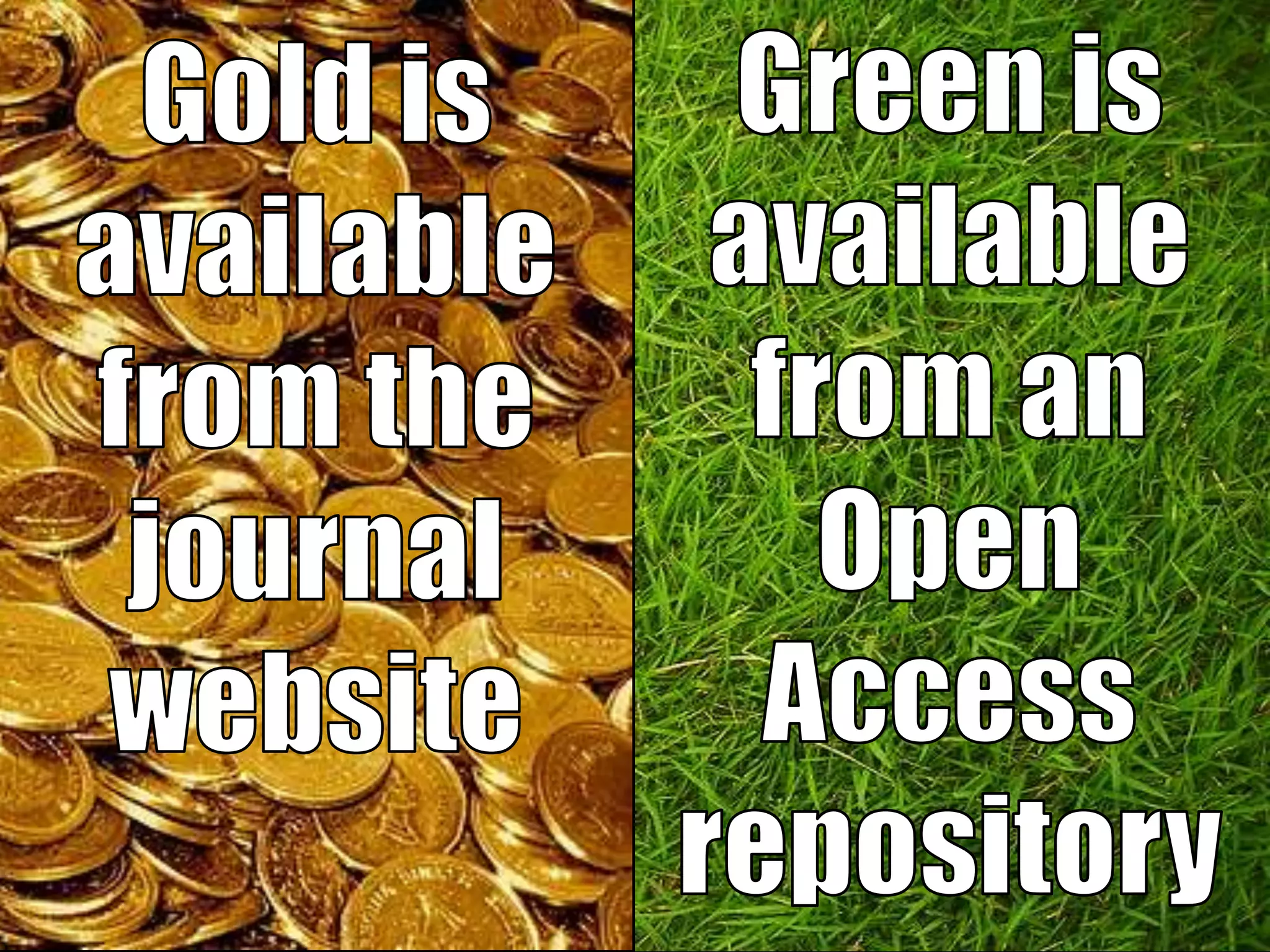
Publishing your 
Research: Open Access 
What is it and what requirements do 
you need to meet? 
James Bisset james.bisset@durham.ac.uk 
Academic Liaison Librarian (Research Support)
Session outline 
- What is “Open Access”? 
- Paywalls, Terminology, Examples 
- Why make your research Open Access? 
- Benefits for authors / Benefits for readers 
- What Open Access requirements are there? 
- OA mandates, identifying your options, DRO 
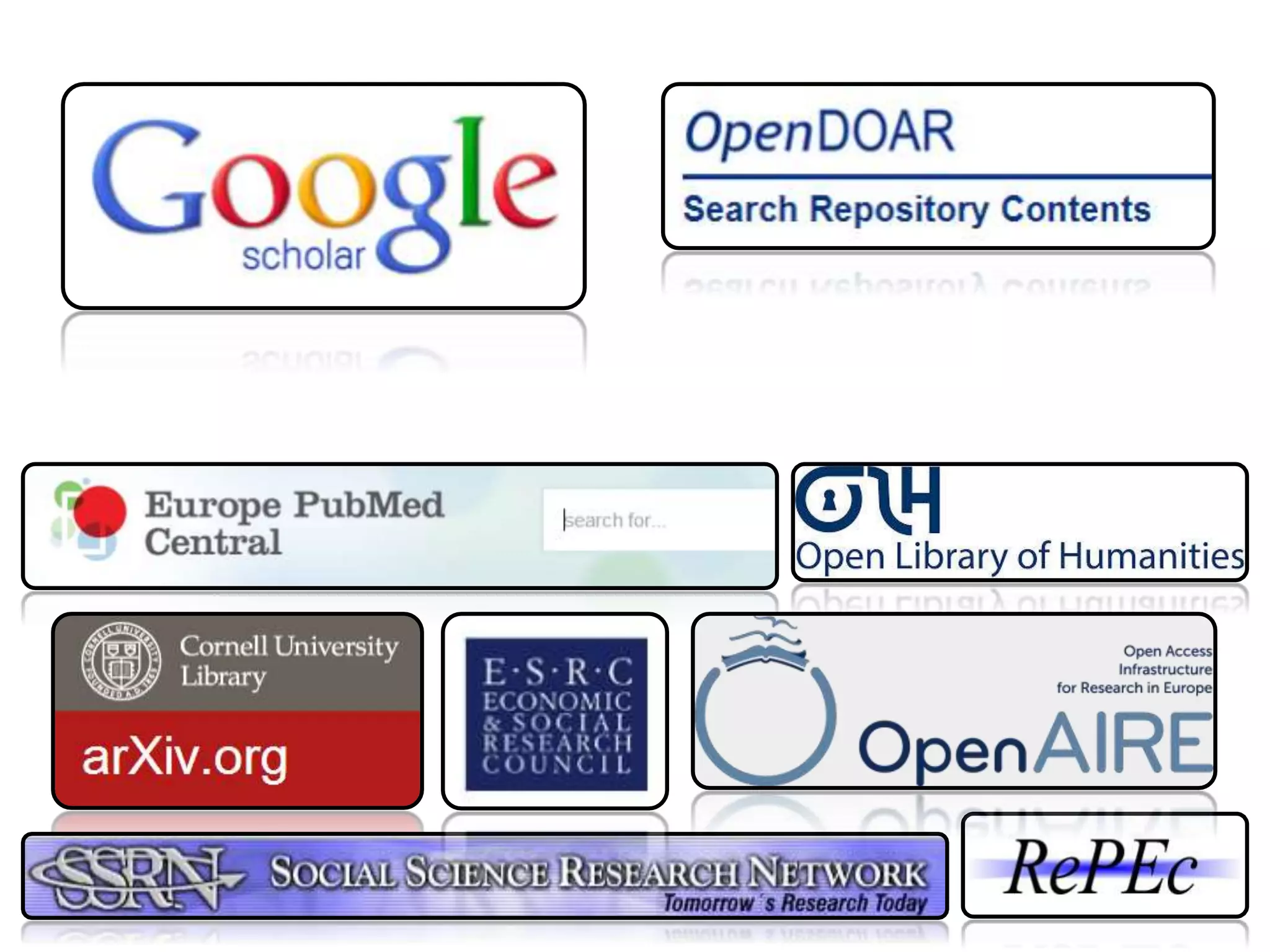
- Searching for open access articles 
- Repositories, OA Journals, Search engines
What is Open 
Access ?
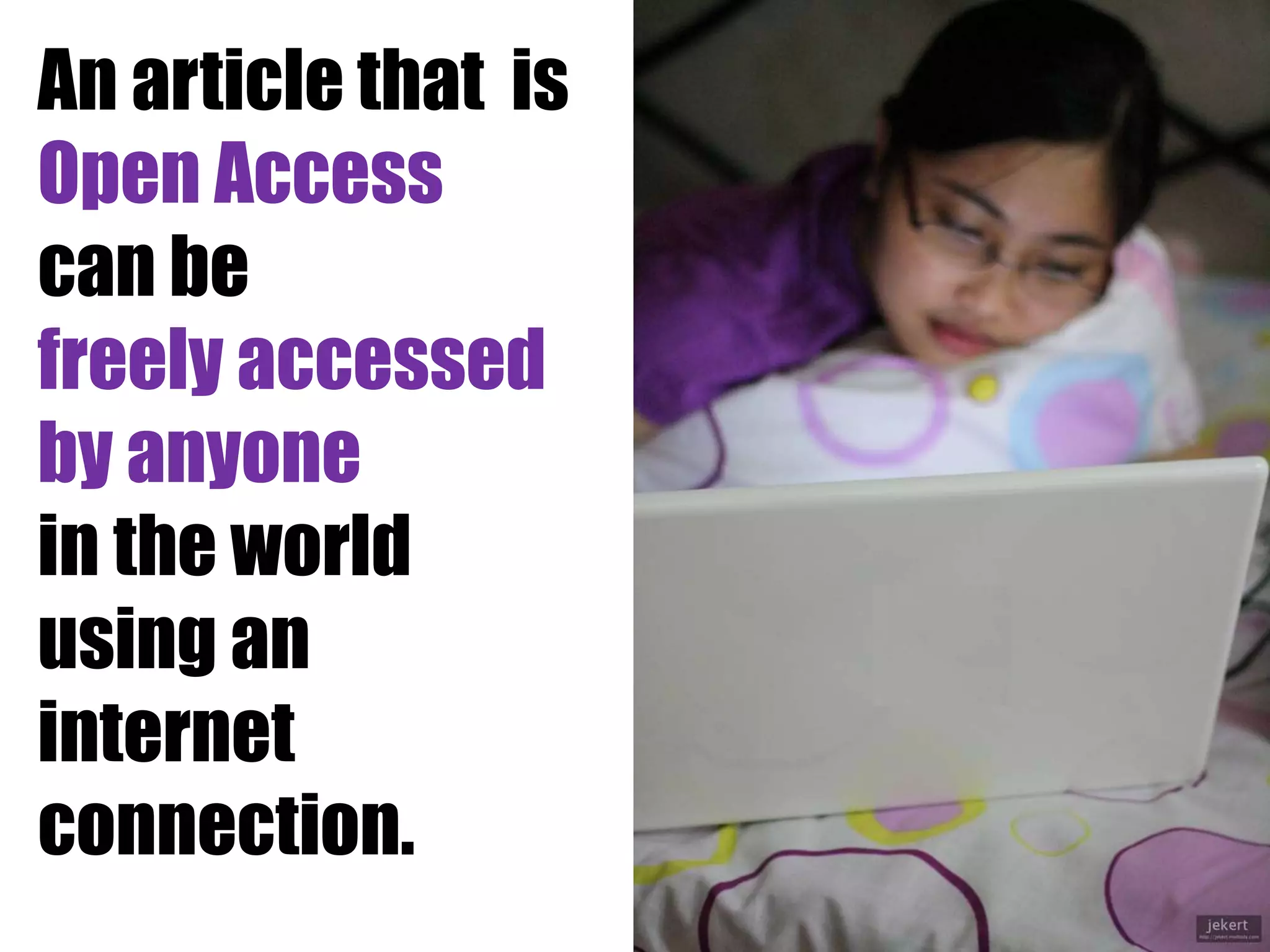
An article that is 
Open Access 
can be 
freely accessed 
by anyone 
in the world 
using an 
internet 
connection.
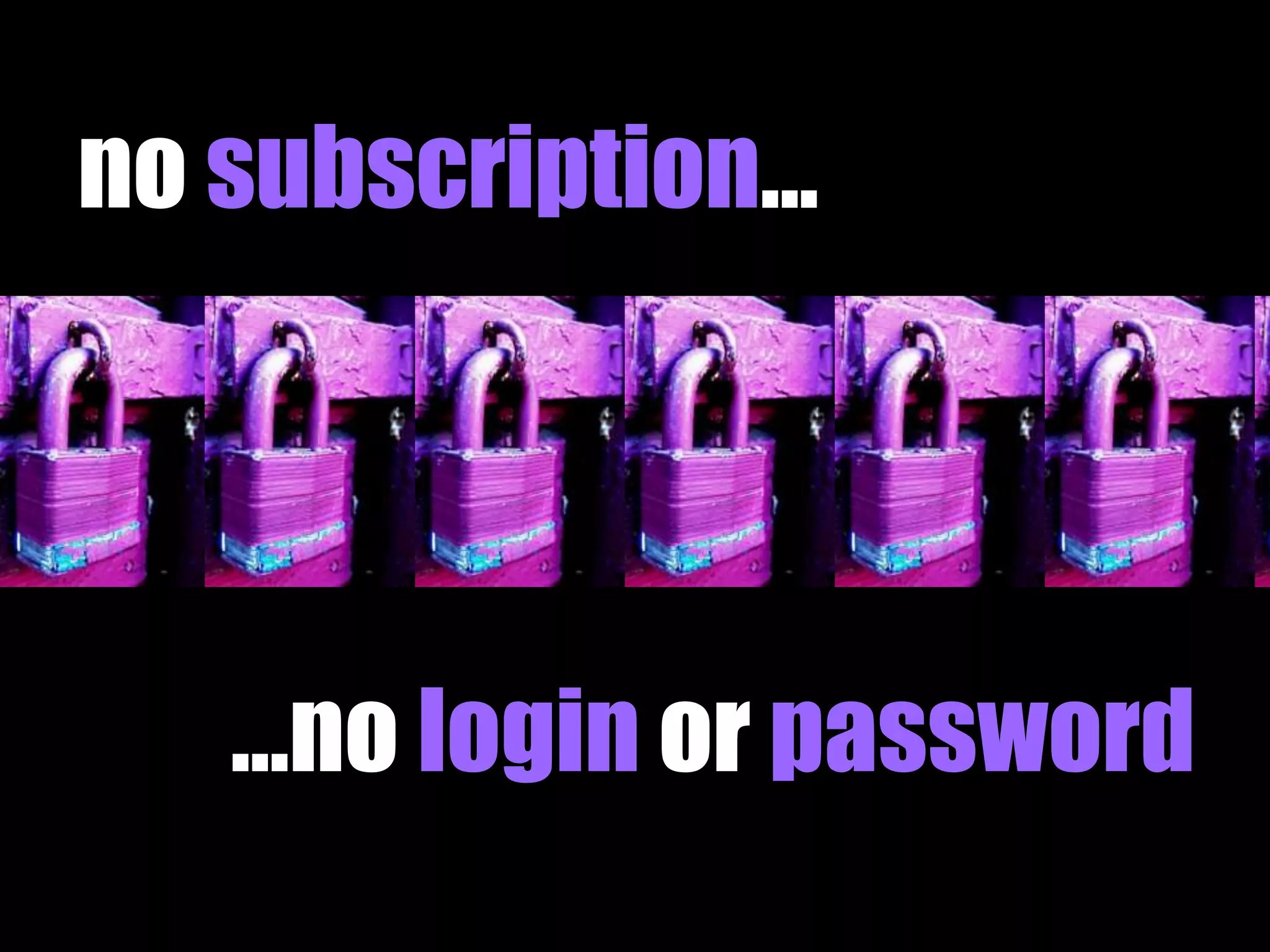
no subscription... 
...no login or password
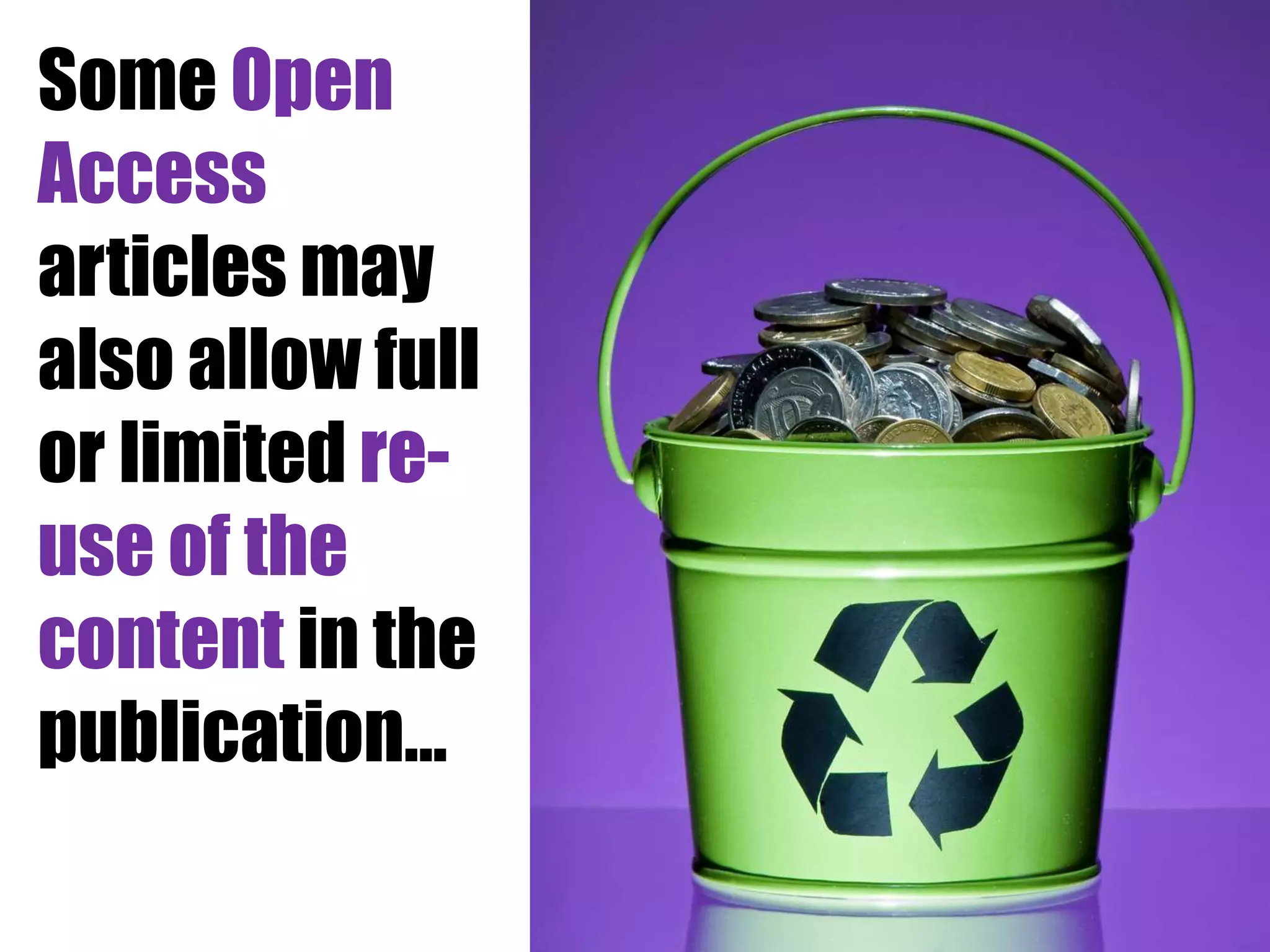
Some Open 
Access 
articles may 
also allow full 
or limited re-use 
of the 
content in the 
publication...
“... free availability on the public internet, permitting any 
users to read, download, copy, distribute, print, search, or 
link to the full texts of these articles, crawl them for 
indexing, pass them as data to software, or use them for 
any other lawful purpose, without financial, legal, or 
technical barriers other than those inseparable from 
gaining access to the internet itself. The only constraint on 
reproduction and distribution, and the only role for 
copyright in this domain, should be to give authors control 
over the integrity of their work and the right to be properly 
acknowledged and cited.“ 
http://www.budapestopenaccessinitiative.org/read 
Budapest Open Access Initiative.
http://dro.dur.ac.uk/view/departments/ 
Via Flickr Creative Commons, by © Stuti Sakhalkar. Original available 
at http://www.flickr.com/photos/theblackcanvas/2945878325/ 
Have a go... 
http://www.plosone.org/browse/
Why a repository? Why can’t I do what 
I want with an article I have written? 
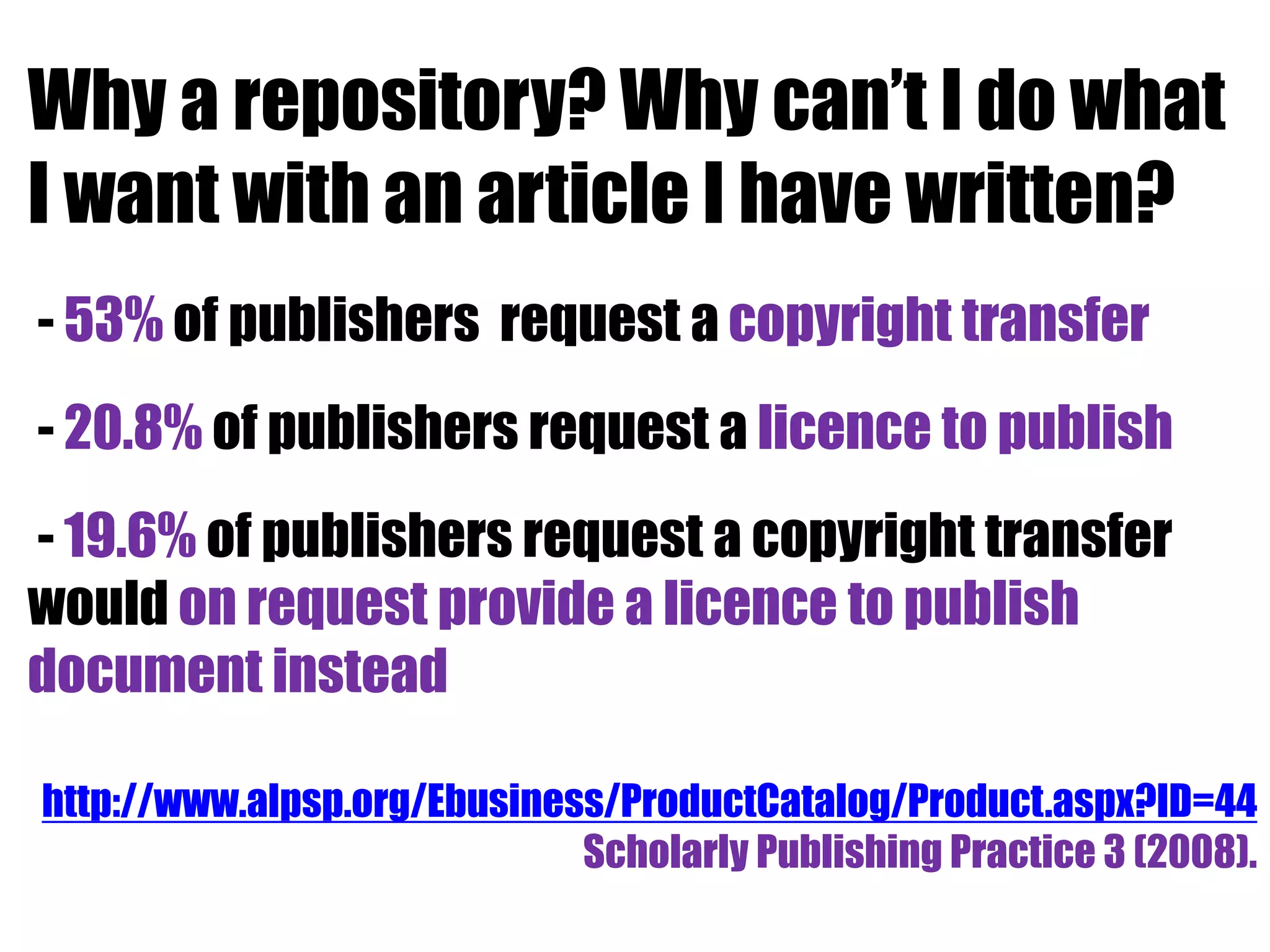
- 53% of publishers request a copyright transfer 
- 20.8% of publishers request a licence to publish 
- 19.6% of publishers request a copyright transfer 
would on request provide a licence to publish 
document instead 
http://www.alpsp.org/Ebusiness/ProductCatalog/Product.aspx?ID=44 
Scholarly Publishing Practice 3 (2008).
Why a repository? Why can’t I do what 
I want with an article I have written? 
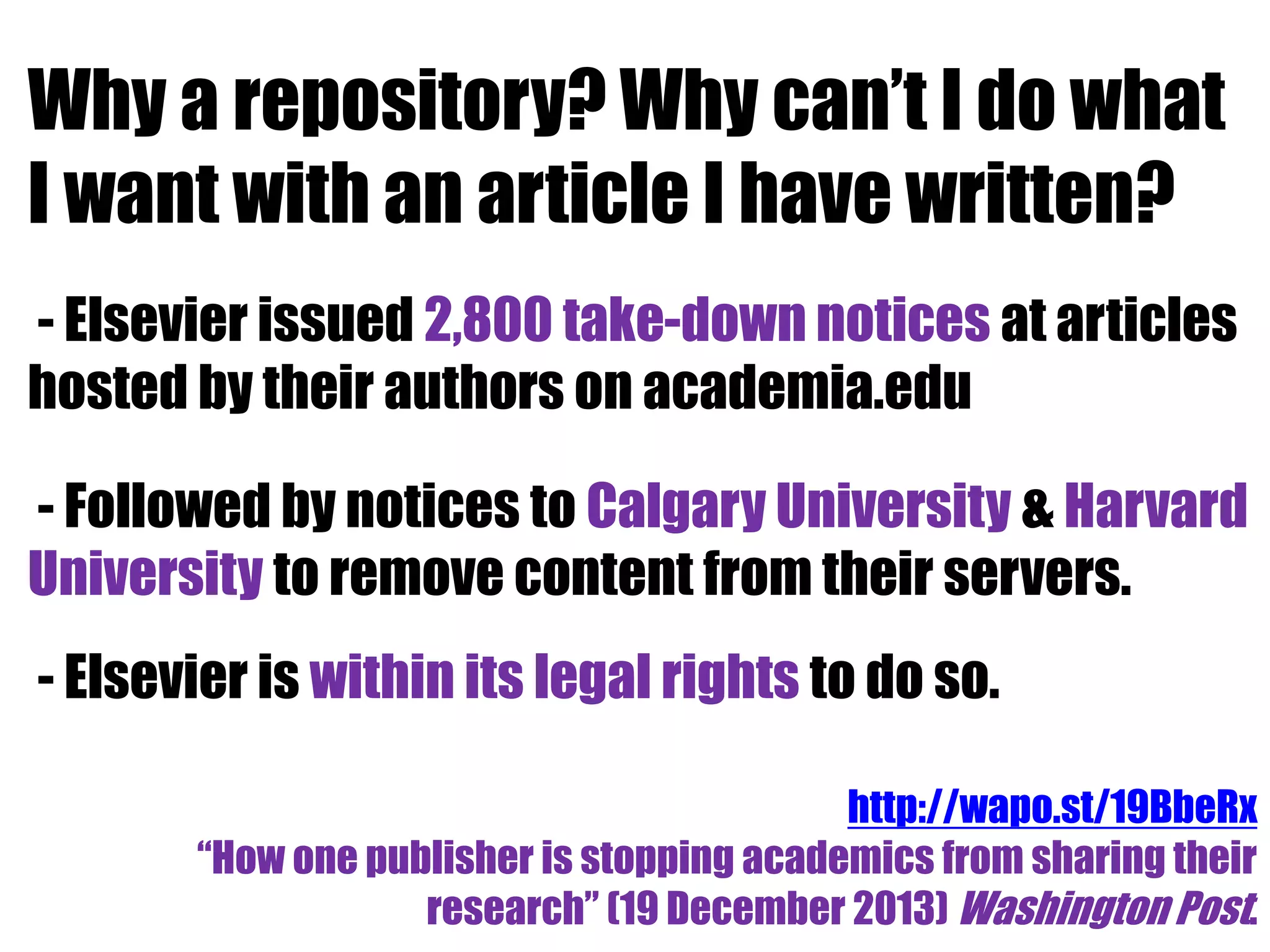
- Elsevier issued 2,800 take-down notices at articles 
hosted by their authors on academia.edu 
- Followed by notices to Calgary University & Harvard 
University to remove content from their servers. 
- Elsevier is within its legal rights to do so. 
http://wapo.st/19BbeRx 
“How one publisher is stopping academics from sharing their 
research” (19 December 2013) Washington Post.
Examples
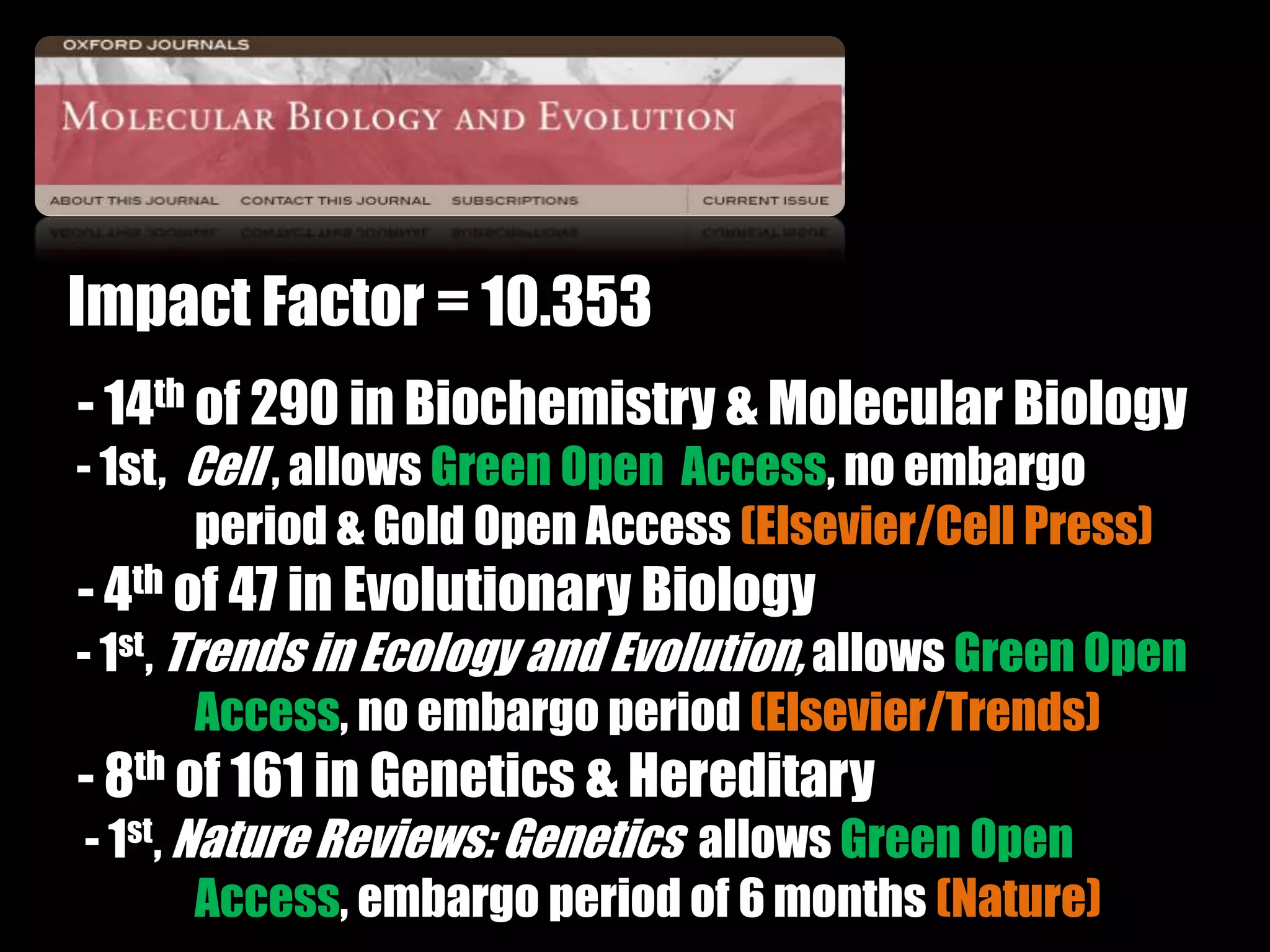
Impact Factor = 10.353 
- 14th of 290 in Biochemistry & Molecular Biology 
- 1st, Cell , allows Green Open Access, no embargo 
period & Gold Open Access (Elsevier/Cell Press) 
- 4th of 47 in Evolutionary Biology 
- 1st, Trends in Ecology and Evolution, allows Green Open 
Access, no embargo period (Elsevier/Trends) 
- 8th of 161 in Genetics & Hereditary 
- 1st, Nature Reviews: Genetics allows Green Open 
Access, embargo period of 6 months (Nature)
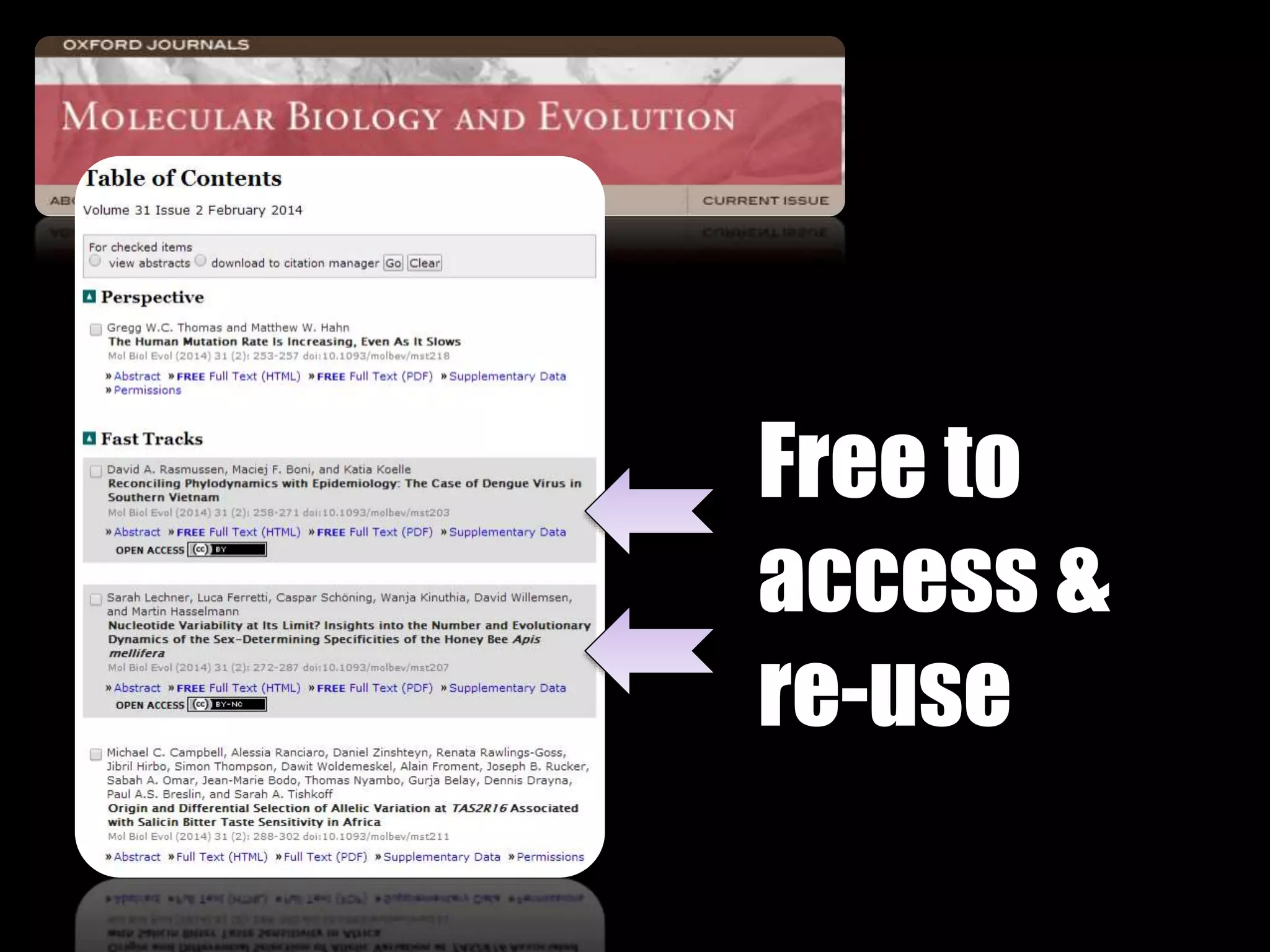
Free to 
access & 
re-use
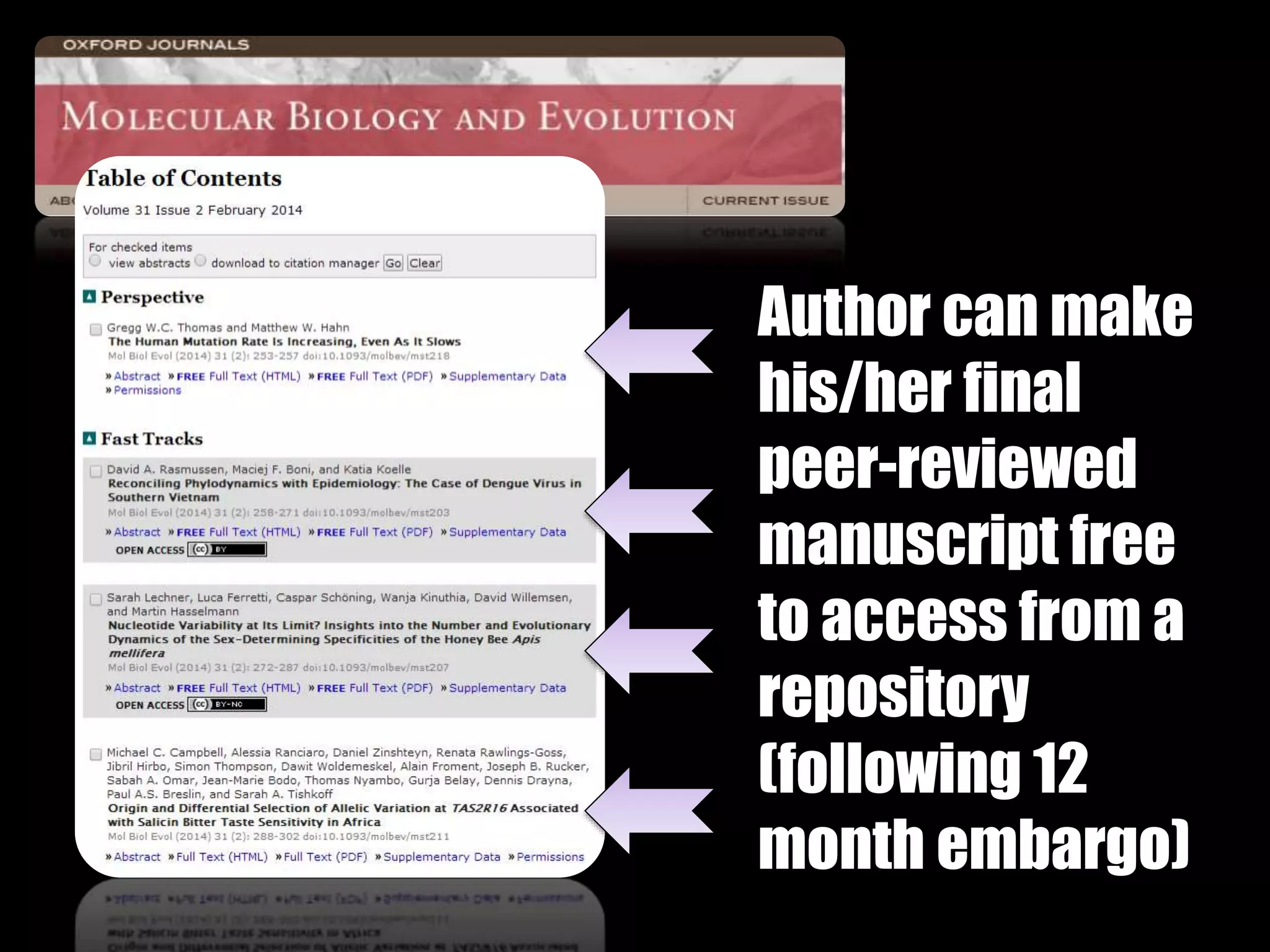
Author can make 
his/her final 
peer-reviewed 
manuscript free 
to access from a 
repository 
(following 12 
month embargo)
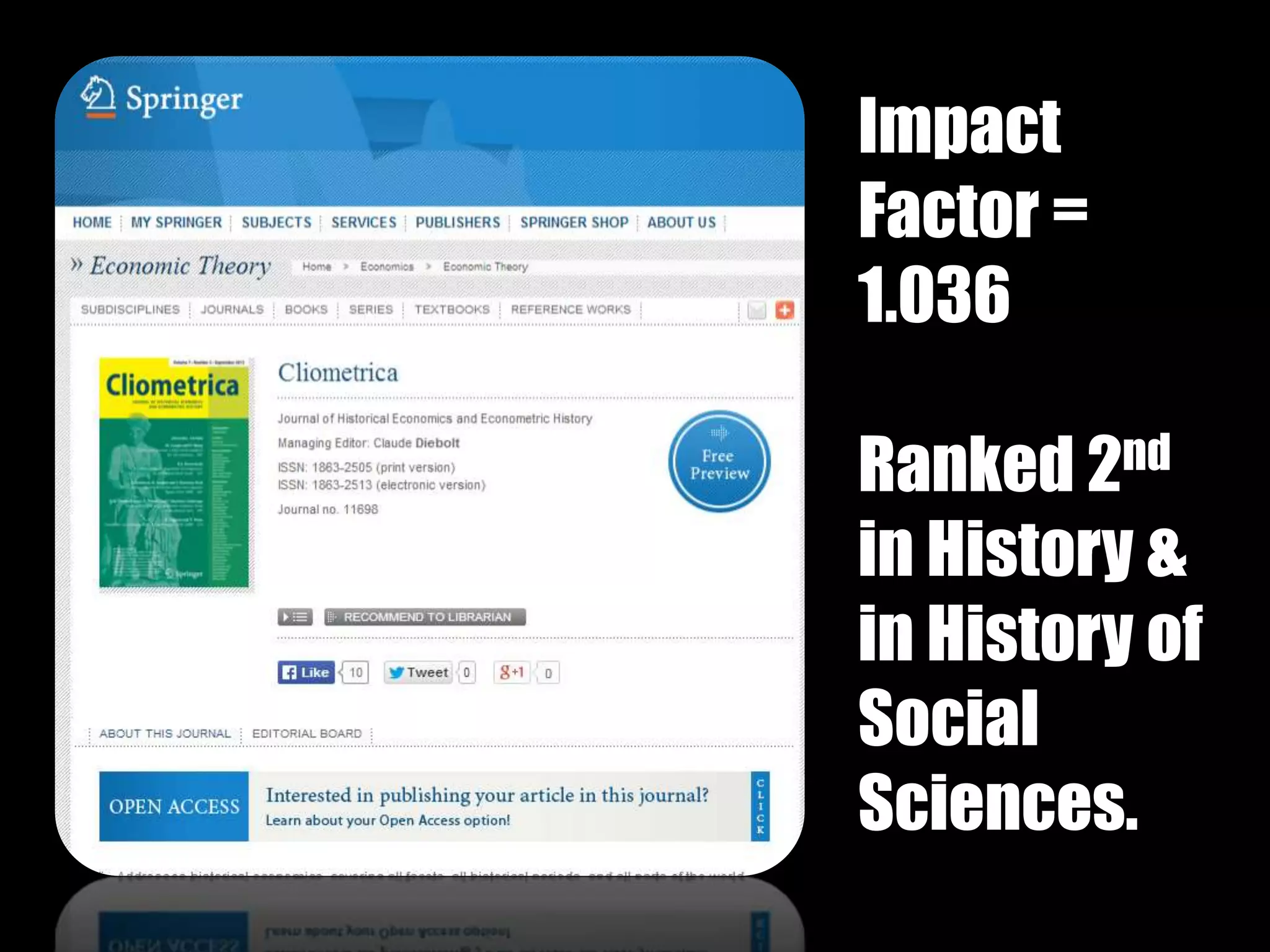
Impact 
Factor = 
1.036 
Ranked 2nd 
in History & 
in History of 
Social 
Sciences.
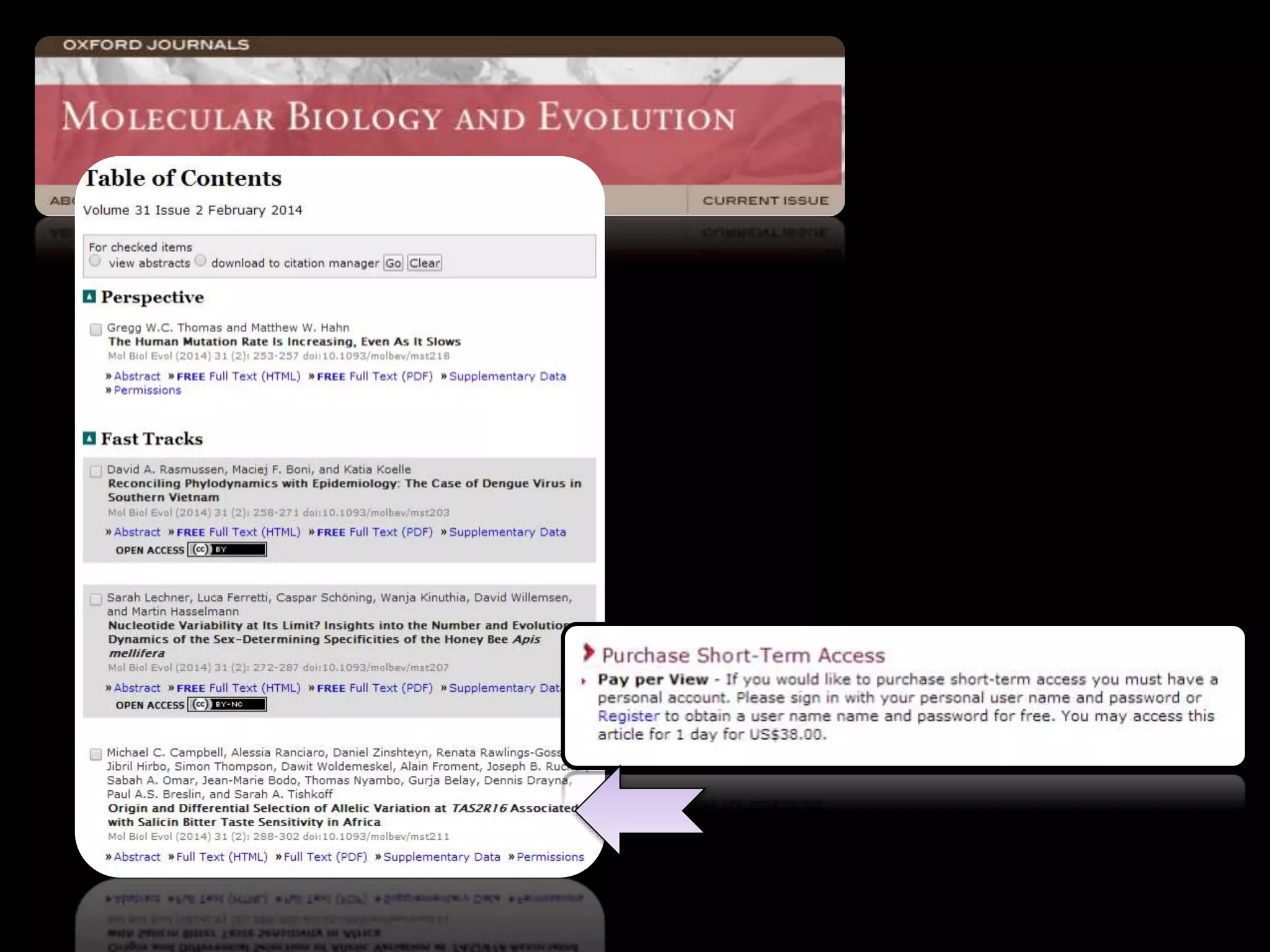
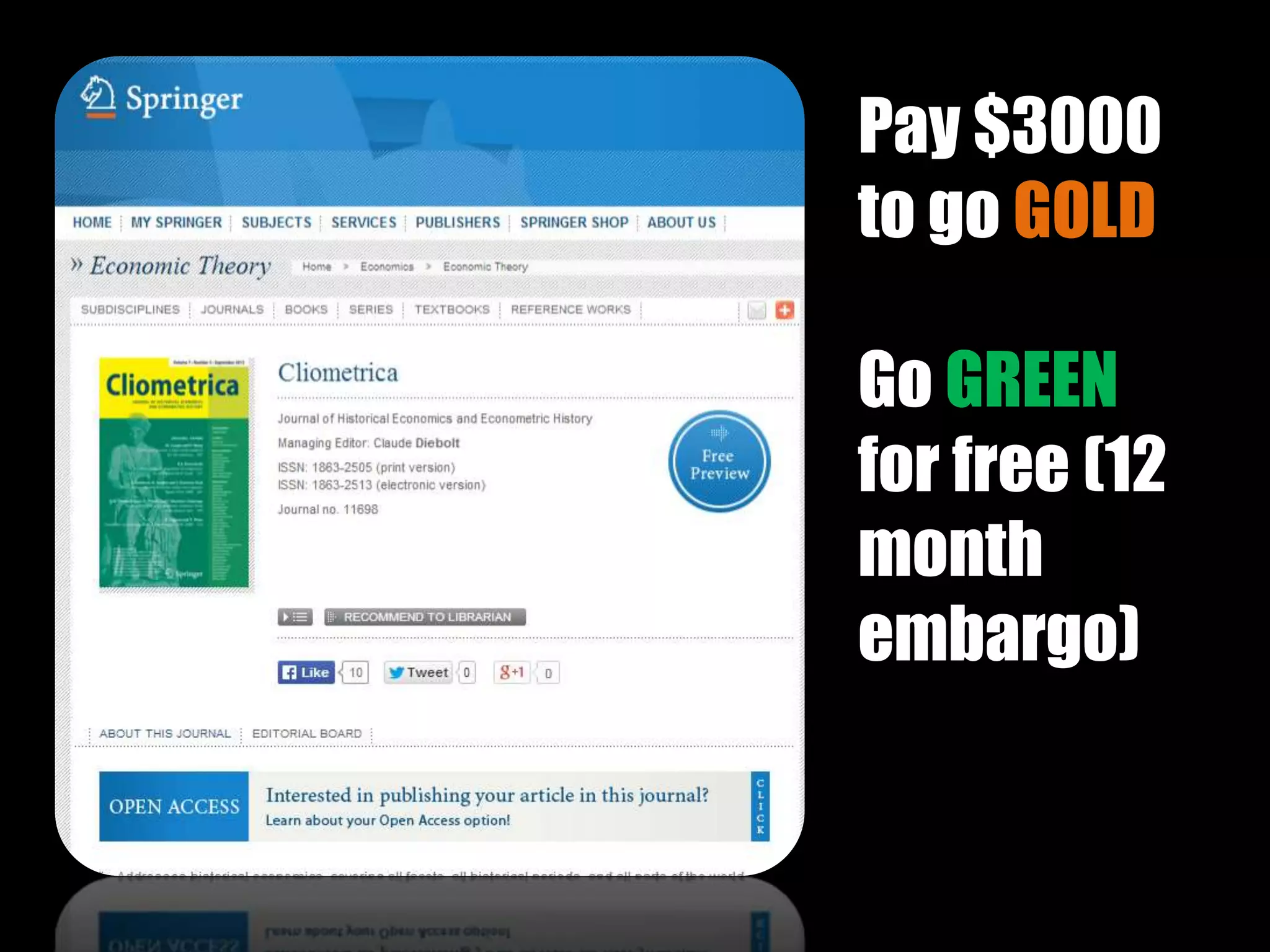
Pay $3000 
to go GOLD 
Go GREEN 
for free (12 
month 
embargo)
Why make your 
research 
Open Access?
“on average across the NHS, [only] 
about a third of relevant journals 
were available free at the point of 
use” 
http://bit.ly/MnfGEY 
Finch Report (June 2012), from data originally reported in 
Heading for the Open Road: costs and benefits of transitions in 
scholarly communications, RIN, PRC, Wellcome Trust, RLUK and 
JISC, 2011.
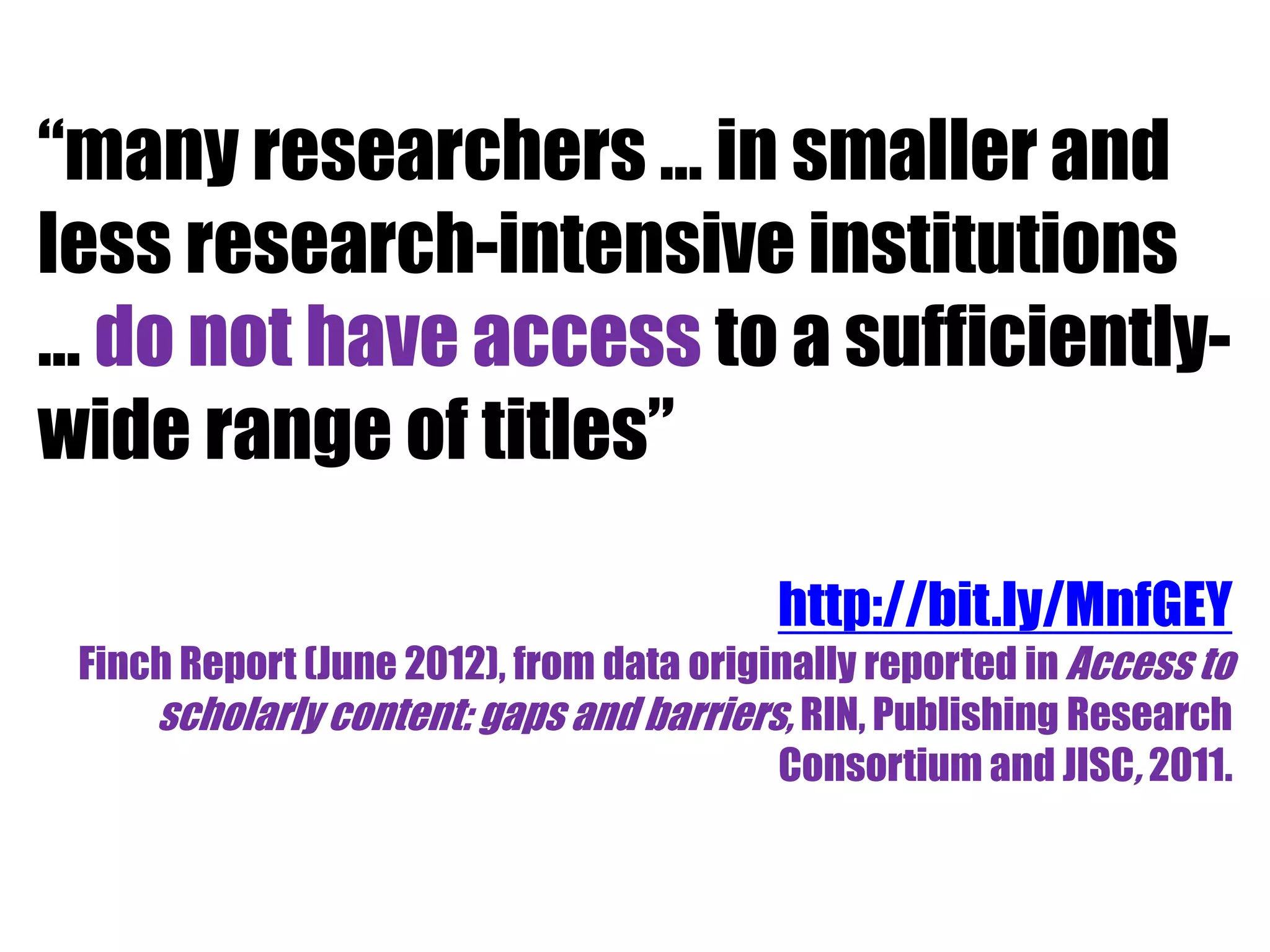
“many researchers … in smaller and 
less research-intensive institutions 
… do not have access to a sufficiently-wide 
range of titles” 
http://bit.ly/MnfGEY 
Finch Report (June 2012), from data originally reported in Access to 
scholarly content: gaps and barriers, RIN, Publishing Research 
Consortium and JISC, 2011.
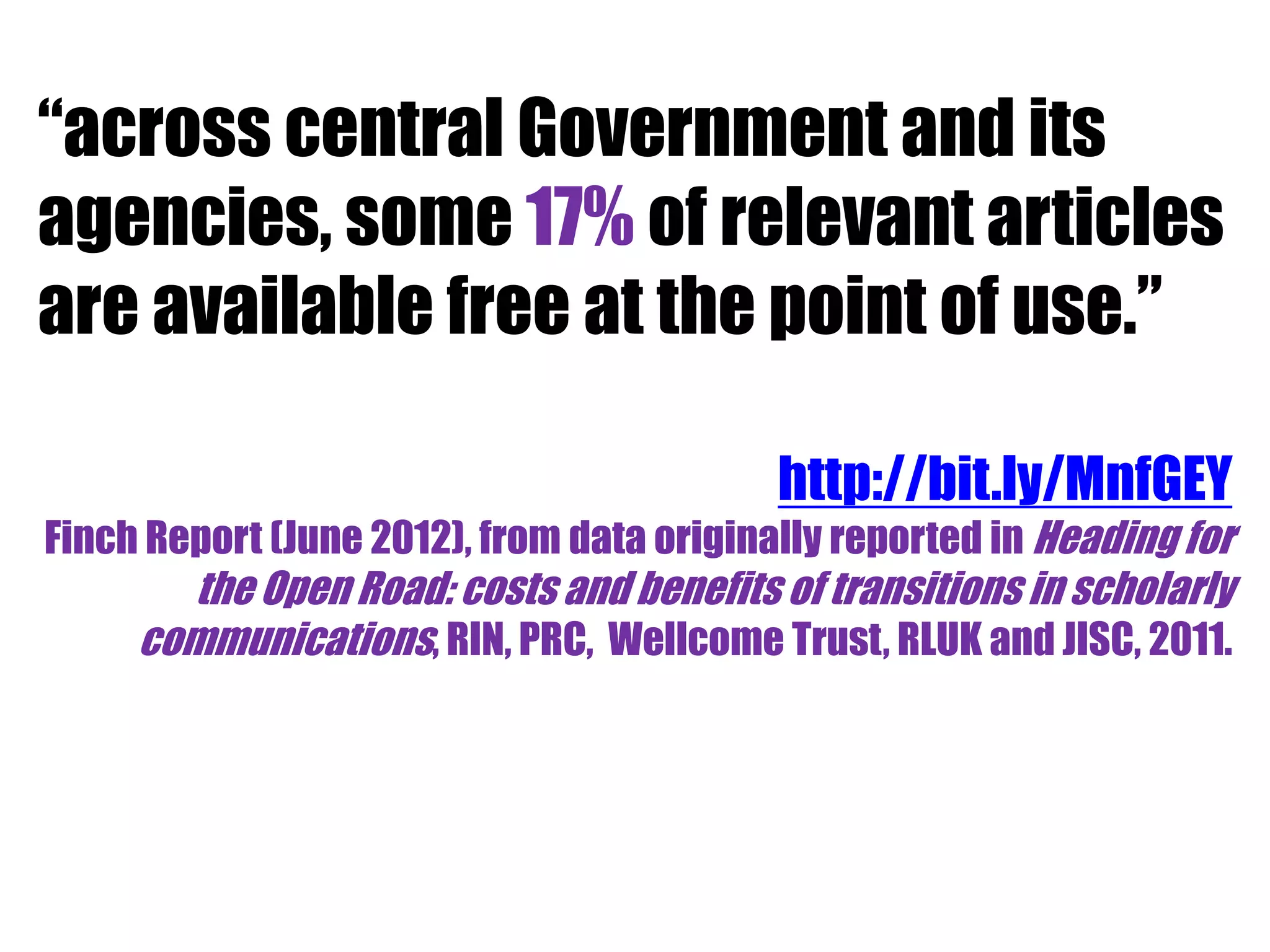
“across central Government and its 
agencies, some 17% of relevant articles 
are available free at the point of use.” 
http://bit.ly/MnfGEY 
Finch Report (June 2012), from data originally reported in Heading for 
the Open Road: costs and benefits of transitions in scholarly 
communications, RIN, PRC, Wellcome Trust, RLUK and JISC, 2011.
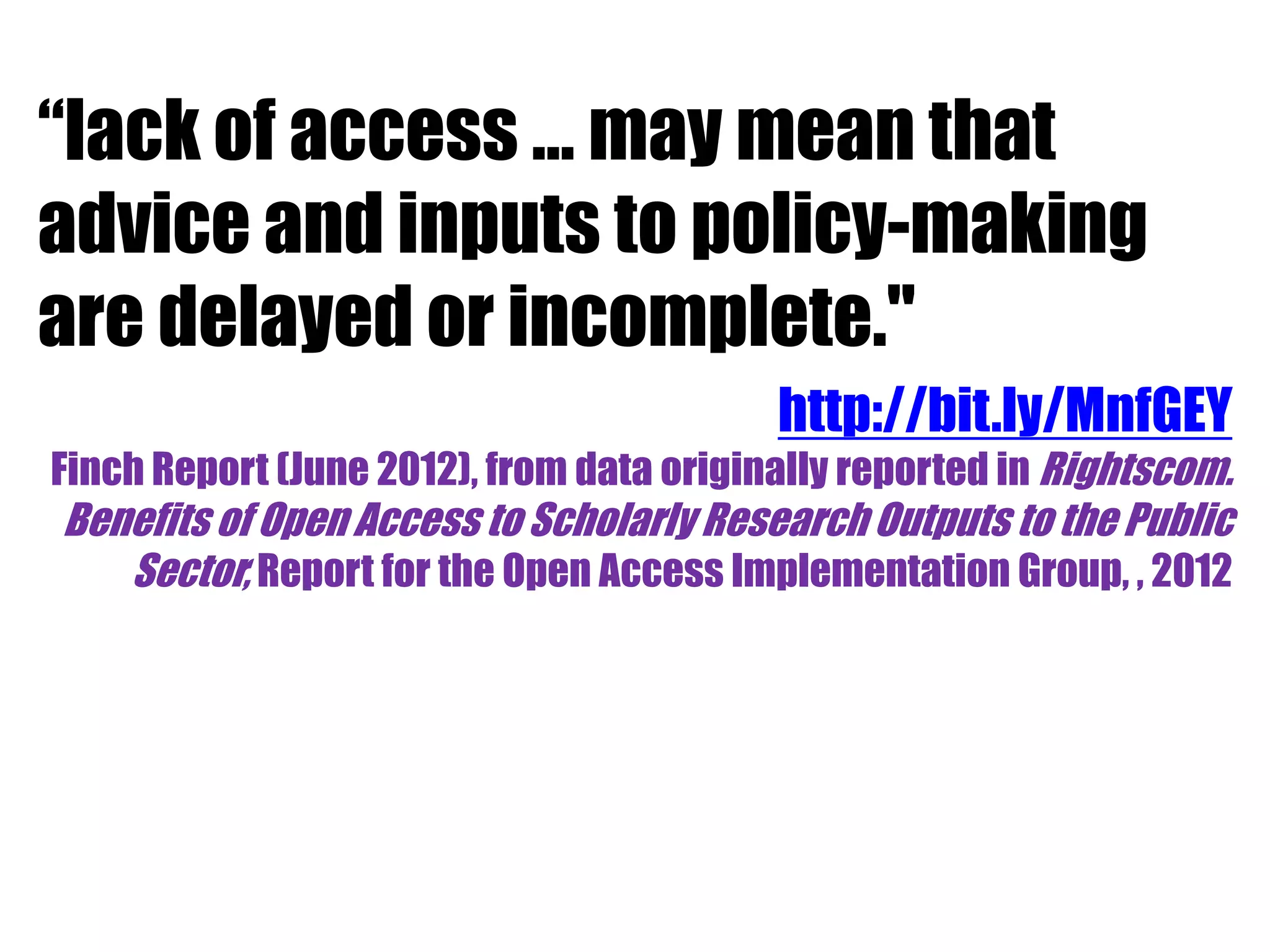
“lack of access … may mean that 
advice and inputs to policy-making 
are delayed or incomplete." 
http://bit.ly/MnfGEY 
Finch Report (June 2012), from data originally reported in Rightscom. 
Benefits of Open Access to Scholarly Research Outputs to the Public 
Sector, Report for the Open Access Implementation Group, , 2012
“the voluntary sector … [often has to] 
rely on reports from research 
organisations and Government 
departments" 
http://bit.ly/MnfGEY 
Finch Report (June 2012), from data originally reported in Office for 
Public Management, Benefits of open access to scholarly research 
for VCS organisations, JISC 2012.
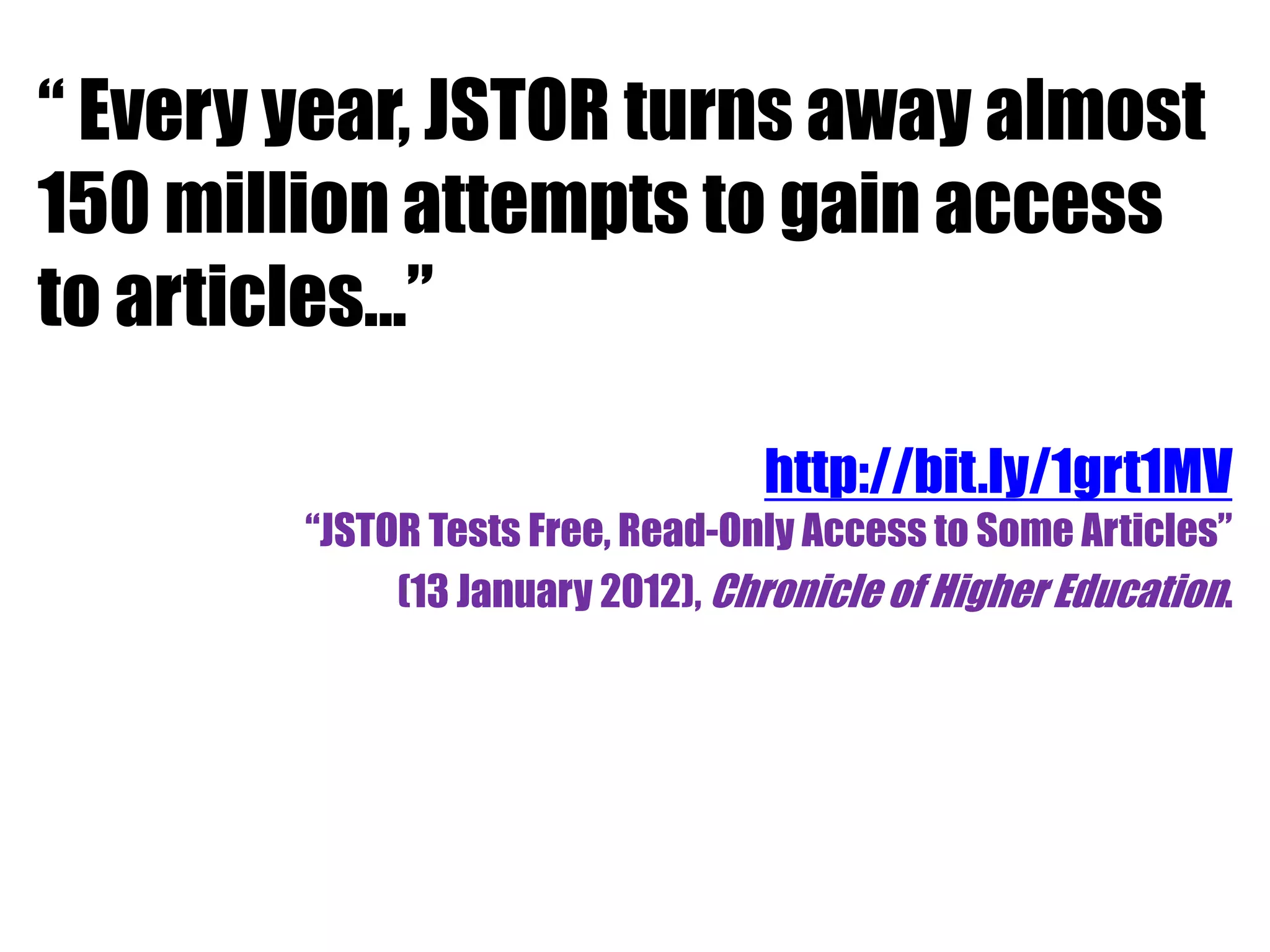
“ Every year, JSTOR turns away almost 
150 million attempts to gain access 
to articles...” 
http://bit.ly/1grt1MV 
“JSTOR Tests Free, Read-Only Access to Some Articles” 
(13 January 2012), Chronicle of Higher Education.
why? 
“Because the cost of the current publication 
system cannot continue to be supported 
without change.”
“journal prices have risen four 
times faster than inflation since 
the mid-1980's” 
Peter Suber, Research Professor of Philosophy at Earlham College and Director of the 
Harvard Open Access Project, quoting research conducted from ARL Statistics 2005- 
06, Association of Research Libraries, Washington, D.C.
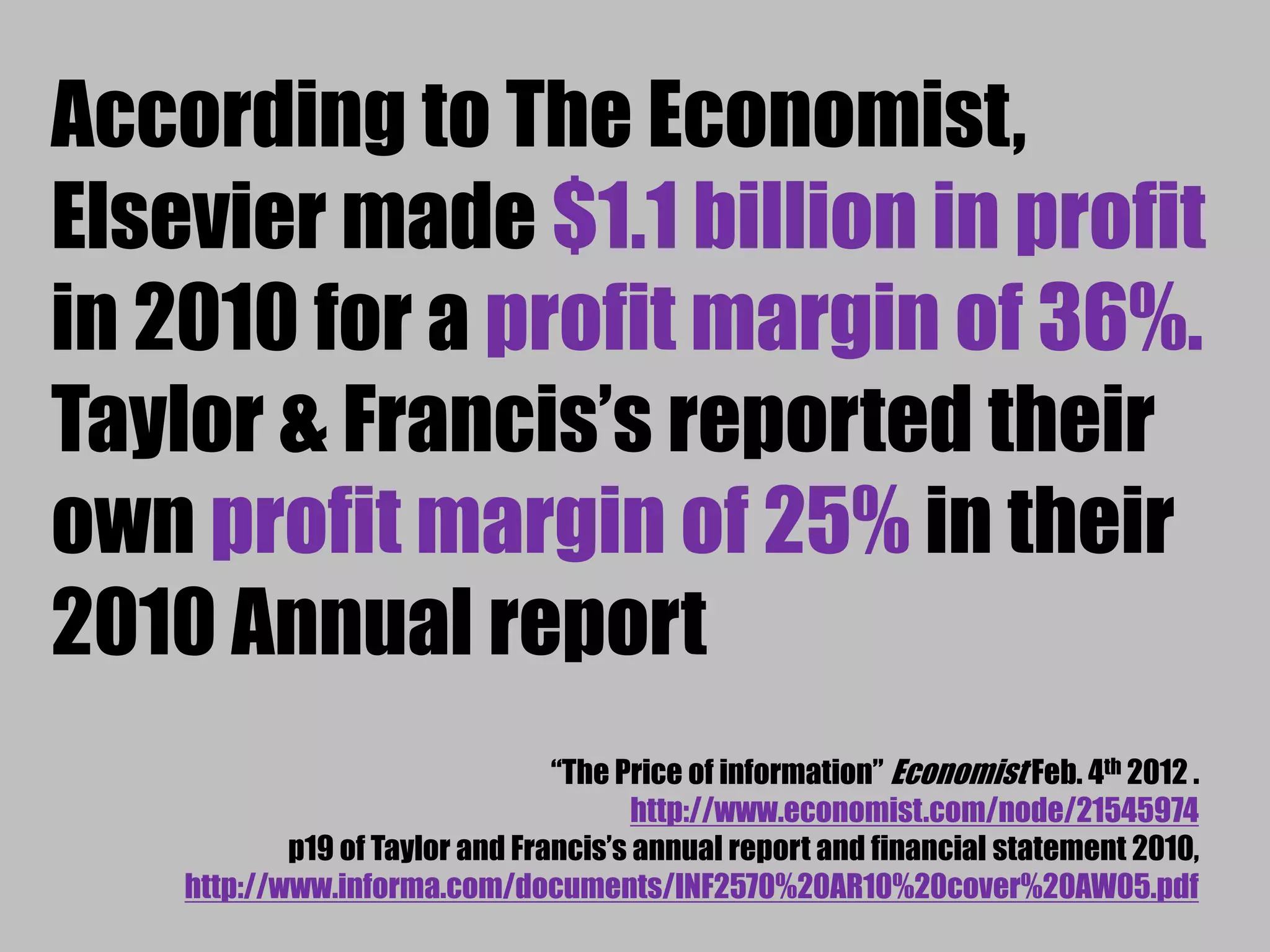
According to The Economist, 
Elsevier made $1.1 billion in profit 
in 2010 for a profit margin of 36%. 
Taylor & Francis’s reported their 
own profit margin of 25% in their 
2010 Annual report 
“The Price of information” Economist Feb. 4th 2012 . 
http://www.economist.com/node/21545974 
p19 of Taylor and Francis’s annual report and financial statement 2010, 
http://www.informa.com/documents/INF2570%20AR10%20cover%20AW05.pdf
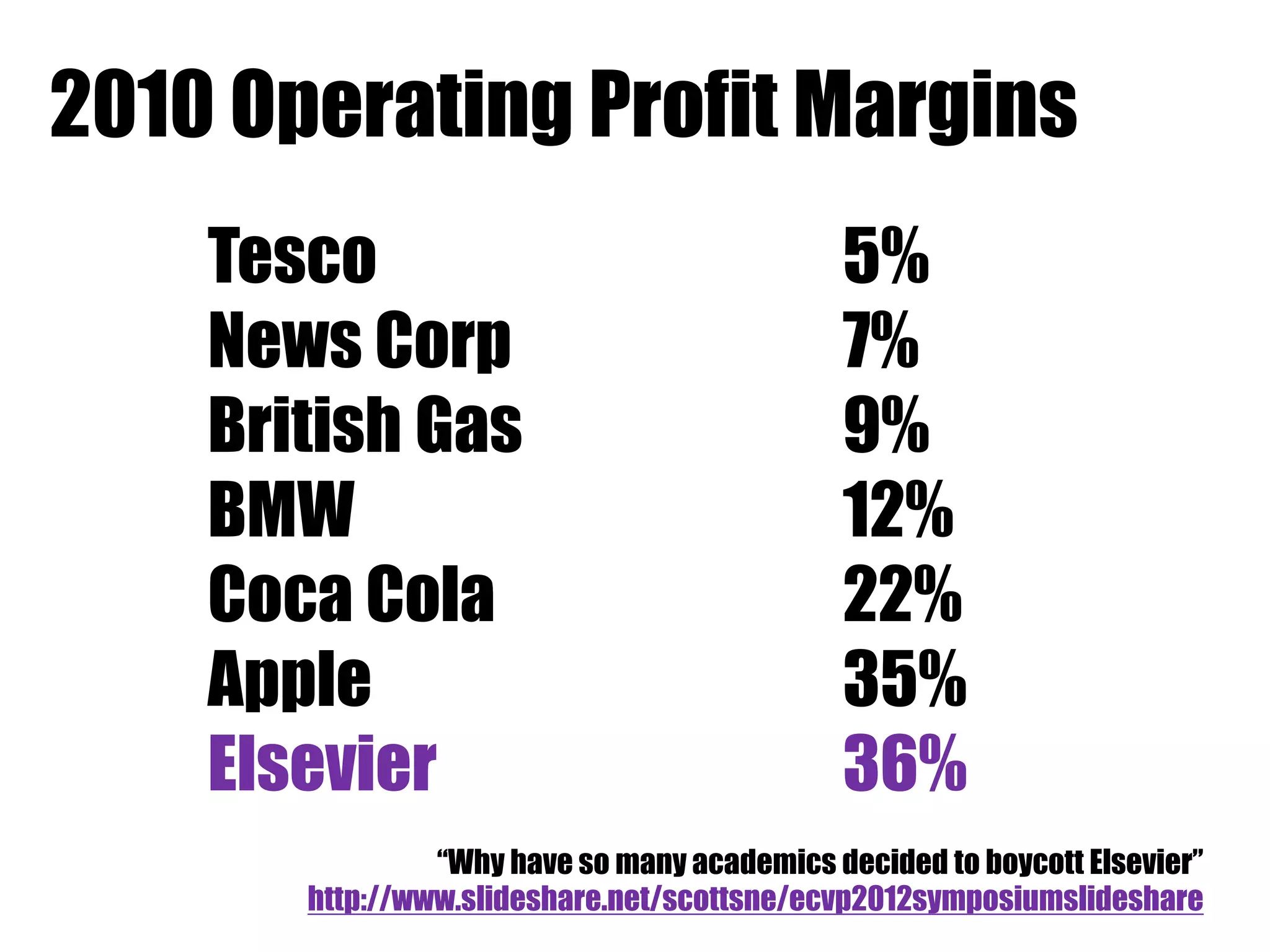
2010 Operating Profit Margins 
Tesco 5% 
News Corp 7% 
British Gas 9% 
BMW 12% 
Coca Cola 22% 
Apple 35% 
Elsevier 36% 
“Why have so many academics decided to boycott Elsevier” 
http://www.slideshare.net/scottsne/ecvp2012symposiumslideshare
why? 
“Because it can boost the visibility and 
broaden access to your research.”
Benefits for authors... 
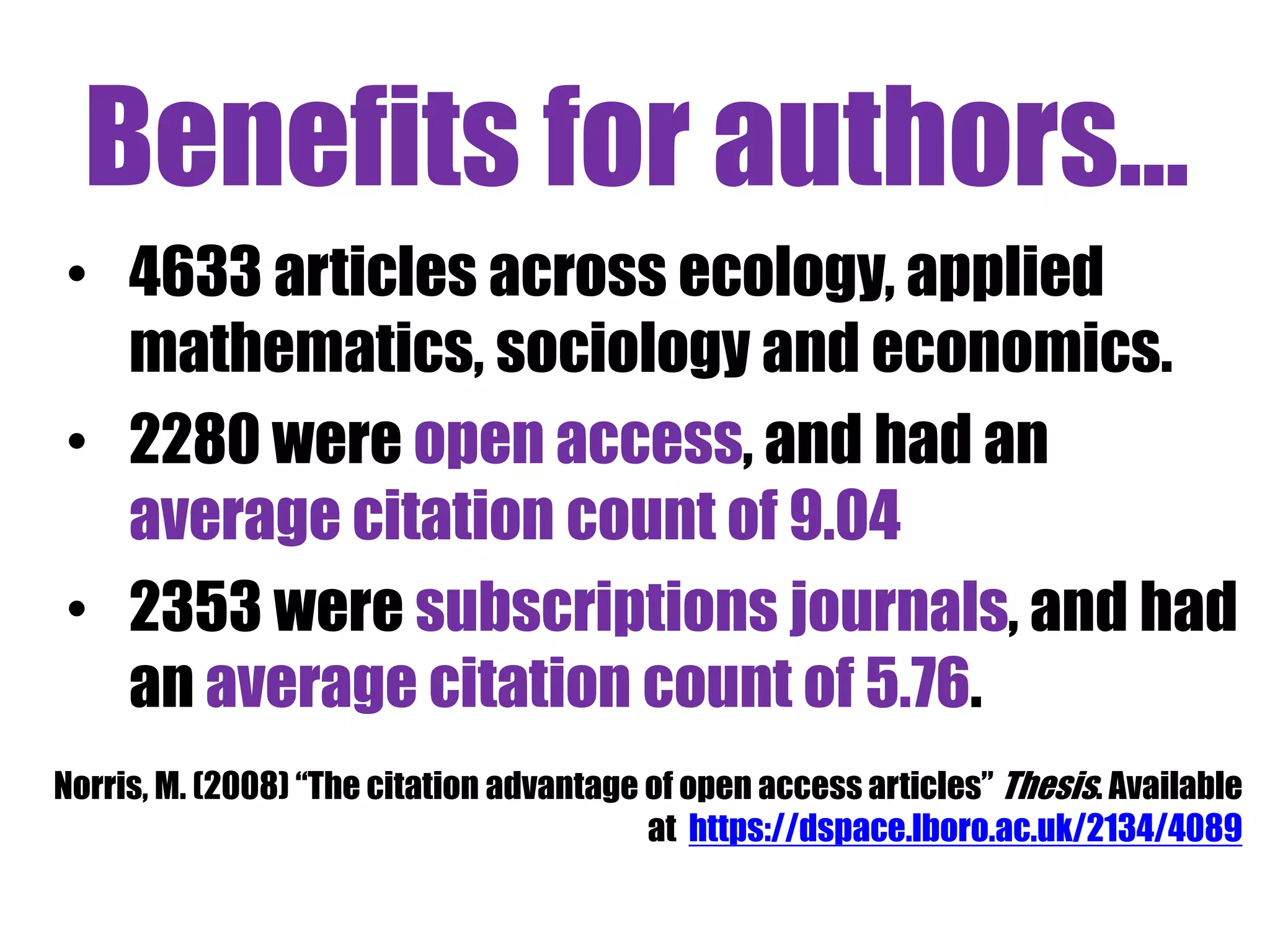
• 4633 articles across ecology, applied 
mathematics, sociology and economics. 
• 2280 were open access, and had an 
average citation count of 9.04 
• 2353 were subscriptions journals, and had 
an average citation count of 5.76. 
Norris, M. (2008) “The citation advantage of open access articles” Thesis. Available 
at https://dspace.lboro.ac.uk/2134/4089
Benefits for authors... 
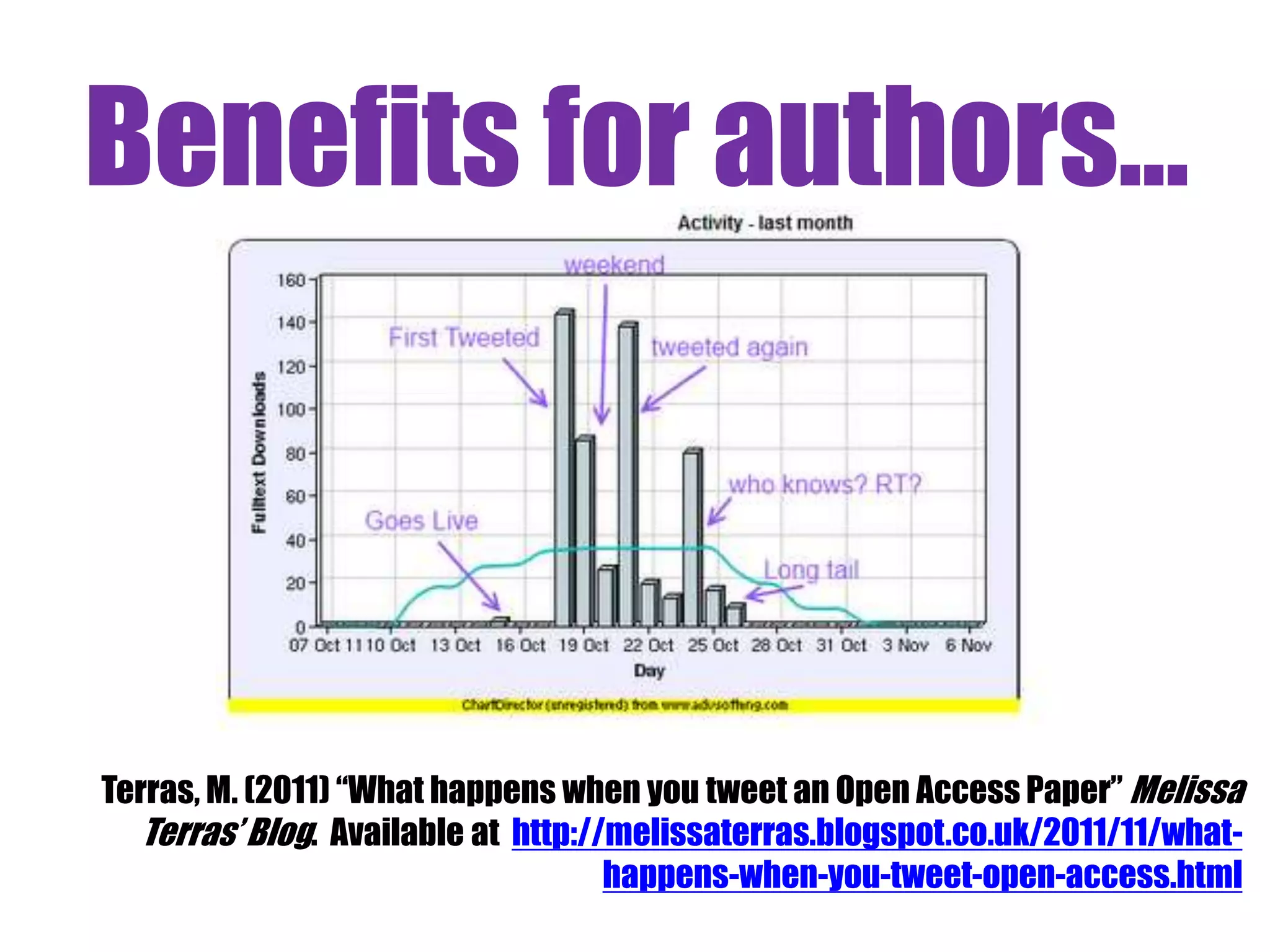
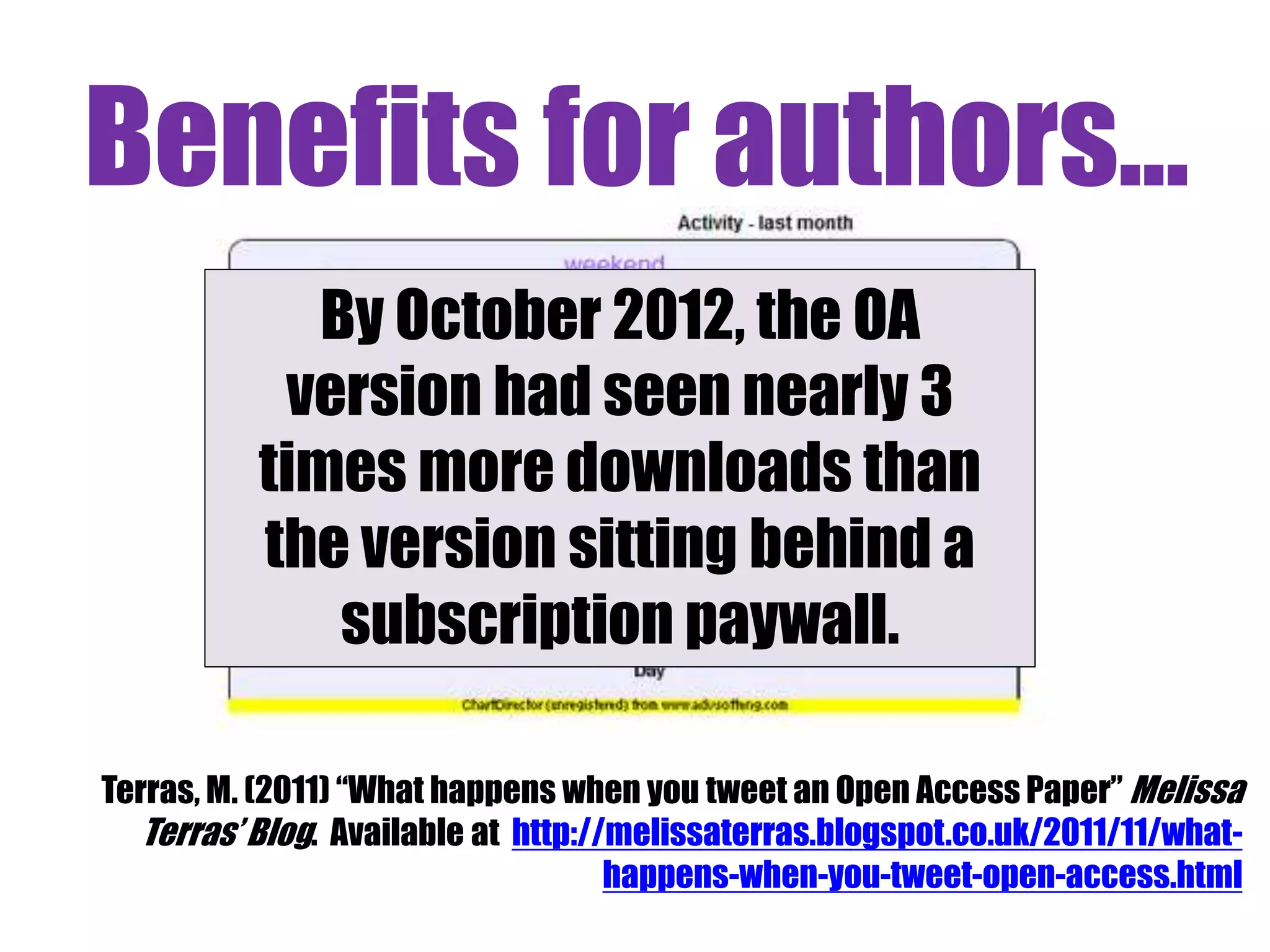
Terras, M. (2011) “What happens when you tweet an Open Access Paper” Melissa 
Terras’ Blog. Available at http://melissaterras.blogspot.co.uk/2011/11/what-happens- 
when-you-tweet-open-access.html
Benefits for authors... 
By October 2012, the OA 
version had seen nearly 3 
times more downloads than 
the version sitting behind a 
subscription paywall. 
Terras, M. (2011) “What happens when you tweet an Open Access Paper” Melissa 
Terras’ Blog. Available at http://melissaterras.blogspot.co.uk/2011/11/what-happens- 
when-you-tweet-open-access.html
Benefits for authors... 
“My gold access papers have huge downloads, 
one staying in the top 20 for over 3 months” 
Dr David Selby, Department of Earth Sciences, Durham University (January 2014) 
“the editor of the journal has emailed me to 
tell me that my article has been one of the 
most downloaded in that year” 
Dr Andy Byford, School of Modern Languages and Cultures, Durham University 
(August 2014)
Benefits for authors... 
“"I am still surprised and continually 
delighted to find many of my works in 
DRO have been downloaded by far more 
people than ever bought the volumes.” 
Dr Michael Crang, Department of Geography, Durham University 
http://dro.dur.ac.uk/testimonials/
why? 
“Because people want to read it and use it but 
they aren’t able to.”
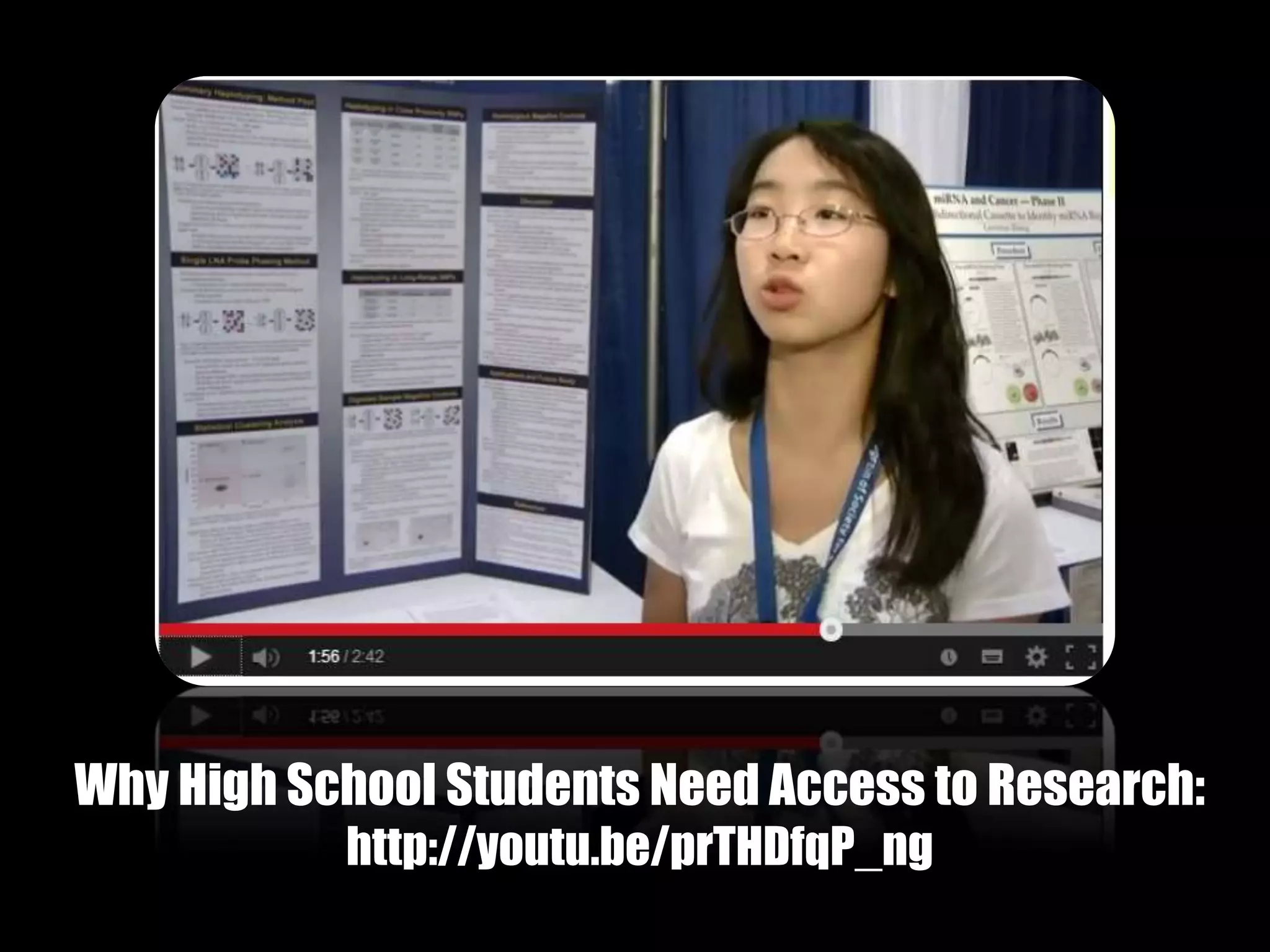
Why High School Students Need Access to Research: 
http://youtu.be/prTHDfqP_ng
why? 
“Because it can boost the visibility and 
broaden access to your research.”
Because the cost of the current publication 
system cannot continue to be supported 
without change. 
Because it can boost the visibility and broaden 
access to your research. 
Because people want to read it and use it but 
they aren’t able to. 
Because you can.
concerns? 
Via Flickr Creative Commons, by © Stuti Sakhalkar. Original available 
at http://www.flickr.com/photos/theblackcanvas/2945878325/
What Open Access 
requirements are 
there?
Things to do... 
• If your research is funded, check what the 
funder requires.. 
• Also check what your employer, or any national 
assessments require... 
• Once you have identified how you want to 
publish your research, and where, check what 
options that publisher allows. 
• Once you have publications accepted, make 
sure you do what is needed to make your 
publications open access.
Required: 1
Check the 
requirements 
of your funder
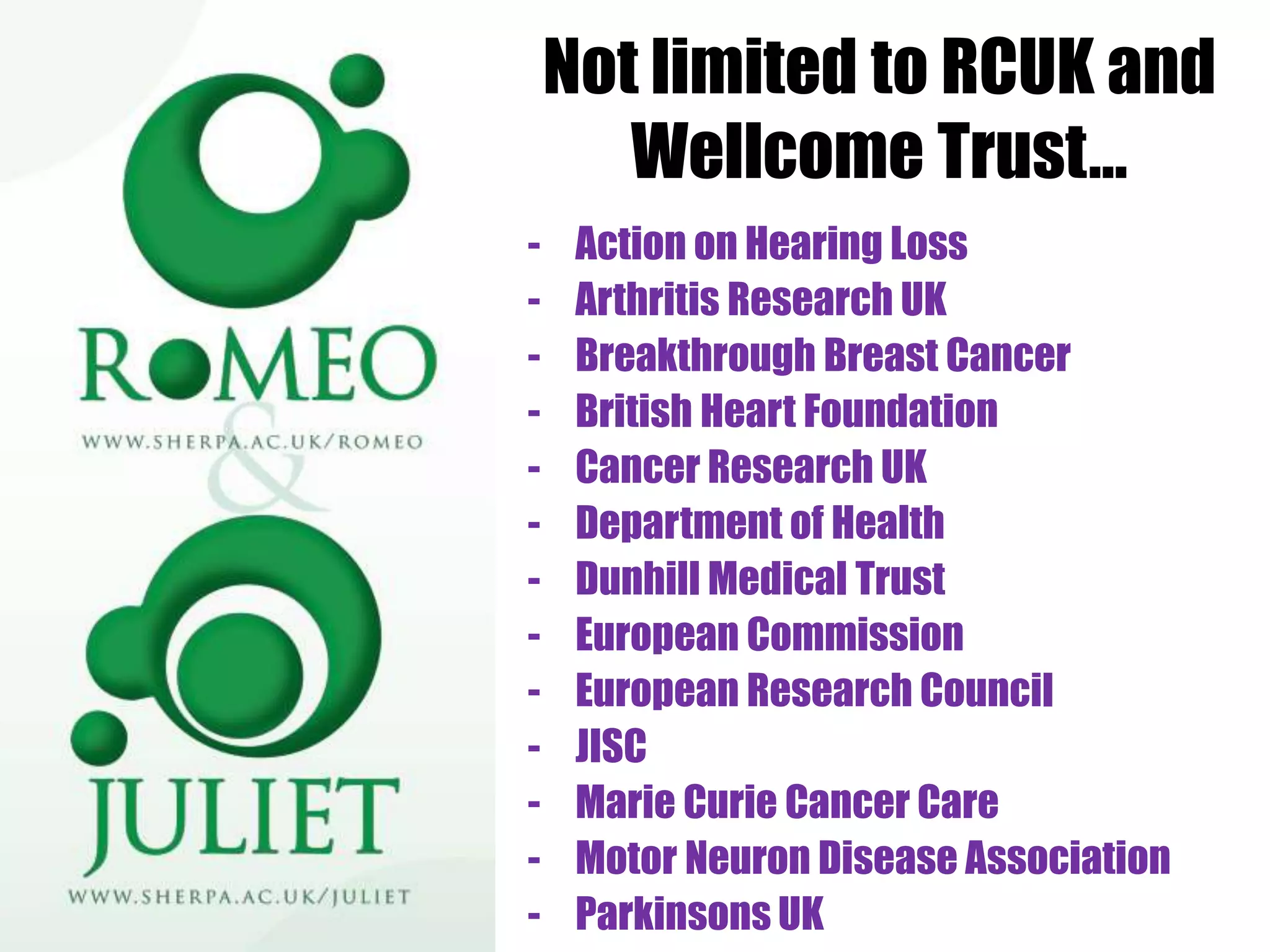
Not limited to RCUK and 
Wellcome Trust… 
- Action on Hearing Loss 
- Arthritis Research UK 
- Breakthrough Breast Cancer 
- British Heart Foundation 
- Cancer Research UK 
- Department of Health 
- Dunhill Medical Trust 
- European Commission 
- European Research Council 
- JISC 
- Marie Curie Cancer Care 
- Motor Neuron Disease Association 
- Parkinsons UK
Example policy: 
RCUK Policy
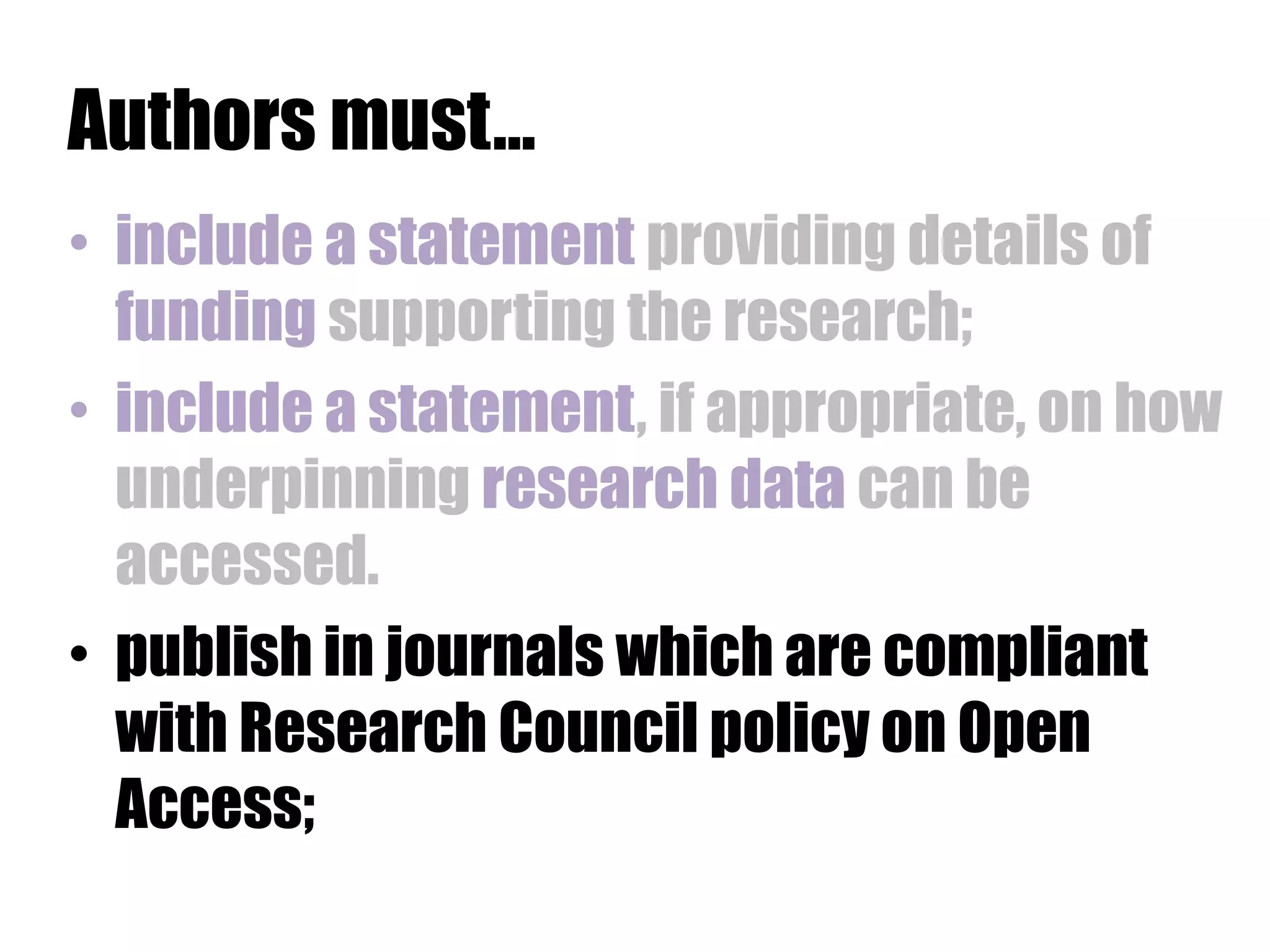
Authors must… 
• include a statement providing details of 
funding supporting the research; 
• include a statement, if appropriate, on how 
underpinning research data can be 
accessed. 
• publish in journals which are compliant 
with Research Council policy on Open 
Access;
Is the journal compliant? 
In order to be deemed compliant with RCUK Policy, a journal must 
either: 
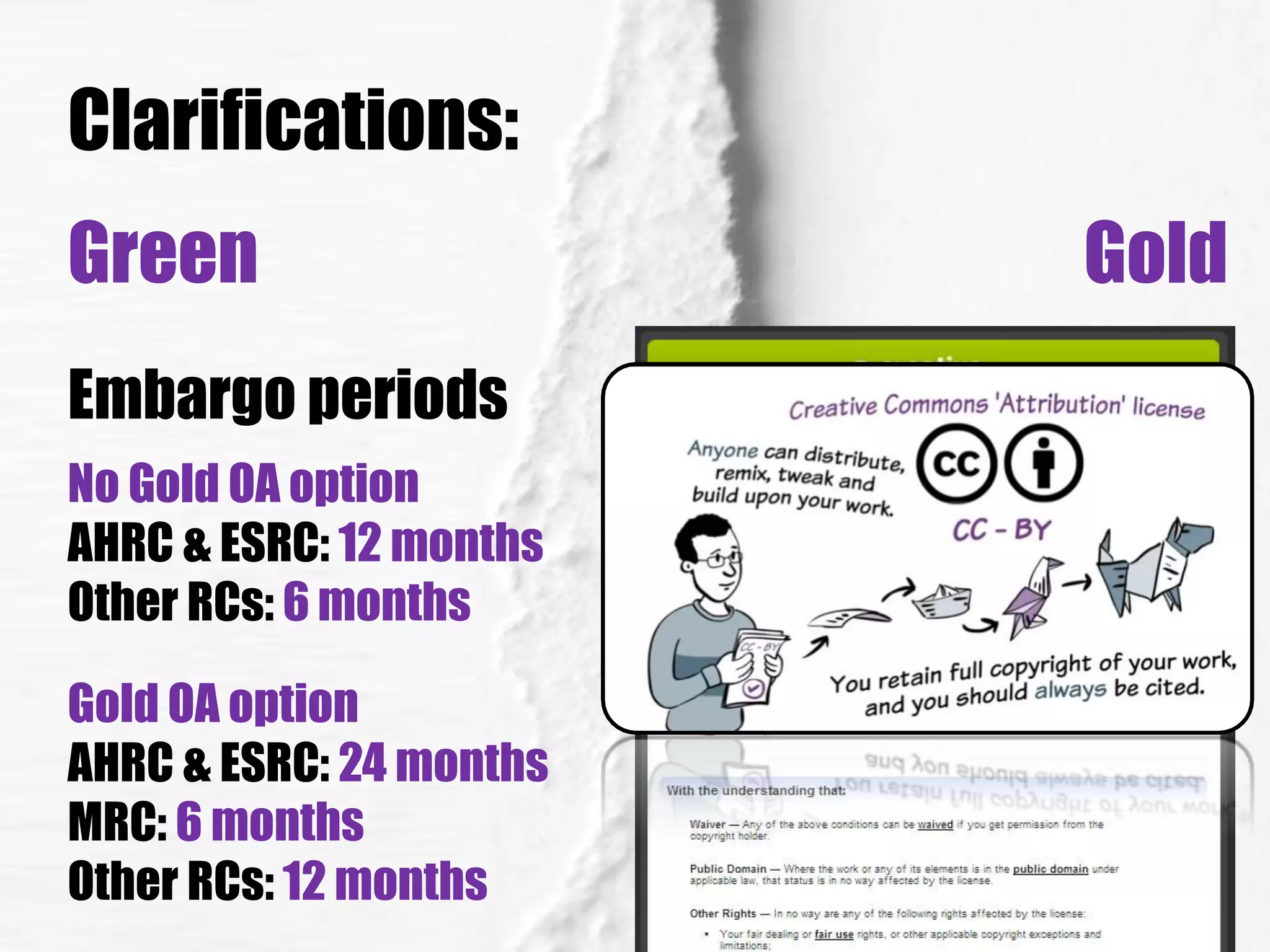
“[GOLD] provide, via its own website, immediate and unrestricted 
access to the final published version of the paper, which should be 
made available using the Creative Commons Attribution (CC BY) 
licence. This may involve payment of an ‘Article Processing Charge’ 
(APC) to the publisher.“ 
or... 
[GREEN] permit the author to deposit their "final Accepted 
Manuscript in any repository, without restriction on non-commercial 
re-use and within a defined period. No APC will be 
payable to the publisher."
Clarifications: 
Green Gold 
Embargo periods 
No Gold OA option 
AHRC & ESRC: 12 months 
Other RCs: 6 months 
Gold OA option 
AHRC & ESRC: 24 months 
MRC: 6 months 
Other RCs: 12 months
Required: 2
Check the requirements of 
your institution
Durham University Policy 
• Durham Open Access Policy 
http://dro.dur.ac.uk/du_oa_policy_summary.pdf 
“Authors must provide an electronic copy of all peer-reviewed journal 
articles and conference papers published since 1st January 2013 
within 3 months of acceptance for publication for deposit in Durham 
Research Online (DRO)” 
“Publications referred to for consideration in promotion applications: 
where published since 1st January 2013 the author’s final peer-reviewed 
manuscript must have been deposited in DRO”
Required: 3
Post-2014 REF
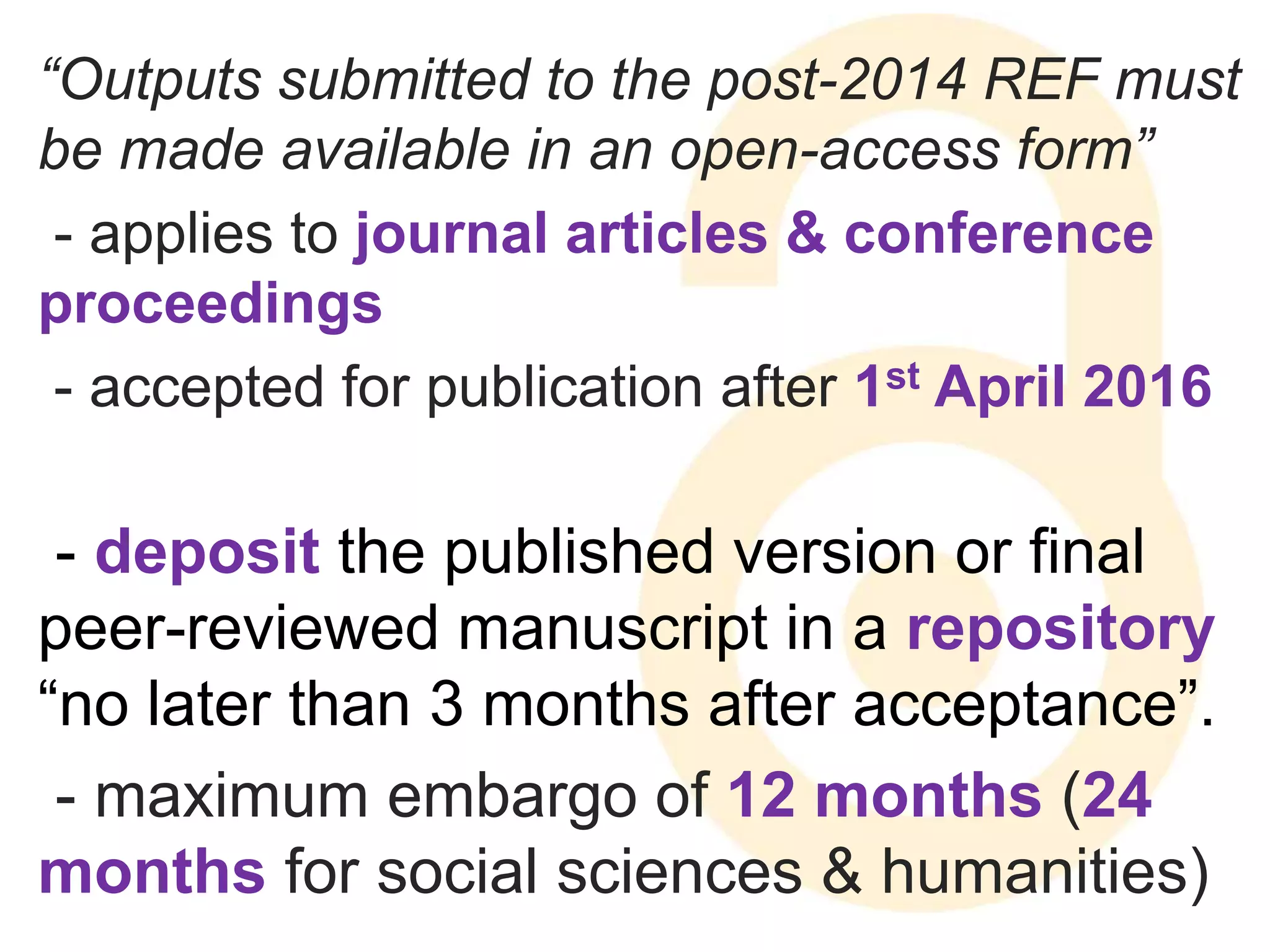
“Outputs submitted to the post-2014 REF must 
be made available in an open-access form” 
- applies to journal articles & conference 
proceedings 
- accepted for publication after 1st April 2016 
- deposit the published version or final 
peer-reviewed manuscript in a repository 
“no later than 3 months after acceptance”. 
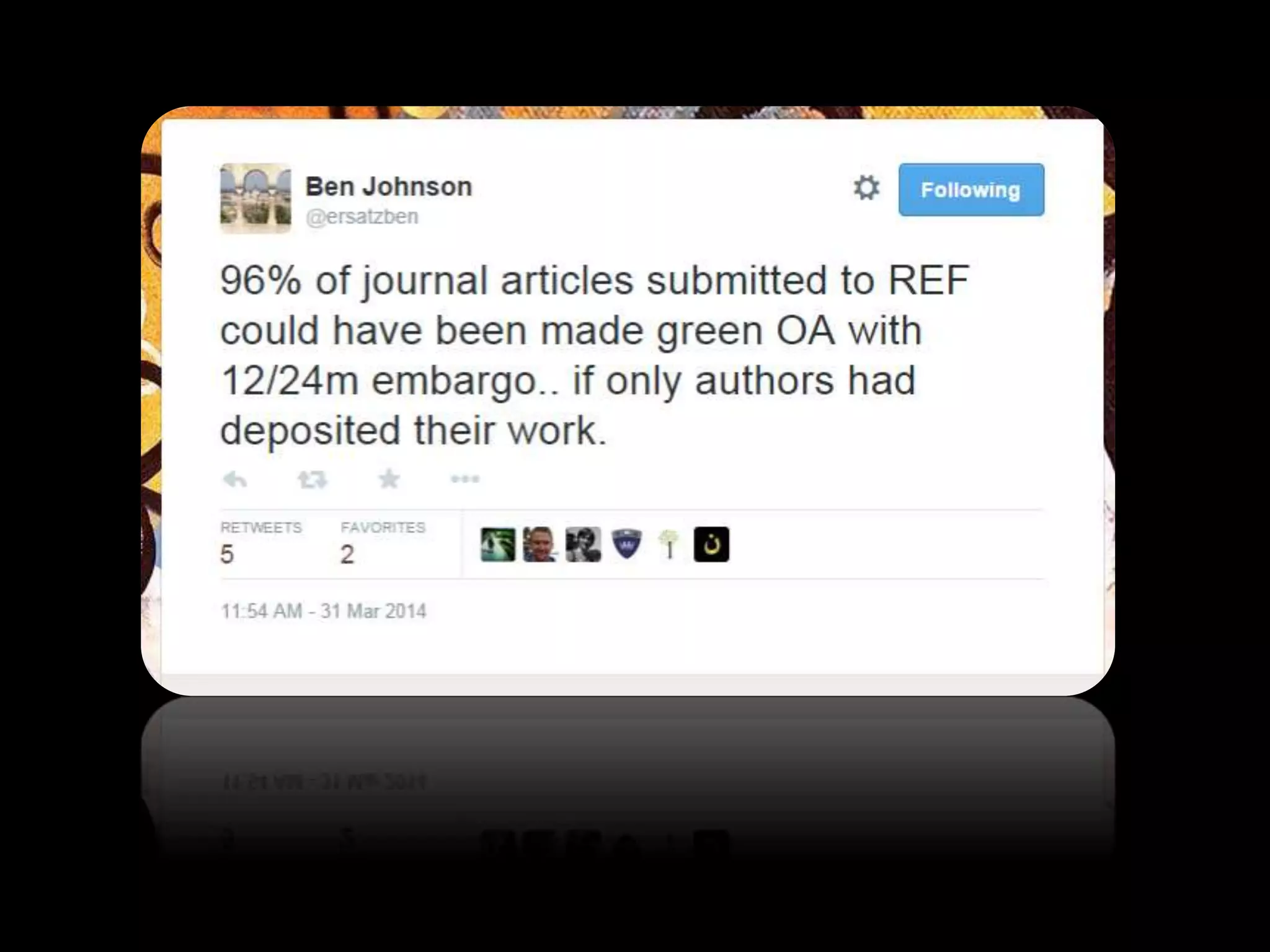
- maximum embargo of 12 months (24 
months for social sciences & humanities)
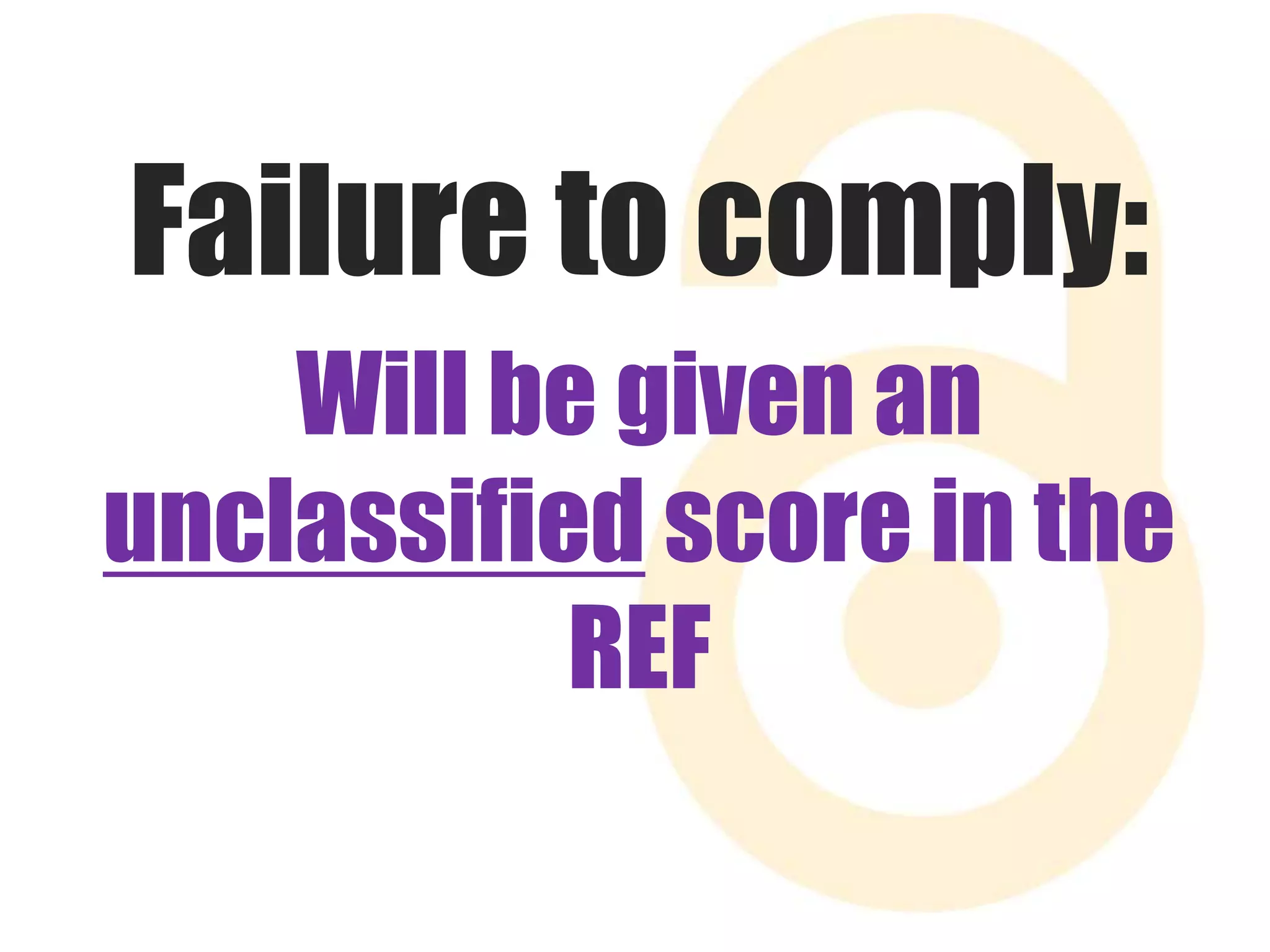
Failure to comply: 
Will be given an 
unclassified score in the 
REF
Have a go... 
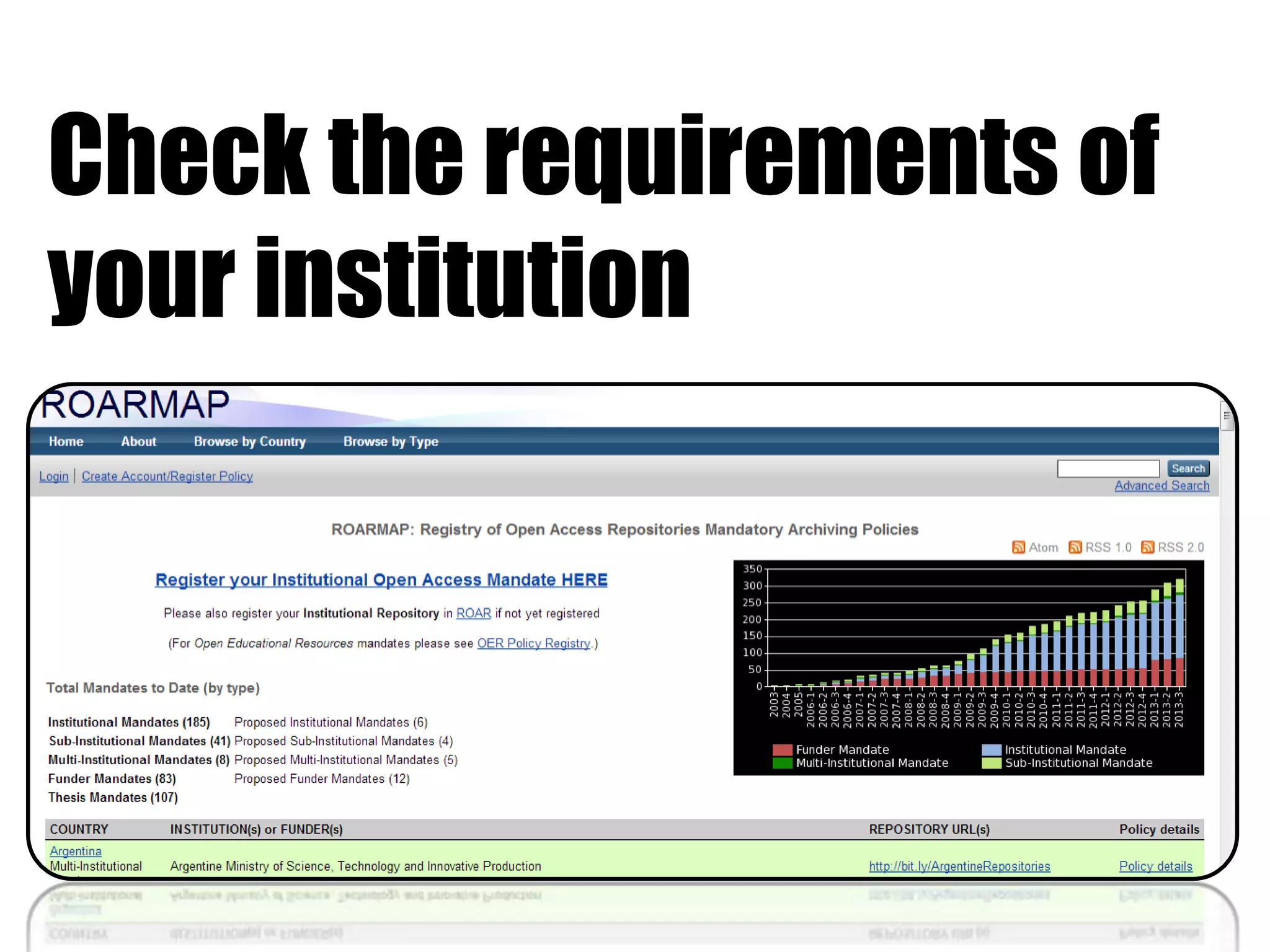
• http://www.sherpa.ac.uk/juliet/ - identify research funder policies 
• http://roarmap.eprints.org/ - identify institutional OA policies 
• http://bit.ly/12SOYCw - Open Access pages (Durham) inc. REF info 
Via Flickr Creative Commons, by © Stuti Sakhalkar. Original available 
at http://www.flickr.com/photos/theblackcanvas/2945878325/
What are you permitted 
to do, and who’s 
permission do you 
need?
Check what 
options your 
journal offers / 
the terms of any 
publishing 
agreement. 
- Sherpa/Romeo 
- Journal/Publisher 
agreement and guidelines
Your journal / publisher does not 
permit self-archiving or offer a 
paid open access option? 
Ask them – it is your research. 
You may be able to negotiate (esp 
if your funder requires you to 
take action).
Have a go... 
• http://www.sherpa.ac.uk/romeo/ - identify journal’s green OA terms 
• http://www.sherpa.ac.uk/fact/ - identify gold/green OA options 
• http://www.doaj.org/ - Directory of Open Access Journals 
• http://bit.ly/THxAsz - Beall’s List of Predatory Publishers 
• have a look at some journals/publishers in your field 
Via Flickr Creative Commons, by © Stuti Sakhalkar. Original available 
at http://www.flickr.com/photos/theblackcanvas/2945878325/
Durham Research 
Online (DRO)
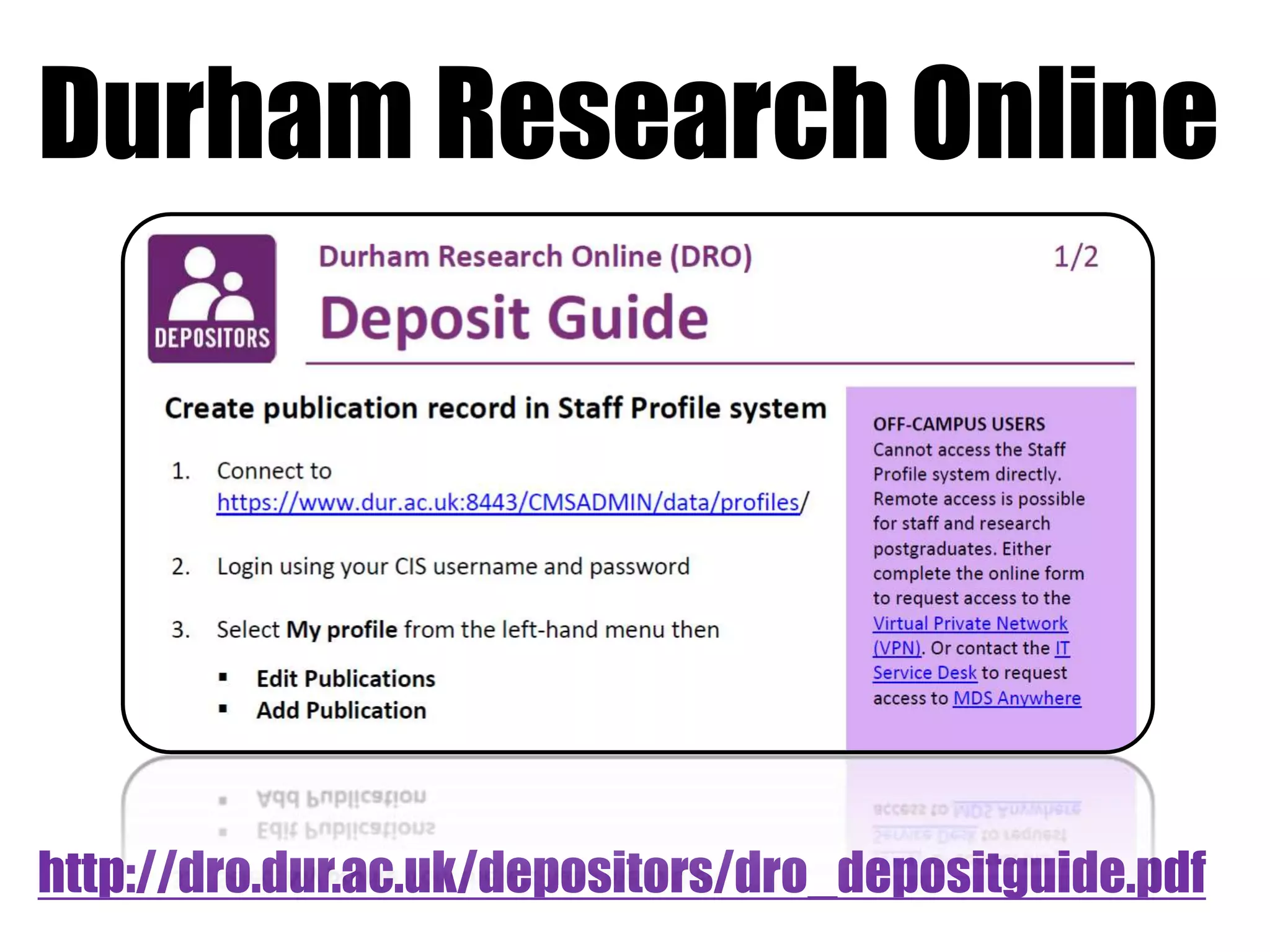
Durham Research Online 
http://dro.dur.ac.uk/depositors/dro_depositguide.pdf
Durham Research Online 
• 12,508 records in DRO 
- 5,903 full text (47%) 
- 282 further records embargoed (2%) 
• Durham Open Access Policy 
http://dro.dur.ac.uk/du_oa_policy_summary.pdf 
• Add bibliographic details; Tick the box; Attach 
your final accepted manuscript.
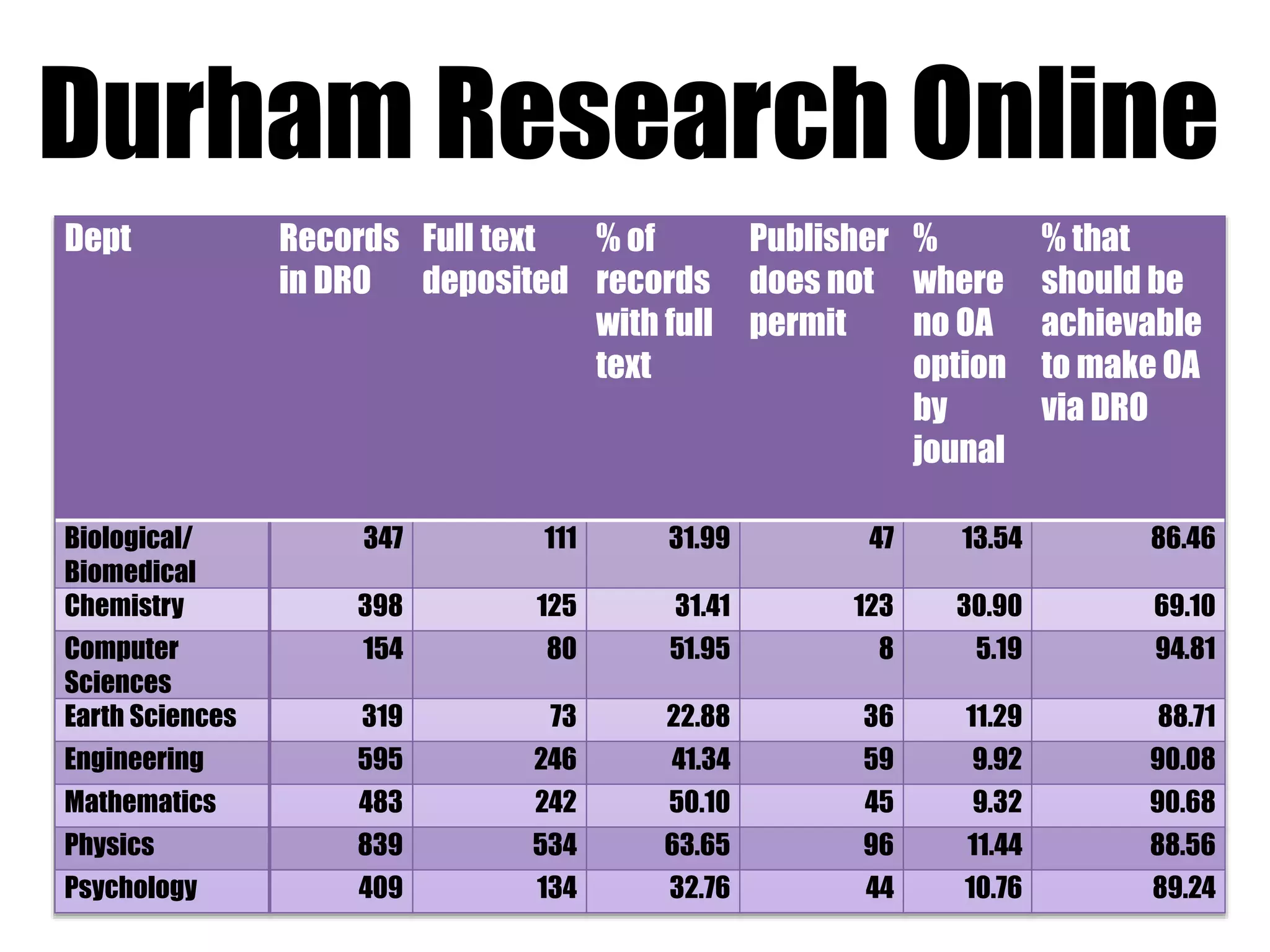
Durham Research Online 
Dept Records 
in DRO 
Full text 
deposited 
% of 
records 
with full 
text 
Publisher 
does not 
permit 
% 
where 
no OA 
option 
by 
jounal 
% that 
should be 
achievable 
to make OA 
via DRO 
Biological/ 
Biomedical 
347 111 31.99 47 13.54 86.46 
Chemistry 398 125 31.41 123 30.90 69.10 
Computer 
154 80 51.95 8 5.19 94.81 
Sciences 
Earth Sciences 319 73 22.88 36 11.29 88.71 
Engineering 595 246 41.34 59 9.92 90.08 
Mathematics 483 242 50.10 45 9.32 90.68 
Physics 839 534 63.65 96 11.44 88.56 
Psychology 409 134 32.76 44 10.76 89.24
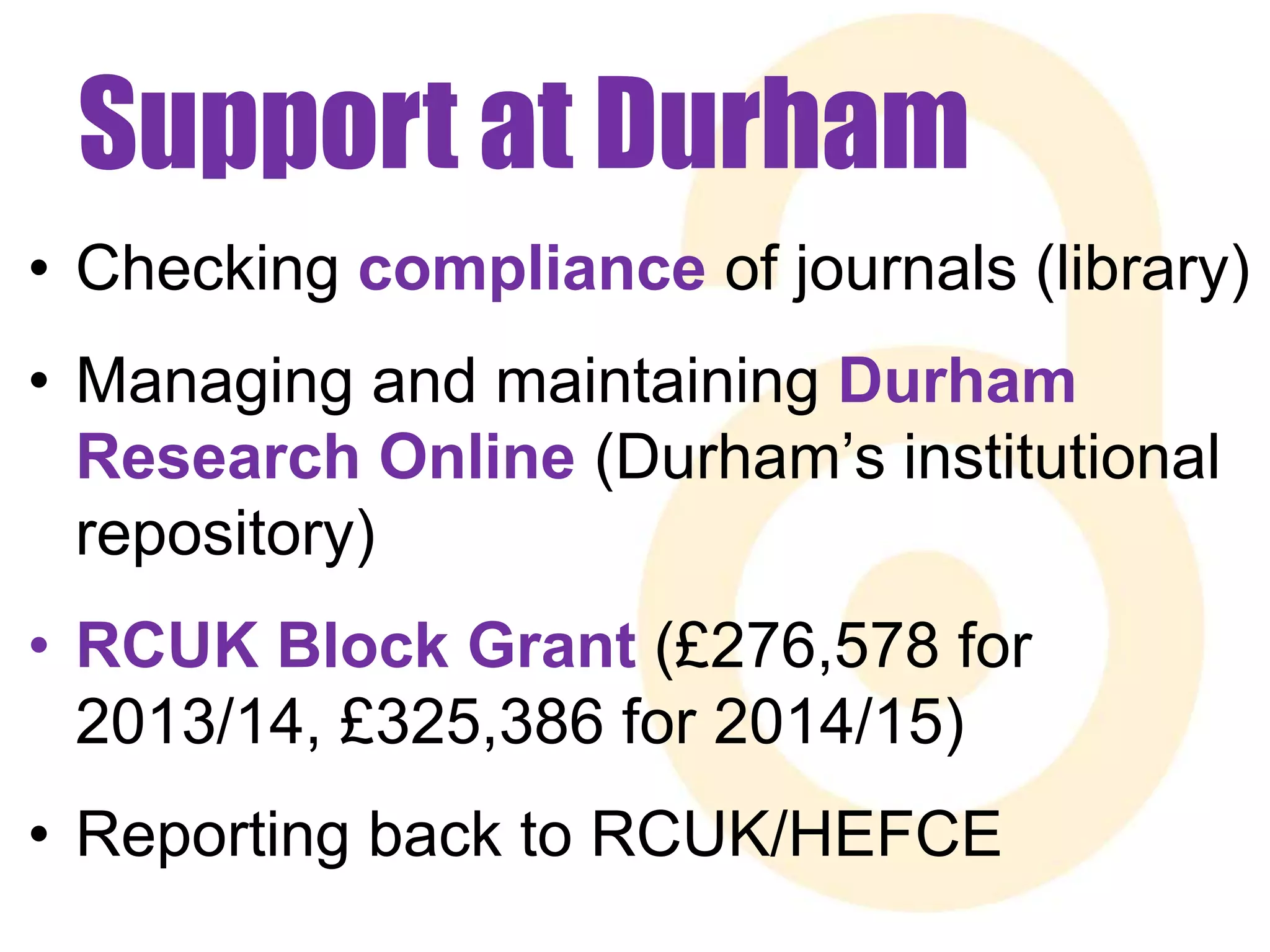
Support at Durham 
• Checking compliance of journals (library) 
• Managing and maintaining Durham 
Research Online (Durham’s institutional 
repository) 
• RCUK Block Grant (£276,578 for 
2013/14, £325,386 for 2014/15) 
• Reporting back to RCUK/HEFCE
Searching for OA 
research
Concerns / 
Q & A
Image Credits 
[6] Via Flickr Creative Commons, and by jekert gwapo: Available at 
http://www.flickr.com/photos/jekert/4412533661/ 
[7] Via Flickr Creative Commons, and by Darwin Bell: Available at 
http://www.flickr.com/photos/darwinbell/1454251440/ 
[51] Via Flickr Creative Commons, and by Chris Devers: Available at 
http://www.flickr.com/photos/cdevers/5128003102/ 
[11-12] Via Flickr Creative Commons, by 110kr and tao_zhyn. Available at 
http://www.flickr.com/photos/tao_zhyn/442965594/in/photostream/ and 
http://www.flickr.com/photos/100kr/209708058/in/photostream/ 
[8] Via Flickr Creative Commons, by Nick Wheeler. Available at 
http://www.flickr.com/photos/7762644@N04/2295584401 
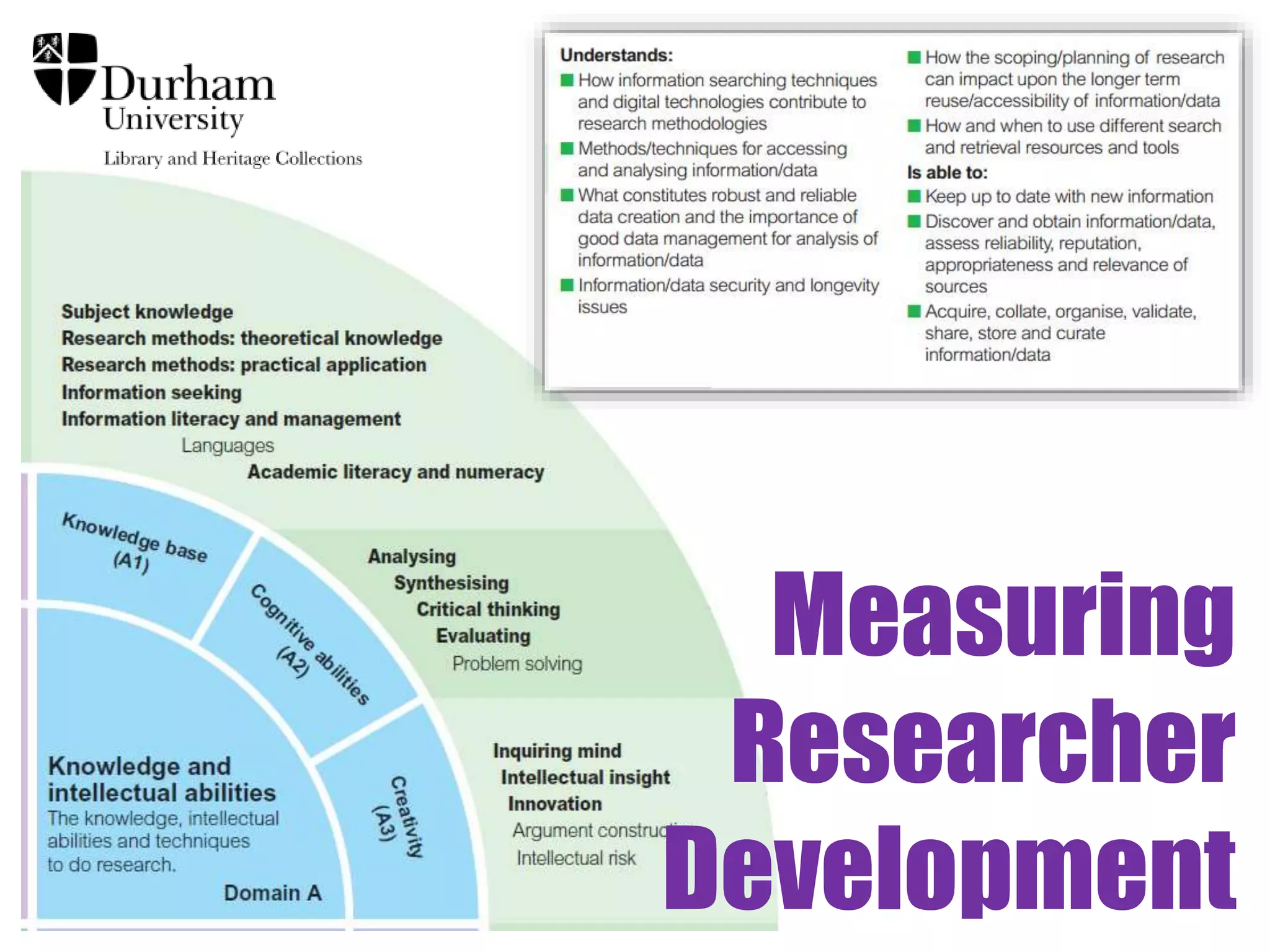
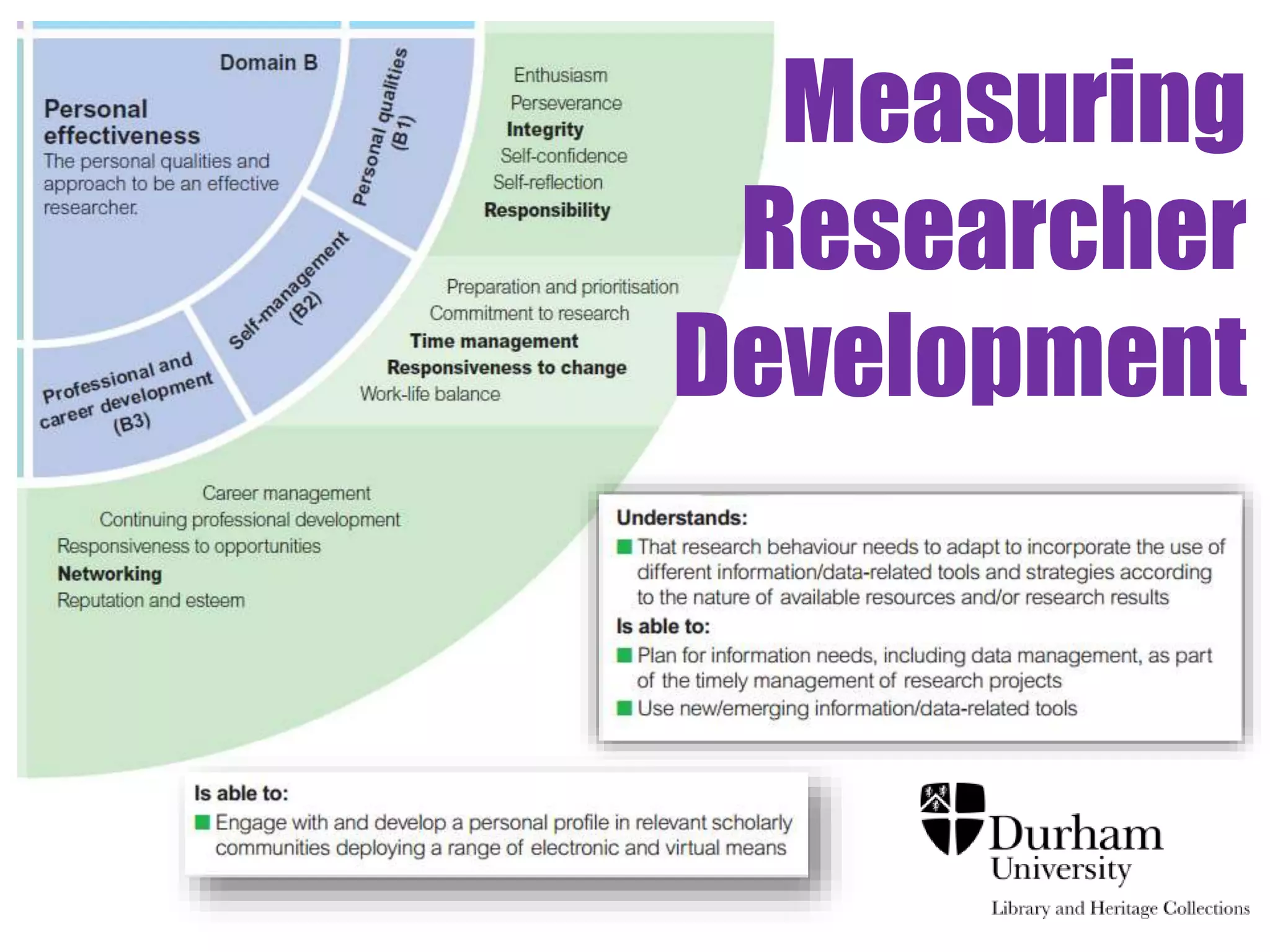
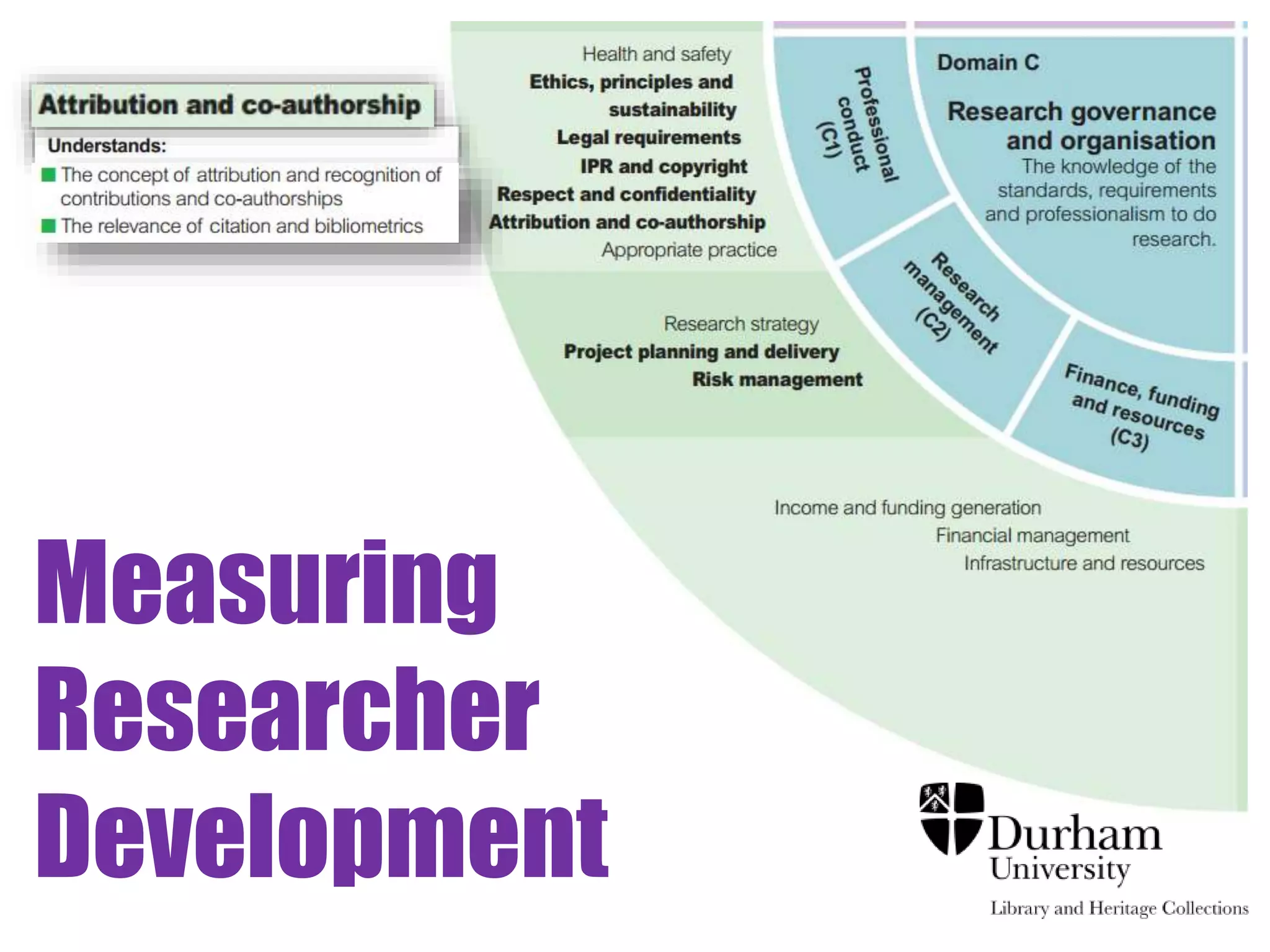
[Slides 78-81] Vitae®, © 2010 Careers Research and Advisory Centre 
(CRAC) Limited‘ Available at www.vitae.ac.uk/rdf
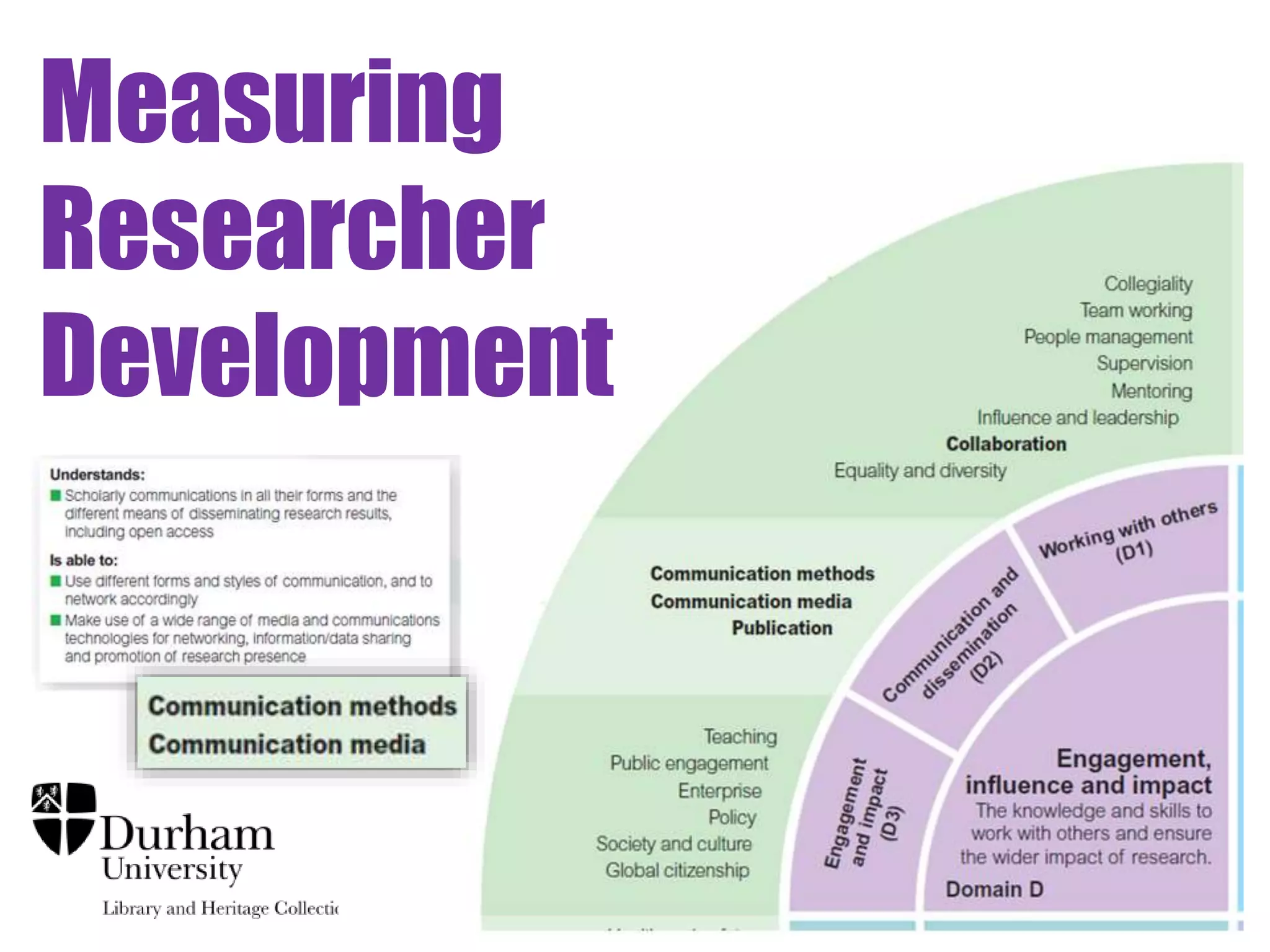
Measuring 
Researcher 
Development
Measuring 
Researcher 
Development
Measuring 
Researcher 
Development
Measuring 
Researcher 
Development

Publishing your research: Open Access (introduction & overview)

  • 1.
    Publishing your Research:Open Access What is it and what requirements do you need to meet? James Bisset james.bisset@durham.ac.uk Academic Liaison Librarian (Research Support)
  • 2.
    Session outline -What is “Open Access”? - Paywalls, Terminology, Examples - Why make your research Open Access? - Benefits for authors / Benefits for readers - What Open Access requirements are there? - OA mandates, identifying your options, DRO - Searching for open access articles - Repositories, OA Journals, Search engines
  • 3.
    What is Open Access ?
  • 6.
    An article thatis Open Access can be freely accessed by anyone in the world using an internet connection.
  • 7.
    no subscription... ...nologin or password
  • 8.
    Some Open Access articles may also allow full or limited re-use of the content in the publication...
  • 9.
    “... free availabilityon the public internet, permitting any users to read, download, copy, distribute, print, search, or link to the full texts of these articles, crawl them for indexing, pass them as data to software, or use them for any other lawful purpose, without financial, legal, or technical barriers other than those inseparable from gaining access to the internet itself. The only constraint on reproduction and distribution, and the only role for copyright in this domain, should be to give authors control over the integrity of their work and the right to be properly acknowledged and cited.“ http://www.budapestopenaccessinitiative.org/read Budapest Open Access Initiative.
  • 10.
    http://dro.dur.ac.uk/view/departments/ Via FlickrCreative Commons, by © Stuti Sakhalkar. Original available at http://www.flickr.com/photos/theblackcanvas/2945878325/ Have a go... http://www.plosone.org/browse/
  • 13.
    Why a repository?Why can’t I do what I want with an article I have written? - 53% of publishers request a copyright transfer - 20.8% of publishers request a licence to publish - 19.6% of publishers request a copyright transfer would on request provide a licence to publish document instead http://www.alpsp.org/Ebusiness/ProductCatalog/Product.aspx?ID=44 Scholarly Publishing Practice 3 (2008).
  • 14.
    Why a repository?Why can’t I do what I want with an article I have written? - Elsevier issued 2,800 take-down notices at articles hosted by their authors on academia.edu - Followed by notices to Calgary University & Harvard University to remove content from their servers. - Elsevier is within its legal rights to do so. http://wapo.st/19BbeRx “How one publisher is stopping academics from sharing their research” (19 December 2013) Washington Post.
  • 15.
  • 16.
    Impact Factor =10.353 - 14th of 290 in Biochemistry & Molecular Biology - 1st, Cell , allows Green Open Access, no embargo period & Gold Open Access (Elsevier/Cell Press) - 4th of 47 in Evolutionary Biology - 1st, Trends in Ecology and Evolution, allows Green Open Access, no embargo period (Elsevier/Trends) - 8th of 161 in Genetics & Hereditary - 1st, Nature Reviews: Genetics allows Green Open Access, embargo period of 6 months (Nature)
  • 17.
  • 19.
    Author can make his/her final peer-reviewed manuscript free to access from a repository (following 12 month embargo)
  • 20.
    Impact Factor = 1.036 Ranked 2nd in History & in History of Social Sciences.
  • 21.
    Pay $3000 togo GOLD Go GREEN for free (12 month embargo)
  • 24.
    Why make your research Open Access?
  • 25.
    “on average acrossthe NHS, [only] about a third of relevant journals were available free at the point of use” http://bit.ly/MnfGEY Finch Report (June 2012), from data originally reported in Heading for the Open Road: costs and benefits of transitions in scholarly communications, RIN, PRC, Wellcome Trust, RLUK and JISC, 2011.
  • 26.
    “many researchers …in smaller and less research-intensive institutions … do not have access to a sufficiently-wide range of titles” http://bit.ly/MnfGEY Finch Report (June 2012), from data originally reported in Access to scholarly content: gaps and barriers, RIN, Publishing Research Consortium and JISC, 2011.
  • 27.
    “across central Governmentand its agencies, some 17% of relevant articles are available free at the point of use.” http://bit.ly/MnfGEY Finch Report (June 2012), from data originally reported in Heading for the Open Road: costs and benefits of transitions in scholarly communications, RIN, PRC, Wellcome Trust, RLUK and JISC, 2011.
  • 28.
    “lack of access… may mean that advice and inputs to policy-making are delayed or incomplete." http://bit.ly/MnfGEY Finch Report (June 2012), from data originally reported in Rightscom. Benefits of Open Access to Scholarly Research Outputs to the Public Sector, Report for the Open Access Implementation Group, , 2012
  • 29.
    “the voluntary sector… [often has to] rely on reports from research organisations and Government departments" http://bit.ly/MnfGEY Finch Report (June 2012), from data originally reported in Office for Public Management, Benefits of open access to scholarly research for VCS organisations, JISC 2012.
  • 30.
    “ Every year,JSTOR turns away almost 150 million attempts to gain access to articles...” http://bit.ly/1grt1MV “JSTOR Tests Free, Read-Only Access to Some Articles” (13 January 2012), Chronicle of Higher Education.
  • 31.
    why? “Because thecost of the current publication system cannot continue to be supported without change.”
  • 32.
    “journal prices haverisen four times faster than inflation since the mid-1980's” Peter Suber, Research Professor of Philosophy at Earlham College and Director of the Harvard Open Access Project, quoting research conducted from ARL Statistics 2005- 06, Association of Research Libraries, Washington, D.C.
  • 33.
    According to TheEconomist, Elsevier made $1.1 billion in profit in 2010 for a profit margin of 36%. Taylor & Francis’s reported their own profit margin of 25% in their 2010 Annual report “The Price of information” Economist Feb. 4th 2012 . http://www.economist.com/node/21545974 p19 of Taylor and Francis’s annual report and financial statement 2010, http://www.informa.com/documents/INF2570%20AR10%20cover%20AW05.pdf
  • 34.
    2010 Operating ProfitMargins Tesco 5% News Corp 7% British Gas 9% BMW 12% Coca Cola 22% Apple 35% Elsevier 36% “Why have so many academics decided to boycott Elsevier” http://www.slideshare.net/scottsne/ecvp2012symposiumslideshare
  • 36.
    why? “Because itcan boost the visibility and broaden access to your research.”
  • 37.
    Benefits for authors... • 4633 articles across ecology, applied mathematics, sociology and economics. • 2280 were open access, and had an average citation count of 9.04 • 2353 were subscriptions journals, and had an average citation count of 5.76. Norris, M. (2008) “The citation advantage of open access articles” Thesis. Available at https://dspace.lboro.ac.uk/2134/4089
  • 38.
    Benefits for authors... Terras, M. (2011) “What happens when you tweet an Open Access Paper” Melissa Terras’ Blog. Available at http://melissaterras.blogspot.co.uk/2011/11/what-happens- when-you-tweet-open-access.html
  • 39.
    Benefits for authors... By October 2012, the OA version had seen nearly 3 times more downloads than the version sitting behind a subscription paywall. Terras, M. (2011) “What happens when you tweet an Open Access Paper” Melissa Terras’ Blog. Available at http://melissaterras.blogspot.co.uk/2011/11/what-happens- when-you-tweet-open-access.html
  • 40.
    Benefits for authors... “My gold access papers have huge downloads, one staying in the top 20 for over 3 months” Dr David Selby, Department of Earth Sciences, Durham University (January 2014) “the editor of the journal has emailed me to tell me that my article has been one of the most downloaded in that year” Dr Andy Byford, School of Modern Languages and Cultures, Durham University (August 2014)
  • 41.
    Benefits for authors... “"I am still surprised and continually delighted to find many of my works in DRO have been downloaded by far more people than ever bought the volumes.” Dr Michael Crang, Department of Geography, Durham University http://dro.dur.ac.uk/testimonials/
  • 42.
    why? “Because peoplewant to read it and use it but they aren’t able to.”
  • 43.
    Why High SchoolStudents Need Access to Research: http://youtu.be/prTHDfqP_ng
  • 45.
    why? “Because itcan boost the visibility and broaden access to your research.”
  • 46.
    Because the costof the current publication system cannot continue to be supported without change. Because it can boost the visibility and broaden access to your research. Because people want to read it and use it but they aren’t able to. Because you can.
  • 47.
    concerns? Via FlickrCreative Commons, by © Stuti Sakhalkar. Original available at http://www.flickr.com/photos/theblackcanvas/2945878325/
  • 48.
    What Open Access requirements are there?
  • 49.
    Things to do... • If your research is funded, check what the funder requires.. • Also check what your employer, or any national assessments require... • Once you have identified how you want to publish your research, and where, check what options that publisher allows. • Once you have publications accepted, make sure you do what is needed to make your publications open access.
  • 50.
  • 51.
    Check the requirements of your funder
  • 52.
    Not limited toRCUK and Wellcome Trust… - Action on Hearing Loss - Arthritis Research UK - Breakthrough Breast Cancer - British Heart Foundation - Cancer Research UK - Department of Health - Dunhill Medical Trust - European Commission - European Research Council - JISC - Marie Curie Cancer Care - Motor Neuron Disease Association - Parkinsons UK
  • 53.
  • 54.
    Authors must… •include a statement providing details of funding supporting the research; • include a statement, if appropriate, on how underpinning research data can be accessed. • publish in journals which are compliant with Research Council policy on Open Access;
  • 55.
    Is the journalcompliant? In order to be deemed compliant with RCUK Policy, a journal must either: “[GOLD] provide, via its own website, immediate and unrestricted access to the final published version of the paper, which should be made available using the Creative Commons Attribution (CC BY) licence. This may involve payment of an ‘Article Processing Charge’ (APC) to the publisher.“ or... [GREEN] permit the author to deposit their "final Accepted Manuscript in any repository, without restriction on non-commercial re-use and within a defined period. No APC will be payable to the publisher."
  • 56.
    Clarifications: Green Gold Embargo periods No Gold OA option AHRC & ESRC: 12 months Other RCs: 6 months Gold OA option AHRC & ESRC: 24 months MRC: 6 months Other RCs: 12 months
  • 57.
  • 58.
    Check the requirementsof your institution
  • 59.
    Durham University Policy • Durham Open Access Policy http://dro.dur.ac.uk/du_oa_policy_summary.pdf “Authors must provide an electronic copy of all peer-reviewed journal articles and conference papers published since 1st January 2013 within 3 months of acceptance for publication for deposit in Durham Research Online (DRO)” “Publications referred to for consideration in promotion applications: where published since 1st January 2013 the author’s final peer-reviewed manuscript must have been deposited in DRO”
  • 60.
  • 61.
  • 62.
    “Outputs submitted tothe post-2014 REF must be made available in an open-access form” - applies to journal articles & conference proceedings - accepted for publication after 1st April 2016 - deposit the published version or final peer-reviewed manuscript in a repository “no later than 3 months after acceptance”. - maximum embargo of 12 months (24 months for social sciences & humanities)
  • 63.
    Failure to comply: Will be given an unclassified score in the REF
  • 64.
    Have a go... • http://www.sherpa.ac.uk/juliet/ - identify research funder policies • http://roarmap.eprints.org/ - identify institutional OA policies • http://bit.ly/12SOYCw - Open Access pages (Durham) inc. REF info Via Flickr Creative Commons, by © Stuti Sakhalkar. Original available at http://www.flickr.com/photos/theblackcanvas/2945878325/
  • 65.
    What are youpermitted to do, and who’s permission do you need?
  • 66.
    Check what optionsyour journal offers / the terms of any publishing agreement. - Sherpa/Romeo - Journal/Publisher agreement and guidelines
  • 67.
    Your journal /publisher does not permit self-archiving or offer a paid open access option? Ask them – it is your research. You may be able to negotiate (esp if your funder requires you to take action).
  • 68.
    Have a go... • http://www.sherpa.ac.uk/romeo/ - identify journal’s green OA terms • http://www.sherpa.ac.uk/fact/ - identify gold/green OA options • http://www.doaj.org/ - Directory of Open Access Journals • http://bit.ly/THxAsz - Beall’s List of Predatory Publishers • have a look at some journals/publishers in your field Via Flickr Creative Commons, by © Stuti Sakhalkar. Original available at http://www.flickr.com/photos/theblackcanvas/2945878325/
  • 69.
  • 70.
    Durham Research Online http://dro.dur.ac.uk/depositors/dro_depositguide.pdf
  • 71.
    Durham Research Online • 12,508 records in DRO - 5,903 full text (47%) - 282 further records embargoed (2%) • Durham Open Access Policy http://dro.dur.ac.uk/du_oa_policy_summary.pdf • Add bibliographic details; Tick the box; Attach your final accepted manuscript.
  • 72.
    Durham Research Online Dept Records in DRO Full text deposited % of records with full text Publisher does not permit % where no OA option by jounal % that should be achievable to make OA via DRO Biological/ Biomedical 347 111 31.99 47 13.54 86.46 Chemistry 398 125 31.41 123 30.90 69.10 Computer 154 80 51.95 8 5.19 94.81 Sciences Earth Sciences 319 73 22.88 36 11.29 88.71 Engineering 595 246 41.34 59 9.92 90.08 Mathematics 483 242 50.10 45 9.32 90.68 Physics 839 534 63.65 96 11.44 88.56 Psychology 409 134 32.76 44 10.76 89.24
  • 73.
    Support at Durham • Checking compliance of journals (library) • Managing and maintaining Durham Research Online (Durham’s institutional repository) • RCUK Block Grant (£276,578 for 2013/14, £325,386 for 2014/15) • Reporting back to RCUK/HEFCE
  • 74.
  • 76.
  • 77.
    Image Credits [6]Via Flickr Creative Commons, and by jekert gwapo: Available at http://www.flickr.com/photos/jekert/4412533661/ [7] Via Flickr Creative Commons, and by Darwin Bell: Available at http://www.flickr.com/photos/darwinbell/1454251440/ [51] Via Flickr Creative Commons, and by Chris Devers: Available at http://www.flickr.com/photos/cdevers/5128003102/ [11-12] Via Flickr Creative Commons, by 110kr and tao_zhyn. Available at http://www.flickr.com/photos/tao_zhyn/442965594/in/photostream/ and http://www.flickr.com/photos/100kr/209708058/in/photostream/ [8] Via Flickr Creative Commons, by Nick Wheeler. Available at http://www.flickr.com/photos/7762644@N04/2295584401 [Slides 78-81] Vitae®, © 2010 Careers Research and Advisory Centre (CRAC) Limited‘ Available at www.vitae.ac.uk/rdf
  • 78.
  • 79.
  • 80.
  • 81.

Editor's Notes

  • #3 Focus on published literature, specifically journal literature where citation analysis tools more developed. Open Access also currently in the UK is focussed on journal literature, although there are moves from HEFRCE and RCUK to look beyond this in the future, and indeed in Australia the Australian Research Councils already are.
  • #5 Most of us in academia get very used to instant access to published research at our finger tips… even when not immediate, we can often request our library gets content for us through document delivery or inter-library loan services at discounted or waived fee-rates.
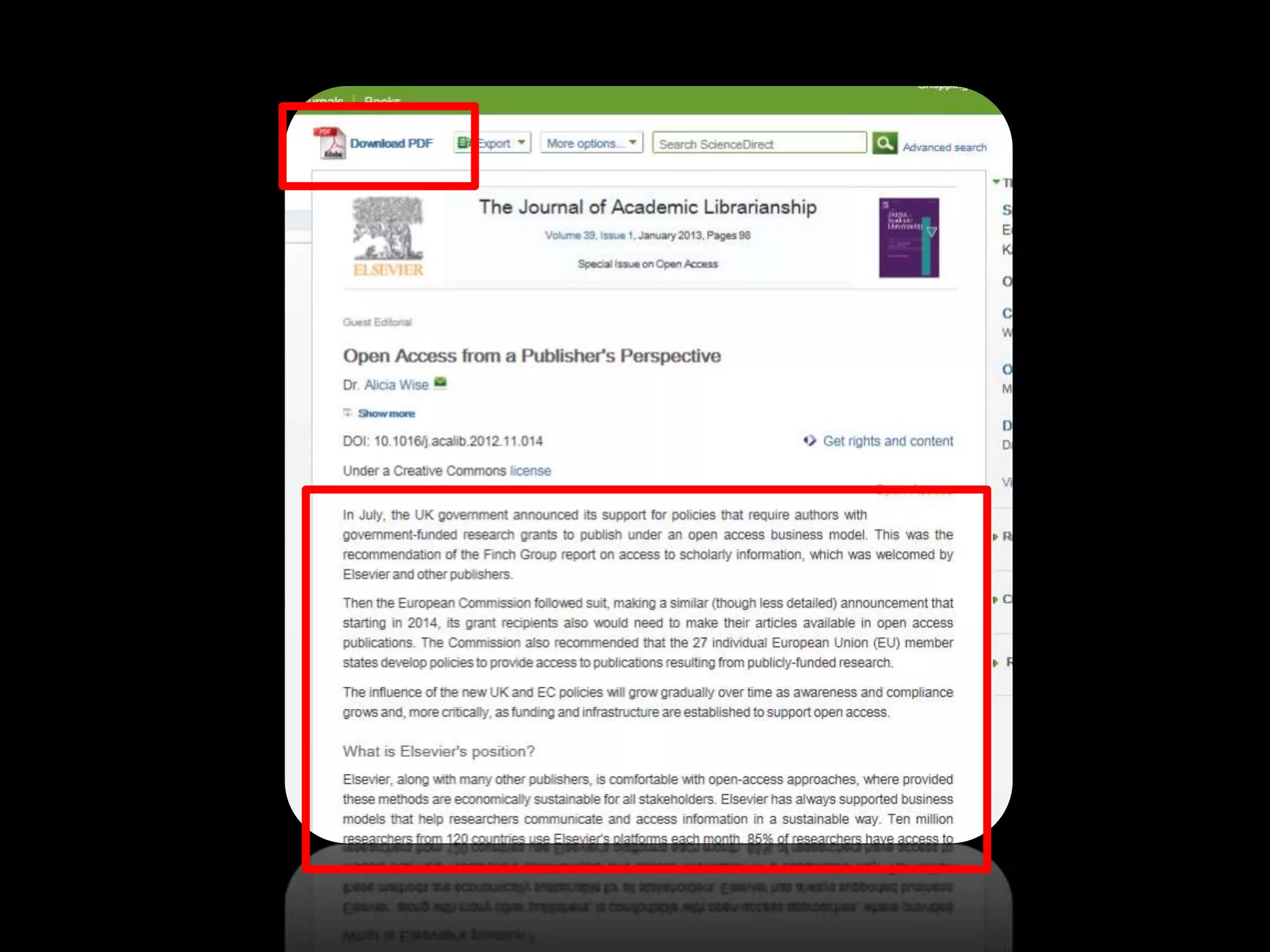
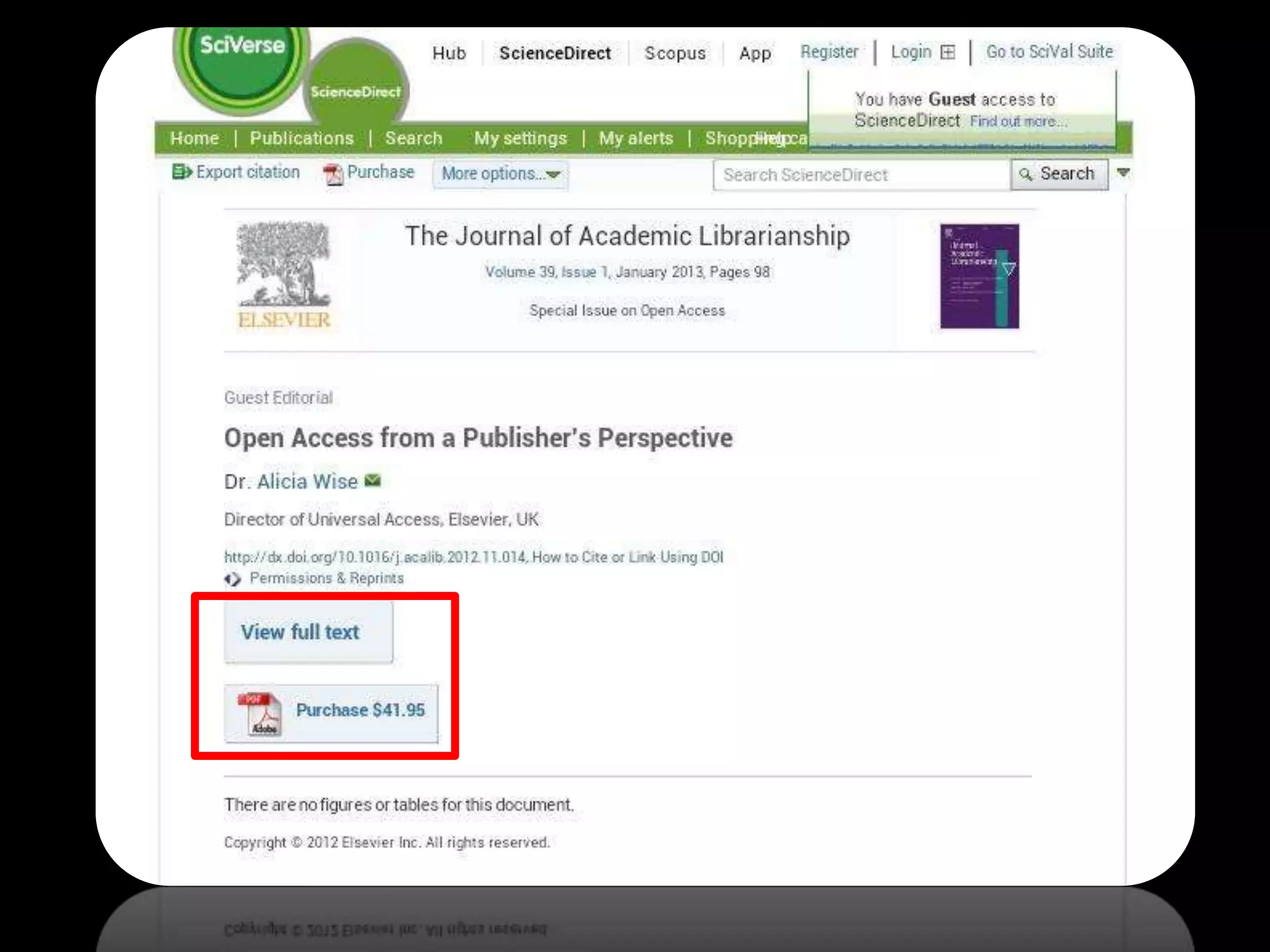
  • #6 What is not “Open Access”? This... (Sadly ironic example… publisher amended this shortly after it was picked up and circulated by academics)
  • #9 There is some division over the issue of whether rights of re-use are needed now, or will develop once ‘access’ has been firmly established.
  • #22 1st in JCRs for History is American Historical Review. Complicated: Green option, no gold option from owners, but is one form publisher. 24 month embargo – fine for REF, not for many funders.
  • #31 For those in arts and humanities
  • #34 http://www.economist.com/node/21545974 http://www.informa.com/documents/INF2570%20AR10%20cover%20AW05.pdf (p19 of annual report and financial statement 2010) Springer = 33.9%, Wiley = 42%
  • #35 http://www.economist.com/node/21545974 http://www.informa.com/documents/INF2570%20AR10%20cover%20AW05.pdf (p19 of annual report and financial statement 2010)
  • #36 http://www.economist.com/node/21545974 http://www.informa.com/documents/INF2570%20AR10%20cover%20AW05.pdf (p19 of annual report and financial statement 2010)
  • #38 Reminder – do not bulk out reference lists. But… reference lists make sense in how authors discover and evaluate research (citation searching, related links in web of science based upon correlation of reference lists and citing articles).
  • #39 Reminder – do not bulk out reference lists. But… reference lists make sense in how authors discover and evaluate research (citation searching, related links in web of science based upon correlation of reference lists and citing articles).
  • #40 Reminder – do not bulk out reference lists. But… reference lists make sense in how authors discover and evaluate research (citation searching, related links in web of science based upon correlation of reference lists and citing articles).
  • #41 Reminder – do not bulk out reference lists. But… reference lists make sense in how authors discover and evaluate research (citation searching, related links in web of science based upon correlation of reference lists and citing articles).
  • #42 Reminder – do not bulk out reference lists. But… reference lists make sense in how authors discover and evaluate research (citation searching, related links in web of science based upon correlation of reference lists and citing articles).
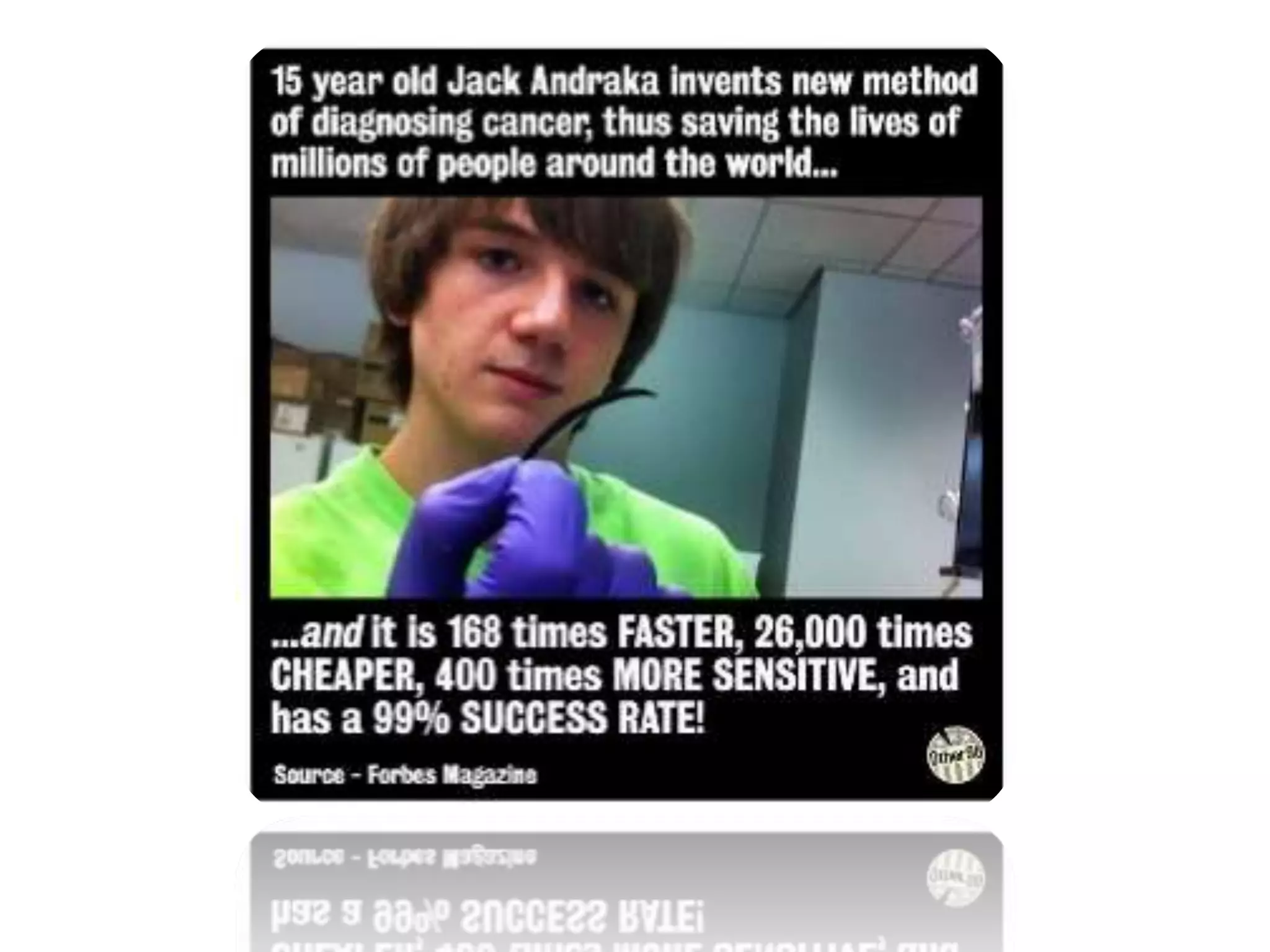
  • #45 Pancreatic Cancer. Applied methods already tested (and published and OA on pubmed) for breast and prostrate cancer, then applied to a tangential field of study. Is a bit of a sensational title, but the question is… would this have been done if he had not had free access to the research. Video has him saying that he would not have had the idea if the articles had been behind the paywalls of up to $100 that other articles are.
  • #48 After c.15 minutes Ask class if they have any concerns, or have heard any concerns about “Open Access publishing”
  • #52 If you are funded, you have signed an agreement with the funder. That agreement could cover anything the funder expects you to achieve or deliver by the end of the project. Wellcome Trust example: if you do not meet OA requirements, you will have funding withheld AND be unable to use non-compliant publications as evidence in subsequent grant applications.
  • #53 These funders are just some of those which have an open access requirement built into their funding contracts. Some require deposit in a repository, some require publishing in an open access journal. These are mostly European and UK funders… there are many others outside of the UK which have similar open access requirements attached to any funding they provide, with varying degrees of reporting enforcement in place. Primarily publically funded research councils, government departments and health funders. But many other funders have advocated support for Open Access, if not setting out any policy requirements (British Academy for one).
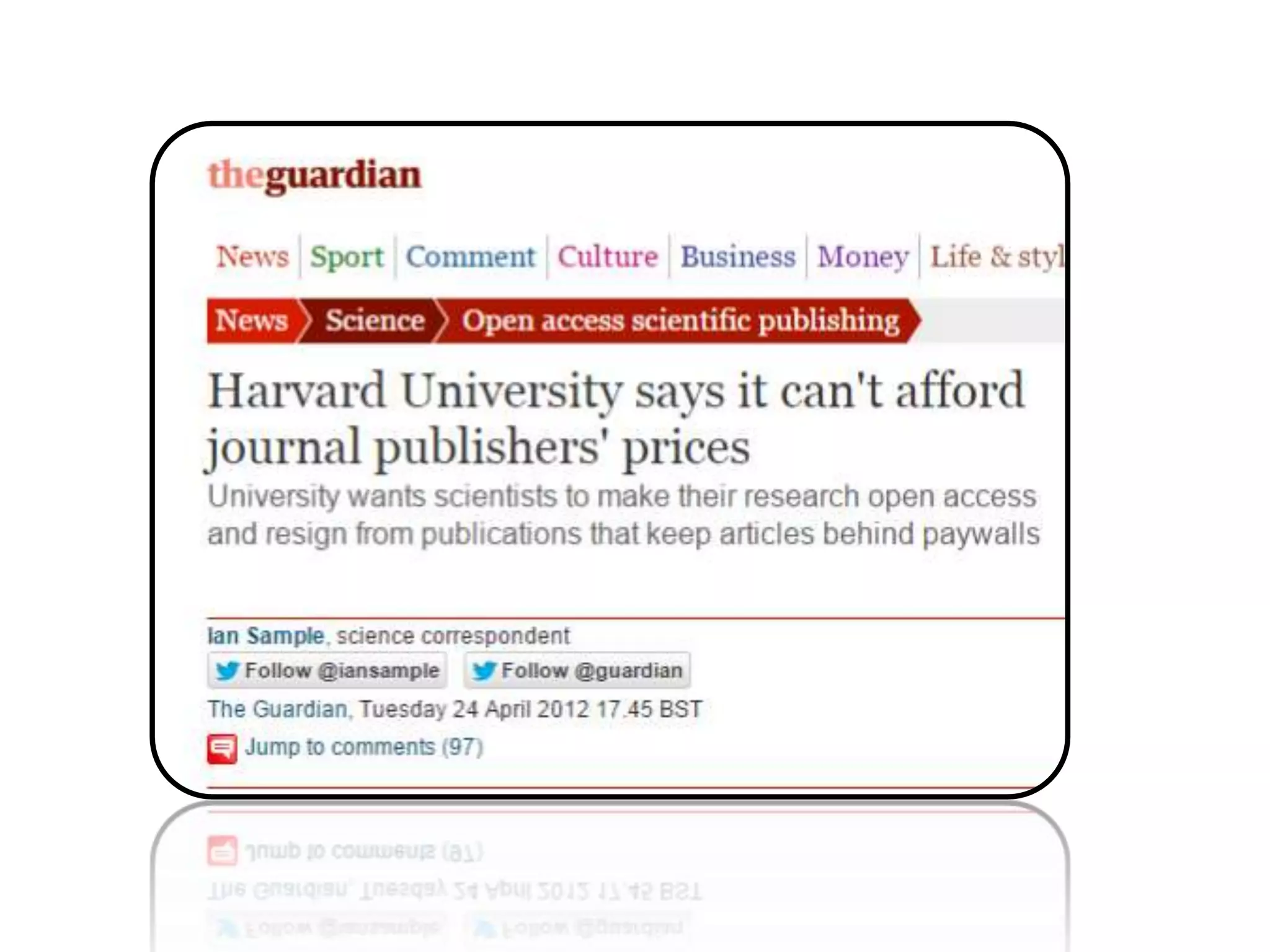
  • #59 Example of Harvard – reaction to increased costs of journal subscriptions Example of Liege and Durham – items must be in DRO for consideration for promotion and probation (qualifier on implementation at Durham).
  • #63 Only 4% of REF2014-submitted journals have embargoes longer than 12/24m. In built exceptions into REF policy. Not clear on how applied, but expected to be a minority of cases.
  • #64 Only 4% of REF2014-submitted journals have embargoes longer than 12/24m.
  • #65 http://research.northumbria.ac.uk/support/2013/10/01/eu-funding-demystified-horizon-2020/
  • #66 This is your research. You should publish it where you wish to publish it. If you fundamentally disagree with open access, then despite the fact that I and others may disagree with you, that is you prerogative (but perhaps do not go seeking funding from public bodies or any funder which requires research to be made accessible).
  • #67 Check publishing agreements... Demo: Sherpa Romeo... Polymer, Nature, Theory Culture & Society
  • #68 Check publishing agreements... Demo: Sherpa Romeo...
  • #69 Two options, depending on your personal opinion:- - look for your journals in your subject area, check what open access options they offer - look for open access journals in your subject area, check what standing they have to their peers.
  • #71 Ask students to check if they have access to the staff profile system.
  • #72  - (2,686 could be OA but author has not provided text) (21%)
  • #73 Reiterate point… REF probably looking at either a target of 70-80% open access, or a 100% target with exceptions…
  • #82 Overview of Twitter.. Don’t show how to create account – on handout. Headlined / about Profile and home page @ Connections page (mentions and interactions) Search function (tweets, users, lists)