Advocating for change in the
scientific enterprise
Jessica Polka
Director, ASAPbio
Visiting Scholar, Whitehead Institute
Visiting Fellow, Harvard Medical School
Twitter: @jessicapolka
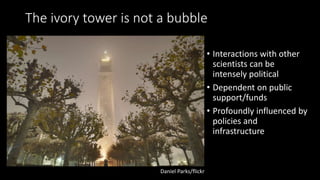
The ivory tower is not a bubble
• Interactions with other
scientists can be
intensely political
• Dependent on public
support/funds
• Profoundly influenced by
policies and
infrastructure
Daniel Parks/flickr
The way we do science is driven by social and
political incentives
What we measure
• “Impact” (ie Journal Name/IF)
• # of papers
• Prestige of institution/mentors
What we don’t measure
• Reproducibility
• Openness/sharing
• Mentoring
Are these structural
forces driving us to do the
best science possible?
How did we get here?
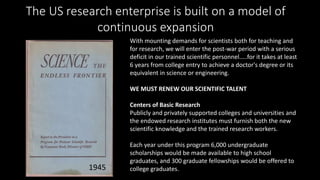
1945
The Wartime Deficit
With mounting demands for scientists both for teaching and
for research, we will enter the post-war period with a serious
deficit in our trained scientific personnel.….for it takes at least
6 years from college entry to achieve a doctor's degree or its
equivalent in science or engineering.
WE MUST RENEW OUR SCIENTIFIC TALENT
Centers of Basic Research
Publicly and privately supported colleges and universities and
the endowed research institutes must furnish both the new
scientific knowledge and the trained research workers.
Each year under this program 6,000 undergraduate
scholarships would be made available to high school
graduates, and 300 graduate fellowships would be offered to
college graduates.
The US research enterprise is built on a model of
continuous expansion
Times have changed
9
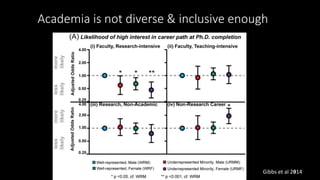
Academia is not diverse & inclusive enough
Gibbs et al 2014
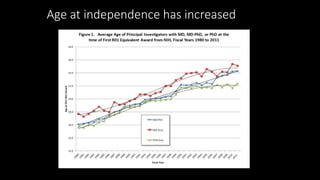
Age at independence has increased
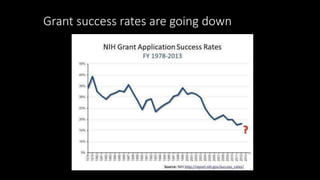
Grant success rates are going down
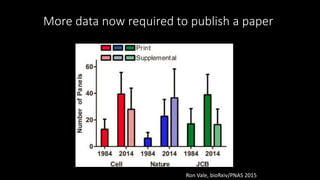
Ron Vale, bioRxiv/PNAS 2015
More data now required to publish a paper
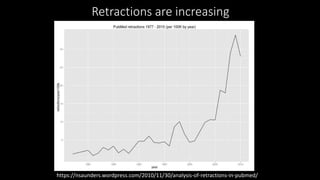
Retractions are increasing
https://nsaunders.wordpress.com/2010/11/30/analysis-of-retractions-in-pubmed/
The environment is “hypercompetitive”
What has changed?
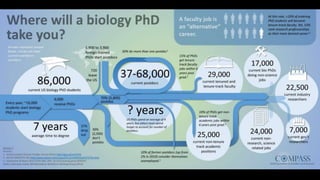
Less money, more people
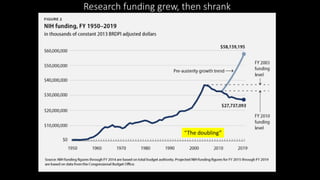
Research funding grew, then shrank
Center for American Progress
“The doubling”
https://nexus.od.nih.gov/all/2016/05/31/how-many-researchers/
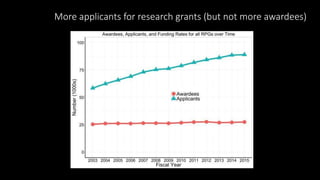
More applicants for research grants (but not more awardees)
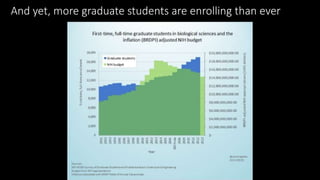
And yet, more graduate students are enrolling than ever
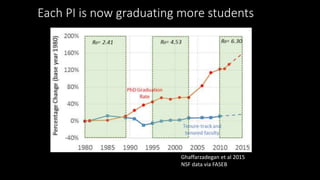
Each PI is now graduating more students
Ghaffarzadegan et al 2015
NSF data via FASEB
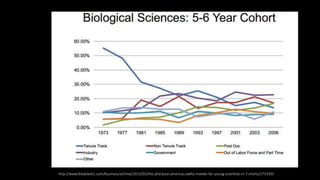
http://www.theatlantic.com/business/archive/2013/02/the-phd-bust-americas-awful-market-for-young-scientists-in-7-charts/273339/
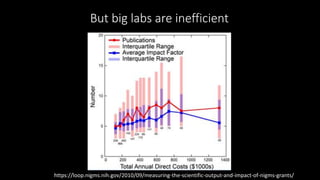
https://loop.nigms.nih.gov/2010/09/measuring-the-scientific-output-and-impact-of-nigms-grants/
But big labs are inefficient
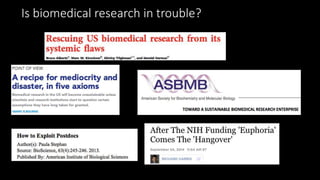
Is biomedical research in trouble?
Solutions
So, what should you & I do?
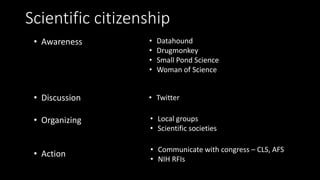
Scientific citizenship
• Awareness
• Discussion
• Organizing
• Action
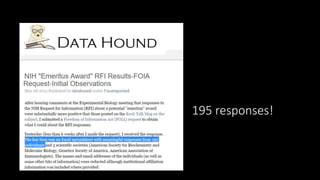
• Datahound
• Drugmonkey
• Small Pond Science
• Woman of Science
• Local groups
• Scientific societies
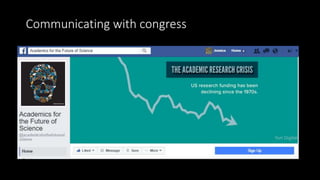
• Communicate with congress – CLS, AFS
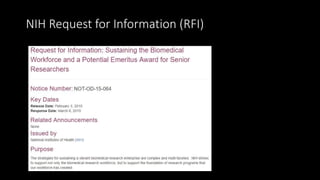
• NIH RFIs
• Twitter
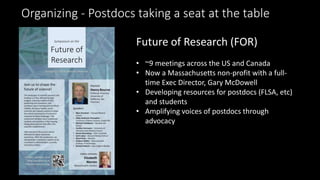
Organizing - Postdocs taking a seat at the table
Future of Research (FOR)
• ~9 meetings across the US and Canada
• Now a Massachusetts non-profit with a full-
time Exec Director, Gary McDowell
• Developing resources for postdocs (FLSA, etc)
and students
• Amplifying voices of postdocs through
advocacy
Organizing - Scientific societies
• The forum for scientific discussion
• Leaders of culture change (see DORA)
• Centers for science policy and communication
• Interested in modernizing & the capturing the next generation
Communicating with congress
NIH Request for Information (RFI)
195 responses!
Zach Chisholm, flickr
Picking a problem
Publication is essential to scientific progress
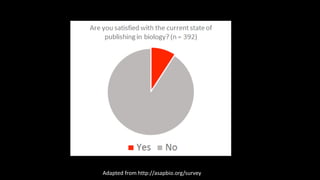
Adapted from http://asapbio.org/survey
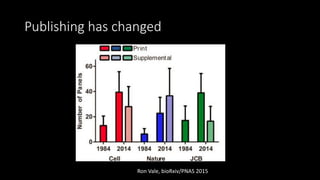
Publishing has changed
Ron Vale, bioRxiv/PNAS 2015
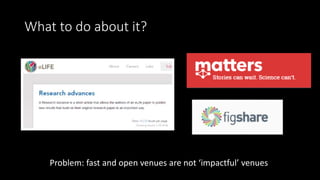
What to do about it?
Problem: fast and open venues are not ‘impactful’ venues
A preprint is a manuscript posted
online before journal-organized
peer review
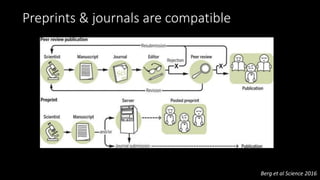
Preprints & journals are compatible
Berg et al Science 2016
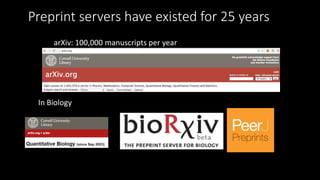
arXiv: 100,000 manuscripts per year
Preprint servers have existed for 25 years
In Biology
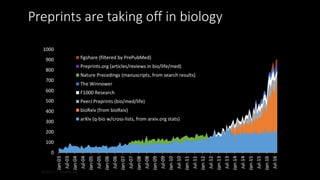
0
100
200
300
400
500
600
700
800
900
1000
Jan-03
Jul-03
Jan-04
Jul-04
Jan-05
Jul-05
Jan-06
Jul-06
Jan-07
Jul-07
Jan-08
Jul-08
Jan-09
Jul-09
Jan-10
Jul-10
Jan-11
Jul-11
Jan-12
Jul-12
Jan-13
Jul-13
Jan-14
Jul-14
Jan-15
Jul-15
Jan-16
Jul-16
figshare (filtered by PrePubMed)
Preprints.org (articles/reviews in bio/life/med)
Nature Precedings (manuscripts, from search results)
The Winnower
F1000 Research
PeerJ Preprints (bio/med/life)
bioRxiv (from bioRxiv)
arXiv (q-bio w/cross-lists, from arxiv.org stats)
Version 1 | asapbio.org
Preprints are taking off in biology
• Benefits of preprints
• Concerns surrounding preprints
• Taking action
• Recent updates
Lack of access to literature
Current problem
Preprints are immediately available
to everyone around the world
Preprints are publicly disclosed work that
can be evaluated for a PhD thesis, postdoc
positions, fellowships, or jobs.
Training periods are long; students/postdocs wait
to publish
Current problem
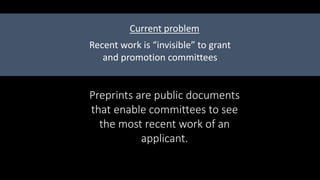
Preprints are public documents
that enable committees to see
the most recent work of an
applicant.
Recent work is “invisible” to grant
and promotion committees
Current problem
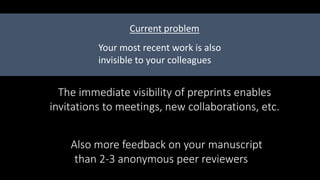
The immediate visibility of preprints enables
invitations to meetings, new collaborations, etc.
Your most recent work is also
invisible to your colleagues
Current problem
Also more feedback on your manuscript
than 2-3 anonymous peer reviewers
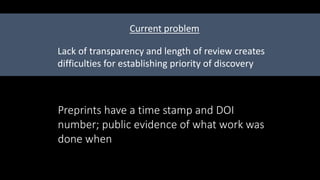
Lack of transparency and length of review creates
difficulties for establishing priority of discovery
Current problem
Preprints have a time stamp and DOI
number; public evidence of what work was
done when
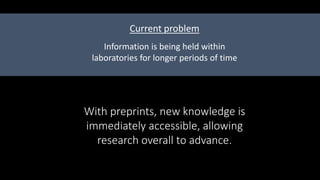
Information is being held within
laboratories for longer periods of time
With preprints, new knowledge is
immediately accessible, allowing
research overall to advance.
Current problem
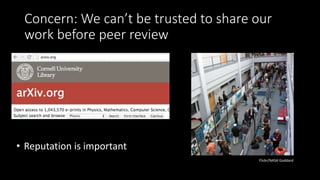
Concern: We can’t be trusted to share our
work before peer review
• Reputation is important
Flickr/NASA Goddard
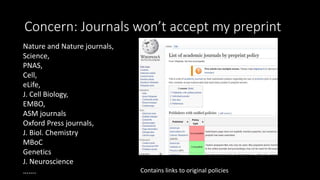
Concern: Journals won’t accept my preprint
Nature and Nature journals,
Science,
PNAS,
Cell,
eLife,
J. Cell Biology,
EMBO,
ASM journals
Oxford Press journals,
J. Biol. Chemistry
MBoC
Genetics
J. Neuroscience
…….
Search Wikipedia: list of academic journals by preprint policy
Contains links to original policies
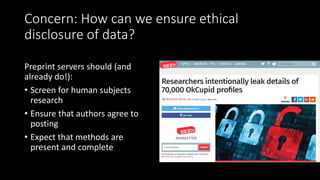
Concern: How can we ensure ethical
disclosure of data?
Preprint servers should (and
already do!):
• Screen for human subjects
research
• Ensure that authors agree to
posting
• Expect that methods are
present and complete
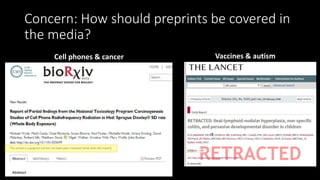
Concern: How should preprints be covered in
the media?
Cell phones & cancer Vaccines & autism
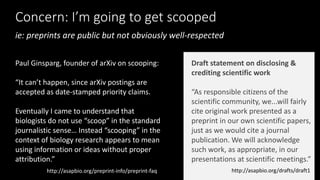
Concern: I’m going to get scooped
http://asapbio.org/preprint-info/preprint-faq
Paul Ginsparg, founder of arXiv on scooping:
“It can’t happen, since arXiv postings are
accepted as date-stamped priority claims.
Eventually I came to understand that
biologists do not use “scoop” in the standard
journalistic sense… Instead “scooping” in the
context of biology research appears to mean
using information or ideas without proper
attribution.”
http://asapbio.org/drafts/draft1
Draft statement on disclosing &
crediting scientific work
“As responsible citizens of the
scientific community, we...will fairly
cite original work presented as a
preprint in our own scientific papers,
just as we would cite a journal
publication. We will acknowledge
such work, as appropriate, in our
presentations at scientific meetings.”
ie: preprints are public but not obviously well-respected
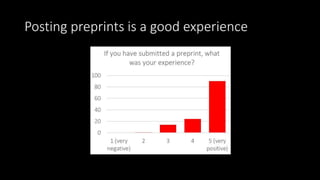
Posting preprints is a good experience
392 responses. Results at asapbio.org/survey
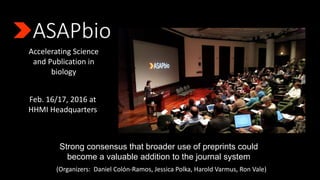
Accelerating Science
and Publication in
biology
Feb. 16/17, 2016 at
HHMI Headquarters
Strong consensus that broader use of preprints could
become a valuable addition to the journal system
(Organizers: Daniel Colόn-Ramos, Jessica Polka, Harold Varmus, Ron Vale)
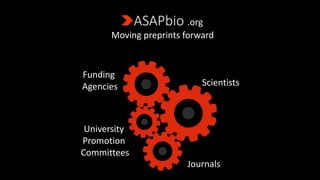
Moving preprints forward
Scientists
University
Promotion
Committees
Journals
Funding
Agencies
.org
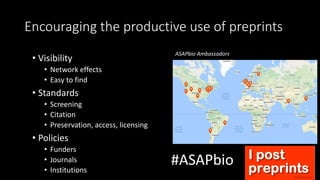
Encouraging the productive use of preprints
• Visibility
• Network effects
• Easy to find
• Standards
• Screening
• Citation
• Preservation, access, licensing
• Policies
• Funders
• Journals
• Institutions
#ASAPbio
ASAPbio Ambassadors
Encouraging the productive use of preprints
• Visibility
• Network effects
• Easy to find
• Standards
• Screening
• Citation
• Preservation, access, licensing
• Policies
• Funders
• Journals
• Institutions
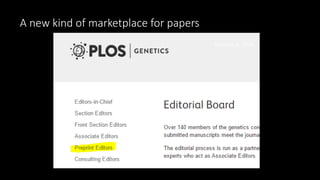
A new kind of marketplace for papers
October 4, 2016
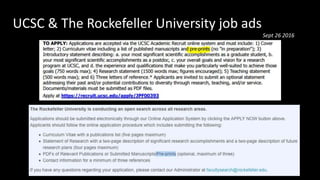
UCSC & The Rockefeller University job ads
Sept 26 2016
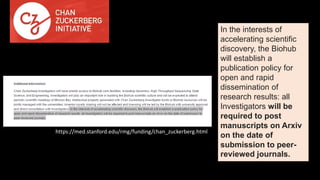
In the interests of
accelerating scientific
discovery, the Biohub
will establish a
publication policy for
open and rapid
dissemination of
research results: all
Investigators will be
required to post
manuscripts on Arxiv
on the date of
submission to peer-
reviewed journals.
https://med.stanford.edu/rmg/funding/chan_zuckerberg.html
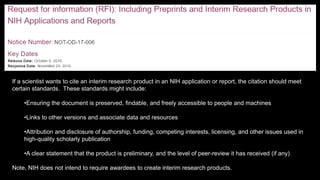
If a scientist wants to cite an interim research product in an NIH application or report, the citation should meet
certain standards. These standards might include:
•Ensuring the document is preserved, findable, and freely accessible to people and machines
•Links to other versions and associate data and resources
•Attribution and disclosure of authorship, funding, competing interests, licensing, and other issues used in
high-quality scholarly publication
•A clear statement that the product is preliminary, and the level of peer-review it has received (if any)
Note, NIH does not intend to require awardees to create interim research products.
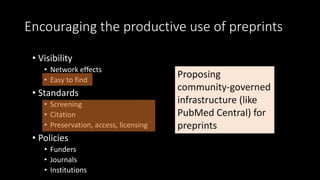
Encouraging the productive use of preprints
• Visibility
• Network effects
• Easy to find
• Standards
• Screening
• Citation
• Preservation, access, licensing
• Policies
• Funders
• Journals
• Institutions
Proposing
community-governed
infrastructure (like
PubMed Central) for
preprints
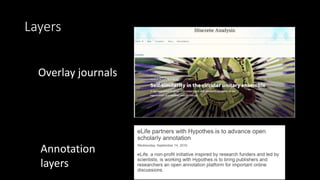
Layers
Overlay journals
Annotation
layers
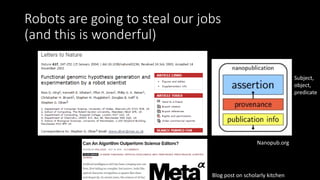
Robots are going to steal our jobs
(and this is wonderful)
Nanopub.org
Subject,
object,
predicate
Blog post on scholarly kitchen
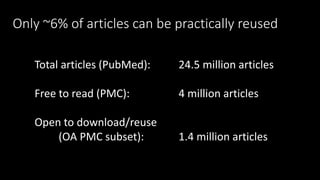
Only ~6% of articles can be practically reused
Total articles (PubMed): 24.5 million articles
Free to read (PMC): 4 million articles
Open to download/reuse
(OA PMC subset): 1.4 million articles
Thank you
ASAPbio Co-organizers
Ron Vale (UCSF)
James Fraser (UCSF)
Daniel Colόn-Ramos (Yale)
Harold Varmus (Cornell)
ASAPbio Funding
Simons
Sloan
Arnold
Moore
Jessica.polka@gmail.com, @jessicapolka
Mentors etc
Pam Silver
Iain Cheeseman
ASCB
FOR Funding
Open Philanthropy
Project
FOR colleagues
Kristin Krukenberg
Sarah Mazilli
Gary McDowell
David Riglar
& many others

Advocating for change in the scientific enterprise

  • 1.
    Advocating for changein the scientific enterprise Jessica Polka Director, ASAPbio Visiting Scholar, Whitehead Institute Visiting Fellow, Harvard Medical School Twitter: @jessicapolka
  • 2.
    The ivory toweris not a bubble • Interactions with other scientists can be intensely political • Dependent on public support/funds • Profoundly influenced by policies and infrastructure Daniel Parks/flickr
  • 3.
    The way wedo science is driven by social and political incentives What we measure • “Impact” (ie Journal Name/IF) • # of papers • Prestige of institution/mentors What we don’t measure • Reproducibility • Openness/sharing • Mentoring
  • 4.
    Are these structural forcesdriving us to do the best science possible?
  • 5.
    How did weget here?
  • 6.
    1945 The Wartime Deficit Withmounting demands for scientists both for teaching and for research, we will enter the post-war period with a serious deficit in our trained scientific personnel.….for it takes at least 6 years from college entry to achieve a doctor's degree or its equivalent in science or engineering. WE MUST RENEW OUR SCIENTIFIC TALENT Centers of Basic Research Publicly and privately supported colleges and universities and the endowed research institutes must furnish both the new scientific knowledge and the trained research workers. Each year under this program 6,000 undergraduate scholarships would be made available to high school graduates, and 300 graduate fellowships would be offered to college graduates. The US research enterprise is built on a model of continuous expansion
  • 7.
  • 9.
    9 Academia is notdiverse & inclusive enough Gibbs et al 2014
  • 10.
    Age at independencehas increased
  • 11.
    Grant success ratesare going down
  • 12.
    Ron Vale, bioRxiv/PNAS2015 More data now required to publish a paper
  • 13.
  • 14.
    The environment is“hypercompetitive” What has changed? Less money, more people
  • 15.
    Research funding grew,then shrank Center for American Progress “The doubling”
  • 16.
  • 17.
    And yet, moregraduate students are enrolling than ever
  • 18.
    Each PI isnow graduating more students Ghaffarzadegan et al 2015 NSF data via FASEB
  • 19.
  • 20.
  • 21.
  • 22.
  • 23.
    So, what shouldyou & I do?
  • 24.
    Scientific citizenship • Awareness •Discussion • Organizing • Action • Datahound • Drugmonkey • Small Pond Science • Woman of Science • Local groups • Scientific societies • Communicate with congress – CLS, AFS • NIH RFIs • Twitter
  • 25.
    Organizing - Postdocstaking a seat at the table Future of Research (FOR) • ~9 meetings across the US and Canada • Now a Massachusetts non-profit with a full- time Exec Director, Gary McDowell • Developing resources for postdocs (FLSA, etc) and students • Amplifying voices of postdocs through advocacy
  • 26.
    Organizing - Scientificsocieties • The forum for scientific discussion • Leaders of culture change (see DORA) • Centers for science policy and communication • Interested in modernizing & the capturing the next generation
  • 27.
  • 28.
  • 29.
    NIH Request forInformation (RFI)
  • 30.
  • 31.
  • 32.
    Publication is essentialto scientific progress
  • 33.
  • 34.
    Publishing has changed RonVale, bioRxiv/PNAS 2015
  • 35.
    What to doabout it? Problem: fast and open venues are not ‘impactful’ venues
  • 36.
    A preprint isa manuscript posted online before journal-organized peer review
  • 37.
    Preprints & journalsare compatible Berg et al Science 2016
  • 38.
    arXiv: 100,000 manuscriptsper year Preprint servers have existed for 25 years In Biology
  • 39.
    0 100 200 300 400 500 600 700 800 900 1000 Jan-03 Jul-03 Jan-04 Jul-04 Jan-05 Jul-05 Jan-06 Jul-06 Jan-07 Jul-07 Jan-08 Jul-08 Jan-09 Jul-09 Jan-10 Jul-10 Jan-11 Jul-11 Jan-12 Jul-12 Jan-13 Jul-13 Jan-14 Jul-14 Jan-15 Jul-15 Jan-16 Jul-16 figshare (filtered byPrePubMed) Preprints.org (articles/reviews in bio/life/med) Nature Precedings (manuscripts, from search results) The Winnower F1000 Research PeerJ Preprints (bio/med/life) bioRxiv (from bioRxiv) arXiv (q-bio w/cross-lists, from arxiv.org stats) Version 1 | asapbio.org Preprints are taking off in biology
  • 40.
    • Benefits ofpreprints • Concerns surrounding preprints • Taking action • Recent updates
  • 41.
    Lack of accessto literature Current problem Preprints are immediately available to everyone around the world
  • 42.
    Preprints are publiclydisclosed work that can be evaluated for a PhD thesis, postdoc positions, fellowships, or jobs. Training periods are long; students/postdocs wait to publish Current problem
  • 43.
    Preprints are publicdocuments that enable committees to see the most recent work of an applicant. Recent work is “invisible” to grant and promotion committees Current problem
  • 44.
    The immediate visibilityof preprints enables invitations to meetings, new collaborations, etc. Your most recent work is also invisible to your colleagues Current problem Also more feedback on your manuscript than 2-3 anonymous peer reviewers
  • 45.
    Lack of transparencyand length of review creates difficulties for establishing priority of discovery Current problem Preprints have a time stamp and DOI number; public evidence of what work was done when
  • 46.
    Information is beingheld within laboratories for longer periods of time With preprints, new knowledge is immediately accessible, allowing research overall to advance. Current problem
  • 47.
    Concern: We can’tbe trusted to share our work before peer review • Reputation is important Flickr/NASA Goddard
  • 48.
    Concern: Journals won’taccept my preprint Nature and Nature journals, Science, PNAS, Cell, eLife, J. Cell Biology, EMBO, ASM journals Oxford Press journals, J. Biol. Chemistry MBoC Genetics J. Neuroscience ……. Search Wikipedia: list of academic journals by preprint policy Contains links to original policies
  • 49.
    Concern: How canwe ensure ethical disclosure of data? Preprint servers should (and already do!): • Screen for human subjects research • Ensure that authors agree to posting • Expect that methods are present and complete
  • 50.
    Concern: How shouldpreprints be covered in the media? Cell phones & cancer Vaccines & autism
  • 51.
    Concern: I’m goingto get scooped http://asapbio.org/preprint-info/preprint-faq Paul Ginsparg, founder of arXiv on scooping: “It can’t happen, since arXiv postings are accepted as date-stamped priority claims. Eventually I came to understand that biologists do not use “scoop” in the standard journalistic sense… Instead “scooping” in the context of biology research appears to mean using information or ideas without proper attribution.” http://asapbio.org/drafts/draft1 Draft statement on disclosing & crediting scientific work “As responsible citizens of the scientific community, we...will fairly cite original work presented as a preprint in our own scientific papers, just as we would cite a journal publication. We will acknowledge such work, as appropriate, in our presentations at scientific meetings.” ie: preprints are public but not obviously well-respected
  • 52.
    Posting preprints isa good experience 392 responses. Results at asapbio.org/survey
  • 53.
    Accelerating Science and Publicationin biology Feb. 16/17, 2016 at HHMI Headquarters Strong consensus that broader use of preprints could become a valuable addition to the journal system (Organizers: Daniel Colόn-Ramos, Jessica Polka, Harold Varmus, Ron Vale)
  • 54.
  • 55.
    Encouraging the productiveuse of preprints • Visibility • Network effects • Easy to find • Standards • Screening • Citation • Preservation, access, licensing • Policies • Funders • Journals • Institutions #ASAPbio ASAPbio Ambassadors
  • 56.
    Encouraging the productiveuse of preprints • Visibility • Network effects • Easy to find • Standards • Screening • Citation • Preservation, access, licensing • Policies • Funders • Journals • Institutions
  • 57.
    A new kindof marketplace for papers October 4, 2016
  • 58.
    UCSC & TheRockefeller University job ads Sept 26 2016
  • 59.
    In the interestsof accelerating scientific discovery, the Biohub will establish a publication policy for open and rapid dissemination of research results: all Investigators will be required to post manuscripts on Arxiv on the date of submission to peer- reviewed journals. https://med.stanford.edu/rmg/funding/chan_zuckerberg.html
  • 60.
    If a scientistwants to cite an interim research product in an NIH application or report, the citation should meet certain standards. These standards might include: •Ensuring the document is preserved, findable, and freely accessible to people and machines •Links to other versions and associate data and resources •Attribution and disclosure of authorship, funding, competing interests, licensing, and other issues used in high-quality scholarly publication •A clear statement that the product is preliminary, and the level of peer-review it has received (if any) Note, NIH does not intend to require awardees to create interim research products.
  • 61.
    Encouraging the productiveuse of preprints • Visibility • Network effects • Easy to find • Standards • Screening • Citation • Preservation, access, licensing • Policies • Funders • Journals • Institutions Proposing community-governed infrastructure (like PubMed Central) for preprints
  • 62.
  • 63.
    Robots are goingto steal our jobs (and this is wonderful) Nanopub.org Subject, object, predicate Blog post on scholarly kitchen
  • 64.
    Only ~6% ofarticles can be practically reused Total articles (PubMed): 24.5 million articles Free to read (PMC): 4 million articles Open to download/reuse (OA PMC subset): 1.4 million articles
  • 65.
    Thank you ASAPbio Co-organizers RonVale (UCSF) James Fraser (UCSF) Daniel Colόn-Ramos (Yale) Harold Varmus (Cornell) ASAPbio Funding Simons Sloan Arnold Moore Jessica.polka@gmail.com, @jessicapolka Mentors etc Pam Silver Iain Cheeseman ASCB FOR Funding Open Philanthropy Project FOR colleagues Kristin Krukenberg Sarah Mazilli Gary McDowell David Riglar & many others