Understanding Open Science:
Definitions and framework
Dr. Nancy Pontika
Open Access Aggregation Officer
CORE
Twitter: @nancypontika
What is Open Science
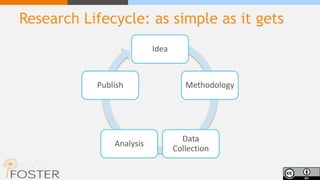
Research Lifecycle: as simple as it gets
Idea
Methodology
Data
Collection
Analysis
Publish
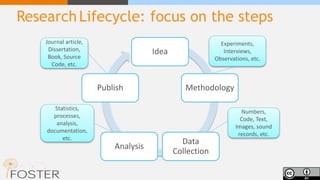
Idea
Methodology
Data
Collection
Analysis
Publish
Journal article,
Dissertation,
Book, Source
Code, etc.
Experiments,
Interviews,
Observations, etc.
Numbers,
Code, Text,
Images, sound
records, etc.
Statistics,
processes,
analysis,
documentation,
etc.
Research Lifecycle: focus on the steps
What is Open Science?
The movement to make scientific research, data and dissemination
accessible to all levels of an inquiring society.
[FOSTER, Open Science Definition https://www.fosteropenscience.eu/taxonomy/term/7]
Scope:
• Transparency in experimental methodology, observation, and collection
of data
• Public availability and reusability of scientific data
• Public accessibility and transparency of scientific communication
• Using web-based tools to facilitate scientific collaboration
[The OpenScience Project, What exactly is open science http://www.openscience.org/blog/?p=269]
Idea
Methodology
Data
Collection
Analysis
Publish
Experiments,
Interviews,
Observations, etc.
Numbers,
Code, Text,
Images, sound
records, etc.
Statistics,
processes,
analysis,
documentation,
etc.
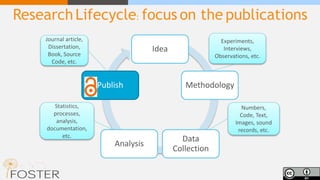
Journal article,
Dissertation,
Book, Source
Code, etc.
ResearchLifecycle: focus on the publications
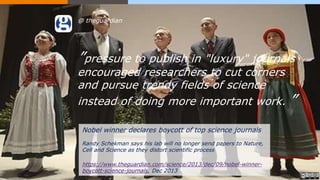
Nobel winner declares boycott of top science journals
Randy Schekman says his lab will no longer send papers to Nature,
Cell and Science as they distort scientific process
https://www.theguardian.com/science/2013/dec/09/nobel-winner-
boycott-science-journals, Dec 2013
@ theguardian
”pressure to publish in "luxury" journals
encouraged researchers to cut corners
and pursue trendy fields of science
instead of doing more important work. ”
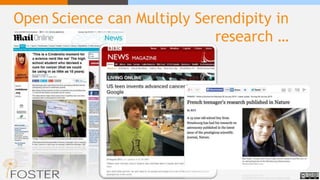
Open Science can Multiply Serendipity in
research …
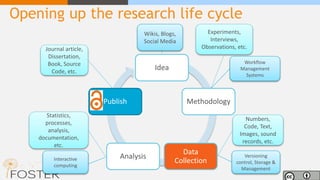
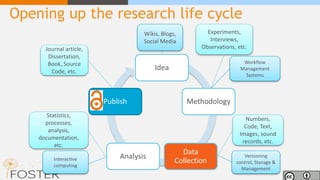
Opening up the research life cycle
Idea
Methodology
Data
Collection
Analysis
Publish
Experiments,
Interviews,
Observations, etc.
Numbers,
Code, Text,
Images, sound
records, etc.
Statistics,
processes,
analysis,
documentation,
etc.
Journal article,
Dissertation,
Book, Source
Code, etc.
Versioning
control, Storage &
Management
Workflow
Management
Systems
Interactive
computing
Wikis, Blogs,
Social Media
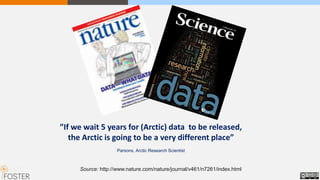
Source: http://www.nature.com/nature/journal/v461/n7261/index.html
”If we wait 5 years for (Arctic) data to be released,
the Arctic is going to be a very different place”
Parsons, Arctic Research Scientist
Mostly due to current methods capture and data malpractice,
approximately 50% of all research data and experiments is considered
not reproducible, and the vast majority (likely over 80%) of data
never makes it to a trusted and sustainable repository.
At an investment of Europe in data-generating research of €120 Billion
between 2014-2020, the annual capital destruction is consequently
very substantial.
“
Source: Realising the European Open Science Cloud, EC DG Research & Innovation 2016
http://ec.europa.eu/research/openscience/pdf/realising_the_european_open_science_cloud_2016.pdf#view=fit&pagemode=none
Opening up the research life cycle
Idea
Methodology
Data
Collection
Analysis
Publish
Experiments,
Interviews,
Observations, etc.
Numbers,
Code, Text,
Images, sound
records, etc.
Statistics,
processes,
analysis,
documentation,
etc.
Journal article,
Dissertation,
Book, Source
Code, etc.
Versioning
control, Storage &
Management
Workflow
Management
Systems
Interactive
computing
Wikis, Blogs,
Social Media
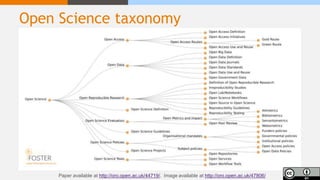
Open Science taxonomy
Paper available at http://oro.open.ac.uk/44719/. Image available at http://oro.open.ac.uk/47806/
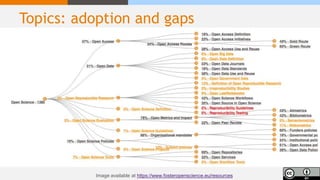
Topics: adoption and gaps
Image available at https://www.fosteropenscience.eu/resources
Open Science
implementation
Is it a wrap rage?
Image from Wikipedia https://en.wikipedia.org/wiki/Wrap_rage
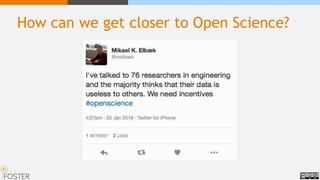
How can we get closer to Open Science?
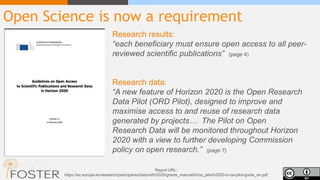
Open Science is now a requirement
Research results:
“each beneficiary must ensure open access to all peer-
reviewed scientific publications” (page 4)
Research data:
“A new feature of Horizon 2020 is the Open Research
Data Pilot (ORD Pilot), designed to improve and
maximise access to and reuse of research data
generated by projects… The Pilot on Open
Research Data will be monitored throughout Horizon
2020 with a view to further developing Commission
policy on open research.” (page 7)
Report URL:
https://ec.europa.eu/research/participants/data/ref/h2020/grants_manual/hi/oa_pilot/h2020-hi-oa-pilot-guide_en.pdf
Funders recognise it
Research and Social Impact
Research Excellence Framework (REF)
65%
20%
15%
Excellence – Impact - Implementation
Quality Research
Outputs
Impact
Research
Environment
[Source: http://www.ref.ac.uk/panels/assessmentcriteriaandleveldefinitions/]
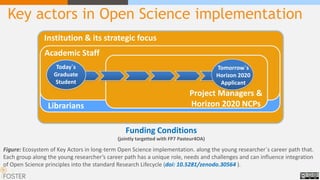
Academic Staff
Today`s
Graduate
Student
Tomorrow`s
Horizon 2020
Applicant
Project Managers &
Horizon 2020 NCPs
Institution & its strategic focus
Librarians
Figure: Ecosystem of Key Actors in long-term Open Science implementation. along the young researcher`s career path that.
Each group along the young researcher’s career path has a unique role, needs and challenges and can influence integration
of Open Science principles into the standard Research Lifecycle (doi: 10.5281/zenodo.30564 ).
Funding Conditions
(jointly targetted with FP7 Pasteur4OA)
Key actors in Open Science implementation
Open Science benefits
General benefits
• Increases research efficiency
• Promotes scholarly rigour and enhances research quality
• Enhances visibility and engagement
• Enables the creation of new research questions
• Enhances collaboration and community building
[Source: Open To All? Case studies of openness in Research
http://www.rin.ac.uk/system/files/attachments/NESTA-RIN_Open_Science_V01_0.pdf]
Benefits for early career researchers
• Become pioneers
• Have gained valuable experience
• Distinguish from the crowd
• Plan successful research proposals
• Receive higher citations
• Know how to comply with funders’ policies
• Comply with funders’ policies
• Demonstrate research and societal impact
[Note: see also benefits of open access for early career researchers
http://oro.open.ac.uk/44720/]
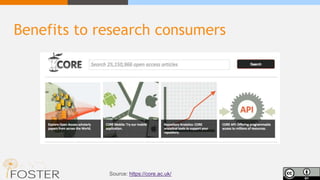
Benefits to research consumers
Source: https://core.ac.uk/
Benefits to Text and Data Miners
Open content enables the collection of a large corpus
and promotes the use of TDM.
• Unlocks hidden information and develops new
knowledge
• Explores new horizons
• Improves research and evidence base
• Improves research process quality
Why Open Science?
All of the Open Access benefits…
• Good for the public benefit
• Research advancement
• More citations
• Larger media coverage
• Taxpayers’ return of investment
• More visibility
• Etc.
Research Reproducibility
• greater visibility and impact for authors & projects
• makes research networked & interconnected
• networked research generates serendipity by default
• speeds up innovation & discovery, takes ideas to the market
& solutions to societal challenges
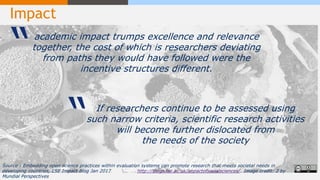
Impact
Source : Embedding open science practices within evaluation systems can promote research that meets societal needs in
developing countries, LSE Impact Blog Jan 2017 http://blogs.lse.ac.uk/impactofsocialsciences/. Image credit: 2 by
Mundial Perspectives
“academic impact trumps excellence and relevance
together, the cost of which is researchers deviating
from paths they would have followed were the
incentive structures different.
If researchers continue to be assessed using
such narrow criteria, scientific research activities
will become further dislocated from
the needs of the society
“
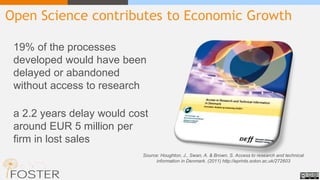
Source: Houghton, J., Swan, A. & Brown, S. Access to research and technical
information in Denmark. (2011) http://eprints.soton.ac.uk/272603
19% of the processes
developed would have been
delayed or abandoned
without access to research
a 2.2 years delay would cost
around EUR 5 million per
firm in lost sales
Open Science contributes to Economic Growth
“By interviewing users the United States National Oceanic and
Atmospheric Administration (NOAA) estimated that the cost of
assembling hard-to-find data with uneven standards and
uncertain quality added about 25% to the cost of products and
services based on these data.”
Source: Marine Knowledge 2020: roadmap http://eur-lex.europa.eu/legal-content/EN/TXT/?uri=SWD:2014:149:FIN
Other benefits
• Media coverage
• Receive more citations for your data
• Open licenses allow reuse
• Discover projects and collaborators
• Open peer review
FOSTER
Facilitate Open Science Training
for European Research
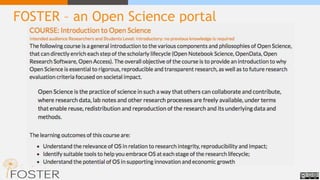
FOSTER – an Open Science portal
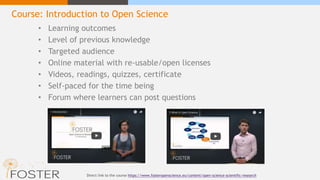
Course: Introduction to Open Science
• Learning outcomes
• Level of previous knowledge
• Targeted audience
• Online material with re-usable/open licenses
• Videos, readings, quizzes, certificate
• Self-paced for the time being
• Forum where learners can post questions
Direct link to the course https://www.fosteropenscience.eu/content/open-science-scientific-research
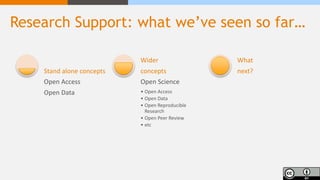
Research Support: what we’ve seen so far…
Open Access
Open Data
Stand alone concepts
Open Science
• Open Access
• Open Data
• Open Reproducible
Research
• Open Peer Review
• etc
Wider
concepts
What
next?
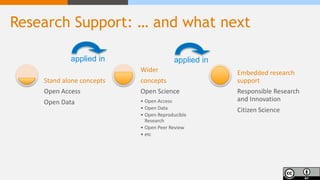
Research Support: … and what next
Open Access
Open Data
Stand alone concepts
Open Science
• Open Access
• Open Data
• Open Reproducible
Research
• Open Peer Review
• etc
Wider
concepts
Responsible Research
and Innovation
Citizen Science
Embedded research
support
applied in applied in
Responsible Research and
Innovation - RRI
RRI Definition
Source: https://renevonschomberg.wordpress.com/definition-of-responsible-innovation/
“Responsible Research and Innovation is a
transparent, interactive process by which
societal actors and innovators become
mutually responsive to each other with a
view to the (ethical) acceptability,
sustainability and societal desirability of the
innovation process and its marketable
products (in order to allow a proper
embedding of scientific and technological
advances in our society).”
(von Schomberg, 2011:9)
RRI Components
Engagement: of all societal actors
Ethics: increase societal relevance and acceptability of
research and innovation outcomes
Governance: developing a framework that integrates all
the RRI elements
Gender equality: integration of the gender dimension in
research and innovation
Open Access: providing access to research results
Science Education: make change happen
Source: http://www.pasteur4oa.eu/sites/pasteur4oa/files/resource/RRI_POLICY%20BRIEF.pdf
RRI opportunities and obstacles
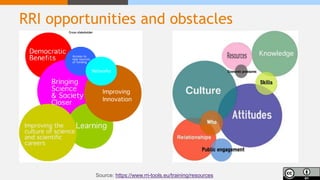
Source: https://www.rri-tools.eu/training/resources
opportunities!from!new!networks;!access!to!new!funding!sources.!
%
The!biggest!clusters!of!issues!were!around!attitudes!and!culture.!!
!
!
Figure%2:%Overview%issues%identified%as%possible%obstacles%to%implementing%RRI%–%shown%by%relative%size/importance.%
https://www.theguardian.com/
technology/2014/jan/25/online-gamers-
solving-sciences-biggest-problems
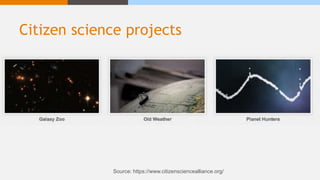
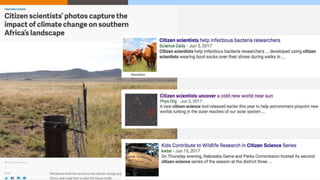
Citizen science projects
Source: https://www.citizensciencealliance.org/
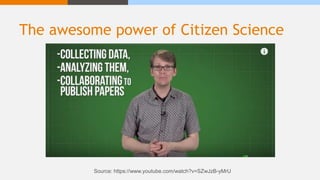
The awesome power of Citizen Science
Source: https://www.youtube.com/watch?v=SZwJzB-yMrU
Assignment:
Think of a research project you recently worked
on. Have you applied OS to all research steps?
Thank you!
Q&A

Understanding Open Science: Definitions and framework

  • 1.
    Understanding Open Science: Definitionsand framework Dr. Nancy Pontika Open Access Aggregation Officer CORE Twitter: @nancypontika
  • 2.
    What is OpenScience
  • 3.
    Research Lifecycle: assimple as it gets Idea Methodology Data Collection Analysis Publish
  • 4.
    Idea Methodology Data Collection Analysis Publish Journal article, Dissertation, Book, Source Code,etc. Experiments, Interviews, Observations, etc. Numbers, Code, Text, Images, sound records, etc. Statistics, processes, analysis, documentation, etc. Research Lifecycle: focus on the steps
  • 5.
    What is OpenScience? The movement to make scientific research, data and dissemination accessible to all levels of an inquiring society. [FOSTER, Open Science Definition https://www.fosteropenscience.eu/taxonomy/term/7] Scope: • Transparency in experimental methodology, observation, and collection of data • Public availability and reusability of scientific data • Public accessibility and transparency of scientific communication • Using web-based tools to facilitate scientific collaboration [The OpenScience Project, What exactly is open science http://www.openscience.org/blog/?p=269]
  • 6.
    Idea Methodology Data Collection Analysis Publish Experiments, Interviews, Observations, etc. Numbers, Code, Text, Images,sound records, etc. Statistics, processes, analysis, documentation, etc. Journal article, Dissertation, Book, Source Code, etc. ResearchLifecycle: focus on the publications
  • 7.
    Nobel winner declaresboycott of top science journals Randy Schekman says his lab will no longer send papers to Nature, Cell and Science as they distort scientific process https://www.theguardian.com/science/2013/dec/09/nobel-winner- boycott-science-journals, Dec 2013 @ theguardian ”pressure to publish in "luxury" journals encouraged researchers to cut corners and pursue trendy fields of science instead of doing more important work. ”
  • 8.
    Open Science canMultiply Serendipity in research …
  • 9.
    Opening up theresearch life cycle Idea Methodology Data Collection Analysis Publish Experiments, Interviews, Observations, etc. Numbers, Code, Text, Images, sound records, etc. Statistics, processes, analysis, documentation, etc. Journal article, Dissertation, Book, Source Code, etc. Versioning control, Storage & Management Workflow Management Systems Interactive computing Wikis, Blogs, Social Media
  • 10.
    Source: http://www.nature.com/nature/journal/v461/n7261/index.html ”If wewait 5 years for (Arctic) data to be released, the Arctic is going to be a very different place” Parsons, Arctic Research Scientist
  • 11.
    Mostly due tocurrent methods capture and data malpractice, approximately 50% of all research data and experiments is considered not reproducible, and the vast majority (likely over 80%) of data never makes it to a trusted and sustainable repository. At an investment of Europe in data-generating research of €120 Billion between 2014-2020, the annual capital destruction is consequently very substantial. “ Source: Realising the European Open Science Cloud, EC DG Research & Innovation 2016 http://ec.europa.eu/research/openscience/pdf/realising_the_european_open_science_cloud_2016.pdf#view=fit&pagemode=none
  • 13.
    Opening up theresearch life cycle Idea Methodology Data Collection Analysis Publish Experiments, Interviews, Observations, etc. Numbers, Code, Text, Images, sound records, etc. Statistics, processes, analysis, documentation, etc. Journal article, Dissertation, Book, Source Code, etc. Versioning control, Storage & Management Workflow Management Systems Interactive computing Wikis, Blogs, Social Media
  • 14.
    Open Science taxonomy Paperavailable at http://oro.open.ac.uk/44719/. Image available at http://oro.open.ac.uk/47806/
  • 15.
    Topics: adoption andgaps Image available at https://www.fosteropenscience.eu/resources
  • 16.
  • 17.
    Is it awrap rage? Image from Wikipedia https://en.wikipedia.org/wiki/Wrap_rage
  • 18.
    How can weget closer to Open Science?
  • 19.
    Open Science isnow a requirement Research results: “each beneficiary must ensure open access to all peer- reviewed scientific publications” (page 4) Research data: “A new feature of Horizon 2020 is the Open Research Data Pilot (ORD Pilot), designed to improve and maximise access to and reuse of research data generated by projects… The Pilot on Open Research Data will be monitored throughout Horizon 2020 with a view to further developing Commission policy on open research.” (page 7) Report URL: https://ec.europa.eu/research/participants/data/ref/h2020/grants_manual/hi/oa_pilot/h2020-hi-oa-pilot-guide_en.pdf
  • 20.
  • 21.
    Research and SocialImpact Research Excellence Framework (REF) 65% 20% 15% Excellence – Impact - Implementation Quality Research Outputs Impact Research Environment [Source: http://www.ref.ac.uk/panels/assessmentcriteriaandleveldefinitions/]
  • 22.
    Academic Staff Today`s Graduate Student Tomorrow`s Horizon 2020 Applicant ProjectManagers & Horizon 2020 NCPs Institution & its strategic focus Librarians Figure: Ecosystem of Key Actors in long-term Open Science implementation. along the young researcher`s career path that. Each group along the young researcher’s career path has a unique role, needs and challenges and can influence integration of Open Science principles into the standard Research Lifecycle (doi: 10.5281/zenodo.30564 ). Funding Conditions (jointly targetted with FP7 Pasteur4OA) Key actors in Open Science implementation
  • 23.
  • 24.
    General benefits • Increasesresearch efficiency • Promotes scholarly rigour and enhances research quality • Enhances visibility and engagement • Enables the creation of new research questions • Enhances collaboration and community building [Source: Open To All? Case studies of openness in Research http://www.rin.ac.uk/system/files/attachments/NESTA-RIN_Open_Science_V01_0.pdf]
  • 25.
    Benefits for earlycareer researchers • Become pioneers • Have gained valuable experience • Distinguish from the crowd • Plan successful research proposals • Receive higher citations • Know how to comply with funders’ policies • Comply with funders’ policies • Demonstrate research and societal impact [Note: see also benefits of open access for early career researchers http://oro.open.ac.uk/44720/]
  • 26.
    Benefits to researchconsumers Source: https://core.ac.uk/
  • 27.
    Benefits to Textand Data Miners Open content enables the collection of a large corpus and promotes the use of TDM. • Unlocks hidden information and develops new knowledge • Explores new horizons • Improves research and evidence base • Improves research process quality
  • 28.
  • 29.
    All of theOpen Access benefits… • Good for the public benefit • Research advancement • More citations • Larger media coverage • Taxpayers’ return of investment • More visibility • Etc.
  • 30.
    Research Reproducibility • greatervisibility and impact for authors & projects • makes research networked & interconnected • networked research generates serendipity by default • speeds up innovation & discovery, takes ideas to the market & solutions to societal challenges
  • 31.
    Impact Source : Embeddingopen science practices within evaluation systems can promote research that meets societal needs in developing countries, LSE Impact Blog Jan 2017 http://blogs.lse.ac.uk/impactofsocialsciences/. Image credit: 2 by Mundial Perspectives “academic impact trumps excellence and relevance together, the cost of which is researchers deviating from paths they would have followed were the incentive structures different. If researchers continue to be assessed using such narrow criteria, scientific research activities will become further dislocated from the needs of the society “
  • 32.
    Source: Houghton, J.,Swan, A. & Brown, S. Access to research and technical information in Denmark. (2011) http://eprints.soton.ac.uk/272603 19% of the processes developed would have been delayed or abandoned without access to research a 2.2 years delay would cost around EUR 5 million per firm in lost sales Open Science contributes to Economic Growth
  • 33.
    “By interviewing usersthe United States National Oceanic and Atmospheric Administration (NOAA) estimated that the cost of assembling hard-to-find data with uneven standards and uncertain quality added about 25% to the cost of products and services based on these data.” Source: Marine Knowledge 2020: roadmap http://eur-lex.europa.eu/legal-content/EN/TXT/?uri=SWD:2014:149:FIN
  • 34.
    Other benefits • Mediacoverage • Receive more citations for your data • Open licenses allow reuse • Discover projects and collaborators • Open peer review
  • 35.
    FOSTER Facilitate Open ScienceTraining for European Research
  • 36.
    FOSTER – anOpen Science portal
  • 37.
    Course: Introduction toOpen Science • Learning outcomes • Level of previous knowledge • Targeted audience • Online material with re-usable/open licenses • Videos, readings, quizzes, certificate • Self-paced for the time being • Forum where learners can post questions Direct link to the course https://www.fosteropenscience.eu/content/open-science-scientific-research
  • 38.
    Research Support: whatwe’ve seen so far… Open Access Open Data Stand alone concepts Open Science • Open Access • Open Data • Open Reproducible Research • Open Peer Review • etc Wider concepts What next?
  • 39.
    Research Support: …and what next Open Access Open Data Stand alone concepts Open Science • Open Access • Open Data • Open Reproducible Research • Open Peer Review • etc Wider concepts Responsible Research and Innovation Citizen Science Embedded research support applied in applied in
  • 40.
  • 41.
    RRI Definition Source: https://renevonschomberg.wordpress.com/definition-of-responsible-innovation/ “ResponsibleResearch and Innovation is a transparent, interactive process by which societal actors and innovators become mutually responsive to each other with a view to the (ethical) acceptability, sustainability and societal desirability of the innovation process and its marketable products (in order to allow a proper embedding of scientific and technological advances in our society).” (von Schomberg, 2011:9)
  • 42.
    RRI Components Engagement: ofall societal actors Ethics: increase societal relevance and acceptability of research and innovation outcomes Governance: developing a framework that integrates all the RRI elements Gender equality: integration of the gender dimension in research and innovation Open Access: providing access to research results Science Education: make change happen Source: http://www.pasteur4oa.eu/sites/pasteur4oa/files/resource/RRI_POLICY%20BRIEF.pdf
  • 43.
    RRI opportunities andobstacles Source: https://www.rri-tools.eu/training/resources opportunities!from!new!networks;!access!to!new!funding!sources.! % The!biggest!clusters!of!issues!were!around!attitudes!and!culture.!! ! ! Figure%2:%Overview%issues%identified%as%possible%obstacles%to%implementing%RRI%–%shown%by%relative%size/importance.%
  • 44.
  • 45.
    Citizen science projects Source:https://www.citizensciencealliance.org/
  • 47.
    The awesome powerof Citizen Science Source: https://www.youtube.com/watch?v=SZwJzB-yMrU
  • 48.
    Assignment: Think of aresearch project you recently worked on. Have you applied OS to all research steps?
  • 49.