Open Access Publication
Research Excellence Training
Thom Blake
Research Support Librarian
2018/19 academic
year
Information Services
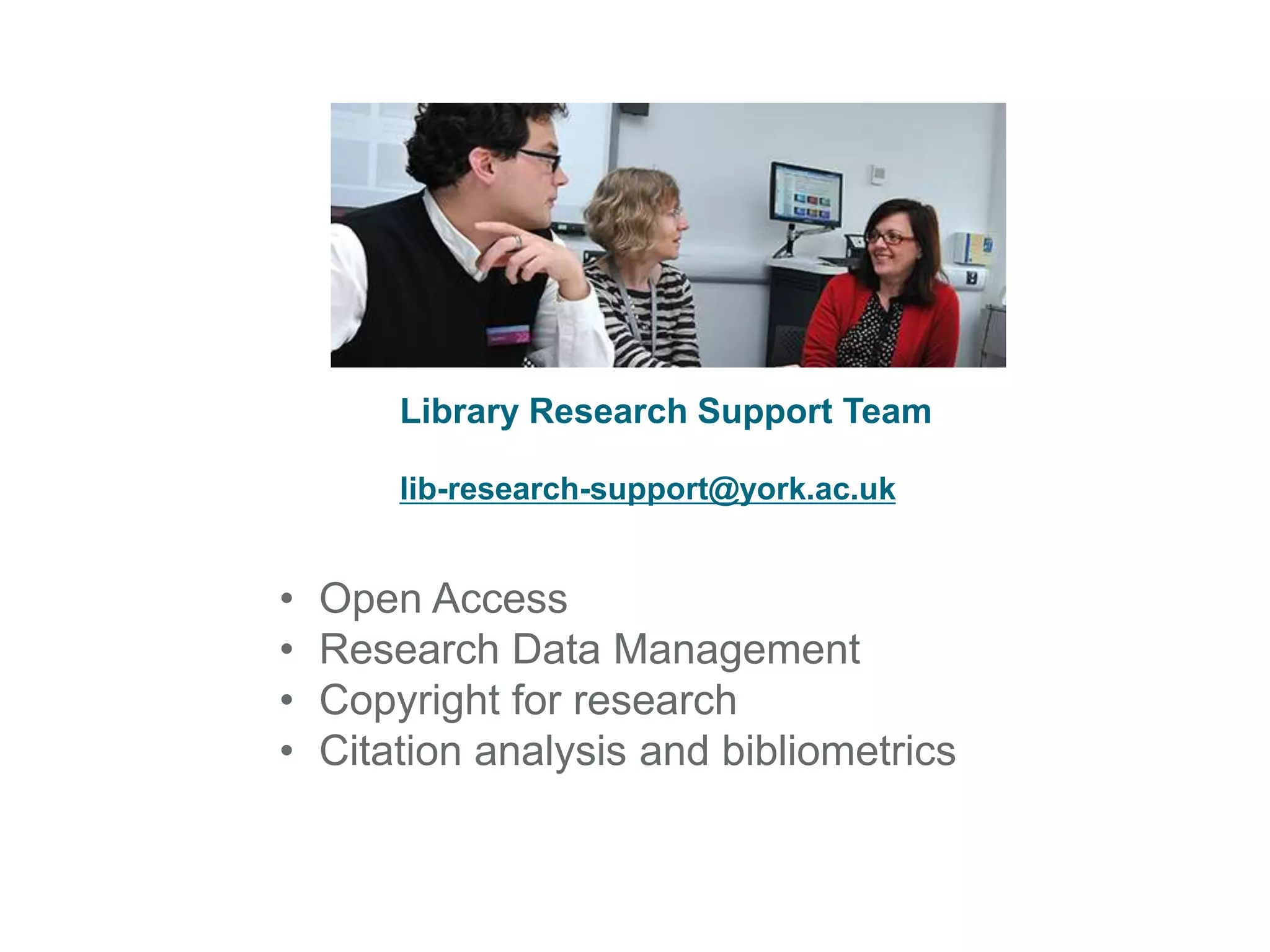
Library Research Support Team
• Open Access
• Research Data Management
• Copyright for research
• Citation analysis and bibliometrics
lib-research-support@york.ac.uk
What we’ll cover today…
• What open access is
• Why we might want to do it
• Models for achieving open access
• Open access journals
• Open access licencing
• Repositories and self-archiving
What is Open Access?
By 'open access’ to [research] literature we
mean its free availability on the public internet,
permitting any users to read, download, copy,
distribute, print, search, or link to the full texts of
articles, crawl them for indexing, pass them as
data to software, or use them for any other
lawful purpose, without financial, legal, or
technical barriers other than those inseparable
from gaining access to the internet itself.
Budapest Open Access Initiative, 2002,
https://www.budapestopenaccessinitiative.org/read
What is Open Access?
By 'open access’ to [research] literature we
mean its free availability on the public internet,
permitting any users to read, download, copy,
distribute, print, search, or link to the full texts of
articles, crawl them for indexing, pass them as
data to software, or use them for any other
lawful purpose, without financial, legal, or
technical barriers other than those inseparable
from gaining access to the internet itself.
Budapest Open Access Initiative, 2002,
https://www.budapestopenaccessinitiative.org/read
By 'open access’ to [research] literature we
mean its free availability on the public internet,
permitting any users to read, download, copy,
distribute, print, search, or link to the full texts of
articles, crawl them for indexing, pass them as
data to software, or use them for any other
lawful purpose, without financial, legal, or
technical barriers other than those inseparable
from gaining access to the internet itself.
What is Open Access?
barrierswithout financial
Budapest Open Access Initiative, 2002,
https://www.budapestopenaccessinitiative.org/read
By 'open access’ to [research] literature we
mean its free availability on the public internet,
permitting any users to read, download, copy,
distribute, print, search, or link to the full texts of
articles, crawl them for indexing, pass them as
data to software, or use them for any other
lawful purpose, without financial, legal, or
technical barriers other than those inseparable
from gaining access to the internet itself.
What is Open Access?
or technical barrierswithout financial
Budapest Open Access Initiative, 2002,
https://www.budapestopenaccessinitiative.org/read
What is Open Access?
By 'open access’ to [research] literature we
mean its free availability on the public internet,
permitting any users to copy … read, download,
distribute … the full texts of
articles … without legal barriers crawl them for
indexing, pass them as data to software, or use
them for any other lawful purpose, without
financial, legal, or technical barriers other than
those inseparable from gaining access to the
internet itself.
Budapest Open Access Initiative, 2002,
https://www.budapestopenaccessinitiative.org/read
What is Open Access?
By 'open access’ to [research] literature we
mean its free availability on the public internet,
permitting any users to read, download, copy,
distribute, print, search, or link to the full texts of
articles, crawl them for indexing, pass them as
data to software, or use them for any other
lawful purpose, without financial, legal, or
technical barriers other than those inseparable
from gaining access to the internet itself.
without
legal
crawl them for indexing,
barriers
the full texts ofpass them as data to software
ortechnical
Budapest Open Access Initiative, 2002,
https://www.budapestopenaccessinitiative.org/read
What is Open Access?
By 'open access’ to [research] literature we
mean its free availability on the public internet,
permitting any users to read, download, copy,
distribute, print, search, or link to the full texts of
articles, crawl them for indexing, pass them as
data to software, or use them for any other
lawful purpose, without financial, legal, or
technical barriers other than those inseparable
from gaining access to the internet itself.
Budapest Open Access Initiative, 2002,
https://www.budapestopenaccessinitiative.org/read
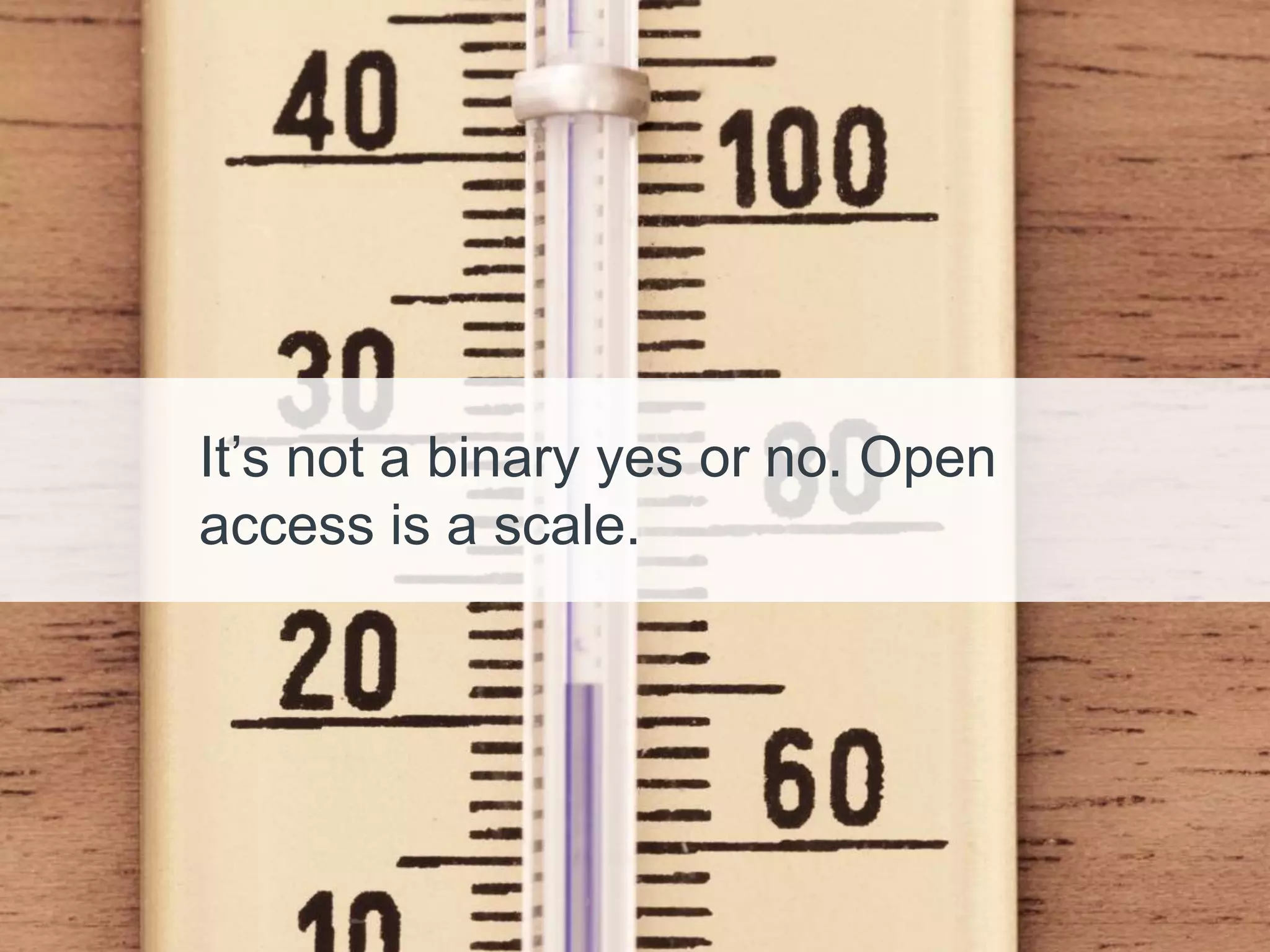
It’s not a binary yes or no. Open
access is a scale.
Discussion…
In your subject area, who might
benefit from greater access to
research publications?
Arguments for open access
Pragmatic
Democratic
Public
Benedikt Fecher & Sascha Friesike, ‘Open Science: One Term, Five Schools of Thought’. In
Sönke Bartling & Sascha Friesike, eds., Opening Science: The Evolving Guide on How the
Internet is Changing Research, Collaboration and Scholarly Publishing. Heidelberg: Springer
Open, 2014.
Arguments for open access
Pragmatic
Democratic
Public
Benedikt Fecher & Sascha Friesike, ‘Open Science: One Term, Five Schools of Thought’. In
Sönke Bartling & Sascha Friesike, eds., Opening Science: The Evolving Guide on How the
Internet is Changing Research, Collaboration and Scholarly Publishing. Heidelberg: Springer
Open, 2014.
“Knowledge-creation could
be more efficient if scientists
worked together.”
• Other researchers
• Open to industry
• Reuse for research – e.g.
text or data mining
Arguments for open access
Pragmatic
Democratic
Public
“The access to knowledge is
unequally distributed.”
• Independent researchers
• Less research-intensive
universities
• Lower income countries
Benedikt Fecher & Sascha Friesike, ‘Open Science: One Term, Five Schools of Thought’. In
Sönke Bartling & Sascha Friesike, eds., Opening Science: The Evolving Guide on How the
Internet is Changing Research, Collaboration and Scholarly Publishing. Heidelberg: Springer
Open, 2014.
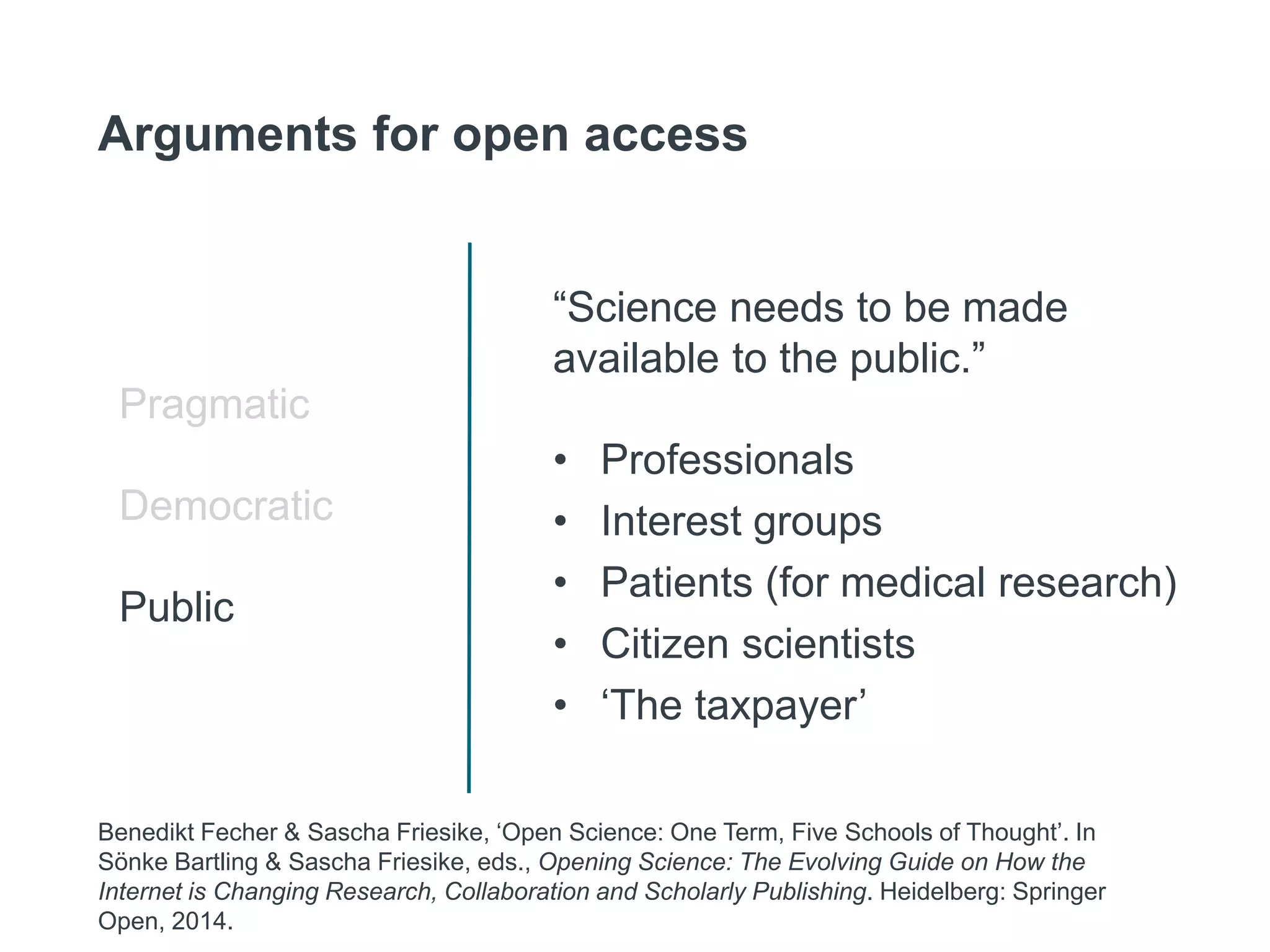
Arguments for open access
Pragmatic
Democratic
Public
“Science needs to be made
available to the public.”
• Professionals
• Interest groups
• Patients (for medical research)
• Citizen scientists
• ‘The taxpayer’
Benedikt Fecher & Sascha Friesike, ‘Open Science: One Term, Five Schools of Thought’. In
Sönke Bartling & Sascha Friesike, eds., Opening Science: The Evolving Guide on How the
Internet is Changing Research, Collaboration and Scholarly Publishing. Heidelberg: Springer
Open, 2014.
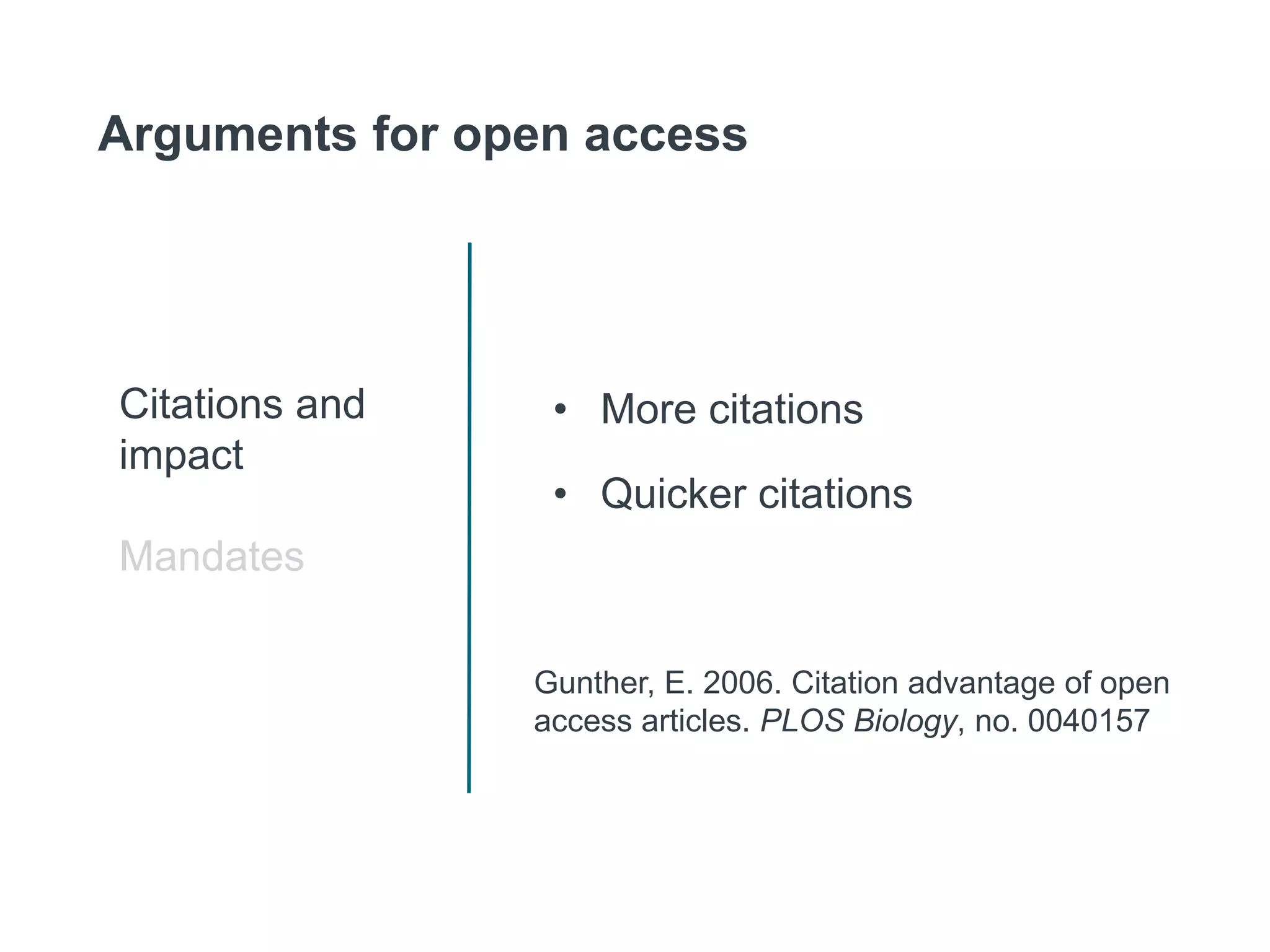
Citations and
impact
Mandates
• More citations
• Quicker citations
Gunther, E. 2006. Citation advantage of open
access articles. PLOS Biology, no. 0040157
Arguments for open access
Citations and
impact
Mandates
Over 75% of our research
funding comes with an open
access mandate.
And there is a university
publication policy.
Arguments for open access
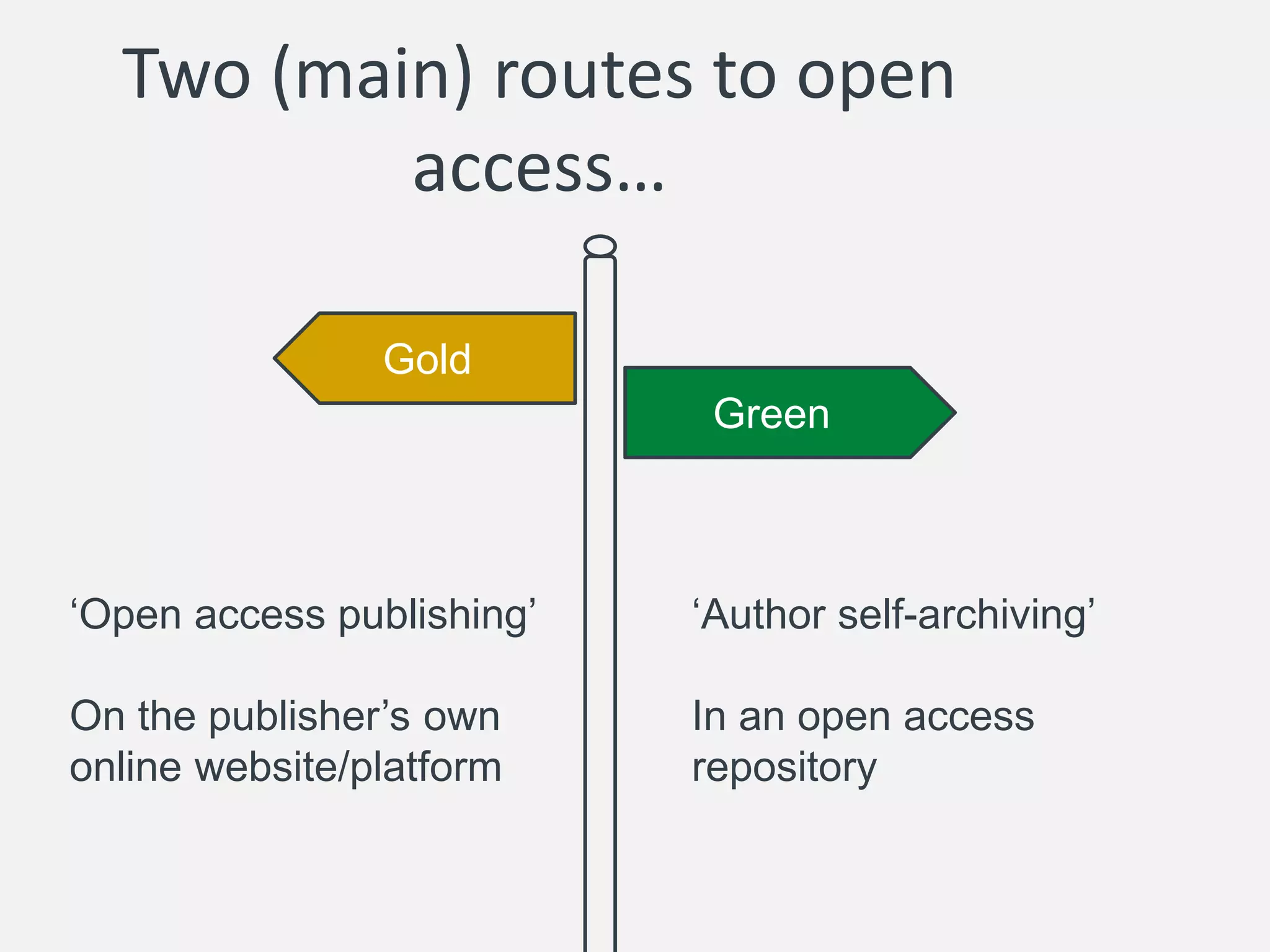
Two (main) routes to open
access…
‘Open access publishing’
On the publisher’s own
online website/platform
‘Author self-archiving’
In an open access
repository
Gold
Green
Two (main) routes to open
access…
‘Open access publishing’
On the publisher’s own
online website/platform
Gold
Green
Subscription publishing model
Author submits
manuscript to publisher
Publisher provides log-in access…
Institution pays
purchase or
subscription fee
…but not for these people.


Review & Edits
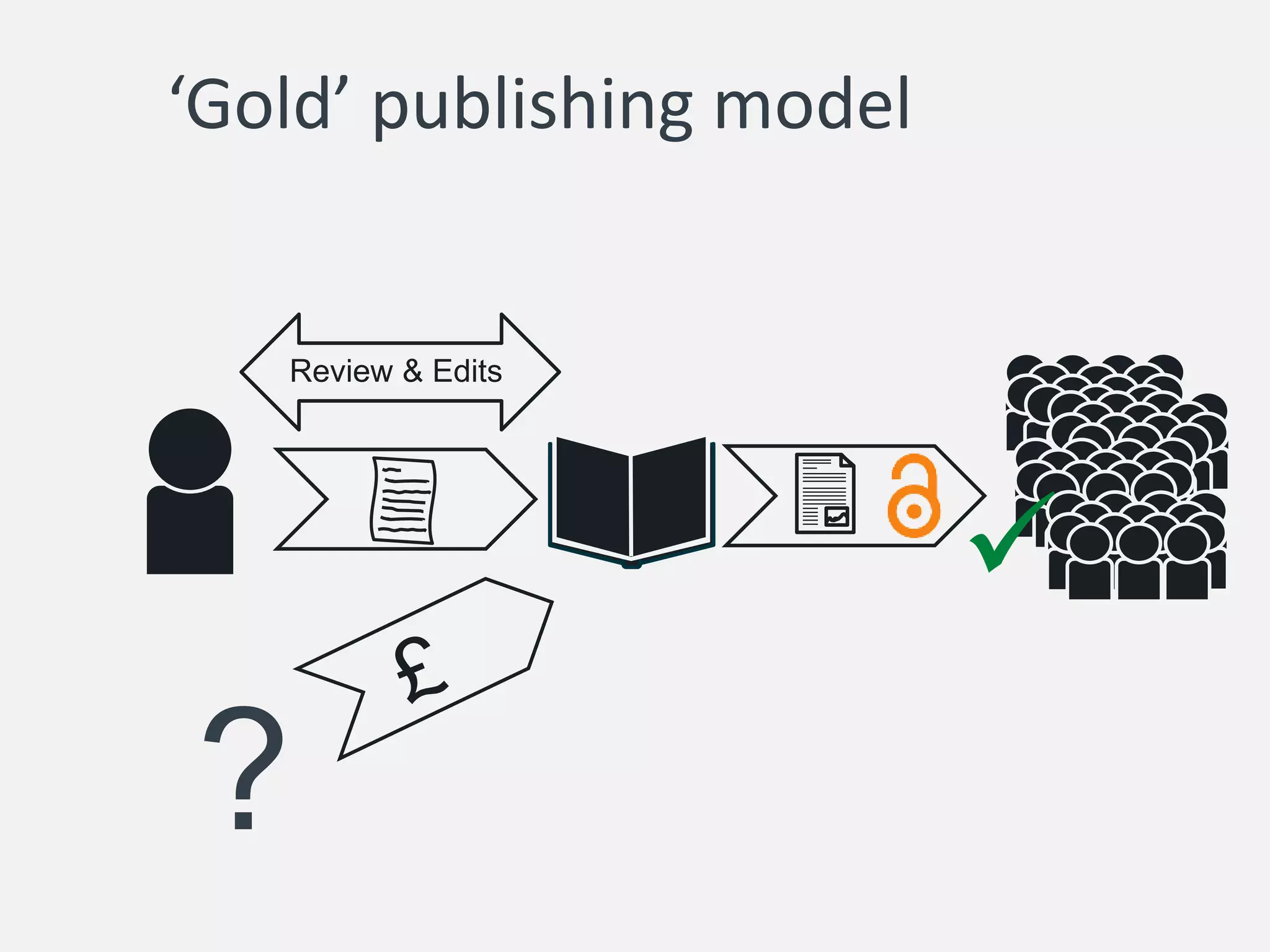
‘Gold’ publishing model

Review & Edits
?
Journal types
Journal types
Subscription journals
(might be possible to go the
‘green’ route)
Journal types
Hybrid journals
Authors decide article by
article.
Subscriptions still needed for
non-open content.
Journal types
Delayed access
All articles made open after
an embargo.
Authors probably still pay a
fee.
Not considered open access
by most funders.
Journal types
Open access
All articles made open.
If the journal charges an
article processing charge
then you will have to be in a
position to pay.
Article Processing
Charges
• Most OA journal are free to
publish.
• Average for those that
charge, £1,500 + VAT.
• £8-£30,000 for a full book.
• Hybrid journals are more
expensive
0 200 400 600 800
£0
£500
£1,000
£1,500
£2,000
£2,500
£3,000
£3,500
£4,000
£0
£500
£1,000
£1,500
£2,000
£2,500
£3,000
£3,500
£4,000
Open Access
journals
Hybrid journals
Openaccessfeeperarticle(excl.VAT)
Sample of journal APC list prices, 2016.
Who should pay for the cost of
open access publishing?
Who pays?
Researcher?
Funder?
University?
Other?
Reuse rights
“Permitting any users to copy, distribute,
print search or link to the full text of articles
… without legal barriers”
Budapest Open Access Initiative, 2002,
https://www.budapestopenaccessinitiative.org/read
Reuse rights
Reuse rights
• Publishers require
copyright transfer or
exclusive rights
• Restricts sharing and
reuse by third-parties
• Restricts reuse by content
authors
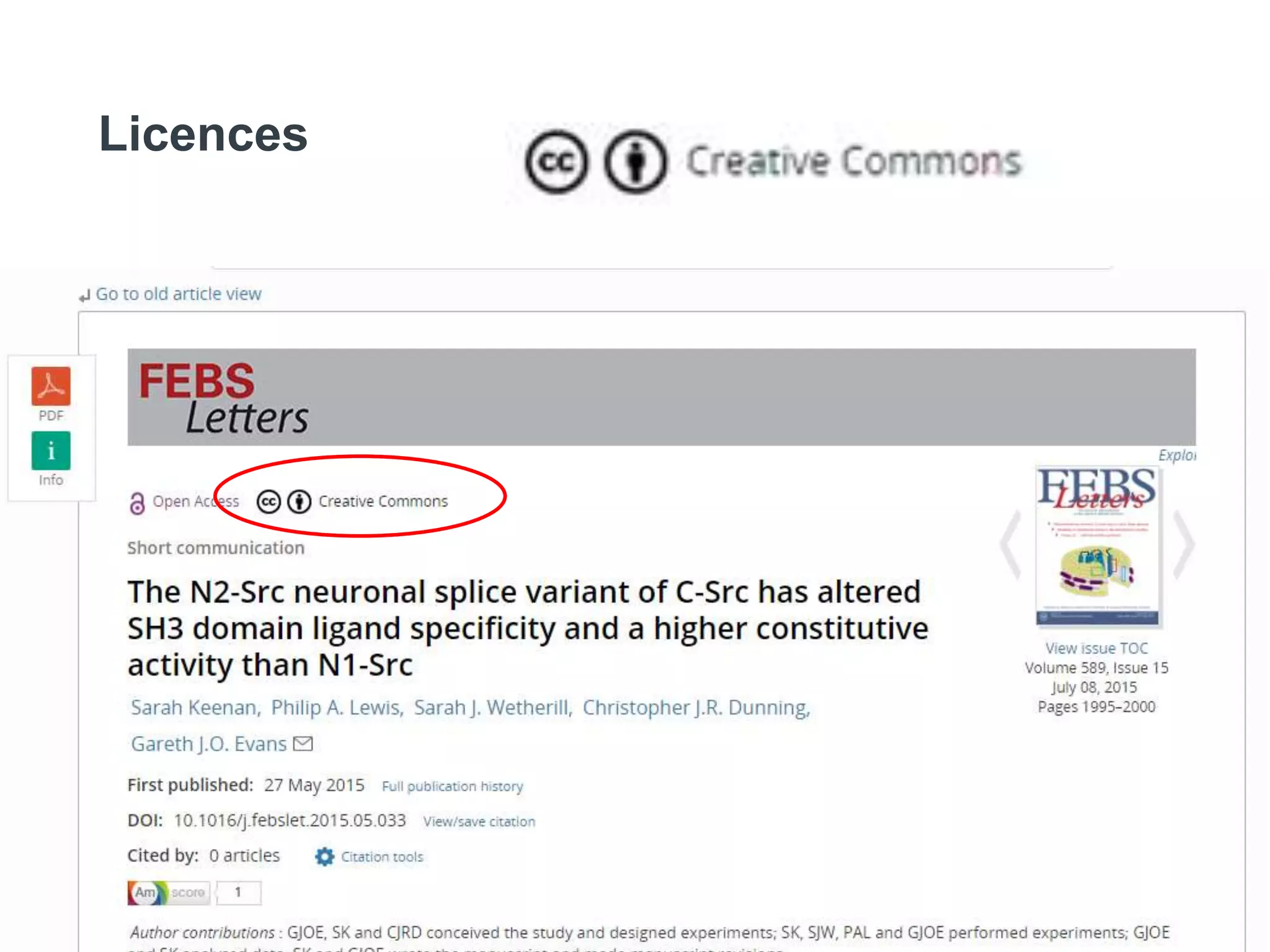
Open access licences
• Rightsholder (authors /
publishers) has exclusive rights
to distribute and reuse content
• Rightsholder can licence others
– i.e. give them permission – to
use content
• Open access licences apply
generally to anyone who wants
to use the content
Creative commons licences
“Our tools give everyone from
individual creators to large companies
and institutions a simple, standardized
way to grant copyright permissions to
their creative work.”
https://creativecommons.org/licenses/
Licences
Licences
Licences
Licences
Licences
Licences
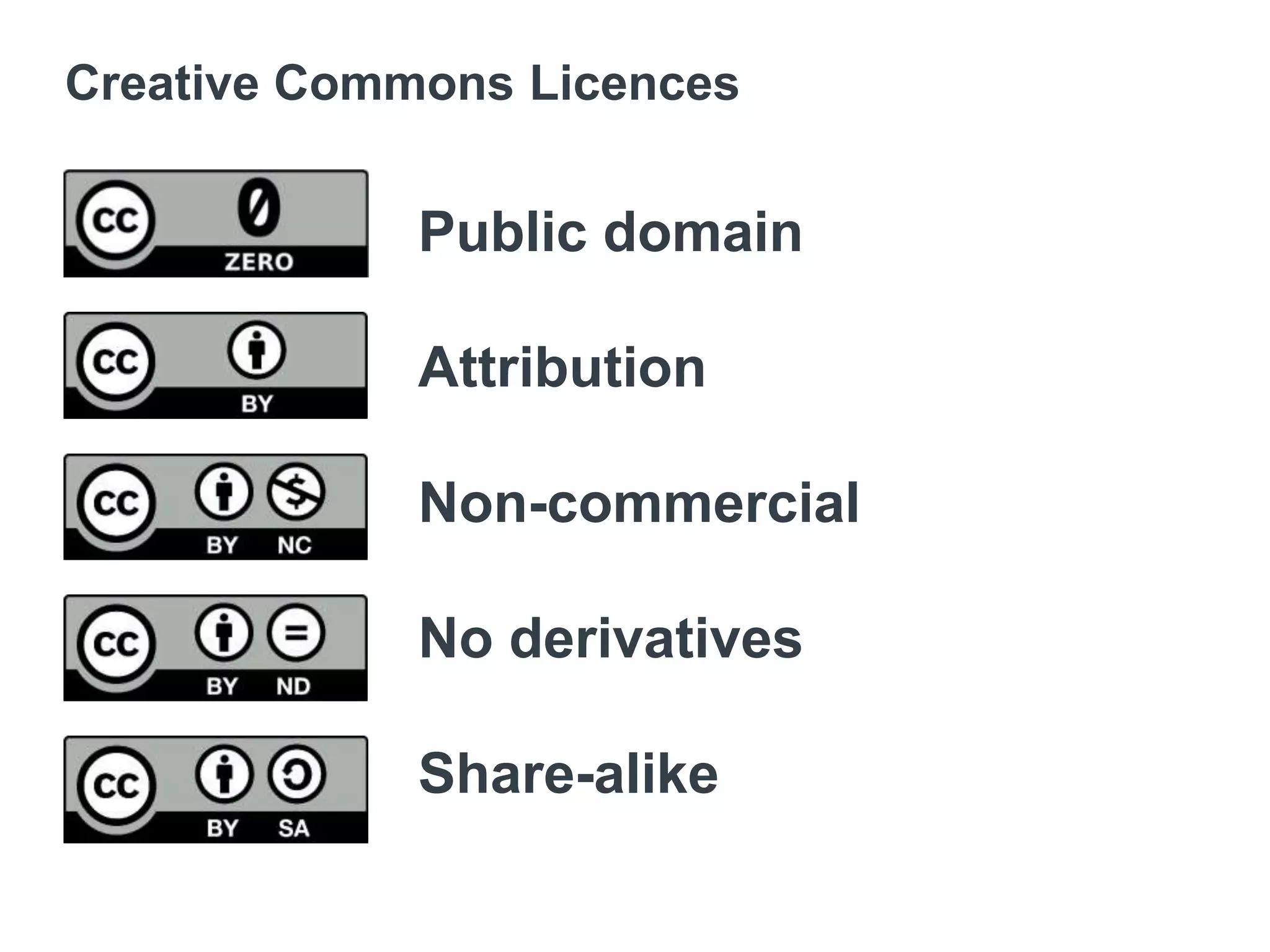
Public domain
Attribution
Non-commercial
No derivatives
Share-alike
Creative Commons Licences
Think about any upcoming
publications you might have, or
your thesis.
What type of licence would you
want to use?
Which wouldn’t you use?
Which licence should we use?
• Might be author’s choice
• Will depend on options offered by the journal
• Might be dictated by whoever pays the APC
Reuse rights
• CC BY generally seen as
the ‘gold-standard’ for
open access
• But some groups do have
concerns that they are too
liberal
Discussion…
What might be the downsides
of ‘gold’ open access?
Are there alternative funding
models that might help?
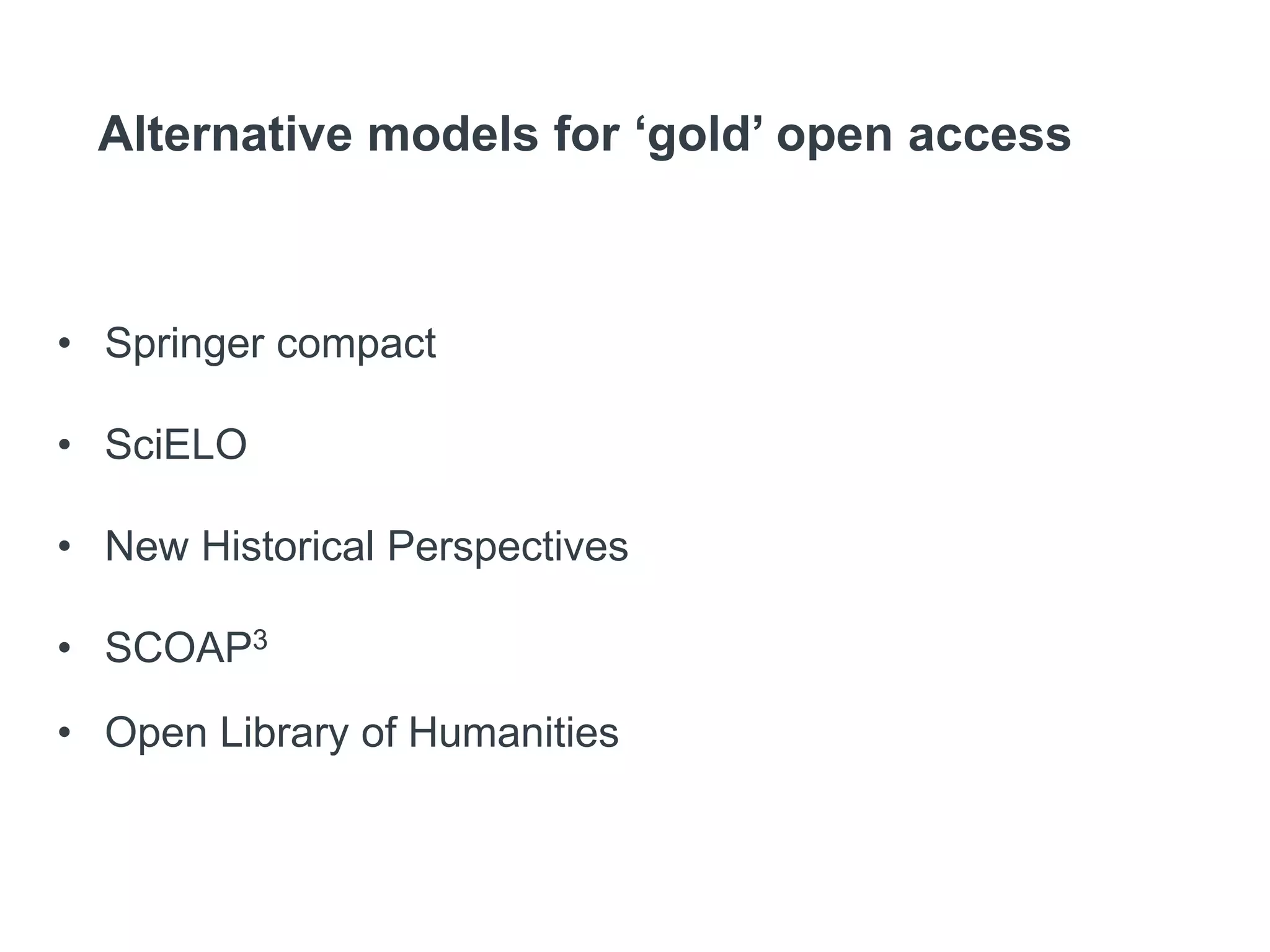
Alternative models for ‘gold’ open access
• Springer compact
• SciELO
• New Historical Perspectives
• SCOAP3
• Open Library of Humanities
Springer Compact
Springer Publishing is one of the biggest academic publishers
in the world.
Under the ‘Springer Compact’ researchers affiliated to The
University of York – and other members – can publish open
access in any Springer journal ‘free of charge’.
The costs is covered by a pre-agreed supplement added the
subscription fee that the Library pays.
SciELO
SciELO is a database and open access publishing platform for
journals in the Spanish and Portuguese language.
The selected journals are open access and free to publish for
all. This is funded by national governmental organisations in
Spanish or Portuguese speaking countries.
Contributing countries ‘curate’ a group of journals, and can
decide which journal are included in the scheme.
Royal Historical Society New Historical
Perspectives
New Historical Perspectives is a book series open to early
career researchers.
Books are fully open access and free to publish. The cost is
subsidised by income streams including sales of non-open-
access books and journal subscriptions.
SCOAP3
SCOAP3 is managed by CERN in Switzerland and provides
free to publish open access to high end journals and articles in
the area of high energy physics.
CERN pay publishers an agreed processing charge for each
article. The total cost is then split between over 3,000 libraries,
funding agencies and research institutions who have joined
the consortium.
Open Library of Humanities
Open Library of Humanities publishes journals in subjects
across arts and humanities.
All journals are fully open access and free to publish.
Libraries are invited to become ‘partners’ and each contribute
an annual amount to fund journal operations. Libraries can
choose how much they want to contribute.
Two (main) routes to open
access…
‘Open access publishing’
On the publisher’s own
online website/platform
‘Author self-archiving’
In an open access
repository
Gold
Green
Two (main) routes to open
access…
‘Author self-archiving’
In an open access
repository
Gold
Green
Subscription publishing model
Author submits
manuscript to publisher
Publisher provides log-in access…
Institution pays
purchase or
subscription fee
…but not for these people.


Review & Edits
‘Green’ open access model

Review & Edits
Author deposits
manuscript to a
repository

Repositories…
…preserve, manage, and provide
access to many types of digital
materials in a variety of formats.
Materials in online repositories are
curated to enable search,
discovery, and reuse.
CASRAI Dictionary, https://dictionary.casrai.org/
Repositories…
• Provide a ‘free’ way of achieving open access
• Help to ensure long-term preservation of
outputs
• Can facilitate machine readability and text
mining
• Can improve ‘findability’ or research outputs
Repositories…
Preprint repositories
Funder repositories
Institutional repositories
Repositories?
Scholarly
networking
sites
Publisher permissions
• What versions will they let
you make open?
• Which websites /
repositories?
• When?
• Publisher will usually have
exclusive rights
• What will they let you make
open?
• Where?
• When?
Publisher permissions
University of York repositories
When you deposit, we check all
this for you.
We use SHERPA/RoMEO
http://www.sherpa.ac.uk/romeo
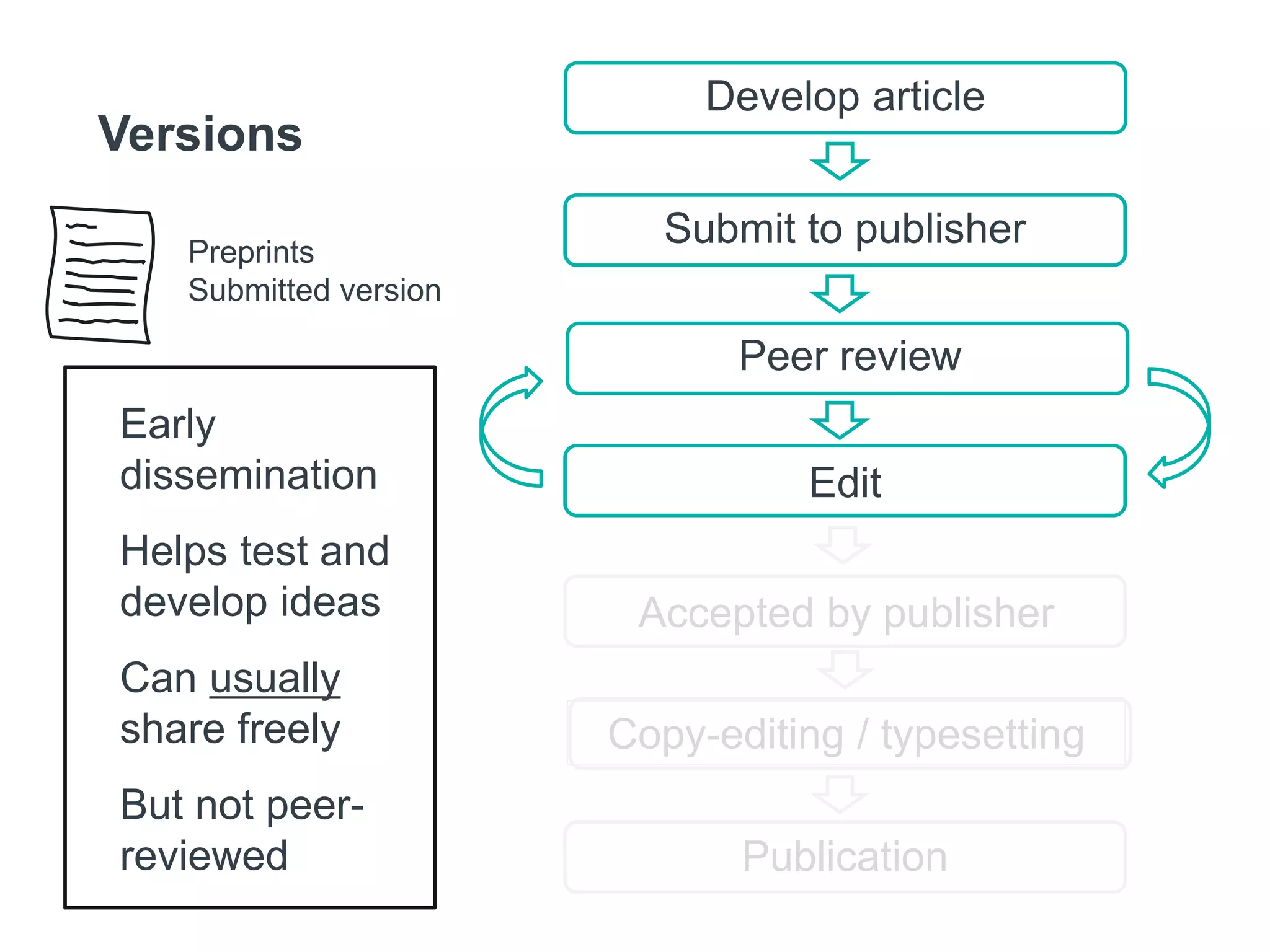
Versions
Submit to publisher
Peer review
Edit
Accepted by publisher
Copy-editing / typesetting
Publication
Develop article
Submit to publisher
Peer review
Edit
Accepted by publisher
Copy-editing / typesetting
Publication
Preprints
Submitted version
Early
dissemination
Helps test and
develop ideas
Can usually
share freely
But not peer-
reviewed
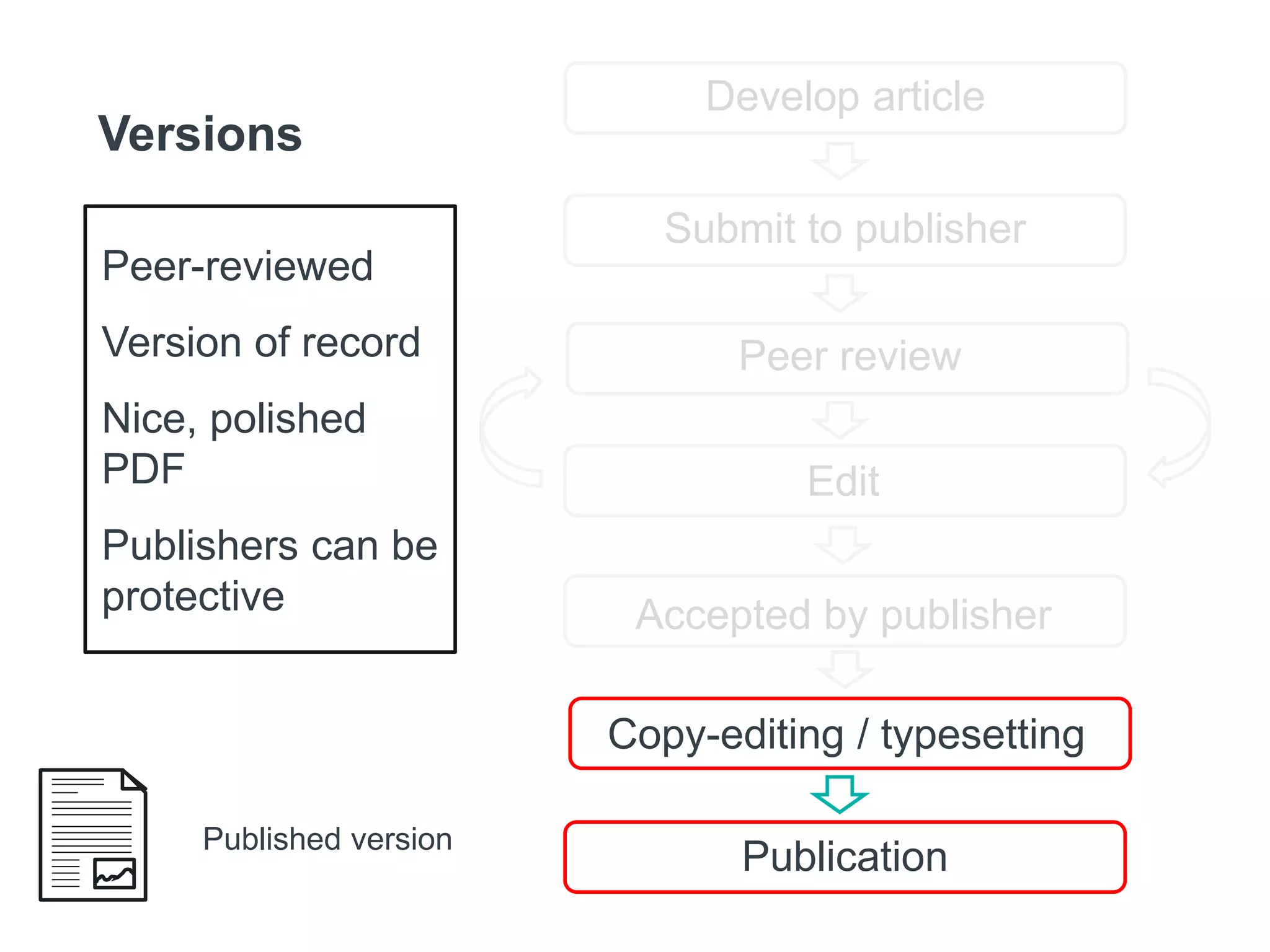
Versions
Develop article
Accepted by publisher
Submit to publisher
Peer review
Edit
Copy-editing / typesetting
Publication
Published version
Peer-reviewed
Version of record
Nice, polished
PDF
Publishers can be
protective
Versions
Develop article
Submit to publisher
Peer review
Edit
Accepted by publisher
Copy-editing / typesetting
Publication
Accepted manuscript
Post-print
Versions
Develop article
Compromise
Peer-reviewed
Publishers likely
to allow sharing
Where?
• Personal webpage?
• University webpage?
• Preprint server?
• Institutional repository?
• Networking sites?
When?
Embargo = Period of time after
publication before
manuscript can be open
access.
But Not a restriction on deposit! –
embargo can be set in the repository
Discussion…
What might be the downsides
of ‘green’ open access?
Are there changes that might
help?
Open Access Theses
https://www.york.ac.uk/research/graduate-school/academic/thesis/submit/
• Successful York PhD students
must deposit their thesis
• Will be made open access –
embargoes may be an option
• Choice of Creative Commons
licence
• Funders might also have
requirements
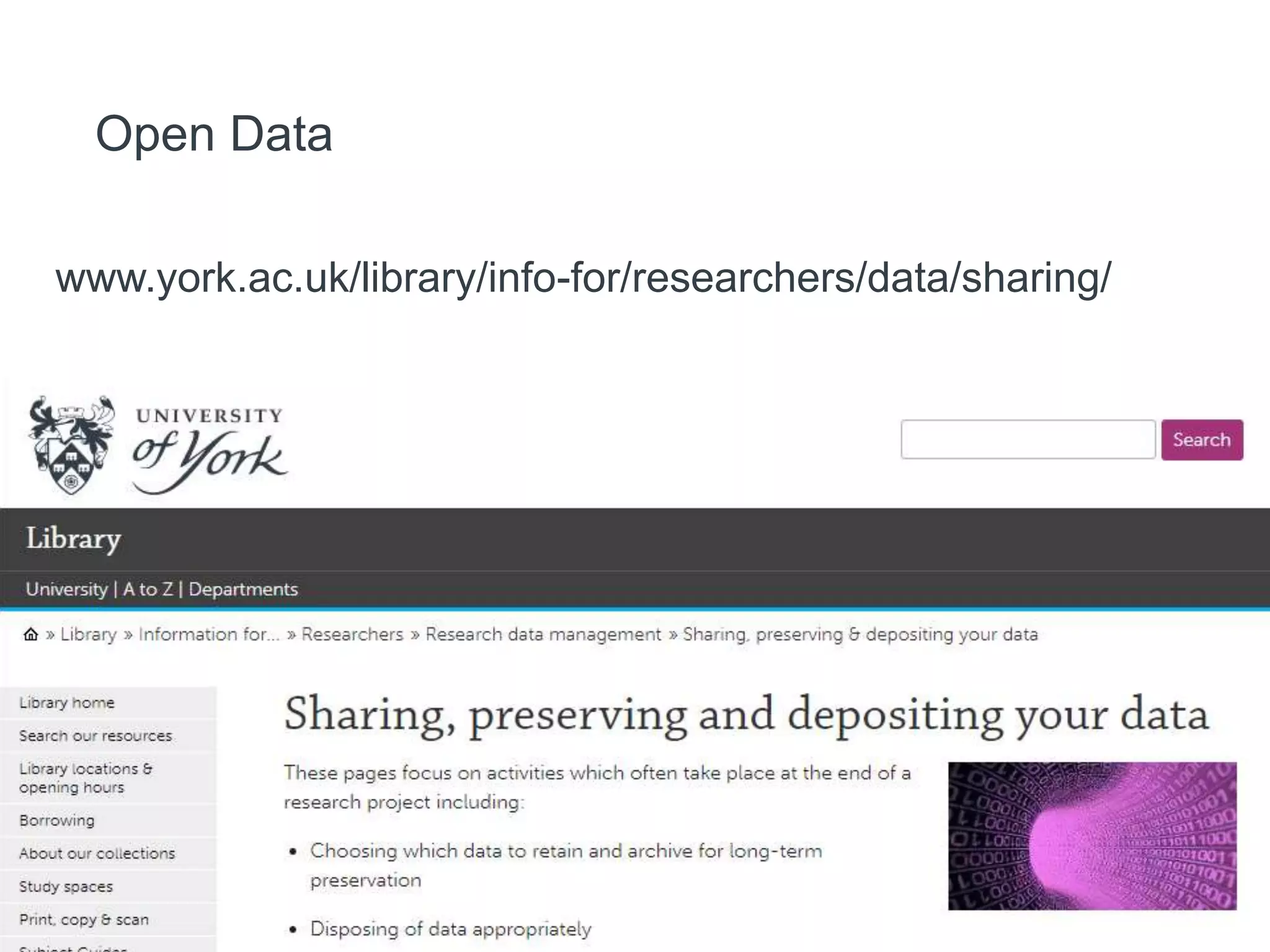
Open Data
www.york.ac.uk/library/info-for/researchers/data/sharing/
Questions?
lib-research-support@york.ac.uk
www.york.ac.uk/open-access
Information Services
We need your
please fill out the course
evaluation form provided

Open access publication (RET workshop)

  • 1.
    Open Access Publication ResearchExcellence Training Thom Blake Research Support Librarian 2018/19 academic year Information Services
  • 2.
    Library Research SupportTeam • Open Access • Research Data Management • Copyright for research • Citation analysis and bibliometrics lib-research-support@york.ac.uk
  • 3.
    What we’ll covertoday… • What open access is • Why we might want to do it • Models for achieving open access • Open access journals • Open access licencing • Repositories and self-archiving
  • 4.
    What is OpenAccess?
  • 5.
    What is OpenAccess? By 'open access’ to [research] literature we mean its free availability on the public internet, permitting any users to read, download, copy, distribute, print, search, or link to the full texts of articles, crawl them for indexing, pass them as data to software, or use them for any other lawful purpose, without financial, legal, or technical barriers other than those inseparable from gaining access to the internet itself. Budapest Open Access Initiative, 2002, https://www.budapestopenaccessinitiative.org/read
  • 6.
    What is OpenAccess? By 'open access’ to [research] literature we mean its free availability on the public internet, permitting any users to read, download, copy, distribute, print, search, or link to the full texts of articles, crawl them for indexing, pass them as data to software, or use them for any other lawful purpose, without financial, legal, or technical barriers other than those inseparable from gaining access to the internet itself. Budapest Open Access Initiative, 2002, https://www.budapestopenaccessinitiative.org/read
  • 7.
    By 'open access’to [research] literature we mean its free availability on the public internet, permitting any users to read, download, copy, distribute, print, search, or link to the full texts of articles, crawl them for indexing, pass them as data to software, or use them for any other lawful purpose, without financial, legal, or technical barriers other than those inseparable from gaining access to the internet itself. What is Open Access? barrierswithout financial Budapest Open Access Initiative, 2002, https://www.budapestopenaccessinitiative.org/read
  • 8.
    By 'open access’to [research] literature we mean its free availability on the public internet, permitting any users to read, download, copy, distribute, print, search, or link to the full texts of articles, crawl them for indexing, pass them as data to software, or use them for any other lawful purpose, without financial, legal, or technical barriers other than those inseparable from gaining access to the internet itself. What is Open Access? or technical barrierswithout financial Budapest Open Access Initiative, 2002, https://www.budapestopenaccessinitiative.org/read
  • 9.
    What is OpenAccess? By 'open access’ to [research] literature we mean its free availability on the public internet, permitting any users to copy … read, download, distribute … the full texts of articles … without legal barriers crawl them for indexing, pass them as data to software, or use them for any other lawful purpose, without financial, legal, or technical barriers other than those inseparable from gaining access to the internet itself. Budapest Open Access Initiative, 2002, https://www.budapestopenaccessinitiative.org/read
  • 10.
    What is OpenAccess? By 'open access’ to [research] literature we mean its free availability on the public internet, permitting any users to read, download, copy, distribute, print, search, or link to the full texts of articles, crawl them for indexing, pass them as data to software, or use them for any other lawful purpose, without financial, legal, or technical barriers other than those inseparable from gaining access to the internet itself. without legal crawl them for indexing, barriers the full texts ofpass them as data to software ortechnical Budapest Open Access Initiative, 2002, https://www.budapestopenaccessinitiative.org/read
  • 11.
    What is OpenAccess? By 'open access’ to [research] literature we mean its free availability on the public internet, permitting any users to read, download, copy, distribute, print, search, or link to the full texts of articles, crawl them for indexing, pass them as data to software, or use them for any other lawful purpose, without financial, legal, or technical barriers other than those inseparable from gaining access to the internet itself. Budapest Open Access Initiative, 2002, https://www.budapestopenaccessinitiative.org/read
  • 12.
    It’s not abinary yes or no. Open access is a scale.
  • 13.
    Discussion… In your subjectarea, who might benefit from greater access to research publications?
  • 14.
    Arguments for openaccess Pragmatic Democratic Public Benedikt Fecher & Sascha Friesike, ‘Open Science: One Term, Five Schools of Thought’. In Sönke Bartling & Sascha Friesike, eds., Opening Science: The Evolving Guide on How the Internet is Changing Research, Collaboration and Scholarly Publishing. Heidelberg: Springer Open, 2014.
  • 15.
    Arguments for openaccess Pragmatic Democratic Public Benedikt Fecher & Sascha Friesike, ‘Open Science: One Term, Five Schools of Thought’. In Sönke Bartling & Sascha Friesike, eds., Opening Science: The Evolving Guide on How the Internet is Changing Research, Collaboration and Scholarly Publishing. Heidelberg: Springer Open, 2014. “Knowledge-creation could be more efficient if scientists worked together.” • Other researchers • Open to industry • Reuse for research – e.g. text or data mining
  • 16.
    Arguments for openaccess Pragmatic Democratic Public “The access to knowledge is unequally distributed.” • Independent researchers • Less research-intensive universities • Lower income countries Benedikt Fecher & Sascha Friesike, ‘Open Science: One Term, Five Schools of Thought’. In Sönke Bartling & Sascha Friesike, eds., Opening Science: The Evolving Guide on How the Internet is Changing Research, Collaboration and Scholarly Publishing. Heidelberg: Springer Open, 2014.
  • 17.
    Arguments for openaccess Pragmatic Democratic Public “Science needs to be made available to the public.” • Professionals • Interest groups • Patients (for medical research) • Citizen scientists • ‘The taxpayer’ Benedikt Fecher & Sascha Friesike, ‘Open Science: One Term, Five Schools of Thought’. In Sönke Bartling & Sascha Friesike, eds., Opening Science: The Evolving Guide on How the Internet is Changing Research, Collaboration and Scholarly Publishing. Heidelberg: Springer Open, 2014.
  • 18.
    Citations and impact Mandates • Morecitations • Quicker citations Gunther, E. 2006. Citation advantage of open access articles. PLOS Biology, no. 0040157 Arguments for open access
  • 19.
    Citations and impact Mandates Over 75%of our research funding comes with an open access mandate. And there is a university publication policy. Arguments for open access
  • 20.
    Two (main) routesto open access… ‘Open access publishing’ On the publisher’s own online website/platform ‘Author self-archiving’ In an open access repository Gold Green
  • 21.
    Two (main) routesto open access… ‘Open access publishing’ On the publisher’s own online website/platform Gold Green
  • 22.
    Subscription publishing model Authorsubmits manuscript to publisher Publisher provides log-in access… Institution pays purchase or subscription fee …but not for these people.   Review & Edits
  • 23.
  • 24.
  • 25.
    Journal types Subscription journals (mightbe possible to go the ‘green’ route)
  • 26.
    Journal types Hybrid journals Authorsdecide article by article. Subscriptions still needed for non-open content.
  • 27.
    Journal types Delayed access Allarticles made open after an embargo. Authors probably still pay a fee. Not considered open access by most funders.
  • 28.
    Journal types Open access Allarticles made open. If the journal charges an article processing charge then you will have to be in a position to pay.
  • 29.
    Article Processing Charges • MostOA journal are free to publish. • Average for those that charge, £1,500 + VAT. • £8-£30,000 for a full book. • Hybrid journals are more expensive 0 200 400 600 800 £0 £500 £1,000 £1,500 £2,000 £2,500 £3,000 £3,500 £4,000 £0 £500 £1,000 £1,500 £2,000 £2,500 £3,000 £3,500 £4,000 Open Access journals Hybrid journals Openaccessfeeperarticle(excl.VAT) Sample of journal APC list prices, 2016.
  • 30.
    Who should payfor the cost of open access publishing?
  • 31.
  • 32.
    Reuse rights “Permitting anyusers to copy, distribute, print search or link to the full text of articles … without legal barriers” Budapest Open Access Initiative, 2002, https://www.budapestopenaccessinitiative.org/read
  • 33.
  • 34.
    Reuse rights • Publishersrequire copyright transfer or exclusive rights • Restricts sharing and reuse by third-parties • Restricts reuse by content authors
  • 35.
    Open access licences •Rightsholder (authors / publishers) has exclusive rights to distribute and reuse content • Rightsholder can licence others – i.e. give them permission – to use content • Open access licences apply generally to anyone who wants to use the content
  • 36.
    Creative commons licences “Ourtools give everyone from individual creators to large companies and institutions a simple, standardized way to grant copyright permissions to their creative work.” https://creativecommons.org/licenses/
  • 37.
  • 38.
  • 39.
  • 40.
  • 41.
  • 42.
  • 43.
  • 44.
    Think about anyupcoming publications you might have, or your thesis. What type of licence would you want to use? Which wouldn’t you use?
  • 45.
    Which licence shouldwe use? • Might be author’s choice • Will depend on options offered by the journal • Might be dictated by whoever pays the APC
  • 46.
    Reuse rights • CCBY generally seen as the ‘gold-standard’ for open access • But some groups do have concerns that they are too liberal
  • 47.
    Discussion… What might bethe downsides of ‘gold’ open access? Are there alternative funding models that might help?
  • 48.
    Alternative models for‘gold’ open access • Springer compact • SciELO • New Historical Perspectives • SCOAP3 • Open Library of Humanities
  • 49.
    Springer Compact Springer Publishingis one of the biggest academic publishers in the world. Under the ‘Springer Compact’ researchers affiliated to The University of York – and other members – can publish open access in any Springer journal ‘free of charge’. The costs is covered by a pre-agreed supplement added the subscription fee that the Library pays.
  • 50.
    SciELO SciELO is adatabase and open access publishing platform for journals in the Spanish and Portuguese language. The selected journals are open access and free to publish for all. This is funded by national governmental organisations in Spanish or Portuguese speaking countries. Contributing countries ‘curate’ a group of journals, and can decide which journal are included in the scheme.
  • 51.
    Royal Historical SocietyNew Historical Perspectives New Historical Perspectives is a book series open to early career researchers. Books are fully open access and free to publish. The cost is subsidised by income streams including sales of non-open- access books and journal subscriptions.
  • 52.
    SCOAP3 SCOAP3 is managedby CERN in Switzerland and provides free to publish open access to high end journals and articles in the area of high energy physics. CERN pay publishers an agreed processing charge for each article. The total cost is then split between over 3,000 libraries, funding agencies and research institutions who have joined the consortium.
  • 53.
    Open Library ofHumanities Open Library of Humanities publishes journals in subjects across arts and humanities. All journals are fully open access and free to publish. Libraries are invited to become ‘partners’ and each contribute an annual amount to fund journal operations. Libraries can choose how much they want to contribute.
  • 54.
    Two (main) routesto open access… ‘Open access publishing’ On the publisher’s own online website/platform ‘Author self-archiving’ In an open access repository Gold Green
  • 55.
    Two (main) routesto open access… ‘Author self-archiving’ In an open access repository Gold Green
  • 56.
    Subscription publishing model Authorsubmits manuscript to publisher Publisher provides log-in access… Institution pays purchase or subscription fee …but not for these people.   Review & Edits
  • 57.
    ‘Green’ open accessmodel  Review & Edits Author deposits manuscript to a repository 
  • 58.
    Repositories… …preserve, manage, andprovide access to many types of digital materials in a variety of formats. Materials in online repositories are curated to enable search, discovery, and reuse. CASRAI Dictionary, https://dictionary.casrai.org/
  • 59.
    Repositories… • Provide a‘free’ way of achieving open access • Help to ensure long-term preservation of outputs • Can facilitate machine readability and text mining • Can improve ‘findability’ or research outputs
  • 60.
  • 61.
  • 62.
  • 63.
    Publisher permissions • Whatversions will they let you make open? • Which websites / repositories? • When?
  • 64.
    • Publisher willusually have exclusive rights • What will they let you make open? • Where? • When? Publisher permissions University of York repositories When you deposit, we check all this for you. We use SHERPA/RoMEO http://www.sherpa.ac.uk/romeo
  • 65.
    Versions Submit to publisher Peerreview Edit Accepted by publisher Copy-editing / typesetting Publication Develop article
  • 66.
    Submit to publisher Peerreview Edit Accepted by publisher Copy-editing / typesetting Publication Preprints Submitted version Early dissemination Helps test and develop ideas Can usually share freely But not peer- reviewed Versions Develop article
  • 67.
    Accepted by publisher Submitto publisher Peer review Edit Copy-editing / typesetting Publication Published version Peer-reviewed Version of record Nice, polished PDF Publishers can be protective Versions Develop article
  • 68.
    Submit to publisher Peerreview Edit Accepted by publisher Copy-editing / typesetting Publication Accepted manuscript Post-print Versions Develop article Compromise Peer-reviewed Publishers likely to allow sharing
  • 69.
    Where? • Personal webpage? •University webpage? • Preprint server? • Institutional repository? • Networking sites?
  • 70.
    When? Embargo = Periodof time after publication before manuscript can be open access. But Not a restriction on deposit! – embargo can be set in the repository
  • 71.
    Discussion… What might bethe downsides of ‘green’ open access? Are there changes that might help?
  • 72.
    Open Access Theses https://www.york.ac.uk/research/graduate-school/academic/thesis/submit/ •Successful York PhD students must deposit their thesis • Will be made open access – embargoes may be an option • Choice of Creative Commons licence • Funders might also have requirements
  • 73.
  • 74.
  • 75.
    We need your pleasefill out the course evaluation form provided

Editor's Notes

  • #5 Definition from Peter Suber – Professor of Philosophy and former Director of Scholarly Communications at Harvard.
  • #6 Definition from Peter Suber – Professor of Philosophy and former Director of Scholarly Communications at Harvard.
  • #7 Definition from Peter Suber – Professor of Philosophy and former Director of Scholarly Communications at Harvard.
  • #8 Definition from Peter Suber – Professor of Philosophy and former Director of Scholarly Communications at Harvard.
  • #9 Definition from Peter Suber – Professor of Philosophy and former Director of Scholarly Communications at Harvard.
  • #10 Definition from Peter Suber – Professor of Philosophy and former Director of Scholarly Communications at Harvard.
  • #11 Definition from Peter Suber – Professor of Philosophy and former Director of Scholarly Communications at Harvard.
  • #12 Definition from Peter Suber – Professor of Philosophy and former Director of Scholarly Communications at Harvard.
  • #21 There are two main ‘routes’ to open access, ‘Green’ and ‘Gold’ – colour coding is completely arbitrary Not mutually exclusive, can do both
  • #22 There are two main ‘routes’ to open access, ‘Green’ and ‘Gold’ – colour coding is completely arbitrary Not mutually exclusive, can do both
  • #23 Standard publishing model: 1: researcher submits to journal 2: period of back and forward with review and edits 3: journal accepted, publisher copyedits, typesets and formats article and published. 4: Universities pay a subscriptions, and as a result their students and staff can get access 5: But people outside of subscribing institutions can’t get access.
  • #24 Standard publishing model: 1: researcher submits to journal 2: period of back and forward with review and edits 3: journal accepted, publisher copyedits, typesets and formats article and published. 4: Universities pay a subscriptions, and as a result their students and staff can get access 5: But people outside of subscribing institutions can’t get access.
  • #25 Firstly, what kind of journal is it.
  • #26 Firstly, what kind of journal is it.
  • #27 Firstly, what kind of journal is it.
  • #28 Firstly, what kind of journal is it.
  • #29 Firstly, what kind of journal is it.
  • #30 Not all open access journals charge a fee, many are free Where we do pay an APC, average cost is about £1500 but it really does range a lot Hybrid journals are more expensive than fully open access
  • #32 For more information about the York Open Access Fund visit the York open access website.
  • #33 First, how can we communicate what reuse rights other people have to your work. Creative Commons are the most commonly used. There are others, such as Open Government Licence or similar in other countries. By adding a Creative Commons licence to something the copyright holder – which might be you – is giving a straightforward way for anyone accessing your content to understand what they can and can’t do with it. Creative Commons licences are not an alternative to copyright A lot of publishers will give you CC licences as an option but charge you for the privilage. Won’t talk at length about this but see the open access webpages and RETT course.
  • #34 First, how can we communicate what reuse rights other people have to your work. Creative Commons are the most commonly used. There are others, such as Open Government Licence or similar in other countries. By adding a Creative Commons licence to something the copyright holder – which might be you – is giving a straightforward way for anyone accessing your content to understand what they can and can’t do with it. Creative Commons licences are not an alternative to copyright A lot of publishers will give you CC licences as an option but charge you for the privilage. Won’t talk at length about this but see the open access webpages and RETT course.
  • #35 First, how can we communicate what reuse rights other people have to your work. Creative Commons are the most commonly used. There are others, such as Open Government Licence or similar in other countries. By adding a Creative Commons licence to something the copyright holder – which might be you – is giving a straightforward way for anyone accessing your content to understand what they can and can’t do with it. Creative Commons licences are not an alternative to copyright A lot of publishers will give you CC licences as an option but charge you for the privilage. Won’t talk at length about this but see the open access webpages and RETT course.
  • #36 First, how can we communicate what reuse rights other people have to your work. Creative Commons are the most commonly used. There are others, such as Open Government Licence or similar in other countries. By adding a Creative Commons licence to something the copyright holder – which might be you – is giving a straightforward way for anyone accessing your content to understand what they can and can’t do with it. Creative Commons licences are not an alternative to copyright A lot of publishers will give you CC licences as an option but charge you for the privilage. Won’t talk at length about this but see the open access webpages and RETT course.
  • #37 First, how can we communicate what reuse rights other people have to your work. Creative Commons are the most commonly used. There are others, such as Open Government Licence or similar in other countries. By adding a Creative Commons licence to something the copyright holder – which might be you – is giving a straightforward way for anyone accessing your content to understand what they can and can’t do with it. Creative Commons licences are not an alternative to copyright A lot of publishers will give you CC licences as an option but charge you for the privilage. Won’t talk at length about this but see the open access webpages and RETT course.
  • #44 Run through the different licences
  • #46 There are a few factors to consider in choosing a licence. First in author’s choice. In reality, for journal articles, you probably won’t get much choice most of the time. Most journals will only offer a limited choice of licence, and many will only give one option. The people paying the APC (in this case the UK Research Councils) might have a requirement.
  • #47 First, how can we communicate what reuse rights other people have to your work. Creative Commons are the most commonly used. There are others, such as Open Government Licence or similar in other countries. By adding a Creative Commons licence to something the copyright holder – which might be you – is giving a straightforward way for anyone accessing your content to understand what they can and can’t do with it. Creative Commons licences are not an alternative to copyright A lot of publishers will give you CC licences as an option but charge you for the privilage. Won’t talk at length about this but see the open access webpages and RETT course.
  • #49 Open Access monographs are still quite small but are becoming more of an issue.
  • #50 Open Access monographs are still quite small but are becoming more of an issue.
  • #51 Open Access monographs are still quite small but are becoming more of an issue.
  • #52 Open Access monographs are still quite small but are becoming more of an issue.
  • #53 Open Access monographs are still quite small but are becoming more of an issue.
  • #54 Open Access monographs are still quite small but are becoming more of an issue.
  • #55 There are two main ‘routes’ to open access, ‘Green’ and ‘Gold’ – colour coding is completely arbitrary Not mutually exclusive, can do both
  • #56 There are two main ‘routes’ to open access, ‘Green’ and ‘Gold’ – colour coding is completely arbitrary Not mutually exclusive, can do both
  • #57 Standard publishing model: 1: researcher submits to journal 2: period of back and forward with review and edits 3: journal accepted, publisher copyedits, typesets and formats article and published. 4: Universities pay a subscriptions, and as a result their students and staff can get access 5: But people outside of subscribing institutions can’t get access.
  • #58 In the green model, the publication process works exactly the same (most notably peer-review still happens) BUT, the author deposits a copy to an OA repository and those who don’t have a subscription can access that copy.
  • #59 Set of services – filestore, but also policies, procedures, quality assurance etc. Dissemination – open access, using accepted metadata standards Research organisation – can be a range of organisation types
  • #60 Set of services – filestore, but also policies, procedures, quality assurance etc. Dissemination – open access, using accepted metadata standards Research organisation – can be a range of organisation types
  • #61 Set of services – filestore, but also policies, procedures, quality assurance etc. Dissemination – open access, using accepted metadata standards Research organisation – can be a range of organisation types
  • #62 Set of services – filestore, but also policies, procedures, quality assurance etc. Dissemination – open access, using accepted metadata standards Research organisation – can be a range of organisation types
  • #63 Whether or not we can deposit a copy to the repository will usually be determined by the terms and conditions in the publishing agreement. You will usually either transfer copyright to the publisher or agree an exclusive licence to publish. Once copyright or exclusive rights have been assigned, even the authors need permission to distribute copies.
  • #64 Whether or not we can deposit a copy to the repository will usually be determined by the terms and conditions in the publishing agreement. You will usually either transfer copyright to the publisher or agree an exclusive licence to publish. Once copyright or exclusive rights have been assigned, even the authors need permission to distribute copies.
  • #65 Whether or not we can deposit a copy to the repository will usually be determined by the terms and conditions in the publishing agreement. You will usually either transfer copyright to the publisher or agree an exclusive licence to publish. Once copyright or exclusive rights have been assigned, even the authors need permission to distribute copies.
  • #66 Here’s a copy of the publication diagram borrowed from HEFCE, showing the different versions produced at each stage.
  • #67 The submitted/preprint version can usually be made available through a repository, but it isn’t peer reviewed. Most funders (including HEFCE for the REF) will want to see a peer-reviewed version being made open access.
  • #68 Final published PDF would be perfect, but most publishers won’t let us put this in an open access repository (they have to protect their income).
  • #69 Accepted manuscript is the compromise. This is the author-prepared version which included any edits made following peer-review, but doesn’t include the publisher’s formatting or typesetting. It’s peer-reviewed, so meets most open access requirements, and most publishers will let us use it (see sherpa romeo). This is usually the one to go for.
  • #70 Accepted manuscript is the compromise. This is the author-prepared version which included any edits made following peer-review, but doesn’t include the publisher’s formatting or typesetting. It’s peer-reviewed, so meets most open access requirements, and most publishers will let us use it (see sherpa romeo). This is usually the one to go for.
  • #71 Most publishers require an embargo period, a period of time after publication before we can make the manuscript open access. They have to protect their income. BUT… this isn’t a restriction on deposit. Deposit the paper to a repository straight away, as early as possible. The embargo can be set in the repository and the paper will automatically become available one it elapses. Practical example: look back at SHERPA/RoMEO. What is the required embargo period for our journal?
  • #73 Open Access monographs are still quite small but are becoming more of an issue.
  • #74 A number of interesting models are emerging: Freemium = html of the book is freely available online, if you want an ‘enhanced’ version (eg. paper, pdf, ebook reader, with metadata) then you have to pay. Crowdsourcing = people buy the ebook for a fee but once a certain number of copies are sold (set in advance) the book becomes open access Library consortia = academic libraries group together to pay for specific titles to be made open access. Libraries would be paying anyway if they weren’t open access.
  • #75 The end. Please get in touch if you need any further details.