OPEN ACCESS
        &
KNOWLEDGE SHARING


        Getaneh Agegn Alemu
       University of Portsmouth
           February 2011
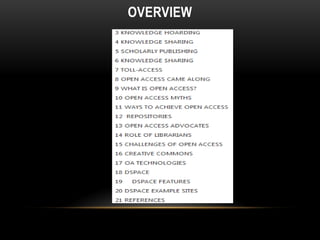
OVERVIEW
KNOWLEDGE HOARDING

• Up until the 17th century
       • Alchemy was a secretive art and was not supposed to be shared
       • Isaac Newton, was both an alchemist and a technologist
       • He broke from his alchemy tradition and he shared


        “If I have seen further, it is by standing upon the shoulders of giants”
        Newton


        Source: The Alchemists by Anders Sandberg,
                    http://hem.bredband.net/arenamontanus/Mage/alchemy.html
KNOWLEDGE SHARING

• “Knowledge wants to be free” (Arunachalam (2008, p.7)
• Knowledge as a near-perfect public good, using it nearly
  costless


• This quest for sharing and openness in science led to the
  flourishing of new disciplines, professional associations, and
  communities of practice


                 Sources: (Willinsky, 2006; Swan, 2006; & Solomon, 2008)
             http://mitpress.mit.edu/catalog/item/default.asp?tid=10611&ttype=2
SCHOLARLY PUBLISHING
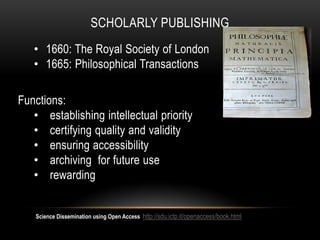
   • 1660: The Royal Society of London
   • 1665: Philosophical Transactions

Functions:
   • establishing intellectual priority
   • certifying quality and validity
   • ensuring accessibility
   • archiving for future use
   • rewarding


   Science Dissemination using Open Access http://sdu.ictp.it/openaccess/book.html
KNOWLEDGE SHARING

• Knowledge is created through science and scholarship
• Collaboration is key
• “No one can claim to be a self made man!” (Arunachalam ,
  2008, p.7)
• Since the beginning of the scientific journal publishing,
  researchers have never expected royalties from their
  intellectual works
• It is the scientists who do the research, who publish,
  who referee, who decide (Willinsky, 2006)
TOLL-ACCESS


• 21st century
   • >25,000 journals, approximately 2.5 million
   • Most of these journals are subscription-based (toll-access)
   • Exorbitant journal prices
   • Libraries cut journal subscriptions
   • Even Harvard University was affected by toll-access
   • Developing countries researchers are hard hit by such a model


                     Source: (Dewatripont et al., 2006; Canessa & Zennaro, 2008).
OPEN ACCESS CAME ALONG

• Free and Open Source Software ("think of free as in free speech, not as in free
  beer“)
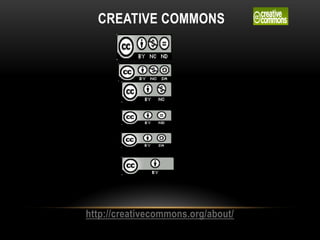
• The Creative Commons (www.creativecommons.org)
• The Wikipedia project
• Proliferation of social networking Web portals
• Libraries are about free access to information
• The Budapest Open Access Initiative in 2001
• The Bethesda Statement on Open Access Publishing in 2003
• The Berlin Declaration on Open Access to Knowledge in the Sciences and
  Humanities in 2003
WHAT IS OPEN ACCESS?
• free and permanent access
   • to peer-reviewed, academically purposeful online content
   • over the Internet and
   • the freedom to:
       • use
       • copy
       • distribute and
       • adapt that content with proper attribution.
   • OA maximizes research usage and impact, productivity and
     progress
OPEN ACCESS MYTHS
• OA violates copyright!

• OA is compromising on quality!

• OA is vanity publishing!

• OA is cost free!

• OA is about royalty works!
WAYS TO ACHIEVE OPEN ACCESS
1. Green OA means depositing articles in online repositories
        • Self-archiving is the “low hanging fruit


2. Gold OA means the journal itself provides immediate full-text
   online access
        • Running a journal is a full time commitment for
          institutions hence it requires a strategic plan of action
          and allocation of resources.
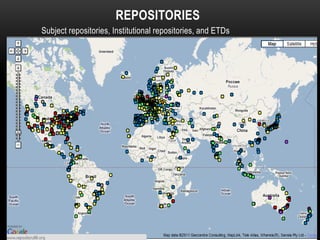
REPOSITORIES
Subject repositories, Institutional repositories, and ETDs
OPEN ACCESS ADVOCATES
• Peter Suber
• The arXiv(http://arxiv.org) launched in 1991 by physicist Paul Ginsparg.
  Currently, the arXiv has 528,147 open access e-prints

• CERN Document Server (CDS)

• The PubMed Central database of the National Institute of Health

• The Research Council UK (RCUK)

• SHERPA/ROMEO website (http://www.sherpa.ac.uk) most publishers allow
  author-self archiving

                       (Suber, 2006) http://www.earlham.edu/~peters/hometoc.htm
ROLE OF LIBRARIANS

• Librarians are the major actors in the open access initiative
• Libraries to advocate and create awareness to their research
  communities about institutional repositories and related issues
  such as copyright, and how to check publisher policies
• The “build it and they will come” approach does not work
• Awareness creation is key


                     (Salo, 2008, p.1)
CHALLENGES OF OPEN ACCESS

• Technical (hardware, software, and bandwidth)
• Social challenges (Zeno‟s paralysis)
Harnad‟s „Zeno‟s Paralysis‟ is coined “after the philosopher who
worried, how can I possibly walk across the room? There isn‟t
enough time! Before I can get across the room I first have to get
half way across the room, and that takes time; but before I can get
half way across the room, I have to get half of half way across the
room; and so on. So there isn‟t the time even to get started; hence
I can‟t possibly walk across the room”


                     (Harnad, 2006, p.78)
CREATIVE COMMONS


http://creativecommons.org/about/
OA TECHNOLOGIES
• Free and Open Source Software
• OAI-MPH compatible
• Institutional Repository Software
    • Dspace(MIT and HP) http://www.dspace.org/
    • Eprints(Univ. of Southampton) http://www.eprints.org/software/download/
    • CDS-Invenio(CERN) http://cdsweb.cern.ch/
    • Fedora(Moore Foundation, Cornell Univ., Univ. of Virginia)
      http://www.fedora-commons.org/
    • Greenstone (http://greenstone.org)
• OA Journals
    • Online Journal System(the Univ. British Columbia) http://pkp.sfu.ca/
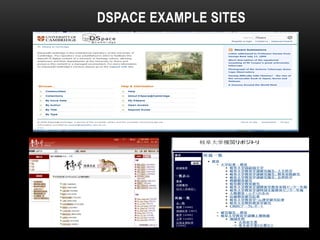
DSPACE
• Dspace allows to:
   •    capture items in any format – in text, video, audio, and data. It distributes
       it over the web. It indexes your work, so users can search and retrieve your
       items. It preserves your digital work over the long term.
• DSpace facilitates:
   • the capture and ingest of materials, including metadata about
     the materials
   • easy access to the materials, both by listing and searching
   • the long term preservation of the materials


                         Source: Dspace Basic Tutorial (n.d.) (Stuart Lewis & Chris Yates )
DSPACE FEATURES

 • DSpace comes with an easily configurable web based
   interface
 • All content types accepted
 • Dublin Core metadata standard
 • Customisable web interface
 • OAI compliant
 • Decentralised submission process
 • Full text search
DSPACE EXAMPLE SITES
REFERENCES
1. Arunachalam, S. (2008). Open access to scientific knowledge. DESIDOC Journal of
   Library and Information Technology, 28 (1), 7-14.
2. Bailey Jr., C.W. (2006). What is open access. In N. Jacobs (Ed.), Open access: key
   strategic, technical, and economic aspects (p. 13-26).Oxford: Chandos Publishing.
3. Canessa, E. & Zennaro, M. (Eds.) (2008). Science dissemination using Open Access: A
   compendium of selected literature on Open Access. Trieste: ICTP.
4. Salo, D. (2008). Innkeeper at the roach motel. Library Trends, 57(2). Retrieved from
   http://minds.wisconsin.edu/handle/1793/22088
5. Stichweh, R. (2003). The multiple publics of science: inclusion and popularization.
   Retrieved from http://www.uni-bielefeld.de/soz/iw/pdf/stw_science_popular.pdf
6. Willinsky, J. (2006). The access principle. Boston: MIT Press. Retrieved from
   http://mitpress.mit.edu/0262232421
Thank You!
       Questions?


getaneh.alemu@port.ac.uk

Open Access and Knowledge Sharing

  • 1.
    OPEN ACCESS & KNOWLEDGE SHARING Getaneh Agegn Alemu University of Portsmouth February 2011
  • 2.
  • 3.
    KNOWLEDGE HOARDING • Upuntil the 17th century • Alchemy was a secretive art and was not supposed to be shared • Isaac Newton, was both an alchemist and a technologist • He broke from his alchemy tradition and he shared “If I have seen further, it is by standing upon the shoulders of giants” Newton Source: The Alchemists by Anders Sandberg, http://hem.bredband.net/arenamontanus/Mage/alchemy.html
  • 4.
    KNOWLEDGE SHARING • “Knowledgewants to be free” (Arunachalam (2008, p.7) • Knowledge as a near-perfect public good, using it nearly costless • This quest for sharing and openness in science led to the flourishing of new disciplines, professional associations, and communities of practice Sources: (Willinsky, 2006; Swan, 2006; & Solomon, 2008) http://mitpress.mit.edu/catalog/item/default.asp?tid=10611&ttype=2
  • 5.
    SCHOLARLY PUBLISHING • 1660: The Royal Society of London • 1665: Philosophical Transactions Functions: • establishing intellectual priority • certifying quality and validity • ensuring accessibility • archiving for future use • rewarding Science Dissemination using Open Access http://sdu.ictp.it/openaccess/book.html
  • 6.
    KNOWLEDGE SHARING • Knowledgeis created through science and scholarship • Collaboration is key • “No one can claim to be a self made man!” (Arunachalam , 2008, p.7) • Since the beginning of the scientific journal publishing, researchers have never expected royalties from their intellectual works • It is the scientists who do the research, who publish, who referee, who decide (Willinsky, 2006)
  • 7.
    TOLL-ACCESS • 21st century • >25,000 journals, approximately 2.5 million • Most of these journals are subscription-based (toll-access) • Exorbitant journal prices • Libraries cut journal subscriptions • Even Harvard University was affected by toll-access • Developing countries researchers are hard hit by such a model Source: (Dewatripont et al., 2006; Canessa & Zennaro, 2008).
  • 8.
    OPEN ACCESS CAMEALONG • Free and Open Source Software ("think of free as in free speech, not as in free beer“) • The Creative Commons (www.creativecommons.org) • The Wikipedia project • Proliferation of social networking Web portals • Libraries are about free access to information • The Budapest Open Access Initiative in 2001 • The Bethesda Statement on Open Access Publishing in 2003 • The Berlin Declaration on Open Access to Knowledge in the Sciences and Humanities in 2003
  • 9.
    WHAT IS OPENACCESS? • free and permanent access • to peer-reviewed, academically purposeful online content • over the Internet and • the freedom to: • use • copy • distribute and • adapt that content with proper attribution. • OA maximizes research usage and impact, productivity and progress
  • 10.
    OPEN ACCESS MYTHS •OA violates copyright! • OA is compromising on quality! • OA is vanity publishing! • OA is cost free! • OA is about royalty works!
  • 11.
    WAYS TO ACHIEVEOPEN ACCESS 1. Green OA means depositing articles in online repositories • Self-archiving is the “low hanging fruit 2. Gold OA means the journal itself provides immediate full-text online access • Running a journal is a full time commitment for institutions hence it requires a strategic plan of action and allocation of resources.
  • 12.
  • 13.
    OPEN ACCESS ADVOCATES •Peter Suber • The arXiv(http://arxiv.org) launched in 1991 by physicist Paul Ginsparg. Currently, the arXiv has 528,147 open access e-prints • CERN Document Server (CDS) • The PubMed Central database of the National Institute of Health • The Research Council UK (RCUK) • SHERPA/ROMEO website (http://www.sherpa.ac.uk) most publishers allow author-self archiving (Suber, 2006) http://www.earlham.edu/~peters/hometoc.htm
  • 14.
    ROLE OF LIBRARIANS •Librarians are the major actors in the open access initiative • Libraries to advocate and create awareness to their research communities about institutional repositories and related issues such as copyright, and how to check publisher policies • The “build it and they will come” approach does not work • Awareness creation is key (Salo, 2008, p.1)
  • 15.
    CHALLENGES OF OPENACCESS • Technical (hardware, software, and bandwidth) • Social challenges (Zeno‟s paralysis) Harnad‟s „Zeno‟s Paralysis‟ is coined “after the philosopher who worried, how can I possibly walk across the room? There isn‟t enough time! Before I can get across the room I first have to get half way across the room, and that takes time; but before I can get half way across the room, I have to get half of half way across the room; and so on. So there isn‟t the time even to get started; hence I can‟t possibly walk across the room” (Harnad, 2006, p.78)
  • 16.
  • 17.
    OA TECHNOLOGIES • Freeand Open Source Software • OAI-MPH compatible • Institutional Repository Software • Dspace(MIT and HP) http://www.dspace.org/ • Eprints(Univ. of Southampton) http://www.eprints.org/software/download/ • CDS-Invenio(CERN) http://cdsweb.cern.ch/ • Fedora(Moore Foundation, Cornell Univ., Univ. of Virginia) http://www.fedora-commons.org/ • Greenstone (http://greenstone.org) • OA Journals • Online Journal System(the Univ. British Columbia) http://pkp.sfu.ca/
  • 18.
    DSPACE • Dspace allowsto: • capture items in any format – in text, video, audio, and data. It distributes it over the web. It indexes your work, so users can search and retrieve your items. It preserves your digital work over the long term. • DSpace facilitates: • the capture and ingest of materials, including metadata about the materials • easy access to the materials, both by listing and searching • the long term preservation of the materials Source: Dspace Basic Tutorial (n.d.) (Stuart Lewis & Chris Yates )
  • 19.
    DSPACE FEATURES •DSpace comes with an easily configurable web based interface • All content types accepted • Dublin Core metadata standard • Customisable web interface • OAI compliant • Decentralised submission process • Full text search
  • 20.
  • 21.
    REFERENCES 1. Arunachalam, S.(2008). Open access to scientific knowledge. DESIDOC Journal of Library and Information Technology, 28 (1), 7-14. 2. Bailey Jr., C.W. (2006). What is open access. In N. Jacobs (Ed.), Open access: key strategic, technical, and economic aspects (p. 13-26).Oxford: Chandos Publishing. 3. Canessa, E. & Zennaro, M. (Eds.) (2008). Science dissemination using Open Access: A compendium of selected literature on Open Access. Trieste: ICTP. 4. Salo, D. (2008). Innkeeper at the roach motel. Library Trends, 57(2). Retrieved from http://minds.wisconsin.edu/handle/1793/22088 5. Stichweh, R. (2003). The multiple publics of science: inclusion and popularization. Retrieved from http://www.uni-bielefeld.de/soz/iw/pdf/stw_science_popular.pdf 6. Willinsky, J. (2006). The access principle. Boston: MIT Press. Retrieved from http://mitpress.mit.edu/0262232421
  • 22.
    Thank You! Questions? getaneh.alemu@port.ac.uk