‘’ In time of rapid
change, experience
could be your worst
enemy ’’
Jean Paul Getty 1982-1976
It is well known that the decision-
making process within companies
presents some critical issues; in
particular, among the companies
controlled by INMAN, it is not fully
satisfactory cause it is not
anchored to a theoretical model.
The purpose of this brief
presentation is to adopt a decision
model, starting from what was
elaborated by John Boyd and
which goes under the name of
‘’O.O.D.A. loop’’.
Theory developed on rapidly
changing scenarios such as military
operational scenarios.
Smart Decision Process
 To keep our companies on track, in both the short and long term, we already know that we will
have to make a lot of decisions; hopefully good decision !
 No matter which is our position, it is up to us to make the tough choices that steer the business
in the right direction.
 To do so, we may turn to tools such as the OODA Loop. This model is relatively simple and
straightforward, but it can be highly effective.
 When we think about the operations of our organization in the frame of the OODA Loop, we will
quickly see that we are never going to be finished making decisions.
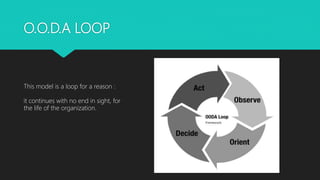
O.O.D.A LOOP
This model is a loop for a reason :
it continues with no end in sight, for
the life of the organization.
O.O.D.A LOOP
There are four stages built in to the OODA Loop, as follows :
 Observe
 Orient
 Decide
 Act
That’s it. It is a so simple model, yet it says so much about how we are going to make decisions in
business.
To help getting the most from this model, we have to go into a bit of detail on each of the four
stages below.
1 - Observe
 In business, observation is something of a constant state of being entrusted to heterogeneous
skills. We should always be observing what is going on around us, looking for information that
can help to make smart decisions.
 At this point in the loop, we are doing just that – taking in information that will be valuable later
on in the loop. ‘’Keeping our mind open’’ is key at this point, as we will want to collect as much
information as possible from multiple prospective.
 Even if we don’t think something may be relevant later on, we never know what kind of twists and
turns we will experience in business. See everything with a curious and interested eye and store it
away for later.
1 - Observe
1 - Observe
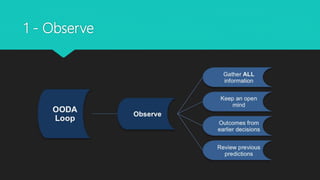
 One of the things we should be observing specifically is the outcome of previous decisions that
we have made.
 Learning from our mistakes is one of the best things we can do as an owner and/or a manager,
even if, yet now, many people are unwilling to acknowledge their limit and/or mistakes despite
they are over than obvious.
 Take a look at our previous predictions and see how they are fair now that they have been put
into action. If we were wrong about a number of things previously, we can use what we have
learned from those miss-steps to make better choices going forward.
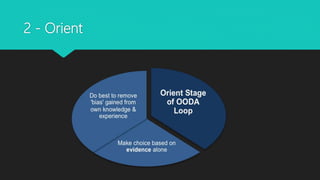
2 - Orient
 This is one stage of the decision-making cycle that we may not have considered previously. In life,
we all have our own experiences, biases, areas of expertise, and more that influence how we see
the world.
 We can think of this as our ‘orientation’ in life. So, when we are confronting a specific decision
that needs to be made in business, we are naturally going to come at the problem through the
‘’lens of our own orientation’’.
 Unfortunately, this can lead to poor decision making.
2 - Orient
2 - Orient
 To make the best possible decisions, we need to orient ourself correctly with the information and
consistent metrics at hand in order to make a good choice.
 If we allow our choices to be based too strongly on our own personal orientation, trouble is likely
to be on the way.
 As a decision maker, we have to be able to set all of that stuff aside in order to make a choice
that is based solely on the evidence in front of us that we must accept.
 By being willing to re-orient ourself on an ongoing basis, we can become a reliable and
productive decision maker.
3 - Decide
 Obviously, it is at this stage in the loop when we actually make our decision. Although we need
to be confident in our decision, it is important to remember that nothing is really final in business
‘’we always have to keep our mind open to making changes later should new information
become available’’.
 A decision that we make today could be sound based on what we know, but that same decision
could be relatively out of touch tomorrow if new information becomes available.
 The best decision makers are those who are confident in their choice today while ‘’remaining
open’’ to new ideas that may come along at any time.
4 - Act
 There is a difference between making a decision and actually putting that decision into action.
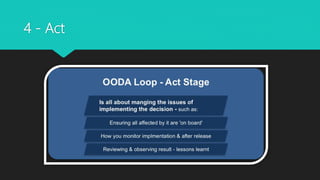
 When we act, we are going to implement the decision we have made, and then closely monitor
the results.
 If we don’t learn from what happens when our decisions go into action, we are destined to
repeat our mistakes over and over again into the future.
4 - Act
 To get the best possible results from our actions, we need to make sure that everyone involved is
“on board” with the choice that we have made.
 Those who are affected by the decision should have a clear understanding of why we are doing
what we are doing ‘’even if they didn’t have any input in the choice that was made’’.
 ‘’The success or failure of a given decision will depend not only on the quality of the decision
itself, but also on the commitment of the individuals responsible for bringing that decision to life’’.
4 - Act
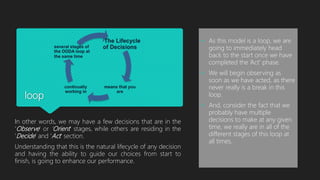
loop
In other words, we may have a few decisions that are in the
‘Observe’ or ‘Orient’ stages, while others are residing in the
‘Decide’ and ‘Act’ section.
Understanding that this is the natural lifecycle of any decision
and having the ability to guide our choices from start to
finish, is going to enhance our performance.
• As this model is a loop, we are
going to immediately head
back to the start once we have
completed the ‘Act’ phase.
• We will begin observing as
soon as we have acted, as there
never really is a break in this
loop.
• And, consider the fact that we
probably have multiple
decisions to make at any given
time, we really are in all of the
different stages of this loop at
all times.
Key Points
 The OODA Loop has been adopted by business to assist in speedy decision making so that as
soon as an external problem is on the horizon, a solution can be found before market
competitiveness is lost.
 This model is very simple, consisting of four stages: Observe, Orient, Decide, and Act.
 These actions constitute a loop that continue for the life of the organization.
 Stage 1 Observe: ‘’We should always be observing what is going on around us, looking for
information that can help us to make smart decisions’’.
 Stage 2 Orient : ‘’We have to be able to set our biases aside in order to make a choice that is
based solely on the evidence in front of us’’.
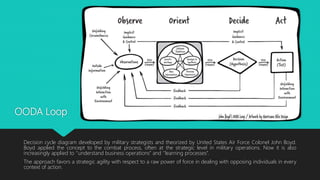
OODA Loop
Decision cycle diagram developed by military strategists and theorized by United States Air Force Colonel John Boyd.
Boyd applied the concept to the combat process, often at the strategic level in military operations. Now it is also
increasingly applied to ‘’understand business operations’’ and ‘’learning processes’’.
The approach favors a strategic agility with respect to a raw power of force in dealing with opposing individuals in every
context of action.
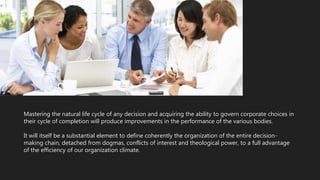
Mastering the natural life cycle of any decision and acquiring the ability to govern corporate choices in
their cycle of completion will produce improvements in the performance of the various bodies.
It will itself be a substantial element to define coherently the organization of the entire decision-
making chain, detached from dogmas, conflicts of interest and theological power, to a full advantage
of the efficiency of our organization climate.

Ooda loop Smart decision process model

  • 1.
    ‘’ In timeof rapid change, experience could be your worst enemy ’’ Jean Paul Getty 1982-1976 It is well known that the decision- making process within companies presents some critical issues; in particular, among the companies controlled by INMAN, it is not fully satisfactory cause it is not anchored to a theoretical model. The purpose of this brief presentation is to adopt a decision model, starting from what was elaborated by John Boyd and which goes under the name of ‘’O.O.D.A. loop’’. Theory developed on rapidly changing scenarios such as military operational scenarios.
  • 2.
    Smart Decision Process To keep our companies on track, in both the short and long term, we already know that we will have to make a lot of decisions; hopefully good decision !  No matter which is our position, it is up to us to make the tough choices that steer the business in the right direction.  To do so, we may turn to tools such as the OODA Loop. This model is relatively simple and straightforward, but it can be highly effective.  When we think about the operations of our organization in the frame of the OODA Loop, we will quickly see that we are never going to be finished making decisions.
  • 3.
    O.O.D.A LOOP This modelis a loop for a reason : it continues with no end in sight, for the life of the organization.
  • 4.
    O.O.D.A LOOP There arefour stages built in to the OODA Loop, as follows :  Observe  Orient  Decide  Act That’s it. It is a so simple model, yet it says so much about how we are going to make decisions in business. To help getting the most from this model, we have to go into a bit of detail on each of the four stages below.
  • 5.
    1 - Observe In business, observation is something of a constant state of being entrusted to heterogeneous skills. We should always be observing what is going on around us, looking for information that can help to make smart decisions.  At this point in the loop, we are doing just that – taking in information that will be valuable later on in the loop. ‘’Keeping our mind open’’ is key at this point, as we will want to collect as much information as possible from multiple prospective.  Even if we don’t think something may be relevant later on, we never know what kind of twists and turns we will experience in business. See everything with a curious and interested eye and store it away for later.
  • 6.
  • 7.
    1 - Observe One of the things we should be observing specifically is the outcome of previous decisions that we have made.  Learning from our mistakes is one of the best things we can do as an owner and/or a manager, even if, yet now, many people are unwilling to acknowledge their limit and/or mistakes despite they are over than obvious.  Take a look at our previous predictions and see how they are fair now that they have been put into action. If we were wrong about a number of things previously, we can use what we have learned from those miss-steps to make better choices going forward.
  • 8.
    2 - Orient This is one stage of the decision-making cycle that we may not have considered previously. In life, we all have our own experiences, biases, areas of expertise, and more that influence how we see the world.  We can think of this as our ‘orientation’ in life. So, when we are confronting a specific decision that needs to be made in business, we are naturally going to come at the problem through the ‘’lens of our own orientation’’.  Unfortunately, this can lead to poor decision making.
  • 9.
  • 10.
    2 - Orient To make the best possible decisions, we need to orient ourself correctly with the information and consistent metrics at hand in order to make a good choice.  If we allow our choices to be based too strongly on our own personal orientation, trouble is likely to be on the way.  As a decision maker, we have to be able to set all of that stuff aside in order to make a choice that is based solely on the evidence in front of us that we must accept.  By being willing to re-orient ourself on an ongoing basis, we can become a reliable and productive decision maker.
  • 11.
    3 - Decide Obviously, it is at this stage in the loop when we actually make our decision. Although we need to be confident in our decision, it is important to remember that nothing is really final in business ‘’we always have to keep our mind open to making changes later should new information become available’’.  A decision that we make today could be sound based on what we know, but that same decision could be relatively out of touch tomorrow if new information becomes available.  The best decision makers are those who are confident in their choice today while ‘’remaining open’’ to new ideas that may come along at any time.
  • 12.
    4 - Act There is a difference between making a decision and actually putting that decision into action.  When we act, we are going to implement the decision we have made, and then closely monitor the results.  If we don’t learn from what happens when our decisions go into action, we are destined to repeat our mistakes over and over again into the future.
  • 13.
    4 - Act To get the best possible results from our actions, we need to make sure that everyone involved is “on board” with the choice that we have made.  Those who are affected by the decision should have a clear understanding of why we are doing what we are doing ‘’even if they didn’t have any input in the choice that was made’’.  ‘’The success or failure of a given decision will depend not only on the quality of the decision itself, but also on the commitment of the individuals responsible for bringing that decision to life’’.
  • 14.
  • 15.
    loop In other words,we may have a few decisions that are in the ‘Observe’ or ‘Orient’ stages, while others are residing in the ‘Decide’ and ‘Act’ section. Understanding that this is the natural lifecycle of any decision and having the ability to guide our choices from start to finish, is going to enhance our performance. • As this model is a loop, we are going to immediately head back to the start once we have completed the ‘Act’ phase. • We will begin observing as soon as we have acted, as there never really is a break in this loop. • And, consider the fact that we probably have multiple decisions to make at any given time, we really are in all of the different stages of this loop at all times.
  • 16.
    Key Points  TheOODA Loop has been adopted by business to assist in speedy decision making so that as soon as an external problem is on the horizon, a solution can be found before market competitiveness is lost.  This model is very simple, consisting of four stages: Observe, Orient, Decide, and Act.  These actions constitute a loop that continue for the life of the organization.  Stage 1 Observe: ‘’We should always be observing what is going on around us, looking for information that can help us to make smart decisions’’.  Stage 2 Orient : ‘’We have to be able to set our biases aside in order to make a choice that is based solely on the evidence in front of us’’.
  • 17.
    OODA Loop Decision cyclediagram developed by military strategists and theorized by United States Air Force Colonel John Boyd. Boyd applied the concept to the combat process, often at the strategic level in military operations. Now it is also increasingly applied to ‘’understand business operations’’ and ‘’learning processes’’. The approach favors a strategic agility with respect to a raw power of force in dealing with opposing individuals in every context of action.
  • 18.
    Mastering the naturallife cycle of any decision and acquiring the ability to govern corporate choices in their cycle of completion will produce improvements in the performance of the various bodies. It will itself be a substantial element to define coherently the organization of the entire decision- making chain, detached from dogmas, conflicts of interest and theological power, to a full advantage of the efficiency of our organization climate.