
1 
ASSIGNMENT 
TOPIC: INFORMAL LEARNING CONTEXT 
Submitted by, 
SIMI.S.S 
Reg. no –180 13975007
2 
INTRODUCTION 
“The human mind can seldom accept completely abstract ideas. They must be derived from or illustrated by concrete examples”- cundy H.M. 
Mathematics fairs and exhibitions are avenues for making mathematics concepts concrete. Moreover such fairs help in relating creative ideas of children to the learning of mathematics. It provides opportunities for the students to go beyond the classroom learning of mathematical concepts and principles. Mathematics fairs offer a platform for the students to experience the true practical value of mathematics and the potential applications of classroom learning of mathematics to daily life situations. Though science fairs are common and popular among schools and colleges. Mathematics fairs are of recent origin and are gradually gaining popularity and momentum.
3 
EXIHIBITION 
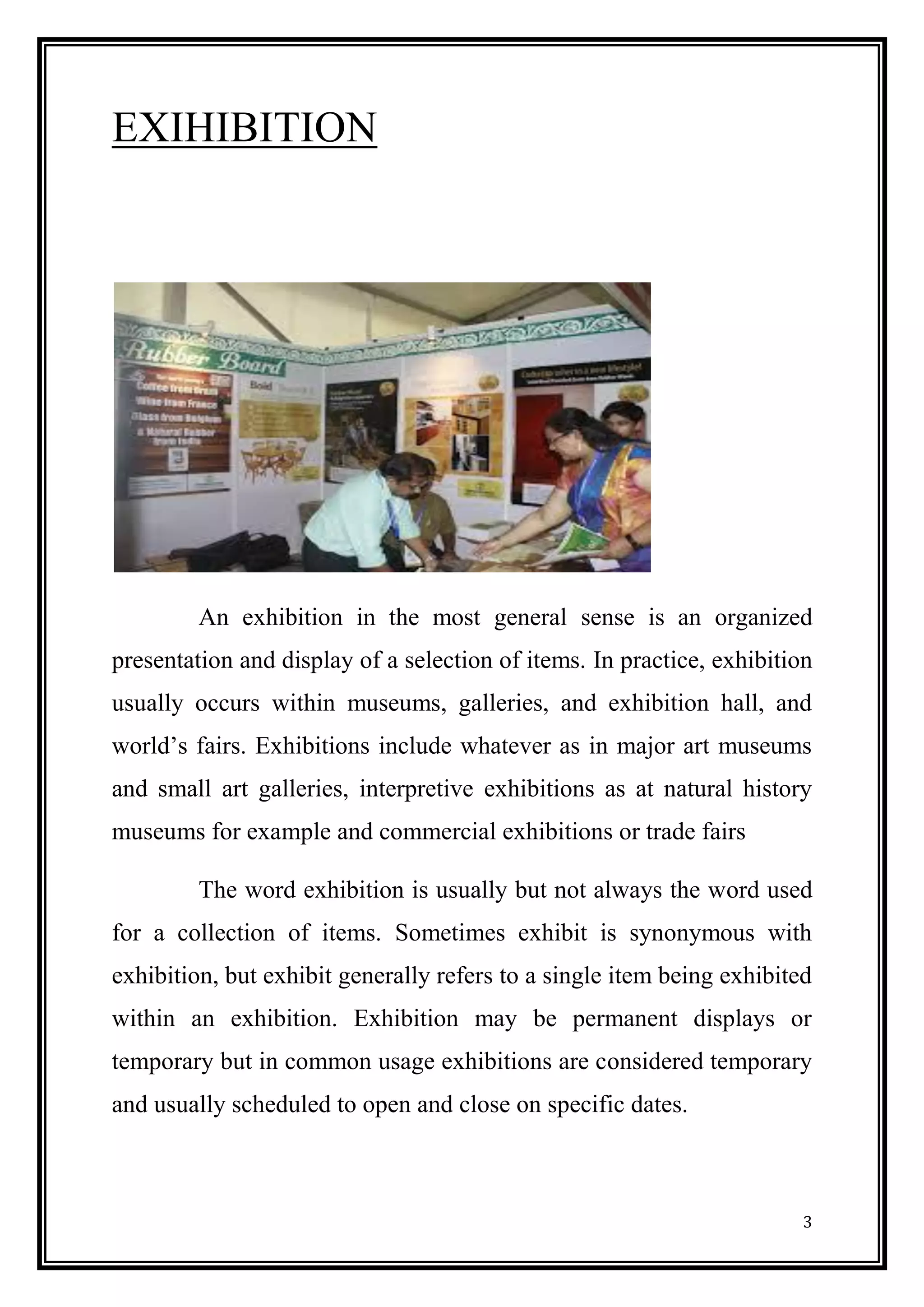
An exhibition in the most general sense is an organized presentation and display of a selection of items. In practice, exhibition usually occurs within museums, galleries, and exhibition hall, and world’s fairs. Exhibitions include whatever as in major art museums and small art galleries, interpretive exhibitions as at natural history museums for example and commercial exhibitions or trade fairs 
The word exhibition is usually but not always the word used for a collection of items. Sometimes exhibit is synonymous with exhibition, but exhibit generally refers to a single item being exhibited within an exhibition. Exhibition may be permanent displays or temporary but in common usage exhibitions are considered temporary and usually scheduled to open and close on specific dates.
4 
PURPOSES OF MATHEMATICS FAIRS 
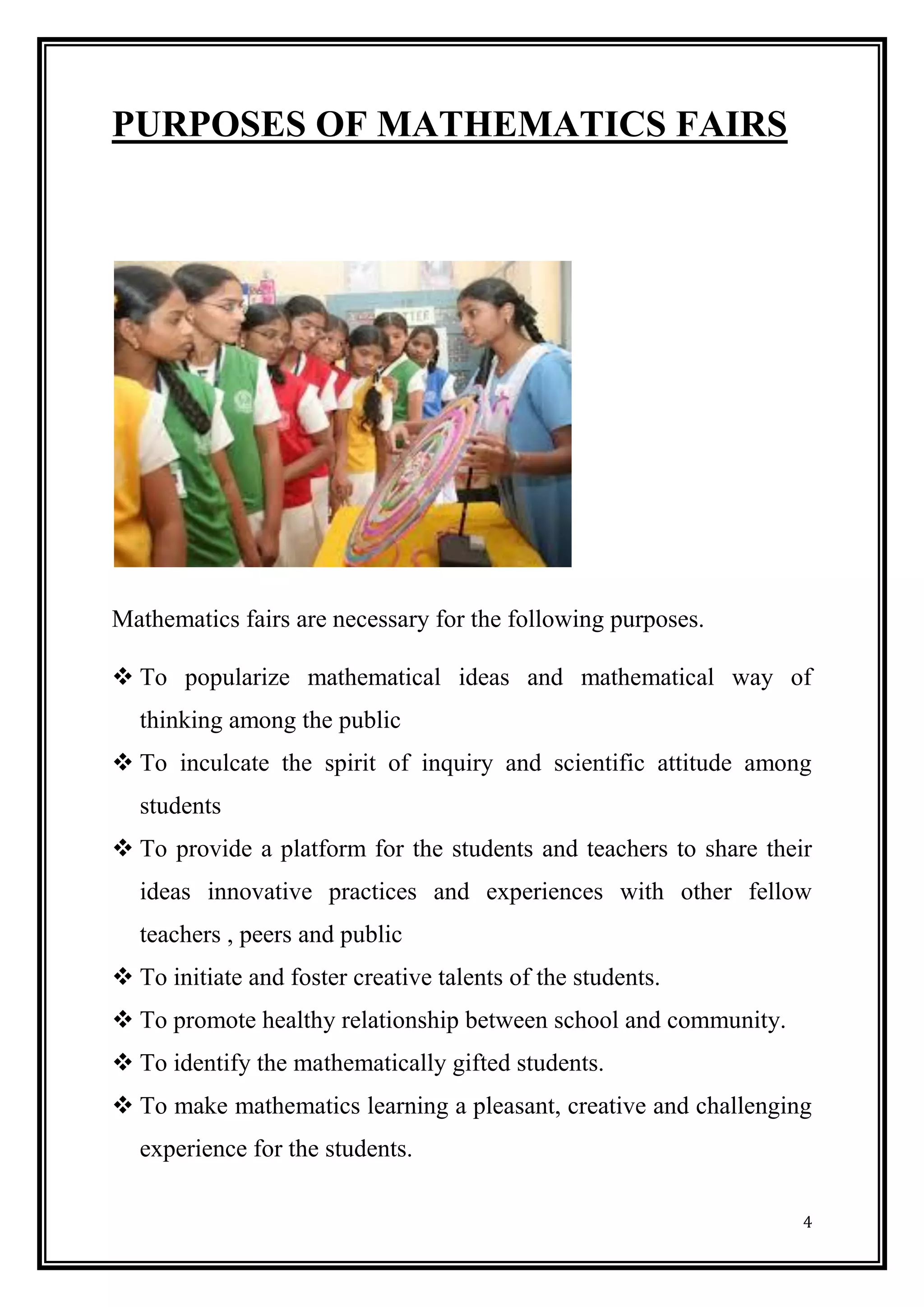
Mathematics fairs are necessary for the following purposes. 
 To popularize mathematical ideas and mathematical way of thinking among the public 
 To inculcate the spirit of inquiry and scientific attitude among students 
 To provide a platform for the students and teachers to share their ideas innovative practices and experiences with other fellow teachers , peers and public 
 To initiate and foster creative talents of the students. 
 To promote healthy relationship between school and community. 
 To identify the mathematically gifted students. 
 To make mathematics learning a pleasant, creative and challenging experience for the students.
5 
 To motivate and foster interest among mathematically backward students. 
 To promote experimenting with innovating mathematical ideas among students. 
 To challenge intellectually the mathematically gifted students.
6 
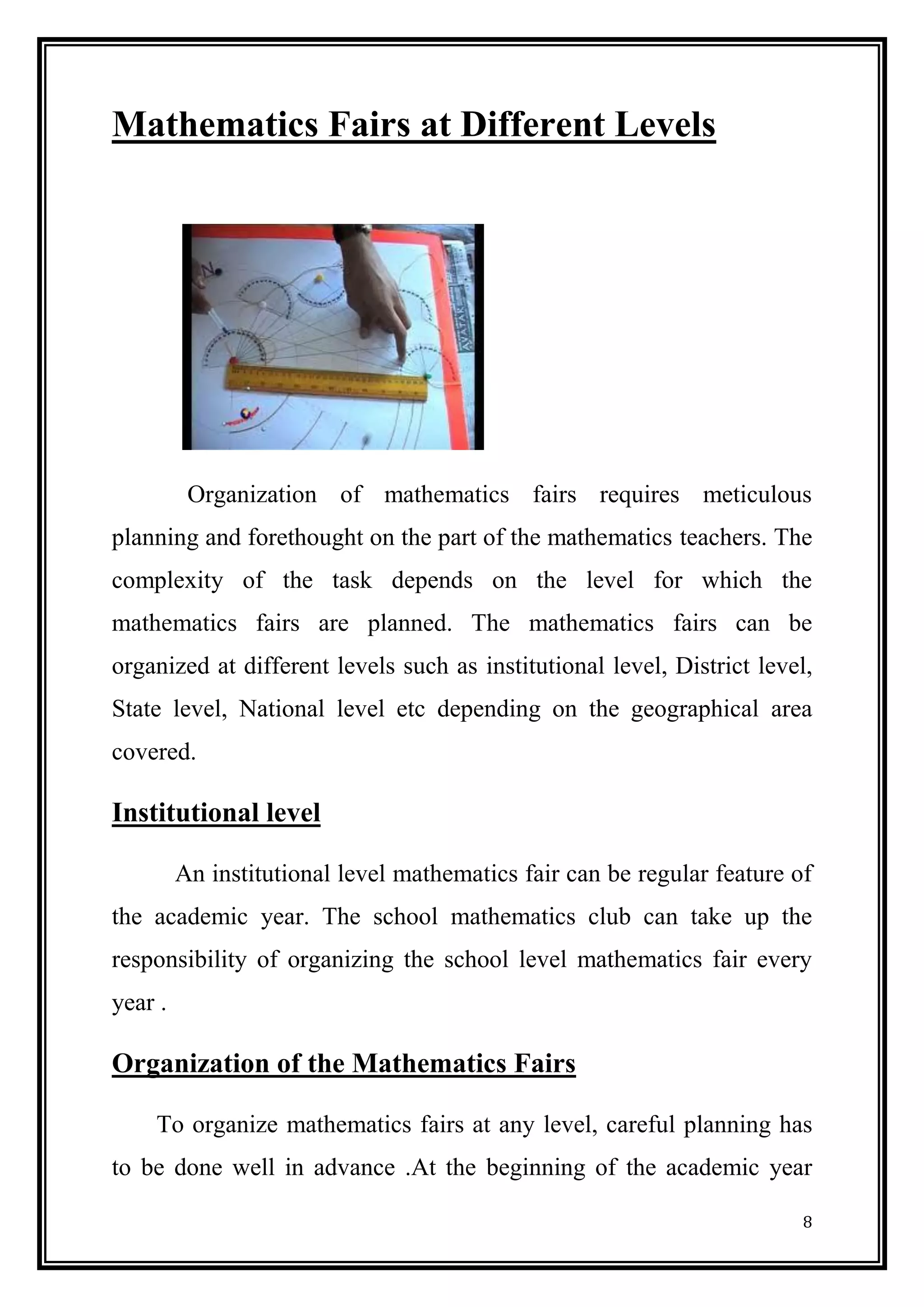
Advantages of Mathematics Fairs 
The following are the major functions served by the mathematics fairs. 
 It creates and sustains interest among students to learn mathematics. 
 It provides opportunities for the students to foster their creative talents. 
 It provides platform for the students and teachers to exhibit their innovative ideas and practices. 
 It helps in developing social qualities like co-operation, tolerance and open mindedness as well as leadership qualities among the children. 
 It helps the students to make abstract exhibit practical applications of mathematical concepts that have been learned in mathematics classroom. 
 It develops good rapport between teacher and students. 
 It breaks the monotony of classroom teaching and learning.
7 
 It provides an avenue for popularizing mathematical ideas and skills among the public. 
 It helps in satisfying the needs of both mathematically gifted and mathematically backward students. 
 The preparation of exhibits for the fair provides a deeper and clear understanding of mathematical concepts and principles. 
 It satisfies the need for social approval and recognition. 
 It helps in bringing about attitudinal changes among the student. 
 It provides firsthand experience in planning and organizing events. 
 It enhances the self confidences of students as they explain and share their ideas with peers and others. 
 It provides ample opportunities for the children to exhibit their talents, to consolidate their learning and to draw new conclusions from the known facts.
8 
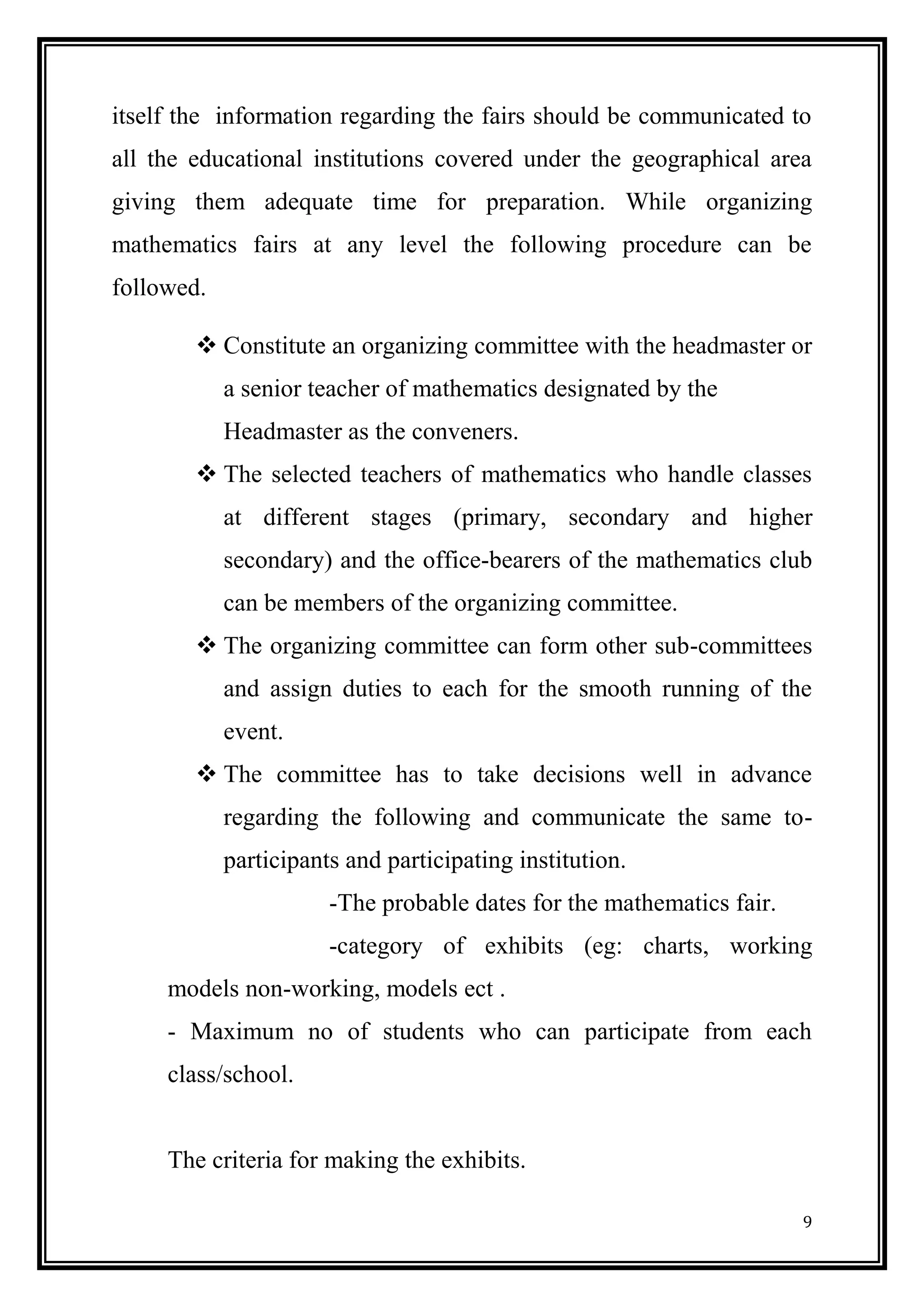
Mathematics Fairs at Different Levels 
Organization of mathematics fairs requires meticulous planning and forethought on the part of the mathematics teachers. The complexity of the task depends on the level for which the mathematics fairs are planned. The mathematics fairs can be organized at different levels such as institutional level, District level, State level, National level etc depending on the geographical area covered. 
Institutional level 
An institutional level mathematics fair can be regular feature of the academic year. The school mathematics club can take up the responsibility of organizing the school level mathematics fair every year . 
Organization of the Mathematics Fairs 
To organize mathematics fairs at any level, careful planning has to be done well in advance .At the beginning of the academic year
9 
itself the information regarding the fairs should be communicated to all the educational institutions covered under the geographical area giving them adequate time for preparation. While organizing mathematics fairs at any level the following procedure can be followed. 
 Constitute an organizing committee with the headmaster or a senior teacher of mathematics designated by the 
Headmaster as the conveners. 
 The selected teachers of mathematics who handle classes at different stages (primary, secondary and higher secondary) and the office-bearers of the mathematics club can be members of the organizing committee. 
 The organizing committee can form other sub-committees and assign duties to each for the smooth running of the event. 
 The committee has to take decisions well in advance regarding the following and communicate the same to- participants and participating institution. 
-The probable dates for the mathematics fair. 
-category of exhibits (eg: charts, working models non-working, models ect . 
- Maximum no of students who can participate from each class/school. 
The criteria for making the exhibits.
10 
- The last date for confirming the participation of the invited institutions in the fair, giving the details regarding the number of participants, number of exhibits, type of exhibits etc 
- The venue of the fair. 
- The number of priest be awarded (item – wise, area wise, category – wise etc) 
- The judges who are well known experts in mathematics to best exhibits without bias and prejudice. 
- Chief guests for inauguration and valedictory functions. 
- The time and venue for inauguration of the fair and valedictory functions for distributing awards and prizes. 
- Estimation of human and financial resources required. 
After receiving the confirmation from participating and participating institutions the organizing institutions has to assess the space and rooms available to accommodate all the participants / institutions each participants / institution should be assigned the room and place to exhibits their exhibits. dummy or a code number can be assigned to each participants/institutions to ensure greater transparency in the judgment of the exhibits.
11 
CONCLUSION 
Mathematics fairs and exhibitions are avenue for making mathematics concept concrete. Such fairs help in creative idea of the children to the learning of mathematics. the main advantages of mathematics fairs is help is helps in satisfying needs of both mathematically gifted and mathematically backward students.
12 
REFERENCE 
1) The techniques of teaching in mathematics – mangal 
2) wikipedia.org

Online Assignment

  • 1.
    1 ASSIGNMENT TOPIC:INFORMAL LEARNING CONTEXT Submitted by, SIMI.S.S Reg. no –180 13975007
  • 2.
    2 INTRODUCTION “Thehuman mind can seldom accept completely abstract ideas. They must be derived from or illustrated by concrete examples”- cundy H.M. Mathematics fairs and exhibitions are avenues for making mathematics concepts concrete. Moreover such fairs help in relating creative ideas of children to the learning of mathematics. It provides opportunities for the students to go beyond the classroom learning of mathematical concepts and principles. Mathematics fairs offer a platform for the students to experience the true practical value of mathematics and the potential applications of classroom learning of mathematics to daily life situations. Though science fairs are common and popular among schools and colleges. Mathematics fairs are of recent origin and are gradually gaining popularity and momentum.
  • 3.
    3 EXIHIBITION Anexhibition in the most general sense is an organized presentation and display of a selection of items. In practice, exhibition usually occurs within museums, galleries, and exhibition hall, and world’s fairs. Exhibitions include whatever as in major art museums and small art galleries, interpretive exhibitions as at natural history museums for example and commercial exhibitions or trade fairs The word exhibition is usually but not always the word used for a collection of items. Sometimes exhibit is synonymous with exhibition, but exhibit generally refers to a single item being exhibited within an exhibition. Exhibition may be permanent displays or temporary but in common usage exhibitions are considered temporary and usually scheduled to open and close on specific dates.
  • 4.
    4 PURPOSES OFMATHEMATICS FAIRS Mathematics fairs are necessary for the following purposes.  To popularize mathematical ideas and mathematical way of thinking among the public  To inculcate the spirit of inquiry and scientific attitude among students  To provide a platform for the students and teachers to share their ideas innovative practices and experiences with other fellow teachers , peers and public  To initiate and foster creative talents of the students.  To promote healthy relationship between school and community.  To identify the mathematically gifted students.  To make mathematics learning a pleasant, creative and challenging experience for the students.
  • 5.
    5  Tomotivate and foster interest among mathematically backward students.  To promote experimenting with innovating mathematical ideas among students.  To challenge intellectually the mathematically gifted students.
  • 6.
    6 Advantages ofMathematics Fairs The following are the major functions served by the mathematics fairs.  It creates and sustains interest among students to learn mathematics.  It provides opportunities for the students to foster their creative talents.  It provides platform for the students and teachers to exhibit their innovative ideas and practices.  It helps in developing social qualities like co-operation, tolerance and open mindedness as well as leadership qualities among the children.  It helps the students to make abstract exhibit practical applications of mathematical concepts that have been learned in mathematics classroom.  It develops good rapport between teacher and students.  It breaks the monotony of classroom teaching and learning.
  • 7.
    7  Itprovides an avenue for popularizing mathematical ideas and skills among the public.  It helps in satisfying the needs of both mathematically gifted and mathematically backward students.  The preparation of exhibits for the fair provides a deeper and clear understanding of mathematical concepts and principles.  It satisfies the need for social approval and recognition.  It helps in bringing about attitudinal changes among the student.  It provides firsthand experience in planning and organizing events.  It enhances the self confidences of students as they explain and share their ideas with peers and others.  It provides ample opportunities for the children to exhibit their talents, to consolidate their learning and to draw new conclusions from the known facts.
  • 8.
    8 Mathematics Fairsat Different Levels Organization of mathematics fairs requires meticulous planning and forethought on the part of the mathematics teachers. The complexity of the task depends on the level for which the mathematics fairs are planned. The mathematics fairs can be organized at different levels such as institutional level, District level, State level, National level etc depending on the geographical area covered. Institutional level An institutional level mathematics fair can be regular feature of the academic year. The school mathematics club can take up the responsibility of organizing the school level mathematics fair every year . Organization of the Mathematics Fairs To organize mathematics fairs at any level, careful planning has to be done well in advance .At the beginning of the academic year
  • 9.
    9 itself theinformation regarding the fairs should be communicated to all the educational institutions covered under the geographical area giving them adequate time for preparation. While organizing mathematics fairs at any level the following procedure can be followed.  Constitute an organizing committee with the headmaster or a senior teacher of mathematics designated by the Headmaster as the conveners.  The selected teachers of mathematics who handle classes at different stages (primary, secondary and higher secondary) and the office-bearers of the mathematics club can be members of the organizing committee.  The organizing committee can form other sub-committees and assign duties to each for the smooth running of the event.  The committee has to take decisions well in advance regarding the following and communicate the same to- participants and participating institution. -The probable dates for the mathematics fair. -category of exhibits (eg: charts, working models non-working, models ect . - Maximum no of students who can participate from each class/school. The criteria for making the exhibits.
  • 10.
    10 - Thelast date for confirming the participation of the invited institutions in the fair, giving the details regarding the number of participants, number of exhibits, type of exhibits etc - The venue of the fair. - The number of priest be awarded (item – wise, area wise, category – wise etc) - The judges who are well known experts in mathematics to best exhibits without bias and prejudice. - Chief guests for inauguration and valedictory functions. - The time and venue for inauguration of the fair and valedictory functions for distributing awards and prizes. - Estimation of human and financial resources required. After receiving the confirmation from participating and participating institutions the organizing institutions has to assess the space and rooms available to accommodate all the participants / institutions each participants / institution should be assigned the room and place to exhibits their exhibits. dummy or a code number can be assigned to each participants/institutions to ensure greater transparency in the judgment of the exhibits.
  • 11.
    11 CONCLUSION Mathematicsfairs and exhibitions are avenue for making mathematics concept concrete. Such fairs help in creative idea of the children to the learning of mathematics. the main advantages of mathematics fairs is help is helps in satisfying needs of both mathematically gifted and mathematically backward students.
  • 12.
    12 REFERENCE 1)The techniques of teaching in mathematics – mangal 2) wikipedia.org