Mathematics Club
“The club represents freedom of expression whereas the classroom
represents conformity and repression” – M.C Kown
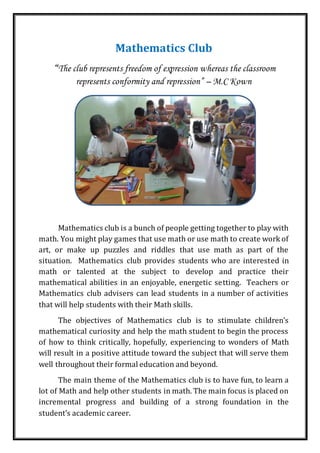
Mathematics club is a bunch of people getting together to play with
math. You might play games that use math or use math to create work of
art, or make up puzzles and riddles that use math as part of the
situation. Mathematics club provides students who are interested in
math or talented at the subject to develop and practice their
mathematical abilities in an enjoyable, energetic setting. Teachers or
Mathematics club advisers can lead students in a number of activities
that will help students with their Math skills.
The objectives of Mathematics club is to stimulate children’s
mathematical curiosity and help the math student to begin the process
of how to think critically, hopefully, experiencing to wonders of Math
will result in a positive attitude toward the subject that will serve them
well throughout their formal education and beyond.
The main theme of the Mathematics club is to have fun, to learn a
lot of Math and help other students in math. The main focus is placed on
incremental progress and building of a strong foundation in the
student’s academic career.
Activity
Games and tournaments of games, especially Mathematical games
such as 3- dimensional tic-tac-toe, strategy games are a big favorite for
my middle school students. There are many different games that are
quite applicable to Mathematics. We have mini tournaments with our
group. The game does not make that much difference as long as it is one
that involves strategy or probability so that a discussion can evolve from
the game.
 Have a birthday party for Mathematicians born in the month.
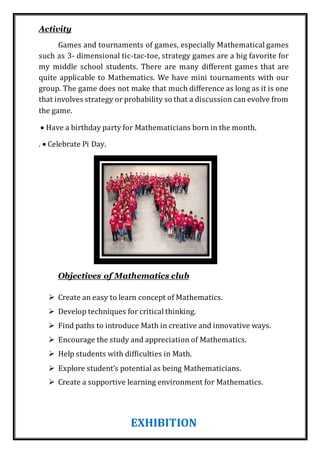
.  Celebrate Pi Day.
Objectives of Mathematics club
 Create an easy to learn concept of Mathematics.
 Develop techniques for critical thinking.
 Find paths to introduce Math in creative and innovative ways.
 Encourage the study and appreciation of Mathematics.
 Help students with difficulties in Math.
 Explore student’s potential as being Mathematicians.
 Create a supportive learning environment for Mathematics.
EXHIBITION
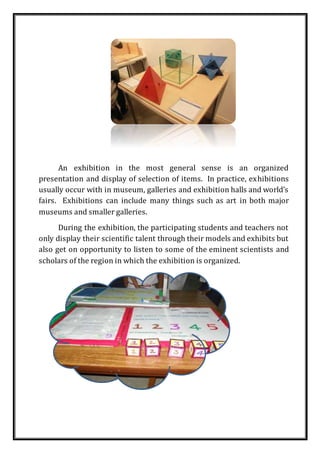
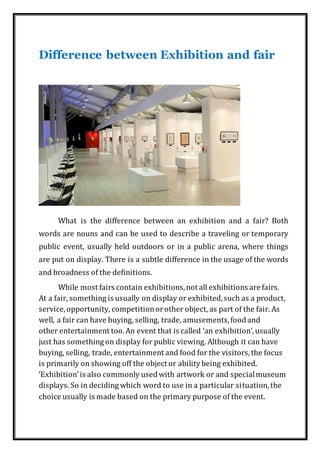
An exhibition in the most general sense is an organized
presentation and display of selection of items. In practice, exhibitions
usually occur with in museum, galleries and exhibition halls and world’s
fairs. Exhibitions can include many things such as art in both major
museums and smaller galleries.
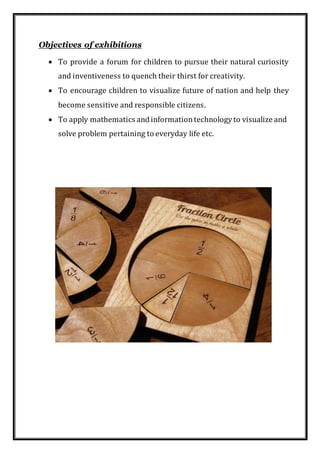
During the exhibition, the participating students and teachers not
only display their scientific talent through their models and exhibits but
also get on opportunity to listen to some of the eminent scientists and
scholars of the region in which the exhibition is organized.
Objectives of exhibitions
 To provide a forum for children to pursue their natural curiosity
and inventiveness to quench their thirst for creativity.
 To encourage children to visualize future of nation and help they
become sensitive and responsible citizens.
 To apply mathematics andinformationtechnologyto visualize and
solve problem pertaining to everyday life etc.
Advantages:
The advantages of exhibitions are pretty endless. Having an
exhibitionofyour work at a good art gallery can draw all kinds of people
in, meaning that you mayend up meeting people who want to represent
or purchase your work. This can help you out tremendously and can get
you noticedin the art world.
Another advantage of having an exhibitionis that you can get
feedback from those who come to see you work. They can leave notes on
their visit,saying whether or not they enjoyed looking at your pieces.
This can provide you with support and constructive criticism which can
help you become better at your work with time.Every bit of experience
is goodfor you. Never take any criticism that you get to heart, just learn
from it. A person's opiniondoesn't account for everyone's opinion.
Disadvantages
One disadvantage of putting your work in an exhibitionis that it
will only be viewed be a certainamount of people. Not many
people visit exhibitions regularly and some people only do it as a tourist
attraction,so make sure that you don't see these people as your main
audience for your future work. In a large gallery, your work may go
unnoticedor at least not get the recognitionthat it deserves due to the
sheer amount of pieces that feature. If your work is interactive,it will be
more likely to get views.
Difference between Exhibition and fair
What is the difference between an exhibition and a fair? Both
words are nouns and can be used to describe a traveling or temporary
public event, usually held outdoors or in a public arena, where things
are put on display. There is a subtle difference in the usage of the words
and broadness of the definitions.
While most fairs contain exhibitions,not all exhibitions are fairs.
At a fair, something is usually on display or exhibited,such as a product,
service,opportunity, competitionorother object, as part of the fair. As
well, a fair can have buying, selling, trade, amusements,foodand
other entertainment too.An event that is called ‘an exhibition’,usually
just has something on display for public viewing. Although it can have
buying, selling, trade, entertainment and food for the visitors,the focus
is primarily on showing off the object or abilitybeing exhibited.
‘Exhibition’is also commonly usedwith artwork or and specialmuseum
displays. So in deciding which word to use in a particular situation,the
choice usually is made based on the primary purpose of the event.
FIELD TRIPS
‘Field trips are a great way to bring excitement and adventure to
learning’ – Amber D Walker
Field trips are a great way to bring excitement andadventure to
learning. Field trips are fun, but they should reinforce educationalgoals.
Although trips must be focusedin order to realize their full values, they
can involve multiple concepts. The main goals focused field trips are
 To ensure that field trips reinforce large learning objectives
 To involve teachers and children in planning process
 To think enough project and objectives associatedwithfield trips.
Field trip offer opportunity for teachers to show students how the
subjects they are teaching are used outside the classroom. Students are
motivated as they learn to connect the subject with real world
situations. Math is often seen as an abstract subject and can benefit
from field trips.
Examples:
1. Sports Event
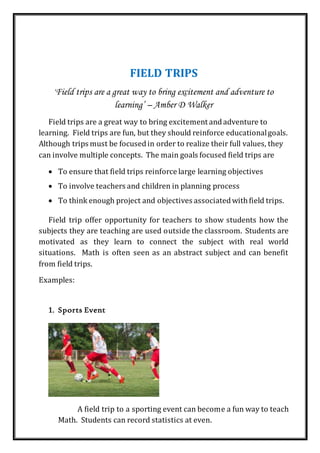
A field trip to a sporting event can become a fun way to teach
Math. Students can record statistics at even.
2. Factory
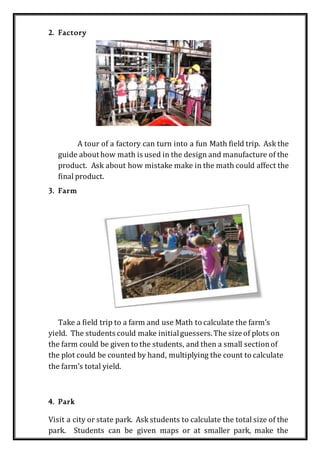
A tour of a factory can turn into a fun Math field trip. Ask the
guide about how math is used in the design and manufacture of the
product. Ask about how mistake make in the math could affect the
final product.
3. Farm
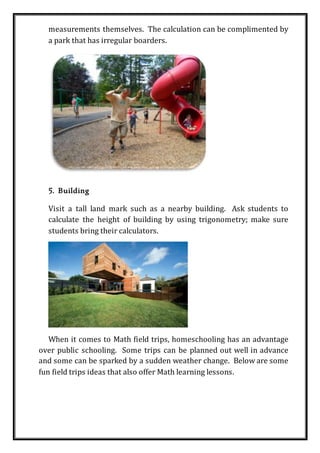
Take a field trip to a farm and use Math to calculate the farm’s
yield. The students could make initialguessers.The size of plots on
the farm could be given to the students, and then a small sectionof
the plot could be counted by hand, multiplying the count to calculate
the farm’s total yield.
4. Park
Visit a city or state park. Ask students to calculate the total size of the
park. Students can be given maps or at smaller park, make the
measurements themselves. The calculation can be complimented by
a park that has irregular boarders.
5. Building
Visit a tall land mark such as a nearby building. Ask students to
calculate the height of building by using trigonometry; make sure
students bring their calculators.
When it comes to Math field trips, homeschooling has an advantage
over public schooling. Some trips can be planned out well in advance
and some can be sparked by a sudden weather change. Below are some
fun field trips ideas that also offer Math learning lessons.
Some of the important advantage of field trip
1. They provide direct source of knowledge and acquaint the
student with first-hand information.
2. They provide an opportunity to the student for development of his
aesthetic sense.
3. They help to develop in students a love for nature and to acquaint
them with the real happiness in the outside world.
4. It helps in development of power of observations, exploration,
judgment and drawing inferences, problem solving ability of
students.
5. It helps in developing qualities of resourcefulness, self- confidence,
initiative and leadership amongst students.
6. It helps in developing co-operative attitude and various others
7. It motivates the students for self-study and self-activity.
8. It helps in the development of creative faculties of the students.
Conclusion
Mathematics club, Exhibition and Field trip are creating an easy to
learn concept of Mathematics. The meeting place where a number of
person meet to discuss something or study some problems is known as
club and where students of Mathematics sit and discuss together is
called Mathematics club.
Exhibitions are effective modes of mass communication and
instruction. If it is organized by the pupils themselves they got
opportunity for self-activity. Special talents of the pupils get revealed
and creativity can be fostered.
Field trips for observing buildings and other structures of any,
depicting geometrical shapes etc. can be attempted. During these visit
students may face so many problems requiring the knowledge of
Mathematics for their solutions. The teacher may utilize such situations
for giving the necessary Mathematical information.
References
1. Mathematics education: Dr. k. Soman
Dr.K. Sivarajan
2. Teaching of Mathematics: Sudhir Kumar
N.Retnakar
3. www.wikipedia.org

Online assignment (1)

  • 1.
    Mathematics Club “The clubrepresents freedom of expression whereas the classroom represents conformity and repression” – M.C Kown Mathematics club is a bunch of people getting together to play with math. You might play games that use math or use math to create work of art, or make up puzzles and riddles that use math as part of the situation. Mathematics club provides students who are interested in math or talented at the subject to develop and practice their mathematical abilities in an enjoyable, energetic setting. Teachers or Mathematics club advisers can lead students in a number of activities that will help students with their Math skills. The objectives of Mathematics club is to stimulate children’s mathematical curiosity and help the math student to begin the process of how to think critically, hopefully, experiencing to wonders of Math will result in a positive attitude toward the subject that will serve them well throughout their formal education and beyond. The main theme of the Mathematics club is to have fun, to learn a lot of Math and help other students in math. The main focus is placed on incremental progress and building of a strong foundation in the student’s academic career.
  • 2.
    Activity Games and tournamentsof games, especially Mathematical games such as 3- dimensional tic-tac-toe, strategy games are a big favorite for my middle school students. There are many different games that are quite applicable to Mathematics. We have mini tournaments with our group. The game does not make that much difference as long as it is one that involves strategy or probability so that a discussion can evolve from the game.  Have a birthday party for Mathematicians born in the month. .  Celebrate Pi Day. Objectives of Mathematics club  Create an easy to learn concept of Mathematics.  Develop techniques for critical thinking.  Find paths to introduce Math in creative and innovative ways.  Encourage the study and appreciation of Mathematics.  Help students with difficulties in Math.  Explore student’s potential as being Mathematicians.  Create a supportive learning environment for Mathematics. EXHIBITION
  • 3.
    An exhibition inthe most general sense is an organized presentation and display of selection of items. In practice, exhibitions usually occur with in museum, galleries and exhibition halls and world’s fairs. Exhibitions can include many things such as art in both major museums and smaller galleries. During the exhibition, the participating students and teachers not only display their scientific talent through their models and exhibits but also get on opportunity to listen to some of the eminent scientists and scholars of the region in which the exhibition is organized.
  • 4.
    Objectives of exhibitions To provide a forum for children to pursue their natural curiosity and inventiveness to quench their thirst for creativity.  To encourage children to visualize future of nation and help they become sensitive and responsible citizens.  To apply mathematics andinformationtechnologyto visualize and solve problem pertaining to everyday life etc.
  • 5.
    Advantages: The advantages ofexhibitions are pretty endless. Having an exhibitionofyour work at a good art gallery can draw all kinds of people in, meaning that you mayend up meeting people who want to represent or purchase your work. This can help you out tremendously and can get you noticedin the art world. Another advantage of having an exhibitionis that you can get feedback from those who come to see you work. They can leave notes on their visit,saying whether or not they enjoyed looking at your pieces. This can provide you with support and constructive criticism which can help you become better at your work with time.Every bit of experience is goodfor you. Never take any criticism that you get to heart, just learn from it. A person's opiniondoesn't account for everyone's opinion. Disadvantages One disadvantage of putting your work in an exhibitionis that it will only be viewed be a certainamount of people. Not many people visit exhibitions regularly and some people only do it as a tourist attraction,so make sure that you don't see these people as your main audience for your future work. In a large gallery, your work may go unnoticedor at least not get the recognitionthat it deserves due to the sheer amount of pieces that feature. If your work is interactive,it will be more likely to get views.
  • 6.
    Difference between Exhibitionand fair What is the difference between an exhibition and a fair? Both words are nouns and can be used to describe a traveling or temporary public event, usually held outdoors or in a public arena, where things are put on display. There is a subtle difference in the usage of the words and broadness of the definitions. While most fairs contain exhibitions,not all exhibitions are fairs. At a fair, something is usually on display or exhibited,such as a product, service,opportunity, competitionorother object, as part of the fair. As well, a fair can have buying, selling, trade, amusements,foodand other entertainment too.An event that is called ‘an exhibition’,usually just has something on display for public viewing. Although it can have buying, selling, trade, entertainment and food for the visitors,the focus is primarily on showing off the object or abilitybeing exhibited. ‘Exhibition’is also commonly usedwith artwork or and specialmuseum displays. So in deciding which word to use in a particular situation,the choice usually is made based on the primary purpose of the event.
  • 7.
    FIELD TRIPS ‘Field tripsare a great way to bring excitement and adventure to learning’ – Amber D Walker Field trips are a great way to bring excitement andadventure to learning. Field trips are fun, but they should reinforce educationalgoals. Although trips must be focusedin order to realize their full values, they can involve multiple concepts. The main goals focused field trips are  To ensure that field trips reinforce large learning objectives  To involve teachers and children in planning process  To think enough project and objectives associatedwithfield trips. Field trip offer opportunity for teachers to show students how the subjects they are teaching are used outside the classroom. Students are motivated as they learn to connect the subject with real world situations. Math is often seen as an abstract subject and can benefit from field trips. Examples: 1. Sports Event A field trip to a sporting event can become a fun way to teach Math. Students can record statistics at even.
  • 8.
    2. Factory A tourof a factory can turn into a fun Math field trip. Ask the guide about how math is used in the design and manufacture of the product. Ask about how mistake make in the math could affect the final product. 3. Farm Take a field trip to a farm and use Math to calculate the farm’s yield. The students could make initialguessers.The size of plots on the farm could be given to the students, and then a small sectionof the plot could be counted by hand, multiplying the count to calculate the farm’s total yield. 4. Park Visit a city or state park. Ask students to calculate the total size of the park. Students can be given maps or at smaller park, make the
  • 9.
    measurements themselves. Thecalculation can be complimented by a park that has irregular boarders. 5. Building Visit a tall land mark such as a nearby building. Ask students to calculate the height of building by using trigonometry; make sure students bring their calculators. When it comes to Math field trips, homeschooling has an advantage over public schooling. Some trips can be planned out well in advance and some can be sparked by a sudden weather change. Below are some fun field trips ideas that also offer Math learning lessons.
  • 10.
    Some of theimportant advantage of field trip 1. They provide direct source of knowledge and acquaint the student with first-hand information. 2. They provide an opportunity to the student for development of his aesthetic sense. 3. They help to develop in students a love for nature and to acquaint them with the real happiness in the outside world. 4. It helps in development of power of observations, exploration, judgment and drawing inferences, problem solving ability of students. 5. It helps in developing qualities of resourcefulness, self- confidence, initiative and leadership amongst students. 6. It helps in developing co-operative attitude and various others 7. It motivates the students for self-study and self-activity. 8. It helps in the development of creative faculties of the students.
  • 11.
    Conclusion Mathematics club, Exhibitionand Field trip are creating an easy to learn concept of Mathematics. The meeting place where a number of person meet to discuss something or study some problems is known as club and where students of Mathematics sit and discuss together is called Mathematics club. Exhibitions are effective modes of mass communication and instruction. If it is organized by the pupils themselves they got opportunity for self-activity. Special talents of the pupils get revealed and creativity can be fostered. Field trips for observing buildings and other structures of any, depicting geometrical shapes etc. can be attempted. During these visit students may face so many problems requiring the knowledge of Mathematics for their solutions. The teacher may utilize such situations for giving the necessary Mathematical information. References 1. Mathematics education: Dr. k. Soman Dr.K. Sivarajan 2. Teaching of Mathematics: Sudhir Kumar N.Retnakar 3. www.wikipedia.org