Mathematical Process of the Month: Connections CN
                                             Learning in all subjects is predicated on making connections between new
Understanding     Mathematical            concepts and existing schema; that is, mental images and ideas, or what the learner
Process Standards
Successful learning in mathematics is
                                          already knows. Powerful learning draws on the learners’ experiences and life context.
achieved       through      “relational   Students with extensive life experience have more pre-existing schema to create
understanding”.        A conceptual       connections with new concepts. This is called “crystalized intelligence”, as opposed
understanding of math builds on
                                          to “fluid intelligence”, which is the natural ability we are born with. Interestingly,
humans’ natural desire to make sense
of things. It helps learners acquire      crystalized intelligence is a greater predictor of student success. This is good news for
new knowledge and apply it in             learners, because while fluid intelligence is innate, crystalized intelligence can be
unfamiliar situations.     Conceptual     controlled. Educators capitalize on this by arranging experiences for students through
understanding improves students’
attitudes toward math because they        field trips, interactive learning experiences, projects, and inquiry. Everything a
can see math as an accessible subject     student has learned in the past becomes the hook on which to hang new
that can be understood. Effective         information. As math educators we are very familiar with this analogy, as we know
mathematics instruction incorporates
seven process to ensure that students
                                          that math concepts build on each other through the years.
develop a conceptual understanding                  There are several types of connections that are important to learning
of       math:       Communication,       mathematical concepts:
Connections, Mental Math and                        Connecting ideas within mathematics. Our curriculum helps us do this by
Estimation,      Problem      Solving,
Reasoning,        Technology       and    organizing mathematical themes which are evident in the strands of the curriculum.
Visualization. Beside the Outcomes        These themes tie mathematical topics together so the student can realize general
in the curriculum document are            principles at work and how they are related. Students will encounter these big ideas
suggestions for which of the
processes lend themselves well to the     repeatedly and in many different contexts as they develop depth of understanding
teaching of that outcome; however,        through the grade levels. As educators, we need to ensure that we highlight these
all processes are interrelated and are    related concepts to help students build on and expand their prior learning;
part of the everyday business in the
classroom.       They are the media
                                          otherwise, math is perceived as fragmented and compartmentalized. Learning is
through which we deliver content.         through memorization which is low-level and not lasting. Our first job as educators is
                                          to become very familiar with the curriculum, especially at our own level but also
Connections: Because the                  through the years so that we can understand ideas that are nested within each other,
learner is constantly searching           and concepts that are threaded and integrated. Ideas must flow naturally from
for connections on many levels,
                                          lesson to lesson and grade to grade.
educators need to orchestrate
the experiences from which
                                                    Connections between math and the real world. All learning is achieved
learners extract understanding            through anchoring new concepts to existing ideas and experiences that are existing
…. Brain research establishes             understandings. The things a learner already knows become the “pegs” on which to
and confirms that multiple                pin new information. A teacher’s task is to illuminate the relations between the
complex and concrete                      known and the new. Teachers must always seek opportunities to draw on students
experiences are essential for             past experiences and understandings to introduce new topics. When students are
meaningful learning and
                                          encouraged to contribute their own understandings into the learning, they are more
teaching. (Caine & Caine, 1991,
p. 5) (Excerpt from Sask                  engaged and have a sense of ownership of the learning. Math must be understood
Foundations PreCalc 10                    as intrinsic and enmeshed in the fabric of life, physics, and society, not an elite,
Curriculum)                               unobtainable, isolated topic. Teachers and resources must draw out the
(Continued from P. 1)
                                     connections between mathematics in the classroom and mathematics in the real
                                     world.
A simple model for talking about        By engaging many senses we create memorable experiences to which concepts
understanding is that to             are linked. This is the basis of inquiry-based, hands on instruction. Exploring
understand something is to           mathematical topics through experiences, manipulatives, collaborative discussions,
connect it with previous             presentations, debates, and multimedia create much more memorable learning
learning or other experiences…
                                     events than pencil and paper seat work, though the actual content and topics may be
A mathematical concept can be
thought of as a network of           the same.
connections between symbols,                  Connections to other areas of learning. Helping students connect to math in
language, concrete experiences,      their lives involves highlighting connections to other subject areas. Our curriculum
and pictures. (Haylock &             documents give suggestions for helping students transfer mathematical knowledge
Cockburn, 2003, p. 18, as cited in   to other disciplines. Some examples are shapes and tessellations in art, data
Saskatchewan Math 8                  interpretation and probability in health and social, data and graphing in science
Curriculum)
                                     education, fractions and music education, timing and statistics in phys ed, and graphs
Existing knowledge and               as models of behaviours in physics, logarithms as necessary to chemistry and physics,
experiences are the anchors to       and calculating and measuring in trades classes. In the same way that math
which we tie new concepts            classrooms draw on literacy and social skills, so should other disciplines require
                                     students to apply mathematical reasoning and value mathematical literacy.

                                     Connections between symbols and procedures in math. Part of our work in
                                     establishing mathematically literate students is helping them gain an understanding
                                     of the representations of mathematical ideas. Students must be actively engaged in
                                     the work of mathematics to be immersed in the language of math. Word walls and
                                     front-loading vocabulary are strategies to assist with connecting to the language of
                                     mathematics, as are Frayer models, carrol diagrams, and other concept attainment
                                     activities and graphical representations. Teachers promote mathematical literacy by
                                     introducing many representations, modelling different approaches, and arranging
                                     opportunities for students to compare, explore, reason with and talk about
                                     mathematical approaches and representations.

                                     Saskatchewan Renewed Mathematics Curriculum
                                     Glanfeild, F. (2007). Reflections on research in school mathematics. Toronto, Pearson.
Communication works together         NCTM Web Site, http://www.nctm.org/
with reflection to produce new       Ontario Association for Mathemamtics Education, http://www.oame.on.ca/main/index1.php?lang=en&code=home
                                     New Jersey Mathematics Curriculum Framework (1996) Standard 3-Mathematical Connections
relationships and connections.       Manitoba Mathematics Curriculum Framework, Grade 8 Curriculum Support Document,
Students who reflect on what         http://www.edu.gov.mb.ca/k12/cur/math/support_gr8/full_doc.pdf
they do and communicate with
others about it are in the best
position to build useful
connections in mathematics.
(Hiebert et al., 1997, p. 6)


                                           Every new idea is connected to pre-existing knowledge and
                                           experiences


                                        SUM conference: May 3-4,                               Sciematics: The Changing Face
 GSSD Divison-wide PD day,
                                        Saskatoon. Featuring Dan Meyer                         of Education. Saskatoon, May
 Feb 1 2013. Math topics:
                                        and Marian Small.                                      9-11, 2012, College of
 Benchmarking with Susan
                                        http://www.smts.ca/sum-                                Agriculture and Biosciences, U
 Muir, Exploring Math
                                        conference                                             of S.
 Instruction with Cindy Smith
                                                                                               http://www.sciematics.com/
Formative Assessment Feature

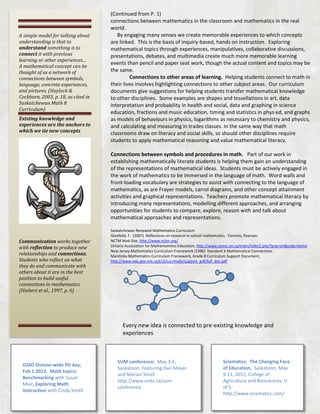
                                       Frayer Model: Like many strategies that may be introduced as
                                       “formative assessments”, The Frayer model (one example is shown at
                                       left) is not only useful for formative assessment but also as a routine
                                       instructional practice. It has been described as a concept map, graphic
                                       organizer, and vocabulary development tool. It can be used to
                                       introduce topics or concepts, front load vocabulary, or check for
                                       understanding. It can also be used for clarifying mathematical symbols.
                                       The Frayer model helps students make sense of words or concepts,
                                       and connect them to pre-existing understandings. It requires critical
                                       thinking to establish deeper understanding, and it creates a visual
                                       reference for concepts and vocabulary. Students can work on a Frayer
                                       model individually, in pairs, or collaboratively in groups. You could
                                       have students include pictures to help make connections with the
                                       concept. After making Frayer models have students examine each
                                       other’s work, compare and discuss. Frayer models have more to them
                                       than meets the eye!

                                                              Customizable, Downloadable Frayer Model
                                                              Templates are available here:
                                                              http://www.worksheetworks.com/miscellanea/
                                                              graphic-organizers/frayer.html

                                                              Shown at left is a table of instructional
                                                              practices (Marzano) that are shown to have
                                                              significant impacts on student learning. The
                                                              Frayer model incorporates several of these!

                                                             “Contextualizing and making connections to the experiences
                                                             of learners are powerful processes in developing
                                                             mathematical understanding. When mathematical ideas are
                                                             connected to each other or to real-world phenomenon,
                                                             students can begin to view mathematics as useful, relevant,
                                                             and integrated.” –WNCP 2006


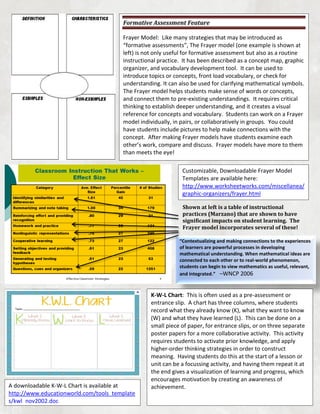
                                                 K-W-L Chart: This is often used as a pre-assessment or
                                                 entrance slip. A chart has three columns, where students
                                                 record what they already know (K), what they want to know
                                                 (W) and what they have learned (L). This can be done on a
                                                 small piece of paper, for entrance slips, or on three separate
                                                 poster papers for a more collaborative activity. This activity
                                                 requires students to activate prior knowledge, and apply
                                                 higher-order thinking strategies in order to construct
                                                 meaning. Having students do this at the start of a lesson or
                                                 unit can be a focussing activity, and having them repeat it at
                                                 the end gives a visualization of learning and progress, which
                                                 encourages motivation by creating an awareness of
A downloadable K-W-L Chart is available at       achievement.
http://www.educationworld.com/tools_template
s/kwl_nov2002.doc
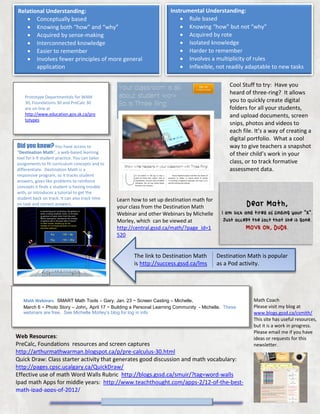
Relational Understanding:                                             Instrumental Understanding:
    Conceptually based                                                    Rule based
    Knowing both “how” and “why”                                          Knowing “how” but not “why”
    Acquired by sense-making                                              Acquired by rote
    Interconnected knowledge                                              Isolated knowledge
    Easier to remember                                                    Harder to remember
    Involves fewer principles of more general                             Involves a multiplicity of rules
       application                                                         Inflexible, not readily adaptable to new tasks
    Flexible, more adaptable to new tasks
                                                                                                 Cool Stuff to try: Have you
                                                                                                 heard of three-ring? It allows
    Prototype Departmentals for WAM
    30, Foundations 30 and PreCalc 30                                                            you to quickly create digital
    are on line at                                                                               folders for all your students,
    http://www.education.gov.sk.ca/pro                                                           and upload documents, screen
    totypes
                                                                                                 snips, photos and videos to
                                                                                                 each file. It’s a way of creating a
                                                                                                 digital portfolio. What a cool
Did you know? You have access to                                                                 way to give teachers a snapshot
“Destination Math”, a web-based learning                                                         of their child’s work in your
tool for k-9 student practice. You can tailor
assignments to fit curriculum concepts and to                                                    class, or to track formative
differentiate. Destination Math is a                                                             assessment data.
responsive program, so it tracks student
answers, gives like problems to reinforce
concepts it finds a student is having trouble
with, or introduces a tutorial to get the
student back on track. It can also track time   Learn how to set up destination math for
on task and correct answers.
                                                your class from the Destination Math
                                                Webinar and other Webinars by Michelle
                                                Morley, which can be viewed at
                                                http://central.gssd.ca/math/?page_id=1
                                                520


                                                       The link to Destination Math        Destination Math is popular
                                                       is http://success.gssd.ca/lms       as a Pod activity.


   Math Webinars. SMART Math Tools – Gary, Jan. 23 ~ Screen Casting – Michelle,                            Math Coach
   March 6 ~ Photo Story – John, April 17 ~ Building a Personal Learning Community - Michelle. These       Please visit my blog at
   webinars are free. See Michelle Morley’s blog for log in info                                           www.blogs.gssd.ca/csmith/
                                                                                                           This site has useful resources,
                                                                                                           but it is a work in progress.
                                                                                                           Please email me if you have
Web Resources:                                                                                             ideas or requests for this
PreCalc, Foundations resources and screen captures                                                         newsletter.
http://arthurmathwarman.blogspot.ca/p/pre-calculus-30.html
Quick Draw: Class starter activity that generates good discussion and math vocabulary:
http://pages.cpsc.ucalgary.ca/QuickDraw/
Effective use of math Word Walls Rubric http://blogs.gssd.ca/smuir/?tag=word-walls
Ipad math Apps for middle years: http://www.teachthought.com/apps-2/12-of-the-best-
math-ipad-apps-of-2012/
Jan 2013

Jan 2013

  • 1.
    Mathematical Process ofthe Month: Connections CN Learning in all subjects is predicated on making connections between new Understanding Mathematical concepts and existing schema; that is, mental images and ideas, or what the learner Process Standards Successful learning in mathematics is already knows. Powerful learning draws on the learners’ experiences and life context. achieved through “relational Students with extensive life experience have more pre-existing schema to create understanding”. A conceptual connections with new concepts. This is called “crystalized intelligence”, as opposed understanding of math builds on to “fluid intelligence”, which is the natural ability we are born with. Interestingly, humans’ natural desire to make sense of things. It helps learners acquire crystalized intelligence is a greater predictor of student success. This is good news for new knowledge and apply it in learners, because while fluid intelligence is innate, crystalized intelligence can be unfamiliar situations. Conceptual controlled. Educators capitalize on this by arranging experiences for students through understanding improves students’ attitudes toward math because they field trips, interactive learning experiences, projects, and inquiry. Everything a can see math as an accessible subject student has learned in the past becomes the hook on which to hang new that can be understood. Effective information. As math educators we are very familiar with this analogy, as we know mathematics instruction incorporates seven process to ensure that students that math concepts build on each other through the years. develop a conceptual understanding There are several types of connections that are important to learning of math: Communication, mathematical concepts: Connections, Mental Math and Connecting ideas within mathematics. Our curriculum helps us do this by Estimation, Problem Solving, Reasoning, Technology and organizing mathematical themes which are evident in the strands of the curriculum. Visualization. Beside the Outcomes These themes tie mathematical topics together so the student can realize general in the curriculum document are principles at work and how they are related. Students will encounter these big ideas suggestions for which of the processes lend themselves well to the repeatedly and in many different contexts as they develop depth of understanding teaching of that outcome; however, through the grade levels. As educators, we need to ensure that we highlight these all processes are interrelated and are related concepts to help students build on and expand their prior learning; part of the everyday business in the classroom. They are the media otherwise, math is perceived as fragmented and compartmentalized. Learning is through which we deliver content. through memorization which is low-level and not lasting. Our first job as educators is to become very familiar with the curriculum, especially at our own level but also Connections: Because the through the years so that we can understand ideas that are nested within each other, learner is constantly searching and concepts that are threaded and integrated. Ideas must flow naturally from for connections on many levels, lesson to lesson and grade to grade. educators need to orchestrate the experiences from which Connections between math and the real world. All learning is achieved learners extract understanding through anchoring new concepts to existing ideas and experiences that are existing …. Brain research establishes understandings. The things a learner already knows become the “pegs” on which to and confirms that multiple pin new information. A teacher’s task is to illuminate the relations between the complex and concrete known and the new. Teachers must always seek opportunities to draw on students experiences are essential for past experiences and understandings to introduce new topics. When students are meaningful learning and encouraged to contribute their own understandings into the learning, they are more teaching. (Caine & Caine, 1991, p. 5) (Excerpt from Sask engaged and have a sense of ownership of the learning. Math must be understood Foundations PreCalc 10 as intrinsic and enmeshed in the fabric of life, physics, and society, not an elite, Curriculum) unobtainable, isolated topic. Teachers and resources must draw out the
  • 2.
    (Continued from P.1) connections between mathematics in the classroom and mathematics in the real world. A simple model for talking about By engaging many senses we create memorable experiences to which concepts understanding is that to are linked. This is the basis of inquiry-based, hands on instruction. Exploring understand something is to mathematical topics through experiences, manipulatives, collaborative discussions, connect it with previous presentations, debates, and multimedia create much more memorable learning learning or other experiences… events than pencil and paper seat work, though the actual content and topics may be A mathematical concept can be thought of as a network of the same. connections between symbols, Connections to other areas of learning. Helping students connect to math in language, concrete experiences, their lives involves highlighting connections to other subject areas. Our curriculum and pictures. (Haylock & documents give suggestions for helping students transfer mathematical knowledge Cockburn, 2003, p. 18, as cited in to other disciplines. Some examples are shapes and tessellations in art, data Saskatchewan Math 8 interpretation and probability in health and social, data and graphing in science Curriculum) education, fractions and music education, timing and statistics in phys ed, and graphs Existing knowledge and as models of behaviours in physics, logarithms as necessary to chemistry and physics, experiences are the anchors to and calculating and measuring in trades classes. In the same way that math which we tie new concepts classrooms draw on literacy and social skills, so should other disciplines require students to apply mathematical reasoning and value mathematical literacy. Connections between symbols and procedures in math. Part of our work in establishing mathematically literate students is helping them gain an understanding of the representations of mathematical ideas. Students must be actively engaged in the work of mathematics to be immersed in the language of math. Word walls and front-loading vocabulary are strategies to assist with connecting to the language of mathematics, as are Frayer models, carrol diagrams, and other concept attainment activities and graphical representations. Teachers promote mathematical literacy by introducing many representations, modelling different approaches, and arranging opportunities for students to compare, explore, reason with and talk about mathematical approaches and representations. Saskatchewan Renewed Mathematics Curriculum Glanfeild, F. (2007). Reflections on research in school mathematics. Toronto, Pearson. Communication works together NCTM Web Site, http://www.nctm.org/ with reflection to produce new Ontario Association for Mathemamtics Education, http://www.oame.on.ca/main/index1.php?lang=en&code=home New Jersey Mathematics Curriculum Framework (1996) Standard 3-Mathematical Connections relationships and connections. Manitoba Mathematics Curriculum Framework, Grade 8 Curriculum Support Document, Students who reflect on what http://www.edu.gov.mb.ca/k12/cur/math/support_gr8/full_doc.pdf they do and communicate with others about it are in the best position to build useful connections in mathematics. (Hiebert et al., 1997, p. 6) Every new idea is connected to pre-existing knowledge and experiences SUM conference: May 3-4, Sciematics: The Changing Face GSSD Divison-wide PD day, Saskatoon. Featuring Dan Meyer of Education. Saskatoon, May Feb 1 2013. Math topics: and Marian Small. 9-11, 2012, College of Benchmarking with Susan http://www.smts.ca/sum- Agriculture and Biosciences, U Muir, Exploring Math conference of S. Instruction with Cindy Smith http://www.sciematics.com/
  • 3.
    Formative Assessment Feature Frayer Model: Like many strategies that may be introduced as “formative assessments”, The Frayer model (one example is shown at left) is not only useful for formative assessment but also as a routine instructional practice. It has been described as a concept map, graphic organizer, and vocabulary development tool. It can be used to introduce topics or concepts, front load vocabulary, or check for understanding. It can also be used for clarifying mathematical symbols. The Frayer model helps students make sense of words or concepts, and connect them to pre-existing understandings. It requires critical thinking to establish deeper understanding, and it creates a visual reference for concepts and vocabulary. Students can work on a Frayer model individually, in pairs, or collaboratively in groups. You could have students include pictures to help make connections with the concept. After making Frayer models have students examine each other’s work, compare and discuss. Frayer models have more to them than meets the eye! Customizable, Downloadable Frayer Model Templates are available here: http://www.worksheetworks.com/miscellanea/ graphic-organizers/frayer.html Shown at left is a table of instructional practices (Marzano) that are shown to have significant impacts on student learning. The Frayer model incorporates several of these! “Contextualizing and making connections to the experiences of learners are powerful processes in developing mathematical understanding. When mathematical ideas are connected to each other or to real-world phenomenon, students can begin to view mathematics as useful, relevant, and integrated.” –WNCP 2006 K-W-L Chart: This is often used as a pre-assessment or entrance slip. A chart has three columns, where students record what they already know (K), what they want to know (W) and what they have learned (L). This can be done on a small piece of paper, for entrance slips, or on three separate poster papers for a more collaborative activity. This activity requires students to activate prior knowledge, and apply higher-order thinking strategies in order to construct meaning. Having students do this at the start of a lesson or unit can be a focussing activity, and having them repeat it at the end gives a visualization of learning and progress, which encourages motivation by creating an awareness of A downloadable K-W-L Chart is available at achievement. http://www.educationworld.com/tools_template s/kwl_nov2002.doc
  • 4.
    Relational Understanding: Instrumental Understanding:  Conceptually based  Rule based  Knowing both “how” and “why”  Knowing “how” but not “why”  Acquired by sense-making  Acquired by rote  Interconnected knowledge  Isolated knowledge  Easier to remember  Harder to remember  Involves fewer principles of more general  Involves a multiplicity of rules application  Inflexible, not readily adaptable to new tasks  Flexible, more adaptable to new tasks Cool Stuff to try: Have you heard of three-ring? It allows Prototype Departmentals for WAM 30, Foundations 30 and PreCalc 30 you to quickly create digital are on line at folders for all your students, http://www.education.gov.sk.ca/pro and upload documents, screen totypes snips, photos and videos to each file. It’s a way of creating a digital portfolio. What a cool Did you know? You have access to way to give teachers a snapshot “Destination Math”, a web-based learning of their child’s work in your tool for k-9 student practice. You can tailor assignments to fit curriculum concepts and to class, or to track formative differentiate. Destination Math is a assessment data. responsive program, so it tracks student answers, gives like problems to reinforce concepts it finds a student is having trouble with, or introduces a tutorial to get the student back on track. It can also track time Learn how to set up destination math for on task and correct answers. your class from the Destination Math Webinar and other Webinars by Michelle Morley, which can be viewed at http://central.gssd.ca/math/?page_id=1 520 The link to Destination Math Destination Math is popular is http://success.gssd.ca/lms as a Pod activity. Math Webinars. SMART Math Tools – Gary, Jan. 23 ~ Screen Casting – Michelle, Math Coach March 6 ~ Photo Story – John, April 17 ~ Building a Personal Learning Community - Michelle. These Please visit my blog at webinars are free. See Michelle Morley’s blog for log in info www.blogs.gssd.ca/csmith/ This site has useful resources, but it is a work in progress. Please email me if you have Web Resources: ideas or requests for this PreCalc, Foundations resources and screen captures newsletter. http://arthurmathwarman.blogspot.ca/p/pre-calculus-30.html Quick Draw: Class starter activity that generates good discussion and math vocabulary: http://pages.cpsc.ucalgary.ca/QuickDraw/ Effective use of math Word Walls Rubric http://blogs.gssd.ca/smuir/?tag=word-walls Ipad math Apps for middle years: http://www.teachthought.com/apps-2/12-of-the-best- math-ipad-apps-of-2012/