ONCHOCERCIASIS, NIGERIAN 
PERSPECTIVE 
B Y 
UWAMOSE, 
Martin Nelson Osaigbokan
Onchocerciasis a River Blindness disease is a chronic parasitic 
multi systemic disease caused by the filarial nematode 
Onchocerca volvulus. 
The parasite causes blindness and severe skin diseases in tropical 
regions of the world. 
Approximately 18–44 million individuals in the world have 
Onchocerciasis infection. It is the second-leading infectious cause 
of preventable blindness in the world after Trachoma (WHO 
2012). 
Man is the only definitive host of this parasite and acquire 
infection through the bite of black fly (genus Simulium). 
The damage caused by this disease is irreversible. When someone 
is blinded by the parasite there is no cure; you can only kill the 
parasites.
 Nigeria is the most endemic country in the world for 
Onchocerciasis. 
 First reported in northern Nigeria in 1908 (Budden 1956). 
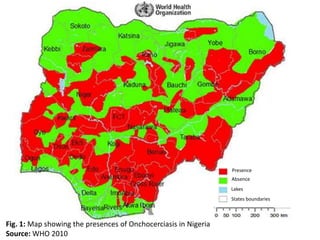
 Endemic areas extend from the North, Southwest & Southeastern 
part of the country with highest prevalence in Zamfara, Kwara - 
NW Nigeria and Enugu, Imo, Ebonyi - SE Nigeria (Meredith 2012) 
 The provisional estimates had suggested that 7–10 million Nigerians 
are infected with Onchocerca volvulus, approximately 40 million 
are at risk of the disease and 120,000 cases of onchocerciasis-related 
blindness (WHO 2010). 
 The disease is lower in individuals between the age of 0–10 years 
but increases with a peak in individuals between the age of 20-30 
years (Uttah 2010).
Presence 
Absence 
Lakes 
States boundaries 
Fig. 1: Map showing the presences of Onchocerciasis in Nigeria 
Source:WHO 2010
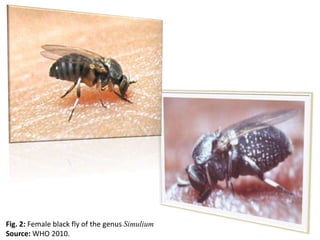
The only known vectors of O. volvulus are the female 
black flies of the genus Simulium. 
The fly bites during daylight hours. 
Eggs require fast-running rivers which have well-oxygenated 
water for breeding grounds. This is 
important because larvae of O. volvulus have an 
obligatory aquatic stage during which they require a high 
oxygen tension. 
Adults emerge after 8-12 days following egg production. 
The adult fly has the ability to travel hundreds of 
kilometres in flight on wind currents. 
Their life span is about 4 weeks.
Fig. 2: Female black fly of the genus Simulium 
Source:WHO 2010.
MORPHOLOGY OF THE 
PARASITE 
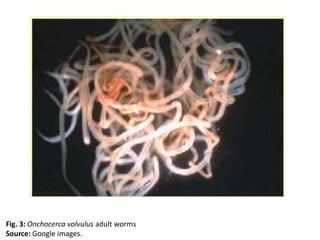
Adult worms are white, opalescent and transparent. 
They are slender and blunt at both ends. 
They are usually found knotted together in pairs or 
groups in subcutaneous tissues. 
Males measures 1.9-4.2cm in length and has a coiled tail. 
The females are much longer, measuring 33.5-50cm in 
length. 
Adult worms live long; the female has an average life 
span of 8 years.
Fig. 3: Onchocerca volvulus adult worms 
Source: Google images.
ETIOLOGY: study of the cause of 
diseases 
Microfilaria invade the midgut of the fly, advance to 
the thoracic muscles where they undergo 
differentiation into L1 larva within 28 hours after the 
blood meal. 
They moth twice producing L2 and L3 larva (infective 
larva) within 06 hours and 7 days respectively. 
Infective L3 larva migrates to the proboscis for future 
deposition into human skin during the next blood 
meal. 
When the Fly bites another person, Infective L3 larvae 
are transmitted to human skin.
ETIOLOGY (CONT.) 
The larvae move under the skin and form nodules where 
they develop into adult worms in 12 to 18 months. Adult 
worms pair and mate in the human host. 
Female Onchocerca gives birth daily to thousands of 
microscopic larvae (microfilaria) 
Microfilaria released from the nodules traverse the skin 
and connective tissue easily. 
The most common migration sites are subepidermal 
lymphatics and the anterior chamber of the eye.
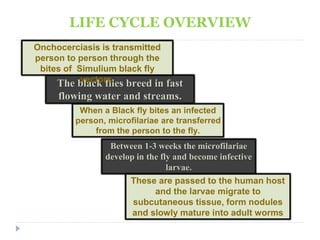
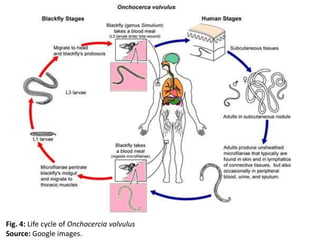
LIFE CYCLE OVERVIEW 
Onchocerciasis is transmitted 
person to person through the 
bites of Simulium black fly 
The black flies breed in fast 
flowing water and streams. 
When a Black fly bites an infected 
person, microfilariae are transferred 
from the person to the fly. 
Between 1-3 weeks the microfilariae 
develop in the fly and become infective 
larvae. 
These are passed to the human host 
and the larvae migrate to 
subcutaneous tissue, form nodules 
and slowly mature into adult worms 
vectors.
Fig. 4: Life cycle of Onchocercia volvulus 
Source: Google images.
Fig. 5: Life cycle of Onchocercia volvulus 
Source: CDC images.
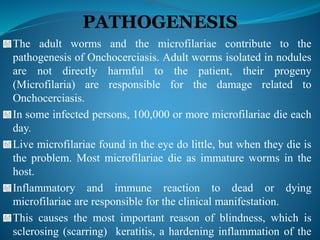
PATHOGENESIS 
The adult worms and the microfilariae contribute to the 
pathogenesis of Onchocerciasis. Adult worms isolated in nodules 
are not directly harmful to the patient, their progeny 
(Microfilaria) are responsible for the damage related to 
Onchocerciasis. 
In some infected persons, 100,000 or more microfilariae die each 
day. 
Live microfilariae found in the eye do little, but when they die is 
the problem. Most microfilariae die as immature worms in the 
host. 
Inflammatory and immune reaction to dead or dying 
microfilariae are responsible for the clinical manifestation. 
This causes the most important reason of blindness, which is 
sclerosing (scarring) keratitis, a hardening inflammation of the
SIGNS AND SYMPTOMS 
The symptoms include: 
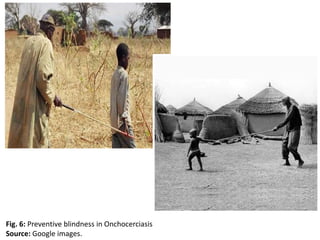
 Preventable blindness 
 Skin rashes 
 Lesions 
 Itching 
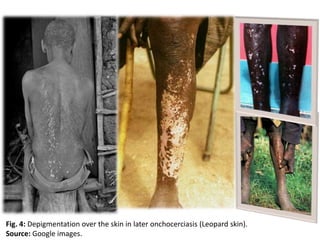
 Skin depigmentation
Fig. 4: Depigmentation over the skin in later onchocerciasis (Leopard skin). 
Source: Google images.
Fig. 5: Eye lesions in Onchocerciasis 
Source: Google images.
Fig. 6: Preventive blindness in Onchocerciasis 
Source: Google images.
DIAGNOSIS 
 The best method for diagnosis is identification of microfilariae in 
bloodless skin snips. 
 Buttocks and legs are often most heavily infected and are most 
likely to yield microfilariae. 
 A small piece of skin is raise with a needle and clipped with 
a razor or scissors.
DIAGNOSIS CONT. 
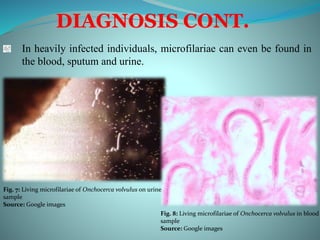
In heavily infected individuals, microfilariae can even be found in 
the blood, sputum and urine. 
Fig. 7: Living microfilariae of Onchocerca volvulus on urine 
sample 
Source: Google images 
Fig. 8: Living microfilariae of Onchocerca volvulus in blood 
sample 
Source: Google images
TREATMENT 
 The treatment is with a single of Ivermectin (150 
microglkg). 
 It kills the microfilaria rapidly, 
 Reduces production of microfilaria from adult worm for 
several month. 
 After treatment, microfilaria disappears from the skin 
within 1 week and from eye within 3 months. 
NOTE: There is no cure; once someone is blind by the 
parasite, you can only kill the parasites 
21
PREVENTION AND CONTROL 
 Primary means of preventing Onchocerciasis in Nigeria 
include: 
1. Vector control – applications of environmentally-safe 
insecticides to the black fly's breeding areas 
(fast-flowing rivers) during the rainy season. 
2. Mass treatment with Ivermectin. 
22
CONCLUSION 
Onchocerciasis is one of the neglected tropical diseases 
of public health concern in Nigeria. It is common in rural 
area where black flies have favourable environment to 
habit and reproduce as the outbreak and spread of this 
disease rely on the activities and survival of black fly. 
The high prevalence of microfilariae in Nigeria 
underscore the need for renewed awareness campaign to 
bring the attention of individuals in endemic areas to the 
importance of personal protective measures against the 
infective bites of the black fly vector. This is also a 
wake-up call to health authorities to embark on massive 
community treatment with Ivermectin. 23
24 
Thanks For Your Time

Onchocerciasis

  • 1.
    ONCHOCERCIASIS, NIGERIAN PERSPECTIVE B Y UWAMOSE, Martin Nelson Osaigbokan
  • 2.
    Onchocerciasis a RiverBlindness disease is a chronic parasitic multi systemic disease caused by the filarial nematode Onchocerca volvulus. The parasite causes blindness and severe skin diseases in tropical regions of the world. Approximately 18–44 million individuals in the world have Onchocerciasis infection. It is the second-leading infectious cause of preventable blindness in the world after Trachoma (WHO 2012). Man is the only definitive host of this parasite and acquire infection through the bite of black fly (genus Simulium). The damage caused by this disease is irreversible. When someone is blinded by the parasite there is no cure; you can only kill the parasites.
  • 3.
     Nigeria isthe most endemic country in the world for Onchocerciasis.  First reported in northern Nigeria in 1908 (Budden 1956).  Endemic areas extend from the North, Southwest & Southeastern part of the country with highest prevalence in Zamfara, Kwara - NW Nigeria and Enugu, Imo, Ebonyi - SE Nigeria (Meredith 2012)  The provisional estimates had suggested that 7–10 million Nigerians are infected with Onchocerca volvulus, approximately 40 million are at risk of the disease and 120,000 cases of onchocerciasis-related blindness (WHO 2010).  The disease is lower in individuals between the age of 0–10 years but increases with a peak in individuals between the age of 20-30 years (Uttah 2010).
  • 4.
    Presence Absence Lakes States boundaries Fig. 1: Map showing the presences of Onchocerciasis in Nigeria Source:WHO 2010
  • 5.
    The only knownvectors of O. volvulus are the female black flies of the genus Simulium. The fly bites during daylight hours. Eggs require fast-running rivers which have well-oxygenated water for breeding grounds. This is important because larvae of O. volvulus have an obligatory aquatic stage during which they require a high oxygen tension. Adults emerge after 8-12 days following egg production. The adult fly has the ability to travel hundreds of kilometres in flight on wind currents. Their life span is about 4 weeks.
  • 6.
    Fig. 2: Femaleblack fly of the genus Simulium Source:WHO 2010.
  • 7.
    MORPHOLOGY OF THE PARASITE Adult worms are white, opalescent and transparent. They are slender and blunt at both ends. They are usually found knotted together in pairs or groups in subcutaneous tissues. Males measures 1.9-4.2cm in length and has a coiled tail. The females are much longer, measuring 33.5-50cm in length. Adult worms live long; the female has an average life span of 8 years.
  • 8.
    Fig. 3: Onchocercavolvulus adult worms Source: Google images.
  • 9.
    ETIOLOGY: study ofthe cause of diseases Microfilaria invade the midgut of the fly, advance to the thoracic muscles where they undergo differentiation into L1 larva within 28 hours after the blood meal. They moth twice producing L2 and L3 larva (infective larva) within 06 hours and 7 days respectively. Infective L3 larva migrates to the proboscis for future deposition into human skin during the next blood meal. When the Fly bites another person, Infective L3 larvae are transmitted to human skin.
  • 10.
    ETIOLOGY (CONT.) Thelarvae move under the skin and form nodules where they develop into adult worms in 12 to 18 months. Adult worms pair and mate in the human host. Female Onchocerca gives birth daily to thousands of microscopic larvae (microfilaria) Microfilaria released from the nodules traverse the skin and connective tissue easily. The most common migration sites are subepidermal lymphatics and the anterior chamber of the eye.
  • 11.
    LIFE CYCLE OVERVIEW Onchocerciasis is transmitted person to person through the bites of Simulium black fly The black flies breed in fast flowing water and streams. When a Black fly bites an infected person, microfilariae are transferred from the person to the fly. Between 1-3 weeks the microfilariae develop in the fly and become infective larvae. These are passed to the human host and the larvae migrate to subcutaneous tissue, form nodules and slowly mature into adult worms vectors.
  • 12.
    Fig. 4: Lifecycle of Onchocercia volvulus Source: Google images.
  • 13.
    Fig. 5: Lifecycle of Onchocercia volvulus Source: CDC images.
  • 14.
    PATHOGENESIS The adultworms and the microfilariae contribute to the pathogenesis of Onchocerciasis. Adult worms isolated in nodules are not directly harmful to the patient, their progeny (Microfilaria) are responsible for the damage related to Onchocerciasis. In some infected persons, 100,000 or more microfilariae die each day. Live microfilariae found in the eye do little, but when they die is the problem. Most microfilariae die as immature worms in the host. Inflammatory and immune reaction to dead or dying microfilariae are responsible for the clinical manifestation. This causes the most important reason of blindness, which is sclerosing (scarring) keratitis, a hardening inflammation of the
  • 15.
    SIGNS AND SYMPTOMS The symptoms include:  Preventable blindness  Skin rashes  Lesions  Itching  Skin depigmentation
  • 16.
    Fig. 4: Depigmentationover the skin in later onchocerciasis (Leopard skin). Source: Google images.
  • 17.
    Fig. 5: Eyelesions in Onchocerciasis Source: Google images.
  • 18.
    Fig. 6: Preventiveblindness in Onchocerciasis Source: Google images.
  • 19.
    DIAGNOSIS  Thebest method for diagnosis is identification of microfilariae in bloodless skin snips.  Buttocks and legs are often most heavily infected and are most likely to yield microfilariae.  A small piece of skin is raise with a needle and clipped with a razor or scissors.
  • 20.
    DIAGNOSIS CONT. Inheavily infected individuals, microfilariae can even be found in the blood, sputum and urine. Fig. 7: Living microfilariae of Onchocerca volvulus on urine sample Source: Google images Fig. 8: Living microfilariae of Onchocerca volvulus in blood sample Source: Google images
  • 21.
    TREATMENT  Thetreatment is with a single of Ivermectin (150 microglkg).  It kills the microfilaria rapidly,  Reduces production of microfilaria from adult worm for several month.  After treatment, microfilaria disappears from the skin within 1 week and from eye within 3 months. NOTE: There is no cure; once someone is blind by the parasite, you can only kill the parasites 21
  • 22.
    PREVENTION AND CONTROL  Primary means of preventing Onchocerciasis in Nigeria include: 1. Vector control – applications of environmentally-safe insecticides to the black fly's breeding areas (fast-flowing rivers) during the rainy season. 2. Mass treatment with Ivermectin. 22
  • 23.
    CONCLUSION Onchocerciasis isone of the neglected tropical diseases of public health concern in Nigeria. It is common in rural area where black flies have favourable environment to habit and reproduce as the outbreak and spread of this disease rely on the activities and survival of black fly. The high prevalence of microfilariae in Nigeria underscore the need for renewed awareness campaign to bring the attention of individuals in endemic areas to the importance of personal protective measures against the infective bites of the black fly vector. This is also a wake-up call to health authorities to embark on massive community treatment with Ivermectin. 23
  • 24.
    24 Thanks ForYour Time