Onchocerciasis
(River blindness)
BY DR.ZEINAB MEDANI
Identification
A chronic nonfatal filarial disease with fibrous nodules in
subcutaneous tissues, particularly of the head and
shoulders (America) or pelvic girdle and lower extremities
(Africa).
Adult worms are found in these nodules, which occur
superficially, and also in deep-seated bundles lying against
the periosteum of bones or near joints.
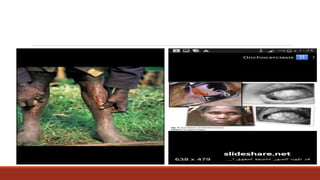
The female worm discharges microfilariae that migrate
through the skin, often causing an intense pruritic rash
when they die, with chronic dermatitis-altered
pigmentation, edema and atrophy of the skin, loss of skin
elasticity and lymphadenitis . Pigment changes, particularly
of the lower limbs, give the condition known as leopard
skin.
Microfilariae frequently reach the eye, where their invasion
and subsequent death causes visual disturbance and
blindness, in heavy infections they may also be found in
blood, tears, sputum and urine.
Epidemiology
Worldwide, there are an estimated 37 million people
infected with O. volvulus and 90 million people remain at
risk.
Approximately half a million people are visually impaired
due to the disease and 270,000 have been blinded.
Onchocerciasis is found primarily in West and Central Africa,
with 99% of infected individuals living in 30 endemic
countries. The disease is also prevalent in Yemen and Latin
American nations.
Diagnosis
Skin biopsy
through evidence of microfilariae in urine
or through the finding of adult worms in excised nodules
evidence of ocular manifestations
Infectious agent : Onchocerca volvulus, a filarial worm
belonging to the class Nematodes.
Reservoir: Humans.
Mode of transmission
Only through the bite of infected female
blackflies of the genus Simulium
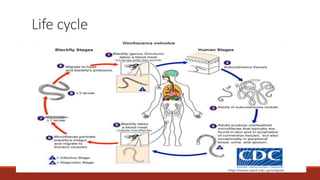
Microfilariae, ingested by a blackfly
feeding on an infected person,
penetrate thoracic muscles of the fly,
develop into infective larvae,
migrate to the cephalic capsule,
are liberated on the skin
and enter the bite wound during a subsequent blood-meal.
Life cycle
Incubation period
7 days in Africa
Microfilariae are found in the skin usually only after 1 year or more
from the time of the infective bite
Period of communicability—People can infect flies as long as
living microfilariae occur in their skin, i.e. for 10–15 years after last
exposure to Simulium bites if untreated.
Methods of control
Preventive measures:
1- Avoid bites of Simulium flies
2- Avoid bites of Simulium flies through use of insecticides
3- Provide facilities for diagnosis and treatment.
B. Control of patient, contacts and the immediate environment
1- report to local health aouthority
2- Specific treatment: Ivermectin for treatment of onchocerciasis in
humans. Given in a single oral dose of 150 micrograms/kg, with
annual retreatment.
In endemic communities, ivermectin treatment for whole
eligible population at least once yearly is recommended.
International measures: The Onchocerciasis Control Program
(OCP), a coordinated program in western Africa sponsored
by the World Bank, UNDP, FAO and WHO. Control has been based
mainly on anti blackfly measures, with insecticides applied
systematically to breeding sites in the rivers of the area. The African
Program for Onchocerciasis Control (APOC) has bee established to
implement effective and sustainable community directed annual
treatment with ivermectin throughout the remaining endemic areas
in Africa, and to eliminate the disease by vector control in selected
foci.
Thanks

Onchocerciasis.pptx

  • 1.
  • 2.
    Identification A chronic nonfatalfilarial disease with fibrous nodules in subcutaneous tissues, particularly of the head and shoulders (America) or pelvic girdle and lower extremities (Africa). Adult worms are found in these nodules, which occur superficially, and also in deep-seated bundles lying against the periosteum of bones or near joints.
  • 3.
    The female wormdischarges microfilariae that migrate through the skin, often causing an intense pruritic rash when they die, with chronic dermatitis-altered pigmentation, edema and atrophy of the skin, loss of skin elasticity and lymphadenitis . Pigment changes, particularly of the lower limbs, give the condition known as leopard skin.
  • 5.
    Microfilariae frequently reachthe eye, where their invasion and subsequent death causes visual disturbance and blindness, in heavy infections they may also be found in blood, tears, sputum and urine.
  • 7.
    Epidemiology Worldwide, there arean estimated 37 million people infected with O. volvulus and 90 million people remain at risk. Approximately half a million people are visually impaired due to the disease and 270,000 have been blinded. Onchocerciasis is found primarily in West and Central Africa, with 99% of infected individuals living in 30 endemic countries. The disease is also prevalent in Yemen and Latin American nations.
  • 8.
    Diagnosis Skin biopsy through evidenceof microfilariae in urine or through the finding of adult worms in excised nodules evidence of ocular manifestations
  • 9.
    Infectious agent :Onchocerca volvulus, a filarial worm belonging to the class Nematodes. Reservoir: Humans.
  • 10.
    Mode of transmission Onlythrough the bite of infected female blackflies of the genus Simulium Microfilariae, ingested by a blackfly feeding on an infected person, penetrate thoracic muscles of the fly, develop into infective larvae, migrate to the cephalic capsule, are liberated on the skin and enter the bite wound during a subsequent blood-meal.
  • 11.
  • 12.
    Incubation period 7 daysin Africa Microfilariae are found in the skin usually only after 1 year or more from the time of the infective bite Period of communicability—People can infect flies as long as living microfilariae occur in their skin, i.e. for 10–15 years after last exposure to Simulium bites if untreated.
  • 13.
    Methods of control Preventivemeasures: 1- Avoid bites of Simulium flies 2- Avoid bites of Simulium flies through use of insecticides 3- Provide facilities for diagnosis and treatment. B. Control of patient, contacts and the immediate environment 1- report to local health aouthority 2- Specific treatment: Ivermectin for treatment of onchocerciasis in humans. Given in a single oral dose of 150 micrograms/kg, with annual retreatment.
  • 14.
    In endemic communities,ivermectin treatment for whole eligible population at least once yearly is recommended.
  • 15.
    International measures: TheOnchocerciasis Control Program (OCP), a coordinated program in western Africa sponsored by the World Bank, UNDP, FAO and WHO. Control has been based mainly on anti blackfly measures, with insecticides applied systematically to breeding sites in the rivers of the area. The African Program for Onchocerciasis Control (APOC) has bee established to implement effective and sustainable community directed annual treatment with ivermectin throughout the remaining endemic areas in Africa, and to eliminate the disease by vector control in selected foci.
  • 16.