Onchocerca volvulus
• Kingdom: Animalia
• Phylum: Nematoda
• Class: Secernentea
• Order: Spirurida
• Family: Onchocercidae
• Genus: Onchocerca
• Species: Onchocerca volvulus
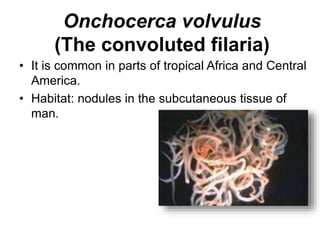
Onchocerca volvulus
(The convoluted filaria)
• It is common in parts of tropical Africa and Central
America.
• Habitat: nodules in the subcutaneous tissue of
man.
Morphology
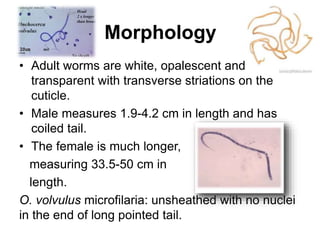
• Adult worms are white, opalescent and
transparent with transverse striations on the
cuticle.
• Male measures 1.9-4.2 cm in length and has
coiled tail.
• The female is much longer,
measuring 33.5-50 cm in
length.
O. volvulus microfilaria: unsheathed with no nuclei
in the end of long pointed tail.
Life cycle
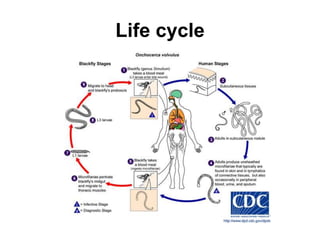
• Definitive host: Man.
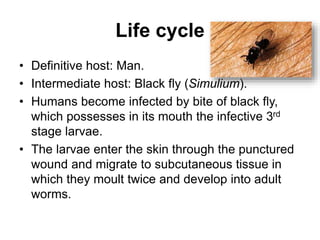
• Intermediate host: Black fly (Simulium).
• Humans become infected by bite of black fly,
which possesses in its mouth the infective 3rd
stage larvae.
• The larvae enter the skin through the punctured
wound and migrate to subcutaneous tissue in
which they moult twice and develop into adult
worms.
• The adult worms live in deep fascia or in the
subcutaneous tissue.
• The females release actively motile, unsheathed
microfilariae which migrate to the skin and eyes of
infected subjects.
• When a black fly again bites diseased human, the
microfilariae migrate into thoracic muscles, they
moult twice and develop into infective larvae.
• The larvae migrate to the mouth parts of black fly
where they transmitted to humans at next blood
meal.
Life cycle
Pathogenesis and clinical signs
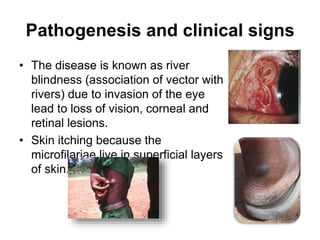
• The disease is known as river
blindness (association of vector with
rivers) due to invasion of the eye
lead to loss of vision, corneal and
retinal lesions.
• Skin itching because the
microfilariae live in superficial layers
of skin.
Diagnosis
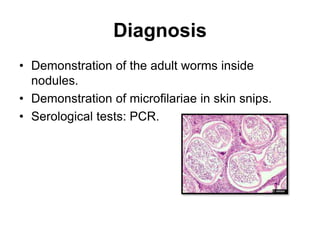
• Demonstration of the adult worms inside
nodules.
• Demonstration of microfilariae in skin snips.
• Serological tests: PCR.
Treatment
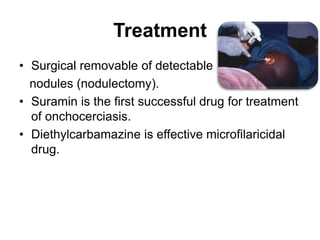
• Surgical removable of detectable
nodules (nodulectomy).
• Suramin is the first successful drug for treatment
of onchocerciasis.
• Diethylcarbamazine is effective microfilaricidal
drug.
Loa loa
• Kingdom: Animalia
• Phylum: Nematoda
• Class: Chromadorea
• Order: Spirurida
• Superfamily: Filarioidea
• Family: Onchocercidae
• Genus: Loa
• Species: Loa loa
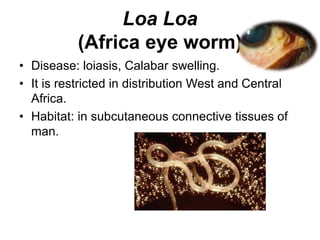
Loa Loa
(Africa eye worm)
• Disease: loiasis, Calabar swelling.
• It is restricted in distribution West and Central
Africa.
• Habitat: in subcutaneous connective tissues of
man.
Morphology
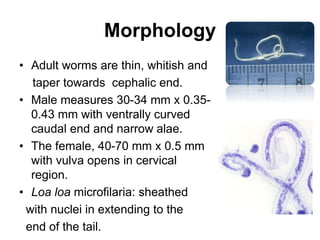
• Adult worms are thin, whitish and
taper towards cephalic end.
• Male measures 30-34 mm x 0.35-
0.43 mm with ventrally curved
caudal end and narrow alae.
• The female, 40-70 mm x 0.5 mm
with vulva opens in cervical
region.
• Loa loa microfilaria: sheathed
with nuclei in extending to the
end of the tail.
Life cycle
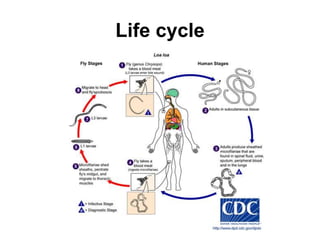
• Definitive host: Man.
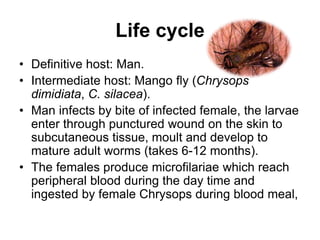
• Intermediate host: Mango fly (Chrysops
dimidiata, C. silacea).
• Man infects by bite of infected female, the larvae
enter through punctured wound on the skin to
subcutaneous tissue, moult and develop to
mature adult worms (takes 6-12 months).
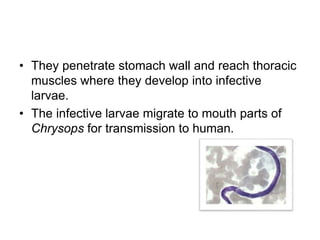
• The females produce microfilariae which reach
peripheral blood during the day time and
ingested by female Chrysops during blood meal,
• They penetrate stomach wall and reach thoracic
muscles where they develop into infective
larvae.
• The infective larvae migrate to mouth parts of
Chrysops for transmission to human.
Life cycle
Pathogenesis and clinical signs
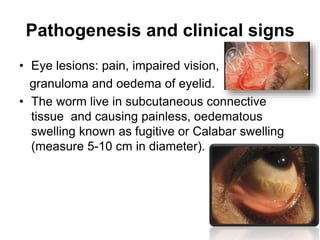
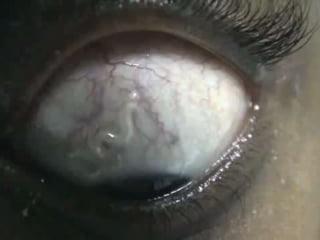
• Eye lesions: pain, impaired vision,
granuloma and oedema of eyelid.
• The worm live in subcutaneous connective
tissue and causing painless, oedematous
swelling known as fugitive or Calabar swelling
(measure 5-10 cm in diameter).
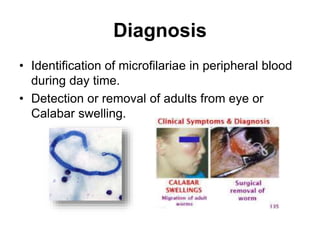
Diagnosis
• Identification of microfilariae in peripheral blood
during day time.
• Detection or removal of adults from eye or
Calabar swelling.
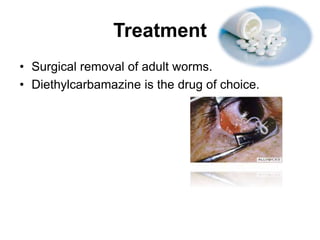
Treatment
• Surgical removal of adult worms.
• Diethylcarbamazine is the drug of choice.
Onchocerciasis (Onchocerca volvulus)

Onchocerciasis (Onchocerca volvulus)

  • 1.
    Onchocerca volvulus • Kingdom:Animalia • Phylum: Nematoda • Class: Secernentea • Order: Spirurida • Family: Onchocercidae • Genus: Onchocerca • Species: Onchocerca volvulus
  • 2.
    Onchocerca volvulus (The convolutedfilaria) • It is common in parts of tropical Africa and Central America. • Habitat: nodules in the subcutaneous tissue of man.
  • 3.
    Morphology • Adult wormsare white, opalescent and transparent with transverse striations on the cuticle. • Male measures 1.9-4.2 cm in length and has coiled tail. • The female is much longer, measuring 33.5-50 cm in length. O. volvulus microfilaria: unsheathed with no nuclei in the end of long pointed tail.
  • 4.
    Life cycle • Definitivehost: Man. • Intermediate host: Black fly (Simulium). • Humans become infected by bite of black fly, which possesses in its mouth the infective 3rd stage larvae. • The larvae enter the skin through the punctured wound and migrate to subcutaneous tissue in which they moult twice and develop into adult worms.
  • 5.
    • The adultworms live in deep fascia or in the subcutaneous tissue. • The females release actively motile, unsheathed microfilariae which migrate to the skin and eyes of infected subjects. • When a black fly again bites diseased human, the microfilariae migrate into thoracic muscles, they moult twice and develop into infective larvae. • The larvae migrate to the mouth parts of black fly where they transmitted to humans at next blood meal.
  • 6.
  • 7.
    Pathogenesis and clinicalsigns • The disease is known as river blindness (association of vector with rivers) due to invasion of the eye lead to loss of vision, corneal and retinal lesions. • Skin itching because the microfilariae live in superficial layers of skin.
  • 8.
    Diagnosis • Demonstration ofthe adult worms inside nodules. • Demonstration of microfilariae in skin snips. • Serological tests: PCR.
  • 9.
    Treatment • Surgical removableof detectable nodules (nodulectomy). • Suramin is the first successful drug for treatment of onchocerciasis. • Diethylcarbamazine is effective microfilaricidal drug.
  • 10.
    Loa loa • Kingdom:Animalia • Phylum: Nematoda • Class: Chromadorea • Order: Spirurida • Superfamily: Filarioidea • Family: Onchocercidae • Genus: Loa • Species: Loa loa
  • 11.
    Loa Loa (Africa eyeworm) • Disease: loiasis, Calabar swelling. • It is restricted in distribution West and Central Africa. • Habitat: in subcutaneous connective tissues of man.
  • 12.
    Morphology • Adult wormsare thin, whitish and taper towards cephalic end. • Male measures 30-34 mm x 0.35- 0.43 mm with ventrally curved caudal end and narrow alae. • The female, 40-70 mm x 0.5 mm with vulva opens in cervical region. • Loa loa microfilaria: sheathed with nuclei in extending to the end of the tail.
  • 13.
    Life cycle • Definitivehost: Man. • Intermediate host: Mango fly (Chrysops dimidiata, C. silacea). • Man infects by bite of infected female, the larvae enter through punctured wound on the skin to subcutaneous tissue, moult and develop to mature adult worms (takes 6-12 months). • The females produce microfilariae which reach peripheral blood during the day time and ingested by female Chrysops during blood meal,
  • 14.
    • They penetratestomach wall and reach thoracic muscles where they develop into infective larvae. • The infective larvae migrate to mouth parts of Chrysops for transmission to human.
  • 15.
  • 16.
    Pathogenesis and clinicalsigns • Eye lesions: pain, impaired vision, granuloma and oedema of eyelid. • The worm live in subcutaneous connective tissue and causing painless, oedematous swelling known as fugitive or Calabar swelling (measure 5-10 cm in diameter).
  • 17.
    Diagnosis • Identification ofmicrofilariae in peripheral blood during day time. • Detection or removal of adults from eye or Calabar swelling.
  • 18.
    Treatment • Surgical removalof adult worms. • Diethylcarbamazine is the drug of choice.